






South Dakota Sedation Dentistry Licensing & Permit Requirements
In South Dakota, your dental license alone only covers you up to the lightest level of sedation. Any dentist who administers nitrous oxide, moderate (conscious) sedation, deep sedation, or general anesthesia must first hold the matching permit from the South Dakota Board of Dentistry, issued under Article 20:43, Chapter 09 of the Administrative Rules of South Dakota. Getting the permit means meeting the training, certification, and live-patient bar for your level and passing a facility inspection. Keeping it means renewing every year, meeting an annual case minimum, and passing a full facility inspection at least once in each five-year licensure cycle. This guide walks both halves, start to finish, with every rule linked to its section of the code and every form linked to the board.
Recent Updates
Last UpdatedNovember 16, 2026
- Re-sourced every rule to South Dakota's own administrative code on the state legislature's site and the Board of Dentistry's own pages, replacing third-party legal aggregators.
- Added the verified annual renewal cycle, renewal fees, and the annual case minimums under ARSD 20:43:09:08.
- Corrected the nitrous oxide permit: the rule requires a board-approved course plus BLS and does not set a fixed statutory clock-hour count.
- Added the exact board application forms for each permit level and the adverse-condition reporting window.
- South Dakota's sedation permits sit in ARSD Article 20:43, Chapter 09: a Nitrous Oxide Inhalation Analgesia Sedation permit, a Moderate Sedation permit (conscious sedation, including the IV route), and a General Anesthesia and Deep Sedation permit, plus a host permit and a staff monitoring permit.
- Minimal sedation needs no permit, but it is capped at a single enteral drug at the maximum recommended dose under 20:43:09:06.02.
- The moderate sedation course requires at least 60 clock hours of didactic training and IV management of at least 20 live patients (20:43:09:04.03), plus current ACLS.
- Permits renew annually (20:43:09:08). Moderate holders must log at least 12 cases a year, general anesthesia holders at least 50, or add three hours of board-approved CE per missed case.
- Permits are kept or lost on inspection. Under 20:43:09:11 a holder must pass a full facility inspection at least once in each five-year cycle, and failing one is an automatic suspension.
What This Guide Covers
- Who issues sedation permits in South Dakota
- The South Dakota permit levels
- How to get or upgrade each permit
- The board forms you actually file
- What the permit requires you to monitor
- Renewal, fees, and the annual case minimum
- Inspections and the five-year cycle
- Recordkeeping obligations tied to your permit
- Keeping the permit: audit-ready records
- Frequently asked questions
- Sources
Who issues sedation permits in South Dakota
Sedation dentistry in South Dakota is regulated by the South Dakota Board of Dentistry, the state agency that licenses dentists, issues every sedation and anesthesia permit, approves the courses, runs the facility inspections, and takes disciplinary action. The rules live in the Administrative Rules of South Dakota, Article 20:43, Chapter 09 (Anesthesia and Analgesia), and every requirement below traces to a numbered section of that chapter. The board also publishes those statutes and rules, the application forms, and the continuing-education requirements on its own site, so you never have to take a figure from a course provider on faith.
The Board Writes the Law
The American Dental Association publishes the sedation guidelines South Dakota and most states lean on, but the ADA is a professional association, not a government agency. It does not license you, inspect you, or discipline you. Your permit, your inspection, and any sanction all come from the South Dakota Board of Dentistry under Article 20:43. South Dakota goes a step further than some states and requires every sedation provider to apply the current standard of care under 20:43:09:14, which lets the board hold you to that standard, but it is still the board, not the ADA, that holds you to it. The real federal layers that sit on top are the DEA (controlled-substance records), HIPAA, and any accreditation body your facility answers to, not an ADA rule that overrides the state.
To apply for a permit, you work through the board's own application process: meeting the training and certification bar for your level, and, for moderate and deeper sedation, passing a facility inspection before the permit issues. Exact fees and current forms are set and updated by the board, so start from the board's own pages, linked throughout this guide, before you file.
Source: South Dakota Board of Dentistry statutes and rules for dentists | ARSD 20:43:09:14 (standard of care)
The South Dakota permit levels
South Dakota names its permits by the type and depth of sedation, and the requirements escalate as the patient is taken deeper. Here is the full ladder, each rung with its governing section of Chapter 09.
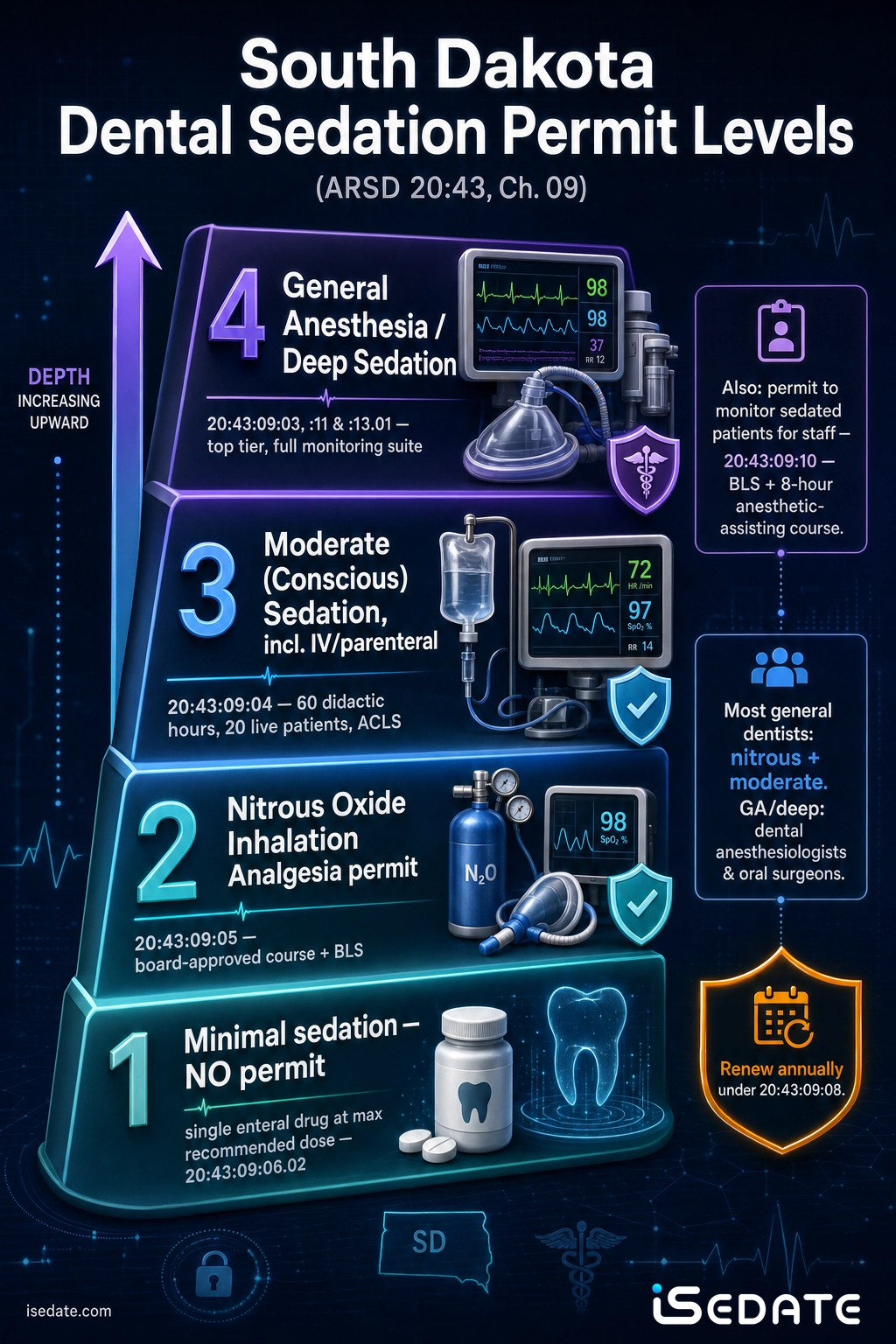
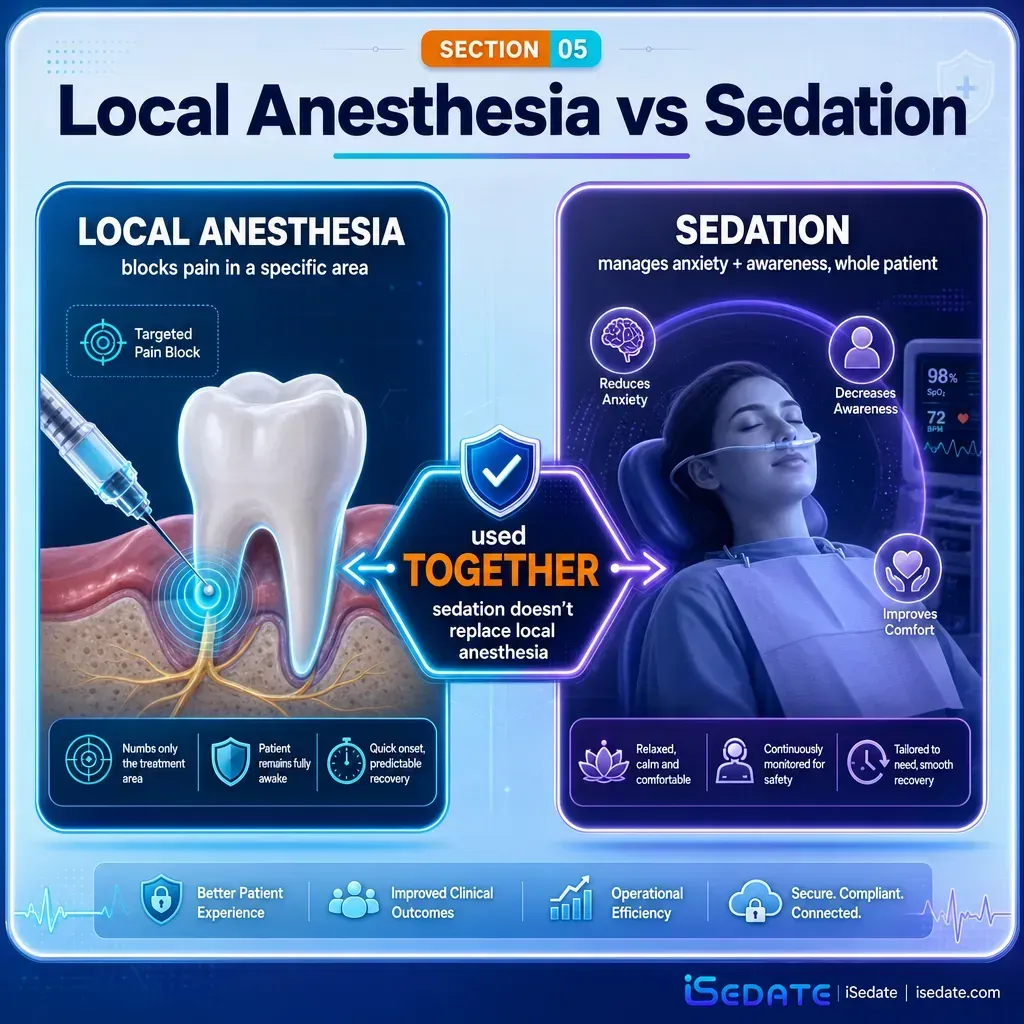
Minimal sedation (no permit required, 20:43:09:06.02). A dentist may give a patient 12 or older a single enteral drug up to the maximum recommended dose, or prescribe it for self-administration, without a sedation permit, as long as emergency drugs and equipment are on hand and the ADA sedation guidelines are followed. It is not unregulated: the single-drug, maximum-recommended-dose limit is a hard line, and the moment a patient responds as if more deeply sedated, the rules for that deeper level take over.
Nitrous Oxide Inhalation Analgesia Sedation permit (20:43:09:05). The entry permit. It authorizes inhaled nitrous oxide and oxygen analgesia sedation, the lightest permitted form of anxiety control, where the patient stays responsive.
Moderate Sedation permit (20:43:09:04). Authorizes moderate, or "Conscious Sedation," including the parenteral and IV route, for patients 12 and older on an outpatient basis. The patient responds purposefully to verbal or tactile stimulation and keeps their own airway. Because South Dakota folds the parenteral route into this single moderate permit rather than splitting it into separate enteral and IV tiers, this is the workhorse permit for a general practice doing real conscious sedation, and it carries the heaviest training and live-patient bar short of general anesthesia.
General Anesthesia and Deep Sedation permit (20:43:09:03, with 20:43:09:11 and 20:43:09:13.01). The top tier. It authorizes deep sedation and general anesthesia, where the patient is not easily aroused or is unconscious and may need airway support, and it incorporates the authority of the moderate, nitrous, and host permits. This tier carries the strictest equipment and inspection requirements and is largely the province of dental anesthesiologists and oral and maxillofacial surgeons. If you are pursuing it, work directly from the chapter with the board.
Host permit and staff monitoring permit (20:43:09:10). A host permit lets a dentist bring in a licensed anesthesia provider to deliver the sedation. Separately, a permit to monitor sedated patients authorizes a hygienist or assistant to monitor under a permitted dentist's direct supervision; it requires current Basic Life Support at the Healthcare Provider level plus a board-approved anesthetic-assisting course of at least eight hours.
Source: ARSD 20:43:09:03 (general anesthesia and deep sedation) | ARSD 20:43:09:10 (monitoring personnel)
How to get or upgrade each permit
Each permit has its own bar to clear: a board-approved course, resuscitation certification, and, for moderate sedation, a count of managed live patients. You move up the ladder by meeting the next level's requirements, passing any required inspection, and applying to the board. The figures below come straight from Chapter 09; where a number is set by the board rather than the rule text, this guide says so instead of inventing one.
| Permit | Route / depth | Training | Live patients | Resuscitation |
|---|---|---|---|---|
| Minimal (no permit, 20:43:09:06.02) | Single enteral drug, max recommended dose | ADA sedation guidelines; emergency drugs and equipment on hand | Not applicable | Per standard of care |
| Nitrous Oxide (20:43:09:05) | Inhalation, lightest | Board-approved course (ADA teaching objectives) or accredited dental school course | Not specified by rule | BLS (Healthcare Provider) |
| Moderate Sedation (20:43:09:04) | Conscious sedation, incl. parenteral / IV | At least 60 didactic clock hours (20:43:09:04.03) | At least 20 individually managed live patients, IV route | ACLS |
| General Anesthesia / Deep (20:43:09:03, :11, :13.01) | Deep sedation / general anesthesia | Accredited residency; see Chapter 09 and confirm with board | 50 cases in prior 12 months for the out-of-state path | Advanced resuscitation; full monitoring suite required |
| Monitoring personnel (20:43:09:10) | Assistant / hygienist monitoring | 8-hour board-approved anesthetic-assisting course | Not applicable | BLS (Healthcare Provider) |
The minimal and nitrous routes
Minimal sedation needs no permit, only the dose discipline and emergency readiness in 20:43:09:06.02. The Nitrous Oxide Inhalation Analgesia Sedation permit requires a board-approved course that meets the ADA's teaching objectives for pain control and sedation, or a nitrous course through an accredited dental school, plus current Basic Life Support at the Healthcare Provider level. South Dakota's rule does not fix a specific clock-hour count for nitrous, so treat any "X-hour" figure you see on a course provider's page as that provider's course length, not a state minimum, and confirm the current requirement with the board. These are the most accessible routes and the usual first step for a practice adding light anxiety control.
The Moderate Sedation permit
This is the biggest step most general dentists and oral surgeons take, because South Dakota's single moderate permit already includes the parenteral and IV route. The course behind it, under 20:43:09:04.03, must run at least 60 clock hours of didactic instruction and include intravenous management of at least 20 individually managed live patients. The permit itself (20:43:09:04) adds current ACLS, requires that a permitted monitor be present and assisting during the case, and holds the office to the facility and equipment rules in 20:43:09:12 and 20:43:09:13. The live-patient count is substantial by design: IV titration demands hands-on competence a classroom cannot replicate.
In Plain Terms
Treating children under 12 under moderate sedation is a separate, higher bar: the dentist needs an accredited advanced dental education residency and current Pediatric Advanced Life Support certification, and a dentist who uses a licensed anesthesia provider for a child under 12 must also hold PALS. If your practice is adults-only for sedation, the standard moderate permit path covers you; if you sedate children, plan for the pediatric requirements before you apply.
For every level, the application, the current fee schedule, and any examination requirement are set by the board and updated periodically. Do not rely on a number you read on a continuing-education provider's page. Confirm the exact forms, exams, and current fees with the South Dakota Board of Dentistry before you file.
Source: ARSD 20:43:09:04.03 (moderate sedation course) | ARSD 20:43:09:05 (nitrous permit)
The board forms you actually file
South Dakota puts the sedation applications, the course-approval requests, and the inspection checklists in one place on the board's site, which is a help: you can see exactly what you will submit before you start a course. Each permit has its own numbered application form.
South Dakota Sedation Permit Application Forms
- Nitrous oxide: Application to Administer Nitrous Oxide.
- Moderate sedation: Application to Administer Moderate Sedation, plus a course-approval request form.
- General anesthesia and deep sedation: Application to Administer General Anesthesia and Deep Sedation.
- Host permit: Host Permit Application, for using a licensed anesthesia provider, plus a course-approval request.
- Facility inspection: the board's inspection checklists and records-review forms, completed by the board-approved inspector.
- Adverse Condition Report: the form used after a qualifying sedation incident (see Recordkeeping, below).
Pull the current versions, with their exact fees and submission instructions, from the board's own application index rather than a third-party summary, since form IDs and fees change.
Source: South Dakota Board of Dentistry dentist application index

What the permit requires you to monitor
A permit is permission plus obligation. Once you hold a moderate or deeper permit, South Dakota is explicit about the monitoring equipment your office must carry. For general anesthesia and deep sedation, 20:43:09:13.01 requires methods to monitor respiratory and cardiac function:
- Oxygenation: pulse oximetry.
- Cardiac activity: an electrocardiogram display.
- Ventilation: a precordial or pretracheal stethoscope and end-tidal carbon dioxide (capnography) measurement.
- Circulation: a blood-pressure monitoring method.
For moderate sedation, 20:43:09:13 requires the office to meet the monitoring-equipment requirements, and 20:43:09:14 requires the dentist to apply the current standard of care at every level. For the full clinical breakdown of what to monitor and chart at each depth, see the companion South Dakota sedation vitals monitoring, charting, and reporting requirements guide, and for how other states structure this, our state-by-state sedation licensing and permit requirements hub.
Source: ARSD 20:43:09:13.01 (equipment, general anesthesia and deep sedation)
Renewal, fees, and the annual case minimum
Getting the permit is a one-time hurdle. Keeping it is an annual obligation, and this is where South Dakota is more specific than most practices expect. Under 20:43:09:08, sedation and anesthesia permits renew every year alongside the dental license, and the board may re-evaluate your credentials and facility at renewal.
Three renewal rules are worth pinning down now so a slow sedation year does not cost you the permit:
- Annual case minimum. A moderate sedation permit holder must complete at least 12 moderate sedation cases a year, and a general anesthesia and deep sedation holder at least 50 cases. Miss the count, and you owe three hours of board-approved continuing education for each missed case, in the relevant level of sedation, on top of any other CE.
- Annual team training. Holders of a general anesthesia and deep sedation, moderate sedation, or host permit must document annual team training on emergency-response protocols where the sedation is provided.
- Renewal fee. The renewal fee for a moderate sedation, general anesthesia and deep sedation, or host permit, and for a dentist's nitrous permit, is set by the board; the current amount is on the board's application and licensure pages. Failing to renew properly is an automatic suspension of the permit.
Because the case counts and the team-training log are checked at renewal, they are also exactly what a thin or backdated record cannot survive. A permit that lapses on a paperwork gap is a permit lost on something entirely avoidable.
Source: ARSD 20:43:09:08 (renewal, fees, and case minimums) | South Dakota Board of Dentistry continuing-education overview
Inspections and the five-year cycle
This is where a permit is kept or lost. Under 20:43:09:11, applicants for a general anesthesia and deep sedation permit, a moderate sedation permit, or a host permit must pass a facility inspection before a temporary permit issues, and a temporary permit holder must pass a full inspection before the permit itself is granted. From then on, a holder of one of those permits must pass a full inspection at least once in each five-year licensure cycle to keep it. The dentist is responsible for all costs of an inspection, and inspectors are board-approved, authorized at the relevant anesthesia level, with at least three years of dental experience.
Myth, Busted
Myth: If your sedations go smoothly, an inspection is a formality.
Fact: A dentist can run flawless cases and still fail an inspection on documentation alone, which under 20:43:09:11 is an automatic suspension.
When an inspector opens your file, they are checking the record and the office, not your intentions: a medication logged without the monitor present, a thin anesthetic record, a recovery assessment never written down. A board review turns on whether your record is complete, contemporaneous, and consistent with the standard of care.
Source: ARSD 20:43:09:11 (inspection and automatic suspension)
Recordkeeping obligations tied to your permit
Holding a permit also means holding a set of documentation duties, and these are exactly what a board inspection examines. South Dakota sources them in two places, and it helps to keep them straight.
The medication record. Under 20:43:11:01, your dental record must include any medication administered, dispensed, or prescribed, with the date, the patient's name, the medication name, and the dosage and amount, including refills. This one is named outright in the code.
The time-oriented anesthetic record. The timed record of drugs, doses, and times, with vitals recorded continually through the case, is not written out as a separate South Dakota statute. It enters through the standard-of-care requirement in 20:43:09:14, which pulls in the ADA sedation guidelines. The obligation is real and the board enforces it; it is simply sourced from the incorporated standard rather than an itemized rule. Our anesthesia record software and dental sedation compliance pages show what that complete record looks like in practice.
Adverse-condition reporting. ARSD 20:43:09:09 addresses reports of adverse conditions connected to sedation and anesthesia care, and the board provides an Adverse Condition Report Form for it. The board's form is due within a short window after a qualifying incident, with a full written report to follow, and rule violations can lead to disciplinary action. Because the exact triggers and timelines are set by the board and updated on the form itself, confirm the current window directly with the board rather than from memory.
Source: ARSD 20:43:11:01 (medical record content) | ADA Guidelines for the Use of Sedation and General Anesthesia by Dentists (2025)
Keeping the permit: audit-ready records
Everything above points to one truth: getting the permit is a one-time hurdle, but keeping it is a daily documentation discipline that an inspector can test at least once every five years, and that a renewal checks every single year. A manual vitals log written by hand mid-case, between titrating a drug and watching an airway, is exactly where records go incomplete, and incomplete records are what a board inspection and a malpractice claim both attack. South Dakota raises the bar further by holding you to the standard of care through 20:43:09:14, so your record is measured against the full time-oriented expectation, not just the medication line the code names.
SedationVault by iSedate removes that failure point. It captures live patient vitals and the drug log automatically into a time-oriented, South Dakota-ready sedation record, carrying the drug names, dosages, and amounts the code requires alongside the times and continually recorded vitals the standard of care expects. When the board inspects or you renew, a complete record is a one-click export, not a scramble through paper.
Book a demo of SedationVault See SedationVault pricingFrequently asked questions
What sedation permits does South Dakota offer?
How many hours do you need for a moderate (IV) sedation permit in South Dakota?
How often do you renew a South Dakota sedation permit?
Does nitrous oxide require a permit in South Dakota?
Do you need a permit for minimal sedation in South Dakota?
Who regulates sedation dentistry in South Dakota?
Licensed in a Neighboring State?
If you practice across state lines, the permit structure changes at the border. See our sedation licensing and permit guides for the states around South Dakota:
- North Dakota sedation dentistry licensing and permit requirements
- Minnesota sedation dentistry licensing and permit requirements
- Iowa sedation dentistry licensing and permit requirements
- Nebraska sedation dentistry licensing and permit requirements
- Montana sedation dentistry licensing and permit requirements
- Wyoming sedation dentistry licensing and permit requirements
- All 50 states: the sedation dentistry licensing and permit requirements hub
Sources
Sources and How to Verify
- ARSD 20:43:09:03: General anesthesia and deep sedation permit requirements
- ARSD 20:43:09:04: Moderate sedation permit requirements
- ARSD 20:43:09:04.03: Moderate sedation course requirements (60 hours, 20 patients)
- ARSD 20:43:09:05: Nitrous oxide sedation and analgesia permit
- ARSD 20:43:09:06.02: Minimal sedation
- ARSD 20:43:09:08: Renewal, fees, and annual case minimums
- ARSD 20:43:09:10: Permit to monitor patients
- ARSD 20:43:09:11: Inspection and automatic suspension
- ARSD 20:43:09:13.01: Equipment, general anesthesia and deep sedation
- ARSD 20:43:09:14: Clinical guidelines (standard of care)
- ARSD 20:43:11:01: Medical record content
- South Dakota Board of Dentistry: dentist application index (sedation forms)
- South Dakota Board of Dentistry: statutes and rules for dentists
- ADA Guidelines for the Use of Sedation and General Anesthesia by Dentists (2025)
This guide summarizes South Dakota sedation permit rules for general information and is not legal advice. Training, live-patient counts, resuscitation, monitoring equipment, renewal, inspections, and recordkeeping are drawn from ARSD Article 20:43, Chapters 09 and 11 as cited, verified against the South Dakota Legislature's rules site and the South Dakota Board of Dentistry's own pages in November 2026. Exact current fees, the verbatim contents of a facility inspection, the adverse-condition reporting window, and the full general anesthesia training specifics are set by the board and can change, so confirm the current details directly with the South Dakota Board of Dentistry before you act.