






North Dakota Sedation Dentistry Licensing & Permit Requirements
In North Dakota, your dental license alone stops being enough the moment you sedate a patient past the lightest tier. Minimal, single-drug oral sedation needs no permit. But any dentist who provides moderate (conscious) sedation, deep sedation, or general anesthesia must first hold the matching permit from the North Dakota Board of Dental Examiners, issued under N.D. Admin. Code 20-02-01-05. Getting the permit means meeting the board's verified training, live-patient, and certification requirements for your level, then passing an office site evaluation. Keeping it means your sedation records survive a board review. This guide covers both halves, with the specific hours and counts drawn straight from the current rule.
Recent Updates
Last UpdatedNovember 16, 2026
- Replaced every "confirm the hours with the board" placeholder with the verified figures from the current rule: the 60-hour moderate-sedation course, 20 live IV patient cases, the 12-hour nitrous course, the five-month deep-sedation/GA training path, the 25-or-75 general-anesthesia case affidavit, and the 32-hour (6 sedation-specific) biennial CE requirement.
- Added the site-evaluation cycle (initial within 60 days, then every three years) and the 7-day adverse-event reporting rule.
- Re-sourced every citation to the original North Dakota Administrative Code on the state's own ndlegis.gov site and the North Dakota Board of Dental Examiners, replacing third-party aggregator links.
See full history of updates to this post
ReviewedOctober 1, 2024
- Confirmed the permit structure and biennial renewal against the version of 20-02-01-05 then in effect. The rule has since been amended again, effective April 1, 2026.
- North Dakota regulates four sedation tiers under 20-02-01-05: nitrous oxide analgesia, minimal sedation, moderate (conscious) sedation, and deep sedation or general anesthesia.
- Minimal single-drug sedation needs no permit; moderate sedation and deep sedation or general anesthesia each need a board permit, renewed every two years. The board may issue a nitrous oxide permit.
- A moderate sedation permit requires a 60-hour course covering enteral and parenteral sedation plus management of 20 live IV patient cases; deep sedation or general anesthesia requires a CODA-accredited program with at least five months of advanced anesthesiology training.
- Every sedation office passes a board site evaluation initially (within 60 days) and at least every three years, and must document quarterly mock codes.
- Moderate and deeper sedation require a time-based anesthesia record with monitoring logged every five minutes and an Aldrete score at discharge (20-02-01-05(8)(b)); records are kept six years.

What This Guide Covers
- Who issues sedation permits in North Dakota
- The four North Dakota sedation tiers
- Requirements for each permit level
- How to apply for or upgrade a permit
- What the permit requires you to monitor
- Recordkeeping and reporting tied to your permit
- Renewal and continuing education
- Site evaluations and record reviews
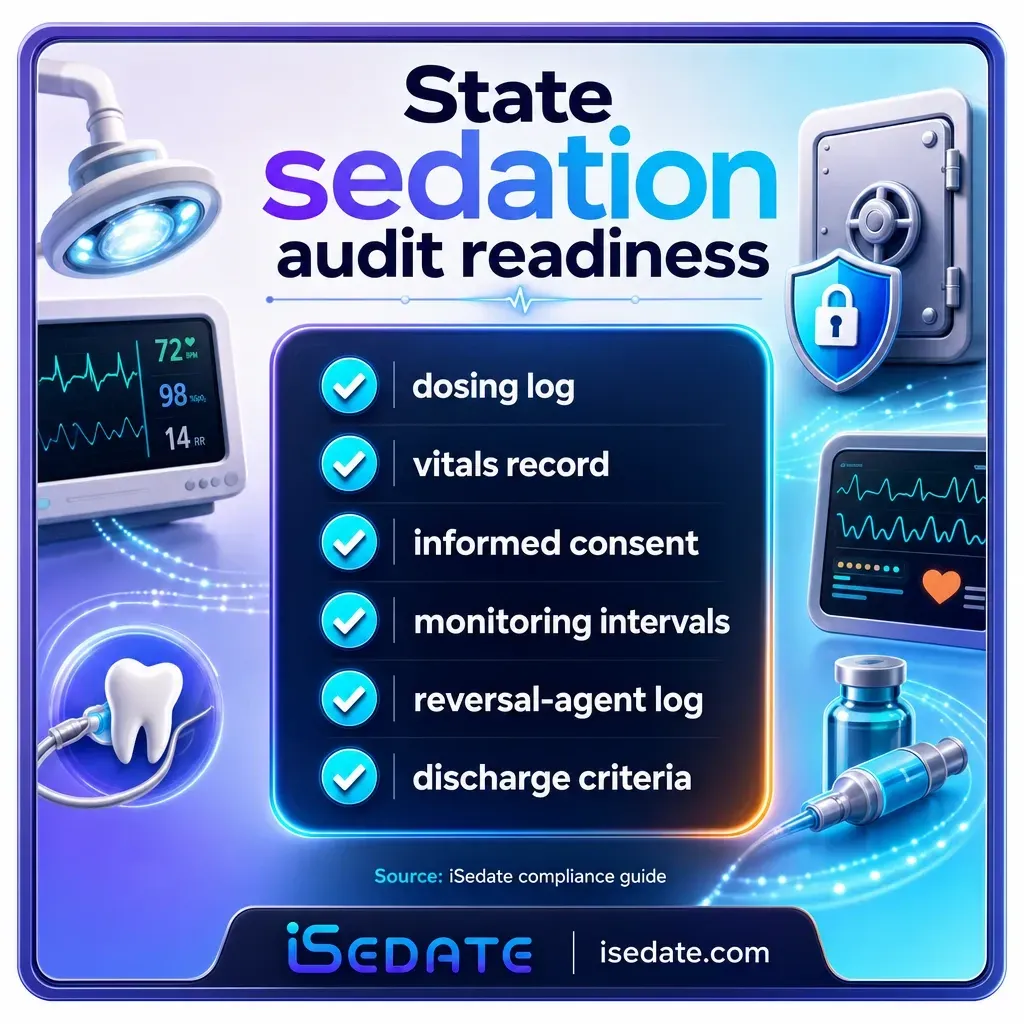
- Keeping the permit: audit-ready records
- Licensed in a neighboring state?
- Frequently asked questions
- Sources
Who issues sedation permits in North Dakota
Sedation dentistry in North Dakota is regulated by the North Dakota Board of Dental Examiners, the state agency that licenses dentists and issues every sedation and anesthesia permit. The board, not any national body, decides who may sedate, runs the office site evaluations, and takes disciplinary action. The rules live in N.D. Admin. Code 20-02-01-05, "Anesthesia and sedation permit requirements," under Title 20, and the permit authority flows from North Dakota Century Code chapter 43-28. The rule has been amended repeatedly, most recently effective April 1, 2026, so apply and renew against the current version.
The ADA Writes the Standard, the Board Writes the Law
The American Dental Association publishes sedation guidelines that North Dakota and most states lean on, and North Dakota's level definitions track them closely. But the ADA is a professional association, not a government agency. It does not license you, evaluate your office, or discipline you. Your permit, your site evaluations, and any sanctions all come from the North Dakota Board of Dental Examiners under 20-02-01-05. Treat the ADA guidelines as best practice and the board's rule as the law you are held to. The real federal layers that sit alongside the state rule are the DEA for controlled-substance handling and HIPAA for records, not any ADA "federal law."
To apply, you work through the board's own process and forms. The exact fee schedule is set by the board and is not fixed in the rule text, so confirm the current application fee on the board's practitioner forms page before you file. Everything else below, the training hours, live-patient counts, certifications, and recordkeeping, is spelled out in the rule and reproduced here.
Source: N.D. Admin. Code 20-02-01-05 | ND Board of Dental Examiners, Anesthesia Overview
The four North Dakota sedation tiers
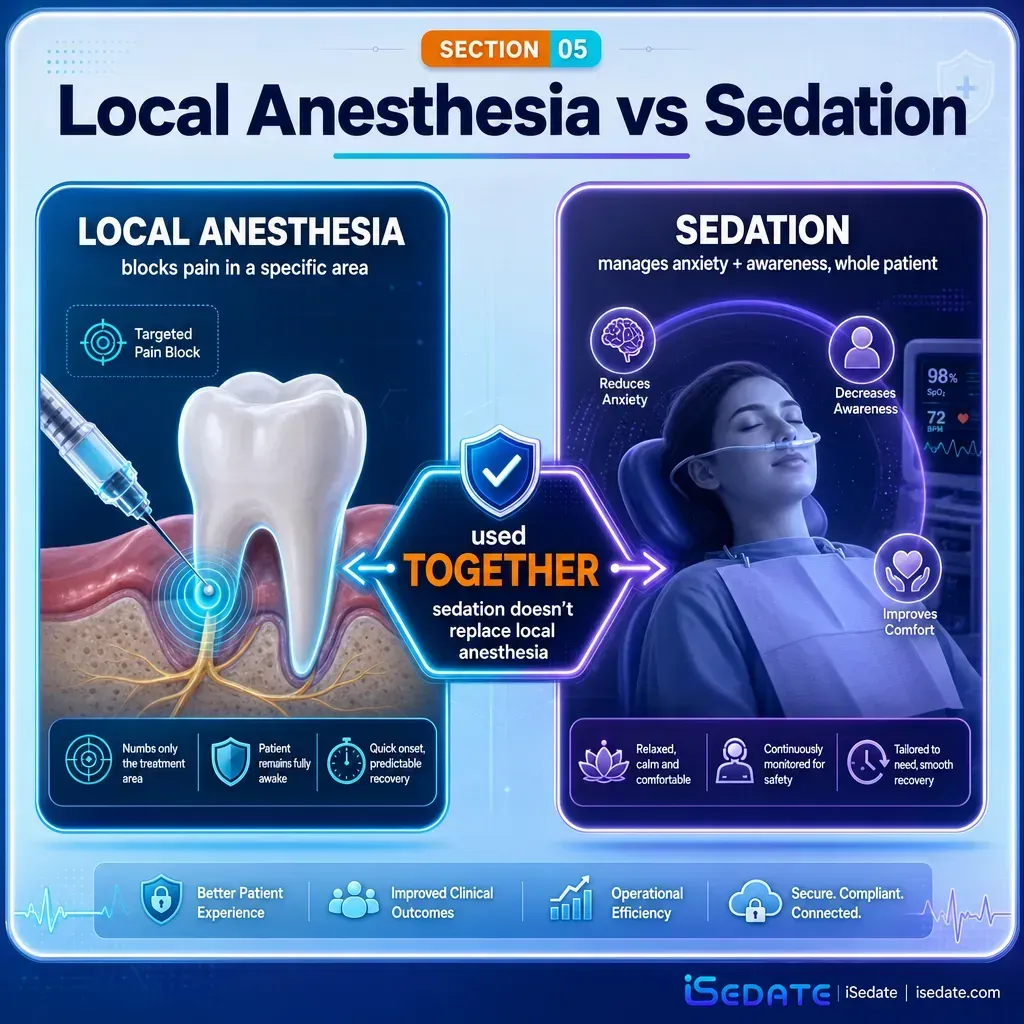
North Dakota names its tiers by the depth the patient reaches, not just the drug or the route. Here is the full ladder, each with its place in 20-02-01-05 and whether it needs a permit.
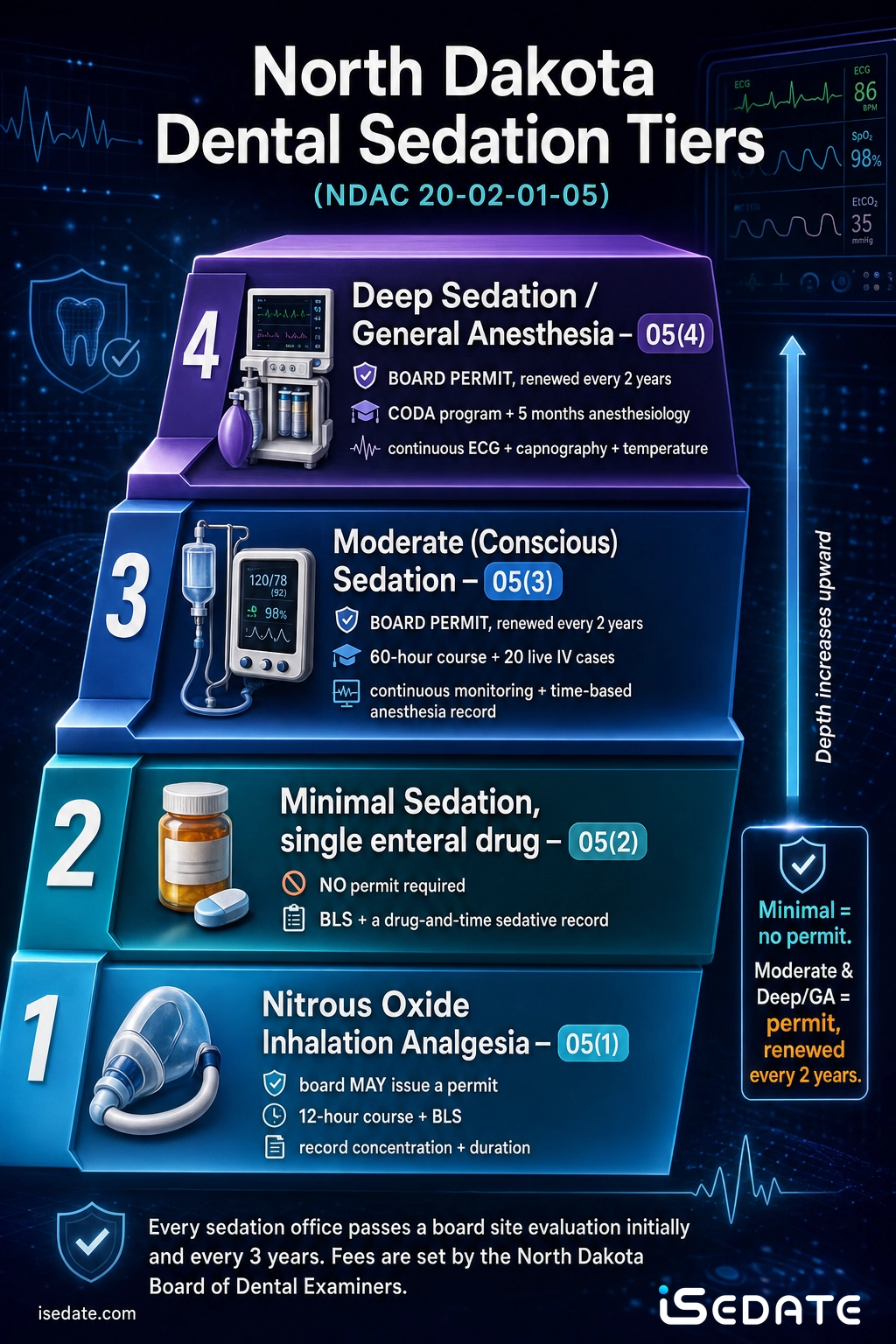
Nitrous oxide inhalation analgesia (20-02-01-05(1)). The entry tier: nitrous oxide and oxygen, the lightest form of anxiety control, where the patient stays fully responsive. The board may issue a nitrous oxide permit to a dentist, hygienist, or registered dental assistant who completes a 12-hour board-approved course within 13 months before applying and holds current Basic Life Support certification. The dental record must capture the concentration administered and the duration.
Minimal sedation (20-02-01-05(2)). A single enteral drug, within the FDA maximum recommended dose for unmonitored home use, where the patient responds normally to verbal command and keeps a stable airway. This tier requires no permit, but the dentist must hold Basic Life Support certification and keep a sedative record listing the names and times of all drugs, plus the patient's time and condition at discharge. The rule is explicit about the line: combining two or more enteral drugs, exceeding the maximum home-use dose, or giving any parenteral drug becomes moderate sedation and requires the permit.
Moderate (conscious) sedation (20-02-01-05(3)). Moderate sedation, which the rule and the profession also call Conscious Sedation, is where the patient responds purposefully to verbal or tactile stimulation and maintains their own airway. This tier requires a board permit, renewed biennially, and it is the first tier that triggers continuous monitoring and a time-based anesthesia record. It is the workhorse permit for general dentists who offer real sedation.
Deep sedation or general anesthesia (20-02-01-05(4)). The top tier, where the patient is not easily aroused or is unconscious and may need airway support. It requires a board permit, renewed biennially, and the heaviest training path and monitoring load. In practice this tier is held mainly by dental anesthesiologists and oral and maxillofacial surgeons; it is largely out of scope for a general dentist, who typically works at nitrous and moderate sedation.
Source: N.D. Admin. Code 20-02-01-05(1)–(4)
Requirements for each permit level
This is the part most state guides skip and the part you actually came for. North Dakota's rule names specific hours, course content, patient counts, and certifications for each permitted level. Here they are, verified against the current code, with the exact subsection for each.
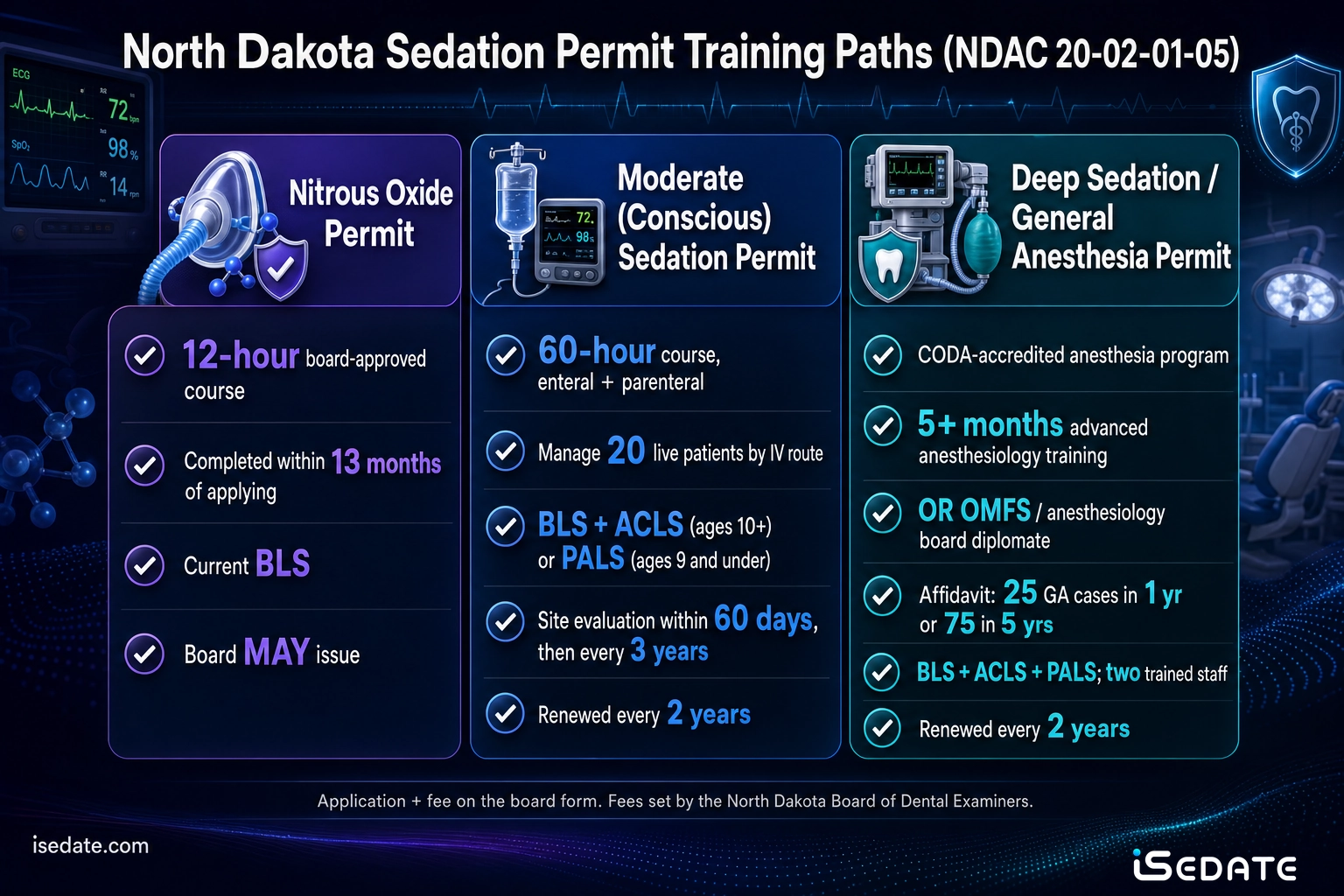
Nitrous oxide permit: the 12-hour path
A nitrous oxide permit is the lightest credential the board issues. The applicant completes a 12-hour board-approved course (or an accredited equivalent) within 13 months before applying, or completes it earlier and documents recent proficiency, and holds current American Heart Association Basic Life Support for the healthcare provider. The inhalation equipment itself must carry a fail-safe that prevents delivery below 30% oxygen (20-02-01-05(1)).
Moderate sedation permit: 60 hours and 20 live IV cases
This is the permit most sedation-minded general dentists pursue, and its bar is specific. Under 20-02-01-05(3)(a), an applicant for an initial moderate sedation permit must complete a comprehensive 60-hour course in moderate sedation covering both enteral and parenteral routes, including the individual management of 20 live-patient clinical cases by the intravenous route, and earn certification in rescuing a patient from a deeper level than intended, including airway management, intravascular or intraosseous access, and reversal medications.
The course must be directed by a dentist or physician with at least three years of experience and formal postdoctoral training in anxiety and pain control, who holds a current permit or license to administer moderate, deep, or general sedation in at least one state. The certification bar is just as specific: a dentist using moderate sedation must hold current Basic Life Support, plus ACLS for patients 10 and older and PALS for patients 9 and younger (20-02-01-05(3)(b)). One exemption exists: a dentist who maintained a North Dakota parenteral sedation permit and was administering parenteral sedation in a dental office before July 1, 2022, does not have to meet the education requirements again.
Moderate Sedation Permit at a Glance
- Training: 60-hour comprehensive course, enteral plus parenteral moderate sedation.
- Clinical cases: individual management of 20 live patients by the IV route, with rescue competency.
- Certification: current BLS, plus ACLS (ages 10+) or PALS (ages 9 and under).
- Site evaluation: completed within 60 days of initial permit approval, then every three years.
- Staff: at least one trained dental sedation staff member present during the case.
- Renewal: biennial, with the dentist's license.
Myth, Busted
Myth: If you hold a moderate sedation permit, you can give a quick dose of propofol or ketamine to settle a tough case.
Fact: A North Dakota moderate sedation permitholder may not use ultra-short-acting barbiturates, propofol, ketamine, or similar agents that would likely render a patient deeply sedated. Those drugs sit above the permit, in deep sedation and general anesthesia.
The rule names these agents directly in 20-02-01-05(3)(c). Using a deep-sedation drug on a moderate permit is not a gray area; it is practicing above your permit level.
Deep sedation or general anesthesia permit: the advanced path
The top permit demands either a completed, CODA-accredited advanced education program in deep sedation and general anesthesia with formal airway training and at least five months of advanced anesthesiology training within the last three years, or recognized specialty standing such as an oral and maxillofacial surgery or dental anesthesiology board diploma or fellowship (20-02-01-05(4)). A dentist who finished that training more than three years ago must file an affidavit showing general anesthesia given to at least 25 patients in the past year or 75 in the past five years, a current deep-sedation or GA permit in another jurisdiction, and 32 hours of relevant continuing education within three years. Deep sedation and GA offices must also keep at least two trained dental sedation staff members present, not one.
Source: N.D. Admin. Code 20-02-01-05(1), (3), (4) | ND Board, Moderate Sedation | ND Board, General Anesthesia & Deep Sedation
How to apply for or upgrade a permit
The path up the ladder is the same at every level: meet the next tier's training and certification requirements, file the board's application with the fee, and pass a site evaluation before you treat patients under the new permit.
- Complete the training for your target level (the 12-hour nitrous course, the 60-hour moderate course with 20 IV cases, or the CODA-accredited deep-sedation program).
- Hold the required certifications (BLS for every level; ACLS and PALS layered on by patient age for moderate and deeper).
- Submit the completed application and fee on the board's form. Find the current application on the board's practitioner forms page and confirm the fee there.
- Schedule and pass your initial site evaluation within 60 days of the board approving the application (20-02-01-05(3)(e) and (5)).
For the clinical breakdown of what each tier must monitor and chart in daily practice, see the companion guide on North Dakota sedation vitals monitoring, charting and reporting requirements, and the national overview in our Sedation Dentistry Licensing & Permit Requirements by State hub.
Source: N.D. Admin. Code 20-02-01-05(3)–(5)
What the permit requires you to monitor
A permit is permission plus obligation. The further up the ladder you go, the more parameters you watch and log. North Dakota sets the monitoring floor for each level in 20-02-01-05(10).
| Level | Required monitoring (20-02-01-05(10)) | Permit? |
|---|---|---|
| Minimal sedation | Pre- and post-procedure heart rate, respiratory rate, blood pressure, and level of sedation | No |
| Moderate (conscious) sedation | Continuous heart rate, respiratory rate, and oxygen saturation; blood pressure every five minutes; capnography; ECG if clinically indicated; level of sedation | Yes |
| Deep sedation / general anesthesia | All of the above, plus continuous ECG, continuous ventilatory status with an advanced airway, and temperature monitoring for volatile gases or malignant-hyperthermia triggers | Yes |
A qualified monitor, the permit provider plus at least one trained dental sedation staff member for moderate sedation, must be continuously present with the patient through the procedure and recovery. Monitoring equipment must be checked, calibrated to the manufacturer's recommendations, and documented annually (20-02-01-05(10)(d)).
Source: N.D. Admin. Code 20-02-01-05(9)–(10)
Recordkeeping and reporting tied to your permit
Holding a permit also means holding a set of documentation duties, and these are exactly what a board site evaluation examines.
The anesthesia record. Under 20-02-01-05(8)(b), moderate sedation and deeper require a time-based anesthesia record documenting height and weight (for BMI and emergency dosing), ASA physical-status class, fasting status, the procedure, the time anesthesia commenced and ended, every medication including oxygen with dosage, route, and time, IV access site and method if used, vital signs before and after, response and any complications, and continuous monitoring data (blood pressure, heart rate, and respiration via ECG and pulse oximetry) recorded every five minutes.
Discharge documentation. The record must document the patient's response to anesthesia, any complications, and the patient's condition and Aldrete score at discharge. North Dakota names the Aldrete discharge-scoring tool in the rule, so a discharge note without a recorded Aldrete score is incomplete on its face.

Adverse-event reporting. This is a hard deadline many dentists miss. Under 20-02-01-05(14)(d), any mortality or incident that causes injury requiring hospitalization during or as a result of any level of sedation or nitrous oxide must be reported to the board within seven days, with a detailed account of the procedure, drugs, technique, and the adverse occurrence, plus the unique identifier from the dental anesthesia incident reporting system. The rule states plainly that a violation is unprofessional conduct and grounds to revoke or suspend the permit or license.
Source: N.D. Admin. Code 20-02-01-05(8), (14) | N.D. Admin. Code 20-02-01-09
Renewal and continuing education
North Dakota sedation and anesthesia permits are not one-time credentials. Under 20-02-01-05(7), all permits renew biennially, concurrent with the dentist's license (dentist licenses renew in odd-numbered years), and renewal depends on three things: the permit requirements still being met, the renewal application and fee reaching the board before the permit expires, and the office site inspection being in good standing. Let any of those slip and the board may suspend your sedation privileges until you late-renew or reapply.
iSedate Renewal Tip
Budget at least 6 sedation-specific CE hours each cycle. North Dakota dentists need 32 continuing-education hours every two years, and for sedation and anesthesia permitholders, at least six of those hours must relate to sedation or anesthesia (20-02-01-06(3)(d)). CPR and the age-appropriate ACLS or PALS certifications must stay current the whole time, not just at renewal.
Source: N.D. Admin. Code 20-02-01-05(7), 20-02-01-06 | ND Board, License & Registration Renewal
Site evaluations and record reviews
This is where a permit is kept or lost. Every location that provides moderate sedation, deep sedation, or general anesthesia must pass a board site evaluation initially (within 60 days of permit approval) and again at least every three years, under 20-02-01-05(5). A board-appointed evaluator reviews credentials, facilities, equipment, emergency drugs, personnel, procedures, and recordkeeping, and the office must show documentation of quarterly mock codes that cover the full list of named clinical emergencies over a two-year span.
When an evaluator opens your file, they are checking the record, not your intentions: whether the time-based anesthesia record is complete, contemporaneous, logged at five-minute intervals, and closed with an Aldrete score at discharge. A dentist can deliver flawless sedation and still fail on the paperwork, because a reviewer cannot grade care that is not documented. If deficiencies turn up, the rule gives 30 days to correct them before the board acts (20-02-01-05(5)(f)).
Source: N.D. Admin. Code 20-02-01-05(5)
Keeping the permit: audit-ready records
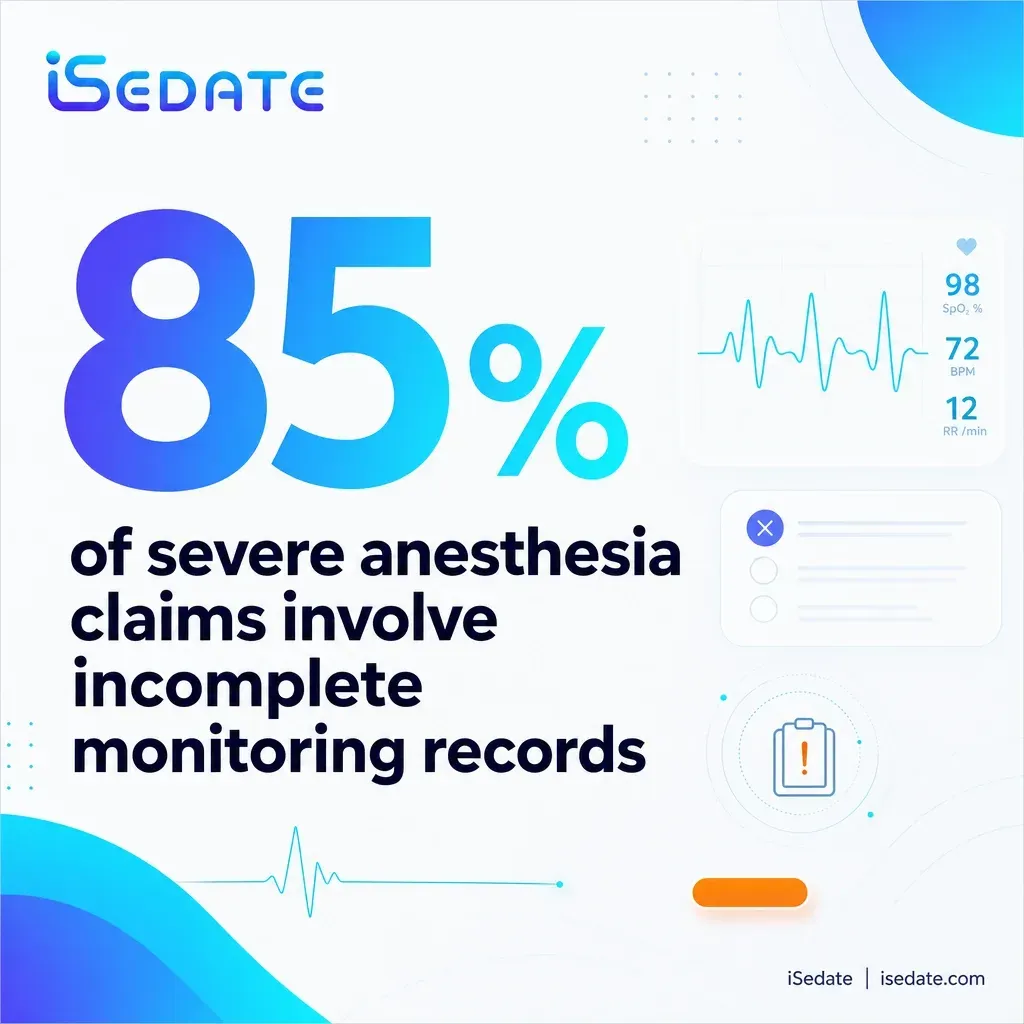
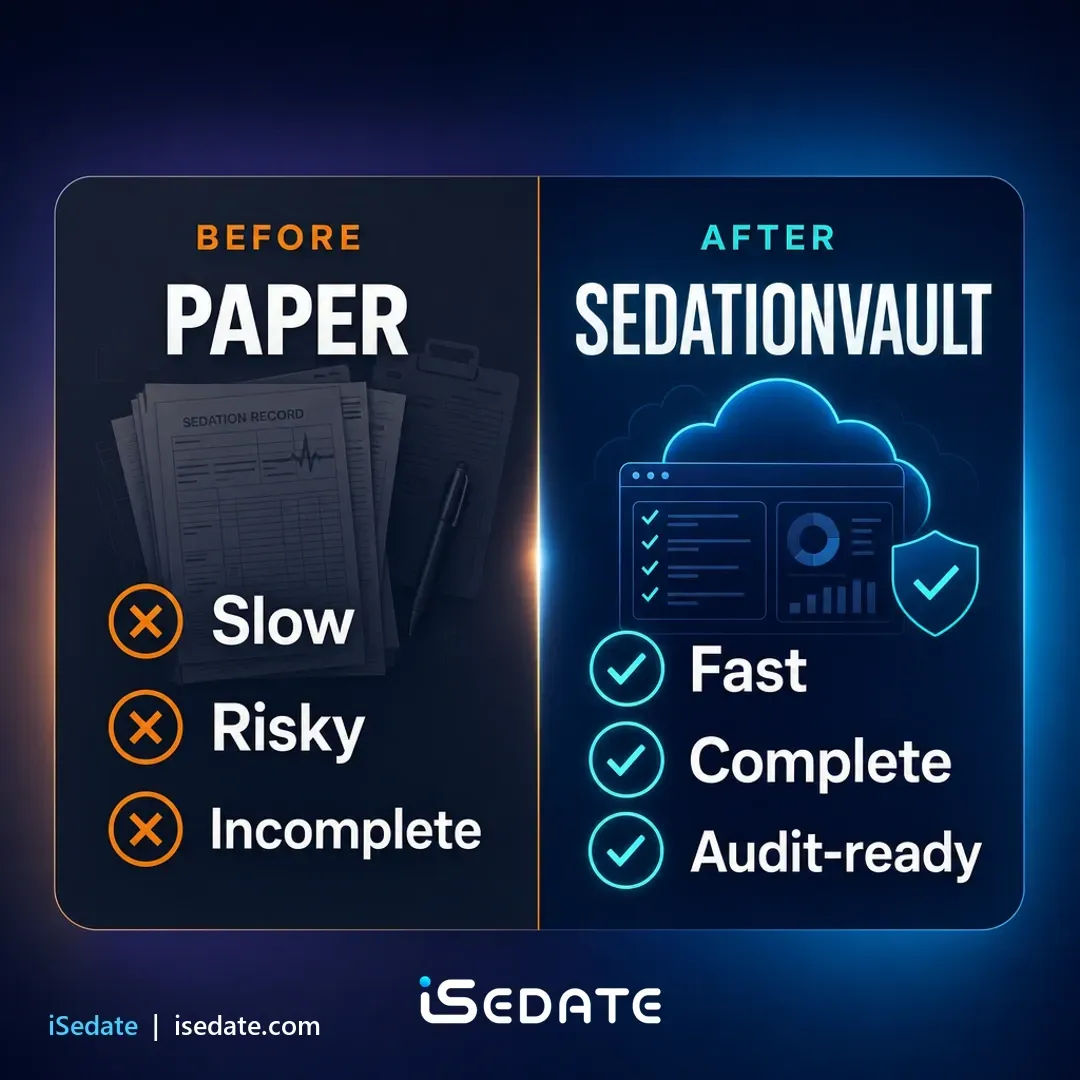
Everything above points to one truth: getting the permit is a periodic hurdle, but keeping it is a daily documentation discipline. A vitals log written by hand every five minutes, between titrating a drug and watching an airway, is exactly where records go incomplete, and incomplete records are what a board site evaluation and a malpractice claim both attack.
SedationVault removes that failure point. It captures live patient vitals and the drug log automatically into a time-based, North Dakota-compliant anesthesia record, holding the five-minute interval that 20-02-01-05 demands and prompting the Aldrete score at discharge, so the record writes itself while you focus on the patient. When the board asks for a file, a complete record is a one-click export, not a scramble through paper, and it stays retained well within the six-year window the rule requires. See how it maps to North Dakota's rules on the dental sedation compliance and anesthesia record software pages.
Book a Demo of SedationVault See SedationVault PricingLicensed in a neighboring state?
Sedation rules change at the state line. If you practice near the border or hold permits in more than one state, compare North Dakota's requirements with its neighbors, and with the full national picture:
- Minnesota Sedation Dentistry Licensing & Permit Requirements
- Montana Sedation Dentistry Licensing & Permit Requirements
- South Dakota Sedation Dentistry Licensing & Permit Requirements
- Sedation Dentistry Licensing & Permit Requirements by State (all 50 states)
Frequently asked questions
What sedation permits does North Dakota require?
Does North Dakota require a permit for minimal or oral sedation?
How do you renew a North Dakota sedation permit?
How often must a North Dakota sedation office pass a site evaluation?
What are the fees for a North Dakota sedation permit?
Related reading: the data behind these rules
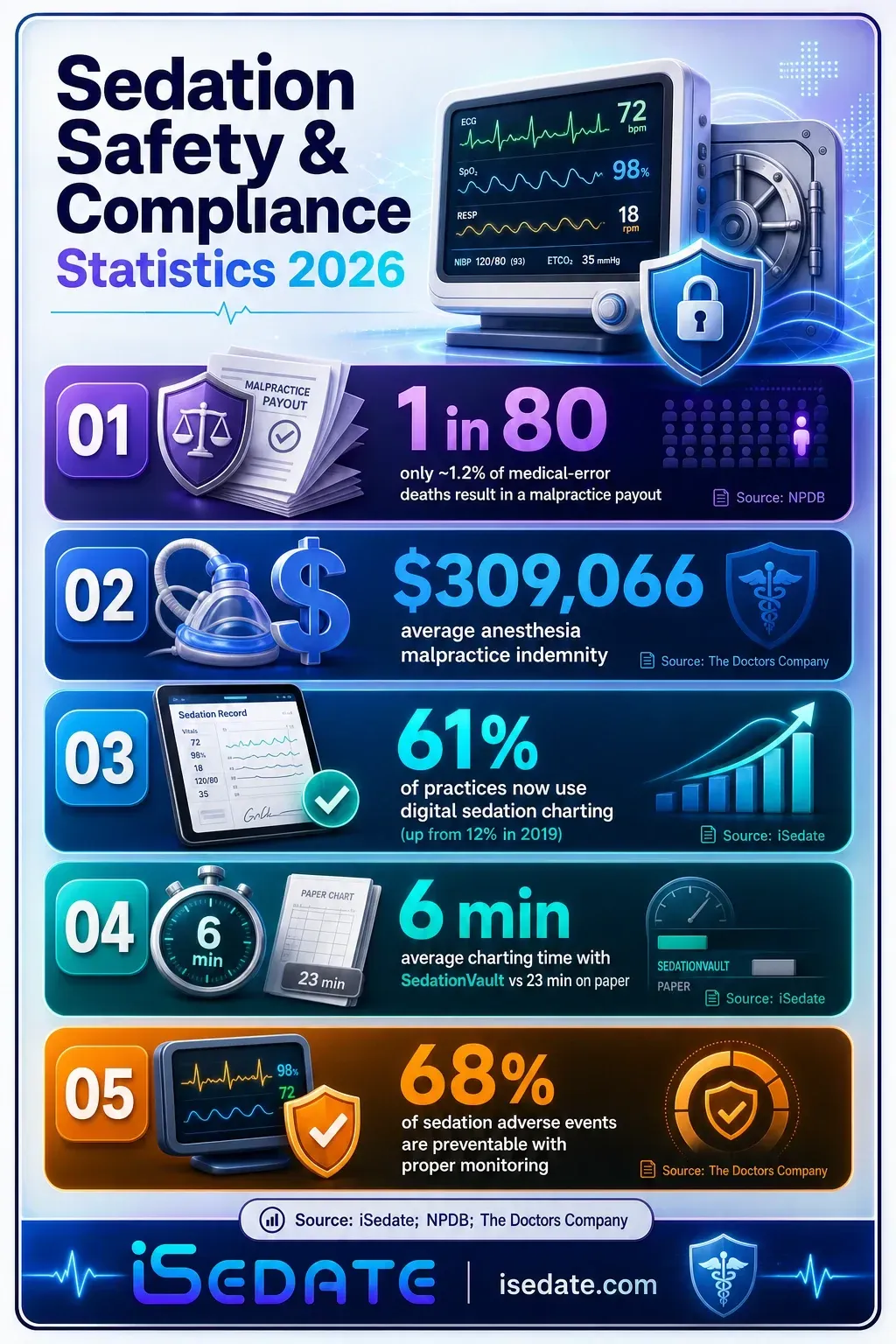
The requirements on this page are the law. These research roundups are the data that explains why they exist and what happens when a practice gets charting or permitting wrong:
Sources
Sources & How We Verified This Guide
Every requirement above was checked against the current North Dakota Administrative Code on the state's own ndlegis.gov publication and cross-referenced with the North Dakota Board of Dental Examiners' own anesthesia pages. Specific figures (60-hour course, 20 IV cases, 12-hour nitrous course, five-month deep-sedation training, 25/75 GA affidavit, 32-hour CE with 6 sedation-specific, every-five-minute logging, six-year retention, seven-day reporting) are quoted from the rule by subsection.
- N.D. Admin. Code ch. 20-02-01, including 20-02-01-05 (Anesthesia and sedation permit requirements), 20-02-01-06 (Continuing education), and 20-02-01-09 (Patient records), North Dakota Legislative Branch, current version amended effective April 1, 2026
- North Dakota Board of Dental Examiners: Anesthesia Overview
- North Dakota Board of Dental Examiners: Moderate Sedation
- North Dakota Board of Dental Examiners: General Anesthesia & Deep Sedation
- North Dakota Board of Dental Examiners: Practitioner Forms (application, fees, site-evaluation form)
- North Dakota Board of Dental Examiners: License & Registration Renewal
This guide summarizes North Dakota sedation permit rules for general information and is not legal advice. Requirements are current as of November 2026 under N.D. Admin. Code 20-02-01-05 (amended effective April 1, 2026). The specific application and renewal fees are set by the North Dakota Board of Dental Examiners and are not fixed in the rule, so confirm the current fees with the board before you file.