






Montana Sedation Dentistry Licensing & Permit Requirements
In Montana, you cannot sedate a patient on your dental license alone. Any dentist who administers nitrous oxide, moderate sedation, deep sedation, or general anesthesia must first hold the matching permit from the Montana Board of Dentistry, issued under the Administrative Rules of Montana, Chapter 138, Subchapter 32. Earning the permit means meeting your tier's training and application requirements and passing an inspection. Keeping it means your sedation records survive a record-accuracy review that happens at least once every five years. This guide walks both halves in order: the exact training and fees for each Montana permit level, and what it takes to stay inspection-ready after the permit is on your wall.
Recent Updates
Last UpdatedNovember 16, 2026
- Verified every requirement against the Montana Board of Dentistry's current permit checklist (updated October 30, 2025) and the official anesthesia permit application.
- Added the confirmed moderate sedation standard: 60 hours of instruction plus management of at least 20 dental patients by the IV route.
- Added the confirmed deep sedation and general anesthesia residency pathways and the ACLS-within-two-years requirement.
- Confirmed fees at $400 total ($200 application plus $200 inspection) and added the $25 anesthesia permit renewal fee.
- Replaced third-party reference links with the board's own official application, checklist, renewal, and rules documents.
- Montana issues three sedation and anesthesia permit levels under ARM 24.138.3221: minimal sedation (including nitrous oxide), moderate (conscious) sedation, and deep sedation or general anesthesia.
- The moderate sedation permit requires 60 hours of instruction plus management of at least 20 dental patients by the IV route, and ACLS completed within two years of application.
- The deep sedation or general anesthesia permit requires a CODA-accredited residency (four-year oral and maxillofacial surgery, or a two-year dental anesthesiology program), and qualifying for it also approves moderate sedation.
- The permit costs $400 to apply ($200 application plus $200 inspection) and renews on the March 1 license cycle for a $25 anesthesia permit fee.
- Moderate and deeper permits are inspected at least every five years, the inspection checks the accuracy of your records, and vitals must be documented at least every five minutes (ARM 24.138.3223 and 24.138.3227).

What This Guide Covers
- Who issues sedation permits in Montana
- The three Montana permit levels
- How to earn each permit: training, ACLS, and fees
- What the permit requires you to monitor
- Reporting obligations tied to your permit
- Renewal and keeping your permit current
- Inspections and record reviews
- Keeping the permit: inspection-ready records
- Frequently asked questions
- Sources
Who issues sedation permits in Montana
Sedation dentistry in Montana is regulated by the Montana Board of Dentistry, housed in the Department of Labor and Industry's Business Standards Division in Helena. The board, not any national body, licenses dentists, issues every sedation and anesthesia permit, appoints the inspectors who review your records, and takes disciplinary action. The rules live in the Administrative Rules of Montana, Title 24, Chapter 138, Subchapter 32 (Anesthesia Rules), enacted under Montana Code Annotated 37-4-308, and every requirement below traces to a rule in that subchapter. You can reach the board at 406-444-6880 or [email protected].
Important
The ADA writes the standard; the board writes the law. The American Dental Association publishes sedation guidelines that Montana and most states lean on, and its 2025 update tightened the expectation of a time-oriented record of drugs and vitals. But the ADA is a professional association, not a government agency. It does not license you, inspect you, or discipline you. Your permit, your five-year inspection, and any sanction all come from the Montana Board of Dentistry under ARM Chapter 138. Treat the ADA guidelines as best practice and Chapter 138 as the rule you are held to. (Separate federal layers, such as DEA controlled-substance logging and HIPAA, apply on top of state law, not instead of it.)
Myth, Busted
Myth: A general dentist's license already covers light sedation, so nitrous oxide and oral sedation do not need a separate permit.
Fact: Montana regulates by depth of sedation, and even minimal sedation, including nitrous oxide and oxygen, sits in its own permitted tier under ARM 24.138.3221. You cannot administer any level of sedation on your dental license alone.
The confusion is common because nitrous feels routine, but Montana still places it inside the permit system, with a training track of its own.
The three Montana permit levels
Montana names its permits by depth of sedation, so the tier reflects how deeply the patient is sedated, not just which drug or route is used. Here is the full ladder, each rung governed by ARM 24.138.3221.
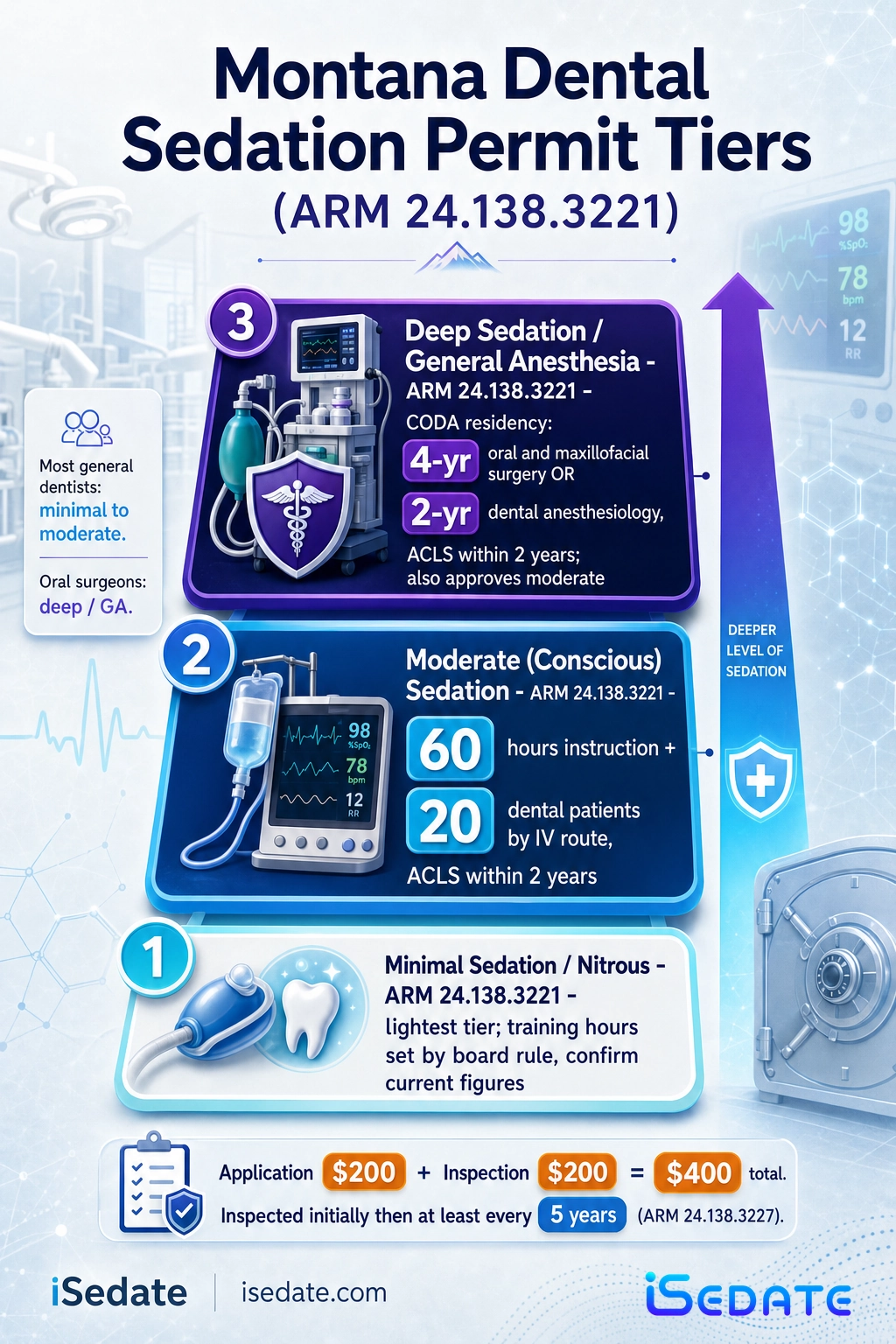
Minimal sedation permit. The entry permit. It authorizes minimal sedation, where the patient responds normally to verbal command and airway and cardiovascular function are unaffected. Nitrous oxide and oxygen inhalation sedation sit in this minimal tier as a separate training track. This is the common starting point for a general practice adding light anxiety control.
Moderate (conscious) sedation permit. Authorizes moderate sedation, widely called Conscious Sedation, where the patient responds purposefully to verbal or tactile stimulation and keeps their own airway. This is the workhorse permit for dentists who provide real sedation, and it brings the full ARM 24.138.3223 monitoring and five-minute recording standard into play.
Deep sedation or general anesthesia permit. The top tier. It authorizes deep sedation and general anesthesia, where the patient is not easily aroused or is unconscious and may need airway support. A distinctive feature of Montana's structure is that qualifying for this permit also approves the holder to provide moderate sedation, so the top credential carries the one below it. A facility operating at this tier must also have at least one additional person dedicated to monitoring vital signs, such as a physician anesthesiologist, a CRNA, or a qualified dentist, under ARM 24.138.3223(4).
iSedate Insight
Match the permit to your real caseload. Most general dentists in Montana operate at the minimal and moderate levels, which is why the moderate permit and its 60-hour, 20-case bar is the one most practices actually chase. The deep sedation and general anesthesia tier is built around surgical residency training, so it is largely the province of oral and maxillofacial surgeons and dentist anesthesiologists, not the typical general practice.
Source: ARM 24.138.3221 (minimum qualifying standards) | Montana Board of Dentistry permit checklist
How to earn each permit: training, ACLS, and fees
Each permit has its own bar to clear, and you move up the ladder by meeting the next tier's requirements and applying to the board. Montana's current permit checklist, updated October 30, 2025, spells out the moderate and deep pathways clearly, so these are no longer a guessing game.
| Permit level | Depth / route | Core training requirement | Resuscitation | Fees |
|---|---|---|---|---|
| Minimal sedation / nitrous | Inhalation, lightest | Formal training tier; hours set by board rule (confirm current figures) | BLS for staff | Per board schedule |
| Moderate (conscious) sedation | Conscious sedation | 60 hours of instruction + management of at least 20 dental patients by IV route | ACLS within 2 years | $200 application + $200 inspection |
| Deep sedation / general anesthesia | Deep sedation / general anesthesia | CODA residency: 4-yr oral & maxillofacial surgery OR 2-yr dental anesthesiology | ACLS within 2 years | $200 application + $200 inspection |
The moderate sedation permit
This is the permit most sedation dentists in Montana are after. Under ARM 24.138.3221 and the board's checklist, you must be a licensed Montana dentist, have formal training in moderate sedation techniques, and clear two concrete bars: a minimum of 60 hours of instruction and documented management of at least 20 dental patients administered sedation by the intravenous route. You submit proof of that training (official transcripts, or a course outline and syllabus if you earned it through continuing education) along with a Patient Log Form attesting to the 20 cases. The log is specific: for each case it records the agents and total doses, start and finish times, the total time of the case, your initials, and the supervising doctor's initials.
The deep sedation and general anesthesia permit
The top tier is built around surgical training rather than a continuing-education hour count. To qualify, a licensed Montana dentist must have completed a residency accredited by the Commission on Dental Accreditation in one of two areas: a four-year oral and maxillofacial surgery program, or a two-year advanced general dentistry education program in dental anesthesiology. You submit proof of that qualifying residency with your application. As noted above, earning this permit also approves you for moderate sedation, so you do not file for both separately.
ACLS, the application, and fees
Both the moderate and the deep permits require that you have completed an advanced course in cardiac life support (ACLS) within two years of the date of your permit application, and the board specifies that web-based courses must include a hands-on lab or megacode portion. That is separate from, and in addition to, the staffing rule that monitoring personnel hold AHA Basic Life Support for Healthcare Providers under ARM 24.138.3223(4).
You apply online through the state's professional licensing portal, and the board notes that paying the fee is what submits your application. Staff then contact you by email, typically within ten business days, with any requests for additional documents. The total fee is $400, made up of a $200 application fee and a $200 inspection fee, paid by credit card or e-check.
One more thing worth knowing before you apply: under changes made by House Bill 584 in 2025, the board issues a temporary permit before your initial inspection, once staff have reviewed your application and confirmed you meet every other requirement. Staff then schedule the inspection with a contracted anesthesia inspector, and you only need to be inspected at one facility even if you plan to provide sedation at several.
Source: Montana Board of Dentistry permit checklist (updated 10/30/25) | Montana dental anesthesia permit application

What the permit requires you to monitor
A permit is permission plus obligation. Once you hold a moderate sedation permit, ARM 24.138.3223 sets the minimum monitoring standards you must meet, watching the patient's physiology continuously and recording it on the clock:
- Oxygenation: oxygen saturation monitored by pulse oximetry, with continuous observation of skin and mucosal color.
- Ventilation: a precordial or pretracheal stethoscope and capnography, which Montana lists in the moderate standard, not only the deep standard.
- Circulation: blood pressure and pulse evaluated, with continuous ECG for patients ASA Class 2 and above.
- The record: all vital signs monitored and recorded at least every five minutes, with pediatric exceptions, and recorded again at completion and before discharge with the associated times.
Deep sedation and general anesthesia add continuous electrocardiac monitoring, an IV line, and end-tidal carbon dioxide for intubated general-anesthesia patients. For the full clinical breakdown of what to monitor and chart at each depth, see the companion guide on Montana sedation vitals monitoring, charting and reporting requirements, and the national overview in our Sedation Dentistry Licensing & Permit Requirements by State hub.
Source: ARM 24.138.3223 (minimum monitoring standards)
Reporting obligations tied to your permit
Holding a permit also means holding a set of documentation and reporting duties, and these are exactly what a board inspection examines.
The anesthetic record. Under ARM 24.138.3223, during moderate and deep sedation, vital signs must be taken and recorded at least every five minutes, then recorded again at the completion of the procedure and before discharge with the associated times. That five-minute interval is tighter than the ten minutes several other states allow.
Incident reporting. Under ARM 24.138.3231, a dentist must submit a written report to the Montana Board of Dentistry within seven days of any incident, any injury causing temporary or permanent disability, or any death involving sedation or anesthesia. Seven days is a short window, and the report you can file is only as good as the contemporaneous record you kept during the case.
Enforcement. Rule violations, including recordkeeping violations found during an inspection, can lead to board disciplinary action. The specific penalty schedule is set by the board and administered case by case, so confirm the current reporting triggers, timelines, and penalties directly with the Montana Board of Dentistry.
Source: ARM 24.138.3231 (incident reporting) and 24.138.3223
Renewal and keeping your permit current
Your sedation permit is tied to your Montana dental license, and both run on the same renewal clock. The dental license and the anesthesia permit expire on March 1, and the board's renewal form lists a $25 anesthesia permit renewal fee, which rises to $50 if filed after March 1.
Montana Permit Renewal At a Glance
- Renewal date: March 1, on the dental license cycle.
- Anesthesia permit renewal fee: $25 ($50 if filed after March 1), per the board's renewal form.
- Resuscitation: ACLS within two years of application for the permit; monitoring personnel hold AHA BLS for Healthcare Providers (ARM 24.138.3223(4)).
- CE hours: set by board rule and updated periodically; confirm your sedation-specific continuing-education requirement with the board.
The exact number of sedation-specific continuing-education hours required each cycle is set by board rule and can change, so it is not reproduced here as a fixed figure. Confirm your current CE requirement and resuscitation documentation with the board so your permit never lapses at renewal.
Source: Montana Board of Dentistry renewal form (anesthesia permit fees)
Inspections and record reviews
This is where a permit is kept or lost, and Montana is unusually structured about it. Under ARM 24.138.3227, every moderate sedation and deep sedation or general anesthesia permit holder is inspected initially and then at intervals not to exceed five years by a board-appointed qualified inspector. The inspection evaluates emergency readiness, equipment, and, critically, the accuracy of your anesthesia record-keeping. These inspection provisions were revised by Montana House Bill 584 in 2025, so the regime you will be measured against is current law.
When an inspector opens your file, they are directed to check the record, not your intentions. A record that is present but thin, a five-minute interval that stretched to eight, a discharge entry with no time attached, is exactly what a record-accuracy review is built to catch. A dentist can have done the sedation correctly and still take a finding on the paperwork.
Source: ARM 24.138.3227 (permit inspections)
Keeping the permit: inspection-ready records
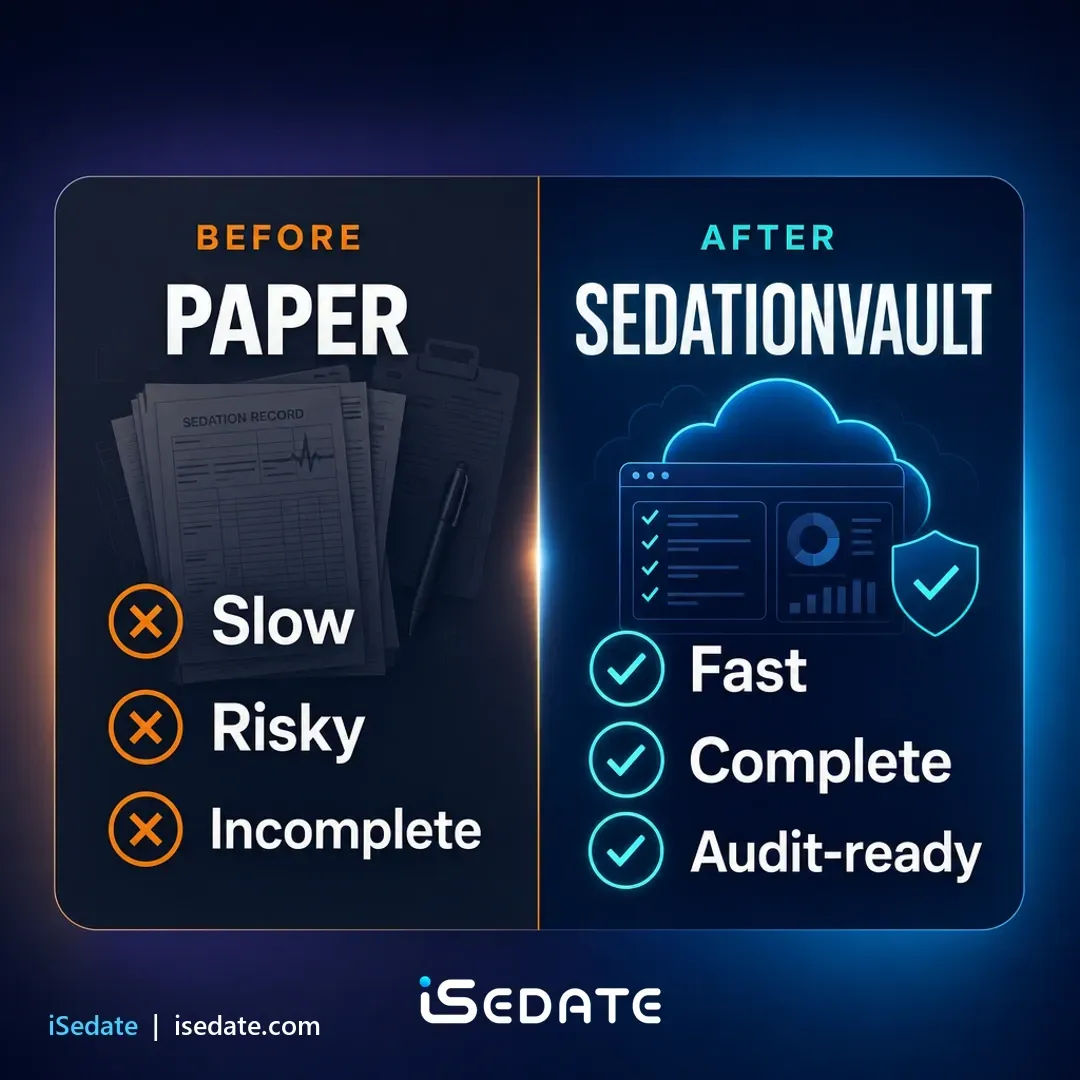
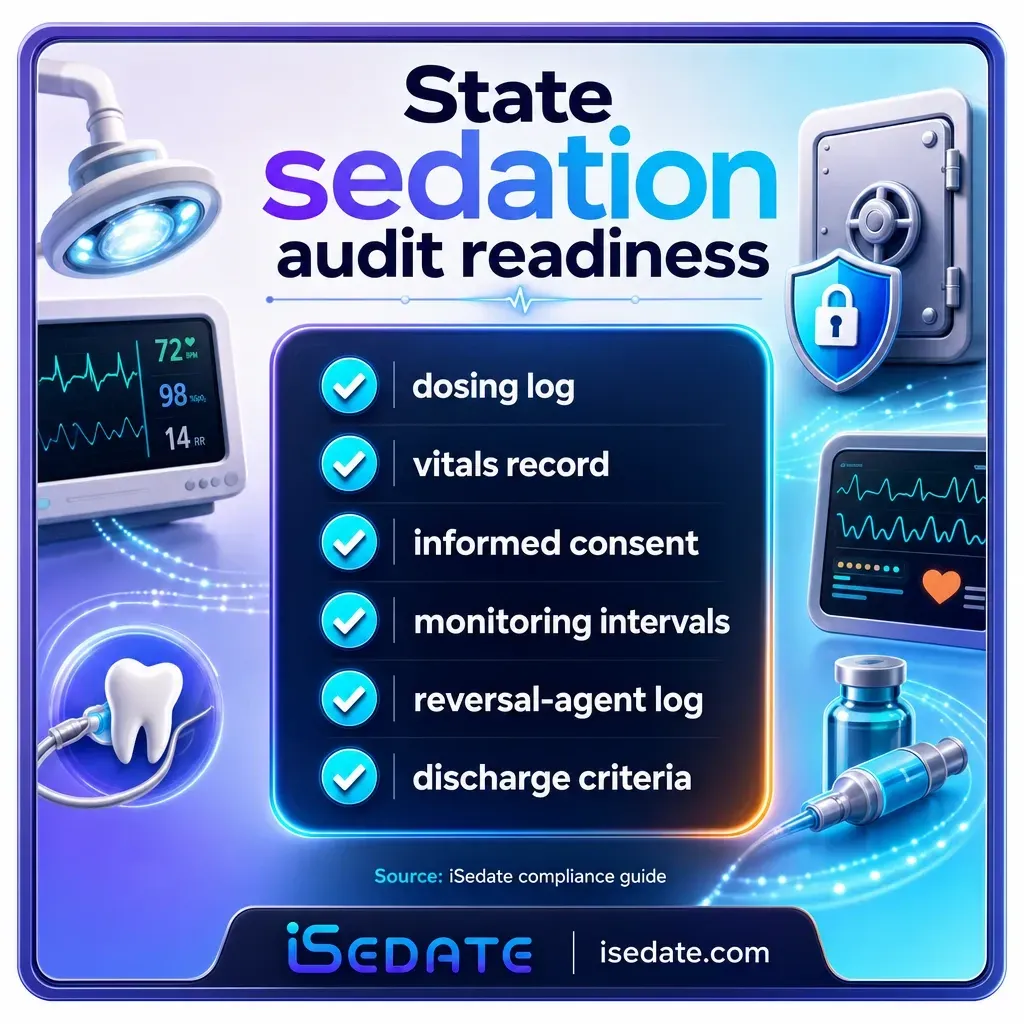
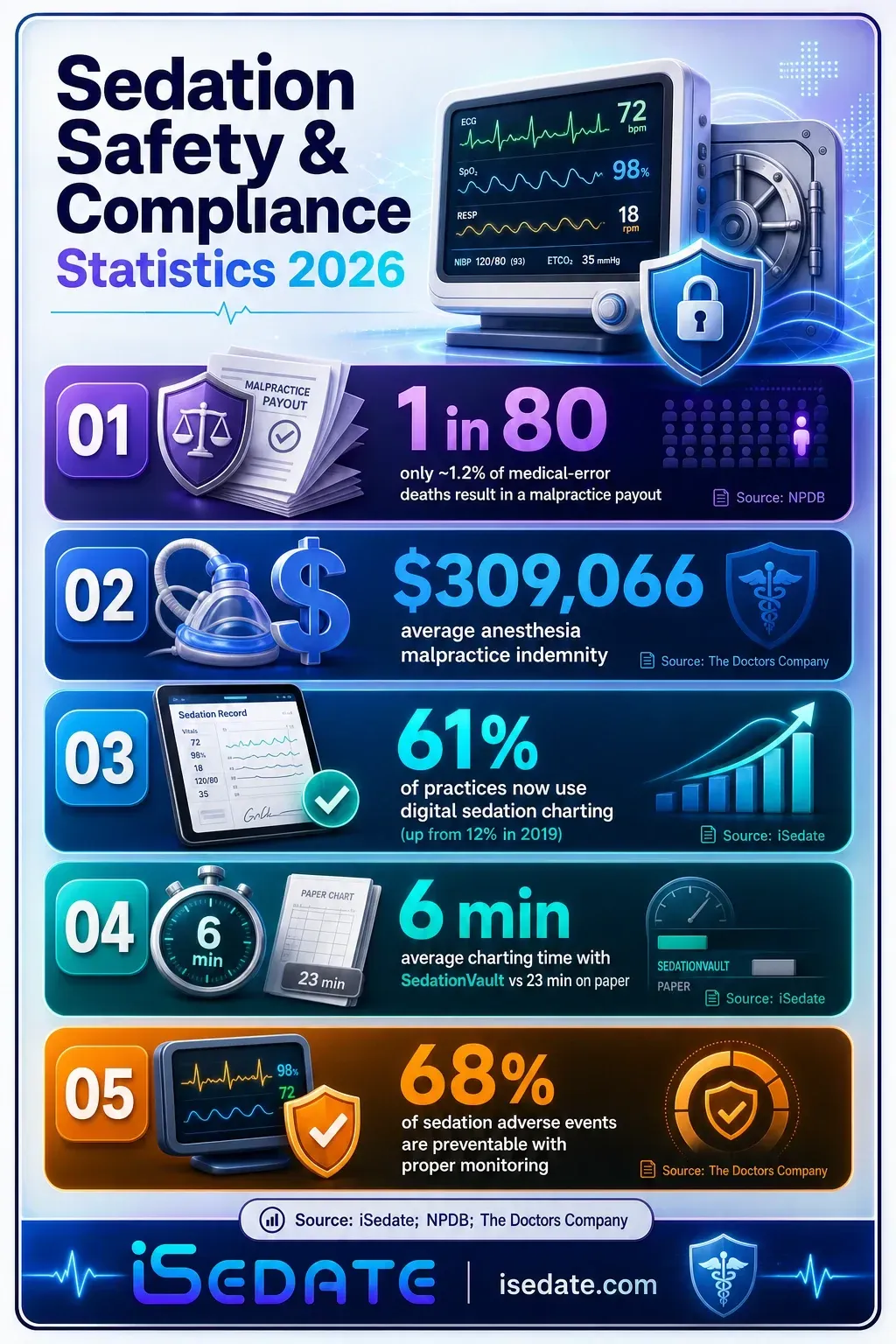
Everything above points to one truth: earning the permit is a one-time hurdle, but keeping it is a daily documentation discipline. A manual vitals log written every five minutes by hand, in between titrating a drug and watching an airway, is exactly where records go incomplete, and incomplete records are what a five-year record-accuracy inspection and a malpractice claim both attack. At Montana's five-minute cadence, that pressure is sharper than in a ten-minute state.
SedationVault removes that failure point. It captures live patient vitals and the drug log automatically into a time-oriented, Montana-compliant anesthetic record, holding the five-minute interval that ARM 24.138.3223 demands and attaching times to the completion and discharge entries, so the record writes itself while you focus on the patient. When the board's inspector asks for the file, a complete record is a one-click export, not a scramble through paper. See how it maps to Montana's rules on the dental sedation compliance and anesthesia record software pages.
Book a demo of SedationVault See SedationVault pricingFrequently asked questions
What sedation permits does Montana offer?
What does a Montana moderate sedation permit require?
What does the Montana deep sedation or general anesthesia permit require?
How much does a Montana dental sedation permit cost?
Do you need a permit for nitrous oxide or minimal sedation in Montana?
How often is a Montana sedation permit inspected?
How often must vitals be recorded during sedation in Montana?
What must a Montana dentist report to the board after a sedation incident?
Licensed in a Neighboring State?
If you practice across the state line, or are adding a second location, see our companion permit guides for the states around Montana, plus the national hub that maps all 50:
- Idaho Sedation Dentistry Licensing & Permit Requirements
- North Dakota Sedation Dentistry Licensing & Permit Requirements
- South Dakota Sedation Dentistry Licensing & Permit Requirements
- Wyoming Sedation Dentistry Licensing & Permit Requirements
- Sedation Dentistry Licensing & Permit Requirements by State (all 50)
Sources & How We Verified This Guide
Every figure on this page was checked against the Montana Board of Dentistry's own current documents and the Administrative Rules of Montana. Where a figure is set by board rule and updated periodically, or where the rule text does not publish a single fixed number, we say so and point you to the board rather than state a number that could go stale.
- Montana Board of Dentistry: Moderate Sedation or Deep Sedation/General Anesthesia Permit Checklist (updated 10/30/25) (requirements, training, ACLS, temporary permit, fees)
- Montana Board of Dentistry anesthesia permit application (fees, patient log, residency pathways)
- Administrative Rules of Montana, Title 24, Chapter 138, Subchapter 32: Anesthesia Rules (24.138.3221, 3223, 3227, 3231)
- Montana Board of Dentistry renewal form (anesthesia permit renewal fees and March 1 cycle)
This guide summarizes Montana sedation permit rules for general information and is not legal advice. The permit levels, the 60-hour and 20-case moderate standard, the CODA residency pathways, the ACLS-within-two-years rule, the $400 application fee and $25 renewal fee, the five-minute recording standard, the five-year inspection interval, and the seven-day incident-reporting deadline are drawn from the board's checklist, application, renewal form, and ARM Chapter 138 as cited. The exact minimal and nitrous training hours, the sedation-specific continuing-education count, and the disciplinary penalty schedule are set by the Montana Board of Dentistry and should be confirmed directly with the board, whose 2025 rulemaking following House Bill 584 may further update these provisions. Requirements are current as of November 2026; verify with the Montana Board of Dentistry before you apply.