







Montana Sedation Vitals Monitoring, Charting & Reporting Requirements
If you administer sedation in Montana, the rule that governs your chart is short, specific, and strict: during moderate sedation and deep sedation or general anesthesia, your patient's vital signs must be taken and recorded at least every five minutes. That standard lives in the Administrative Rules of Montana at ARM 24.138.3223, it is enforced by the Montana Board of Dentistry, and the accuracy of that record is precisely what a board inspector evaluates, on a cycle built into your permit rather than triggered only by a complaint. Montana also tightened its anesthesia inspection provisions through House Bill 584 in 2025, so the scrutiny on these records is current law. This guide breaks down what you must monitor and record at each sedation level, what a compliant Montana sedation record actually looks like, where practices most often fall short, and how to make the chart inspection-ready before the inspector ever arrives.
Recent Updates
Last UpdatedNovember 16, 2026
- Re-verified every rule against Montana's primary sources and replaced the prior aggregator citations with the original official ARM text, the Board of Dentistry's own permit application, and the moderate and deep sedation inspection checklist.
- Confirmed the 2025 House Bill 584 revision to the anesthesia inspection provisions and linked the Board's implementing rulemaking.
- Added a worked "what a compliant Montana sedation record looks like" example, an oral-versus-IV documentation breakdown, and a documentation-and-malpractice context section with a sourced closed-claims figure.
- The core rule: under ARM 24.138.3223, Montana requires vital signs to be taken and recorded at least every five minutes during moderate sedation and deep sedation or general anesthesia, a tighter interval than the ten minutes several states allow.
- Who enforces it: the Montana Board of Dentistry, whose board-appointed inspectors evaluate the accuracy of anesthesia record-keeping under ARM 24.138.3227, initially and at least once every five years.
- The record must capture vitals every five minutes and again at the completion of the procedure and before discharge, each with the associated times, plus the drugs, doses, and times administered.
- Recently updated: Montana House Bill 584 (2025) revised the anesthesia inspection provisions, so the record-review regime is current law.
- Adverse events are reportable: ARM 24.138.3231 requires a written report to the board within seven days of any incident, disabling injury, or death involving sedation.

What This Guide Covers
- Who regulates sedation in Montana
- The Montana sedation permit levels
- What you must monitor at each level
- What you must record: the five-minute rule
- What a compliant Montana sedation record looks like
- How Montana inspects records (and how dentists get burned)
- Why this matters: what a charting gap costs
- Incident reporting and enforcement
- The easy button: an inspection-ready record
- Frequently asked questions
- Sources and citations
Who regulates sedation in Montana
Sedation and anesthesia in a Montana dental office are regulated by the Montana Board of Dentistry, housed in the Department of Labor and Industry's Business Standards Division. The board issues the anesthesia permits, appoints the inspectors who review records, and takes disciplinary action. The rules are not scattered through general dental law. They sit in one place: the Administrative Rules of Montana, Title 24, Chapter 138, Subchapter 32 (Anesthesia Rules), adopted under the authority of Montana Code Annotated 37-4-308.
That matters for compliance, because it means your recordkeeping obligation is a named administrative rule with an exact citation, not a vague standard of care. When an inspector asks whether your sedation record meets the requirement, the answer is measured against the specific rules of Subchapter 32 below.
The ADA Standard vs. Montana Law
It is worth being precise about the American Dental Association here. The ADA publishes national sedation guidelines that most boards lean on, and its 2025 update reinforced the expectation of a time-oriented record of drugs and vital signs. But the ADA is a private professional standard, not a federal agency and not the law. No federal ADA rule overrides Montana. In Montana, the law is ARM Chapter 138, enforced by the Montana Board of Dentistry. The federal layers that do apply sit alongside it, the DEA controlled-substance log for your sedative agents, HIPAA for the record itself, and any accreditation standard your facility opts into. For the clinical "what and why" behind these requirements across every state, see our Dental Sedation Vitals, Charting & Reporting Requirements by State hub.
Source: ARM Chapter 138, Subchapter 32 (Anesthesia Rules)
The Montana sedation permit levels
Montana structures its permits by depth of sedation, and the monitoring and recording duties escalate with each tier. Knowing which permit you hold tells you which rules apply. These are the levels as ARM 24.138.3221 defines them.
| Montana permit | What it covers | Citation |
|---|---|---|
| Minimal sedation | Minimal sedation, including nitrous oxide and oxygen inhalation (a separate training tier) | ARM 24.138.3221; 24.138.3223(3) |
| Moderate sedation | Moderate sedation, commonly called Conscious Sedation | ARM 24.138.3221; 24.138.3223(2) |
| Deep sedation / general anesthesia | Deep sedation or general anesthesia (qualifying also approves moderate sedation) | ARM 24.138.3221; 24.138.3223(1) |
One feature of Montana's structure is worth noting: qualifying for the deep sedation or general anesthesia permit also approves the holder to provide moderate sedation, so the top credential carries the one below it. This guide focuses on the recording standard that applies to moderate sedation and deeper, because that is where ARM 24.138.3223 sets the five-minute duty most explicitly. If you are working out which permit to apply for or how to upgrade, that is a separate process, covered in our guide to Montana Sedation Dentistry Licensing & Permit Requirements.
Source: ARM 24.138.3221 (minimum qualifying standards) | Montana Board of Dentistry anesthesia permit application
What you must monitor at each level
In Montana, what you are required to monitor is what you are required to write down. ARM 24.138.3223 sets the minimum monitoring standards by sedation level, and the recording duty is built into the same rule. The required parameters intensify as the sedation deepens.
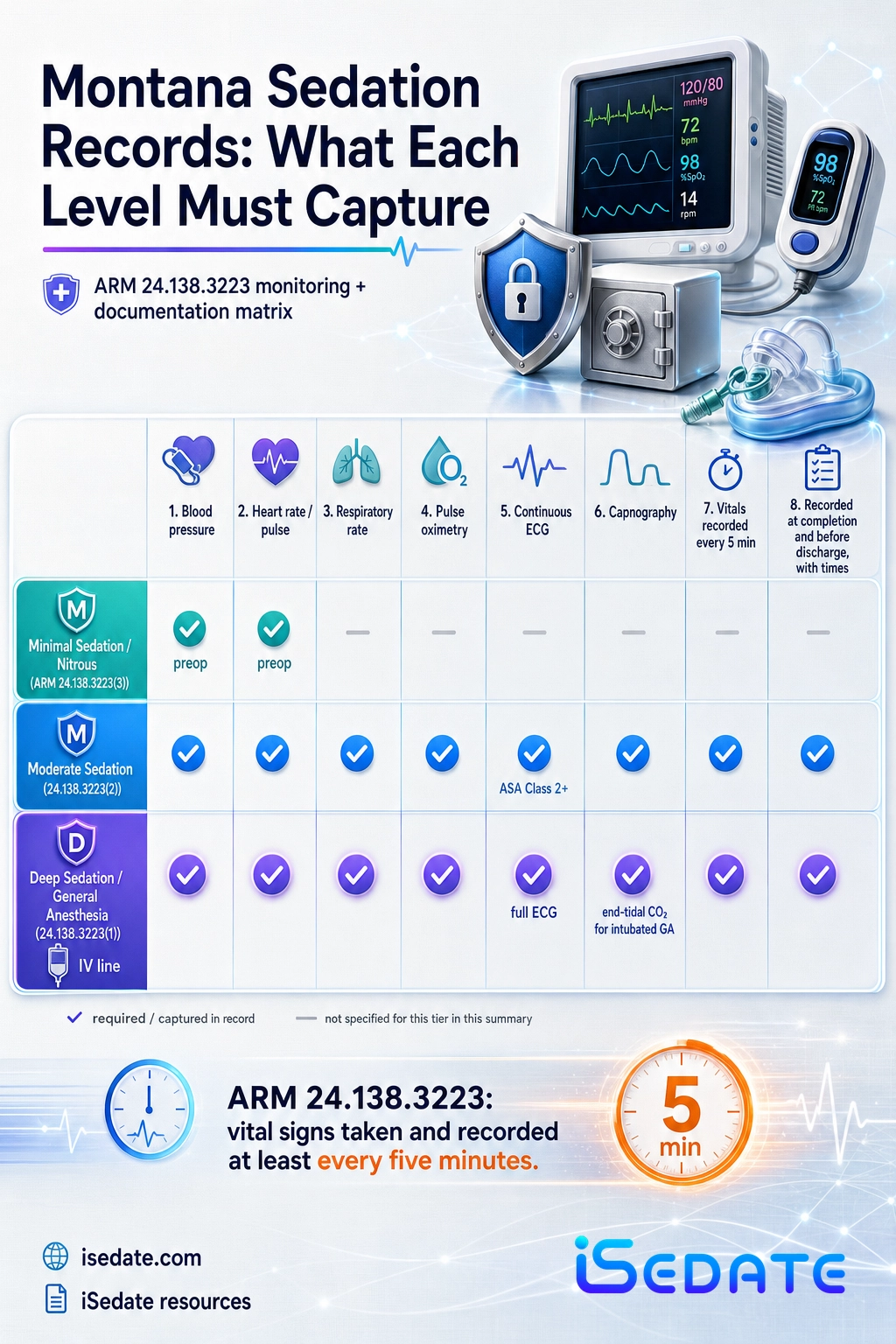
- Minimal sedation (sub (3)): preoperatively, blood pressure and heart rate (for pediatric patients, all vital signs unless the patient cannot tolerate it).
- Moderate sedation (sub (2)): preoperative vital signs (blood pressure, pulse, respiratory rate, and oximetry); continuous ECG for patients ASA Class 2 and above; all vital signs monitored and recorded at least every five minutes, with pediatric exceptions; a precordial or pretracheal stethoscope and capnography; and continuous observation of skin and mucosal color. Postoperative vitals are recorded at completion and prior to discharge.
- Deep sedation / general anesthesia (sub (1)): preoperative vital signs plus electrocardiac monitoring; intraoperatively, vital signs taken and recorded at least every five minutes, a precordial or pretracheal stethoscope and capnography, continuous ECG, an IV line, continuous skin and mucosal color, and end-tidal carbon dioxide for intubated general-anesthesia patients. Postoperative vitals are recorded at completion and prior to discharge with the associated times.
Montana also sets a staffing floor. Under ARM 24.138.3223(4), the facility must be staffed by monitoring personnel holding AHA Basic Life Support for Healthcare Providers, and a deep sedation or general anesthesia facility needs at least one additional person dedicated to monitoring vital signs, such as a physician anesthesiologist, a CRNA, or a qualified dentist.
Myth, Busted
Myth: Capnography is only for general anesthesia, so my moderate cases do not need it.
Fact: Not in Montana. ARM 24.138.3223 lists a precordial or pretracheal stethoscope and capnography inside the moderate sedation standard, not only the deep and general anesthesia standard.
The depth of sedation, not your plan for it, drives the requirement. The moment a patient reaches moderate (Conscious) Sedation, the full sub (2) standard applies, including the five-minute recording interval.
Source: ARM 24.138.3223 (minimum monitoring standards)
What you must record: the five-minute rule
This is the section a Montana inspector reads first. The recording mandate is embedded directly in the monitoring rule, ARM 24.138.3223, and it has two parts worth knowing by heart.
1. Vitals taken and recorded at least every five minutes
For both moderate sedation and deep sedation or general anesthesia, vital signs must be taken and recorded at least every five minutes during the procedure. "Recorded" is the operative word. Monitoring the patient continuously but only writing a reading at the start and end of the case does not satisfy the rule. The documentation itself has to land on the page at least every five minutes, with the time attached to each entry. That five-minute cadence is tighter than the ten-minute interval several other states allow, which makes a hand-kept Montana log one of the harder records to keep complete during a live case.
State Law
2. Vitals recorded at completion and before discharge, with times
The record does not end when the procedure does. ARM 24.138.3223 requires vital signs (blood pressure, pulse, and oximetry) to be recorded at the completion of the procedure and prior to discharge, each with the associated times. That turns discharge into a documented clinical decision rather than a verbal one, and it closes the loop on the time-oriented record: a continuous, time-stamped chain from the preoperative baseline, through the five-minute intraoperative readings, to a recorded completion and a recorded discharge.
Montana's rule does not publish a long separate list of additional record fields beyond these recording duties, so the five-minute recording and the timed completion and discharge entries are the operative requirements. If you see a longer field list attributed to Montana, confirm it against the board's own rule text, because the ARM language above is what an inspector measures against. A specific record-retention period is not stated in Subchapter 32, so apply your general patient-record retention obligation and confirm the current expectation with the Montana Board of Dentistry.
Source: ARM 24.138.3223 (recording duties)
See how a time-oriented anesthesia record is built automaticallyWhat a compliant Montana sedation record looks like
Knowing the rule and passing a review are two different skills. The gap is almost always the same thing: a complete, time-stamped record that proves every requirement was met. Here is what that looks like in practice, broken into the three phases ARM 24.138.3223 governs.
Montana Sedation Record: Required Contents
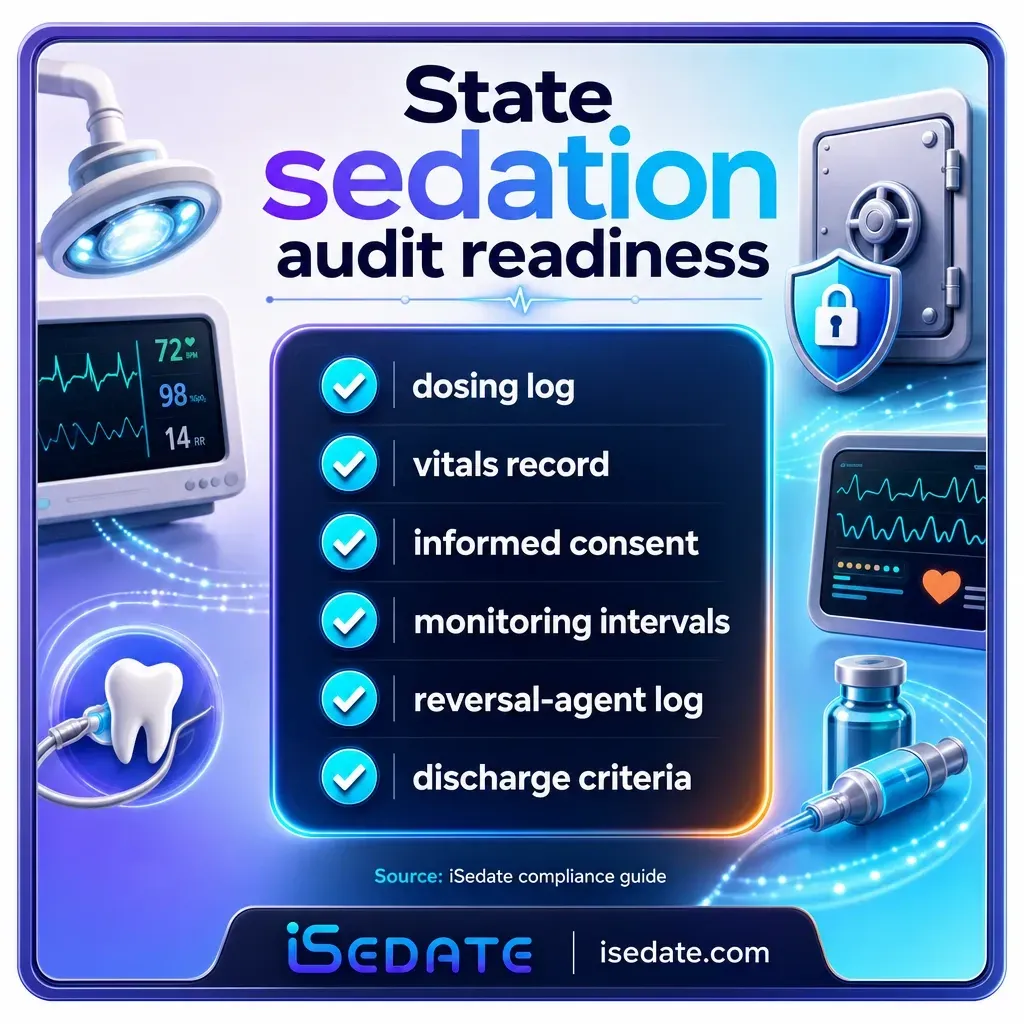
- Pre-op baseline: the vital signs required at your sedation level, taken and recorded before the first agent, plus an ASA classification and the completed informed consent for sedation.
- Drugs, doses, and times: every sedative and local anesthetic agent, the dose, and the exact time it was given, as a running medication log alongside the vitals.
- Intra-op vitals every five minutes: each reading time-stamped, with no gap longer than five minutes from the first agent to the end of the procedure.
- Equipment and monitoring in use: the modalities the rule requires at your level (oximetry, ECG where required, capnography for moderate and deeper), documented as applied.
- Completion and discharge vitals: blood pressure, pulse, and oximetry recorded at the end of the procedure and again before discharge, each with its time, plus the discharge assessment.
A compliant intra-operative log is simply that five-minute cadence rendered as rows. Here is an illustrative moderate-sedation example (sample values, shown only to picture the format an inspector expects to see):
| Time | BP | Pulse | SpO₂ | Resp | EtCO₂ | Note |
|---|---|---|---|---|---|---|
| 1:02 | 124/78 | 72 | 99% | 14 | n/a | Pre-op baseline; consent on file |
| 1:07 | 120/76 | 70 | 99% | 14 | 36 | Midazolam 2 mg IV at 1:06 |
| 1:12 | 118/74 | 68 | 98% | 13 | 37 | Procedure start |
| 1:17 | 116/74 | 69 | 98% | 13 | 37 | Color normal; patient responsive |
| 1:22 | 118/76 | 71 | 99% | 14 | 36 | Stable |
| 1:40 | 122/78 | 72 | 99% | 14 | n/a | Completion vitals; discharge assessment |
Oral versus IV sedation changes the detail, not the cadence. With oral moderate sedation, the medication log is simpler, often a single pre-op dose and time, but the five-minute vitals interval and the timed completion and discharge entries are identical. With IV moderate or deep sedation you add the IV line itself, titrated doses each stamped with their own time, and, for deep and general anesthesia, continuous ECG and end-tidal CO₂ for intubated general-anesthesia patients. The record gets denser as the sedation deepens, but the backbone, a time-stamped reading at least every five minutes, never changes.
Source: ARM 24.138.3223 | Montana moderate and deep sedation permit checklist

How Montana inspects records (and how dentists get burned)
Montana does not leave record review to chance or to a complaint. It builds inspection into the permit itself. Under ARM 24.138.3227, every moderate sedation and deep sedation or general anesthesia permit holder is inspected initially and at intervals not to exceed five years by a board-appointed qualified inspector. That inspection evaluates three things: emergency readiness, equipment, and the accuracy of anesthesia record-keeping.
Read that last item again, because it is the one dentists underestimate. The inspector is not only checking that you own a capnograph and a crash cart. The rule directs them to evaluate the accuracy of your records. A record that is present but thin, a five-minute interval that stretched to eight, a completion or discharge entry with no time attached, is exactly what that accuracy review is built to catch. And these provisions are not stale: Montana House Bill 584 (2025) revised the board's anesthesia inspection authority, and the board opened implementing rulemaking in October 2025, so the regime you will be measured against is current law.
Important
A Montana inspector does not grade your sedation on how the patient did. The rule directs them to evaluate the accuracy of the anesthesia record-keeping. If the time-oriented record has gaps, a missing five-minute reading or an untimed discharge entry, that is a record-accuracy finding on an inspection that happens at least once every five years. The care can be flawless and the record can still fail.
Source: ARM 24.138.3227 (permit inspections) | Board of Dentistry 2025 rulemaking implementing HB 584
Why this matters: what a charting gap costs
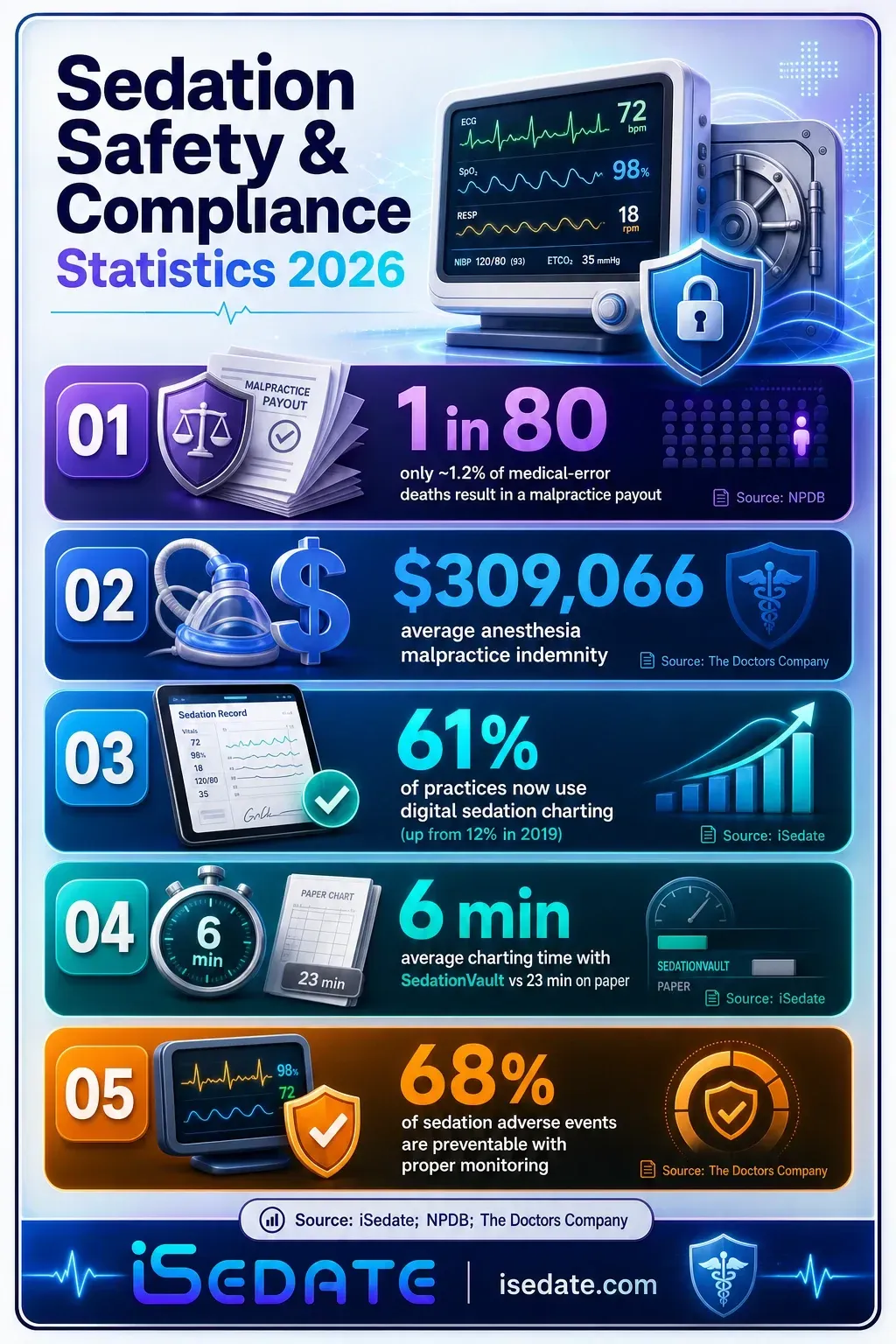
A thin sedation record is not only an inspection problem. It is the first document a plaintiff's attorney and a board investigator reach for, and the same gaps that fail a record-accuracy inspection are the gaps that sink a defense. The point of the five-minute rule is not bureaucracy. It is that the chart is the only contemporaneous proof of what you watched and when.
Closed-Claims Data
State Law
Those two numbers sit on the same table. A seven-day reporting window is short, and the quality of the report you can file depends entirely on the contemporaneous record you kept during the case, which is also the record that, in nearly one in five dental claims, turns out to be where the problem was. For the deeper data behind the rules, these research roundups are the companion reads:
Related Research
Source: The Doctors Company: Patient Safety in Dentistry, Documentation | ARM 24.138.3231
Incident reporting and enforcement
Montana's recordkeeping rules are backed by a hard reporting deadline. Under ARM 24.138.3231, a dentist must submit a written report to the Montana Board of Dentistry within seven days of any incident, any injury causing temporary or permanent disability, or any death involving sedation or anesthesia. Seven days is a short window, and a complete, time-stamped anesthetic record is the document that report is built from.
The board can also take disciplinary action for rule violations, and incomplete sedation records are not a filing technicality. They are the evidence a board weighs when deciding whether the standard of care was met. The exact disciplinary and penalty schedule is administered by the board and can change, so confirm current details directly with the Montana Board of Dentistry rather than relying on a figure that may be out of date. The board's current anesthesia permit application and renewal form carry the current fees and are the authoritative place to check them.
Source: ARM 24.138.3231 (reporting adverse occurrences)
The easy button: an inspection-ready record
The gap between knowing the rule and passing a review is almost always the same thing: a five-minute interval log kept by hand during a live sedation case. When a team is managing an airway and an anxious patient, a vitals reading written every five minutes on paper is exactly where the record develops holes, a skipped interval here, a missing time stamp there, a drug given in the moment and logged later from memory. At a five-minute cadence, that pressure is sharper than in a ten-minute state.
That is the problem SedationVault by iSedate was built to remove. It connects wirelessly to the vitals monitor already in your operatory and captures oxygen saturation, heart rate, respiratory rate, and blood pressure live, on the clock, alongside the drug log, so the time-oriented anesthetic record writes itself as the case runs rather than being reconstructed afterward. The five-minute interval that ARM 24.138.3223 demands is held automatically, and the completion and discharge entries carry their times. When a Montana inspector asks for the chart, it exports as a one-click, inspection-ready sedation visit report that already carries the timed readings, the dosages, and the discharge assessment the rule asks for, whether the case was oral or IV, minimal or deep. The point is not fancier charting. It is turning the exact items ARM 24.138.3223 requires into something the software guarantees are present and time-stamped, which is also what dental sedation compliance turns on.
Book a demo and see your Montana sedation record build itselfNot Legal Advice
This guide summarizes Montana sedation recordkeeping rules for general information and does not constitute legal or compliance advice. Consult a qualified professional, and confirm current requirements with the Montana Board of Dentistry, for guidance specific to your practice.
Frequently asked questions
How often must vitals be recorded during sedation in Montana?
Does Montana require a written sedation record?
Who reviews sedation records in Montana?
Is capnography required for moderate sedation in Montana?
Does Montana require reporting a sedation-related injury or death?
What are the Montana dental sedation permit levels?
Related guides and neighboring states
Licensed in more than one state, or practicing near the Montana line? The documentation rules change at the border. See the same-silo guides for Montana's neighbors, or the full index for every state:
- Idaho Sedation Vitals Monitoring, Charting & Reporting Requirements
- North Dakota Sedation Vitals Monitoring, Charting & Reporting Requirements
- South Dakota Sedation Vitals Monitoring, Charting & Reporting Requirements
- Wyoming Sedation Vitals Monitoring, Charting & Reporting Requirements
- Dental Sedation Vitals, Charting & Reporting Requirements by State (all 50 states)
Sources and citations
Our Sources & Verification
This guide cites Montana's primary regulatory sources. Rule text is drawn from the Administrative Rules of Montana, Title 24, Chapter 138, Subchapter 32 (Anesthesia Rules), as published by the Montana Board of Dentistry, and the regulator is the Montana Board of Dentistry within the Department of Labor and Industry. Every external link was checked to confirm it resolves to the official source. Where a detail is administered by the board and subject to change, it is flagged for direct confirmation rather than stated as fixed.
- ARM Title 24, Chapter 138, Subchapter 32: Anesthesia Rules (official full text, 24.138.3221, 3223, 3227, 3231)
- Montana Board of Dentistry anesthesia permit application
- Montana moderate and deep sedation / general anesthesia permit application checklist
- Montana Board of Dentistry anesthesia permit renewal form
- Board of Dentistry 2025 rulemaking notice implementing House Bill 584
- The Doctors Company: Patient Safety in Dentistry, Documentation (closed-claims data)
Confirm directly with the board: the exact disciplinary and penalty schedule, the precise moderate and deep sedation training hours, live-case counts, and ACLS specifics, continuing-education and recertification cycles, current fee amounts, and any patient-record retention period are set by the Montana Board of Dentistry, are not fixed in Subchapter 32's recording duties, and should be verified before you rely on them. The board's 2025 rulemaking following House Bill 584 may further update the inspection provisions.