







Idaho Sedation Vitals Monitoring, Charting & Reporting Requirements
If you administer sedation in Idaho, the rule is blunt about where the record lives and how long it has to survive: a sedation record kept inside the patient's dental record, owned by the treating dentist, and retained for at least seven years. That obligation sits in IDAPA 24.31.01, the rules of the Idaho State Board of Dentistry, and it is the first thing a board reviewer asks to see. Idaho handles the details differently from states that print an itemized charting interval in their rule text, and getting that distinction right is the whole point of this guide. Below is what Idaho requires you to monitor and record, where the detailed standard actually comes from, what a defensible chart looks like, and how to keep the record audit-ready.
Recent Updates
Last UpdatedNovember 16, 2026
- Re-verified every citation against the current IDAPA 24.31.01, the full rule rewrite effective July 1, 2024.
- Corrected the sedation-permit citation to Section 100.05 (the rule places the permit tiers under Licensure, not under the practice-standards section).
- Clarified that Idaho's rule does not print vital-sign intervals, and that the professional anesthesia-evaluation standard it incorporates by reference is the AAOMS Office Anesthesia Evaluation Manual, not a dental-sedation guideline.
- Added the verified emergency-drug rule (Section 200.10), the minimum anesthesia-site equipment (Section 200.11), the five-year permit renewal with 25 CE hours (Section 100.05.b), and the current sedation-permit fee.
- Replaced homepage links with the Board's own rule and guidance pages.
Key Takeaways
- The core rule: under IDAPA 24.31.01.200.14, the sedation record must be maintained in the patient's dental record and is the treating dentist's responsibility, and Section 200.08 requires a record for every patient, kept at least seven years.
- Who enforces it: the Idaho State Board of Dentistry, within the Division of Occupational and Professional Licenses (DOPL), not the ADA.
- The honest nuance: Idaho's rule text does not print a fixed minute interval. Permit holders must be trained to a level consistent with the requirements established by the Board (Section 100.05.a), and the rule incorporates the AAOMS Office Anesthesia Evaluation Manual by reference.
- The sedation provider monitors the patient until discharge, and the discharge condition belongs in the record (Section 200.14).
- Adverse events are reportable: a death, or a hospital or emergency transport for treatment exceeding 24 hours, must be reported to the Board in writing within seven days (Section 200.15).

Table of Contents
- Who regulates sedation in Idaho
- Idaho's sedation permit levels
- What you must monitor, and where the standard comes from
- What the sedation record must contain
- What compliant documentation looks like
- How Idaho reviews records and reports events
- Why a thin record is the real exposure
- The audit-ready record, handled
- Related guides and neighboring states
- Frequently asked questions
- Our sources and fact-checking
Who regulates sedation in Idaho
Sedation and anesthesia in an Idaho dental office are regulated by the Idaho State Board of Dentistry, which sits within the Division of Occupational and Professional Licenses (DOPL). The Board issues sedation permits, reviews records, and takes disciplinary action. Its rules are gathered in one place: IDAPA 24.31.01, adopted under Idaho Code Title 54, Chapter 9. The current version is not a light edit. It is a full rule rewrite that took effect on July 1, 2024, with every provision tagged "(7-1-24)," so an office working from a pre-2024 printout is working from superseded text.
That matters for compliance because your recordkeeping obligation is a named administrative rule with an exact citation, not a vague standard of care. It is also worth being precise about the ADA. The American Dental Association publishes the national clinical guidelines most sedation training is built around, but the ADA is a professional association, not a government agency. It does not license you, review your records, or discipline you. Idaho's own rule incorporates a professional standard by reference, the AAOMS Office Anesthesia Evaluation Manual, for office anesthesia evaluation, and it ties sedation training to "requirements established by the Board." The law you are held to is IDAPA 24.31.01, and the body that enforces it is the Idaho State Board of Dentistry. For the clinical "what and why" that sits behind every state's version of these duties, see our Dental Sedation Vitals, Charting & Reporting Requirements by State hub.
Source: Idaho State Board of Dentistry, Statutes, Rules and Guidance | IDAPA 24.31.01 (effective 7-1-2024)
Idaho's sedation permit levels
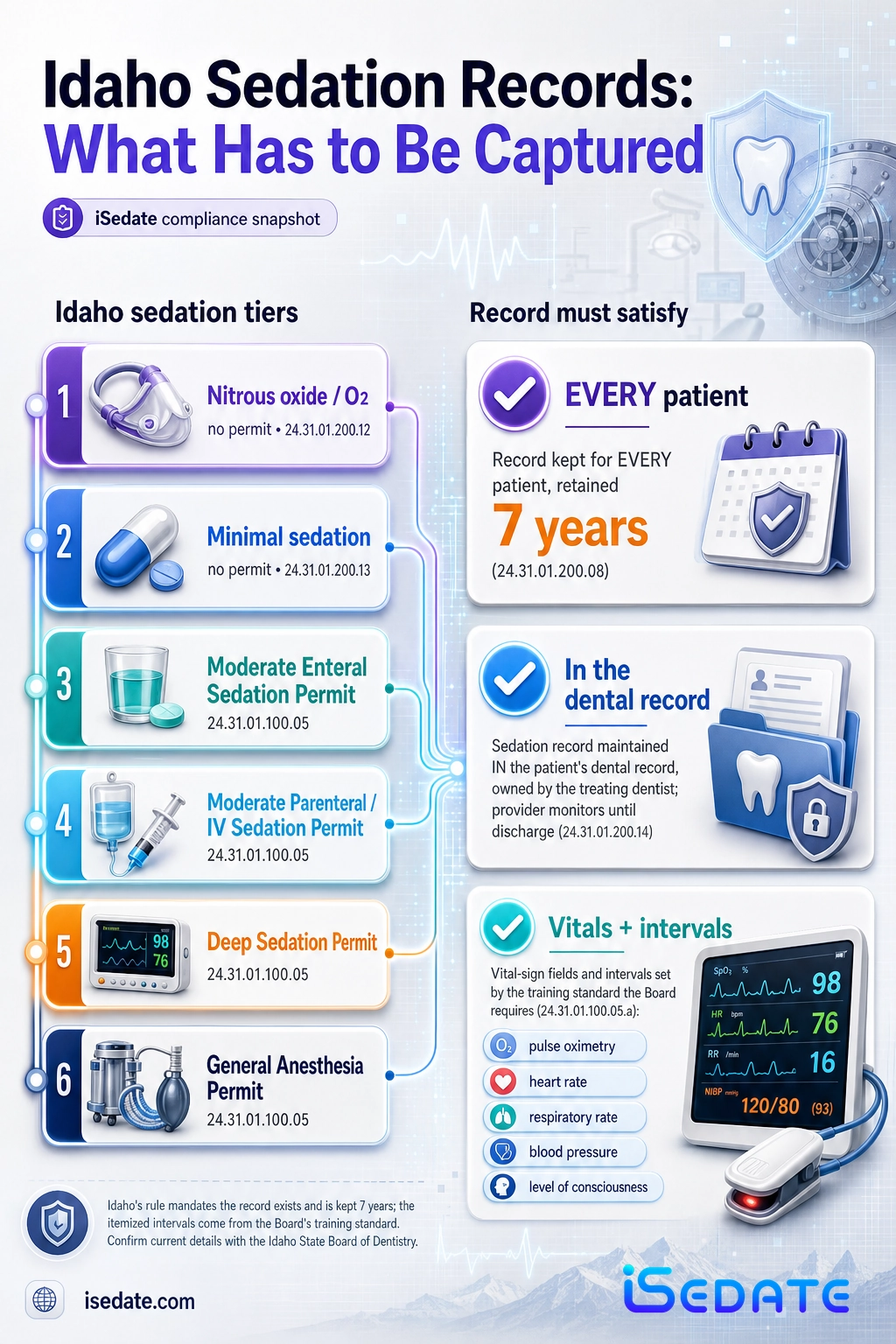
Idaho names its permits by depth and route, and the duties climb with each tier. Which permit you hold tells you which training and monitoring standard applies. These are the levels as IDAPA 24.31.01.100.05 defines them, plus the two no-permit tiers below them:
| Idaho tier | What it covers | Citation |
|---|---|---|
| Nitrous oxide / oxygen | Inhaled nitrous oxide and oxygen; no permit required | IDAPA 24.31.01.200.12 |
| Minimal sedation | A single enteral drug within the FDA maximum for unmonitored home use, patients 16 and older; no permit required | IDAPA 24.31.01.200.13 |
| Moderate Enteral Sedation Permit | Enteral or combined inhalation-enteral routes | IDAPA 24.31.01.100.05 |
| Moderate Parenteral Sedation Permit | Any route, including IV; required to moderately sedate a child under 16 and under 100 lb | IDAPA 24.31.01.100.05 |
| Deep Sedation Permit | Any route | IDAPA 24.31.01.100.05 |
| General Anesthesia Permit | Any route | IDAPA 24.31.01.100.05 |
Nitrous oxide and the narrowest form of minimal sedation do not require a permit in Idaho, though for a patient under 100 pounds or under 16, minimal sedation without a permit is limited to nitrous oxide or a single enteral dose (Section 200.13). Moderate sedation, the level long known as Conscious Sedation, is the floor where a Board permit and the full monitoring and record duties attach, and that is the level most sedation dentists are permitted for. A moderate permit renews every five years and requires at least 25 continuing education hours in sedation (Section 100.05.b). Working out which permit to apply for, or how to upgrade, is its own process, covered in our companion Idaho Sedation Dentistry Licensing & Permit Requirements guide.
Source: IDAPA 24.31.01.100.05, .200.12, .200.13
What you must monitor, and where the standard comes from
Idaho ties what you monitor to a Board-set training standard rather than printing every parameter in the rule text. Under Section 100.05.a, a permit holder must be trained to administer sedation "to a level consistent with requirements established by the Board," and under Section 200.14 the qualified sedation provider "will monitor the patient's condition until the patient is discharged." The practical reading is that monitoring is continuous and provider-attended through the whole case, with the specific parameters defined by the Board's training standard and the professional anesthesia-evaluation manual the rule incorporates by reference.
That standard mirrors the physiological systems every modern sedation guideline watches as depth increases:
- Oxygenation: oxygen saturation by pulse oximetry, continuous at moderate sedation and above.
- Ventilation: chest excursion and ventilation evaluated continually, with end-tidal carbon dioxide added as depth increases.
- Circulation: blood pressure and heart rate taken continually, with continuous ECG expected at deep sedation and general anesthesia.
- Consciousness: the patient's level of sedation assessed continually, because the depth, not the drug, defines the obligation.
Because these exact parameters and intervals live in the Board's training standard rather than in the rule text, confirm the current monitoring requirement directly with the Idaho State Board of Dentistry before relying on any single figure, and never borrow a minute-by-minute interval printed in another state's rule.
Myth, Busted
Myth: Nitrous or a single oral pill is light, so I do not really need to monitor or chart it closely.
Fact: The depth of sedation, not the route or the drug, drives the obligation.
Idaho exempts nitrous and the narrowest minimal sedation from the permit requirement, but the moment a patient reaches moderate sedation the full monitoring and record standard applies, no matter how the drug was delivered. Sedation levels are defined by patient response, and a patient can reach a deeper level than intended, which is exactly why the record has to show what you watched.
Source: IDAPA 24.31.01.100.05 and .200.14
What the sedation record must contain
This is the section a reviewer reads first. Idaho's rule is explicit that the record must exist, where it must live, and how long it must be kept. What it does not do, and this is the honest distinction that catches out-of-state dentists off guard, is print an itemized minute-by-minute charting template in the rule text. Those details flow from the Board's training standard. Here is how the pieces fit together.
A record for every patient, kept seven years
Under Section 200.08, a record must be maintained for each person receiving dental services, regardless of whether any fee is charged, and it is retained for at least seven years from the date of the last entry. The only exceptions are when the patient asks for the records to be transferred to another dentist, when the dentist gives the records to the patient, or when the practice is sold to a dentist who will maintain them. The rule also recognizes standard record formats such as PARQ or SOAP. This is the baseline every entry, sedation included, has to satisfy.
The sedation record lives in the dental record
Under Section 200.14, the sedation record must be maintained in the patient's dental record and is the responsibility of the dentist performing the dental procedures. That is a meaningful allocation of duty: even when a separate qualified provider, such as an anesthesiologist or a CRNA, administers and monitors the sedation, the operating dentist owns the record. The same section requires the sedation provider to monitor the patient's condition until discharge, which means the discharge condition belongs in the record too.
Idaho Law
The itemized fields come from the Board standard
Idaho's rule mandates that the sedation record exists and is kept, but the enumerated contents, the time-oriented drug and dose log and the vital-sign charting, are set by the Board's training standard rather than spelled out in Section 200. A complete sedation record, built to that standard, reads as a time-oriented anesthetic record: every drug, dose, and administration time listed alongside the monitored parameters, with pulse oximetry, heart rate, respiratory rate, blood pressure, and level of consciousness recorded through the case at moderate sedation and above, and the discharge assessment at the end. Because the exact intervals are a Board standard rather than a printed rule, confirm the current requirement with the Idaho State Board of Dentistry instead of assuming a figure borrowed from another state.
Source: IDAPA 24.31.01.200.08 and .200.14
What compliant documentation looks like
Knowing the record must exist is not the same as knowing what a defensible one looks like. The gap between the two is where most review findings live. Here is the concrete shape of an Idaho sedation record that holds up.
Oral sedation and IV sedation are documented the same way, in different depth
The format does not change with the route. An oral moderate case and an IV moderate case both produce a time-oriented record of drugs, doses, times, and monitored vitals. What changes is how much there is to capture: an IV case carries titrated doses given in the moment, so the drug-and-time log is longer and the monitoring is denser, and the deeper the intended plane, the more parameters, such as end-tidal carbon dioxide and continuous ECG, the standard expects you to track and therefore to chart. The record has to reflect the case that actually happened, not the case you planned.
A sample charting cadence
Idaho does not print an interval, so this is an illustration of a defensible rhythm, not a quoted rule. A clean moderate-sedation record typically shows a baseline set of vitals before the first drug, the drug name, dose, route, and time for every agent given, vital signs captured at a steady interval through the procedure and at each change in depth or dose, any airway or rescue intervention with its time, and a final set of vitals with the documented discharge condition and who released the patient. The through-line is simple: a reader should be able to reconstruct the whole case, minute by minute, from the chart alone.
The equipment the record assumes
Idaho's rule does print the hardware that has to be present, and a good record implicitly proves it was. Every site where anesthetic agents are administered must stock a defined set of emergency drugs (Section 200.10), and any office giving local anesthesia must keep suction capable of clearing the airway, a portable positive-pressure oxygen system with full face masks and a bag-valve mask, a properly sized blood pressure cuff, and a stethoscope (Section 200.11). Nitrous offices add a fail-safe delivery system and scavenging (Section 200.12). When a monitoring value or a rescue step appears in your record, it should be consistent with the equipment the rule requires you to have on hand.
Idaho Law
Source: IDAPA 24.31.01.200.10, .200.11, .200.12
See how a time-oriented anesthesia record builds itself
How Idaho reviews records and reports events
Two obligations govern what happens after a sedation case in Idaho: the Board's power to review your records, and your duty to report serious events. Moderate-permit applicants also complete a Board clinical evaluation, where reviewers confirm that the required items were documented, so the record is not only kept, it is read.
On review, the Idaho State Board of Dentistry can examine a permit holder's records, and the integrity of those records is itself a rule. Under Section 300.02, altering a patient's record with intent to deceive is unprofessional conduct. The record you keep contemporaneously is the record the Board expects to see, and reconstructing it later is exactly the exposure the rule guards against.
On reporting, Idaho sets a hard deadline. Under Section 200.15, a dentist must report to the Board in writing, within seven days, any patient death or any transport of a patient to a hospital or emergency center for medical treatment that exceeds 24 hours. That is a specific, verifiable obligation, and it is one of the few sedation timelines Idaho prints directly in its rule text.
Idaho Law
Build the record as the case runs, not from memory afterward. A reviewer does not grade your sedation on how the patient did. They grade it on whether the contemporaneous record, housed in the patient's dental record and retained for seven years, proves what you monitored and when. If the sedation record has gaps, the default assumption on review is that the monitoring had gaps too.
Source: IDAPA 24.31.01.200.15 and .300.02
Why a thin record is the real exposure
IDAPA 24.31.01 is backed by enforcement. Under Section 300.01, the Board may revoke, suspend, or restrict a sedation permit for just cause, and a summary suspension is available when needed to protect the public. Under Section 300.02, the unprofessional-conduct grounds are broad and include record alteration and practicing beyond the scope of a permit. Incomplete or altered sedation records are not a filing technicality. They are the evidence the Board weighs when deciding whether the standard of care was met, and the same gaps that fail a board review are the gaps a plaintiff's attorney looks for in a malpractice claim.
State Fee
The disciplinary schedule, the detail of the Board's monitoring standard, and the current fees are administered by the Board and can change, so confirm current details with the Idaho State Board of Dentistry rather than relying on a figure that may be out of date. What does not change is the exposure created by a thin record: in both a board review and a lawsuit, the contemporaneous sedation record is the first thing requested and the hardest thing to reconstruct after the fact. The research below is the data behind why these rules exist:
The Data Behind These Rules
The requirements on this page are the law. These research roundups explain why they exist and what happens when a practice gets charting wrong:
The audit-ready record, handled
The gap between knowing the rule and passing a review is almost always the same thing: a live vitals log kept by hand during a sedation case. When a team is managing an airway and an anxious patient, a chart filled in from memory after the appointment is exactly where the record develops holes, a skipped reading here, a drug given in the moment and logged later, a discharge that was never written down.
That is the problem SedationVault by iSedate was built to remove. It connects wirelessly to the vitals monitor already in your operatory and captures pulse oximetry, heart rate, respiratory rate, and blood pressure live, on the clock, alongside the drug log, so the time-oriented sedation record writes itself as the case runs rather than being reconstructed afterward. When the Board asks for the chart, it exports as a one-click, audit-ready sedation visit report that already carries the drug and dose log, the monitored vitals, and the discharge assessment, filed to live inside the patient's dental record the way Section 200.14 requires. The point is not fancier charting. It is turning the record Idaho expects into something the software keeps present, contemporaneous, and complete, which is also what dental sedation compliance turns on.
Book a demo and watch your Idaho sedation record build itselfRelated guides and neighboring states
Licensed in more than one state, or practicing near the Idaho line? The documentation duties rhyme from state to state, but the citations and deadlines do not. See the same guide for a neighboring state, or the full map:
- Montana sedation charting and reporting requirements
- Nevada sedation charting and reporting requirements
- Oregon sedation charting and reporting requirements
- Utah sedation charting and reporting requirements
- Washington sedation charting and reporting requirements
- Wyoming sedation charting and reporting requirements
- Our 50-state sedation charting and reporting hub
Frequently asked questions
Does Idaho require a written sedation record?
How long must Idaho dental and sedation records be kept?
Does Idaho law specify a vitals charting interval?
Who enforces sedation records in Idaho?
Does Idaho require an adverse-event report after sedation?
What does the Board actually look at in a sedation record?
Our Sources and Fact-Checking
This guide cites Idaho's primary regulatory sources, verified against the current rule text. The rule is IDAPA 24.31.01, the Rules of the Idaho State Board of Dentistry, in the full rewrite effective July 1, 2024; the regulator is the Idaho State Board of Dentistry within the Division of Occupational and Professional Licenses. Idaho's rule requires that a sedation record be maintained in the patient's dental record (Section 200.14) and retained for seven years (Section 200.08), but it does not enumerate an itemized vital-sign interval in the rule text; permit holders are trained "to a level consistent with requirements established by the Board" (Section 100.05.a), and the rule incorporates the AAOMS Office Anesthesia Evaluation Manual by reference for office anesthesia evaluation (Section 002). The ADA's national guidelines are described as the clinical standard most sedation training follows, not as Idaho law. Where a detail (the exact monitoring intervals, the Board's clinical-evaluation items, or current fees) is administered by the Board or sits in a standard not reproduced in the rule, confirm it directly with the Idaho State Board of Dentistry before relying on it.
- IDAPA 24.31.01: Rules of the Idaho State Board of Dentistry (current, effective 7-1-2024)
- Idaho State Board of Dentistry: Statutes, Rules and Guidance
- Idaho State Board of Dentistry (DOPL): board page and fee schedule
- ADA Guidelines for the Use of Sedation and General Anesthesia by Dentists, referenced as the national clinical standard sedation training is built around, not as Idaho law.