







Wyoming Sedation Vitals Monitoring, Charting & Reporting Requirements
If you administer moderate or deeper sedation in Wyoming, the rule is unusually specific about what has to be written down: a documented anesthesia record of every medication and time, the patient's blood pressure, heart rate, and oxygen saturation recorded at least every five minutes, and a recorded capnograph and EKG. That standard lives in the Wyoming Board of Dental Examiners Rules, Chapter 5, Section 5-6, it is enforced by the board through a sedation facility inspection process, and the record is the first thing an inspector examines. This guide breaks down what Wyoming requires you to monitor and record at each sedation level, what a compliant Wyoming sedation chart actually looks like, and how to keep the record audit-ready.
Recent Updates
Last UpdatedNovember 16, 2026
- Re-verified the Chapter 5, Section 5-6 citations (the five-minute vitals interval, the capnograph, the EKG, and the anesthesia-record fields) against the current rule, amended effective May 29, 2024.
- Replaced the third-party legal aggregator links with the Wyoming Board of Dental Examiners' own dentists and laws-and-rules pages and the state's official administrative rules portal.
- Confirmed the exact permit names and the five-year facility re-inspection against the board's own website, and added a sample five-minute charting cadence, an oral-versus-IV comparison, a required-equipment list, and an audit-preparation section.
- The core rule: Wyoming moderate, deep, and general anesthesia require a documented anesthesia record under Chapter 5, Section 5-6(c), with blood pressure, heart rate, and oxygen saturation recorded at least every five minutes.
- Capnography and EKG are mandatory from the moderate level upward, and both must be used and recorded alongside the five-minute vitals, which is stricter than states that reserve them for deep sedation only.
- The record must capture medications administered, start and end times, parenteral access, IV fluids, ventilation status, response and complications, and the recovery and discharge condition with the permit holder's authorization.
- Who enforces it: the Wyoming Board of Dental Examiners, through a sedation facility inspection process that re-inspects permitted sedation offices every five years.
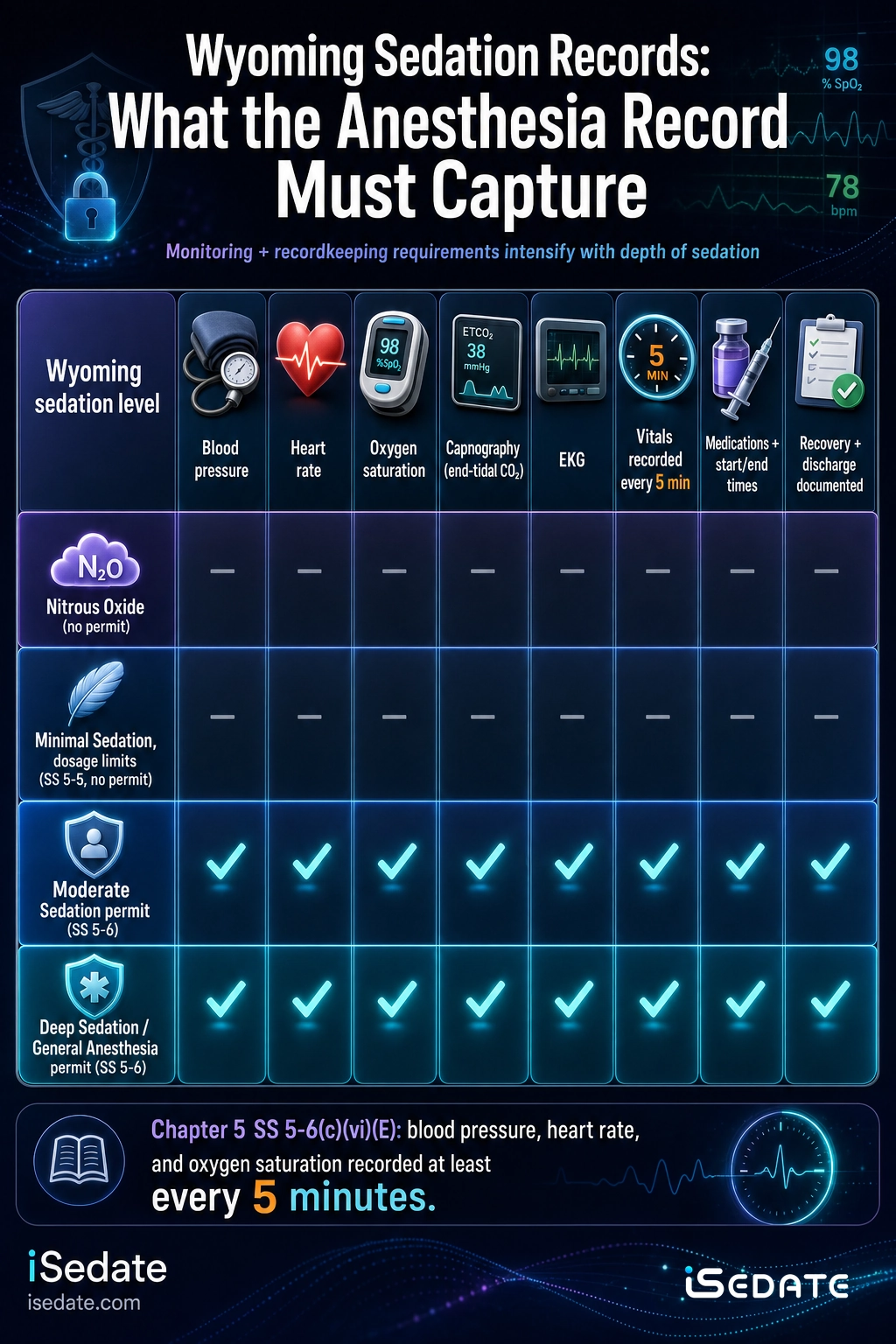
- No permit is needed for nitrous oxide or for minimal sedation within the dosage limits in Section 5-5; the documented monitoring standard begins at the Moderate Sedation Permit (oral and IV Conscious Sedation) and continues through deep sedation and general anesthesia.

What This Guide Covers
- Who regulates sedation records in Wyoming
- The Wyoming sedation permit levels
- What you must monitor at each level
- What your sedation record must contain
- What a compliant Wyoming sedation chart looks like
- How Wyoming reviews records (the facility inspection)
- Why a thin record is the expensive one
- The easy button: an audit-ready record
- Related guides and neighboring states
- Frequently asked questions
- Sources and citations
Who regulates sedation records in Wyoming
Sedation and anesthesia in a Wyoming dental office are regulated by the Wyoming Board of Dental Examiners, the state agency that issues sedation permits, inspects facilities, and takes disciplinary action. The rules are not scattered across general dental law. They sit in one place: the board's administrative rules, Agency 034, Chapter 5, titled "Anesthesia Administration and Sedation Permit Procedures." The monitoring and recordkeeping obligations for moderate and deeper sedation live in Section 5-6.
That matters for compliance because it means your recordkeeping obligation is a named administrative rule with an exact citation, not a vague standard of care. When an inspector asks whether your anesthesia record meets the requirement, the answer is measured against the specific subsections of Chapter 5 below. It is also worth being precise about the role of the ADA here. The American Dental Association publishes national sedation guidelines that most boards lean on, but the ADA is a private national association, not a federal agency. It does not license you, inspect your office, or audit your chart. In Wyoming, the law is Chapter 5, and the body that enforces it is the Wyoming Board of Dental Examiners. The federal layers that do apply sit elsewhere, in DEA controlled-substance recordkeeping and HIPAA, not in an ADA rule that overrides the state. For the clinical reasoning behind these duties across every state, see our Dental Sedation Vitals, Charting & Reporting Requirements by State hub.
Source: Wyoming Board of Dental Examiners: dentists and sedation | Board of Dental Examiners laws and rules
The Wyoming sedation permit levels
Wyoming uses its own structure, and the requirements escalate with the depth of sedation. Knowing which level you work at tells you which monitoring and recordkeeping rules apply. These are the levels as Chapter 5 defines them, with the permit names confirmed against the board's own site:
| Wyoming level | What it covers | Citation |
|---|---|---|
| Nitrous oxide | Inhaled nitrous oxide / oxygen (no permit required) | Chapter 5 |
| Minimal sedation | Minimal sedation, enteral route, within set dosage limits (no permit) | Chapter 5, Section 5-5 |
| Moderate Sedation Permit | Moderate, or Conscious Sedation (oral and IV), with full monitoring and records | Chapter 5, Section 5-6 |
| Deep Sedation / General Anesthesia Permit | Deep sedation or general anesthesia (the top tier) | Chapter 5, Section 5-6 |
Nitrous oxide and minimal sedation within the dosage limits in Section 5-5 do not require a permit in Wyoming. The documented monitoring and recordkeeping standard that this guide focuses on begins at the Moderate Sedation Permit, where oral and IV Conscious Sedation live, and continues up through deep sedation and general anesthesia, all governed by Section 5-6. That is deliberate: Section 5-6 is where Wyoming spells out the five-minute vitals interval, the capnograph, the EKG, and the itemized anesthesia record. Separately, the board requires a Facility Permit for every dental office where sedation is performed, which is what ties your office to the inspection process covered below.
The training bar climbs with the permit. Wyoming's moderate and IV sedation pathway requires sixty hours of didactic instruction and the clinical management of at least twenty live sedation patients, plus ACLS certification, before the Moderate Sedation Permit is issued.
If you are working out which permit to apply for, how to upgrade, or what the training, application, and fees involve, that belongs in a separate process, covered in our guide to Wyoming Sedation Dentistry Licensing & Permit Requirements. Exact permit titles and current fees are set by the board, so confirm them directly with the Wyoming Board of Dental Examiners.
Source: Wyoming Board of Dental Examiners: dentists and sedation | Wyoming sedation training requirements (where to take the required class)
What you must monitor at each level
In Wyoming, what you are required to monitor is what you are required to write down. The two are inseparable: Section 5-6 defines the physiological parameters and the equipment, and the same section requires them to be recorded. For moderate sedation, deep sedation, and general anesthesia, the monitoring load is heavy and specific:
- Oxygenation: oxygen saturation is monitored and recorded at least every five minutes under Section 5-6(c)(vi)(E).
- Circulation: blood pressure and heart rate are monitored and recorded at least every five minutes under Section 5-6(c)(vi)(E), and recorded before and after anesthesia under Section 5-6(c)(vi)(A).
- Ventilation: ventilation status (spontaneous, assisted, or controlled) is recorded under Section 5-6(c)(vi)(H), and a capnograph (end-tidal carbon dioxide monitor) must be used and recorded under Section 5-6(b)(i)(H) and (c)(vi)(G).
- Cardiac rhythm: an EKG must be used and recorded under Section 5-6(b)(i)(I) and (c)(vi)(F).
Before the procedure, Section 5-6(c)(ii) requires that you record an airway assessment, respiratory rate, and temperature. And for deep sedation and general anesthesia, Section 5-6(d)(ii) requires at least one of the two additional dental personnel in the room to be experienced in patient monitoring and documentation. The deeper you go, the more parameters you are both watching and logging.
Myth, Busted
Myth: Capnography and EKG are only required for deep sedation and general anesthesia.
Fact: In Wyoming, that is not how Section 5-6 reads. The capnograph and the EKG are required equipment and recorded parameters for moderate sedation as well as deep sedation and general anesthesia, alongside the five-minute recording of blood pressure, heart rate, and oxygen saturation.
The depth of sedation, not the route or the drug, drives the requirement. The moment a patient reaches moderate sedation, the full Section 5-6 monitoring and recording standard applies, which is stricter than many states that reserve capnography and EKG for deep sedation only.
Source: Wyoming Board of Dental Examiners Rules, Chapter 5, Section 5-6
What your sedation record must contain
This is the section a reviewer reads first. For moderate and deeper sedation, Section 5-6(c) spells out what the anesthesia record must contain, and it has three parts worth knowing by heart.
1. A documented, time-based anesthesia record
Under Section 5-6(c), every administration must be documented in an anesthesia record. It must include the medication or medications administered (5-6(c)(vi)(C)), the time anesthesia commenced and ended (5-6(c)(vi)(D)), the parenteral access site and method if used (5-6(c)(vi)(B)), any IV fluids (5-6(c)(vi)(I)), and the patient's response to anesthesia including any complications (5-6(c)(vi)(J)). The record also carries the surrounding case detail: medical history and age (5-6(c)(i)), ASA classification (5-6(c)(iii)), the procedures performed (5-6(c)(iv)), and informed consent (5-6(c)(v)). A note that a patient "tolerated sedation well" is not this record. A timeline of drugs, times, access, fluids, and response is. Note that Section 5-6(c)(vi)(C) names the "medication(s) administered" and does not separately itemize dosages in that subsection, so follow the exact rule text and your professional standard of care for dose documentation.
2. Vitals recorded at least every five minutes
Under Section 5-6(c)(vi)(E), blood pressure, heart rate, and oxygen saturation must be monitored and recorded at least every five minutes. This is the interval that catches practices out. Monitoring continuously but only writing a reading at the start and end of the case does not satisfy the rule. The documentation itself has to land on the page at least every five minutes, with vitals also recorded before and after anesthesia under Section 5-6(c)(vi)(A).
3. Recovery, discharge, and the capnograph and EKG trace
Recovery has its own documentation duty. Under Section 5-6(c)(vi)(K), the record must capture the starting time of recovery and the time of discharge, and under Section 5-6(c)(vi)(L) it must document the patient's condition at discharge together with the permit holder's authorization. On top of the vitals, the recorded capnograph (5-6(c)(vi)(G)) and EKG (5-6(c)(vi)(F)) are part of that same record, as is the recorded ventilation status (5-6(c)(vi)(H)). The result the rule is after is a single, chronological document that proves, minute by minute, what was given, what was measured, and how the patient was when they left.
Wyoming Anesthesia Record: Required Elements
- Pre-procedure: medical history and age, ASA classification, airway assessment, respiratory rate, temperature, and informed consent (Section 5-6(c)(i)-(v), (c)(ii)).
- Drug log: every medication administered, with the time anesthesia commenced and ended (5-6(c)(vi)(C), (D)).
- Access and fluids: the parenteral access site and method, and any IV fluids, if used (5-6(c)(vi)(B), (I)).
- Vitals timeline: blood pressure, heart rate, and oxygen saturation recorded at least every five minutes, plus before and after anesthesia (5-6(c)(vi)(E), (A)).
- Mandatory traces: the recorded capnograph, EKG, and ventilation status (5-6(c)(vi)(G), (F), (H)).
- Response and discharge: response to anesthesia and complications, the recovery start and discharge times, and the discharge condition with the permit holder's authorization (5-6(c)(vi)(J), (K), (L)).
Source: Wyoming Board of Dental Examiners Rules, Chapter 5, Section 5-6(c)
See how a time-based anesthesia record is built automaticallyWhat a compliant Wyoming sedation chart looks like
Knowing the rule is one thing. Knowing what the page should read like at 10:42 a.m. mid-case is another. A compliant Wyoming sedation record is a running timeline, not a form filled in from memory afterward, and because Section 5-6 fixes a five-minute interval, the readings have to appear on a steady clock. Here is the shape of a moderate (Conscious Sedation) record a reviewer would expect to see, with vitals captured at least every five minutes and every drug time-stamped as it is given.
| Time | SpO2 | HR | BP | EtCO2 | EKG | Sedation / event |
|---|---|---|---|---|---|---|
| 10:30 | 99% | 74 | 128/80 | 38 | NSR | Baseline recorded before anesthesia; monitors applied; consent confirmed |
| 10:34 | 99% | 72 | 126/78 | 37 | NSR | Midazolam given IV; time logged |
| 10:39 | 98% | 70 | 122/76 | 38 | NSR | Patient relaxed, responds to voice; local anesthetic given |
| 10:44 | 98% | 71 | 124/78 | 37 | NSR | Procedure begins; vitals stable |
| 10:49 | 97% | 73 | 126/80 | 39 | NSR | Five-minute reading logged; patient comfortable |
| 10:54 | 98% | 72 | 124/78 | 38 | NSR | Five-minute reading logged; ventilation spontaneous |
| 11:05 | 99% | 72 | 124/78 | 38 | NSR | Procedure complete; recovery begins, time recorded |
| 11:20 | 99% | 74 | 126/80 | - | - | Discharge condition documented; discharged by permit holder to adult escort |
The example above is illustrative, not a clinical protocol, and the drugs and doses are stand-ins for whatever your case actually uses. The point it makes is structural: readings appear at least every five minutes, the capnograph and EKG are on the page alongside them, every drug has a time, and the case closes with a recorded recovery start, discharge time, and discharge condition authorized by the permit holder. That is the difference between a record that proves what happened and one that asks a reviewer to take your word for it.
Oral versus IV: what changes in the record
Both oral and IV Conscious Sedation sit at the moderate level and carry the same Section 5-6 duties, but the record has different pressure points depending on the route.
| Record element | Oral Conscious Sedation | IV (intravenous) sedation |
|---|---|---|
| Drug log | Each dose and the time taken; note any incremental or repeat dosing | Each titrated increment, dose, and time; the parenteral access site and method (5-6(c)(vi)(B)) |
| Onset timing | Slower, less predictable; chart the time to effect | Rapid onset; chart titration against response closely |
| Monitoring and traces | Five-minute vitals, capnograph, and EKG all required | Five-minute vitals, capnograph, and EKG required; IV access allows faster rescue, chart it |
| IV fluids | Usually none; note if an access line is placed | IV fluids recorded if used (5-6(c)(vi)(I)) |
| Discharge entry | Recovery start, discharge time, condition, and permit holder authorization (5-6(c)(vi)(K), (L)) | Recovery start, discharge time, condition, and permit holder authorization (5-6(c)(vi)(K), (L)) |
Equipment the record assumes you have
A defensible record is only possible if the operatory can produce the readings. At moderate sedation and above, Section 5-6 assumes this equipment is present and functioning:
- Pulse oximeter for oxygen saturation recorded at least every five minutes.
- Blood pressure and heart-rate monitoring recorded at least every five minutes and before and after anesthesia.
- Capnograph (end-tidal carbon dioxide monitor), used and recorded (5-6(b)(i)(H), (c)(vi)(G)).
- EKG, used and recorded (5-6(b)(i)(I), (c)(vi)(F)).
- A second trained team member, with one of the two additional personnel experienced in monitoring and documentation for deep sedation and general anesthesia (5-6(d)(ii)).

How Wyoming reviews records (the facility inspection)
Wyoming reviews sedation documentation through a defined facility inspection process, and it is part of the same chapter as the recordkeeping rules. A sedation facility inspector reviews the office's equipment, documentation, and emergency medications against Chapter 5, then submits findings to the board. The inspection is not a one-time hurdle at permitting. According to the board's own guidance, permitted sedation facilities are re-inspected every five years, an initial inspection is performed by two approved inspectors and a reinspection may be done by one, which means your anesthesia records are a standing, reviewable part of holding a sedation permit in Wyoming.
Here is where dentists get burned. The inspection reviews documentation against Section 5-6, so a record missing its five-minute interval, its capnograph or EKG trace, its start and end times, or its discharge authorization is a documentation deficiency even when the clinical care was flawless. It is rarely the sedation that fails a review. It is the record: a stretched interval, a missing time stamp, a required monitor that was used but not recorded.
What Reviewers Actually Grade
A reviewer does not grade your sedation on how the patient did. They grade whether the contemporaneous record proves what you did and when. If the anesthesia record has gaps, the default assumption on review is that the monitoring had gaps too. Record blood pressure, heart rate, and oxygen saturation at least every five minutes, capture the capnograph and EKG, and document recovery start, discharge time, and discharge condition for every case.
The precise disciplinary schedule, the specific penalty amounts, the board's phone number, the continuing-education cycle, and current permit fees are administered by the board and can change, so confirm those details directly with the Wyoming Board of Dental Examiners rather than relying on a figure that may be out of date. What does not change is the exposure created by a thin record.
Source: Wyoming Board of Dental Examiners: sedation facility inspections | Wyoming Administrative Rules, Agency 034 (Board of Dental Examiners)
Why a thin record is the expensive one
A documentation deficiency under Chapter 5 can lead to board discipline, but the inspector is not the only reader of your sedation chart. The same gaps that fail a facility inspection are the gaps a plaintiff's attorney looks for in a malpractice claim. Analyses of closed anesthesia malpractice claims have long found that inadequate monitoring and incomplete documentation are recurring themes in the cases that end badly for the provider, which is why the contemporaneous record matters as much as the clinical care itself.
Incomplete sedation records are not a filing technicality. They are the evidence a board weighs when deciding whether the standard of care was met, and the evidence a jury weighs when deciding whether to believe you. For the underlying data on how documentation drives those outcomes, see our research roundups on how sedation charting affects malpractice case outcomes, vital-signs monitoring and sedation safety, and documentation-error rates and chart defensibility. The through-line is consistent: in both a board review and a lawsuit, the contemporaneous anesthesia record is the first thing requested and the hardest thing to reconstruct after the fact.
The easy button: an audit-ready record
The gap between knowing the rule and passing a review is almost always the same thing: a five-minute interval log kept by hand during a live sedation case, with a capnograph and an EKG trace that also have to make it onto the record. When a team is managing an airway and an anxious patient, a vitals reading written every five minutes on paper is exactly where the record develops holes, a skipped interval here, a missing time stamp there, a drug given in the moment and logged later from memory.
That is the problem SedationVault by iSedate was built to remove. It connects wirelessly to the vitals monitor already in your operatory and captures oxygen saturation, heart rate, and blood pressure live, on the clock, alongside the drug log, so the time-based anesthesia record writes itself as the case runs rather than being reconstructed afterward. The five-minute readings land on their own, the recovery start and discharge entries are prompted for, and nothing the rule names is left to memory at the end of a busy appointment. When the board's inspector asks for the chart, it exports as a one-click, audit-ready sedation visit report that already carries the five-minute vitals, the start and stop times, the medications, and the discharge condition and authorization Section 5-6(c) asks for. The point is not fancier charting. It is turning the exact items Chapter 5 requires into something the software guarantees are present and time-stamped, which is also what dental sedation compliance turns on.
Book a demo and watch your Wyoming sedation record build itselfRelated guides and neighboring states
Sedation recordkeeping rules change at every state line. Licensed in a neighboring state, or practicing across more than one? See our charting and reporting guides for the surrounding states, and the national overview:
- Colorado Sedation Vitals Monitoring, Charting & Reporting Requirements
- Idaho Sedation Vitals Monitoring, Charting & Reporting Requirements
- Montana Sedation Vitals Monitoring, Charting & Reporting Requirements
- Nebraska Sedation Vitals Monitoring, Charting & Reporting Requirements
- South Dakota Sedation Vitals Monitoring, Charting & Reporting Requirements
- Utah Sedation Vitals Monitoring, Charting & Reporting Requirements
- Dental Sedation Vitals, Charting & Reporting Requirements by State (all 50)
Frequently asked questions
Does Wyoming require a written sedation record?
How often must vitals be recorded during sedation in Wyoming?
Does Wyoming require capnography and EKG during sedation?
Who audits sedation records in Wyoming?
What are the Wyoming dental sedation permit levels?
Does a chart note that the patient "tolerated sedation well" meet Wyoming's requirement?
Sources and citations
Our Sourcing and Fact-Checking
This guide cites Wyoming's primary regulatory sources. The monitoring and record obligations come from the Wyoming Board of Dental Examiners Rules, Agency 034, Chapter 5, "Anesthesia Administration and Sedation Permit Procedures," specifically Section 5-6 (moderate, deep, and general anesthesia). The Section 5-6 citations were verified against the current rule, amended effective May 29, 2024. The exact permit names and the five-year facility re-inspection cadence were confirmed against the board's own website. The full current rule text is published by the state on the Wyoming Administrative Rules portal, reachable from the board's laws-and-rules page. Where a detail (the current penalty schedule, the board's phone number, the continuing-education cycle, the latest effective date, exact permit titles, or permit fees) is administered by the board and subject to change, confirm it directly with the board before relying on it.
- Wyoming Board of Dental Examiners: dentists, sedation permits, and facility inspections
- Wyoming Board of Dental Examiners: laws and rules (Dental Practice Act and current filed rules)
- Wyoming Administrative Rules, Agency 034: the state's official rules portal for Chapter 5
- Wyoming sedation training requirements (where to complete the required sedation class)
This content is for informational purposes only and does not constitute legal or compliance advice. Confirm current requirements with the Wyoming Board of Dental Examiners before relying on them for your practice.