







Utah Sedation Vitals Monitoring, Charting & Reporting Requirements
If you sedate patients in Utah, the recordkeeping duty is real, but it is not written the way many states write it. Utah does not publish one itemized statute listing every field your sedation chart must contain. Instead, Utah Administrative Code R156-69 requires you to comply with the national ADA and ASA sedation standards, which call for a time-oriented anesthetic record and continually recorded vital signs, and then adds its own hard duties: record the discharge time and who discharged the patient, and keep the record for at least seven years. Those requirements are enforced by the Utah Division of Professional Licensing, and they are exactly what a reviewer examines first. This guide breaks down what you must monitor and record at each sedation level, what a compliant Utah sedation chart actually looks like, and how to keep the record audit-ready.
Recent Updates
Last UpdatedNovember 16, 2026
- Re-verified every Utah citation (R156-69-301a, R156-69-301b, R156-69-502, and Utah Code 58-1-510) against the current rule and statute.
- Replaced third-party legal aggregator links with the Utah Division of Professional Licensing's own dentistry pages (board, laws and rules, sedation permit, and FAQ).
- Added a sample intra-operative charting cadence, an oral-versus-IV comparison, a required-equipment list, and an audit-preparation section.
- The core structure: Utah adopts the ADA, AAOMS, and ASA sedation standards through R156-69-301a(3)(a), so the time-oriented anesthetic record and continually recorded vitals are the operative standard even though Utah's rule does not itemize them.
- Utah's own hard rules: under R156-69-502 it is unprofessional conduct to fail to record the discharge time and the person who discharged the patient, and to fail to keep the record for at least seven years.
- Direct monitoring mandates: R156-69-301a requires pulse oximetry for moderate (conscious) sedation, and pulse oximetry plus capnography for deep sedation and general anesthesia.
- Who enforces it: the Utah Division of Professional Licensing (DOPL), which administers the Dentist and Dental Hygienist Licensing Board, not the ADA.
- The monitoring plan: Utah Code 58-1-510 requires a described plan to monitor the patient's oxygenation, ventilation, and circulation.

What This Guide Covers
- Who regulates sedation records in Utah
- The Utah sedation permit levels
- What you must monitor at each level
- What your sedation record must contain
- What a compliant Utah sedation chart looks like
- How Utah enforces records and inspects practices
- Why a thin record is the expensive one
- The easy button: an audit-ready record
- Related guides and neighboring states
- Frequently asked questions
- Sources and citations
Who regulates sedation records in Utah
Sedation and anesthesia in a Utah dental office are regulated by the Utah Division of Professional Licensing dentistry program (DOPL), the agency within the Utah Department of Commerce that administers the Dentist and Dental Hygienist Licensing Board. DOPL issues the anesthesia permits, holds the records to account, and takes disciplinary action. The governing rules sit in Utah Administrative Code R156-69, the Dentist and Dental Hygienist Practice Act Rule, under the enabling Dental Practice Act in Title 58, Chapter 69.
Utah's rule leans on the national guidelines in an unusual way, and it is worth being precise about. The American Dental Association publishes sedation guidelines that most boards reference, and those guidelines are a professional standard, not a law on their own. The ADA is a private national association, not a federal agency, so it does not license you or audit your chart. In Utah, though, R156-69-301a(3)(a) requires a permitted dentist to comply with the ADA guidelines, the ADA Sedation and General Anesthesia Policy Statement, the AAOMS standards, and the ASA standards as applicable to the permit level. So those standards carry weight in Utah not because they are federal law, which they are not, but because Utah's own rule tells dentists to follow them. The agency that enforces all of it is DOPL. For the clinical reasoning behind these duties across every state, see our Dental Sedation Vitals, Charting & Reporting Requirements by State hub.
Source: Utah DOPL dentistry program | DOPL dentistry laws and rules
The Utah sedation permit levels
Utah's permit qualifications are set out in R156-69-301b, and the obligations escalate with the depth of sedation. These are the permit levels as that section describes them:
| Utah permit | What it covers | Citation |
|---|---|---|
| Local anesthesia permit | Local anesthesia only | R156-69-301b(2) |
| Minimal sedation permit | Minimal sedation (anxiolysis), including nitrous oxide | R156-69-301b(3) |
| Moderate sedation permit | Moderate, or Conscious Sedation (oral and IV) | R156-69-301b(4) |
| Deep sedation and general anesthesia permit | Deep sedation or general anesthesia (the top tier) | R156-69-301b(5) |
Most general dentists work at the minimal and moderate levels, where oral and IV Conscious Sedation live. The deep sedation and general anesthesia permit is the top tier, carried most often by dental anesthesiologists and oral and maxillofacial surgeons, and it sits under its own monitoring standard. The training bar climbs with the permit: Utah's moderate sedation qualification in R156-69-301b(4) requires comprehensive moderate-sedation training that includes managing a meaningful number of live sedation cases before the permit is granted.
This guide focuses on the moderate and deeper levels, because that is where the monitoring mandates in R156-69-301a are stated directly and where the record obligations carry the most weight. If you are working out which permit to apply for, how to upgrade, or what the training and application involve, that belongs in a separate process, covered in our guide to Utah Sedation Dentistry Licensing & Permit Requirements.
Source: DOPL dentist sedation and general anesthesia permit
What you must monitor at each level
In Utah, two things define what you monitor: the equipment stated directly in the rule, and the broader physiological monitoring the adopted national standards require. R156-69-301a names the equipment, and the ADA and ASA standards, together with the monitoring plan required by statute, fill in the full physiological picture. For moderate (conscious) sedation, the rule is explicit:
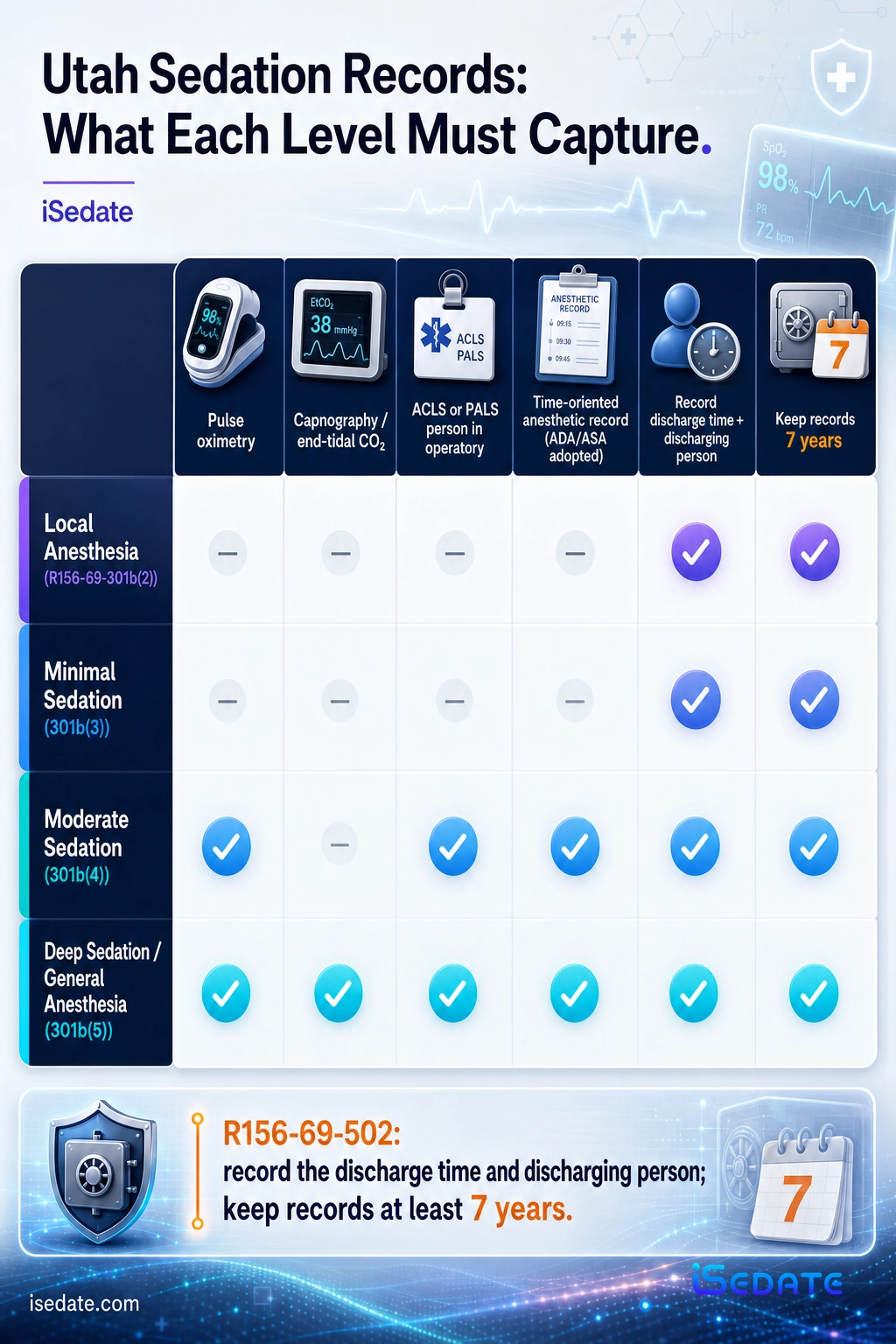
- Pulse oximetry: under R156-69-301a(2)(c)(iii)(A), a dentist providing moderate sedation must use pulse oximetry, so oxygen saturation is measured continuously.
- Trained rescue personnel: under R156-69-301a(2)(c)(iii)(B), at least one individual trained in ACLS, or PALS for pediatric patients, must be present in the operatory during the sedation.
- Oxygenation, ventilation, and circulation: Utah Code 58-1-510 requires a described plan to monitor the patient's oxygenation, ventilation, and circulation, and the adopted ADA and ASA standards require those systems, including heart rate and blood pressure, to be evaluated continually.
- Level of consciousness: the patient's responsiveness is continually assessed under the same adopted standards, because depth of sedation is itself a monitored parameter.
For deep sedation and general anesthesia, the equipment mandate steps up. Under R156-69-301a(2)(d)(iii)(A), the dentist must use pulse oximetry and end-tidal carbon dioxide monitoring with capnography, and under (2)(d)(iii)(B) an ACLS or PALS trained individual must again be present. The adopted ASA standards add continuous electrocardiography at this depth. The deeper you go, the more parameters you are both watching and logging.
Myth, Corrected
Myth: Utah's rule only names pulse oximetry, so a pulse oximeter is all I have to monitor and chart.
Fact: The named equipment is a floor, not a ceiling. Because R156-69-301a(3)(a) requires compliance with the ADA and ASA standards Utah adopts, and Utah Code 58-1-510 requires a monitoring plan for oxygenation, ventilation, and circulation, the full physiological picture, including heart rate, blood pressure, and level of consciousness, applies at moderate sedation and above.
The depth of sedation, not the shortest list in the rule, drives the obligation. A chart that logs only oxygen saturation is thin against the standard a reviewer actually applies.
Source: DOPL sedation and general anesthesia permit requirements | DOPL dentistry laws and rules
What your sedation record must contain
This is the section a reviewer reads first, and in Utah it comes from three places at once rather than one itemized list. Knowing where each piece lives is what keeps the record defensible.
1. A time-oriented anesthetic record, by adoption
Under R156-69-301a(3)(a), a permitted dentist must comply with the ADA guidelines and the ASA standards. For moderate sedation, those standards call for a time-oriented anesthetic record: the names, doses, and administration times of all drugs, including local anesthetics, with pulse oximetry, heart rate, respiratory rate, blood pressure, and level of consciousness recorded continually. "Time-oriented" is the operative idea. The record is organized against the clock, not as a single end-of-visit summary. A note that a patient "tolerated sedation well" is not this record. A timeline of drugs, doses, times, and vitals is. Because Utah reaches this through the adopted standards rather than its own numbered list, the burden is identical even though the citation is different.
2. Vitals recorded continually, with pulse oximetry mandated by rule
Utah's rule itself requires pulse oximetry for moderate sedation and adds capnography for deep sedation and general anesthesia. Unlike some states, Utah does not fix a maximum minute interval in its rule. What it requires, through the adopted ADA and ASA standards, is that vital signs be recorded continually across the case. The practical standard is the one a reviewer applies everywhere: monitoring the patient but only writing a reading at the start and end of the case does not produce a defensible record. The documentation has to track the case as it runs.
3. The discharge record and the retention rule, stated directly
Here Utah is specific, and it is in its own rule, not the adopted standards. Under R156-69-502, it is unprofessional conduct to fail to record the time the patient was discharged and the identity of the person who discharged the patient. The same section makes it unprofessional conduct to fail to maintain the patient's records for a minimum of seven years, and to fail to establish and maintain appropriate dental records. So the two ends of the sedation record that Utah spells out by name are the discharge entry and the retention period.
Utah Sedation Record: Required Elements
- Pre-sedation: health history, ASA physical status, airway assessment, baseline vitals, NPO status, and informed consent for the sedation.
- Drug log: every drug given, including local anesthetics and reversal agents, with its dose, route, and the exact time of administration.
- Vitals timeline: pulse oximetry, heart rate, respiratory rate, and blood pressure recorded continually through the case, plus capnography for deep sedation and general anesthesia.
- Level of consciousness: the patient's responsiveness logged across the case, not just at the start.
- Discharge entry: the discharge time and the name of the person who discharged the patient, plus the discharge assessment (R156-69-502).
- Retention: the complete record kept for at least seven years (R156-69-502).
Source: DOPL dentistry laws and rules (R156-69-301a, R156-69-502)
See how a time-oriented anesthesia record is built automaticallyWhat a compliant Utah sedation chart looks like
Knowing the rule is one thing. Knowing what the page should read like at 10:42 a.m. mid-case is another. A compliant Utah sedation record is a running timeline, not a form filled in from memory afterward. Here is the shape of a moderate (conscious) sedation record a reviewer would expect to see, with vitals captured at a steady cadence and every drug time-stamped as it is given.
| Time | SpO2 | HR | BP | RR | Sedation / event |
|---|---|---|---|---|---|
| 10:30 | 99% | 74 | 128/80 | 16 | Baseline recorded; monitors applied; consent confirmed |
| 10:34 | 99% | 72 | 126/78 | 15 | Midazolam 2 mg IV given |
| 10:39 | 98% | 70 | 122/76 | 14 | Patient relaxed, responds to voice; local anesthetic given |
| 10:44 | 98% | 71 | 124/78 | 14 | Procedure begins; vitals stable |
| 10:49 | 97% | 73 | 126/80 | 15 | Vitals logged; patient comfortable |
| 11:05 | 99% | 72 | 124/78 | 16 | Procedure complete; recovery begins |
| 11:20 | 99% | 74 | 126/80 | 16 | Discharge criteria met; discharged by Dr. Coleman to adult escort |
The example above is illustrative, not a clinical protocol. The point it makes is structural: readings appear at a regular rhythm, every drug has a dose and a time, and the case closes with a named discharge entry. That is the difference between a record that proves what happened and one that asks a reviewer to take your word for it.
Oral versus IV: what changes in the record
Both oral and IV Conscious Sedation sit at the moderate level and share the same core duties, but the record has different pressure points depending on the route.
| Record element | Oral Conscious Sedation | IV (intravenous) sedation |
|---|---|---|
| Drug log | Each dose and the time taken; note any incremental or repeat dosing | Each titrated increment, dose, and time; IV start time and site |
| Onset timing | Slower, less predictable; chart the time to effect | Rapid onset; chart titration against response closely |
| Monitoring | Pulse oximetry required; full physiological monitoring per adopted standards | Pulse oximetry required; IV access allows faster rescue, chart it |
| Reversal readiness | Reversal agents available and charted if used | Reversal agents and IV fluids available and charted if used |
| Discharge entry | Time, discharging person, discharge assessment (R156-69-502) | Time, discharging person, discharge assessment (R156-69-502) |
Equipment the record assumes you have
A defensible record is only possible if the operatory can produce the readings. At moderate sedation and above, Utah's rule and the standards it adopts assume this equipment is present and functioning:
- Pulse oximeter for continuous oxygen saturation (required by rule at moderate sedation and above).
- Capnograph for end-tidal carbon dioxide at deep sedation and general anesthesia (required by rule at that depth).
- Blood pressure and heart-rate monitoring to evaluate circulation continually under the adopted standards.
- Supplemental oxygen and a positive-pressure delivery system for airway support.
- Emergency drugs and reversal agents, with an ACLS or PALS trained individual in the operatory.

How Utah enforces records and inspects practices
The agency that reviews your sedation records in Utah is the Utah Division of Professional Licensing. Violating the monitoring and permit rules in R156-69-301a or R156-69-301b is itself unprofessional conduct, and the record failures named in R156-69-502, a missing discharge time, an unnamed discharging person, records not kept for seven years, or records that are simply not appropriate, are each grounds for discipline. In Utah, the record is not a filing detail. It is the thing the rule sanctions you for getting wrong.
The soft-cite structure is exactly where Utah dentists get caught. Because the detailed "what to record" list lives in the adopted ADA and ASA standards rather than in a single Utah paragraph, it is easy to assume Utah asks for less than it does. It does not. A reviewer measures your record against the standards the rule adopts and against the discharge and retention duties the rule names. The care can be flawless and the record can still fail if the time-oriented chart has gaps or the discharge entry is missing.
What Reviewers Actually Grade
A reviewer does not grade your sedation on how the patient did. They grade whether the contemporaneous record proves what you did and when, and whether the discharge time and discharging person are on the page. If the time-oriented record has gaps, the default assumption on review is that the monitoring had gaps too. Record every drug, dose, and time, and close the case with a documented discharge.
The precise disciplinary schedule, any routine office-inspection cadence for permit holders, the continuing-education cycle, and current permit fees are administered by DOPL and can change, so confirm those details directly with the division rather than relying on a figure that may be out of date. What does not change is the exposure created by a thin record: in both a licensing review and a lawsuit, the contemporaneous sedation record is the first thing requested and the hardest thing to reconstruct after the fact. You can check current requirements and open questions on the DOPL dentistry FAQ.
Source: DOPL dentistry laws and rules (R156-69-502) | DOPL dentistry FAQ
Why a thin record is the expensive one
An unprofessional-conduct finding under R156-69-502 can lead to license action and other discipline, but the licensing board is not the only reader of your sedation chart. The same gaps that fail a DOPL review are the gaps a plaintiff's attorney looks for in a malpractice claim. Analyses of closed anesthesia malpractice claims have long found that inadequate monitoring and incomplete documentation are recurring themes in the cases that end badly for the provider, which is why the contemporaneous record matters as much as the clinical care itself.
Incomplete sedation records are not a technicality. They are the evidence a board weighs when deciding whether the standard of care was met, and the evidence a jury weighs when deciding whether to believe you. For the underlying data on how documentation drives those outcomes, see our research roundups on how sedation charting affects malpractice case outcomes, vital-signs monitoring and sedation safety, and documentation-error rates and chart defensibility. The through-line is consistent: the practices that document continually are the ones that survive a review or a claim intact.
The easy button: an audit-ready record
The gap between knowing the rule and passing a review is almost always the same thing: a continual vitals log kept by hand during a live sedation case, plus a discharge entry that is easy to forget at the end of a busy appointment. When a team is managing an airway and an anxious patient, a record kept on paper is exactly where holes develop, a skipped reading here, a drug given in the moment and logged later from memory, a discharge time that never made it onto the page.
That is the problem SedationVault by iSedate was built to remove. It connects wirelessly to the vitals monitor already in your operatory and captures pulse oximetry, heart rate, respiratory rate, and blood pressure live, on the clock, alongside the drug log, so the time-oriented anesthetic record the adopted ADA and ASA standards call for writes itself as the case runs rather than being reconstructed afterward. It prompts for and captures the discharge time and the discharging person that R156-69-502 names. When DOPL or a plaintiff's attorney asks for the chart, it exports as a one-click, audit-ready sedation visit report that already carries the doses, the times, the vitals, and the discharge assessment, and it is retained well past the seven-year minimum. The point is not fancier charting. It is turning the exact items Utah's rule and the standards it adopts require into something the software guarantees are present and time-stamped, which is also what dental sedation compliance turns on.
Book a demo and watch your Utah sedation record build itselfRelated guides and neighboring states
Sedation recordkeeping rules change at every state line. Licensed in a neighboring state, or practicing across more than one? See our charting and reporting guides for the surrounding states, and the national overview:
- Arizona Sedation Vitals Monitoring, Charting & Reporting Requirements
- Colorado Sedation Vitals Monitoring, Charting & Reporting Requirements
- Idaho Sedation Vitals Monitoring, Charting & Reporting Requirements
- Nevada Sedation Vitals Monitoring, Charting & Reporting Requirements
- Wyoming Sedation Vitals Monitoring, Charting & Reporting Requirements
- Dental Sedation Vitals, Charting & Reporting Requirements by State (all 50)
Frequently asked questions
Does Utah require a written sedation record?
How often must vitals be recorded during sedation in Utah?
Who audits sedation records in Utah?
How long must Utah dentists keep sedation records?
What are the Utah dental sedation permit levels?
Does a chart note that the patient "tolerated sedation well" meet Utah's requirement?
Sources and citations
Our Sourcing and Fact-Checking
This guide cites Utah's primary regulatory sources. The record obligations come from Utah Administrative Code R156-69 (the Dentist and Dental Hygienist Practice Act Rule), specifically R156-69-301a, R156-69-301b, and R156-69-502, together with the monitoring-plan requirement in Utah Code 58-1-510. Because R156-69-301a(3)(a) requires compliance with the ADA and ASA sedation standards, the detailed "what to record" list lives in those adopted standards by design rather than in an itemized Utah paragraph. Rule and statute citations below are accessed through the Utah Division of Professional Licensing's own dentistry pages; the full current rule text is published by the Utah Office of Administrative Rules and the statute by the Utah Legislature, and both can be reached from DOPL's laws-and-rules page. Where a detail (the current penalty schedule, inspection cadence, continuing-education cycle, or permit fees) is administered by DOPL and subject to change, confirm it directly with the division before relying on it.
- Utah Division of Professional Licensing: Dentistry program and board
- DOPL Dentistry Laws and Rules (access to R156-69 and the Dental Practice Act, Title 58 Chapter 69)
- DOPL dentist minimal, moderate, deep sedation and general anesthesia permit
- DOPL Dentistry frequently asked questions
- Utah dentist anesthesia and training verification form (DOPL)
- DOCS Education Utah sedation courses (where to complete the required sedation training)
This content is for informational purposes only and does not constitute legal or compliance advice. Confirm current requirements with the Utah Division of Professional Licensing before relying on them for your practice.















