







Arizona Sedation Vitals Monitoring, Charting & Reporting Requirements
If you administer general anesthesia or deep sedation in Arizona, the law is specific about what has to be written down: a procedure-specific anesthesia record that captures electrocardiograph, pulse oximetry, and blood pressure readings before, during, and after the case, every drug with its dose and timing, and a documented discharge. That requirement lives in Arizona Administrative Code R4-11-1301(E), it was last amended effective September 12, 2022, and it is enforced by the Arizona State Board of Dental Examiners through an on-site evaluation that looks straight at your records. This guide breaks down what Arizona requires you to monitor and record at each sedation level, what a compliant chart actually looks like, where dentists most often fall short, and how to make the record audit-ready.
Recent Updates
Last UpdatedNovember 16, 2026
- Replaced third-party legal aggregators with the Arizona State Board of Dental Examiners' own rules, applications, and evaluation guidance as the primary sources.
- Added current, sourced malpractice-cost figures for sedation claims (CNA 2025 and The Doctors Company) to the section on why documentation matters.
- Expanded the practical guidance: a sample time-oriented record, the oral-versus-IV documentation differences, record retention, and how to prepare for an on-site evaluation.
Key Takeaways
- The core rule: Arizona general anesthesia and deep sedation require an itemized anesthesia record under A.A.C. R4-11-1301(E), covering ECG, pulse oximetry, and blood pressure pre-operatively, intra-operatively, and post-operatively, plus every medication with dose, time, route, and site.
- Who enforces it: the Arizona State Board of Dental Examiners, through an on-site evaluation under R4-11-1301(D) that reviews your equipment, controlled-substance logs, and patient records.
- It is current law: R4-11-1301 was amended effective September 12, 2022, and the Board has had the permit rules under active review since, so verify the current text before you rely on it.
- Each level keeps its own record: oral sedation (R4-11-1303) and parenteral or moderate sedation (R4-11-1302) each require a sedation record for every procedure.
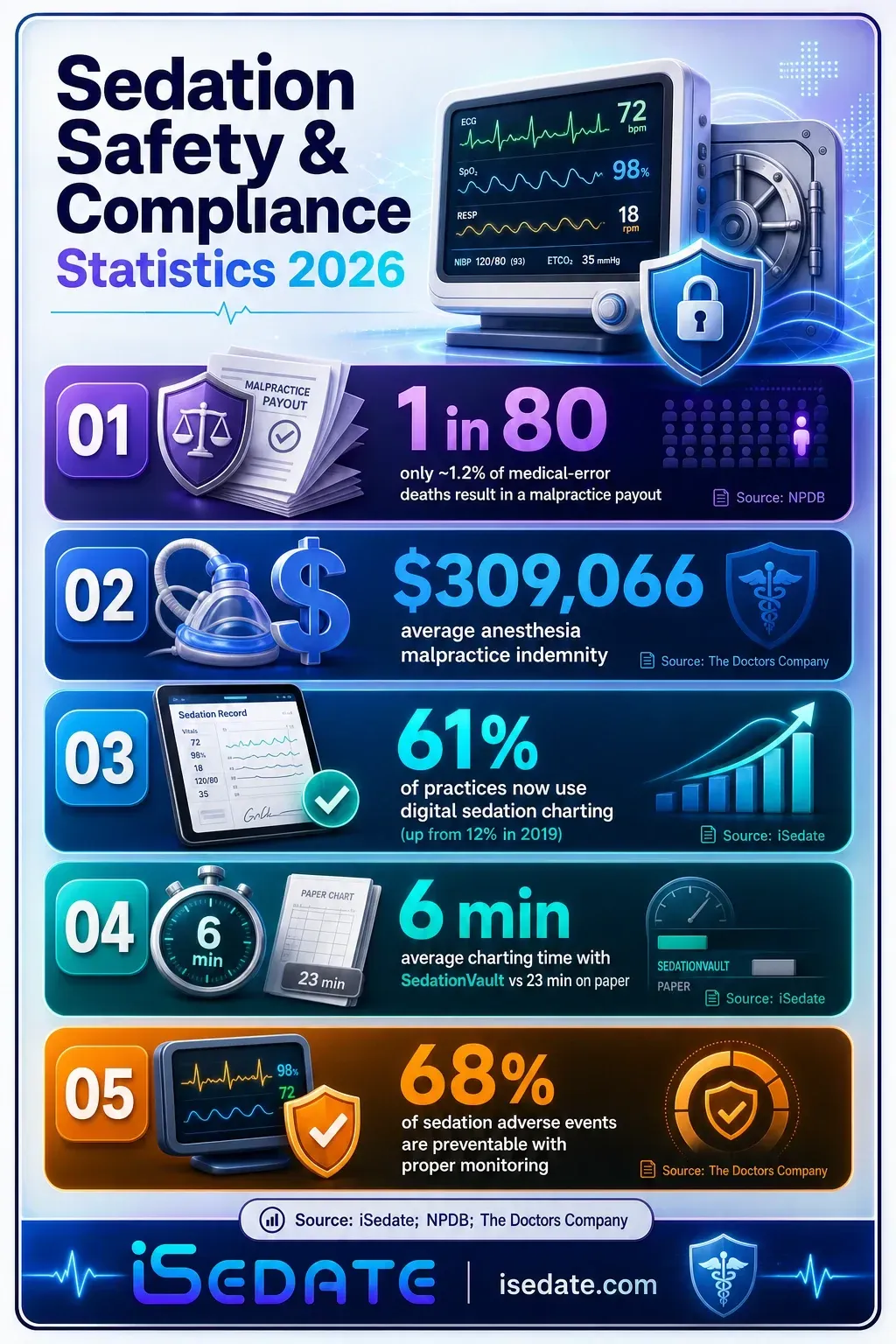
- The money reason: dental claims involving procedural sedation average $248,821 in total incurred cost, and the contemporaneous record is the first document anyone requests.

What This Guide Covers
- Who regulates sedation in Arizona
- The Arizona sedation permit levels
- What you must monitor at each level
- What you must record: the compliance core
- What a compliant record actually looks like
- How Arizona audits records (and how dentists get burned)
- Why a thin record gets expensive
- Penalties and adverse-event reporting
- Retention and audit preparation
- The audit-ready record
- Frequently asked questions
- Sources and citations
Who regulates sedation in Arizona
Sedation and anesthesia in an Arizona dental office are regulated by the Arizona State Board of Dental Examiners, the state agency that issues anesthesia and sedation permits, evaluates offices on site, and takes disciplinary action. The rules are not scattered across general dental law. They sit in one place: the Arizona Administrative Code, Title 4, Chapter 11, Article 13, "General Anesthesia and Sedation," under statutory authority in A.R.S. Title 32, Chapter 11.
That matters for compliance because your recordkeeping obligation is a named administrative rule with an exact citation, not a vague standard of care. When an evaluator asks whether your anesthesia record meets the requirement, the answer is measured against the specific subsections of Article 13 below.
Myth, Corrected
Myth: "The ADA sets federal sedation law, so following the ADA guidelines is all the documentation rule I need to worry about."
Fact: The American Dental Association is a private professional body, not a federal agency, and its sedation and anesthesia guidelines are a national standard, not law.
In Arizona the binding rule is Article 13, enforced by the State Board of Dental Examiners. The real federal layers that sit on top of it are the DEA's controlled-substance recordkeeping for the drugs you log and HIPAA for the protected health information in the chart, not an "ADA statute."
The Arizona sedation permit levels
Arizona uses its own permit structure, numbered by the section of the code that governs each one, and the requirements escalate with the depth of sedation. Knowing which permit you hold tells you which monitoring and recordkeeping rules apply. These are the levels as Article 13 defines them, from lightest to deepest:
| Arizona permit | What it covers | Citation |
|---|---|---|
| Nitrous oxide (no permit) | Nitrous oxide / oxygen inhalation analgesia | Standard of care |
| Section 1303 Permit | Oral sedation | A.A.C. R4-11-1303 |
| Section 1302 Permit | Parenteral (IV) and moderate (conscious) sedation | A.A.C. R4-11-1302 |
| Section 1301 Permit | General anesthesia and deep sedation | A.A.C. R4-11-1301 |
| Section 1304 Permit | Records for physician-anesthesiologist or CRNA-provided anesthesia | A.A.C. R4-11-1304 |
Nitrous oxide alone does not require a sedation permit in Arizona and is handled under the standard of care. The permits begin at Section 1303 for oral sedation, move up to Section 1302 for parenteral and moderate sedation, the level most clinicians still call Conscious Sedation, which includes the IV route, and reach their top tier at Section 1301 for general anesthesia and deep sedation. A separate Section 1304 permit governs the records a dentist must keep when a physician-anesthesiologist or a CRNA provides the anesthesia in the dental office.
This guide centers on the general anesthesia and deep sedation record under R4-11-1301, because that is the level whose record contents Arizona spells out most explicitly. If you are working out which permit to apply for or how to upgrade, that is a separate process, covered in our guide to Arizona Sedation Dentistry Licensing & Permit Requirements. For how the documentation rules compare across every state, see the hub: Dental Sedation Vitals, Charting & Reporting Requirements by State.
Source: Arizona State Board of Dental Examiners anesthesia and sedation permit applications
What you must monitor at each level
In Arizona, what you are required to monitor is what you are required to write down. The two are inseparable: the equipment and supervision standard in R4-11-1301 defines the physiological parameters, and the recordkeeping rule in R4-11-1301(E) requires them to be documented. For general anesthesia and deep sedation, the permit holder must have specific monitoring equipment present and in use, and must supervise the patient without interruption. The required equipment under R4-11-1301(B) includes:
- An electrocardiograph monitor for continuous cardiac tracing.
- A pulse oximeter for oxygen saturation.
- A blood pressure monitoring device and a stethoscope.
- A cardiac defibrillator or AED and supplemental oxygen.
Two supervision rules sit on top of the equipment list. The permit holder must continuously supervise the patient from the initiation of anesthesia or deep sedation until its termination, and until oxygenation, ventilation, and circulation are stable. Supplemental oxygen is used for the entire procedure. The rule does not reduce this to a single number of minutes between readings; instead it ties the obligation to the patient, requiring continuous supervision and documentation across the pre-operative, intra-operative, and post-operative phases.
Myth, Busted
Myth: "Arizona doesn't name a 10-minute interval, so a reading at the start and the end is enough."
Fact: R4-11-1301 requires continuous supervision until the patient is stable and a record documenting ECG, pulse oximetry, and vital signs across all three phases of the case, with every medication logged against its time intervals.
A two-line record cannot show continuous supervision. The absence of a fixed minute-count is not permission to chart less; it is a direction to chart the whole timeline.
For oral sedation under R4-11-1303 and parenteral or moderate sedation under R4-11-1302, each level requires its own sedation record for every procedure. The specific monitoring-equipment and record-entry lists for those two sections are set within R4-11-1302 and R4-11-1303 themselves, so confirm the exact items for your permit level directly in those sections and with the Board.
What you must record: the compliance core
This is the section an evaluator reads first. For general anesthesia and deep sedation, A.A.C. R4-11-1301(E) spells out exactly what the anesthesia record must contain, and it is an itemized list, not a general instruction to keep good notes.
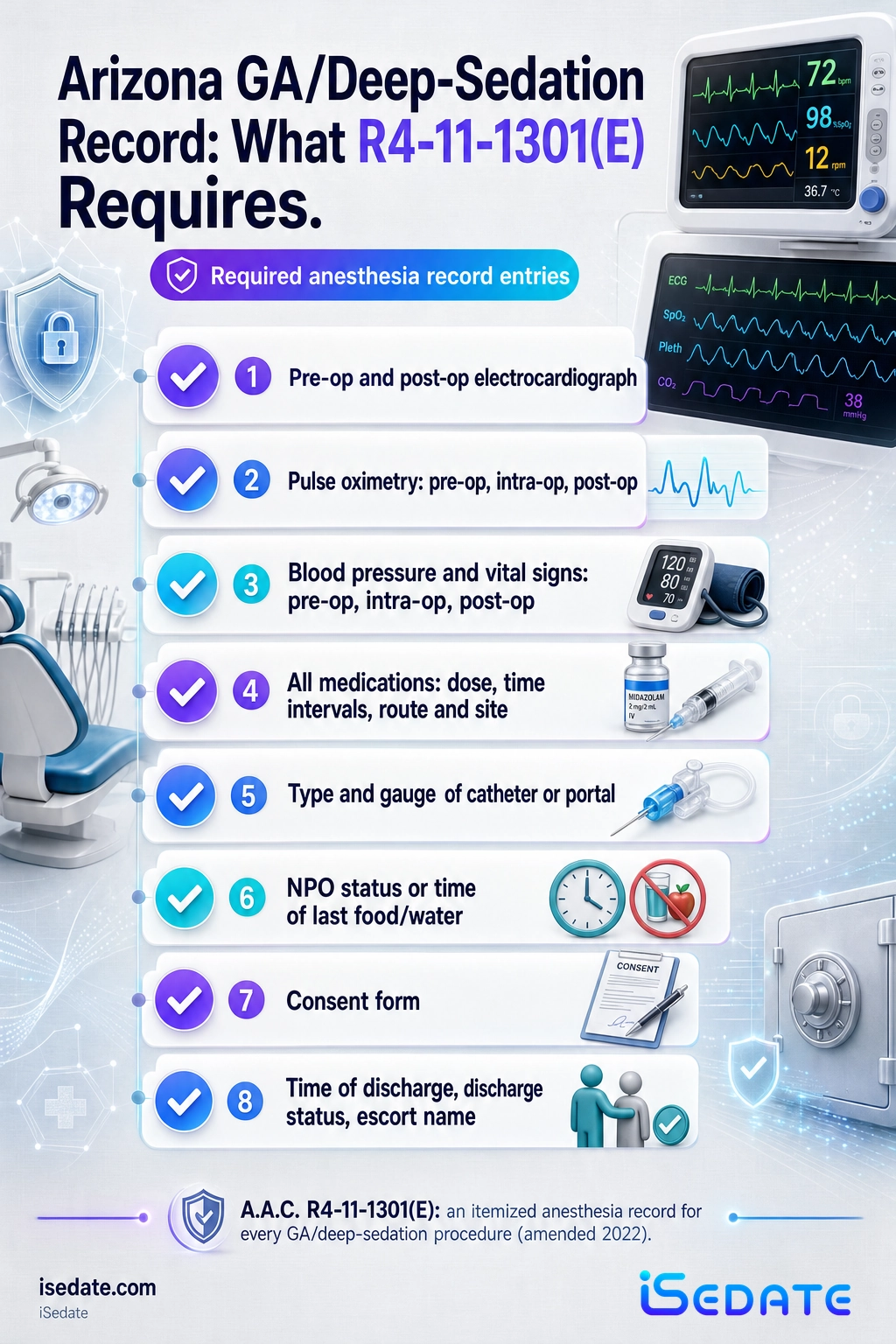
The itemized anesthesia record
Under R4-11-1301(E), the permit holder must keep an anesthesia record for each procedure that documents all eight of the following:
| # | Required entry |
|---|---|
| 1 | Pre-operative and post-operative electrocardiograph documentation |
| 2 | Pre-operative, intra-operative, and post-operative pulse oximeter readings |
| 3 | Pre-operative, intra-operative, and post-operative blood pressure and vital signs |
| 4 | All medications given, with dosage, time intervals, and route and site of administration |
| 5 | Type and gauge of catheter or portal |
| 6 | Whether the patient was NPO, or the time of last food or water intake |
| 7 | The consent form |
| 8 | Time of discharge, discharge status, and name of the escort |
A time-oriented drug and vitals timeline
The heart of that list is the combination of entries 2, 3, and 4. Pulse oximetry and blood pressure and vital signs are required at three phases, and every medication must carry its dosage, its time intervals, and its route and site. Read together, these entries describe a record organized against the clock. A note that a patient "tolerated general anesthesia well" is not this record. A timeline of readings and drugs, each stamped with its time, is.
The pre-op and discharge bookends
The record does not start when the first drug is pushed and it does not end when the patient wakes. Entry 6 requires the NPO status or the time of last intake, captured before the case. Entry 7 requires the consent form. Entry 8 requires the time of discharge, the discharge status, and the name of the escort who takes the patient home. Those bookends are where incomplete records most often show their gaps, because they happen at the busiest moments, intake and turnover, when a hand-written log is easiest to shortcut.
Source: Arizona State Board of Dental Examiners statutes and rules
What a compliant record actually looks like
Knowing the eight required entries is one thing. Knowing what a passing chart looks like on the page is what keeps you out of trouble. A compliant general-anesthesia record reads as a time-stamped timeline, not a paragraph. Arizona does not fix a minute interval, but the national standard the rule mirrors, the ADA's guidelines, calls for a continually recorded, time-oriented record: in practice, vital signs entered at regular short intervals, commonly every five minutes for moderate sedation and continuously for deep sedation and general anesthesia, with each drug stamped at the moment it is given.
Here is a simplified, illustrative example of how the intra-operative portion of that timeline should read. The exact cadence and values are examples only, not an Arizona-mandated interval:
| Time | HR | SpO2 | BP | Drug / dose / route |
|---|---|---|---|---|
| 9:02 (baseline) | 74 | 99% | 126/78 | Pre-op vitals recorded |
| 9:10 | 72 | 99% | 122/76 | Induction agent, IV, left antecubital |
| 9:15 | 70 | 98% | 118/74 | Reading logged |
| 9:20 | 71 | 98% | 120/75 | Maintenance dose, IV |
| 9:25 | 73 | 99% | 124/77 | Reading logged |
| 9:40 (recovery) | 76 | 99% | 128/80 | Post-op vitals, airway stable |
iSedate Charting Advice
Record the "no change" readings too. The gaps in a timeline are read as unmonitored minutes, not as uneventful ones. A row that shows the vitals were stable is evidence of supervision; a blank stretch is the thing an evaluator or a plaintiff's expert circles.
Oral versus IV documentation. The parameters you capture scale with the route and depth. An oral-sedation record under R4-11-1303 still documents baseline and periodic vitals, the agent and dose with times, and recovery and discharge, but it does not carry the IV-specific entries that R4-11-1301(E) adds for deeper levels: the type and gauge of catheter or portal, and the continuous ECG tracing. An IV or general-anesthesia record carries all of it, including the entry 5 catheter detail that an oral-sedation chart has no reason to hold. Match the record to the permit level you are working under, and when you move a patient deeper than planned, the record moves to the deeper standard with them.
See how a time-oriented anesthesia record is built automatically
How Arizona audits records (and how dentists get burned)
Arizona does something many states do not: it sends dentists on site to look at the office before and after a permit is issued. Under A.A.C. R4-11-1301(D), an applicant for a general anesthesia and deep sedation permit schedules an on-site evaluation at which the office administers anesthesia under observation. An initial evaluation is conducted by two Board-member or designee dentists; a renewal evaluation is conducted by one. The evaluators look at the equipment, the personnel, and the way the patient is administered to, and they ask oral emergency and medication questions. Critically, they also review the controlled-substance logs and the patient records, and at renewal they review competency records.
Here is where dentists get burned. The evaluation does not grade your sedation on how the patient did. It grades the office on whether the record and the logs prove what the equipment, the drugs, and the monitoring actually were. A missing time stamp, a medication given but not logged against its interval, a discharge that was never documented, a controlled-substance log that does not reconcile: each of these is visible on paper to an evaluator standing in your operatory. An evaluation can result in a Pass, a Conditional Approval, or a Category 1, 2, or 3 Failure, with a re-evaluation required after 30, 60, or 90 days depending on the category.
An evaluator does not reconstruct your intentions. They read the contemporaneous record and the logs in front of them. If the anesthesia record has gaps, the default assumption is that the monitoring had gaps too, and a Category Failure sends you back for re-evaluation in 30 to 90 days. Document every phase, every drug with its time interval, and every discharge, and keep the controlled-substance log reconciled.
The Board has published its own account of what routinely goes wrong in these evaluations, which is worth reading before yours. Source: Arizona State Board of Dental Examiners, Common Pitfalls in the anesthesia and sedation evaluation
Why a thin record gets expensive
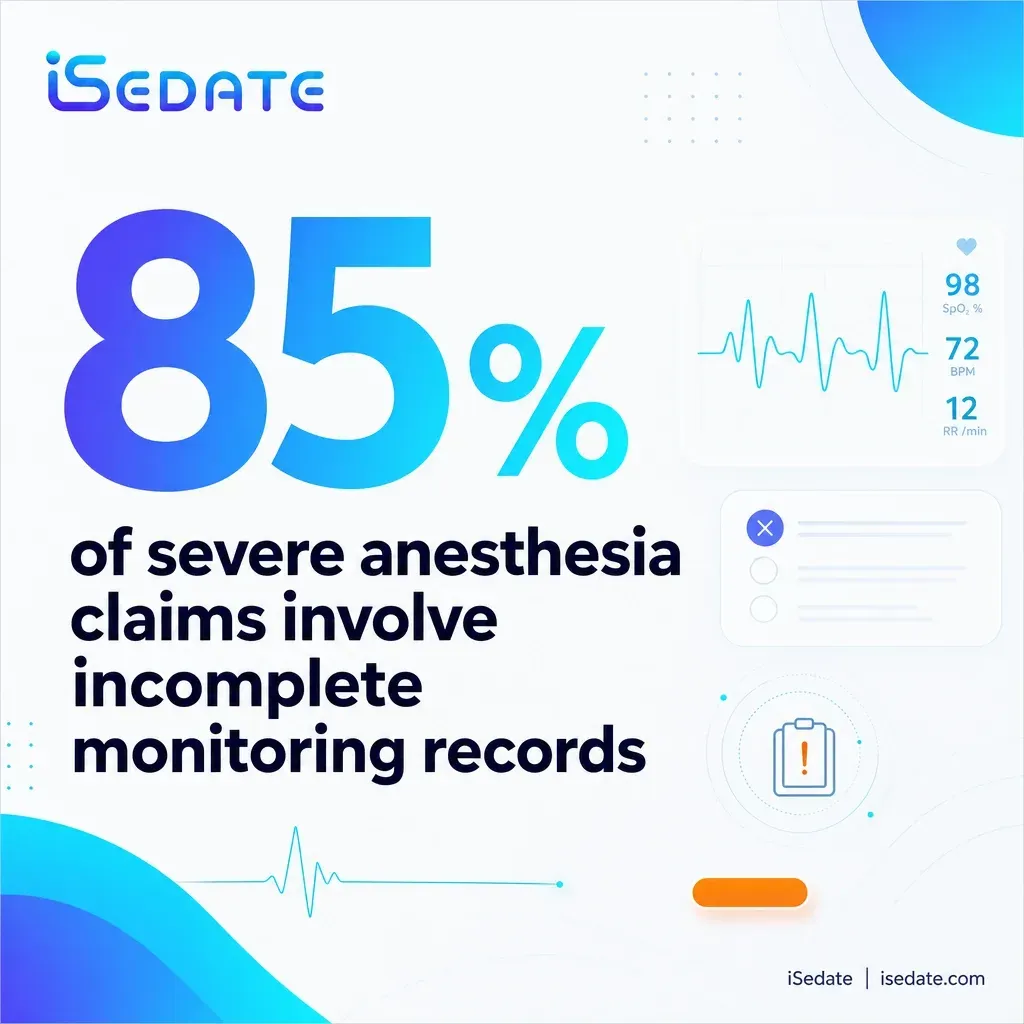
The record is not just a permit-renewal formality. When a sedation case goes wrong, the contemporaneous chart is the first document a malpractice reviewer, a board investigator, or a plaintiff's attorney requests, and its completeness often decides whether the case is defensible. The numbers show why that is worth getting right.
Those are the sedation-specific figures. Across dental claims generally, the pattern is the same: cases closed with an indemnity payment average $116,000, and every high-severity dental claim in the study paid, averaging more than $400,000. The common thread in indefensible claims is not usually a dramatic technical error; it is a record that cannot prove what was monitored and when.
iSedate's View on Documentation Risk
Read the two sets of figures together. A procedural-sedation claim already runs into six figures before you add the cost of a record that fails to defend you. The chart is the cheapest piece of risk management in the operatory, and it is the one most often shortchanged under time pressure. The practices that stay defensible are the ones whose record proves continuous supervision without anyone having to remember the case.
Penalties and adverse-event reporting
Article 13 is backed by enforcement. Under A.A.C. R4-11-1305, a death or an incident that requires an emergency medical response during the administration of, or recovery from, general anesthesia, deep, moderate, or minimal sedation must be reported to the Board. Board guidance has indicated the report is due within 10 days, but because the Board has had the permit rules under active review, confirm the current reporting trigger and timeline directly with the Board. The contemporaneous anesthesia record is the first document a reviewer requests when an adverse occurrence is reported, because it is the evidence of what was monitored and when.
Beyond mandatory reporting, the Board can deny, suspend, or revoke a permit and can impose the disciplinary penalties available under A.R.S. Title 32, Chapter 11. The exact penalty schedule and any fine amounts are administered by the Board and can change, so confirm current details directly with the Arizona State Board of Dental Examiners rather than relying on a figure that may be out of date.
Retention and audit preparation
Two practical questions follow from all of this: how long you keep the record, and how you keep it ready. On retention, the anesthesia record is part of the patient dental record, which Arizona dentists must retain and produce on request. Arizona does not set a retention period inside the anesthesia rule itself; it is governed by the Board's general dental-records rules and, for the protected health information in the chart, by HIPAA. Confirm the current retention period with the Board before you purge any sedation record, and when in doubt, keep it longer rather than shorter, because the malpractice statute of limitations can outlast a short retention window.
On-Site Evaluation Readiness Checklist
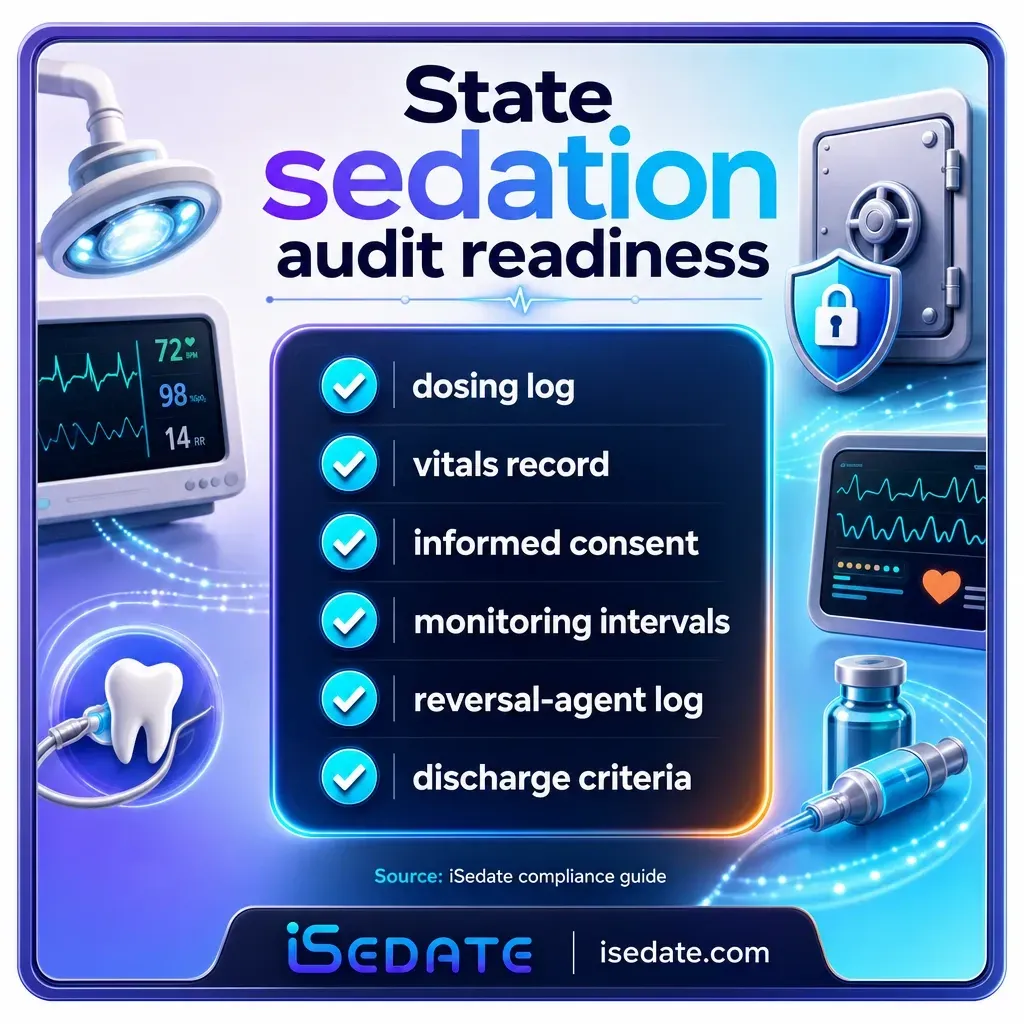
- Every GA and deep-sedation case has a complete R4-11-1301(E) record, with all eight entries present and time-stamped.
- The controlled-substance log reconciles to the drugs charted on the anesthesia records, with no unexplained gaps.
- Required monitoring equipment is present, in working order, and in use: ECG, pulse oximeter, blood pressure device and stethoscope, defibrillator or AED, and supplemental oxygen.
- Consent forms are signed and filed with the matching procedure record.
- Discharge entries name the escort and the discharge status for every case.
- Staff can answer the oral emergency and medication questions the evaluators ask.
The audit-ready record
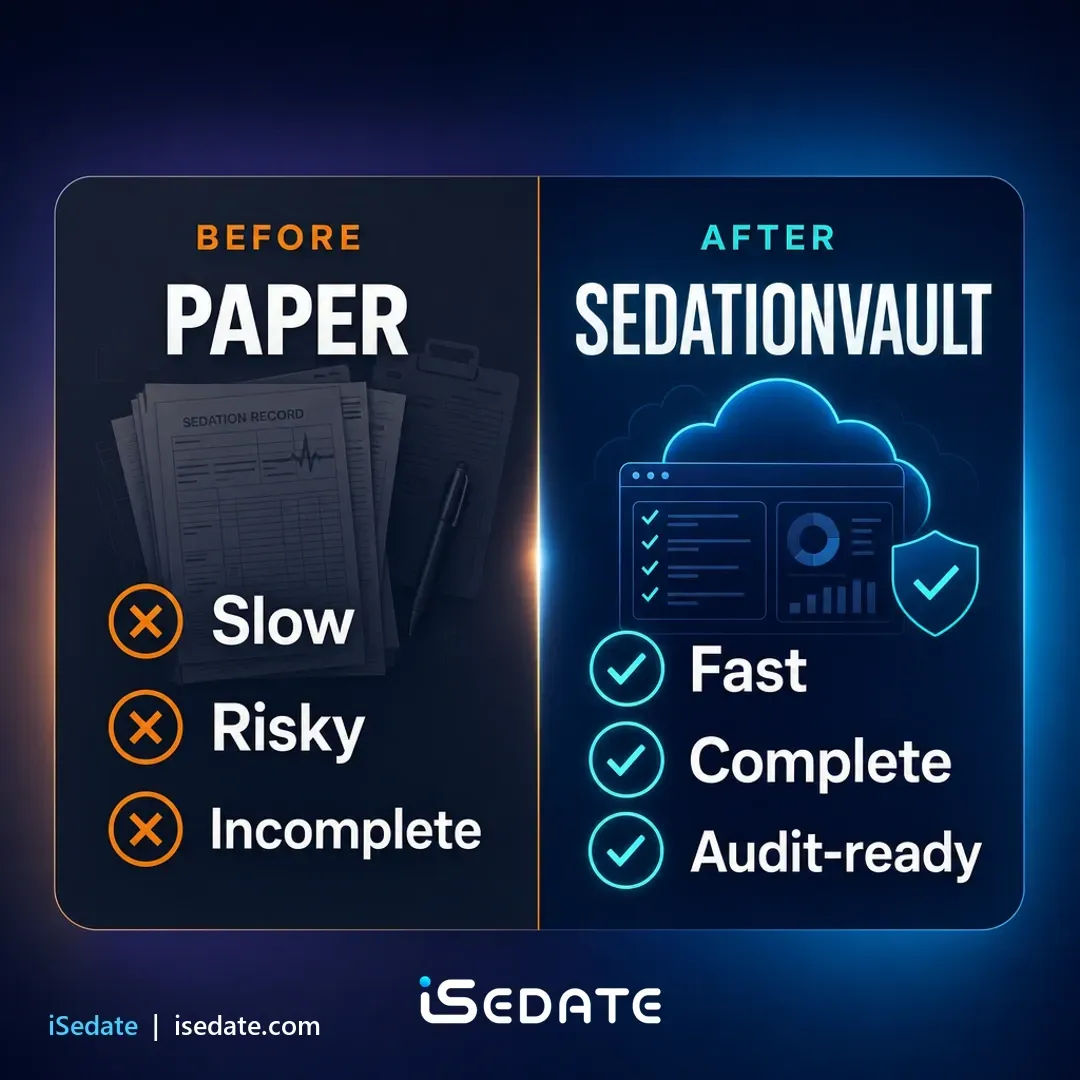
The gap between knowing the rule and passing an evaluation is almost always the same thing: an eight-item record kept by hand during a live general-anesthesia case. When a team is managing an airway and an anxious patient, a vitals reading and a drug entry written in the moment are exactly where the record develops holes, a skipped intra-operative reading here, a medication logged later from memory there, a discharge note that never names the escort.
That is the problem SedationVault by iSedate was built to remove. It connects to the vitals monitor already in your operatory and captures pulse oximetry, heart rate, blood pressure, and the ECG trace live, on the clock, alongside the drug log, so the anesthesia record writes itself as the case runs rather than being reconstructed afterward. When the Board arrives for an on-site evaluation, or asks for a chart after an adverse-occurrence report, it exports as a one-click, audit-ready sedation visit report that already carries the pre-operative, intra-operative, and post-operative readings, the dosages and times, the NPO status, the consent, and the discharge status and escort that R4-11-1301(E) asks for. The point is not fancier charting. It is turning the exact eight items the rule requires into something the software guarantees are present and time-stamped, which is also what dental sedation compliance turns on. If you want the numbers first, see SedationVault pricing.
Book a demo and see your Arizona sedation record build itselfThis content is for informational purposes only and does not constitute legal or compliance advice. Regulations change, and the Arizona State Board of Dental Examiners has had the anesthesia and sedation permit rules under active review. Confirm current requirements directly with the Board and consult a qualified professional for guidance specific to your practice.
Frequently asked questions
Does Arizona require a written sedation record?
What must an Arizona general-anesthesia sedation record include?
How often does Arizona require sedation vitals to be charted?
Who audits sedation records in Arizona?
Does Arizona require reporting of sedation adverse events?
How long must Arizona dental sedation records be kept?
Licensed in a Neighboring State?
If you administer sedation across state lines, the documentation rules change at the border. See our charting and reporting guides for nearby states:
- California Sedation Vitals Monitoring, Charting & Reporting Requirements
- Nevada Sedation Vitals Monitoring, Charting & Reporting Requirements
- New Mexico Sedation Vitals Monitoring, Charting & Reporting Requirements
- Utah Sedation Vitals Monitoring, Charting & Reporting Requirements
- Colorado Sedation Vitals Monitoring, Charting & Reporting Requirements
- All 50 states: Dental Sedation Vitals, Charting & Reporting Requirements by State
Sources and citations
Our Sourcing and Fact-Checking
This guide cites Arizona's primary regulator and its published materials. Rule text is Arizona Administrative Code, Title 4, Chapter 11, Article 13, "General Anesthesia and Sedation," enforced by the Arizona State Board of Dental Examiners; R4-11-1301 was amended effective September 12, 2022 (28 A.A.R. 1885). Because the Board has had the permit rules under active review, confirm the current text and any administered detail, such as the penalty schedule, permit fees, the board phone number, or the record-retention period, directly with the Board before relying on it. The specific record-entry lists for R4-11-1302 (parenteral and moderate) and R4-11-1303 (oral) are set within those sections and should be confirmed there for your permit level. Malpractice-cost figures are quoted from the sources named in each stat box.
- Arizona State Board of Dental Examiners: statutes, rules, and resources
- Arizona State Board of Dental Examiners: anesthesia and sedation permit applications and forms
- Arizona State Board of Dental Examiners: Common Pitfalls in the anesthesia and sedation evaluation
- CNA & Dentist's Advantage Dental Professional Liability Claim Report, 3rd Edition (2025)
- The Doctors Company Dental Closed Claims Study (loss years 2010 to 2024)
- American Dental Association: Guidelines for the Use of Sedation and General Anesthesia by Dentists