







Colorado Sedation Vitals Monitoring, Charting & Reporting Requirements
If you administer sedation in Colorado, the rule is specific about what has to land on the page: an anesthesia record that captures the patient's height and weight, ASA classification, NPO status, and every drug, with oxygen saturation, blood pressure, and heart rate written down at least every 5 minutes and respiratory rate at least every 15 minutes. That requirement lives in the Colorado Dental Board's rules at 3 CCR 709-1 Rule 1.14(O), it is backed by the Dental Practice Act at C.R.S. 12-220-411, and it is the first thing a board inspector reads when your office comes up for review. This guide breaks down what Colorado requires you to monitor and record at each permit level, what a compliant anesthesia record actually looks like, where dentists most often fall short, and how to keep the record audit-ready.
Recent Updates
Last UpdatedNovember 16, 2026
- Verified every citation against the current 3 CCR 709-1, effective August 30, 2026, pulled from the Colorado Secretary of State's Code of Colorado Regulations.
- Replaced third-party statute mirrors with the Colorado Dental Board's own laws, applications, and FAQ pages and the official Secretary of State rule page.
- Added a sample charting cadence, the oral-versus-IV documentation difference, retention and the federal DEA and HIPAA layers, and a corrected note that the ADA guideline is a private standard, not federal law.
Key Takeaways
- The core rule: Colorado's anesthesia record under 3 CCR 709-1 Rule 1.14(O) must document height and weight, ASA classification, NPO status, and drugs, with oxygen saturation, blood pressure, and heart rate recorded at least every 5 minutes and respiratory rate at least every 15 minutes for moderate and deeper sedation.
- Who enforces it: the Colorado Dental Board, within the Department of Regulatory Agencies (DORA), through 3 CCR 709-1 and the Dental Practice Act (C.R.S. Title 12, Article 220).
- Two intervals, not one: Colorado times SpO2, blood pressure, and heart rate at the 5-minute mark and respiratory rate at the 15-minute mark, which is stricter than a single blanket interval.
- Capnography is required for moderate sedation (conscious sedation) and for deep sedation or general anesthesia, phased in by July 1, 2016, with temperature and ventilation monitoring added for the deepest level.
- The record is the audit: the Board reinspects before renewing a moderate or deep sedation permit, and the complete anesthesia record must be part of any morbidity and mortality report.

What This Guide Covers
- Who regulates sedation in Colorado
- The Colorado sedation permit levels
- What you must monitor at each level
- What the record must contain: the compliance core
- What compliant documentation actually looks like
- How Colorado audits records (and how dentists get burned)
- Why a thin record is the real exposure
- Penalties and adverse-event reporting
- The easy button: an audit-ready record
- Frequently asked questions
- Related guides and neighboring states
- Sources and citations
Who regulates sedation in Colorado
Sedation and anesthesia in a Colorado dental office are regulated by the Colorado Dental Board, which sits within the Department of Regulatory Agencies (DORA), Division of Professions and Occupations. The Board issues sedation and anesthesia permits, inspects offices, reviews records, and takes disciplinary action. Its authority comes from the Dental Practice Act at C.R.S. 12-220-411, and the operative detail lives in the Board's rules at 3 CCR 709-1, specifically Rule 1.14 (Anesthesia) and Rule 1.9 (Record Keeping Requirements). You can read both the statute and the rules on the Board's own Colorado Dental Board laws and rules page.
That matters for compliance because your recordkeeping obligation is a named administrative rule with an exact citation, not a vague standard of care. When an inspector asks whether your anesthesia record meets the requirement, the answer is measured against the specific subsections of Rule 1.14 and Rule 1.9 below.
In Plain Terms
The American Dental Association publishes national sedation guidelines that most boards lean on, but those guidelines are a private professional standard, not law. The ADA is not a federal agency and it does not override a state board. In Colorado, the enforceable law is 3 CCR 709-1 and the Dental Practice Act, and the body that enforces it is the Colorado Dental Board. The genuine federal layers that sit on top of the state rule are the DEA, which requires controlled-substance records and a biennial inventory under 21 CFR Part 1304, and HIPAA, which governs how you protect and release the chart. Those are federal. The ADA guideline is not.
One timing note worth flagging: Colorado's anesthesia and records rules were re-adopted during 2026, and the version described here is the current rule effective August 30, 2026. Because the Board revisits these rules periodically, confirm you are reading the current text on the Board's laws and rules page before you rely on a specific subsection.
Source: Colorado Dental Board laws and rules (DORA) | 3 CCR 709-1 (Colorado Secretary of State)
The Colorado sedation permit levels
Colorado uses its own permit structure, named by depth of sedation rather than by a numbered level. Knowing which permit you hold tells you which monitoring and recordkeeping rules apply. These are the permits the Board issues under Rule 1.14 and C.R.S. 12-220-411:
| Colorado permit | What it covers | Citation |
|---|---|---|
| Nitrous oxide (no permit) | Nitrous oxide / oxygen analgesia; no sedation permit required | C.R.S. 12-220-411(4)(c)(I) |
| Minimal Sedation Permit | Minimal sedation (anxiolysis), adults | 3 CCR 709-1 Rule 1.14 |
| Minimal Sedation Permit with Pediatric Designation | Minimal sedation for pediatric patients | Rule 1.14; C.R.S. 12-220-411(2)(b) |
| Moderate Sedation Permit | Moderate sedation (conscious sedation), including the IV (parenteral) route | 3 CCR 709-1 Rule 1.14 |
| Deep Sedation / General Anesthesia Permit | Deep sedation or general anesthesia (the top tier) | 3 CCR 709-1 Rule 1.14 |
Two features set Colorado apart from a simple ladder. First, nitrous oxide and oxygen analgesia does not require a sedation permit, and dental assistants may monitor nitrous under supervision (C.R.S. 12-220-411(4)(c)(I)). Second, treating pediatric patients under sedation requires a separate, board-designated permit (C.R.S. 12-220-411(2)(b)), so a Minimal Sedation Permit for adults does not automatically extend to children. The Board also issues a short-lived Inspection Permit, valid for a maximum of 90 days, used while an office works through the inspection process. This guide focuses on the moderate sedation and deeper standard, because that is where Colorado's record and monitoring rules are spelled out most explicitly. If you are working out which permit to apply for or how to upgrade, that belongs in a separate process, covered in our guide to Colorado sedation dentistry licensing and permit requirements. The Board's permit forms live on its dental applications and forms page.
Source: C.R.S. 12-220-411 via the Colorado Dental Board | 3 CCR 709-1 Rule 1.14
What you must monitor at each level
In Colorado, what you are required to monitor is what you are required to write down. Rule 1.14 defines monitoring as the evaluation of the patient's physical condition and level of anesthesia across the entire peri-anesthesia period, which runs from the pre-anesthesia assessment through discharge. For moderate sedation and deeper, the monitoring load builds as the depth increases:
- Oxygenation: oxygen saturation is monitored continuously by pulse oximetry, with the recorded value captured on the anesthesia record.
- Ventilation: capnography (end-tidal carbon dioxide) is required for moderate sedation and for deep sedation or general anesthesia, a requirement the Board phased in by July 1, 2016.
- Circulation: blood pressure and heart rate are monitored and recorded through the case.
- Deep sedation and general anesthesia add more: the Board's revisions added temperature monitoring and ventilation-status monitoring at the deepest level, and pediatric patients carry added airway assessment and temperature recording.
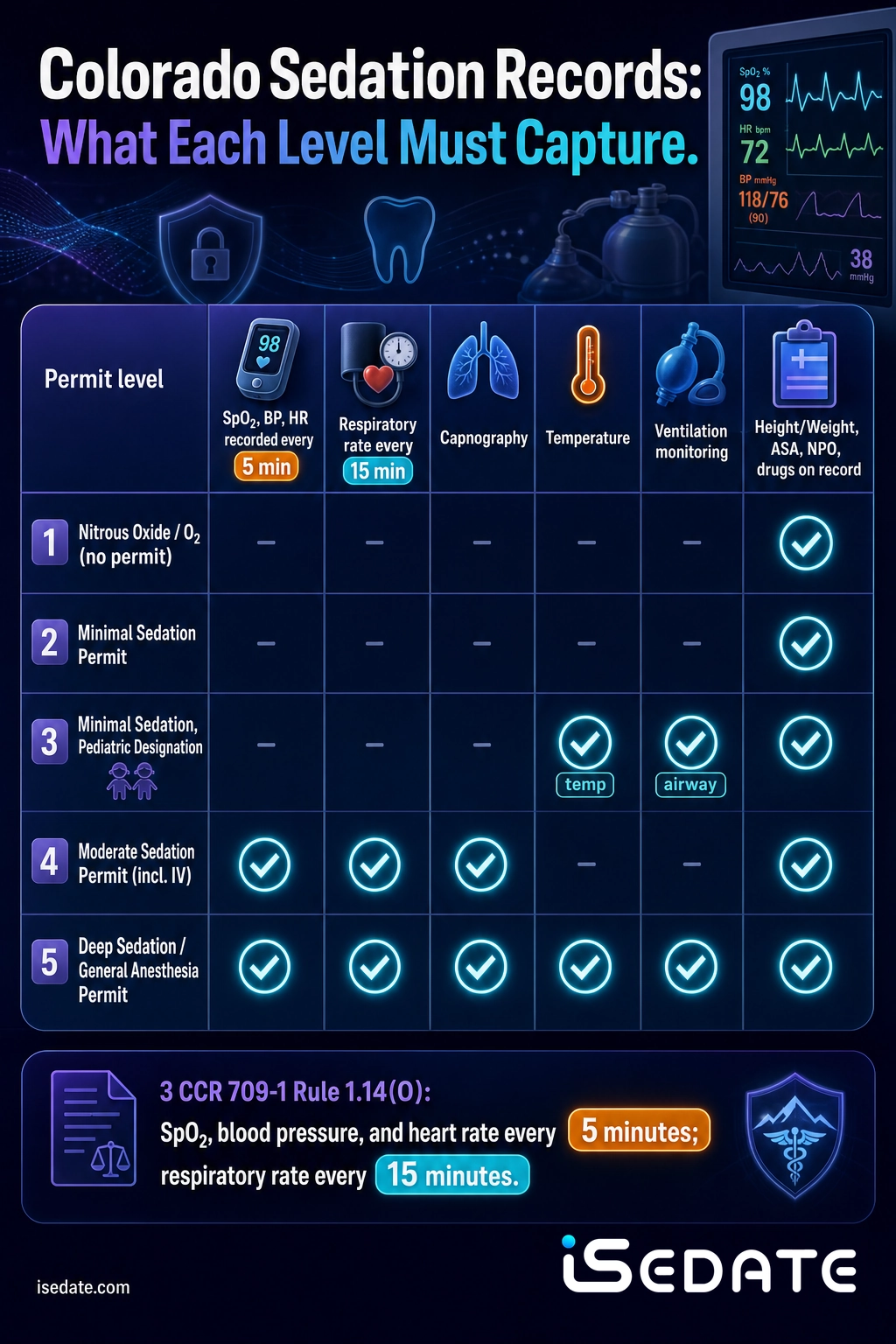
The jump from minimal to moderate sedation is where the obligations change sharply. Capnography and the timed vitals record attach at the moderate level and above, so a practice that is comfortable with minimal sedation cannot assume the same light footprint once a patient is moderately sedated. The route does not change this: whether moderate sedation is reached with an oral regimen or an IV, the same anesthesia record and the same 5-minute and 15-minute intervals apply once the patient is at that depth. The IV route simply adds the drug, dose, and time entries for each titration to the same timed record. For the exact monitoring subsections that apply to the minimal level and any permit-specific equipment list, confirm the current text with the current 3 CCR 709-1 rule text, since those details are set by rule and are periodically revised.
Myth, Busted
Myth: Nitrous or a single oral pill is light, so I don't really need to chart much.
Fact: The depth of sedation, not the route or the drug, drives the requirement. The moment a patient reaches moderate sedation, the full anesthesia record and the timed vitals intervals apply, no matter how the drug was delivered, under 3 CCR 709-1 Rule 1.14(O).
Sedation levels are defined by patient response, and patients can reach a deeper level than intended. Chart to the depth the patient actually reaches, not the depth you planned.
Source: 3 CCR 709-1 Rule 1.14 (Anesthesia)
What the record must contain: the compliance core
This is the section an inspector reads first. Colorado's anesthesia record requirement sits at 3 CCR 709-1 Rule 1.14(O), with the Board's general records duties in Rule 1.9. It has two parts worth knowing by heart.
The anesthesia record: what every chart must contain
Under Rule 1.14(O), the anesthesia record must document the patient's height and weight (used to calculate BMI and to dose emergency medications), ASA physical status classification, NPO status, and the drugs administered. These are not optional add-ons. They are the identifying and safety data a reviewer expects to see captured before and during the case, and a note that a patient tolerated sedation well does not satisfy any of them. The record is built around specific, retrievable fields, not a narrative summary.
What Every Colorado Anesthesia Record Must Capture
- Height and weight for BMI and emergency-medication dosing
- ASA physical status classification
- NPO status confirmed before sedation
- Every drug administered, with dose and time
- Oxygen saturation, blood pressure, and heart rate at least every 5 minutes
- Respiratory rate at least every 15 minutes
- The full peri-anesthesia period, from pre-anesthesia assessment through discharge
Two timed intervals: 5 minutes and 15 minutes
For moderate sedation and for deep sedation or general anesthesia, Rule 1.14(O) sets two documentation intervals. Oxygen saturation, blood pressure, and heart rate must be recorded at least every 5 minutes. Respiratory rate must be recorded at least every 15 minutes. This two-interval structure is where Colorado is stricter than a state with a single blanket interval, and it is the detail practices most often miss. Monitoring continuously but writing a reading only at the start and end of the case does not satisfy the rule, and logging all four parameters only every 15 minutes misses the 5-minute requirement for the three core vitals.
Rule 1.9, the Board's general Record Keeping Requirements rule, ties the two together: its anesthesia provision points back to Rule 1.14(O) for the anesthesia record, and it requires that any morbidity and mortality report include the complete anesthesia record. In other words, if something goes wrong, the timed record you kept during the case becomes the document the Board reads. The whole chart is also measured across the peri-anesthesia period, so the recovery and discharge phases are part of the same recordkeeping duty, not an afterthought. Retention of the record is set by the Board in Rule 1.9, and offices that handle controlled substances also keep separate drug records under the federal DEA rules; confirm the current minimum retention period, and any longer period for minors, with the Colorado Dental Board rules.
Source: 3 CCR 709-1 Rule 1.14(O) and Rule 1.9
See how a time-oriented anesthesia record is built automaticallyWhat compliant documentation actually looks like
Knowing the rule is one thing. Seeing what it produces on the page is another. Here is a plain sample of the charting cadence Rule 1.14(O) asks for on a moderate sedation case. The point is the rhythm, not these exact numbers: the three core vitals land on the 5-minute grid and respiratory rate lands on the 15-minute grid, every case, start to finish.
| Time | SpO2 | BP | HR | Resp. rate | Drug / note |
|---|---|---|---|---|---|
| 0:00 | 99% | 124/78 | 72 | 14 | Baseline; ASA II; NPO confirmed; ht/wt recorded |
| 0:05 | 98% | 122/76 | 74 | First dose administered, dose and time logged | |
| 0:10 | 98% | 120/74 | 70 | Capnography waveform normal | |
| 0:15 | 97% | 118/74 | 71 | 13 | Respiratory rate charted on the 15-minute mark |
| 0:20 | 98% | 120/76 | 72 | Stable |
A few things make this record pass rather than fail. The three core vitals never skip a 5-minute row. Respiratory rate shows up on every 15-minute mark and is a real reading, not a number copied from memory after the case. Each drug entry carries its own dose and time. And the identifying and safety fields (height and weight, ASA, NPO) are captured up front, where a reviewer looks first. The required equipment behind this is the same equipment the rule assumes you are using: a pulse oximeter, a blood-pressure device, a capnograph for moderate and deeper sedation, and, for deep sedation or general anesthesia, temperature and ventilation monitoring. If a required reading is genuinely unavailable, Colorado's approach is to record why in the chart rather than leave a silent gap, so document the reason on the record itself.
Source: 3 CCR 709-1 Rule 1.14 (Anesthesia)

How Colorado audits records (and how dentists get burned)
Colorado does not wait for something to go wrong to look at your records. The Board runs a standing office inspection program, and the anesthesia record is at the center of it.
Under C.R.S. 12-220-411(5), the Board must operate an office inspection program completed upon application for and renewal of anesthesia and sedation permits. The inspectors are required to be experts in outpatient deep sedation or general anesthesia and moderate sedation, the inspected licensee pays a reasonable board-set fee, and the inspectors report their results to the Board in writing. Critically, the statute requires reinspection of an office before the Board renews a moderate sedation or a deep sedation or general anesthesia permit. Minimal sedation permits are not subject to that renewal reinspection, which tells you where the Board concentrates its attention: the moderate level and above, exactly where the timed anesthesia record applies. The Board's dental professional FAQ spells out which permits trigger an on-site inspection.
Here is where dentists get burned. When an inspector opens the file, they are checking the record, not your intentions. A missing height and weight, an ASA classification that was never recorded, a 5-minute interval that stretched to ten, respiratory rate that was logged once instead of every 15 minutes, a drug given but not documented. The clinical care can be flawless and the record can still fail, because the record is the only thing the inspector can grade.
Important
Gaps in the record read as gaps in the care. An inspector does not grade your sedation on how the patient did. They grade it on whether the anesthesia record proves what you did and when. If the timed record has gaps, the default assumption on review is that the monitoring had gaps too. Capture height and weight, ASA status, and NPO status up front, and hold the 5-minute interval for SpO2, blood pressure, and heart rate across the whole peri-anesthesia period.
Source: C.R.S. 12-220-411(5) via the Colorado Dental Board
Why a thin record is the real exposure
The requirements above are not paperwork for its own sake. The anesthesia record is the single document that follows a sedation case into every place it can be questioned: a routine renewal inspection, a board complaint, and a malpractice claim. In all three, the record is requested first and is the hardest thing to reconstruct after the fact.
Think about what that five-year cycle means in practice. Every moderate and deeper sedation record you keep is a renewal and audit asset the Board can call on, and the renewal reinspection is a scheduled, predictable event, not a surprise. A complete, time-stamped record is the easy pass. A thin one is where a renewal, a complaint, or a plaintiff's attorney finds the opening, because the same gaps that fail an inspection are the gaps a malpractice suit is built on. For the data behind why documentation drives these outcomes, see our research on how sedation charting affects malpractice case outcomes, the numbers on vital-signs monitoring and sedation safety, and documentation-error rates and chart defensibility.
Penalties and adverse-event reporting
Colorado's rules are backed by enforcement. The Board can take disciplinary action under the Dental Practice Act (C.R.S. Title 12, Article 220) for rule violations, including recordkeeping violations, and the Board maintains a fining schedule in 3 CCR 709-1 for violations of the act and its rules. A failed or refused inspection also affects whether a permit is issued or renewed. When a serious event occurs, Rule 1.9 requires that the morbidity and mortality report include the complete anesthesia record, so an incomplete chart is not a filing technicality. It is the evidence the Board weighs when deciding whether the standard of care was met.
The exact disciplinary schedule, the precise fine amounts, the inspection fee, and the current reporting triggers and timelines are administered by the Board and can change, so confirm current details directly with the Colorado Dental Board rules rather than relying on a figure that may be out of date. What does not change is the exposure created by a thin record.
Source: Colorado Dental Board laws and rules | 3 CCR 709-1 fining schedule
The easy button: an audit-ready record
The gap between knowing the rule and passing an inspection is almost always the same thing: a timed vitals log kept by hand during a live sedation case. Colorado makes that harder than most states, because it asks for two intervals at once, a 5-minute capture of oxygen saturation, blood pressure, and heart rate and a 15-minute capture of respiratory rate, on top of the height and weight, ASA status, NPO status, and drug log. When a team is managing an airway and an anxious patient, a dual-interval record written on paper is exactly where holes appear, a skipped 5-minute mark here, a respiratory rate logged from memory there.
That is the problem SedationVault by iSedate was built to remove. It connects to the vitals monitor already in your operatory and captures oxygen saturation, blood pressure, heart rate, and respiratory rate live, on the clock, alongside the drug log, so the anesthesia record writes itself as the case runs rather than being reconstructed afterward. The 5-minute and 15-minute intervals that Rule 1.14(O) demands are held by the software, not by someone's memory mid-case, and the same record works whether the patient reached conscious sedation on an oral regimen or through an IV. When the Colorado Dental Board asks for the chart, it exports as a one-click, audit-ready sedation visit report that already carries the timed vitals, the dosages, the ASA and NPO fields, and the discharge record the rule asks for. The point is not fancier charting. It is turning the exact items Rule 1.14(O) requires into something the software guarantees are present and time-stamped, which is also what dental sedation compliance turns on. If you are comparing the cost of that against the cost of a failed renewal inspection, our pricing page lays it out plainly.
Book a demo and see your Colorado sedation record build itselfFrequently asked questions
Does Colorado require a written sedation record?
How often must vitals be recorded during sedation in Colorado?
Who audits sedation records in Colorado?
What is Colorado's anesthesia record rule?
Is capnography required for sedation in Colorado?
How long must a Colorado dental practice keep sedation records?
Is the ADA sedation guideline federal law in Colorado?
Related guides and neighboring states
Licensed in more than one state, or want the clinical "what and why" behind these rules? Start with the national hub, then jump to a neighboring state's documentation guide:
- Dental Sedation Vitals, Charting & Reporting Requirements by State (the all-50 hub)
- Arizona Sedation Vitals Monitoring, Charting & Reporting Requirements
- Kansas Sedation Vitals Monitoring, Charting & Reporting Requirements
- Nebraska Sedation Vitals Monitoring, Charting & Reporting Requirements
- New Mexico Sedation Vitals Monitoring, Charting & Reporting Requirements
- Oklahoma Sedation Vitals Monitoring, Charting & Reporting Requirements
- Utah Sedation Vitals Monitoring, Charting & Reporting Requirements
- Wyoming Sedation Vitals Monitoring, Charting & Reporting Requirements
Sources and citations
Our Sources and Fact-Checking
This guide cites Colorado's primary regulatory sources. Rule text is drawn from 3 CCR 709-1 (Colorado Dental Board), Rule 1.14 (Anesthesia) and Rule 1.9 (Record Keeping Requirements), in the version effective August 30, 2026 and verified against the Colorado Secretary of State's Code of Colorado Regulations. The governing statute is C.R.S. 12-220-411, published by the Colorado Dental Board. The regulator is the Colorado Dental Board within DORA. Federal controlled-substance records are governed by the DEA at 21 CFR Part 1304. Where a detail (such as the current fining schedule, inspection fee, retention period, or minimal-level monitoring specifics) is administered by the Board and subject to change, confirm it directly with the Board before relying on it.
- Colorado Dental Board: laws and rules (DORA, Division of Professions and Occupations)
- 3 CCR 709-1: Colorado Dental Board Rules (Rule 1.14 Anesthesia, Rule 1.9 Record Keeping), eff. 08/30/2026
- Colorado Dental Board: applications and forms
- Colorado Dental Board: professional FAQ (on-site inspection program)
- 21 CFR Part 1304: DEA records and reports of registrants
This guide summarizes Colorado sedation recordkeeping rules for general information and is not legal or compliance advice. Consult a qualified professional, and confirm the current rule text with the Colorado Dental Board, for guidance specific to your situation. Because Rule 1.14 and Rule 1.9 were revised in 2026 and are periodically amended, confirm the current text and any retention, fee, or minimal-level details with the Board before you act.















