







Kansas Sedation Vitals Monitoring, Charting & Reporting Requirements
If you run parenteral (IV) conscious sedation in a Kansas dental office, the state is specific about what goes in the chart, and it has to be written as the case runs. Under the Kansas Dental Board's sedation rules in K.A.R. Article 71-5, you create a record at the time of care that captures every fluid and drug and its amount, the route and site, the administration times, and the patient's blood pressure, heart rate, and oxygen saturation at the start of sedation, at the end of the procedure, and at least every five minutes in between. That record stays in the patient's chart for at least 10 years, the Kansas Dental Board enforces it, and it is the first document a reviewer or a plaintiff's attorney asks for. This guide walks through exactly what Kansas requires you to monitor and document at each sedation level, what a compliant record looks like minute by minute, and where real practices lose a review.
Recent Updates
Last UpdatedNovember 16, 2026
- Rechecked every Kansas citation against the state's own official sources: the Kansas Dental Practices Act (K.S.A. 65-1444) on the Kansas Office of Revisor of Statutes, and the Kansas Dental Board.
- Added the board's office-inspection authority and the 30-day adverse-event reporting rule (K.A.R. 71-5-9).
- Added a minute-by-minute example of a compliant Kansas sedation record and an oral-versus-IV documentation breakdown.
Key Takeaways
- The core rule: Kansas parenteral conscious sedation requires a contemporaneous record under K.A.R. 71-5-11, with blood pressure, heart rate, and oxygen saturation documented at the start, at the end, and at least every five minutes.
- The record must name each fluid administered and its amount, the site of each medication and any catheter used, and each sedative agent with its approximate time and amount.
- Retention is long: the sedation record stays in the patient's record for at least 10 years, and the same duty reaches Level I oral sedation.
- IV sedation adds continuous capnography (exhaled carbon dioxide) plus an AED on hand, and the responsiveness check is charted every five minutes too.
- Enforcement is real: the Kansas Dental Board can inspect a sedation office under K.S.A. 65-1444, and a sedation death or injury must be reported to the board within 30 days under K.A.R. 71-5-9.

What This Guide Covers
- Who regulates sedation records in Kansas
- The Kansas sedation permit levels
- What you must monitor at each level
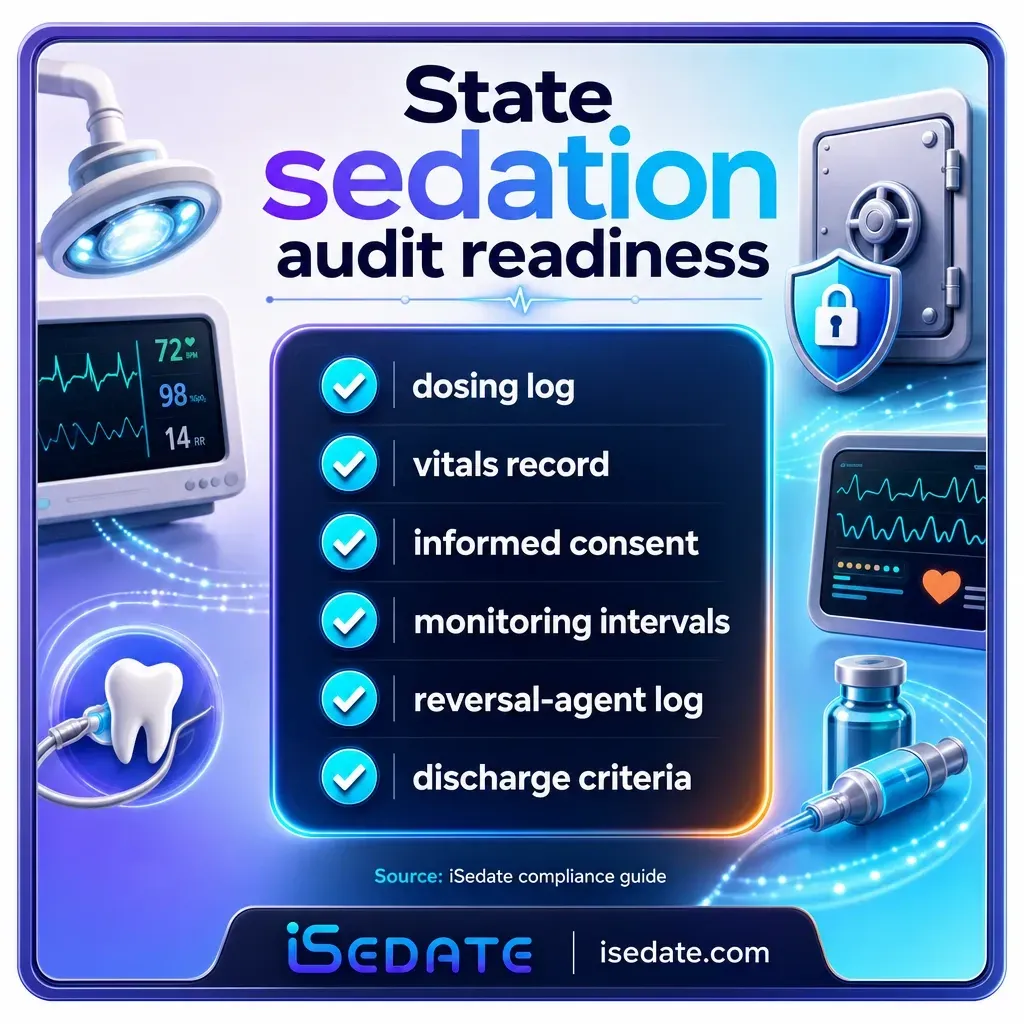
- What the sedation record must contain
- What a compliant Kansas record looks like
- How Kansas reviews records and reports emergencies
- Why a thin sedation record is a liability
- The easy button: an audit-ready record
- Frequently asked questions
- Sources and citations
Who regulates sedation records in Kansas
Sedation and anesthesia in a Kansas dental office are regulated by the Kansas Dental Board, the state agency that issues sedation permits, sets the recordkeeping standard, inspects sedation offices, and takes disciplinary action. Its authority comes from the Kansas Dental Practices Act (K.S.A. 65-1444), which gives the board the power to issue sedation permits and makes any office authorized to administer sedation subject to inspection by the board.
The sedation rules themselves are not scattered through general dental law. They sit together in the Kansas Administrative Regulations, Agency 71, Article 5, the article that governs anesthesia and sedation, published by the Kansas Office of Administrative Rules and Regulations. That matters for compliance because your recordkeeping obligation is a named administrative regulation with an exact citation, not a vague standard of care. When a reviewer asks whether your sedation record meets the requirement, the answer is measured against the specific subsections of K.A.R. 71-5-11 below.
Set the Record Straight on the ADA
The American Dental Association is a professional body, not a federal regulator. The ADA publishes national sedation guidelines that most boards lean on, but those guidelines are a standard, not law, and there is no "federal ADA law" that overrides your state. In Kansas, the law is K.A.R. Article 71-5 and the enforcer is the Kansas Dental Board. The federal layers that do apply are separate: the DEA for controlled-substance logs, HIPAA for records privacy, and any accreditation body you have opted into.
Source: Kansas Dental Practices Act, K.S.A. 65-1444 (Office of Revisor of Statutes)
The Kansas sedation permit levels
Kansas uses its own permit structure, and the requirements escalate with each level. Knowing which permit you hold tells you which monitoring and recordkeeping rules apply. These are the levels as Article 71-5 defines them.
| Kansas permit | What it covers | Governing rule |
|---|---|---|
| Nitrous oxide | Inhaled nitrous oxide and oxygen (no sedation permit required) | K.A.R. Article 71-5 |
| Level I sedation permit | Oral / enteral conscious sedation | K.A.R. 71-5-10 |
| Level II: Parenteral Conscious Sedation | Parenteral conscious sedation, including the IV route | K.A.R. 71-5-11 |
| Level III | Deep sedation and general anesthesia (the top tier) | K.A.R. 71-5-12 |
Most general dentists offering light anxiety control work with nitrous oxide or a Level I oral permit, while the Level II Parenteral Conscious Sedation permit is the one that authorizes IV sedation. Level III (deep sedation and general anesthesia) is the top tier, carried most often by dental anesthesiologists and oral and maxillofacial surgeons, and it sits under its own rule with stricter monitoring. This guide focuses on the parenteral conscious sedation standard in 71-5-11, because that is the level whose monitoring and record requirements Kansas spells out most explicitly. If you are working out which permit to apply for or how to upgrade, that belongs in a separate process, covered in our guide to Kansas sedation dentistry licensing and permit requirements.
Source: Kansas Dental Board anesthesia and sedation permit applications
What you must monitor at each level
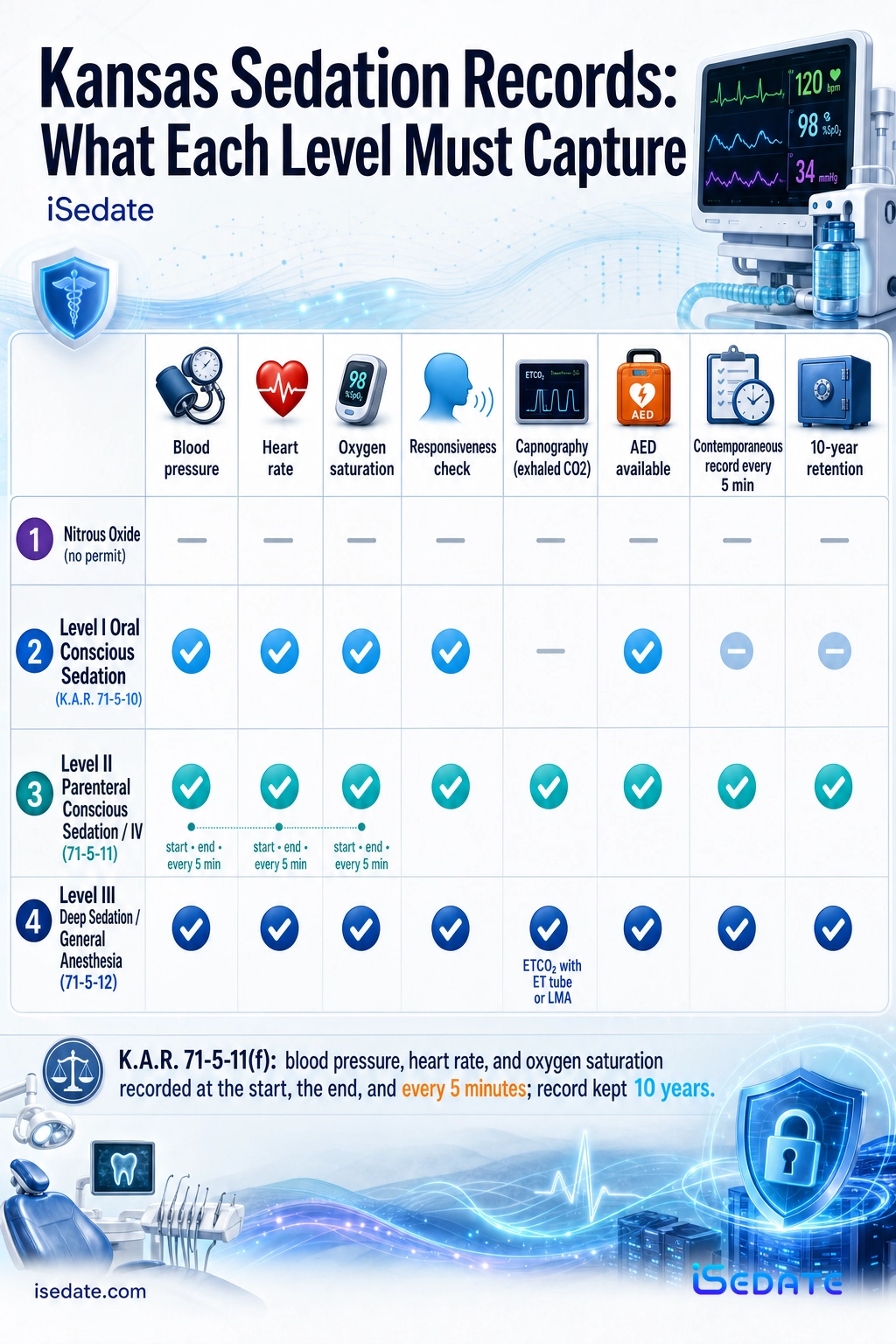
In Kansas, what you are required to monitor is what you are required to write down. The two are inseparable: the monitoring standard in K.A.R. 71-5-11 defines the physiological parameters, and the recordkeeping rule in the same regulation requires them to be documented. For parenteral conscious sedation (Level II), the dentist monitors the patient through administration and recovery across these systems.
- Ventilation and exhaled CO2: during administration, the dentist continuously monitors for the presence of exhaled carbon dioxide using a capnograph, unless precluded by the patient, the procedure, or the equipment.
- Oxygenation: oxygen saturation is recorded at least every five minutes during administration and recovery.
- Circulation: blood pressure and heart rate are recorded at least every five minutes during administration and recovery.
- Consciousness: the patient's ability to respond to physical stimulation or verbal command is recorded every five minutes.
An equipment rule sits on top of that: an automated external defibrillator or a defibrillator must be available and in working order during parenteral conscious sedation. Level III (deep sedation and general anesthesia) goes further still, adding end-tidal carbon dioxide monitoring when an endotracheal tube or laryngeal mask airway is used. The deeper you go, the more parameters you are both watching and logging.
Myth, Busted
Myth: A light IV drip is barely sedation, so the full monitoring and charting does not really apply.
Fact: The depth of sedation, not the drug or the dose, drives the requirement. Once a patient is under parenteral conscious sedation, the full 71-5-11 monitoring and recording standard applies, capnograph and all.
Sedation levels are defined by patient response, and a patient can reach a deeper level than you planned. Charting as though the case were "barely sedation" is exactly the record a reviewer reads as a gap.
Source: Kansas Dental Board sedation permit requirements
What the sedation record must contain
This is the section a reviewer reads first. For parenteral conscious sedation, K.A.R. 71-5-11 spells out exactly what the record must contain, and it has to be made at the time of care, not reconstructed afterward. It breaks into three parts worth knowing by heart.
1. A contemporaneous record of fluids, drugs, and routes
Whenever sedation is given, a record must be made at the time of care. It names each fluid administered and its amount, and the site of each medication and, if applicable, the catheter type. "At the time of care" is the operative phrase: this is a live record built against the clock, not a single end-of-visit summary. A note that a patient "tolerated IV sedation well" is not this record. A timeline of fluids, drugs, routes, and the sites they went into is.
2. Agents, times, and vitals at the start, the end, and every five minutes
The record must document the sedative agents administered, the approximate time each was given, and the amount of each agent, together with the patient's blood pressure, heart rate, and oxygen saturation at the start of sedation, at the end of the procedure, and at five-minute intervals. This is the interval that catches practices out. Monitoring continuously but writing a reading only at the start and the end does not satisfy the rule. The documentation itself has to land on the page at least every five minutes, and that same five-minute cadence carries through recovery.
3. Retention and the Level I cross-reference
The record is not short-lived. The sedation record is kept as part of the patient's record for at least 10 years. And the duty is not limited to IV cases: the records required for Level I oral sedation must also be made contemporaneously and retained for at least 10 years. In practice, that means the contemporaneous, time-stamped record is the standard whether you are working under a Level I oral permit or a Level II parenteral permit.
What the Kansas Sedation Record Must Capture
- Each fluid administered and its amount
- The site of each medication and the catheter type, if one is used
- Each sedative agent, its amount, and the approximate time it was given
- Blood pressure, heart rate, and oxygen saturation at the start of sedation
- The same three vitals at the end of the procedure
- The same three vitals at least every five minutes in between, and through recovery
- The responsiveness check (physical stimulation or verbal command) every five minutes
- Retention of the full record in the chart for at least 10 years
See how a time-oriented anesthesia record is built automatically

What a compliant Kansas record looks like
Knowing the itemized list is one thing. Seeing it laid out on the clock is what makes the standard concrete. A compliant Kansas parenteral sedation record reads as a continuous timeline: a baseline set of vitals before the first agent, then a time-stamped row at least every five minutes, each carrying blood pressure, heart rate, oxygen saturation, and a responsiveness note, with each drug and fluid logged the moment it is given. Here is a shortened example of the cadence for a routine case.
| Time | BP | HR | SpO2 | Responsiveness | Agents / fluids given |
|---|---|---|---|---|---|
| 9:00 (baseline) | 128/78 | 72 | 99% | Alert, follows commands | IV established, normal saline started (site: left antecubital, 20g catheter) |
| 9:05 (start) | 124/76 | 70 | 99% | Responds to voice | Midazolam 2 mg IV at 9:05 |
| 9:10 | 118/74 | 68 | 98% | Responds to voice | Fentanyl 25 mcg IV at 9:11 |
| 9:15 | 116/72 | 66 | 98% | Responds to light touch | Capnograph waveform present |
| 9:20 | 118/74 | 68 | 99% | Responds to voice | Procedure underway |
| 9:25 (end) | 122/76 | 70 | 99% | Alert | Procedure complete, recovery begun |
The values above are an illustration of the format, not clinical targets. What makes the record compliant is not any single number, it is the unbroken five-minute cadence, the baseline and end readings, and the fact that every agent and fluid is tied to a time. Keep logging the same vitals every five minutes through recovery until the patient meets your discharge criteria.
Oral (Level I) versus IV (Level II): what changes in the chart
The documentation backbone is the same at both levels, a contemporaneous record retained 10 years, but the IV level adds parameters and equipment the oral level does not require.
| Record element | Level I oral | Level II parenteral / IV |
|---|---|---|
| Contemporaneous, time-stamped record | Required | Required |
| 10-year retention | Required | Required |
| Drugs, doses, and times logged | Required | Required |
| Fluids, routes, and catheter site | Not applicable | Required |
| Continuous capnography (exhaled CO2) | Not required | Required during administration |
| AED or defibrillator on hand | Confirm with the board | Required |
Because the parenteral level adds the capnograph, the AED, and the IV fluid and site detail, an IV case has more rows and more fields to keep current in real time. That is precisely where a record develops holes. When the exact scope of a Level I requirement is not spelled out in the material you hold, confirm it directly with the Kansas Dental Board rather than assuming the oral and IV standards are identical.
Source: Kansas Dental Board anesthesia and sedation permit requirements
How Kansas reviews records and reports emergencies
When the Kansas Dental Board opens your file, it checks the record, not your intentions. The Dental Practices Act gives the board the authority to issue the sedation permits and to inspect the office of any dentist authorized to administer sedation, and that review turns on whether your contemporaneous sedation record is complete, time-stamped, and intervaled correctly.
Why the Record, Not the Care, Decides a Review
A reviewer grades the proof, not the outcome. They do not grade your sedation on how the patient did; they grade it on whether the contemporaneous record proves what you did and when. If the five-minute interval has gaps, the default assumption on review is that the monitoring had gaps too. Record blood pressure, heart rate, and oxygen saturation at the start, at the end, and at every five-minute mark, and log each agent and fluid as it is given.
Kansas also treats a sedation emergency as a reportable event. Under K.A.R. 71-5-9, a dentist must submit a written report to the Kansas Dental Board within 30 days of a mortality or morbidity related to sedation or general anesthesia. The contemporaneous record is the backbone of that report, which is one more reason the five-minute log cannot have holes. The board's routine office-inspection cadence, the exact disciplinary schedule, and the precise adverse-event triggers are administered by the board and can change, so confirm the current process and forms directly with the Kansas Dental Board rather than relying on a figure that may be out of date.
Source: Kansas Dental Practices Act, K.S.A. 65-1444 | Kansas Dental Board
Why a thin sedation record is a liability
The same gaps that fail a board review are the gaps a plaintiff's attorney looks for. In both a board matter and a malpractice claim, the contemporaneous sedation record is the first thing requested and the hardest thing to reconstruct after the fact, which is exactly why 71-5-11 requires it to be made at the time of care. The care can be flawless and the record can still fail, because the regulation sets an explicit, itemized standard and a reviewer measures the chart against it line by line.
iSedate Insight
Across the sedation matters we study, the dispute is rarely about whether the clinician acted reasonably. It is about whether the chart can prove it. A record with an unbroken five-minute cadence and every drug tied to a time is a defense built before the case ever starts; a record with a 12-minute gap hands the other side its argument.
The hard numbers behind that pattern live in our research roundups: how sedation charting affects malpractice case outcomes, the data on vital-signs monitoring and sedation safety, and the research on documentation-error rates and chart defensibility. Read together with the Kansas rule, they make the case for charting that is airtight by default.
The easy button: an audit-ready record
The gap between knowing the rule and passing a review is almost always the same thing: a five-minute interval log kept by hand during a live sedation case. When a team is managing an airway and an anxious patient, a vitals reading written every five minutes on paper is exactly where the record develops holes, a skipped interval here, a missing time stamp there, a drug given in the moment and logged later from memory. Kansas's five-minute cadence is a shorter leash than many states impose, which means more rows to fill and more chances to miss one.
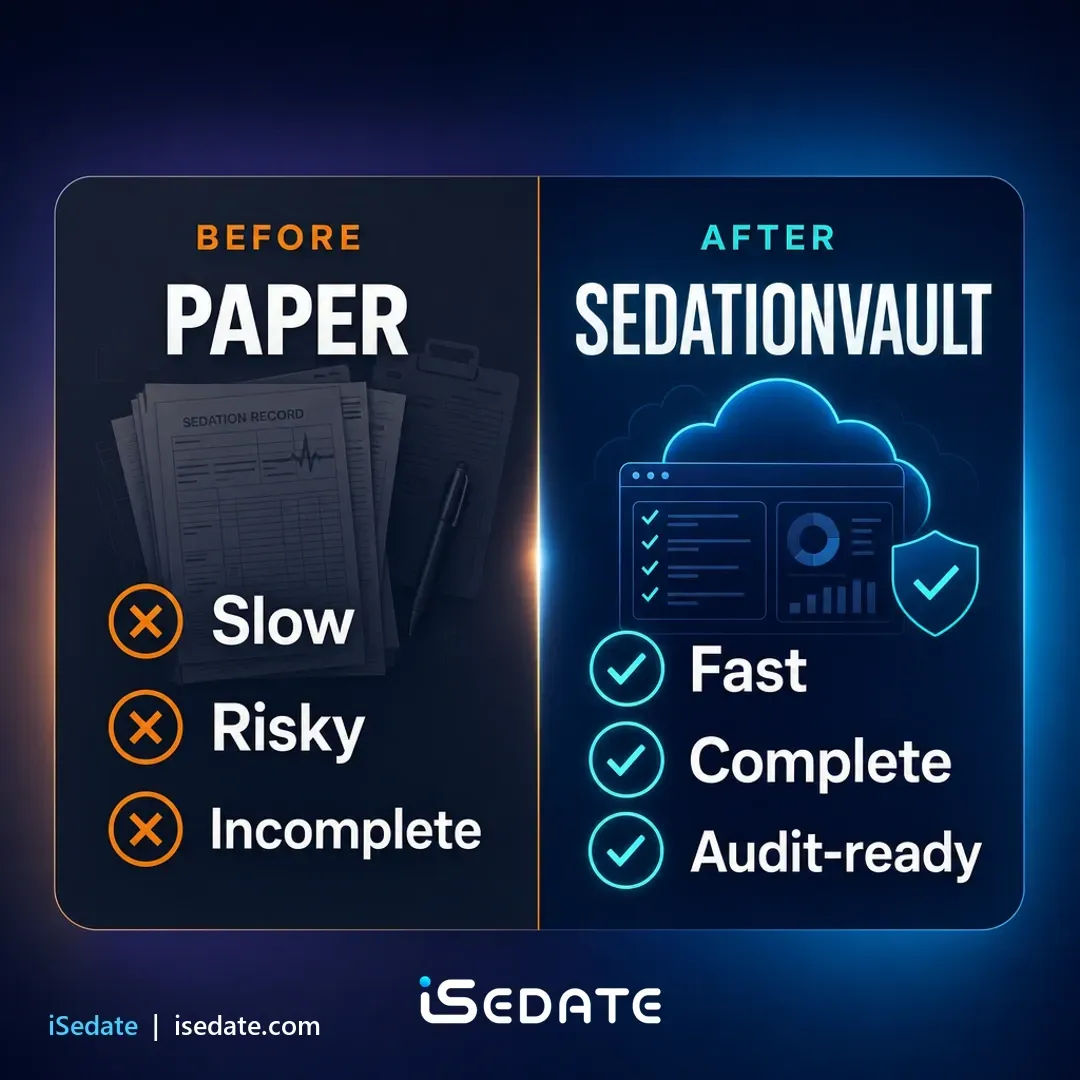
That is the problem SedationVault by iSedate was built to remove. It connects to the vitals monitor already in your operatory and captures blood pressure, heart rate, and oxygen saturation live, on the clock, alongside the drug and fluid log, so the contemporaneous record for a Conscious Sedation case writes itself as the procedure runs rather than being reconstructed afterward. When the Kansas Dental Board asks for the chart, it exports as a one-click, audit-ready sedation visit report that already carries the start and end readings, the five-minute intervals, the agents and amounts, the sites, and the retention trail the rule asks for. The point is not fancier charting. It is turning the exact items 71-5-11 requires into something the software guarantees are present and time-stamped, which is also what dental sedation compliance turns on.
Frequently asked questions
Does Kansas require a written sedation record?
How often must vitals be recorded during sedation in Kansas?
How long must Kansas dental sedation records be kept?
Does Kansas require capnography during IV sedation?
Do I have to report a sedation emergency to the Kansas Dental Board?
Who regulates sedation records in Kansas?
Related guides and neighboring states
This page is part of our documentation silo. For the clinical "what and why" behind these rules across the country, start with the hub guide, Dental Sedation Vitals, Charting & Reporting Requirements by State. Licensed in a neighboring state? See our charting and reporting guides for Colorado, Missouri, Nebraska, and Oklahoma.
Sources and citations
How We Verified This Guide
This guide cites Kansas's own official sources. The board's authority, its inspection power, and the statutory basis for the sedation permits come from the Kansas Dental Practices Act (K.S.A. 65-1444), published by the Kansas Office of Revisor of Statutes. The sedation rules, including the parenteral conscious sedation standard in K.A.R. 71-5-11 and the adverse-event reporting rule in K.A.R. 71-5-9, are part of Kansas Administrative Regulations Article 71-5, enforced by the Kansas Dental Board; the official current text is published in the Kansas Administrative Regulations by the Kansas Office of Administrative Rules and Regulations. Where a detail (the routine inspection cadence, the exact penalty schedule, adverse-event forms and triggers, continuing-education requirements, Level I specifics, or permit fees) is administered by the board and subject to change, confirm it directly with the Kansas Dental Board before relying on it. This content is for informational purposes only and is not legal or compliance advice; consult the Kansas Dental Board or a qualified professional for guidance specific to your practice.
- Kansas Dental Practices Act, K.S.A. 65-1444 (Kansas Office of Revisor of Statutes)
- Kansas Dental Board: anesthesia and sedation permit applications and requirements
- Kansas Administrative Regulations, Agency 71, Article 5 (71-5-9 adverse-event reporting; 71-5-10 Level I oral; 71-5-11 Level II parenteral; 71-5-12 Level III), published by the Kansas Office of Administrative Rules and Regulations.