






Kansas Sedation Dentistry Licensing & Permit Requirements
In Kansas, you cannot provide oral or IV sedation on your dental license alone. A dentist who administers enteral (oral) conscious sedation, parenteral (IV) conscious sedation, or deep sedation and general anesthesia must first hold the matching permit from the Kansas Dental Board, issued under Kansas Administrative Regulations, Article 71-5. Getting the permit means meeting the training, certification, and clinical-case requirements for your level. Keeping it means your sedation records survive a board review. This guide walks both halves: how a Kansas dentist earns a sedation permit, and what it takes to keep it.
Recent Updates
Last UpdatedNovember 16, 2026
- Corrected the Level II (parenteral) didactic-training figure to 40 hours to match the course requirement in K.A.R. 71-5-11(b)(3).
- Replaced third-party legal aggregators with the Kansas Dental Board and the Kansas Office of Revisor of Statutes as the cited official sources.
- Added the verified permit fees ($100 / $150 / $200 by level), the sedation-specific CE hours for renewal, and the board report required within 30 days of a sedation mortality or morbidity.
Key Takeaways
- Kansas regulates sedation under K.A.R. Article 71-5. Nitrous oxide alone needs no permit; enteral, parenteral, and deep sedation each carry their own permit.
- Level I covers enteral (oral) conscious sedation (71-5-10), Level II covers parenteral conscious sedation, including the IV route (71-5-11), and Level III covers deep sedation and general anesthesia (71-5-12).
- The jump to IV: a Level I oral permit needs at least 18 education hours, 20 clinical experiences, and BLS; a Level II parenteral permit needs a board-approved course of at least 40 didactic hours plus 20 clinical cases, and ACLS.
- For parenteral conscious sedation, Kansas requires a contemporaneous record with vitals documented at the start, the end, and every five minutes, kept for at least 10 years (K.A.R. 71-5-11).
- The board can review your sedation records, and incomplete records are where permits get challenged, so the record is the thing to get right on every single case.

What This Guide Covers
- Who issues sedation permits in Kansas
- The Kansas sedation permit levels
- How to get or upgrade each permit
- What the permit requires you to monitor
- Reporting and recordkeeping obligations
- Fees, CE, and renewal
- Inspections and record reviews
- Keeping the permit: audit-ready records
- Frequently asked questions
- Related guides and neighboring states
- Sources
Who issues sedation permits in Kansas
Sedation dentistry in Kansas is regulated by the Kansas Dental Board, the state agency that licenses dentists and issues every sedation permit. Its authority comes from the Kansas Dental Practice Act, which gives the board power to issue permits to administer sedation and general anesthesia and to set different requirements for each type of sedation a dentist is authorized to use (K.S.A. 65-1444). The board, not any national body, decides who may sedate, runs the record reviews, and takes disciplinary action. The detailed rules live in Kansas Administrative Regulations, Agency 71, Article 5, which governs anesthesia and sedation, and every requirement below traces to a regulation in that article.
The Board Writes the Law, Not the ADA
The American Dental Association publishes sedation guidelines that Kansas and most states lean on, but the ADA is a private professional association, not a government agency. It does not license you, audit you, or discipline you. Your permit, your record reviews, and any sanctions all come from the Kansas Dental Board under Article 71-5. The federal layers that do apply are separate again: the DEA for controlled-substance logs, HIPAA for records, and any accreditation body you join voluntarily. Treat the ADA guidelines as best practice and K.A.R. Article 71-5 as the rule you are held to.
To apply for a permit, you work through the board's own application process. The application forms, the approved-course list, and the current fee schedule are maintained by the board, so confirm the exact forms and current fees directly with the Kansas Dental Board before you file. What is fixed in regulation, and what this guide covers, is the training, certification, clinical-case, monitoring, and recordkeeping standard for each level.
Source: Kansas Dental Board permit applications and approved courses | K.S.A. 65-1444, Kansas Office of Revisor of Statutes
The Kansas sedation permit levels
Kansas names its permits by level, and the level reflects how deeply the patient is sedated, not just which drug or route is used. Here is the full ladder, each rung with its governing regulation in Article 71-5.
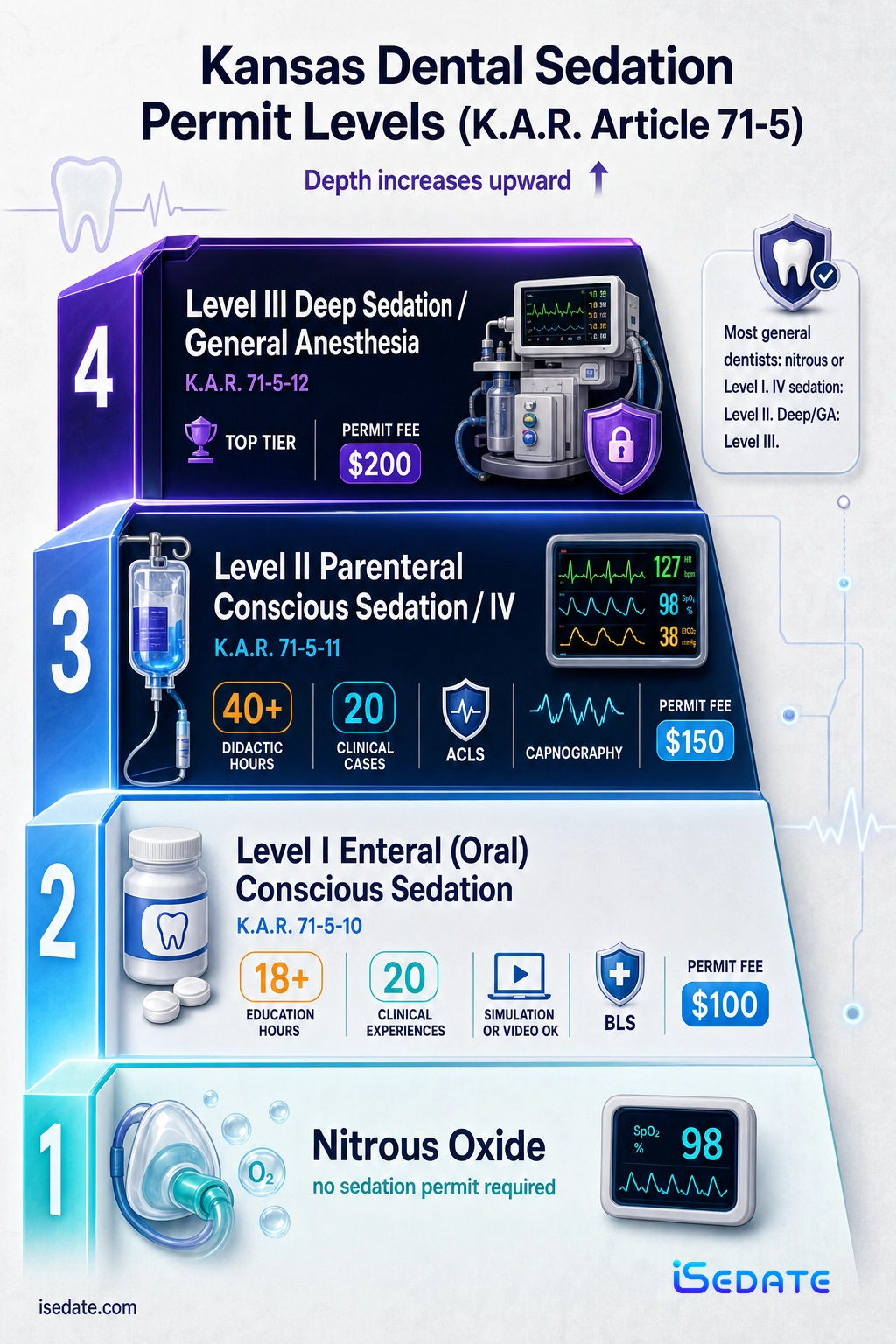
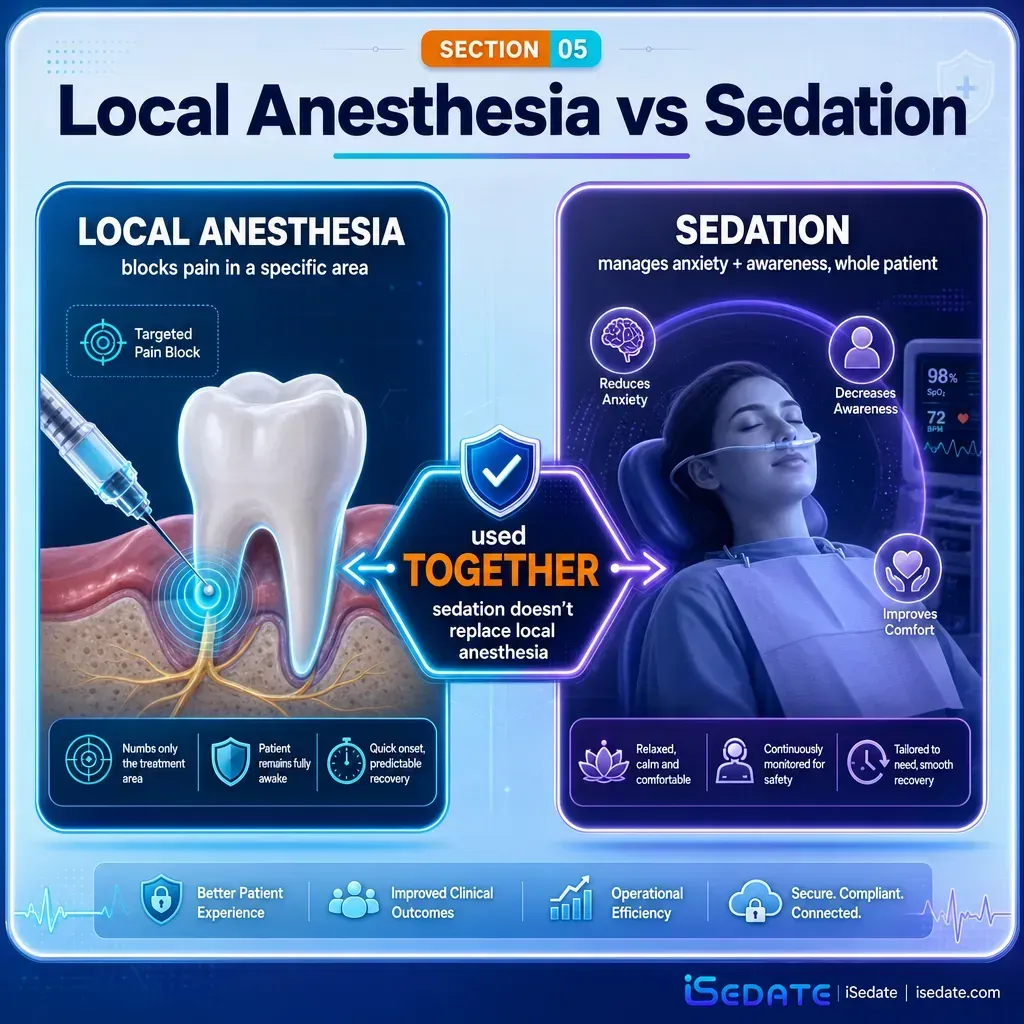
Nitrous oxide needs no sedation permit. Inhaled nitrous oxide and oxygen is the lightest form of anxiety control, where the patient stays fully responsive. Kansas does not require a separate sedation permit for nitrous oxide alone, though it remains subject to the board's general practice rules.
Level I, enteral (oral) conscious sedation (K.A.R. 71-5-10). Authorizes enteral conscious sedation, typically an oral drug regimen, where the patient responds purposefully to verbal or tactile stimulation and keeps their own airway. This is the common starting point for general dentists who offer real oral conscious sedation.
Level II, parenteral conscious sedation (K.A.R. 71-5-11). Authorizes parenteral conscious sedation, meaning the IV route and other injected routes that bypass the gastrointestinal tract. Because IV sedation carries a higher risk and a faster onset, Level II sits above Level I and carries heavier training, monitoring, and record requirements, including continuous capnography during administration. This is where sedation-trained dentists and oral surgeons typically operate.
Level III, deep sedation and general anesthesia (K.A.R. 71-5-12). The top tier. It authorizes deep sedation and general anesthesia, where the patient is not easily aroused or is unconscious and may need airway support. Level III is largely the province of dental anesthesiologists and oral and maxillofacial surgeons, so most general dentists operate at nitrous oxide or Level I, step up to Level II for IV work, and do not pursue Level III. Its full training and monitoring rules sit in K.A.R. 71-5-12, so if you are pursuing it, work directly from that regulation with the board.
Source: Kansas Dental Board permit levels and applications
How to get or upgrade each permit
Each permit has its own bar to clear: a set amount of training, resuscitation certification, and a count of clinical cases. You move up the ladder by meeting the next level's requirements and applying to the board. The figures below are drawn from Article 71-5.
| Permit | Route / depth | Training | Clinical cases | Resuscitation | Permit fee |
|---|---|---|---|---|---|
| Nitrous oxide (no permit) | Inhalation, lightest | Not a permitted level | Not applicable | Not specified | None |
| Level I (71-5-10) | Enteral (oral) conscious sedation | At least 18 hours of education | 20 clinical experiences (may be simulation or video) | BLS | $100 |
| Level II (71-5-11) | Parenteral / IV conscious sedation | Board-approved course of at least 40 didactic hours | 20 clinical cases of parenteral conscious sedation | ACLS | $150 |
| Level III (71-5-12) | Deep sedation / general anesthesia | See K.A.R. 71-5-12 (confirm with board) | 20 clinical cases of deep sedation or general anesthesia over the preceding two years | See K.A.R. 71-5-12 | $200 |
Level I: enteral (oral) conscious sedation
To hold a Level I permit, you complete a board-approved course or training program that includes at least 18 hours of education and 20 clinical experiences, hold current BLS certification, and apply to the board under K.A.R. 71-5-10. Kansas allows those 20 clinical experiences to be met through simulation or video presentations, which makes Level I the most accessible sedation permit and the usual first step for a general practice adding real oral conscious sedation. An alternative path lets an established dentist document 20 clinical cases of conscious sedation over the preceding five years for board review instead of the course.
Level II: adding IV sedation
Upgrading to a Level II permit for parenteral conscious sedation is the biggest step a general dentist or oral surgeon takes. The course path requires a board-approved program of at least 40 hours of didactic instruction plus 20 clinical cases of parenteral conscious sedation, with current ACLS, under K.A.R. 71-5-11. Note the difference from Level I: the clinical requirement is now live clinical cases, not simulation or video, because IV titration demands hands-on competence a classroom cannot replicate. The resuscitation bar also rises from BLS to ACLS. An alternative path lets an applicant document at least 20 clinical cases of parenteral sedation over the preceding two years for board evaluation.
Myth, Busted
Myth: A quick weekend course is enough for a general dentist to start running IV sedation in Kansas.
Fact: A Kansas Level II permit for parenteral conscious sedation takes a board-approved course of at least 40 didactic hours, 20 clinical cases, and current ACLS before the board will issue it, per the Kansas Dental Board's permit requirements.
The confusion usually comes from nitrous oxide, which needs no permit at all. The permitted levels above it each carry real training and clinical-case bars.
Course providers are approved by the board, and the board's applications page lists the current providers for each level. Do not rely on a requirement you read on a CE provider's page, and confirm the exact forms and current fees with the Kansas Dental Board before you file.
Source: Kansas Dental Board applications and approved course providers

What the permit requires you to monitor
A permit is permission plus obligation. Once you hold a Level II permit for parenteral conscious sedation, K.A.R. 71-5-11 requires you to monitor the patient through administration and recovery across these systems:
- Ventilation and exhaled carbon dioxide: during administration, you must continuously monitor for the presence of exhaled carbon dioxide using a capnograph, unless the patient, the procedure, or the equipment precludes it (71-5-11(e)(2)).
- Oxygenation and circulation: blood pressure, heart rate, and oxygen saturation are recorded at least every five minutes during administration and recovery (71-5-11(g)(1)).
- Consciousness: the patient's ability to respond to physical stimulation or verbal command is recorded every five minutes (71-5-11(g)(2)).
- Emergency readiness: an automated external defibrillator or defibrillator must be available and in working order (71-5-11(e)(3)).
Level III, for deep sedation and general anesthesia under K.A.R. 71-5-12, goes further still. For the full clinical breakdown of what to monitor and chart at each depth, see the companion guide on Kansas sedation vitals monitoring, charting, and reporting requirements, and the national overview in our Sedation Dentistry Licensing & Permit Requirements by State hub.
Source: Kansas Dental Board sedation rules and applications
Reporting and recordkeeping obligations
Holding a permit also means holding a set of documentation duties, and these are exactly what a board review examines.
The contemporaneous sedation record
Under K.A.R. 71-5-11(f), whenever parenteral sedation is given, a record must be made at the time of care. It must include the name and amount of each fluid administered, the site of each medication and the catheter type where one is used, and documentation of the sedative agents, their approximate administration times, and amounts, together with the patient's blood pressure, heart rate, and oxygen saturation at the start of sedation, at the end of the procedure, and at five-minute intervals.
Ten-year retention
Under K.A.R. 71-5-11(f), the sedation record is kept as part of the patient's record for at least 10 years, and the same contemporaneous-record and 10-year retention duty applies to the sedation records required for Level I under K.A.R. 71-5-10.
Adverse-event reporting
Kansas ties a hard reporting trigger to sedation care. Under the board's anesthesia and sedation rules in Article 71-5, a permit holder must file a written report with the board within 30 days of any mortality or morbidity associated with the administration of sedation or general anesthesia, describing the dental procedure and the incident. The exact penalty schedule that can follow is set by the board under the Kansas Dental Practice Act, so confirm the current reporting form and timelines directly with the Kansas Dental Board.
Source: Kansas Dental Board | K.S.A. 65-1444, Kansas Office of Revisor of Statutes
Fees, CE, and renewal
Your sedation permit is tied to your Kansas dental license and is renewed as part of the biennial license renewal. Each level carries its own permit fee and its own sedation-specific continuing-education requirement on top of the CE you already do for license renewal.
Kansas sedation permit fee by level (K.A.R. Article 71-5)
Renewal also turns on staying current in resuscitation and sedation CE: BLS and six hours of sedation-specific continuing education for Level I, and ACLS and eight hours of sedation-specific continuing education, which includes airway and intravenous-sedation complications and their management, for Level II. Fees and CE requirements are set by board rule and can change, so confirm your current renewal cycle, CE hours, resuscitation requirements, and fees directly with the Kansas Dental Board so your permit never lapses at renewal.
Source: Kansas Dental Board permit fees and renewal
Inspections and record reviews
This is where a permit is kept or lost. The permits that authorize parenteral and deeper sedation, Level II and Level III, carry the heaviest scrutiny, because that is where the risk is. The Kansas Dental Board has authority to review a permit holder's sedation records, and the routine review process for permit holders is set by board rule, so confirm the current inspection and review process directly with the board.
When a reviewer opens your file, they are checking the record, not your intentions. Kansas sets an explicit, itemized documentation standard in 71-5-11(f): fluids and amounts, medication sites and catheter type, agents and times, and vitals at the start, the end, and every five minutes. A board review turns on whether that contemporaneous record is complete, time-stamped, and intervaled correctly. In other words, the dentist can perform the sedation correctly and still lose on the paperwork, because the paperwork is what the regulation measures.
Source: Kansas Dental Board
Keeping the permit: audit-ready records
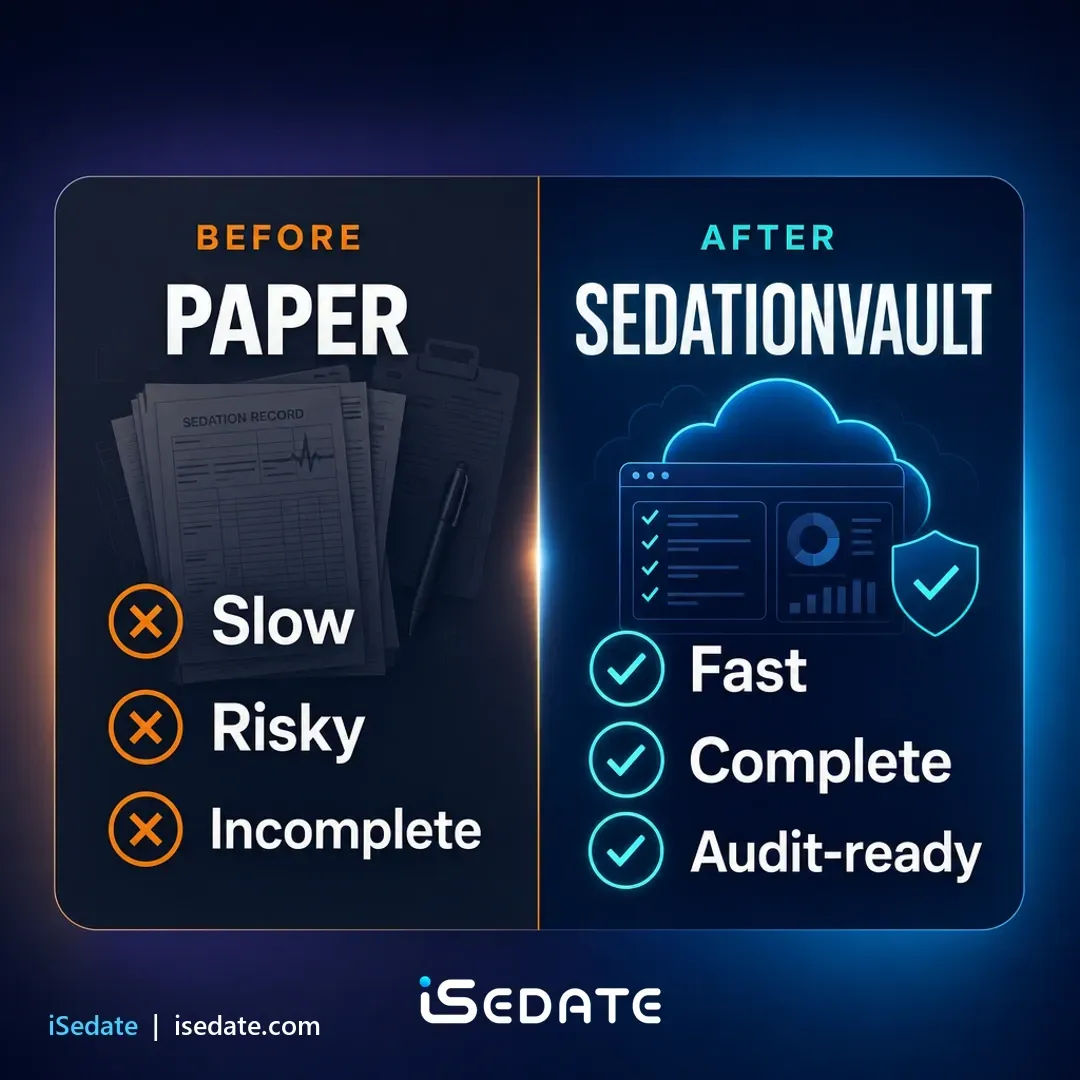
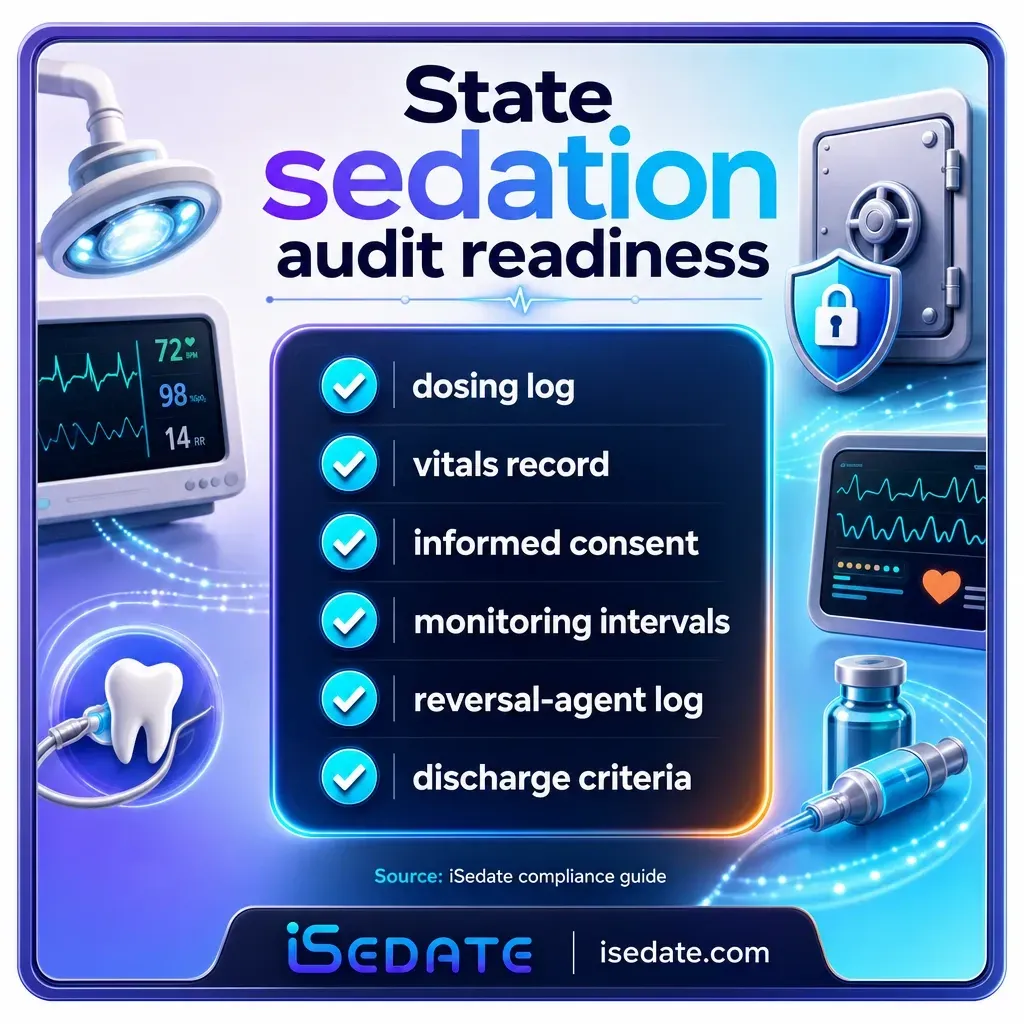
Everything above points to one truth: getting the permit is a one-time hurdle, but keeping it is a daily documentation discipline. A manual vitals log written every five minutes by hand, between titrating a drug and watching an airway, is exactly where records go incomplete, and incomplete records are what a board review and a malpractice claim both attack. Kansas's five-minute interval is a tighter cadence than many states impose, which means more rows to fill and more chances to miss one.
SedationVault removes that failure point. It captures live patient vitals from any connected vitals monitor and logs drugs and fluids automatically into a contemporaneous, Kansas-ready sedation record, holding the five-minute interval that 71-5-11 demands, so the record writes itself while you focus on the patient. When the board asks for the file, a complete 10-year record is a one-click, audit-ready PDF, not a scramble through paper. See how it maps to Kansas rules on the dental sedation compliance and anesthesia record software pages.
Book a Demo of SedationVault See SedationVault PricingFrequently asked questions
What sedation permits does Kansas offer?
How many hours do you need for an IV sedation permit in Kansas?
Do you need a permit for nitrous oxide in Kansas?
What does a Kansas sedation permit cost?
How often do you renew a Kansas sedation permit?
How long must Kansas sedation records be kept?
Related guides and neighboring states
Licensed in a neighboring state, or comparing requirements across state lines? See our sedation licensing and permit guides for the states around Kansas, and the full national hub:
- Colorado Sedation Dentistry Licensing & Permit Requirements
- Missouri Sedation Dentistry Licensing & Permit Requirements
- Nebraska Sedation Dentistry Licensing & Permit Requirements
- Oklahoma Sedation Dentistry Licensing & Permit Requirements
- Sedation Dentistry Licensing & Permit Requirements by State (all 50 states)
For the Kansas clinical companion, see Kansas Sedation Vitals Monitoring, Charting & Reporting Requirements.
Sources
- Kansas Dental Board, permit applications and approved course providers (permit levels, applications, fees, approved courses)
- K.S.A. 65-1444, Kansas Office of Revisor of Statutes (statutory authority for sedation and anesthesia permits)
- K.A.R. Agency 71, Article 5: Anesthesia and sedation (71-5-7 definitions, 71-5-9 general requirements and reporting, 71-5-10 Level I, 71-5-11 Level II, 71-5-12 Level III). The official text is published in the Kansas Administrative Regulations; confirm the current Article 71-5 wording with the Kansas Dental Board.
This guide summarizes Kansas sedation permit rules for general information and is not legal advice. Training, clinical-case counts, resuscitation requirements, monitoring, recordkeeping, fees, and CE are drawn from K.A.R. Article 71-5 and K.S.A. 65-1444 as cited and are current as of November 2026. Application forms, the approved-course list, the exact fee schedule, the routine inspection process, the penalty schedule, and Level III (71-5-12) training specifics are set by the Kansas Dental Board and should be confirmed directly with the board before you act.