






Nebraska Sedation Dentistry Licensing & Permit Requirements
In Nebraska, your dental license alone does not let you sedate a patient. Before the first dose of minimal, moderate, deep, or general anesthesia, the dentist must hold the matching permit from the Nebraska Board of Dentistry, and for anything past minimal sedation the office itself has to pass an inspection first. Those permits, the training behind them, the renewal clock, and the records that keep them live in one chapter of state rule, 172 NAC 56, backed by the Dentistry Practice Act. This guide walks the whole path: which permit each level needs, how to qualify, how to renew, and the recordkeeping that keeps the credential from being challenged.
Recent Updates
Last UpdatedNovember 16, 2026
- Rewrote the guide against the current 172 NAC 56 (amended effective June 2, 2024) and the Nebraska Board of Dentistry's own licensure page.
- Replaced the third-party statute mirrors (Cornell LII, Justia) with direct links to the official Nebraska Legislature statutes (38-1139, 38-1140, 38-1141), the DHHS Board of Dentistry licensure page, and the board's own application forms.
- Added the verified requirements the prior version left open: the mandatory office inspection, the onsite evaluation, the 30-hour license CE cycle, and the 6-hour sedation-specific CE for permit holders.
- Clarified the three permit levels by their official Nebraska names and the per-location rule.
- Nebraska issues three sedation permits under 172 NAC 56: Minimal, Moderate, and General Anesthesia/Deep Sedation. Nitrous oxide and inhalation analgesia need only a Nebraska dental license.
- Each permit is issued to the dentist per location, and dentists applying for a moderate or general anesthesia/deep sedation permit must have the office inspected before it issues.
- Permits are valid until March 1 of the next odd-numbered year, and the permit fee is $200 for issuance or renewal (172 NAC 56-012).
- License renewal takes 30 CE hours every 24 months, and moderate and general anesthesia/deep sedation permit holders must earn at least 6 of those hours in anesthesia or sedation administration.
- A moderate, deep, or general anesthesia permit requires a per-patient anesthesia record of blood pressure, pulse, drugs and amounts, procedure length, and complications (172 NAC 56, section 009.04(E)). Incomplete records are where permits get challenged.
What This Guide Covers
Do You Need a Permit to Sedate Patients in Nebraska?
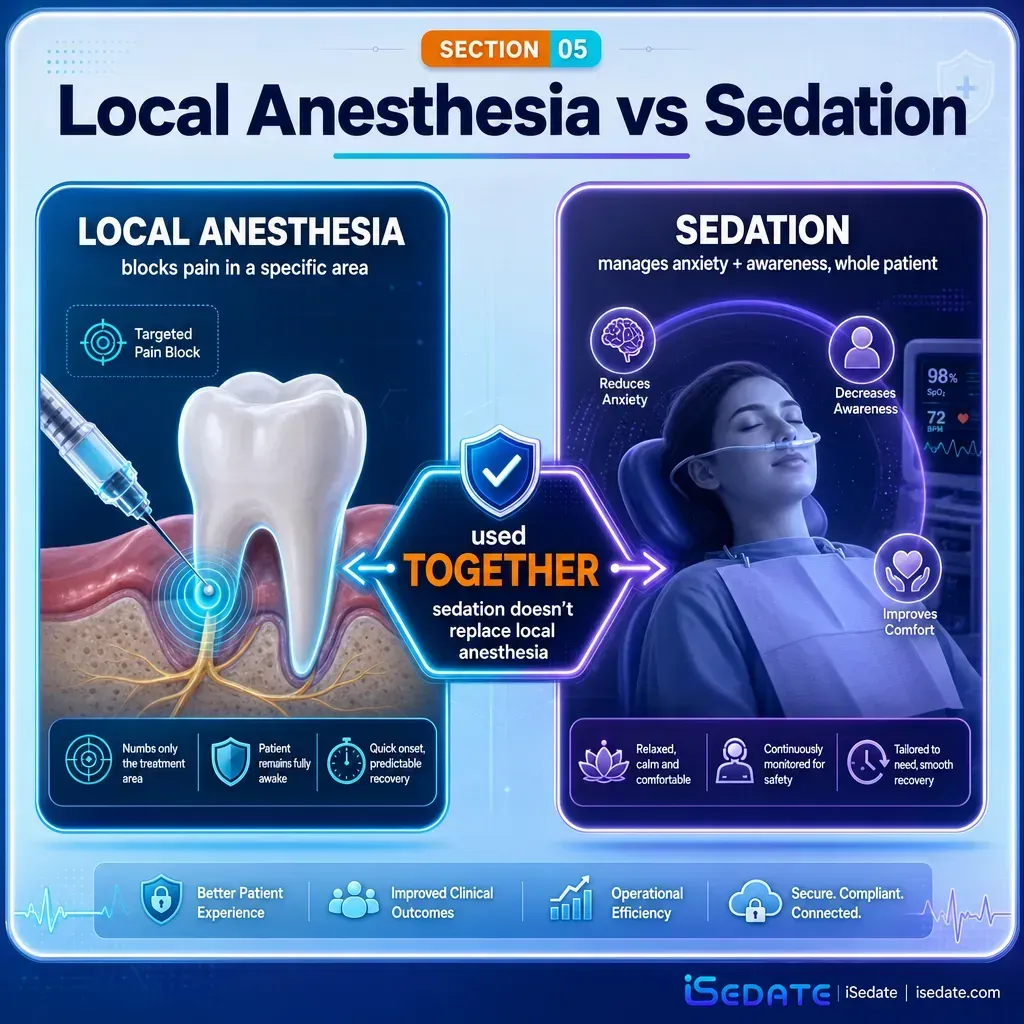
Usually, yes. Inhalation analgesia, the nitrous oxide that keeps a patient fully responsive, is the one exception: the Nebraska Board of Dentistry says a licensed dentist may provide it without a permit. Everything deeper needs a permit. Minimal sedation, moderate sedation, deep sedation, and general anesthesia each require a permit the board issues to the dentist, and that permit is tied to the location where you administer it. If you add sedation at a second office or move practices, you file a change-of-location application for the new address.
The part dentists most often underestimate is the office side. For moderate sedation and for general anesthesia/deep sedation, the board inspects your office before it issues the permit, and the deeper permits also require you to pass an onsite evaluation covering physical evaluation, monitoring, sedation, and emergency medicine. The permit is not a form you file alone, it is a credential the board verifies in your operatory.
Source: Nebraska DHHS Board of Dentistry licensure page
Who Issues Nebraska Sedation Permits
Sedation dentistry in Nebraska is regulated by the Nebraska Board of Dentistry, administered through the Nebraska Department of Health and Human Services, Division of Public Health, Licensure Unit. Under the Dentistry Practice Act, the department, acting on the board's recommendation, issues each sedation and anesthesia permit to a qualifying Nebraska-licensed dentist. The board, not any national body, decides who may sedate, inspects offices, sets the record requirements, and acts on violations. The detailed rules live in Title 172 of the Nebraska Administrative Code, Chapter 56, governing the licensure of dentists to administer minimal, moderate, or general anesthesia and deep sedation.
Myth, Busted
Myth: The ADA guidelines are federal law, so meeting them is enough to sedate legally in Nebraska.
Fact: The American Dental Association is a private professional association, not a government agency. It publishes sedation guidelines that Nebraska leans on, but it does not license, inspect, or discipline anyone. Your authority to sedate comes from a Nebraska Board of Dentistry permit under 172 NAC 56.
Federal rules still apply around the edges: the DEA governs controlled-substance records and HIPAA governs patient data. But the permit, the office inspection, and any sanction are the board's call under Nebraska rule.
To apply, you work through the board's own forms, one for each level: the Minimal Sedation Permit application, the Moderate Sedation Permit application, and the General Anesthesia/Deep Sedation Permit application. The current fee amounts are set by board rule and updated periodically, so confirm the exact forms and fees with the board before you file. The Licensure Unit answers questions at (402) 471-2118.
Source: Nebraska DHHS Board of Dentistry | 172 NAC Chapter 56 (official rules)
The Nebraska Permit Levels
Nebraska names its permits by depth of sedation, and the depth, not just the drug or the route, decides which permit you need. Nebraska's rules still use the older term Conscious Sedation in places, which maps to today's Moderate Sedation Permit. Here is the full ladder under Chapter 56 and the Dentistry Practice Act.
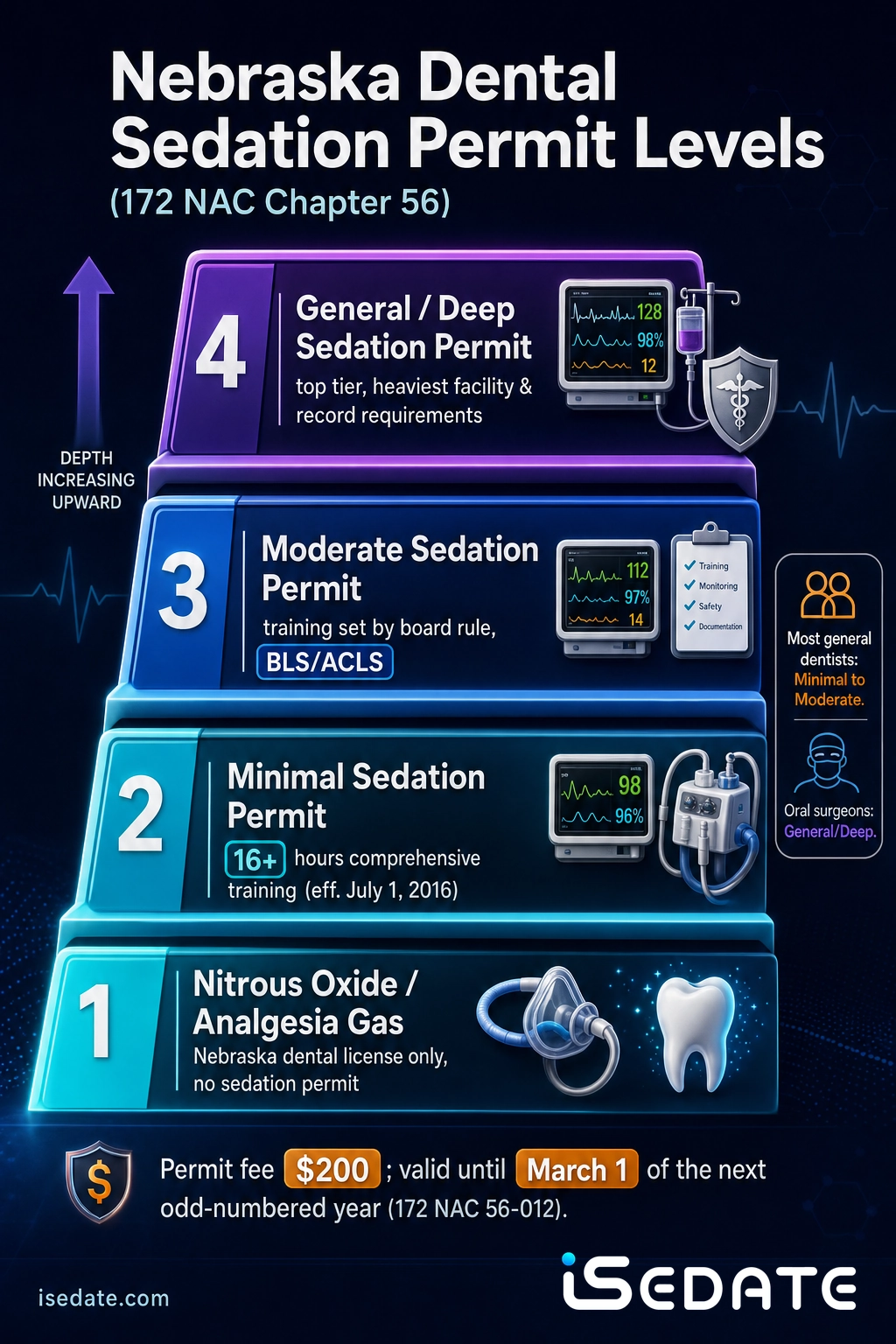
Nitrous oxide and inhalation analgesia, no permit. The lightest form of anxiety control, where the patient stays fully responsive, requires a Nebraska dental license but no separate sedation permit. It sits outside the three-permit scheme below. Note that inhalation analgesia permits issued before July 1, 2016 terminated on that date, because the current rule folds nitrous into the base dental license.
Minimal Sedation Permit (Neb. Rev. Stat. 38-1141). Authorizes minimal sedation, or anxiolysis, typically a single oral drug, where the patient responds normally to verbal command and airway and cardiovascular function are unaffected. This is the common starting point for general dentists offering light oral sedation. The permit requires a properly equipped facility, current BLS (plus PALS if the dentist treats patients age 12 or younger), and either a board-approved advanced education program or competency in minimal sedation consistent with ADA standards through a board-approved comprehensive training program.
Moderate Sedation Permit (Neb. Rev. Stat. 38-1140). Authorizes moderate, or Conscious Sedation, where the patient responds purposefully to verbal or tactile stimulation and keeps their own airway. This is the workhorse permit for dentists doing real conscious sedation, and it carries the fuller facility, certification, and anesthesia-record duties. A permit holder may also administer minimal sedation.
General Anesthesia/Deep Sedation Permit (Neb. Rev. Stat. 38-1139). The top tier. It authorizes deep sedation and general anesthesia, where the patient is not easily aroused or is unconscious and may need airway support. This permit is largely the province of dental anesthesiologists and oral and maxillofacial surgeons and runs beyond the scope of a general practice. It carries the heaviest facility, emergency-management, and recordkeeping requirements in Chapter 56. A holder may also administer moderate and minimal sedation.
State Law
Source: Neb. Rev. Stat. 38-1141 (minimal) | 38-1140 (moderate) | 38-1139 (general anesthesia/deep sedation)
How to Qualify for Each Permit
Each permit has its own bar to clear, and you move up the ladder by meeting the next level's requirements and applying to the board. The statutes set three things for every level above nitrous: a facility equipped for that depth of sedation, current life-support certification, and a training path. Moderate and deeper permits add a passing onsite evaluation and the office inspection.
| Permit | Depth | Life support | Onsite evaluation / inspection |
|---|---|---|---|
| Nitrous / inhalation analgesia (no permit) | Lightest, inhalation | Nebraska dental license only | None |
| Minimal Sedation Permit | Minimal / anxiolysis | BLS (PALS if treating age 12 and under) | Facility equipped per board rule |
| Moderate Sedation Permit | Moderate / Conscious Sedation | BLS + ACLS or approved emergency course | Onsite evaluation + office inspection |
| General Anesthesia/Deep Sedation Permit | Deep sedation / general anesthesia | Current life-support and emergency certifications | Onsite evaluation + office inspection |
The minimal sedation permit
Nebraska's minimal sedation permit was created by LB80, effective July 1, 2016, which closed the gap that let dentists give oral sedation on the license alone. The statute requires a board-approved comprehensive training program consistent with ADA standards. In practice that comprehensive standard is at least 16 hours of didactic training, which is also the floor sedation-education providers use for Nebraska. Verify the specific course against the board's approved minimal sedation training list before you enroll.
State Law
The moderate and general anesthesia/deep sedation permits
The moderate permit requires a facility equipped for moderate sedation, current BLS plus ACLS or an approved emergency-management course, a passing onsite evaluation, and either a board-approved advanced education program in moderate sedation or fellowship in the American Dental Society of Anesthesiology. The general anesthesia/deep sedation permit adds the heaviest facility and emergency standards, current life-support and emergency certifications, a passing onsite evaluation under the board's standard, and completion of a board-approved advanced education program (or fellowship in the American Dental Society of Anesthesiology). For both, the office is inspected before the permit issues. Confirm the current training and certification against the board's approved moderate sedation training list.
iSedate Pro Tip
Treat the onsite evaluation and office inspection as the real deadline. The paperwork can be perfect and the permit still waits on the board confirming your operatory is equipped and your team is ready. Have monitoring equipment, emergency drugs, and staff certifications in place before you schedule the visit, not after.
For enrollment in a board-recognized course, providers such as DOCS Education's Nebraska course listings are one place to look, but always confirm the specific course is board-approved against the board's own pages. The requirement is competency and a completed, approved program, not simply attendance.
Source: Neb. Rev. Stat. 38-1140 (moderate) | 38-1139 (general anesthesia/deep sedation)

What the Permit Requires You to Record
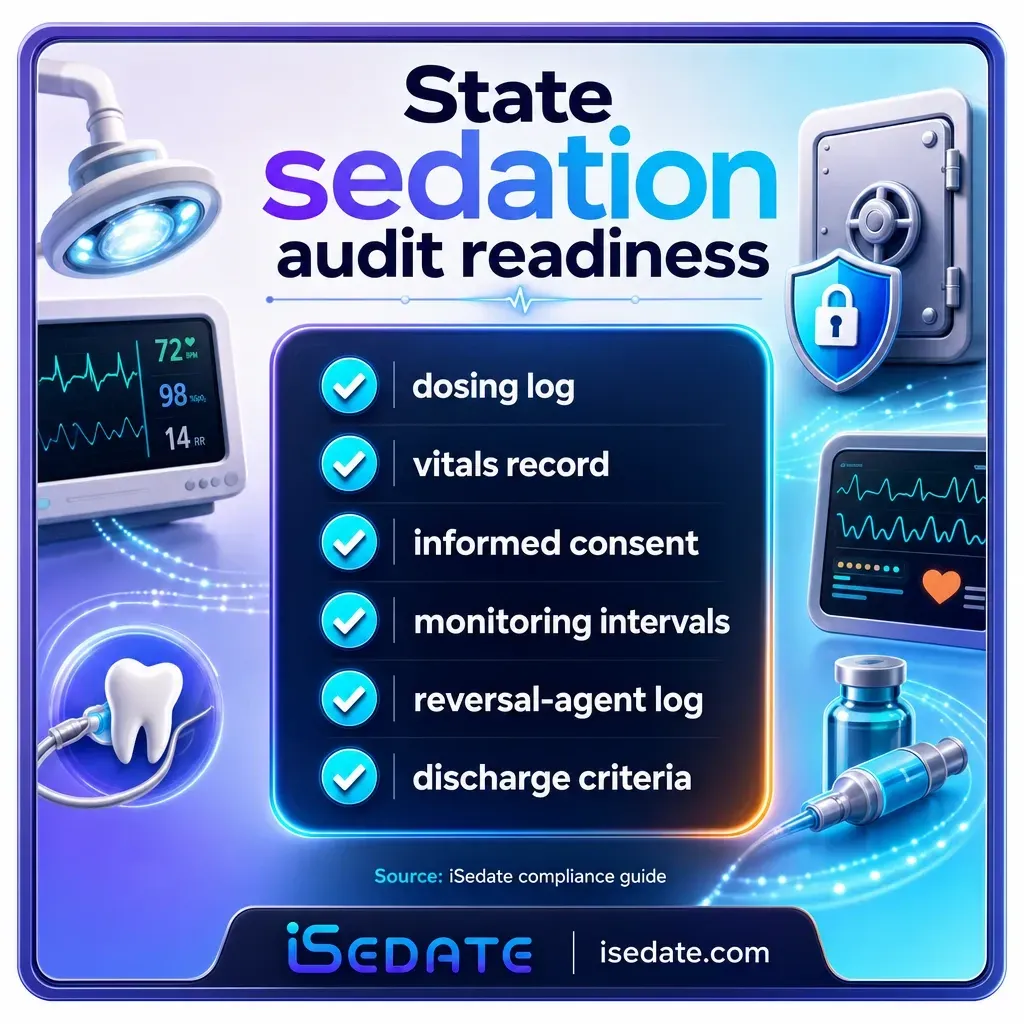
A permit is permission plus obligation. Once you hold a moderate, deep, or general anesthesia permit, 172 NAC 56, section 009.04(E)(i) requires each location to keep an anesthesia record for every patient. In the rule's own words, that record must include blood pressure, pulse, drugs and amounts administered, length of the procedure, and any complications of anesthesia, alongside medical history and physical evaluation records for each patient. The record must also name, and verify the certification of, anyone who assists in administering the sedation, and document the permit holder's current ACLS (or an approved emergency-management course) and the assisting staff's current BLS.
For minimal sedation, a lighter list applies under section 009.04(E)(ii): medical history and physical evaluation records, documentation of the medication and dosage administered, the names of the permit holder and anyone assisting, and the required certifications. For the full clinical breakdown of what to capture and how, see our companion guide on Nebraska Sedation Vitals Monitoring, Charting & Reporting Requirements, and the national overview in our Sedation Dentistry Licensing & Permit Requirements by State hub.
Important
A complete chart is what a board review turns on, not your clinical intent. The sedation can be textbook and the permit can still be challenged on the paperwork: a missing blood-pressure or pulse entry, a drug given but not logged with its amount, an assisting staff member whose certification was never documented, a complication recalled but never written down.
Source: 172 NAC 56, section 009.04(E) (official Nebraska rules)
Renewal, Fees, CE, and Inspections
Nebraska sets its sedation permits on a defined clock. A permit is valid until March 1 of the next odd-numbered year after it is issued, which puts renewal on a roughly biennial schedule, and the permit fee is $200 for issuance or renewal under 172 NAC 56-012. Fees are set by board rule and updated periodically, so confirm the current amount with the board rather than relying on a figure you read elsewhere.
State Law
Your permit rides on your Nebraska dental license, and the license itself renews on continuing education. The board requires 30 hours of acceptable CE every 24-month period. Sedation adds a targeted slice to that total: every general anesthesia/deep sedation and moderate sedation permit holder must earn at least 6 of those hours directly in administering and managing anesthesia or sedation in the dental office.
State Law
Nebraska Sedation Permit Renewal Checklist
- Hold the permit until March 1 of the next odd-numbered year, then renew through the board.
- Pay the $200 permit fee for issuance or renewal (172 NAC 56-012), confirming the current amount with the board.
- Keep your Nebraska dental license current with 30 CE hours every 24 months.
- Earn at least 6 of those hours in anesthesia or sedation administration and management (moderate and general anesthesia/deep sedation holders).
- Maintain current BLS for the team and the required ACLS or emergency-management certification for your level.
- File a change-of-location application if you move the office where you administer sedation.
On the office side, dentists applying for a moderate or general anesthesia/deep sedation permit must have the office inspected before the permit issues, and the board can verify an operating permit holder still meets the standard. If a holder falls below the minimum qualifications, the board may pursue disciplinary action under the Dentistry Practice Act and the Uniform Credentialing Act. The exact adverse-event reporting triggers, timelines, and penalty schedule are set under those acts and by board rule and can change, so confirm the current duties directly with the board.
Source: Nebraska DHHS Board of Dentistry (renewal, CE, inspection) | 172 NAC 56 regulation index
Keeping the Permit: Audit-Ready Records
Everything above points to one truth: earning the permit is a one-time hurdle, but keeping it is a daily documentation discipline. A manual vitals and drug log written by hand, between titrating a drug and watching an airway, is exactly where records go incomplete, and incomplete records are what a board review and a malpractice claim both attack.
SedationVault removes that failure point. It captures live patient vitals and the drug log automatically into a per-patient anesthesia record that holds the blood pressure, pulse, drugs and amounts, procedure length, and complications that section 009.04(E)(i) names, so the record builds itself while you focus on the patient. When the board asks for a file, a complete record is a one-click export, not a scramble through paper. See how it maps to Nebraska's rule on the dental sedation compliance and anesthesia record software pages.
Book a Demo of SedationVault See SedationVault PricingFrequently Asked Questions
What sedation permits does Nebraska require?
Do you need a permit for nitrous oxide in Nebraska?
How do you qualify for a moderate sedation permit in Nebraska?
How often do you renew a Nebraska sedation permit, and what continuing education is required?
Does Nebraska inspect a dental office before issuing a sedation permit?
What records does a Nebraska sedation permit require?
Licensed in a Neighboring State?
Nebraska's rules are its own. If you also practice across a state line, the permit levels, training paths, and renewal cycles change. See our guides for each neighbor, plus the all-50 overview:
- Colorado Sedation Dentistry Licensing & Permit Requirements
- Iowa Sedation Dentistry Licensing & Permit Requirements
- Kansas Sedation Dentistry Licensing & Permit Requirements
- Missouri Sedation Dentistry Licensing & Permit Requirements
- South Dakota Sedation Dentistry Licensing & Permit Requirements
- Wyoming Sedation Dentistry Licensing & Permit Requirements
- Sedation Dentistry Licensing & Permit Requirements by State
Sources
Sources & How We Verified This Guide
Every requirement above was checked against the official Nebraska statutes on the Nebraska Legislature's site, the Nebraska DHHS Board of Dentistry's own licensure page, and the current 172 NAC Chapter 56 (amended effective June 2, 2024). Fee amounts in 172 NAC 56-012 and specific CE and training courses change over time and should be confirmed with the board before you file.
- Nebraska DHHS Board of Dentistry licensure page: permit levels, per-location rule, office inspection, CE hours, and application forms.
- Neb. Rev. Stat. 38-1139, 38-1140, and 38-1141: the general anesthesia/deep sedation, moderate, and minimal sedation permit statutes.
- 172 NAC Chapter 56 (official Nebraska Administrative Code): permit standards, the section 009.04(E) records list, fees (56-012), and renewal.
- Nebraska DHHS Title 172 regulation index: confirms Chapter 56 was amended effective June 2, 2024.
- Board-approved minimal sedation training list and moderate sedation training list: the courses the board recognizes.
This guide summarizes Nebraska sedation permit rules for general information and is not legal advice. Requirements are current as of November 2026. Application forms, the exact permit fee, the onsite-evaluation standard, CE specifics, the office-inspection process, and any disciplinary and adverse-event reporting timelines are set and updated by the Nebraska Board of Dentistry and should be confirmed directly with the board before you act.