






New Mexico Sedation Vitals Monitoring, Charting & Reporting Requirements
If you sedate patients in a New Mexico dental office, the state's recordkeeping rule has a feature many dentists miss: you must keep two documents, not one. The patient record has to reflect the vital signs you monitored and the ASA classification you assigned, and on top of that New Mexico requires a drug log kept separate from the patient record, listing every drug, its dosage or amount, and the date it was given. Those duties live in Title 16, Chapter 5, Part 15 of the New Mexico Administrative Code (16.5.15 NMAC), they are enforced by the New Mexico Board of Dental Health Care, and the sedation record is the first thing a board inspection examines, on an authority that lets an inspector arrive unannounced. This guide breaks down what New Mexico requires you to monitor and record at each sedation level, what a compliant New Mexico sedation record actually looks like, where dentists most often fall short, and how to make the record audit-ready before anyone asks for it.
Recent Updates
Last UpdatedNovember 16, 2026
- Re-verified every rule against New Mexico's primary source, the official 16.5.15 NMAC text published by the State Records Center and Archives, and replaced the prior aggregator citations with the original official rule text and the New Mexico Board of Dental Health Care's own pages.
- Added a worked "what a compliant New Mexico sedation record looks like" example, an oral-versus-IV documentation breakdown, and a documentation-and-malpractice context section with a sourced closed-claims figure.
- Clarified that New Mexico sets no fixed charting interval for most sedation, with the single nitrous oxide time-stamp exception spelled out, so the record standard is stated honestly rather than borrowed from another state.
- Two documents, not one: for minimal, moderate, and deep sedation, 16.5.15 NMAC requires a drug log kept separate from the patient record, listing the drugs, the dosage or amount, and the date of administration.
- Who enforces it: the New Mexico Board of Dental Health Care, under the Regulation and Licensing Department, not the ADA; the rule is a named administrative code (16.5.15 NMAC), not a vague standard of care.
- The patient record must reflect the vital-sign monitoring required for the level provided, the ASA physical-status classification, and informed consent.
- No fixed interval: unlike some states, New Mexico sets no required numeric interval for charting vitals; the rule defines monitoring as constantly watching the patient, and the record must reflect it. The one time-stamped exception is nitrous oxide.
- Inspection can be unannounced: by the board's sedation affidavit, the facility, the provider, and previous sedation records are subject to inspection, scheduled or unannounced.
What This Guide Covers
- Who regulates sedation in New Mexico
- The New Mexico sedation permit levels
- What you must monitor at each level
- What you must record: the two-document rule
- What a compliant New Mexico sedation record looks like
- How New Mexico inspects records (and how dentists get burned)
- Why this matters: what a charting gap costs
- Enforcement and disciplinary action
- The easy button: an audit-ready record
- Frequently asked questions
- Sources and citations
Who regulates sedation in New Mexico
Sedation and anesthesia in a New Mexico dental office are regulated by the New Mexico Board of Dental Health Care, housed in the state's Regulation and Licensing Department. The board issues the sedation permits, inspects the offices that hold them, and takes disciplinary action. The rules are not scattered through general dental law. They sit in one place: 16.5.15 NMAC, the part of the New Mexico Administrative Code that governs sedation, anesthesia, and analgesia.
That matters for compliance, because it means your recordkeeping obligation is a named administrative rule with an exact citation, not a vague standard of care. When a reviewer asks whether your sedation record meets the requirement, the answer is measured against the specific subsections of 16.5.15 NMAC below.
The ADA Standard vs. New Mexico Law
It is worth being precise about the American Dental Association here. The ADA publishes national sedation guidelines that most boards lean on, and New Mexico even points to the current ADA guidelines for part of its recovery and discharge standard. But the ADA is a private professional standard, not a federal agency and not the law. No federal ADA rule overrides New Mexico. In New Mexico, the law is 16.5.15 NMAC, enforced by the New Mexico Board of Dental Health Care. The federal layers that do apply sit alongside it: the DEA controlled-substance log for your sedative agents, HIPAA for the record itself, and any accreditation standard your facility opts into. For the clinical "what and why" behind these duties across every state, see our Dental Sedation Vitals, Charting & Reporting Requirements by State hub.
Source: 16.5.15 NMAC (official rule text) | New Mexico Board of Dental Health Care
The New Mexico sedation permit levels
New Mexico uses its own structure, and the requirements escalate with each level. Knowing which permit you hold tells you which monitoring and recordkeeping rules apply. These are the levels as 16.5.15 NMAC defines them.
| New Mexico level | What it covers | Citation |
|---|---|---|
| Nitrous Oxide Inhalation Analgesia | Inhaled nitrous oxide and oxygen analgesia | 16.5.15.12 NMAC |
| Minimal Sedation | Minimal sedation using an oral sedative with nitrous oxide (anxiolysis without nitrous oxide needs no permit) | 16.5.15.13 NMAC |
| Moderate Sedation | Moderate sedation, commonly called Conscious Sedation, including the parenteral (IV) route | 16.5.15.14 NMAC |
| Deep Sedation / General Anesthesia | Deep sedation or general anesthesia (the top tier) | 16.5.15.15 NMAC |
Two New Mexico-specific points are worth flagging. First, the minimal sedation rule, which took effect March 18, 2018, requires a permit for minimal sedation that combines an oral sedative with nitrous oxide, while anxiolysis achieved without nitrous oxide does not require this permit. Second, the moderate level (16.5.15.14) folds the parenteral (IV) route in, rather than splitting enteral and IV into separate numbered permits as some states do. This guide focuses on what each level requires you to chart. If you are working out which permit to apply for or how to upgrade, that belongs in a separate process, covered in our guide to New Mexico Sedation Dentistry Licensing & Permit Requirements.
Source: 16.5.15 NMAC (permit levels 16.5.15.12–.15)
What you must monitor at each level
In New Mexico, what you are required to monitor is what the record must reflect. The two are inseparable: 16.5.15 NMAC defines the physiological parameters to watch at each level, and it requires the patient record to show that monitoring took place. The parameters build as the sedation deepens.
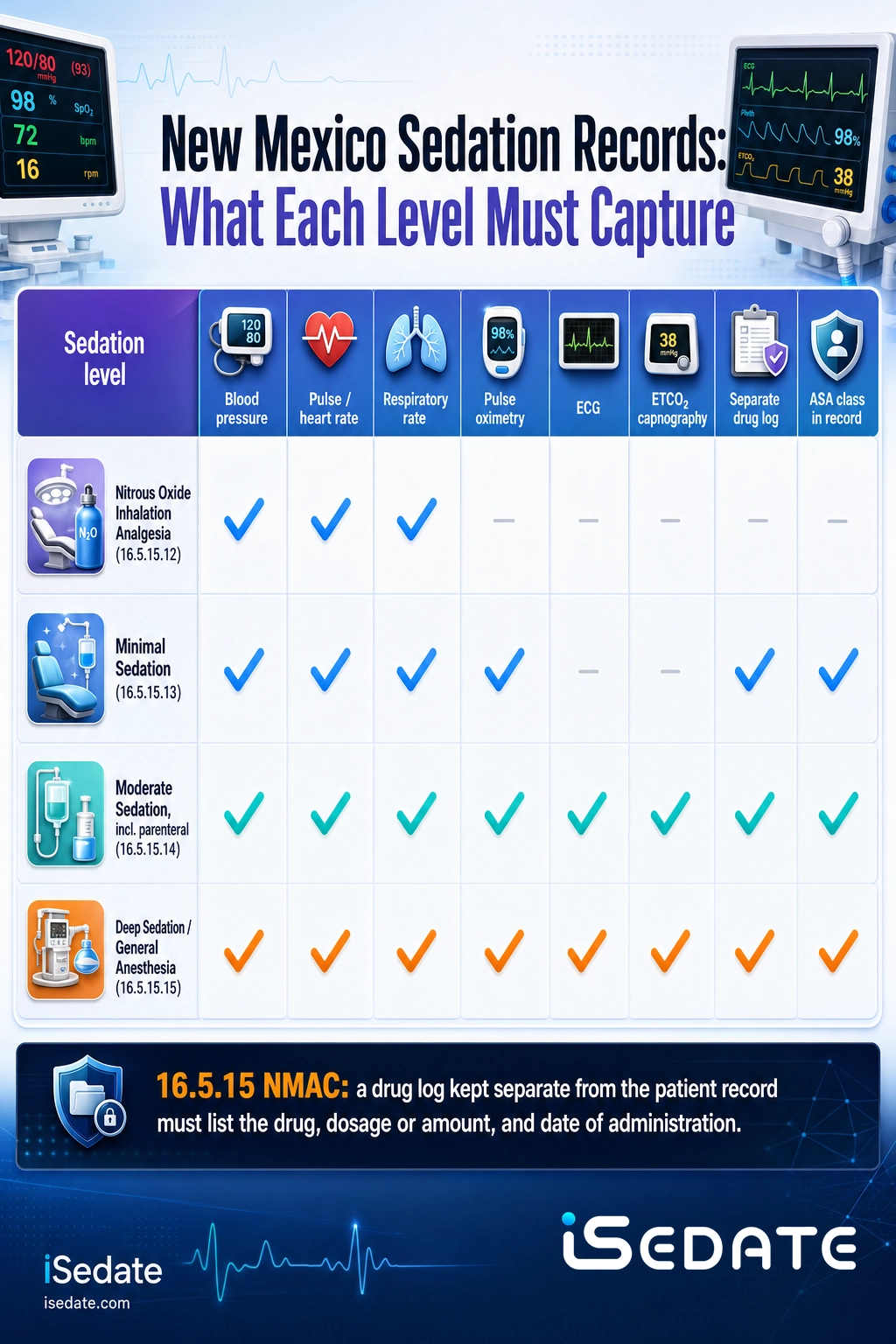
- Nitrous oxide (16.5.15.12 NMAC): the record must reflect evidence of appropriate monitoring of vital signs, including blood pressure, pulse, and respiratory rate.
- Minimal sedation (16.5.15.13 NMAC): the facility must have adequate equipment to monitor the patient's vital signs, and the record must show monitoring of blood pressure, pulse, pulse oximetry, and respiratory rate during the procedure, along with the effect of the medication.
- Moderate sedation (16.5.15.14 NMAC): the patient must be monitored, and the record must reflect the preoperative evaluation including ASA class, pulse oximetry, and blood pressure. ECG is required for parenteral administration, and ETCO₂ capnography or a precordial stethoscope is required for moderate parenteral sedation.
- Deep sedation / general anesthesia (16.5.15.15 NMAC): the record must reflect ECG, pulse oximetry, blood pressure, and ETCO₂ capnography monitoring.
The defined term does real work here. Under 16.5.15.7 NMAC, to "monitor" means to constantly watch or check on the condition of the patient. That is a continuous duty, not a snapshot. The jump from minimal to moderate adds pulse oximetry and ASA documentation, and the move to the parenteral (IV) route inside the moderate level is where ECG and capnography enter. The deeper you go, the more parameters you are both watching and recording.
Myth, Busted
Myth: New Mexico has no required interval, so I can chart the vitals once at the end.
Fact: No. 16.5.15.7 NMAC defines monitoring as constantly watching the patient, and the record must reflect that monitoring.
It is true that New Mexico sets no fixed numeric interval for most sedation. But a single end-of-case entry does not show constant monitoring, and it does not survive a reviewer asking what the patient's vitals were doing during the case. The absence of a stated interval is not permission to chart less; it is a standard your contemporaneous record still has to meet.
Source: 16.5.15 NMAC (monitoring by level, 16.5.15.12–.15)
What you must record: the two-document rule
This is the section a reviewer reads first. New Mexico's record requirements come in two parts: a drug log that stands apart from the patient record, and a patient record that carries the clinical picture.
1. A drug log kept separate from the patient record
This is the New Mexico feature that catches practices out. For minimal sedation (16.5.15.13 NMAC), moderate sedation (16.5.15.14 NMAC), and deep sedation or general anesthesia (16.5.15.15 NMAC), the dentist must keep a log of the drugs used that is separate from the patient's record. That log must list the drugs, the dosage or amount of drug used, and the date of administration. A drug noted only inside the clinical chart, with no separate log, does not satisfy the rule. The log is its own document.
State Law
2. A patient record that reflects monitoring, ASA class, and consent
Alongside the drug log, the patient record itself has to carry the clinical picture. It must reflect the vital-sign monitoring required for the level you provided, the ASA physical-status classification assigned in the preoperative evaluation, and the patient's informed consent. For nitrous oxide there is one explicit time-stamped duty: under 16.5.15.12 NMAC, the record should note the dose percentage of nitrous oxide, the time of administration, and the time the patient was released. That is the only clock-based entry New Mexico spells out by number, and it is easy to forget on a routine nitrous case.
3. A documented recovery and discharge
Recovery has its own documentation duty for the deeper levels. For moderate sedation (16.5.15.14 NMAC) and deep sedation or general anesthesia (16.5.15.15 NMAC), the dentist must document recovery and discharge in accordance with the current ADA guidelines. This is the point where New Mexico explicitly folds the national professional standard into its own rule: the board makes the current ADA recovery and discharge criteria the measuring stick, so a discharge that is not documented against those criteria is a gap in a New Mexico record, not just a departure from best practice.
Source: 16.5.15.13, .14, and .15 NMAC (record and drug-log duties)
See how a time-oriented anesthesia record and separate drug log are built automaticallyWhat a compliant New Mexico sedation record looks like
Knowing the rule and passing a review are two different skills. In New Mexico the gap is almost always the same thing: the two documents have to exist, be complete, and be written as the case runs. Here is what that looks like in practice, broken into the pieces 16.5.15 NMAC actually asks for.
New Mexico Sedation Record: Required Contents
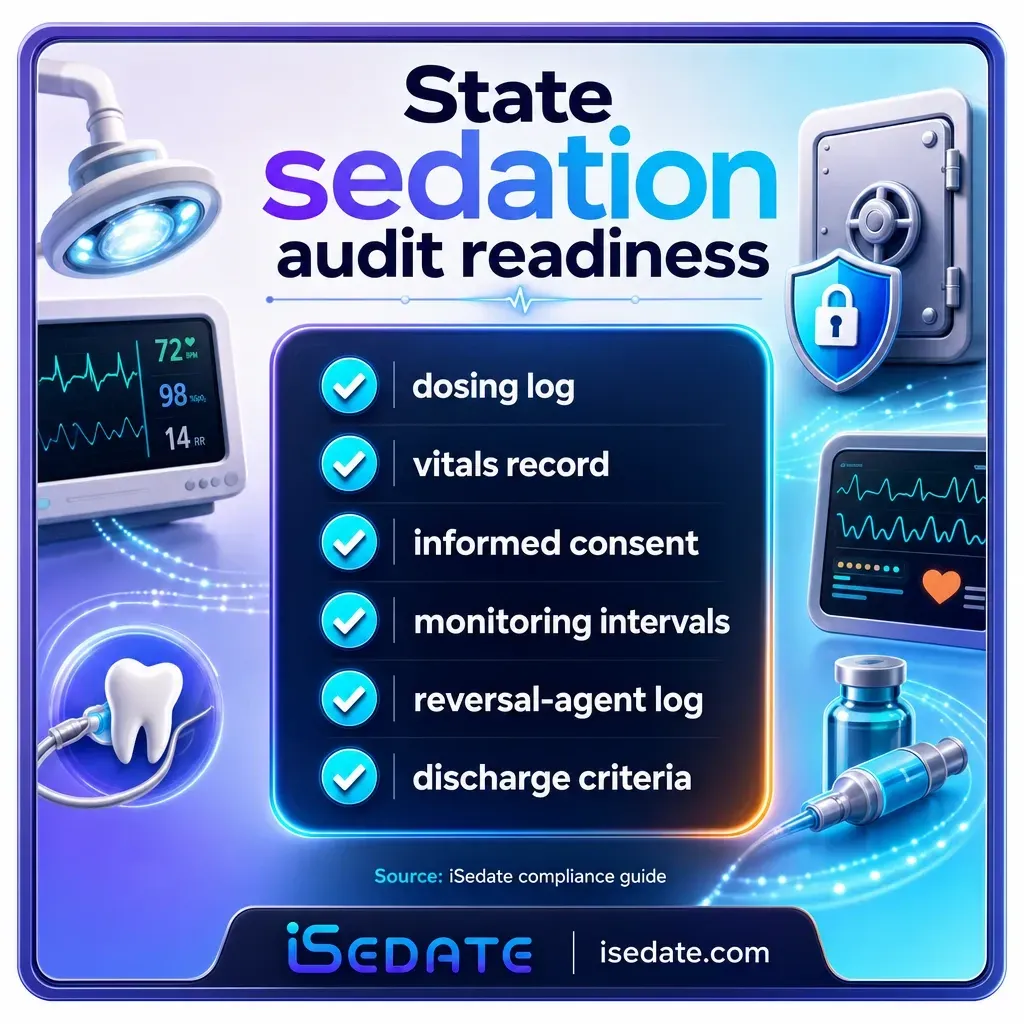
- The separate drug log: a standalone log, apart from the patient chart, listing each sedative and agent used, its dosage or amount, and the date of administration.
- Pre-op baseline and ASA class: the vital signs required at your level, taken and recorded before the first agent, plus the ASA physical-status classification and the completed informed consent for sedation.
- Monitored vitals reflected in the record: the parameters your level requires (blood pressure, pulse, respiratory rate, pulse oximetry, and ECG or ETCO₂ capnography where the level calls for them), documented as monitored, not just owned as equipment.
- Nitrous time stamps, when nitrous is used: the dose percentage of nitrous oxide, the time of administration, and the time the patient was released.
- Recovery and discharge: for moderate and deep sedation or general anesthesia, recovery and discharge documented in accordance with the current ADA guidelines.
Oral versus IV sedation changes the detail, not the duty. With oral minimal or moderate sedation, the drug log is simpler, often a single agent, dose, and date, and the monitored parameters stop at blood pressure, pulse, respiratory rate, and pulse oximetry. The moment you move to the parenteral (IV) route inside the moderate level, 16.5.15.14 NMAC adds ECG and either ETCO₂ capnography or a precordial stethoscope, and at deep sedation or general anesthesia 16.5.15.15 NMAC requires ECG, pulse oximetry, blood pressure, and capnography together. The record gets denser as the sedation deepens, but the backbone, a separate drug log plus a patient record that reflects the monitoring and the ASA class, never changes.
Because New Mexico does not publish a fixed charting interval for most sedation, the practical standard is a contemporaneous record that genuinely reflects constant monitoring, not a reading entered from memory after the case. If you see a longer field list or a specific interval attributed to New Mexico, confirm it against the board's own 16.5.15 NMAC text, because that rule language is what an inspector measures against. A specific record-retention period is not stated in 16.5.15 NMAC, so apply your general patient-record retention obligation and confirm the current expectation with the New Mexico Board of Dental Health Care.
Source: 16.5.15 NMAC (record contents by level)

How New Mexico inspects records (and how dentists get burned)
Holding a sedation permit in New Mexico comes with a standing agreement to be inspected. The board's sedation affidavit states that all aspects of the facility and provider that pertain to the use of anesthesia, including previous sedation records, are subject to inspection, whether scheduled or unannounced. That last word matters: an inspector can arrive without notice, and the record you produce is the record exactly as it stands that day.
Here is where dentists get burned. It is rarely the clinical care that fails a review. It is the record: a missing separate drug log, a patient chart that does not reflect the monitored vitals the level required, an ASA classification that was assigned but never written down, a nitrous case without the administration and release times, a discharge that was never documented against the ADA criteria. The sedation can be flawless and the paperwork can still fail, because two documents were required and only one exists, or the one that exists has gaps.
Important
A New Mexico inspector does not grade your sedation on how the patient did. They grade it on whether the contemporaneous record, and the separate drug log, prove what you did. If the drug log is missing or the patient record does not reflect constant monitoring, the default assumption on review is that the monitoring had gaps too. Keep both documents, and keep them complete as you go, not after the fact.
Source: New Mexico Board of Dental Health Care, sedation affidavit (inspection authority)
Why this matters: what a charting gap costs
A thin sedation record is not only an inspection problem. It is the first document a plaintiff's attorney and a board investigator reach for, and the same gaps that fail an inspection are the gaps that sink a defense. The point of New Mexico's two-document rule is not bureaucracy. It is that the chart and the drug log are the only contemporaneous proof of what you gave, what you watched, and when.
Closed-Claims Data
Nearly one in five dental claims turns on documentation. On a sedation case, the documents in question are exactly the two New Mexico names: the patient record that is supposed to reflect the monitored vitals and the ASA class, and the separate drug log of every agent, dose, and date. When either is thin, the question a board or a jury asks is no longer "was the care good," it is "can you prove what you did." For the deeper data behind the rules, these research roundups are the companion reads:
Related Research
Source: The Doctors Company: Patient Safety in Dentistry, Documentation (closed-claims data)
Enforcement and disciplinary action
16.5.15 NMAC is backed by enforcement. Under 16.5.16 NMAC and the state's Uniform Licensing Act, the board may take disciplinary actions, including revocation of the sedation or anesthesia permit, for rule violations. Incomplete sedation records are not a filing technicality. They are the evidence a board weighs when deciding whether the standard of care was met, and the same gaps that fail an inspection are the gaps a plaintiff's attorney looks for in a malpractice claim.
The exact disciplinary schedule, any routine office-inspection cadence for permit holders, and specific penalty amounts are administered by the board and can change, so confirm current details directly with the New Mexico Board of Dental Health Care rather than relying on a figure that may be out of date. What does not change is the exposure created by a thin record: in both a board inspection and a lawsuit, the contemporaneous sedation record and the separate drug log are the first things requested and the hardest to reconstruct after the fact.
Source: 16.5.15 NMAC | New Mexico Board of Dental Health Care, statutes and rules
The easy button: an audit-ready record
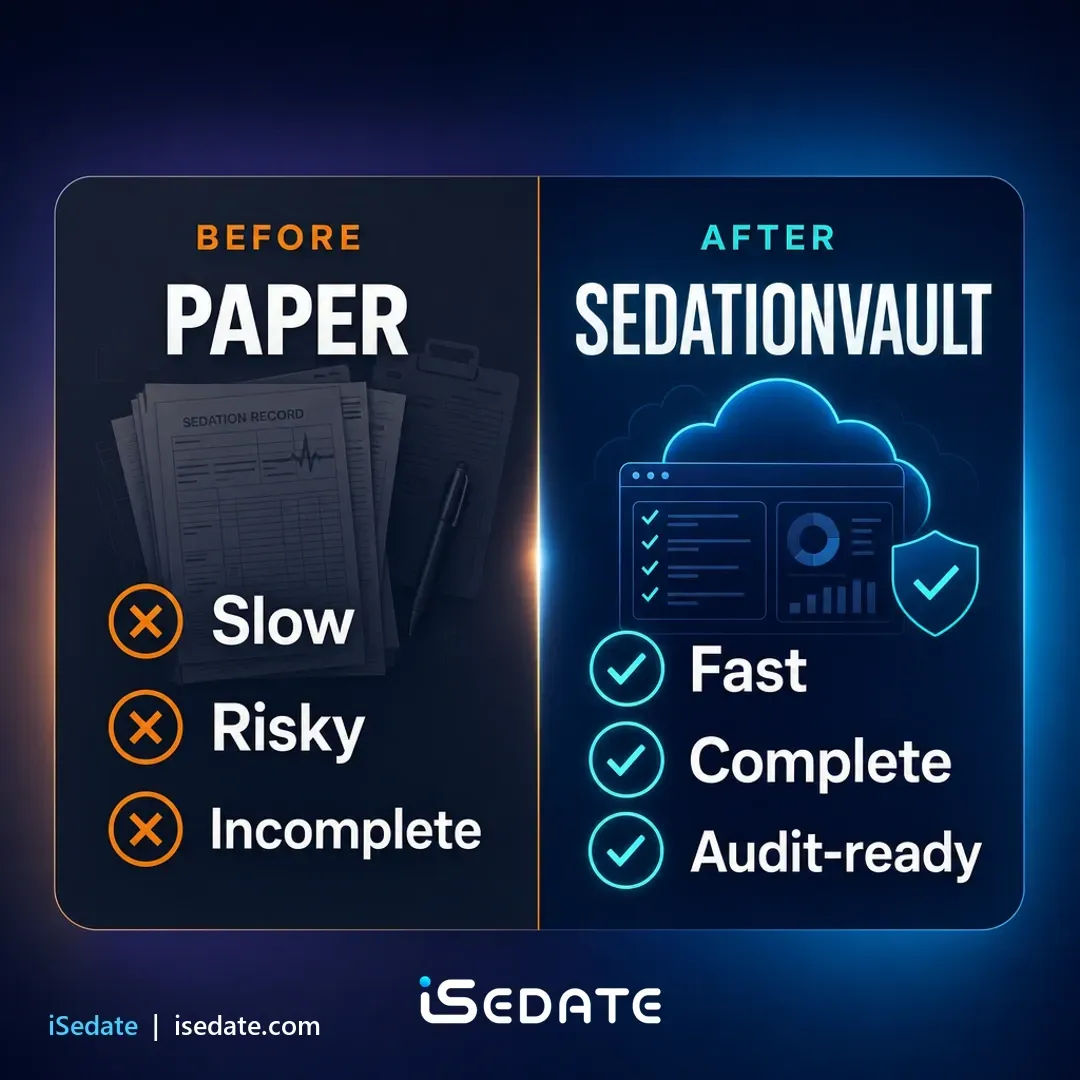
The gap between knowing the rule and passing a review is almost always the same thing: keeping a complete, contemporaneous record and a separate drug log by hand during a live sedation case. When a team is managing an airway and an anxious patient, a vitals entry made from memory after the case, or a drug written in the chart but never logged separately, is exactly where a New Mexico record develops holes, the kind that read as a missing document when an inspector arrives unannounced.
That is the problem SedationVault by iSedate was built to remove. It connects wirelessly to the vitals monitor already in your operatory and captures pulse oximetry, heart rate, respiratory rate, and blood pressure live, on the clock, while it maintains the drug log alongside, so the patient record reflects the monitoring and the separate drug log exists as its own document, both written as the case runs rather than reconstructed afterward. When the New Mexico board asks for the file, it exports as a one-click, audit-ready sedation visit report that already carries the monitored vitals, the dosages, the ASA class, the nitrous time stamps where they apply, and the discharge assessment the rule asks for, whether the case was oral or IV, minimal or deep. The point is not fancier charting. It is turning the exact items 16.5.15 NMAC requires into something the software guarantees are present, which is also what dental sedation compliance turns on.
Book a demo and see your New Mexico sedation record build itselfNot Legal Advice
This guide summarizes New Mexico sedation recordkeeping rules for general information and does not constitute legal or compliance advice. Consult a qualified professional, and confirm current requirements with the New Mexico Board of Dental Health Care, for guidance specific to your practice.
Frequently asked questions
Does New Mexico require a separate drug log for sedation?
How often must vitals be recorded during sedation in New Mexico?
Does New Mexico require a written sedation record?
Who inspects sedation records in New Mexico?
What are the New Mexico dental sedation permit levels?
Does the ASA classification have to be in a New Mexico sedation record?
Related guides and neighboring states
Licensed in more than one state, or practicing near the New Mexico line? The documentation rules change at the border. See the same-silo guides for New Mexico's neighbors, or the full index for every state:
- Arizona Sedation Vitals Monitoring, Charting & Reporting Requirements
- Colorado Sedation Vitals Monitoring, Charting & Reporting Requirements
- Oklahoma Sedation Vitals Monitoring, Charting & Reporting Requirements
- Texas Sedation Vitals Monitoring, Charting & Reporting Requirements
- Dental Sedation Vitals, Charting & Reporting Requirements by State (all 50 states)
Sources and citations
Our Sources & Verification
This guide cites New Mexico's primary regulatory sources. Rule text is drawn from 16.5.15 NMAC as published by the New Mexico State Records Center and Archives, the regulator is the New Mexico Board of Dental Health Care under the Regulation and Licensing Department, and the inspection authority is from the board's sedation affidavit. Every external link was checked to confirm it resolves to the official source. Where a detail is administered by the board and subject to change, it is flagged for direct confirmation rather than stated as fixed.
- 16.5.15 NMAC: Sedation, Anesthesia, and Analgesia (official full rule text, 16.5.15.12–.15)
- 16.5.15 NMAC (official PDF of the full part)
- New Mexico Board of Dental Health Care (Regulation and Licensing Department)
- New Mexico Board of Dental Health Care: statutes, rules, and rule hearings
- New Mexico Board of Dental Health Care, sedation affidavit (inspection authority)
- The Doctors Company: Patient Safety in Dentistry, Documentation (closed-claims data)
Confirm directly with the board: the exact disciplinary and penalty schedule, any routine office-inspection cadence, the precise minimal, moderate, and deep sedation training hours and ACLS specifics, continuing-education and recertification cycles, current fee amounts, and any patient-record retention period are set by the New Mexico Board of Dental Health Care, are not fixed in 16.5.15 NMAC's recording duties, and should be verified before you rely on them.