







California Sedation Vitals Monitoring, Charting & Reporting Requirements
If you administer moderate sedation in California, the record is not an afterthought, it is the rule. State law requires a time-oriented anesthesia record that logs pulse oximetry before, during, and after the procedure, every drug and dose, any complication, and the patient's condition at discharge. That duty comes from the California Business and Professions Code and the Dental Board of California's regulations in Title 16, Article 5, and California has tightened those rules twice in recent years through SB 501 and SB 1453. This guide breaks down exactly what California requires you to monitor and record, what a compliant time-oriented record looks like line by line, how the intervals differ from other states, where dentists most often fall short, and how to make the record survive a board review.
Recent Updates
Last UpdatedNovember 16, 2026
- Re-verified every California statute and regulation citation against the Dental Board of California's current permit pages and official regulation text.
- Added a sample time-oriented sedation record and an oral-versus-IV documentation breakdown so you can see what a compliant chart looks like.
- Updated the inspection guidance after confirming the five-year inspection cycle on the board's general anesthesia permit page.
Key Takeaways
- The core rule: California requires a time-oriented anesthesia record under BPC 1647.6 and 16 CCR Article 5, documenting pulse oximetry before, during, and after the procedure, plus all drugs, doses, complications, and the discharge condition.
- Who enforces it: the Dental Board of California, which issues the permits, inspects offices, and reviews records.
- Tighter than many states: the intra-operative interval is reported to be roughly every five minutes, not the ten-minute interval some states allow. Confirm the exact figure in the current Article 5 text with the board.
- Recent reform: SB 501 (effective Jan 1, 2022) and SB 1453 (effective Jan 1, 2025) overhauled the permit system and raised the monitoring and staffing bar, especially for pediatric patients.
- Keeping the permit turns on the record: the board inspects within one year of a new permit, refusing an inspection means denial or revocation (BPC 1647.7), and the on-site inspection fee is $2,000.

What This Guide Covers
- Who regulates sedation in California
- California's sedation permit levels
- What you must monitor and chart
- What the record must contain
- What compliant documentation looks like
- How California inspects and audits records
- Why a thin record costs so much
- How to build an audit-ready record
- Frequently asked questions
- Related guides and neighboring states
- Sources and methodology
Who regulates sedation in California
Sedation and anesthesia in a California dental office are regulated by the Dental Board of California, the state agency that issues anesthesia and sedation permits, inspects offices, reviews records, and takes disciplinary action. The authority is split across two bodies of law. The statutes sit in the California Business and Professions Code, Division 2, Chapter 4, at sections 1646 through 1647.x and 1682, and the operational detail sits in the California Code of Regulations, Title 16, Division 10, Article 5, which the board writes and enforces.
That split matters because your recordkeeping duty is a named statute plus a named regulation, not a vague standard of care. California has also moved recently. The legislature overhauled the permit system with SB 501, effective January 1, 2022, and amended it again with SB 1453, effective January 1, 2025. Both tightened the rules, so a record that was adequate five years ago may not meet today's framework. The board summarizes the newest changes in its official SB 1453 licensee alert.
It is worth being precise about the American Dental Association here. The ADA publishes national sedation guidelines that most boards lean on, and its most recent update, adopted in October 2025, expects a time-oriented anesthetic record of all drugs and continually recorded vitals for every sedation level. But those guidelines are a professional standard, not law. The ADA is not a federal agency and it does not override California: in this state the law is the Business and Professions Code and 16 CCR Article 5, the body that enforces it is the Dental Board of California, and the federal layers that sit on top are narrow ones like the DEA (controlled-substance logs) and HIPAA (records privacy). For the clinical reasons behind these rules and a 50-state view, see our all-50-state sedation vitals, charting, and reporting guide.
California's sedation permit levels
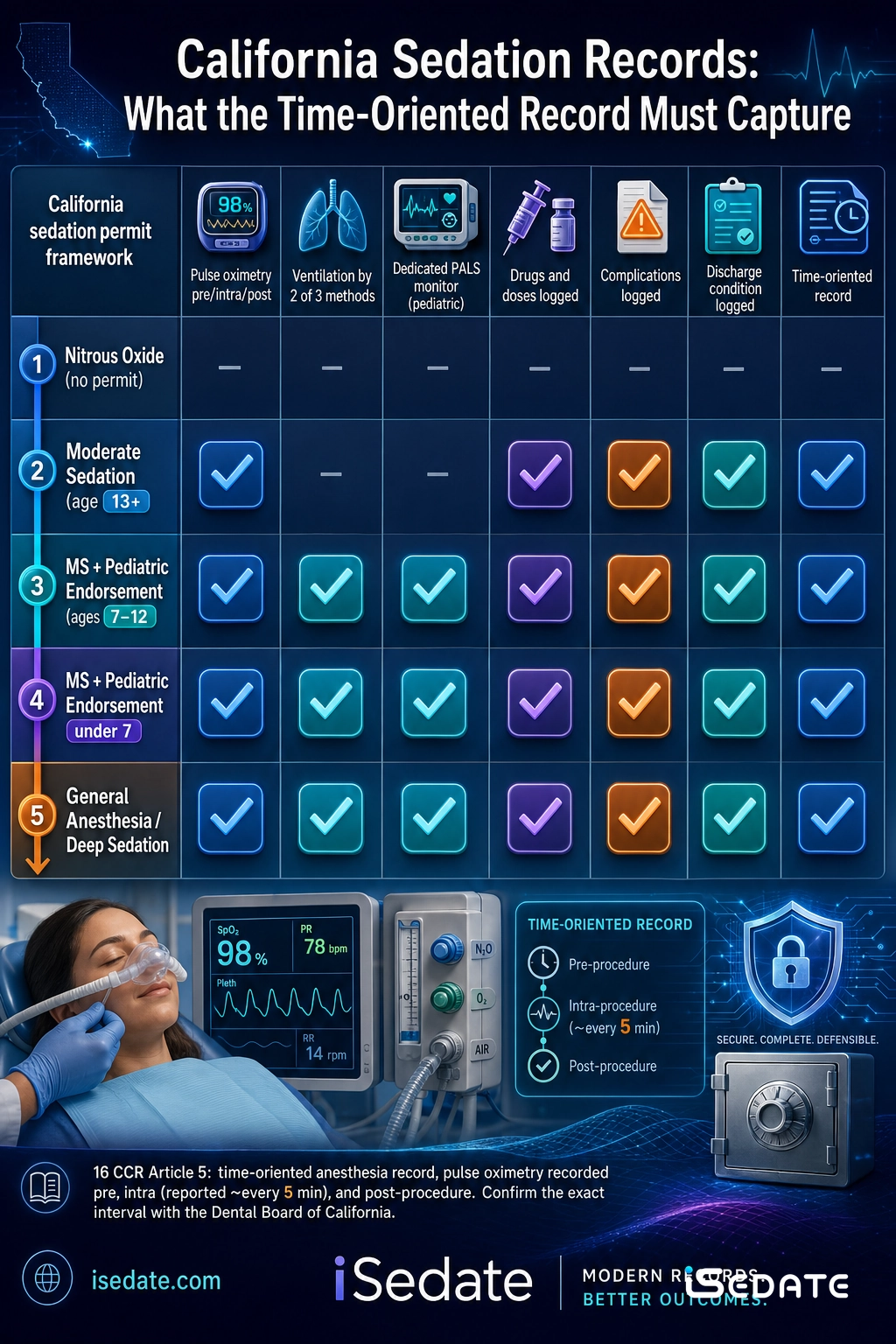
California restructured its permits under SB 501, and knowing which permit you hold tells you which monitoring and recordkeeping rules apply. The framework the board administers today looks like this:
| California permit | What it covers | Authority |
|---|---|---|
| Nitrous oxide (no permit required) | Inhaled nitrous oxide / oxygen sedation | No DBC permit |
| Moderate Sedation permit | Moderate sedation, patients 13 and older | BPC 1647.1 |
| Moderate Sedation with Pediatric Endorsement (ages 7 to 12) | Moderate sedation for patients ages 7 to 12 | BPC 1647.3 |
| Moderate Sedation with Pediatric Endorsement (under 7) | Moderate sedation for patients under 7 | BPC 1647.3 |
| General Anesthesia / Deep Sedation permit | Deep sedation or general anesthesia (top tier) | BPC 1646 et seq. |
Two points are easy to miss. First, nitrous oxide does not require a permit in California, though BLS certification and proper gas scavenging are the standard of care. Second, the terminology shifted under reform. The common phrase Conscious Sedation, long used for moderate sedation, no longer names a standalone California permit: SB 501 retired the old standalone Conscious Sedation permit on January 1, 2022 and folded that scope into the Moderate Sedation permit framework. If your credentials still reference a "conscious sedation permit," that language is out of date, and the moderate sedation framework is what governs you now. The board does still list a separate Oral Conscious Sedation for Adult Patients permit among its licensee permits, so if you are unsure which permit applies, confirm it on the board's permit pages or in our guide to California sedation dentistry licensing and permit requirements. This article focuses on the moderate-sedation recordkeeping standard, because that is the level most sedation dentists are permitted for.
What you must monitor and chart
In California, what you are required to monitor is what you are required to write down. The two are inseparable: the monitoring standard defines the physiological parameters, and the time-oriented record requires each of them to be documented against the clock. For moderate sedation, the dentist monitors the patient's oxygenation, ventilation, circulation, and level of consciousness, with oxygen saturation measured continuously by pulse oximetry and captured in the record before, during, and after the procedure.
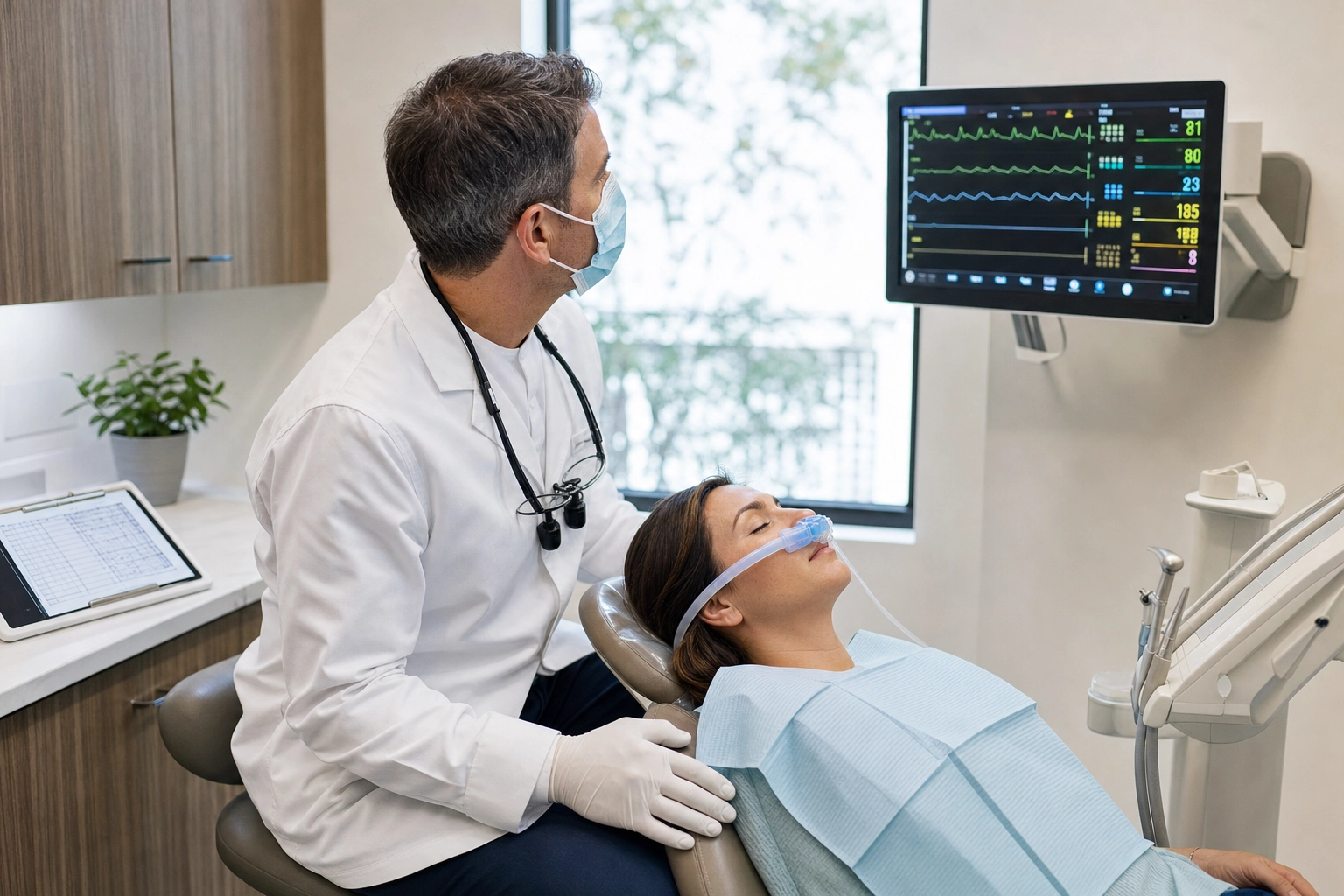
The equipment that feeds that record is itself part of the standard of care. A compliant moderate-sedation operatory runs a pulse oximeter, a blood-pressure monitor, a means of monitoring ventilation (such as a precordial stethoscope or capnography), supplemental oxygen and a positive-pressure delivery device, suction, and age-appropriate emergency and reversal drugs. The monitor is not decoration: every number it displays is a number the time-oriented record is expected to carry.
California then layers additional, stricter duties onto pediatric sedation, which is where SB 501 focused much of its tightening:
Pediatric Monitoring Requirements (patients under 13)
- Continuous pulse oximetry. Under BPC 1682(c), a patient under 13 must be continuously monitored during the procedure with a pulse oximeter or superior monitoring equipment.
- Ventilation by two of three methods. Ventilation must be monitored by at least two of three methods: precordial stethoscope auscultation, capnography, or verbal communication with the patient (verbal communication is not acceptable for deep sedation or general anesthesia).
- Dedicated monitoring staff. Under BPC 1647.2(c), the dentist must be physically present and have at least two support personnel, one of whom holds current Pediatric Advanced Life Support (PALS) certification and is dedicated to monitoring the patient.
- Recovery monitoring. Under BPC 1682(b), recovering patients must be closely monitored, and the recovery staff-to-patient ratio may not exceed three patients to one staff member.
Myth, Busted
Myth: Nitrous or a single oral pill is light sedation, so full monitoring and charting do not really apply.
Fact: The depth of sedation, not the route or the drug, drives the requirement. California and the ADA both define sedation levels by patient response, and the moment a patient reaches moderate sedation the full monitoring and time-oriented recording standard applies, regardless of how the drug was delivered. See the board's moderate sedation permit requirements.
This matters because patients can reach a deeper level than intended. An oral regimen meant to produce light anxiolysis can tip into moderate sedation, and at that point the record has to prove you were monitoring at the deeper level.
What the record must contain
This is the section a reviewer reads first. California's recordkeeping duty comes from a statute and a regulation working together, and it has three parts worth knowing by heart.
1. The statute that requires the record
Under BPC 1647.6, any dentist who holds a sedation permit shall maintain records of the physical evaluation, the medical history, and the moderate sedation procedures. This is the statutory hook: the obligation to document is not merely good practice, it is a condition of holding the permit. The official text sits in the board's official modified anesthesia and sedation regulation text (BPC 1647.6 and 1682 alongside 16 CCR Article 5).
2. A written, time-oriented anesthesia record
The operational detail lives in the Dental Board of California's regulations in 16 CCR Article 5. Those rules require a time-oriented anesthesia or sedation record: one organized against the clock, not a single end-of-visit summary. The record must document pulse oximetry pre-operatively, at multiple points intra-operatively, and post-operatively, along with the drugs and doses administered, any complications, and the patient's condition at discharge. A note that a patient "tolerated sedation well" is not this record. A timeline of vitals, drugs, doses, and times is.
3. The interval: California runs short
The intra-operative interval for recording pulse oximetry in California is reported to be approximately every five minutes, noticeably tighter than the ten-minute interval some states accept. For deep sedation and general anesthesia, the post-procedure monitoring interval is reported at roughly fifteen minutes. These short intervals are consistent with California's post-SB-501 posture as one of the stricter states, but because the exact figures are set in the board's current Article 5 regulation text, confirm them directly with the Dental Board of California before relying on them.
One more duty wraps around pediatric cases. Under BPC 1647.3, pediatric-endorsement patient records are kept confidential and retained up to three renewal periods, so the retention clock on a sedation record is tied to the board's renewal cycle, not a single calendar year.
See how a time-oriented anesthesia record builds automaticallyWhat compliant documentation looks like
Knowing the rule is one thing; producing the artifact is another. A compliant California sedation record reads as a timeline. Below is an illustrative example of the cadence a time-oriented moderate-sedation record is built to capture. It is a teaching example, not legal advice or a template to copy blindly, but it shows the shape a reviewer expects to see.
| Phase | Time | What the record captures |
|---|---|---|
| Pre-operative baseline | Before the first drug | Baseline SpO2, heart rate, respiratory rate, blood pressure, level of consciousness, confirmed NPO status, ASA classification, and the completed physical evaluation and medical history. |
| Drug administration | At each dose | Drug name, dose, route, and the exact time given, with the titration recorded dose by dose for IV cases. |
| Intra-operative monitoring | At the recording interval (reported ~5 min) | SpO2, heart rate, respiratory rate, blood pressure, and level of consciousness logged against the clock, plus supplemental oxygen flow and any airway intervention. |
| Any event | As it happens | Complications, desaturation, reversal agents given, and the response, each time-stamped. |
| Post-operative and discharge | Recovery through release | Continued vitals at the post-op interval, return to baseline consciousness, who released the patient, discharge condition, and the responsible adult escort. |
iSedate Charting Advice
Capture the pre-operative baseline before the first drug is given. California's time-oriented record starts at baseline, and a missing pre-op reading is the single most common gap a reviewer flags. Confirm NPO status, record a full set of baseline vitals, and start the clock before anything is administered, so the record proves the patient's starting point.
Oral versus IV sedation: what changes in the record
The monitoring standard and the time-oriented record apply to moderate sedation whether the drug is swallowed or infused, but the documentation detail differs. For oral moderate sedation, the record still logs continuous pulse oximetry and vitals at the interval, plus the oral agent, dose, and time, and it should note any repeat or supplemental dose. For IV moderate sedation, the record carries more: IV access site and time, each titrated dose logged individually with its time, fluids, and the moment-to-moment response that titration produces. In both cases the rule is the same, a contemporaneous timeline, but an IV case generates more time-stamped entries, and a reviewer expects to see them.
How California inspects and audits records
California does not wait for a complaint to look at your sedation program. The Dental Board of California conducts an on-site inspection within one year of issuing an initial permit and then on a recurring cycle after that. The board's general anesthesia permit requirements state a five-year inspection cycle for those permits; the recurring interval for a moderate-sedation permit is set by statute under BPC 1647.7, so confirm the exact cycle for your permit type with the board. What is not ambiguous is the consequence of saying no: refusing an inspection is not a delay tactic, it is an automatic ground for denial or revocation of the permit.
Here is where dentists get burned. An inspection or records review grades the record, not the intention. It is rarely the clinical care that fails: it is the documentation, a missing pre-operative reading, an intra-operative interval that stretched too long, a drug given but not logged, a discharge condition never written down. The care can be flawless and the record can still fail.
What a Reviewer Actually Grades
A reviewer does not grade your sedation on how the patient did. They grade whether the contemporaneous, time-oriented record proves what you monitored and when. If the record has gaps, the default assumption on review is that the monitoring had gaps too. Capture pulse oximetry and the drug log on the clock, from pre-op through discharge, so the record speaks for itself.

Why a thin record costs so much
California's sedation rules are backed by real enforcement. Beyond the automatic denial or revocation that follows a refused inspection under BPC 1647.7, the board disciplines permit holders under its broader unprofessional-conduct authority in BPC 1680 and the sections that follow. Incomplete sedation records are not a filing technicality. They are the evidence the board weighs when deciding whether the standard of care was met, and the same gaps that fail an inspection are the gaps a plaintiff's attorney looks for in a malpractice claim.
The exact disciplinary schedule and specific penalty amounts are administered by the Dental Board of California and can change, so confirm current details directly with the board rather than relying on a figure that may be out of date. What does not change is the exposure created by a thin record: in both a board inspection and a lawsuit, the contemporaneous, time-oriented sedation record is the first thing requested and the hardest thing to reconstruct after the fact. The data behind that exposure is worth reading alongside the law:
The Data Behind the Rules
The requirements on this page are the law. These research roundups are the numbers that explain why they exist and what a documentation failure actually costs:
How to build an audit-ready record
The gap between knowing the rule and passing a review is almost always the same: a short-interval vitals log kept by hand during a live case. When a team is managing an airway and an anxious patient, a pulse-oximetry reading written every five minutes on paper is exactly where the record develops holes, a skipped interval here, a missing pre-op reading there, a drug logged later from memory. California's tighter interval only sharpens that risk.
That is the problem SedationVault by iSedate was built to remove. It connects to the vitals monitor already in your operatory and captures pulse oximetry, heart rate, respiratory rate, and blood pressure live, on the clock, alongside the drug log, so the time-oriented anesthesia record writes itself as the case runs rather than being reconstructed afterward. When the Dental Board of California inspects or asks for the chart, it exports as a one-click, audit-ready sedation visit report that already carries the pre-op, intra-op, and post-op readings, the doses, and the discharge condition the rule asks for. The point is not fancier charting. It is turning the exact items BPC 1647.6 and 16 CCR Article 5 require into something the record guarantees are present and time-stamped, which is also what dental sedation compliance ultimately turns on. If you want to see what that costs, the SedationVault pricing page lays it out.
iSedate Insight
In a California board review, the record is the witness. Every rule on this page, the monitoring standard, the short interval, the drug log, the discharge note, converges on one artifact: a contemporaneous, time-stamped record. Build the record so it proves the monitoring, and compliance stops being a separate task you have to remember to do.
Frequently asked questions
Does California require a written sedation record?
How often must vitals be recorded during sedation in California?
Who inspects and audits sedation records in California?
What changed under SB 501 and SB 1453?
Does California require monitoring staff for pediatric sedation?
How long must a California sedation record be kept?
Related guides and neighboring states
Licensed in a neighboring state, or comparing requirements across the region? Each guide below covers that state's own sedation vitals, charting, and reporting rules, and the hub links all fifty:
- Arizona sedation vitals monitoring, charting, and reporting requirements
- Nevada sedation vitals monitoring, charting, and reporting requirements
- Oregon sedation vitals monitoring, charting, and reporting requirements
- The all-50-state sedation vitals, charting, and reporting hub
Working out which permit you need, or how to apply, rather than how to chart? Start with our California sedation dentistry licensing and permit requirements guide.
Sources and methodology
Our Research and Fact-Checking Process
This guide cites California's primary regulatory sources and was re-verified against the Dental Board of California's current permit pages and official regulation text. The regulator is the Dental Board of California; the statutes are in the California Business and Professions Code (Division 2, Chapter 4, sections 1646 through 1647.x and 1682); and the operational detail is in the California Code of Regulations, Title 16, Division 10, Article 5. The recent reforms are SB 501 (effective Jan 1, 2022) and SB 1453 (effective Jan 1, 2025). Where a detail is set in the board's current regulation text and subject to change, notably the exact intra-operative recording interval, the recurring inspection cycle for a moderate-sedation permit, and the specific penalty schedule, we flag it and direct you to confirm it directly with the Dental Board of California. This guide is general information, not legal advice.
- Dental Board of California, Moderate Sedation permit requirements
- Dental Board of California, General Anesthesia / Deep Sedation permit requirements
- Official modified anesthesia / sedation regulation text (BPC 1647.6, 1682; 16 CCR Article 5)
- Dental Board of California, permits for licensees (applications and inspections)
- Dental Board of California, SB 1453 licensee alert (effective Jan 1, 2025)















