







Nevada Sedation Vitals Monitoring, Charting & Reporting Requirements
If you provide moderate sedation, deep sedation, or general anesthesia in a Nevada dental office, the state is specific about what has to be written down. Nevada Administrative Code 631.2229 requires an anesthesia administration record that captures the patient's vital signs, the names of the drugs and the amounts and times administered, the length of the procedure, and any complications of anesthesia, on top of a medical history, a physical evaluation, and an ASA acuity classification. That rule sits inside NAC Chapter 631, it is enforced by the Nevada State Board of Dental Examiners, and it is wired directly into the inspection a board evaluator runs when reviewing your office for a permit. This guide breaks down what Nevada requires you to monitor, the equipment and consent the record depends on, exactly what to chart, what you must report after an adverse event, and how to keep the whole record audit-ready.
Recent Updates
Last UpdatedNovember 16, 2026
- Re-verified every rule against Nevada's official code and replaced the third-party legal aggregators with the primary sources: the Nevada Legislature's published NAC Chapter 631 and the Nevada State Board of Dental Examiners' own pages.
- Added the required monitoring equipment under NAC 631.2227 and how it differs between a moderate sedation permit and a general anesthesia or deep sedation permit.
- Added the written-consent and medical-history rule under NAC 631.2237 and the 30-day adverse-event report required by NAC 631.2241.
- Added a concrete example of what a compliant Nevada sedation record looks like, section by section.
- The core rule: Nevada requires an anesthesia administration record under NAC 631.2229 that documents the patient's vital signs, every drug with its amount and time, the length of the procedure, and any complications of anesthesia.
- Who enforces it: the Nevada State Board of Dental Examiners, through the office inspections and evaluations that NAC 631.2229 attaches the record rules to.
- The record is bigger than the vitals log: it also needs an adequate medical history, records of physical evaluation, an ASA acuity classification, and a signed written consent taken before sedation under NAC 631.2237.
- Equipment is prescribed, too: NAC 631.2227 sets the monitoring equipment your office must have, and it is stricter for general anesthesia and deep sedation than for moderate sedation.
- Serious events are reportable: under NAC 631.2241 a sedation-related death, permanent injury, or hospitalization must be reported to the board within 30 days or the permit can be revoked.

What This Guide Covers
- Who regulates sedation in Nevada
- The Nevada sedation permit structure
- What you must monitor, and the equipment Nevada requires
- What you must record: the compliance core
- What a compliant Nevada sedation record looks like
- How Nevada reviews records (and how dentists get burned)
- Reporting a sedation adverse event: the 30-day rule
- The easy button: an audit-ready record
- Frequently asked questions
- Sources and citations
Who regulates sedation in Nevada
Sedation and anesthesia in a Nevada dental office are regulated by the Nevada State Board of Dental Examiners, the state agency that issues anesthesia and sedation permits, inspects offices, reviews records, and takes disciplinary action. The rules are not scattered through general dental law. They sit together in Nevada Administrative Code, Chapter 631, in the subchapter titled "Administration of General Anesthesia, Moderate Sedation, or Deep Sedation," which runs from NAC 631.2211 through 631.2256.
That matters for compliance because your recordkeeping obligation is a named administrative rule with an exact citation, NAC 631.2229, not a vague standard of care. When a board evaluator asks whether your sedation record meets the requirement, the answer is measured against that specific section. It is also worth being precise about what the American Dental Association is here. The ADA publishes national sedation guidelines that most boards lean on, but those guidelines are a private professional standard, not law, and the ADA is not a government agency. In Nevada, the law is NAC Chapter 631, and the body that issues permits, inspects, and disciplines is the Nevada State Board of Dental Examiners. Separate federal layers also apply to your drug handling and records, including the DEA for controlled-substance logs and HIPAA for records privacy, but those do not replace the state record rule.
In Plain Terms
Nevada does not use the "Level 1 through 4" numbering some states do. It licenses by named permit, it writes the record rules straight into the office inspection, and it points you to one section, NAC 631.2229, for what the chart must contain. Learn that section and you know the standard you will be graded on.
Source: Nevada State Board of Dental Examiners, Laws and Regulations | NAC Chapter 631
The Nevada sedation permit structure
Nevada uses its own permit structure, and it does not number its permits by level. Knowing which permit your office holds tells you which recordkeeping and equipment rules apply, because NAC 631.2229 and NAC 631.2227 attach their requirements to specific permits and to the office-level certificate. Moderate sedation is the level most often called Conscious Sedation, and these are the categories that Chapter 631 works with:
| Nevada permit or authorization | What it covers | Where it sits |
|---|---|---|
| Nitrous oxide and pediatric minimal sedation | Light inhalation and minimal sedation, no sedation permit required | Governed by the standard of care |
| Moderate sedation permit (Conscious Sedation) | Moderate sedation, including the intravenous (IV) route | NAC 631.2213 to 631.2256 |
| Deep sedation permit | Deep sedation | NAC 631.2213 to 631.2256 |
| General anesthesia permit | General anesthesia, the deepest tier | NAC 631.2213 to 631.2256 |
| Certificate of site approval | Office-level approval of the facility where sedation or anesthesia is provided | Named in NAC 631.2229 |
Two points are worth drawing out. First, Nevada separates the practitioner's permit from the facility. A certificate of site approval is an office-level approval, and NAC 631.2229 names it alongside the general anesthesia and moderate sedation permits as a trigger for the record requirements. Second, nitrous oxide and pediatric minimal sedation do not carry a sedation permit in Nevada; they are governed by the applicable standard of care. The scope rule, NAC 631.2211, also makes clear that the sedation subchapter does not apply to local anesthesia. If you are working out which permit to apply for or how to upgrade, that belongs in a separate process, covered in our guide to Nevada sedation dentistry licensing and permit requirements.
Source: NAC 631.2213 (permit required) | NAC 631.2211 (scope)
What you must monitor, and the equipment Nevada requires
In Nevada, what you are required to monitor is what ends up on the record, and Nevada is specific about the equipment you monitor with. The record rule, NAC 631.2229, requires the patient's vital signs to be captured in the anesthesia administration record, which means the physiological parameters you watch during the case are the same ones your documentation has to prove. For moderate and deeper sedation, the clinical parameters a sedation record is built around are four systems, consistent with the national ADA standard Nevada's rules operate against:
- Consciousness: the patient's level of consciousness and responsiveness, assessed continually through the case.
- Oxygenation: color of mucosa, skin, or blood observed, with oxygen saturation measured by pulse oximetry.
- Ventilation: chest excursion observed, with ventilation evaluated by auscultation, end-tidal carbon dioxide, or verbal contact with the patient.
- Circulation: blood pressure and heart rate, with continuous electrocardiography appropriate to deeper levels and the intravenous route.
The equipment Nevada actually names
The monitoring you chart is only as good as the equipment behind it, and NAC 631.2227 sets a minimum equipment list that scales with the depth of sedation you are permitted for. The list is where the practical difference between an oral or moderate sedation office and a general anesthesia office shows up:
| Monitoring and resuscitation equipment | Moderate sedation permit | General anesthesia or deep sedation |
|---|---|---|
| Pulse oximeter | Required | Required |
| Blood pressure equipment and stethoscope | Required | Required |
| Electrocardioscope and defibrillator | Not required | Required |
| Capnography monitor | Not required | Required |
| Laryngoscope, endotracheal tubes, and forceps | Not required | Required |
Offices treating children face additional pediatric equipment requirements, including pediatric blood pressure cuffs and pediatric pads for the electrocardioscope and defibrillator. The exact list, and any changes to it, are administered by the board, so confirm the current equipment requirements for your permit level against the rule and with the board before an inspection.
One honest caveat belongs here. The exact continuous-monitoring intervals Nevada attaches to each permit level sit inside the monitoring provisions of NAC 631.2213 to 631.2256 and the applicable standard of care, and the cadence can differ by level. NAC 631.2229 itself lists the vital signs as a required record element without stating a single universal interval, so rather than quote a number that may not match your permit, confirm the specific monitoring interval for your sedation level directly with the board. What is not ambiguous is the record: whatever you monitor, the patient's vital signs have to be documented.
Myth, Busted
Myth: Nitrous or a single oral pill is light, so the full sedation record does not really apply.
Fact: The depth of sedation the patient reaches, not the route or the drug, drives the obligation.
The moment a patient reaches moderate sedation, the office falls under the permit, equipment, and recordkeeping framework in NAC Chapter 631, no matter how the drug was delivered. Sedation levels are defined by patient response, and a patient can drift deeper than intended, which is exactly why the contemporaneous record matters.
Source: NAC 631.2227 (facilities and equipment) | NAC 631.2229 (records of patients)
What you must record: the compliance core
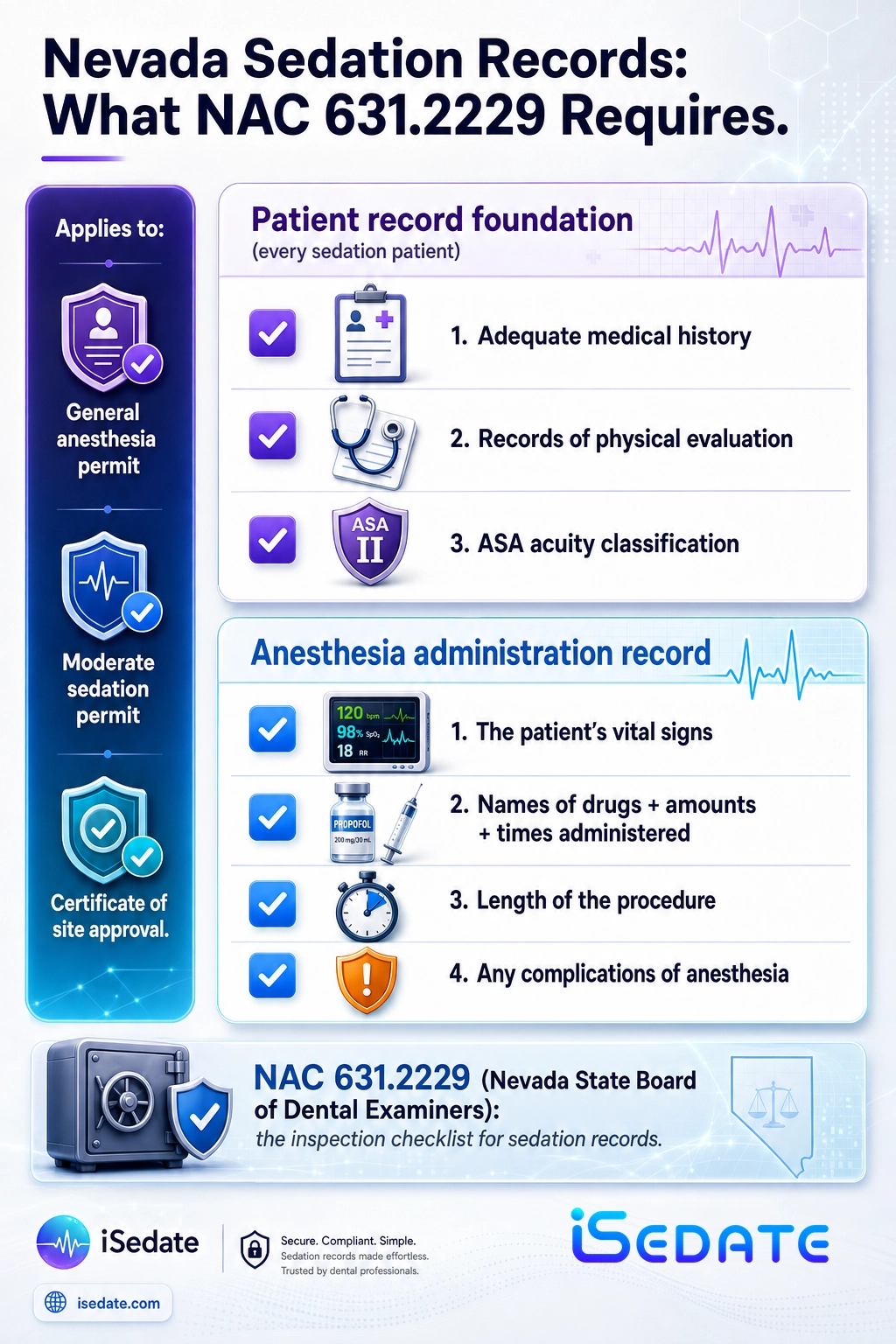
This is the section a board evaluator reads first. NAC 631.2229, titled "Inspections and evaluations: Minimum standards for records of patients," spells out exactly what the patient record must contain for an office inspected or evaluated for a general anesthesia permit, a moderate sedation permit, or a certificate of site approval. It has three layers worth knowing by heart.
1. The pre-sedation foundation
Before any anesthesia detail, NAC 631.2229 requires the patient record to include an adequate medical history, records of physical evaluation, and an American Society of Anesthesiologists acuity classification. NAC 631.2237 adds that a written consent and a medical history must be taken before sedation, that the medical-history questions and the patient's answers must be permanently recorded and signed by the patient before administration, and that they are kept as a permanent part of the treatment record. In plain terms, the chart has to show that the patient was assessed, risk-classified, and consented before sedation began. The ASA class is not a formality; it is the baseline that makes the rest of the record defensible, because it documents the clinical judgment that the patient was an appropriate candidate for the planned level of sedation.
2. The anesthesia administration record
For the anesthesia administration record itself, NAC 631.2229 requires four specific elements. Each one is a line a reviewer looks for:
- The patient's vital signs.
- The names of the drugs and the amounts and times administered.
- The length of the procedure.
- Any complications of anesthesia.
Read those together and the standard is clear. A note that a patient "tolerated sedation well" does not satisfy this rule. The record has to name each drug with its amount and the time it was given, carry the patient's vital signs, state how long the procedure ran, and document any complication. The drug log in particular is explicit: not just what was administered, but how much and when.
State Law
3. Retention and the controlled-substance layer
The signed consent and medical history are kept as a permanent part of the treatment record, and drugs given during sedation are frequently controlled substances, which carry their own federal DEA logging obligations on top of the state chart. The practical reading is that the sedation record is not a disposable worksheet. It is a permanent, reviewable document, and the drug entries in it have to reconcile with your controlled-substance log. When you are unsure how long to keep a specific record or how your DEA log should line up with the chart, confirm current retention requirements with the board and your own compliance counsel.
Source: NAC 631.2229 | NAC 631.2237 (consent and medical history)
See how an anesthesia administration record is built automaticallyWhat a compliant Nevada sedation record looks like
Knowing the four elements is one thing. Seeing them filled in is what makes the standard concrete. A compliant Nevada moderate or IV sedation record does not need to be elaborate; it needs to be complete and contemporaneous. Here is what each required layer looks like in practice for a single appointment.
A Compliant Sedation Record, Section by Section
- Pre-sedation: medical history questionnaire completed and signed by the patient; physical evaluation noted; ASA class recorded (for example, "ASA II, controlled hypertension"); written sedation consent signed and dated before any drug is given.
- Baseline vitals: blood pressure, heart rate, respiratory rate, and oxygen saturation recorded before induction, so there is a starting point to compare against.
- Intra-op vitals: vital signs recorded at regular intervals through the case and at any change in sedation depth, each entry time-stamped, so the record shows the patient was monitored continuously rather than once.
- Drug log: every agent named, with its dose and the exact clock time it was administered, including any reversal agent (for example, "Midazolam 2 mg IV at 10:14; Fentanyl 50 mcg IV at 10:16").
- Procedure length: start and end times recorded, so the duration is on the chart, not estimated later.
- Discharge and complications: recovery vitals and discharge criteria noted; any complication of anesthesia documented plainly, and "none" stated when there were none.
The difference between this and a record that fails a review is almost never clinical. It is whether each line was captured as the case ran. A drug logged later from memory loses its exact time. A vital sign watched on the monitor but never written down is, to a reviewer, a vital sign that was never taken. The rule does not ask whether you monitored the patient. It asks whether the record proves it.
iSedate Charting Advice
Time-stamp every drug and every vitals reading as it happens. The single most common inspection finding is a correct clinical decision with a missing or reconstructed time. A record that carries live, clock-accurate entries is both harder to question on inspection and far easier to defend if a case is ever reviewed.

How Nevada reviews records (and how dentists get burned)
Nevada does something notable with these record rules: it writes them straight into the inspection. NAC 631.2229 is titled "Inspections and evaluations: Minimum standards for records of patients," which means the record requirements are not a separate paperwork rule sitting off to the side. They are the yardstick a board evaluator uses when inspecting or evaluating your office for a general anesthesia permit, a moderate sedation permit, or a certificate of site approval. Holding one of those permits comes with a standing expectation that your sedation records are reviewable against the NAC 631.2229 checklist.
Here is where dentists get burned. It is rarely the clinical care that fails a review. It is the record: a missing drug time, a procedure length never captured, a vital-signs line that was never written down, an ASA classification that was skipped, a consent that was signed after the drug rather than before. The care can be flawless and the record can still fall short of what NAC 631.2229 and NAC 631.2237 itemize, and on inspection the office is graded on the document, not on the dentist's recollection of how the appointment went.
Important
A board evaluator grades the record, not your memory of the case. If the anesthesia administration record is missing a drug time, a vital-sign reading, or the length of the procedure, it fails the NAC 631.2229 standard even if the sedation was textbook. Capture every element the rule names, as the case runs.
The routine inspection cadence for permit holders, the inspector qualifications, and the grading thresholds are administered by the board and can change, so confirm the current inspection process with the Nevada board's licenses and permits office rather than relying on a figure that may be out of date.
Source: NAC 631.2229 | Nevada State Board of Dental Examiners
Reporting a sedation adverse event: the 30-day rule
Charting is the everyday obligation. Reporting is the one that turns a bad day into a disciplinary matter if it is missed. Nevada has an explicit adverse-event reporting rule, NAC 631.2241, and it carries a hard deadline.
State Law
Under NAC 631.2241, any mortality or unusual incident that results in the permanent physical or mental injury or hospitalization of a patient, as a direct result of general anesthesia, deep sedation, or moderate sedation, must be reported to the board within 30 days of the incident. The consequence for not reporting is spelled out in the rule itself: the board is authorized to revoke the permit. That is why a complete, contemporaneous record is not just an inspection concern. When a serious event happens, the sedation record is the document that supports the report you are required to file, and it is the first thing requested in any board or legal review that follows. A thin record makes the hardest moment in a sedation practice harder to defend.
The exact disciplinary schedule, penalty amounts, and any additional reporting triggers beyond NAC 631.2241 are administered by the board under NAC and NRS Chapter 631 and can change, so confirm current details directly with the Nevada board's laws and regulations office. What does not change is the exposure created by a thin record: in both a board inspection and a lawsuit, the contemporaneous sedation record is the first thing requested and the hardest thing to reconstruct after the fact. For the data behind why documentation drives these outcomes, see our research roundups on how sedation charting affects malpractice case outcomes and documentation-error rates and chart defensibility.
Source: NAC 631.2241 (report of injuries) | NAC Chapter 631
The easy button: an audit-ready record
The gap between knowing the rule and passing a review is almost always the same thing: a drug-and-vitals log kept by hand during a live sedation case. When a team is managing an airway and an anxious patient, the record is exactly where holes develop, a drug given and logged later without its time, a vital-sign reading missed, the procedure length never written in, a complication noted on a sticky note and never transcribed.
That is the problem SedationVault by iSedate was built to remove. It connects to the vitals monitor already in your operatory and captures the patient's vital signs live, on the clock, alongside a drug log that records each agent with its amount and the exact time it was given, so the anesthesia administration record builds itself as the case runs rather than being reconstructed afterward. When the Nevada board inspects your office and asks for the chart, it exports as a one-click, audit-ready sedation visit report that already carries the vital signs, the drug names, amounts, and times, the length of the procedure, the signed consent and history, and a place for any complication, the exact items NAC 631.2229 and NAC 631.2237 require. The point is not fancier charting. It is turning the elements the rules name into something the software guarantees are present and time-stamped, which is also what dental sedation compliance turns on. For the clinical "what and why" across every state, see our hub guide, Dental Sedation Vitals, Charting and Reporting Requirements by State.
Book a demo and see your Nevada sedation record build itselfFrequently asked questions
Does Nevada require a written sedation record?
What must a Nevada dental anesthesia record include?
What monitoring equipment does Nevada require for sedation?
Who reviews sedation records in Nevada?
How often must vitals be recorded during sedation in Nevada?
Do I have to report a sedation complication to the Nevada board?
Which Nevada permits trigger these record rules?
Related Guides and Neighboring States
Licensed in a neighboring state, or want the clinical context behind the rules? Start with the all-50 hub, then see the charting and reporting guide for your state:
- Dental Sedation Vitals, Charting and Reporting Requirements by State (the all-50 hub)
- Arizona Sedation Vitals Monitoring, Charting and Reporting Requirements
- California Sedation Vitals Monitoring, Charting and Reporting Requirements
- Idaho Sedation Vitals Monitoring, Charting and Reporting Requirements
- Oregon Sedation Vitals Monitoring, Charting and Reporting Requirements
- Utah Sedation Vitals Monitoring, Charting and Reporting Requirements
Sources and citations
Our Sources and Verification Process
This guide cites Nevada's primary regulatory sources only. The full sedation subchapter, including the record rule NAC 631.2229, the equipment rule NAC 631.2227, the consent rule NAC 631.2237, the scope rule NAC 631.2211, the permit rule NAC 631.2213, and the adverse-event report rule NAC 631.2241, is published by the Nevada Legislature; the regulator is the Nevada State Board of Dental Examiners. Each rule was read against the official code text. Where a detail (such as the current penalty schedule, inspection cadence, per-level continuous-monitoring intervals, permit fees, or continuing-education cycle) is administered by the board and subject to change, we have not stated a specific figure; confirm those directly with the board before relying on them. This is general information, not legal advice.
- NAC 631.2229: Inspections and evaluations, minimum standards for records of patients
- NAC 631.2227: Minimum standards for physical facilities and equipment
- NAC 631.2237: Written consent and medical history required before anesthesia or sedation
- NAC 631.2241: Report of injuries to patients
- NAC 631.2213: Permit for administration of general anesthesia, moderate sedation, or deep sedation
- NAC Chapter 631: Dentistry (full chapter, including the sedation subchapter NAC 631.2211 to 631.2256)
- Nevada State Board of Dental Examiners: Laws and Regulations
- Nevada State Board of Dental Examiners: Licenses and Permits















