






Nevada Sedation Dentistry Licensing & Permit Requirements
In Nevada, your dental license alone does not let you sedate a patient. Before you administer moderate sedation, deep sedation, or general anesthesia, you must hold the matching permit from the Nevada State Board of Dental Examiners under Nevada Administrative Code Chapter 631, and each office where sedation is given needs its own certificate of site approval. Getting the permit means meeting the training, certification, and live-patient bar for your level. Keeping it means your sedation records survive a Board inspection. This guide walks both halves, with every official form and statute linked, plus the one correction most third-party pages get wrong: Nevada has no standalone "deep sedation permit."
Recent Updates
Last UpdatedNovember 16, 2026
- Corrected the permit structure to match NAC 631.2213 verbatim: Nevada has no standalone deep sedation permit (deep sedation is authorized under the general anesthesia permit), and the moderate sedation permit splits into a patients-13-and-older permit and a patients-12-and-younger pediatric permit.
- Added the verified training bar for each permit, the $200 biennial renewal fee and 6-hour CE requirement, and the required pre-issuance inspection.
- Replaced third-party statute links with the official Nevada Administrative Code and the Nevada State Board of Dental Examiners' own licensing and application pages.
- A dentist cannot administer moderate sedation, deep sedation, or general anesthesia in Nevada without the matching permit from the State Board of Dental Examiners under NAC Chapter 631, and each location needs a certificate of site approval.
- Nevada issues three administrator permits: moderate sedation (patients 13+), moderate sedation (patients 12 and younger), and general anesthesia. There is no standalone deep sedation permit; deep sedation falls under the general anesthesia permit.
- The adult moderate sedation permit requires a Board-approved course of at least 60 hours plus 20 live patients and ACLS (NAC 631.2213). The pediatric version requires 60 hours plus 25 patients age 12 or younger.
- Permits renew with your license on a biennial cycle ($200 fee under NAC 631.029) and require 6 hours of anesthesia or sedation CE; the Board inspects offices before issuing and re-evaluates them over time.
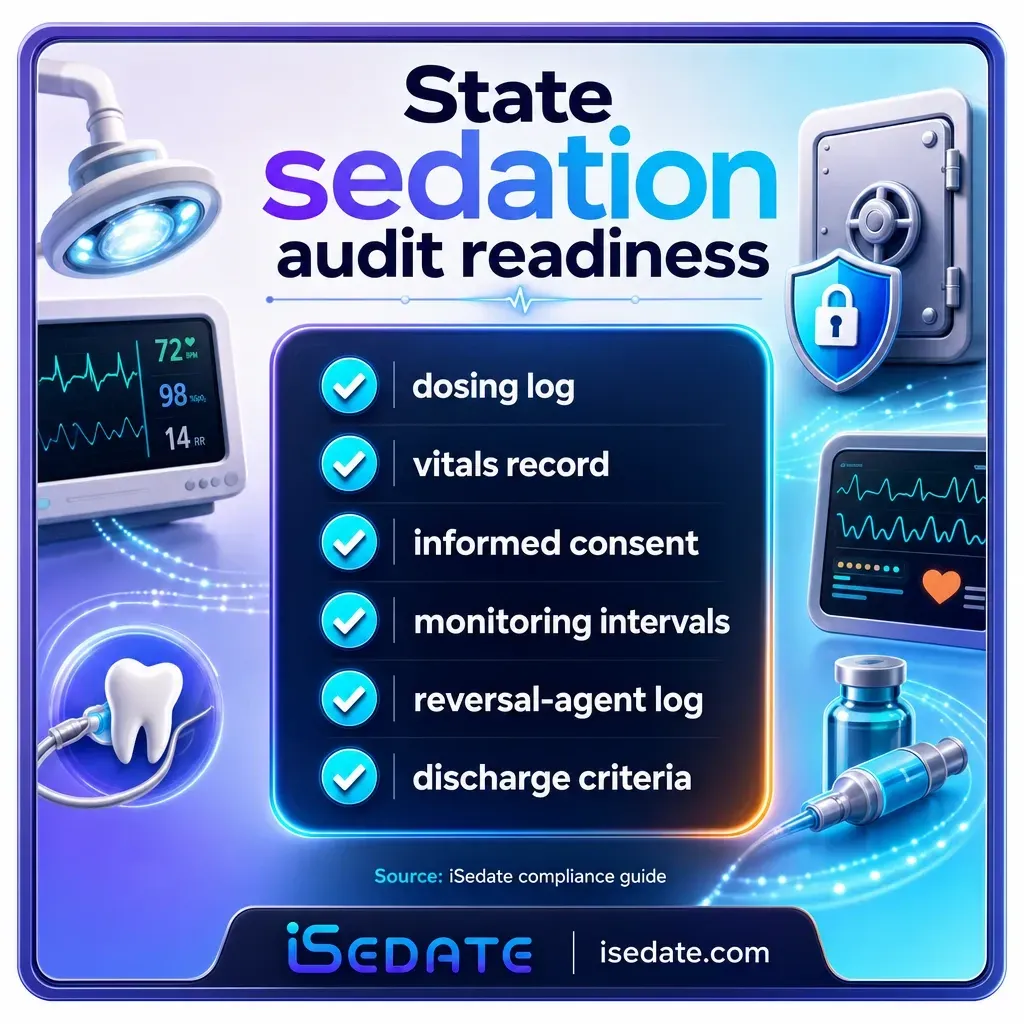
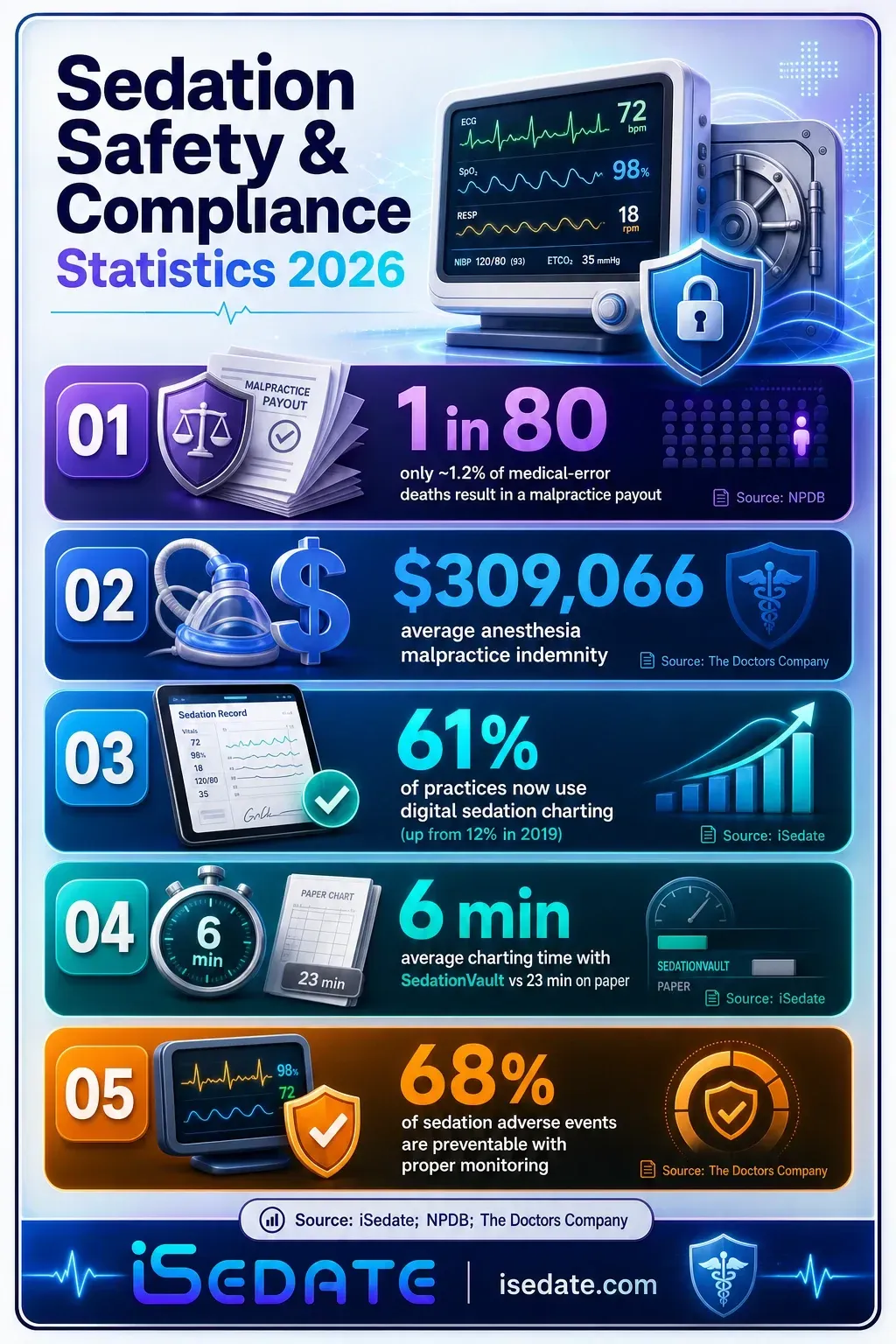
- Under NAC 631.2229, your anesthesia administration record must capture vital signs, drug names, amounts and times, the length of the procedure, and any complications. Incomplete records are where permits get challenged.
What This Nevada Permit Guide Covers
- Who issues sedation permits in Nevada
- The Nevada sedation permit structure
- What falls outside a sedation permit
- How to qualify for each permit
- How to apply: forms, inspection, and fees
- What your permit requires you to monitor and record
- Renewals, CE, and re-evaluation
- Inspections and keeping your permit
- Frequently asked questions
- Related guides and neighboring states
- Sources
Who issues sedation permits in Nevada
Sedation dentistry in Nevada is regulated by the Nevada State Board of Dental Examiners' licenses and permits page, the state agency that licenses dentists and issues every sedation and anesthesia permit. The Board, not any national association, decides who may sedate, approves the office site, runs the inspections, reviews the records, and takes disciplinary action. The rules live in Nevada Administrative Code Chapter 631, in the subchapter "Administration of General Anesthesia, Moderate Sedation, or Deep Sedation" (NAC 631.2211 through 631.2256). Every requirement below traces to that chapter or to the Board's own published forms.
Important
The ADA writes the standard; the Board writes the law. The American Dental Association publishes sedation guidelines that Nevada's rules lean on, and the Board even requires general anesthesia training to follow the ADA teaching guidelines. But the ADA is a professional association, not a government agency. It does not license you, inspect you, or discipline you. Your permit, your site approval, your inspections, and any sanctions all come from the Nevada State Board of Dental Examiners. Separate federal layers (DEA controlled-substance records, HIPAA) apply on top, but they do not replace the Board's permit.
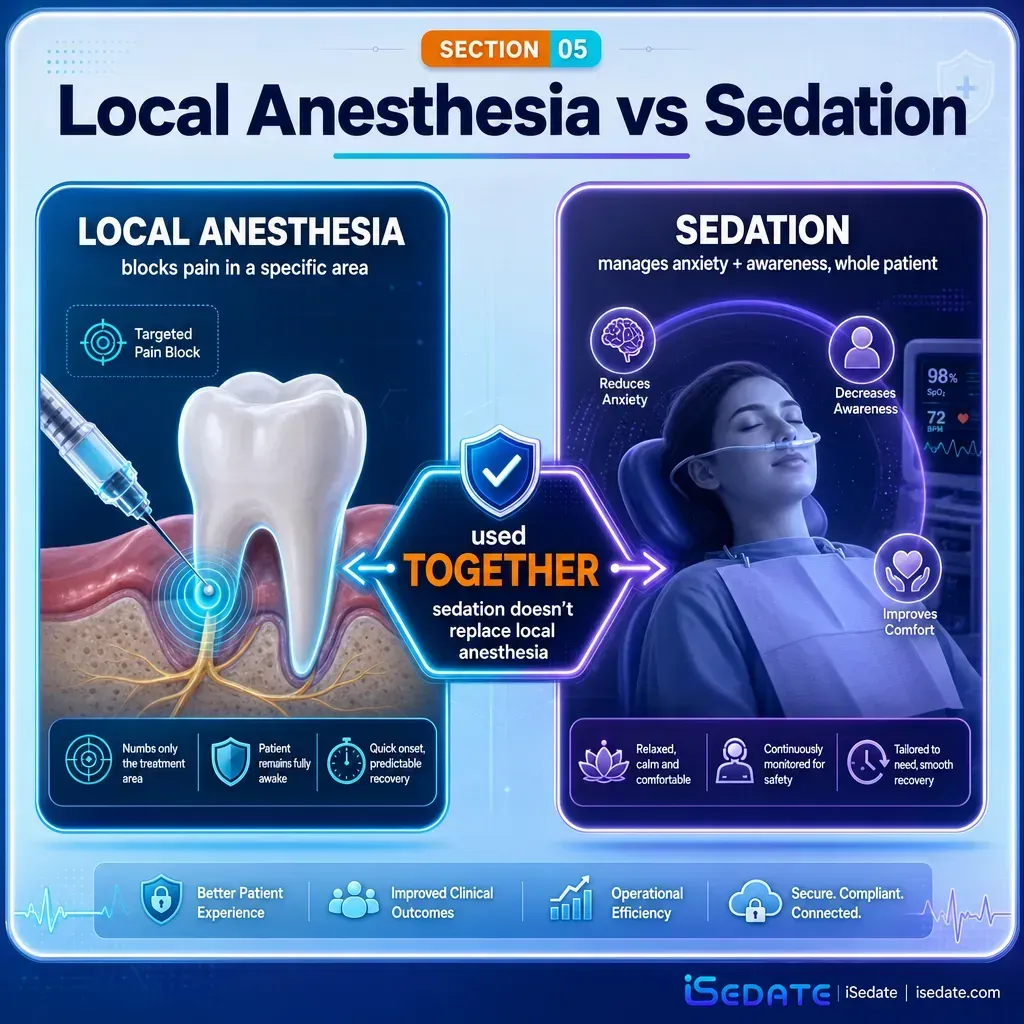
Nevada draws one line worth understanding from the start. The scope rule, NAC 631.2211, provides that the sedation subchapter does not apply to local anesthesia, to nitrous oxide-oxygen analgesia delivered through a system that guarantees at least 25 percent oxygen, or to a low single dose of oral medication that cannot induce a controlled state of depressed consciousness. Everything in this guide sits above that line: the sedation and anesthesia permits and the office-level site approval that Chapter 631 governs.
Source: NSBDE Dentist Licenses and Permits | NAC Chapter 631
The Nevada sedation permit structure
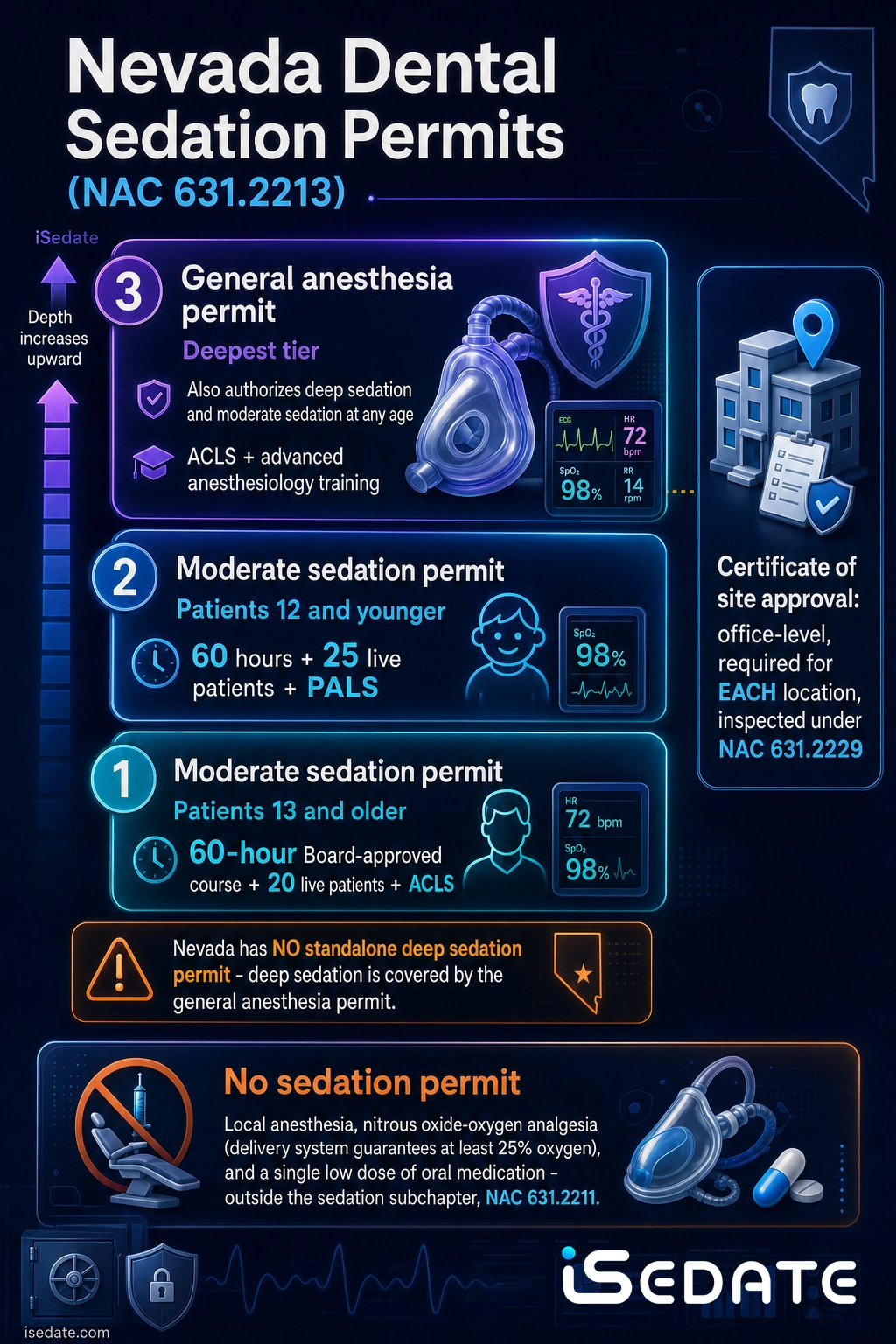
Nevada does not number its permits "Level 1 through 4." It names them by depth of sedation and patient age, and it keeps the office-level approval separate from the practitioner's permit. Under NAC 631.2213, there are three administrator permits plus the site certificate.
Myth, Corrected
Myth: Nevada issues a separate "deep sedation permit" that sits between the moderate sedation permit and general anesthesia.
Fact: There is no standalone deep sedation permit in Nevada. Under NAC 631.2213, deep sedation is authorized under the general anesthesia permit, whose holder may administer general anesthesia, deep sedation, and moderate sedation to patients of any age.
Several third-party summaries copy a "moderate, deep, general" ladder from other states. Nevada folds deep sedation into the general anesthesia permit, so a dentist who wants to provide deep sedation applies for the general anesthesia permit, not a separate one.
Moderate sedation permit, patients 13 and older. This is the workhorse permit for general and sedation-trained dentists who provide real conscious sedation, including the intravenous (IV) route. "Conscious Sedation" is the term Nevada's Board used for years and still appears on its older application pages; today the Board calls this level moderate sedation. Because IV titration carries a faster onset and higher risk, this permit carries the heavier training and record requirements covered below.
Moderate sedation permit, patients 12 and younger. A separate pediatric permit. The training is built around the same 60-hour floor, but the live-patient experience must be with children, and the resuscitation certification shifts toward pediatric advanced life support. A dentist who treats both adults and children under moderate sedation needs the matching qualification for each age group.
General anesthesia permit. The deepest authorization. Its holder may administer general anesthesia, deep sedation, and moderate sedation to any age. This is largely the province of dental anesthesiologists and oral and maxillofacial surgeons, and its training path runs through advanced hospital-based anesthesiology programs rather than a weekend course.
Certificate of site approval, the office level. Separate from the practitioner's permit, Nevada approves the facility itself, and a certificate is required for each location where sedation is provided. NAC 631.2229 names site approval alongside the general anesthesia and moderate sedation permits as a trigger for the patient-record requirements, which tells you the Board inspects the office, not only the dentist.
Source: NAC 631.2213 | NSBDE Dentist Licenses and Permits
What falls outside a sedation permit
Not every form of anxiety control triggers the sedation subchapter. NAC 631.2211 carves out three things a general dentist commonly uses.
- Local anesthesia. The numbing injection that defines routine dentistry sits entirely outside the sedation permit rules.
- Nitrous oxide-oxygen analgesia. Excluded from the sedation subchapter as long as the delivery system has a mechanism that guarantees at least 25 percent oxygen. The Board handles local anesthesia and nitrous oxide through its own separate permits and proficiency forms, not the sedation-permit track.
- A single low dose of oral medication that is not enough to induce a controlled state of depressed consciousness, and that is not combined with any other method of sedation.
The practical takeaway: the moment you move from one of these into true moderate sedation (the controlled, titrated state, especially by the IV route), you are in permit territory and the full Chapter 631 requirements apply.
Source: NAC 631.2211 (scope)
How to qualify for each permit
Each permit has its own bar in NAC 631.2213: a defined training path, resuscitation certification, and, for moderate sedation, a count of live patients managed as the operator. You move up by meeting the next permit's requirements and applying to the Board.
| Permit | Who it is for | Training path (NAC 631.2213) | Live patients | Resuscitation |
|---|---|---|---|---|
| Moderate sedation (patients 13+) | General and sedation dentists providing oral or IV conscious sedation to adults | Board-approved course of not less than 60 hours dedicated exclusively to moderate sedation, or an equivalent CODA specialty program | At least 20 patients as operator | ACLS (or a Board-approved medical-emergencies and airway course with the CODA pathway) |
| Moderate sedation (patients 12 and younger) | Dentists sedating children | Not less than 60 hours dedicated exclusively to moderate sedation of these patients, or an equivalent CODA specialty program | At least 25 patients age 12 or younger | PALS (or a Board-approved airway course with the CODA pathway) |
| General anesthesia (covers deep sedation) | Dental anesthesiologists and oral surgeons | Board-approved advanced anesthesiology training under the ADA teaching guidelines, or a CODA graduate program in oral and maxillofacial surgery or dental anesthesiology | Set within the training program | ACLS |
The moderate sedation permit: adding adult IV sedation
Stepping up to the adult moderate sedation permit is the biggest move a general dentist makes. NAC 631.2213(2)(a) sets the path: a Board-approved course of at least 60 hours dedicated exclusively to moderate sedation, plus successful administration as the operator to at least 20 patients, plus current ACLS, with the permit in hand before you treat an adult under moderate sedation. The alternative route is an equivalent CODA-accredited specialty program paired with ACLS or a Board-approved course on medical emergencies and airway management.
The live-patient requirement is substantial because IV titration demands hands-on competence a classroom cannot replicate. Nevada also tells applicants to confirm that a specific course has been approved by the Board before enrolling, so verify course approval first. Many dentists meet the didactic-and-clinical requirement through an accredited provider such as DOCS Education's Nevada sedation training; the Board, not the provider, decides whether a given course counts.
The pediatric moderate sedation permit
Treating children under moderate sedation is its own permit. The didactic floor is the same 60 hours, but it must be dedicated to moderate sedation of patients 12 and younger, the operator experience must be with at least 25 such patients, and the Board looks for pediatric advanced life support rather than the adult ACLS alone. A dentist who holds only the adult permit may not sedate a 12-year-old under moderate sedation.
The general anesthesia permit (and deep sedation)
The general anesthesia permit is the only route to deep sedation or general anesthesia in Nevada. NAC 631.2213 requires completion of an ACLS course plus either Board-approved advanced anesthesiology training following the ADA sedation teaching guidelines, or a CODA-accredited graduate program in oral and maxillofacial surgery or dental anesthesiology. There is no 60-hour weekend path to this permit; the training is measured in years, not hours. If you are pursuing it, work directly from Chapter 631 with the Board.
Source: NAC 631.2213 | DOCS Education: Nevada

How to apply: forms, inspection, and fees
Nevada's sedation applications are paper forms published by the Board, each tied to a specific permit. The Board's online application column still reads "not available yet," so download the matching PDF, complete it in full, and submit it with the fee.
The Board's Sedation Permit Applications
- Moderate Sedation Admin (13+) Permit Application and its matching Site Permit Application.
- Pediatric Moderate Sedation Admin Permit Application.
- General Anesthesia Admin Permit Application and the General Anesthesia Site Permit Application.
- Anesthesia Admin Permit Renewal Application for permits already held.
You can download the current versions from the Board's permit applications and forms page. Two steps catch dentists off guard. First, the inspection comes before the permit: NAC 631 requires the Board to inspect and evaluate the dentist and the office before it issues an original general anesthesia or moderate sedation permit, so your room, monitors, and emergency drugs must be ready at application time, not after. Second, the site certificate is per location: a dentist practicing in two offices needs site approval for each.
On fees, confirm the current amount on the application itself, because the Board updates them. The Board's recent application forms list roughly $750 for an administrator permit and $500 for a site permit, with lower amounts on the periodic re-evaluation forms. The amount that is fixed in the code is the renewal fee below.
Source: NSBDE Permit Applications and Forms | NAC 631.029 (fees)
What your permit requires you to monitor and record
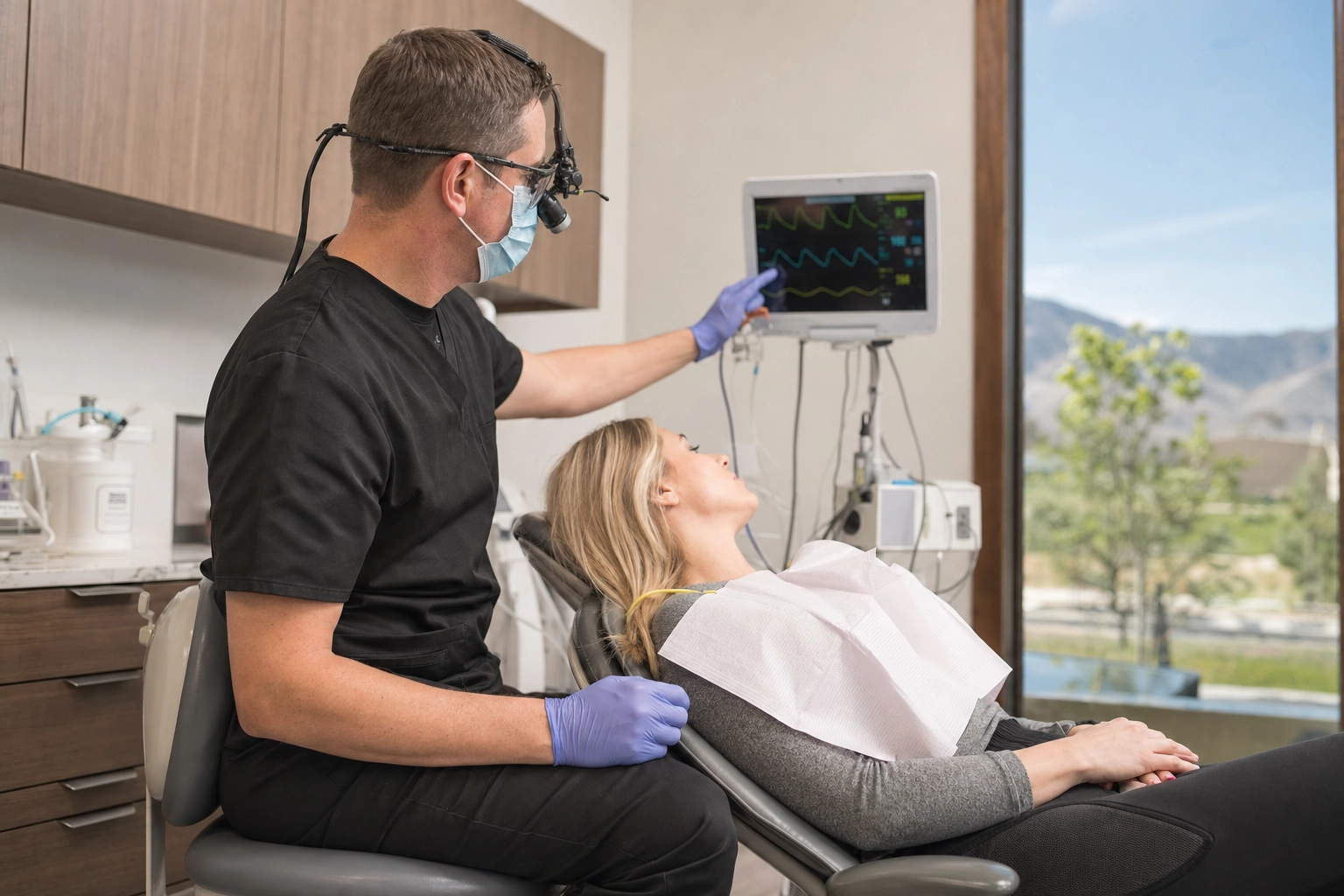
A permit is permission plus obligation. Once you hold a moderate or general anesthesia permit, the clinical parameters you watch are the same ones your record must prove. Consistent with the ADA standard Nevada's rules operate against, a sedation case is monitored across level of consciousness, oxygenation (observed color plus pulse oximetry), ventilation, and circulation (blood pressure and heart rate, with electrocardiography appropriate to deeper levels and the IV route).
The specific continuous-monitoring intervals Nevada attaches to each permit level sit inside the monitoring provisions of NAC 631.2213 through 631.2256 and the standard of care, and the cadence can differ by level, so confirm the exact interval for your permit with the Board. What is not ambiguous is the record. Under NAC 631.2229, the patient record must include an adequate medical history, records of physical evaluation, and an American Society of Anesthesiologists acuity classification, and the anesthesia administration record must capture four things.
For the full clinical breakdown of exactly what to chart and how often, see our companion guide on Nevada sedation vitals monitoring, charting and reporting requirements. Software built for this, like anesthesia record software, captures each of those four elements automatically so the record is complete before the patient leaves the chair.
Source: NAC 631.2229
Renewals, CE, and re-evaluation
Your sedation permit is tied to your Nevada dental license, and the Board renews the two together on the same form. Three things govern staying current.
On top of the biennial renewal, the Board periodically re-inspects and re-evaluates sedation offices and the holder's credentials to confirm the room, equipment, and competence still meet the standard. Treat the re-evaluation like the original inspection: your emergency equipment, monitoring, and records should be audit-ready at all times, not assembled the week the notice arrives. Because fee amounts and the exact re-evaluation schedule are set by Board rule and updated periodically, confirm your renewal cycle and current CE requirement directly with the Board.
Source: NSBDE Dentist Licenses and Permits | NAC 631.029
Inspections and keeping your permit
This is where a permit is kept or lost, and Nevada is unusually direct about it. NAC 631.2229 is written as part of "inspections and evaluations," which means the record requirements are built straight into the inspection. When the Board inspects or evaluates an office for a general anesthesia permit, a moderate sedation permit, or a certificate of site approval, your patient records are measured against the 631.2229 checklist.
When an evaluator opens a file, they are checking the record, not your intentions. The question is whether the anesthesia administration record carries the vital signs, the drug names with amounts and times, the length of the procedure, and any complications, and whether the broader record shows the medical history, physical evaluation, and ASA classification. A dentist can have handled the sedation flawlessly and still lose on the paperwork.
That is the daily discipline a permit demands, and it is exactly where a hand-written vitals-and-drug log fails: written between titrating a drug and watching an airway, manual records go incomplete, and incomplete records are what a Board inspection and a malpractice claim both attack. SedationVault by iSedate removes that failure point. It captures live vital signs and the drug log automatically into an anesthesia administration record, logging each agent with its amount and the exact time it was given, so the record writes itself while you focus on the patient. When the Board asks for the file, a complete record is a one-click export rather than a scramble through paper. See how it maps to the state rules on the dental sedation compliance page.
Book a demo of SedationVault See SedationVault pricingFrequently asked questions
What sedation permits does Nevada offer dentists?
How many hours and live patients does a Nevada moderate (IV) sedation permit require?
Is there a separate deep sedation permit in Nevada?
Do you need a permit for nitrous oxide in Nevada?
How often do you renew a Nevada dental sedation permit?
What happens if your sedation records fail a Board inspection?
Related guides and neighboring states
Licensed, or planning to practice, in a state near Nevada? Sedation permit rules change at every border. See our state guides for each neighbor, and the full 50-state hub for the rest:
- Arizona Sedation Dentistry Licensing & Permit Requirements
- California Sedation Dentistry Licensing & Permit Requirements
- Idaho Sedation Dentistry Licensing & Permit Requirements
- Oregon Sedation Dentistry Licensing & Permit Requirements
- Utah Sedation Dentistry Licensing & Permit Requirements
- Sedation Dentistry Licensing & Permit Requirements by State (all 50 states)
Sources
- Nevada Administrative Code Chapter 631 (official full chapter, including the sedation subchapter NAC 631.2211 to 631.2256, permit rule 631.2213, records rule 631.2229, and the 631.029 fee schedule)
- Nevada State Board of Dental Examiners: Dentist Licenses and Permits (permit types, renewal with license, CE requirement)
- NSBDE Permit and Certification Applications and Forms (the application PDFs for each permit)
- DOCS Education: Nevada sedation training (a provider of Board-approved courses; course approval is decided by the Board)
This guide summarizes Nevada sedation permit rules for general information and is not legal advice. The permit structure, training requirements, record rules, and renewal fee are drawn from NAC Chapter 631 as cited. Initial application fees, the exact re-evaluation schedule, per-level continuous-monitoring intervals, and the penalty schedule are set and updated by the Nevada State Board of Dental Examiners and should be confirmed directly with the Board (phone 702-486-7044) before you act. Requirements are current as of November 2026.