






Oregon Sedation Dentistry Licensing & Permit Requirements
In Oregon, you cannot sedate a patient on your dental license alone. Any dentist who administers nitrous oxide, minimal sedation, moderate (conscious) sedation, or general anesthesia must first hold the matching anesthesia permit from the Oregon Board of Dentistry, issued under OAR Chapter 818, Division 26. The Board issues four permit levels to new applicants, each with its own training hours, resuscitation certification, patient-experience count, and biennial fee. Getting the permit means meeting those requirements. Keeping it means your anesthesia records, your continuing education, and your office evaluation all hold up to Board review. This guide walks both halves, with the current Board figures, so you have every requirement and link in one place.
Recent Updates
Last UpdatedNovember 16, 2026
- Corrected the permit structure: Oregon now issues four anesthesia permits to new applicants, and the Board no longer issues new deep sedation permits (renewal only).
- Added the Oregon Board of Dentistry's current, verified figures: training hours for every level, the two-year continuing-education cycle, and the biennial permit fees effective December 1, 2025.
- Replaced third-party rule aggregators with the state's own official sources: the Oregon Secretary of State administrative-rules database and the Board's Anesthesia Permits page, including the application forms and office-evaluation rule.
- Oregon issues four anesthesia permits to new applicants under OAR Chapter 818, Division 26: Nitrous Oxide (818-026-0040), Minimal Sedation (818-026-0050), Moderate Sedation (818-026-0060), and General Anesthesia (818-026-0070).
- The Board no longer issues new deep sedation permits (818-026-0065); that rule now covers renewals of existing permits only.
- Moderate (conscious) sedation is one permit with two training paths: oral needs 24 hours and 10 patient experiences; IV needs 60 hours and 20 patient experiences, both with BLS plus ACLS and/or PALS.
- Permits are biennial. Fees run from $40 (nitrous) to $400 (general anesthesia), and renewal requires 4 or 14 continuing-education hours by level.
- At every level the permit holder or an anesthesia monitor must monitor and record the patient's condition on a contemporaneous anesthesia record, kept in the dental chart (OAR 818-026-0050 through 818-026-0080). A reportable death, serious complication, or injury triggers a Board report that must include that record (818-026-0120).

What This Oregon Permit Guide Covers
- Who issues sedation permits in Oregon
- The four Oregon permits issued today
- Training and certification by permit level
- Fees and how to apply
- What your permit requires you to monitor
- Reporting and recordkeeping obligations
- Continuing education and renewal
- Keeping the permit: review-ready records
- Frequently asked questions
- Sources
Who issues sedation permits in Oregon
Sedation dentistry in Oregon is regulated by the Oregon Board of Dentistry (OBD), the state agency that licenses dentists and issues every anesthesia permit. The Board, not any national body, decides who may sedate, runs the office evaluations, reviews records, and takes disciplinary action. The rules live in OAR Chapter 818, Division 26, titled "Anesthesia," and every requirement below traces to a numbered rule in that division. The Board's office is at 1500 SW 1st Avenue, Suite 770, Portland, OR 97201, phone 971-673-3200.
Important
The American Dental Association writes the standard; the Board writes the law. The ADA is a private professional association, not a government agency. It publishes sedation and anesthesia guidelines that Oregon leans on, and the Board's own rules require training that meets the ADA guidelines in effect when your training began. But the ADA does not license you, evaluate your office, or discipline you. Your permit, your office evaluation, and any sanctions all come from the Oregon Board of Dentistry under Division 26. The real federal layers that sit alongside the Board are the DEA for controlled-substance records, HIPAA for patient privacy, and accreditation bodies where they apply, not any "federal ADA law."
You can read the current rules in full on the state's own publication, the Oregon Secretary of State administrative-rules database for Chapter 818, Division 26, and you apply through the Board's own Oregon Board of Dentistry Anesthesia Permits page, which carries the requirements and the application form for each level.
Source: Oregon SOS, OAR Chapter 818, Division 26 | Oregon Board of Dentistry, Anesthesia Permits
The four Oregon permits issued today
Oregon names its permits by how deeply the patient is sedated, not just which drug or route is used. One Moderate Sedation Permit reaches both oral and IV moderate (conscious) sedation, and general anesthesia sits under its own permit. The Deep Sedation Permit rule is still on the books, but the Board no longer issues new ones, so for a dentist seeking a permit today there are four live levels. Here is the full ladder, each with its governing rule in Division 26.
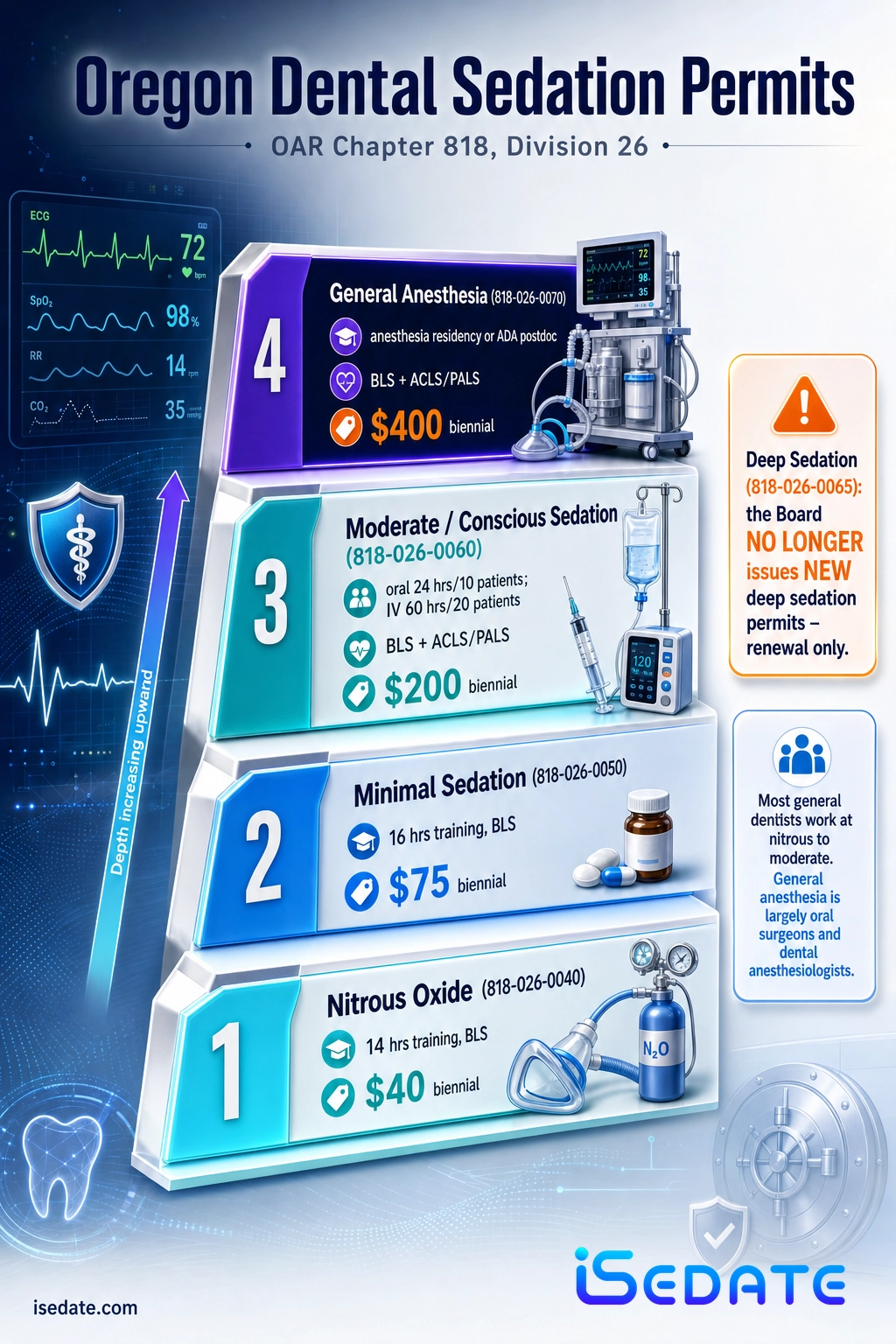
Nitrous Oxide Permit (OAR 818-026-0040). The entry permit. It authorizes nitrous oxide and oxygen inhalation sedation, the lightest form of anxiety control, where the patient stays fully responsive. It is open to both dentists and dental hygienists and is the usual first step for a general practice adding light sedation.
Minimal Sedation Permit (OAR 818-026-0050). Authorizes minimal sedation (anxiolysis), typically a single oral drug, where the patient responds normally to verbal command and airway and cardiovascular function are unaffected. At this level the permit holder or an anesthesia monitor must already monitor and record the patient's condition. This is a common starting point for general dentists offering light oral sedation.
Moderate Sedation Permit (OAR 818-026-0060). The workhorse permit for real sedation dentistry, and the level most patients mean when they say "Conscious Sedation." In Oregon this single permit covers both the oral route and the IV route, with the training bar rising for the IV path. The patient responds purposefully to verbal or tactile stimulation, maintains their own airway, and must be visually monitored at all times, including through recovery.
General Anesthesia Permit (OAR 818-026-0070). The top tier. It authorizes general anesthesia, where the patient is unconscious and airway support is routinely required, and the permit holder or a trained anesthesia monitor must monitor and record the patient's condition on a contemporaneous record. General anesthesia is largely the province of dental anesthesiologists and oral and maxillofacial surgeons, and the training path reflects that, so most general dentists operate between nitrous and moderate sedation and never pursue this level.
Myth, Busted
Myth: Oregon still hands out new deep sedation permits as a middle tier between moderate and general anesthesia.
Fact: The Oregon Board of Dentistry no longer issues new deep sedation permits; the Deep Sedation Permit rule (818-026-0065) now applies only to renewing an existing permit.
If you are planning your training path today, plan around moderate sedation or general anesthesia, not deep sedation, because a new deep sedation permit is not available.
Source: Oregon Board of Dentistry, Anesthesia Permits | OAR 818-026-0035 (Classes of Anesthesia Permit)
Training and certification by permit level
Each permit has its own bar to clear: a set number of training hours, resuscitation certification, and, for moderate sedation, a count of managed patient experiences. You move up the ladder by meeting the next level's requirements and applying to the Board. The figures below come from the Oregon Board of Dentistry's published anesthesia-permit requirements.
| Permit | Route / depth | Training | Patient experiences | Resuscitation |
|---|---|---|---|---|
| Nitrous Oxide (818-026-0040) | Inhalation, lightest | At least 14 hours | Not specified | BLS |
| Minimal (818-026-0050) | Minimal / anxiolysis | At least 16 hours | Not specified | BLS |
| Moderate, oral (818-026-0060) | Enteral (oral) moderate | At least 24 hours | At least 10 patients | BLS + ACLS and/or PALS |
| Moderate, IV (818-026-0060) | Parenteral (IV) moderate | At least 60 hours | At least 20 patients | BLS + ACLS and/or PALS |
| General Anesthesia (818-026-0070) | General anesthesia | 2-year anesthesia residency or ADA-accredited postdoctoral program | Per the training program | BLS + ACLS and/or PALS |
Nitrous and minimal sedation
The Nitrous Oxide Permit is the most accessible: at least 14 hours of nitrous training from a CODA-accredited dental or dental hygiene program (or equivalent postgraduate training) plus current BLS. The Minimal Sedation Permit requires a licensed Oregon dentist, current BLS, and at least 16 hours of comprehensive training that meets the ADA guidelines in effect when the training began, or equivalent graduate training the Board accepts. Minimal sedation already carries the monitor-and-record duty under OAR 818-026-0050.
Moderate sedation: oral first, then IV
Oregon's Moderate Sedation Permit is where most sedation dentists operate, and it has two training paths inside one permit. The enteral (oral) path is the more accessible of the two, built around at least 24 hours of instruction and at least 10 patient experiences. Adding the IV route is the bigger step: the parenteral path calls for at least 60 hours and at least 20 patient experiences. Either path requires current BLS plus ACLS and/or PALS as appropriate to your patient population. An ADA-accredited postdoctoral program, such as a general practice residency, can satisfy the training in place of a standalone course. Required training must be primary-source verified, meaning the school or program sends the verification to the Board directly.
Where do you take the required course? Oregon accepts training from CODA-accredited dental programs and ADA-accredited postdoctoral programs, and commercial continuing-education providers such as DOCS Education's Oregon sedation courses market programs built to the Board's hour requirements. Verify that any course you choose meets the current Oregon rule before you enroll, because the permit, not the course certificate, is what the Board grants.
Source: Oregon Board of Dentistry, Anesthesia Permits (requirements by level)

Fees and how to apply
Once you meet a level's training and certification bar, you apply to the Board for that permit. Applications are submitted on the Board's own forms, one per level, all linked from the Board's moderate sedation application form and its siblings on the Anesthesia Permits page. Under OAR 818-026-0030, the applicant must pay the permit fee, submit the Board-approved application, and consent to an office evaluation, and the permit is issued to coincide with the dentist's licensing period.
Oregon Anesthesia Permit Fees (Biennial)
- Nitrous Oxide Permit: $40
- Minimal Sedation Permit: $75
- Moderate Sedation Permit: $200
- Deep Sedation Permit (renewal only): $400
- General Anesthesia Permit: $400
These fees are set in the Board's fee rule, OAR 818-001-0087, effective December 1, 2025, and they are biennial because the permit renews with your two-year license cycle. The application forms indicate that applications are mailed to the Board with payment by money order and that processing commonly takes several weeks, so build that lead time in before a planned start date. Fees and timelines change, so confirm the current figure on the application form before you file.
The office evaluation
Oregon does not issue a sedation permit on paperwork alone. Under OAR 818-026-0110, the Board conducts office evaluations, and the permits that authorize moderate sedation and general anesthesia carry the heaviest scrutiny because that is where the risk is. Treat your facility, your monitoring equipment, your emergency drugs, and your records as part of the application, not an afterthought, because the evaluation looks at all of them.
Source: Oregon Board of Dentistry fee rule filing, OAR 818-001-0087 (effective December 1, 2025) | OAR 818-026-0030 and 818-026-0110
What your permit requires you to monitor
A permit is permission plus obligation. Once you hold an Oregon sedation permit, the governing rules state the same duty at every level: the dentist permit holder or an anesthesia monitor shall monitor and record the patient's condition. For moderate sedation, OAR 818-026-0060 adds that the patient shall be visually monitored at all times, including recovery, and for general anesthesia, OAR 818-026-0070 requires monitoring and recording of the patient's condition on a contemporaneous record. Clinically, "the patient's condition" is the familiar set of systems every sedation standard watches:
- Consciousness: level of consciousness and responsiveness to verbal command, continually assessed.
- Oxygenation: color of mucosa, skin, and blood evaluated, with oxygen saturation monitored by pulse oximetry.
- Ventilation: chest excursion observed and ventilation evaluated, with end-tidal carbon dioxide at the deeper levels.
- Circulation: blood pressure and heart rate evaluated, with continuous ECG at the deeper levels.
The exact per-parameter interval list for each level sits in the full Division 26 rule text, so read it alongside your permit. For the full clinical breakdown of what to monitor and chart at each depth, see the companion guide on Oregon sedation vitals monitoring, charting and reporting requirements, and the national overview in our Sedation Dentistry Licensing & Permit Requirements by State hub.
Source: OAR 818-026-0060 and 818-026-0070
Reporting and recordkeeping obligations
Holding a permit also means holding a set of documentation and reporting duties, and these are exactly what a Board review examines.
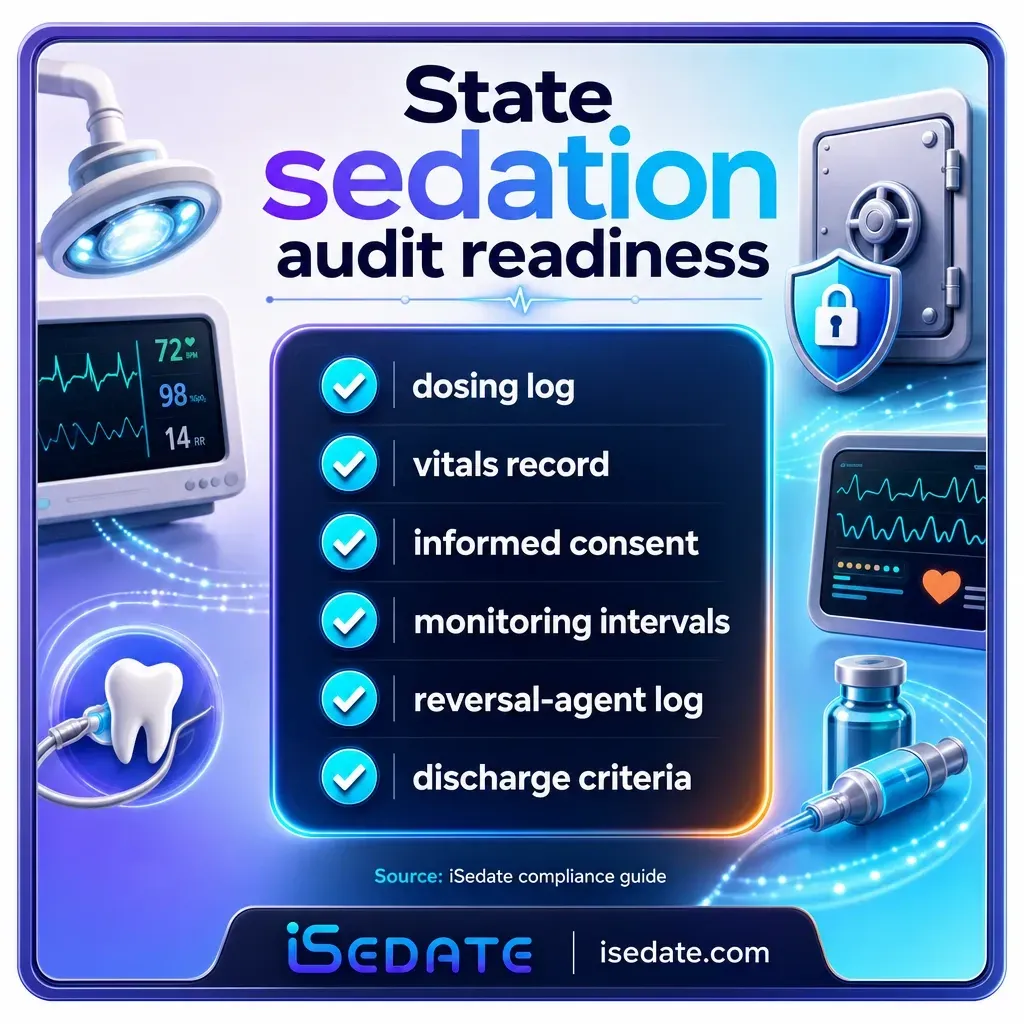
The anesthesia record. Under OAR 818-026-0050, 818-026-0060, and 818-026-0070, the permit holder or anesthesia monitor must monitor and record the patient's condition on a contemporaneous record at the level administered. This is the single duty that runs through every Oregon permit.
The record in the chart, and discharge. Under OAR 818-026-0080, when a separate qualified provider induces the anesthesia, a copy of the anesthesia record must be maintained in the patient's dental record, and that is the responsibility of the dentist performing the dental procedures; the dental record must also document the patient's condition at discharge.
Adverse-event reporting. Under OAR 818-026-0120, a report to the Board of a death, serious complication, or injury connected to anesthesia must include the anesthesia record and the signed informed-consent form. The rule is built on the assumption that a complete contemporaneous record already exists, which is why an incomplete record is where permits get challenged.
Source: OAR 818-026-0080 and 818-026-0120
Continuing education and renewal
Your sedation permit is tied to your Oregon dental license and renews on the same two-year cycle. The Board sets the continuing-education floor by permit level, and it rises with depth.
| Permit level | CE per two-year cycle | Resuscitation to maintain |
|---|---|---|
| Nitrous Oxide and Minimal Sedation | 4 hours | Current BLS |
| Moderate Sedation, Deep Sedation, General Anesthesia | 14 hours | Current BLS plus ACLS and/or PALS |
Let any required certification lapse and the permit lapses with it, so track your BLS, ACLS, and PALS expiration dates against your renewal date. Confirm your exact cycle and CE hours on the Board's anesthesia-permit materials at renewal time, because the rules are updated periodically.
Source: Oregon Board of Dentistry, Anesthesia Permits (renewal continuing education)
Keeping the permit: review-ready records
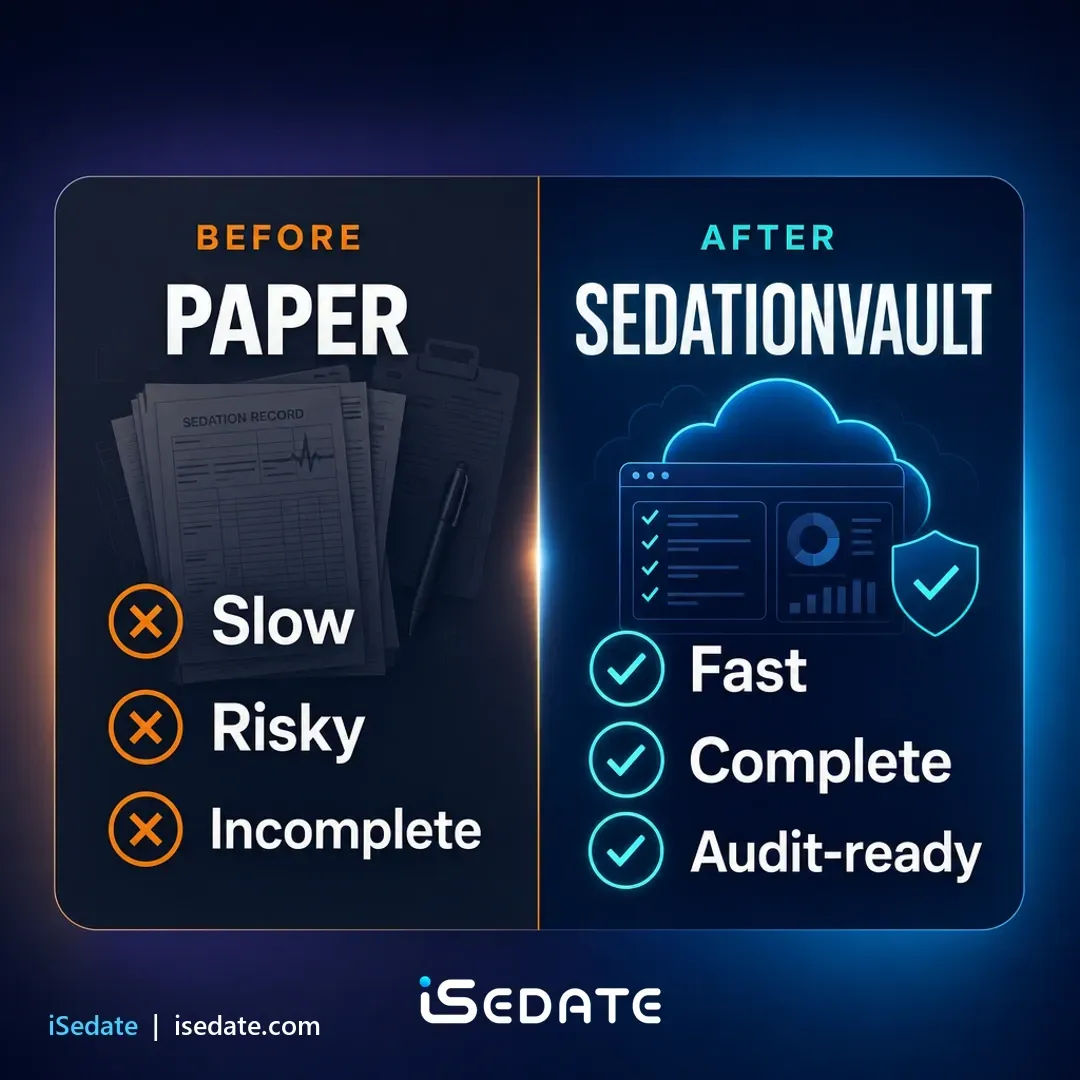
Everything above points to one truth: getting the permit is a one-time hurdle, but keeping it is a daily documentation discipline. A vitals log written by hand, between titrating a drug and watching an airway, is exactly where records go incomplete, and incomplete records are what a Board review and a malpractice claim both attack. Oregon's "contemporaneous" standard is precisely what a hand-kept record struggles to satisfy.
SedationVault removes that failure point. It captures live patient vitals and the drug log automatically into a contemporaneous anesthesia record, so the record writes itself while you focus on the patient, and a copy drops into the dental chart exactly as OAR 818-026-0080 requires. When the Board asks for the file, or an incident report needs the anesthesia record attached, a complete record is a one-click export, not a scramble through paper. See how it maps to the rules on the dental sedation compliance and anesthesia record software pages.
Book a Demo of SedationVault See SedationVault PricingLicensed in a neighboring state?
Permit rules stop at the state line, and a dentist practicing across the region needs each state's own guide. If you hold or are pursuing a permit nearby, see our requirements guides for neighboring states:
- California Sedation Dentistry Licensing & Permit Requirements
- Idaho Sedation Dentistry Licensing & Permit Requirements
- Nevada Sedation Dentistry Licensing & Permit Requirements
- Washington Sedation Dentistry Licensing & Permit Requirements
- All 50 states: Sedation Dentistry Licensing & Permit Requirements by State
Frequently asked questions
What sedation permits does Oregon issue to dentists?
How many training hours do you need for an IV sedation permit in Oregon?
Does Oregon still issue deep sedation permits?
How much does an Oregon sedation permit cost?
How do you keep an Oregon sedation permit in good standing?
Do you need a permit just to monitor a patient sedated by someone else?
Sources & How We Verified This Guide
Every requirement on this page was checked against the state's own official sources rather than third-party rule aggregators. The permit structure, training hours, continuing-education cycle, fees, and office-evaluation rule were confirmed on the Oregon Board of Dentistry's Anesthesia Permits page and the Oregon Secretary of State administrative-rules database in November 2026.
- Oregon Board of Dentistry, Anesthesia Permits (permit levels, requirements by level, application forms, renewal CE)
- Oregon Secretary of State, OAR Chapter 818, Division 26 (Anesthesia)
- Oregon Board of Dentistry fee rule filing, OAR 818-001-0087 (biennial permit fees, effective December 1, 2025)
- Oregon Board of Dentistry, Moderate Sedation Permit application form
This guide summarizes Oregon sedation permit rules for general information and is not legal advice. Requirements current as of November 2026. Fees, forms, processing times, and continuing-education details are set by the Oregon Board of Dentistry and updated periodically; verify the current figures on the Board's Anesthesia Permits page before you apply.