







Oregon Sedation Vitals Monitoring, Charting & Reporting Requirements
If you administer sedation in Oregon, the recordkeeping rule is not vague. At every permit level you must monitor and record the patient's condition on a contemporaneous anesthesia record, and Oregon tells you exactly how often: vital signs at least every 15 minutes at minimal and moderate sedation, and blood pressure, heart rate, and oxygen saturation every 5 minutes under general anesthesia. The rules sit together in Oregon Administrative Rules Chapter 818, Division 26, they are enforced by the Oregon Board of Dentistry, and the record they require is the document a Board review turns on. This guide breaks down what Oregon requires you to monitor and record at each level, what a compliant chart actually contains, and how to make it review-ready.
Recent Updates
Last UpdatedNovember 16, 2026
- Verified every Oregon Administrative Rule citation against the Oregon Secretary of State's official rules database and the Oregon Board of Dentistry, and replaced third-party aggregator links with the original official rule text.
- Added the specific vital-sign intervals Oregon actually requires: at least every 15 minutes at minimal and moderate sedation, and every 5 minutes for blood pressure, heart rate, and oxygen saturation under general anesthesia.
- Added that Oregon requires continuous end-tidal CO2 (capnography) monitoring at moderate sedation and above, not only at general anesthesia.
- Updated the permit list: Oregon no longer issues new Deep Sedation permits (existing holders renew), and general anesthesia is the top tier.
- Added the 5-day Board reporting window for a death, serious complication, or injury under OAR 818-026-0120.
Key Takeaways
- The core duty: at every Oregon sedation level, the permit holder or anesthesia monitor must monitor and record the patient's condition, under OAR 818-026-0050, -0060, and -0070.
- Oregon does publish intervals: vitals at least every 15 minutes at minimal and moderate sedation, and every 5 minutes for blood pressure, heart rate, and oxygen saturation under general anesthesia.
- Capnography is required from moderate sedation up: continuous pulse oximetry and end-tidal CO2 at moderate sedation, plus continuous ECG under general anesthesia (and for cardiac patients at moderate).
- The record travels with the chart: under OAR 818-026-0080 a copy of the anesthesia record stays in the patient's dental record, and a discharge entry is required.
- The record is evidence: a death, serious complication, or injury triggers a written Board report within 5 days that must include the anesthesia record, under OAR 818-026-0120.

What This Guide Covers
- Who regulates sedation in Oregon
- The Oregon sedation permits
- What you must monitor and record at each level
- What a compliant Oregon sedation record contains
- How Oregon reviews records (and where dentists get burned)
- Discharge and adverse-event reporting
- The easy button: a contemporaneous record that writes itself
- Frequently asked questions
- Sources and citations
Who regulates sedation in Oregon
Sedation and anesthesia in an Oregon dental office are regulated by the Oregon Board of Dentistry, the state agency that issues anesthesia permits, conducts office evaluations, reviews records, and takes disciplinary action. The rules are not scattered through general dental law. They sit together in one place: Oregon Administrative Rules, Chapter 818, Division 26, titled "Anesthesia." Each permitted level has its own numbered rule, and every recordkeeping obligation below traces to a specific one of them.
That precision matters. When a reviewer asks whether your anesthesia record meets the requirement, the answer is measured against the exact Division 26 rule for the level you administered, not against a vague standard of care. It is also worth being precise about the American Dental Association. The ADA publishes national sedation guidelines that many boards lean on, and it updated them through its House of Delegates in October 2025, but those guidelines are a professional standard, not law. In Oregon, the law is Division 26, and the regulator is the Oregon Board of Dentistry. Getting the charting right is the center of what dental sedation compliance turns on.
Source: Oregon Board of Dentistry, Laws & Rules | Oregon Secretary of State, OAR 818-026-0050
The Oregon sedation permits
Oregon names its permits by the depth of sedation they authorize, and the requirements escalate with each one. Knowing which permit you hold tells you which monitoring and recordkeeping rule applies. The Moderate Sedation Permit is the workhorse for most general dentists: under OAR 818-026-0060 it covers both enteral (oral) moderate sedation and parenteral (IV) moderate sedation, the level clinicians commonly call Conscious Sedation. One structural note that is easy to get wrong: Oregon no longer issues new Deep Sedation permits. Existing holders still renew under OAR 818-026-0065, but general anesthesia is now the top tier, and a General Anesthesia Permit reaches every lower level beneath it.
| Oregon permit | What it covers | Citation |
|---|---|---|
| Nitrous Oxide Sedation Permit | Inhaled nitrous oxide / oxygen sedation | OAR 818-026-0040 |
| Minimal Sedation Permit | Minimal sedation (anxiolysis) | OAR 818-026-0050 |
| Moderate Sedation Permit | Moderate sedation, both enteral (oral) and parenteral (IV) | OAR 818-026-0060 |
| Deep Sedation Permit (renewal only) | Deep sedation; no new permits issued, existing holders renew | OAR 818-026-0065 |
| General Anesthesia Permit | General anesthesia; top tier, reaches the lower levels | OAR 818-026-0070 |
Deep sedation and general anesthesia are carried most often by dental anesthesiologists and oral and maxillofacial surgeons. This guide focuses on the monitor-and-record standard that runs through every level, because that duty is the heart of Oregon's charting law. If you are working out which permit to apply for, what training it takes, or how to upgrade, that process belongs in our companion guide to Oregon Sedation Dentistry Licensing & Permit Requirements.
Source: Oregon Board of Dentistry, Anesthesia Permits | OAR 818-026-0060 (Moderate Sedation)
What you must monitor and record at each level
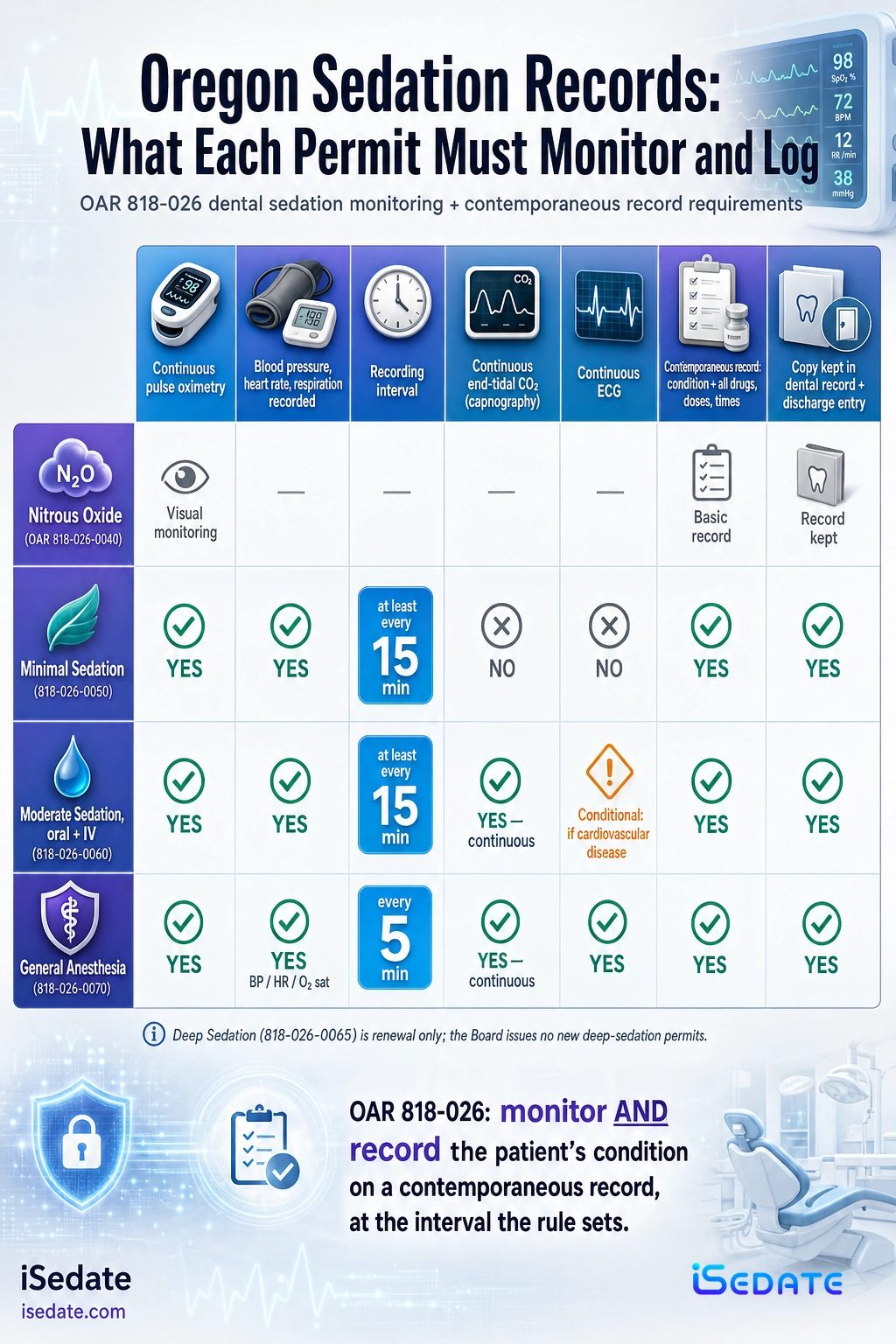
In Oregon, what you are required to monitor is what you are required to write down, and the rule attaches a documentation interval to it. The requirements build as the sedation deepens. Here is what each level actually demands.
Minimal sedation (OAR 818-026-0050)
The patient must be visually monitored at all times, including recovery, and the permit holder or anesthesia monitor must monitor and record the patient's condition. Pulse oximetry runs continuously, and the color of the mucosa, skin, or blood must be evaluated continually. The patient's response to verbal stimuli, blood pressure, heart rate, pulse oximetry, and respiration must be monitored and documented at least every 15 minutes when they can reasonably be obtained. The record logs every medication with its dose, time interval, and route, and a discharge entry is made in the patient's record by the dentist permit holder.
Moderate sedation, enteral and IV (OAR 818-026-0060)
This is the level most general dentists charting Conscious Sedation work at, and the monitoring tightens. The patient must be continuously monitored, visually monitored at all times including the recovery phase, and never left alone while sedated. Oregon requires continuous pulse oximetry and continuous end-tidal CO2 (capnography) monitoring, and patients with cardiovascular disease must have continuous ECG. Blood pressure, heart rate, and respiration are recorded at regular intervals and at least every 15 minutes. Preoperative and postoperative vital signs must be documented, and every medication is recorded with its dose, time interval, and route. If a required value cannot be obtained, the reason has to be documented in the record. Two trained people are required in the operatory, an anesthesia monitor plus one other person with current BLS certification, and a discharge entry noting the patient's condition and the responsible party closes the case.
Myth, Busted
Myth: Oregon does not publish a vitals interval, so there is more latitude on how often you chart.
Fact: Oregon sets an explicit maximum. At minimal and moderate sedation, vitals are recorded at regular intervals and at least every 15 minutes; under general anesthesia, blood pressure, heart rate, and oxygen saturation are assessed every 5 minutes.
The "no published number" idea usually comes from states that frame the duty only as a standing obligation to monitor. Oregon writes both the duty and the interval into the rule, so a gap longer than the stated interval reads on review as a gap in the monitoring.
Deep sedation and general anesthesia (OAR 818-026-0065 and 818-026-0070)
At the deepest levels, monitoring is continuous across the board. Under general anesthesia, OAR 818-026-0070 requires continuous monitoring of heart rate, heart rhythm, oxygen saturation, and respiration, using pulse oximetry, continuous ECG, and continuous end-tidal CO2. Blood pressure, heart rate, and oxygen saturation are assessed every 5 minutes and contemporaneously documented in the patient record, and the permit holder or anesthesia monitor must monitor and record the patient's condition on a contemporaneous record. Recovery is monitored by a trained individual, including the use of pulse oximetry. Deep sedation holders renewing under OAR 818-026-0065 carry the same contemporaneous-record duty.
Source: OAR 818-026-0050 (Minimal) | OAR 818-026-0070 (General Anesthesia)
See how a contemporaneous anesthesia record captures every interval automaticallyWhat a compliant Oregon sedation record contains
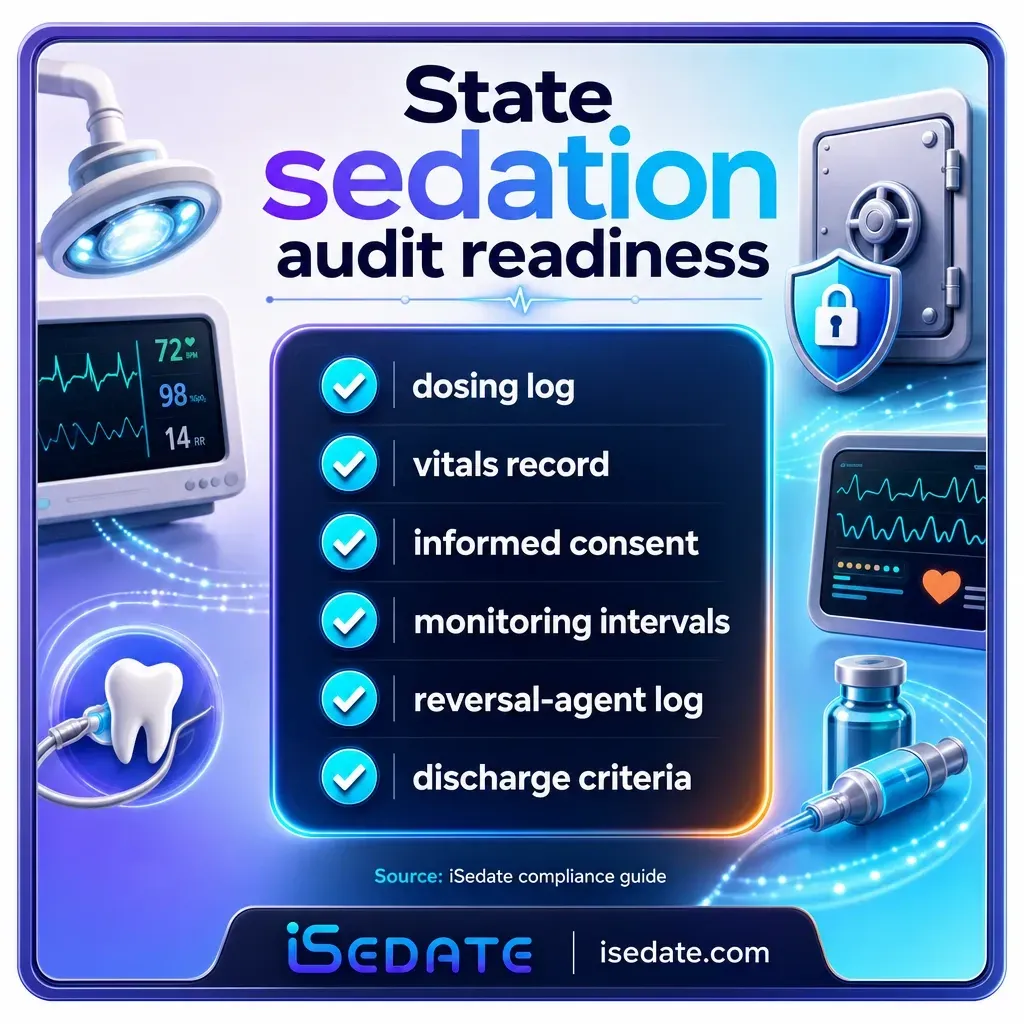
A reviewer does not want to hear that the case went well. They want to open the chart and see the required elements, time-stamped and in order. Pulling the Division 26 rules together, a compliant Oregon moderate-sedation record carries all of the following.
Oregon Moderate-Sedation Record Checklist
- Baseline: preoperative vital signs documented before the first drug is given.
- Continuous monitors: pulse oximetry and end-tidal CO2 running throughout, plus ECG if the patient has cardiovascular disease.
- Timed vitals: blood pressure, heart rate, and respiration recorded at regular intervals and at least every 15 minutes, each set stamped with its time.
- Drug log: every medication with its dose, time interval, and route of administration.
- Gaps explained: if a value could not reasonably be obtained, the reason written into the record.
- Recovery and discharge: postoperative vitals, a discharge entry noting the patient's condition, and the responsible party who takes the patient home.
The charting duty does not change between oral and IV moderate sedation, because both fall under OAR 818-026-0060. The same timed vitals, the same continuous capnography, and the same drug log apply to a patient who swallowed a sedative and to one on an IV line. The practical difference is that an IV case also documents venous access and the titrated doses and times as drug is given, which is exactly where a hand-kept record tends to drift behind the clock.
iSedate Charting Advice
Stamp every entry with a real time rather than a single end-of-visit summary. Oregon's interval rules are enforced against the clock, so a vitals set with no time, or a 25-minute gap at moderate sedation, is a documentation defect even when the patient did fine. A note that a patient "tolerated sedation well" is not the record Oregon asks for; a running, time-stamped account of the monitored condition with the drugs and doses is.
Source: OAR 818-026-0060 (Moderate Sedation)

How Oregon reviews records (and where dentists get burned)
The Oregon Board of Dentistry conducts office anesthesia evaluations as part of its permitting process, under its Office Evaluations rule (OAR 818-026-0110), and it holds general disciplinary authority over rule violations, including recordkeeping violations. The exact evaluation cadence and any penalty schedule are administered by the Board and can change, so confirm those specifics directly with the Oregon Board of Dentistry rather than relying on a figure that may be out of date. What does not change is the exposure a thin record creates.
Here is where dentists get burned. The care can be flawless and the record can still fail, because a reviewer does not grade the sedation on how the patient did. They grade it on whether the contemporaneous record is complete: a missing time stamp, a stretch of the case with no documented condition, a drug given but not logged, a discharge that was never written down. Because Oregon states both the duty and the interval, a gap longer than every 15 minutes at moderate sedation reads as a gap in the monitoring itself.
What Gets Practices in Trouble
A reviewer assumes that what is not in the contemporaneous record did not happen. If the anesthesia record has holes, the default assumption on review is that the monitoring had holes too. Record the patient's condition on the clock at the required interval, keep a copy in the dental chart under OAR 818-026-0080, and document the discharge condition, so the chart proves the care.
The numbers below are Oregon's own, and they are the ones a review is measured against. They are the easiest thing to get right in advance and the hardest thing to reconstruct after the fact.
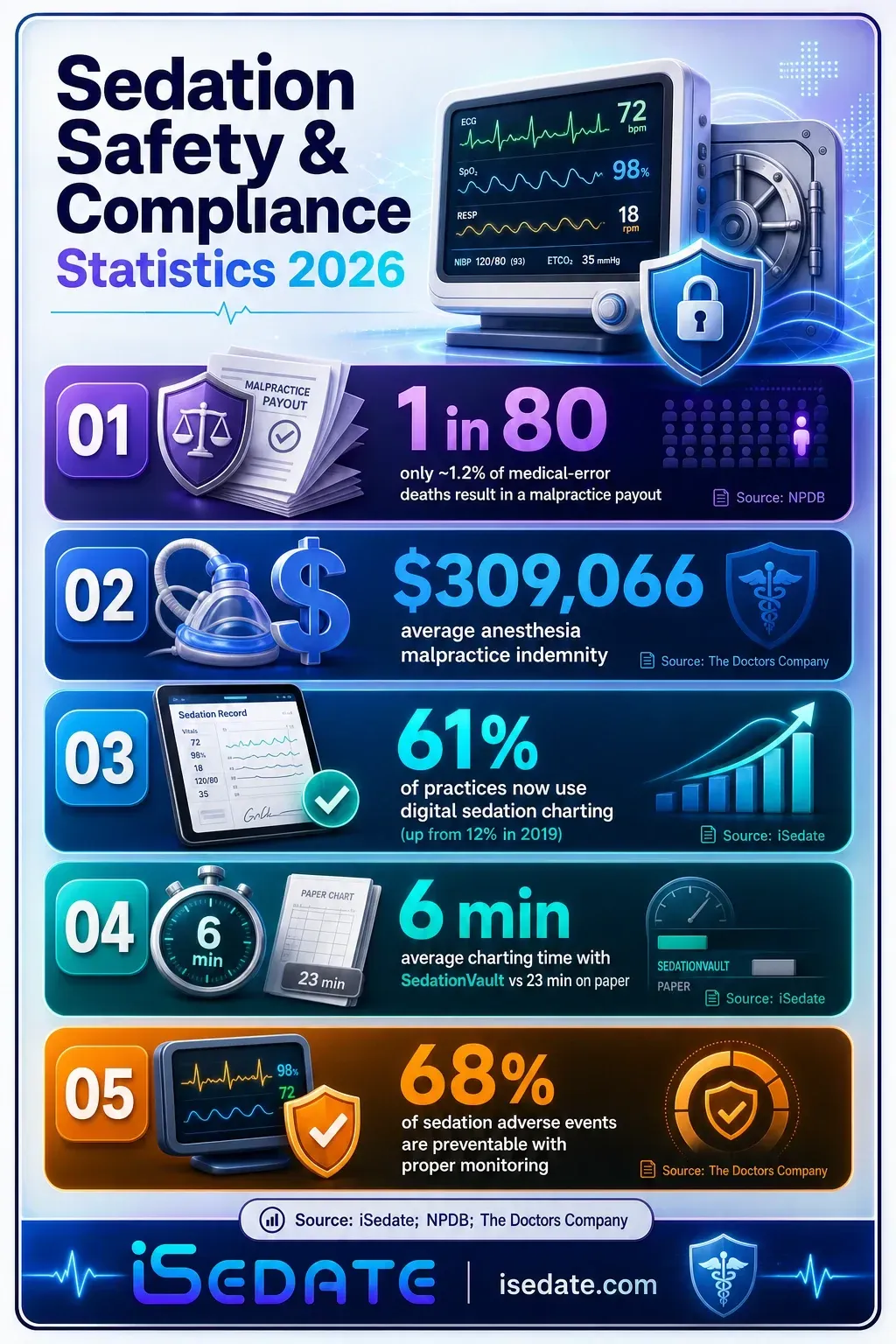
Related reading: the data behind these rules
The requirements on this page are the law. These research roundups are the data that explains why they exist and what a charting or documentation failure costs:
Source: OAR 818-026-0080 | Oregon Board of Dentistry, Laws & Rules
Discharge and adverse-event reporting
Oregon ties the anesthesia record directly to its most serious reporting obligation. Under OAR 818-026-0120, if a death, serious complication, or injury may have resulted from sedation or anesthesia, the licensee who performed the dental procedure must file a written detailed report with the Board within 5 days, filed with the patient's original complete dental records. The report names the patient, the people present, where the incident occurred, the anesthesia type and drug dosages, and a narrative with approximate times, and it must include the anesthesia record and the signed informed-consent form when required. If a separate provider administered the anesthetic, that person files a report too.
The lesson is structural: Oregon's incident rule assumes a complete, time-based anesthesia record already exists. There is no way to build it after the fact. The same is true at a far more common moment than an adverse event, the ordinary discharge. Under OAR 818-026-0080, when a dentist performs the procedure while a qualified provider induces the anesthesia, the dental record must document the patient's condition at discharge and a copy of the anesthesia record must be kept in the patient's dental record, and that copy is the responsibility of the dentist performing the procedure. A sedation case is not fully charted until the discharge condition is on the page and the record is in the chart.
Source: OAR 818-026-0120 (Reporting) | OAR 818-026-0080
The easy button: a contemporaneous record that writes itself
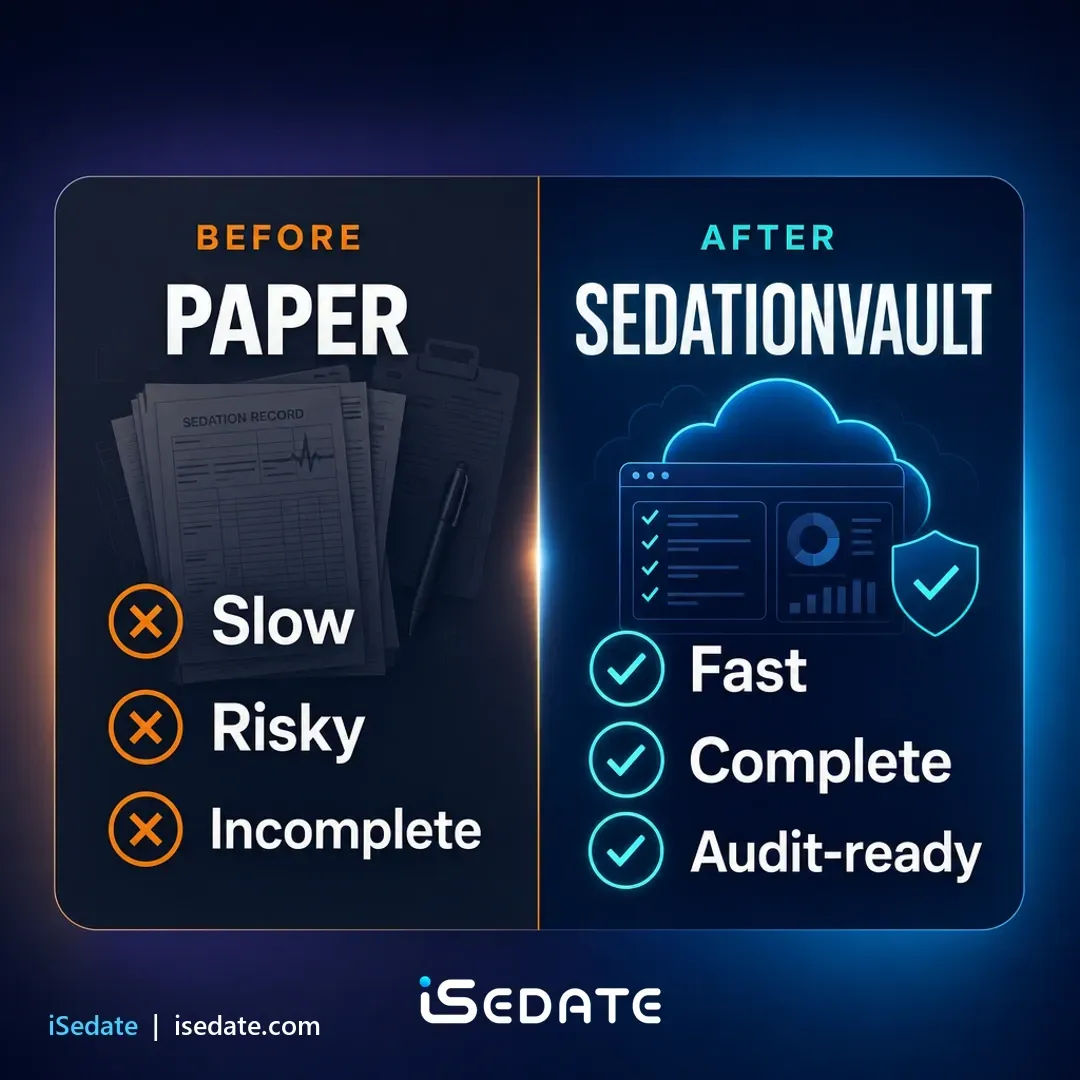
The gap between knowing the rule and surviving a review is almost always the same thing: a time-based log kept by hand during a live case. When a team is managing an airway and an anxious patient, a hand-kept record is exactly where holes develop, a skipped 15-minute set here, a missing time stamp there, a drug given and logged later from memory. Oregon's interval-based standard is precisely what a paper record struggles to satisfy.
That is the problem SedationVault by iSedate was built to remove. It connects wirelessly to the vitals monitor already in your operatory and captures oxygen saturation, heart rate, respiratory rate, blood pressure, and end-tidal CO2 live, on the clock, alongside the drug log, so the contemporaneous record builds itself at the interval the rule requires rather than being reconstructed afterward. When the Board asks for the chart, or an OAR 818-026-0120 report needs the anesthesia record attached, it exports as a one-click sedation visit report that already carries the times, the dosages, and the discharge condition, and a copy drops into the dental record exactly as OAR 818-026-0080 requires. You can see SedationVault pricing before you commit to anything.
Important
This guide is informational and is not legal or compliance advice. Oregon's rules change, and some details (office-evaluation cadence, penalty specifics, and renewal requirements) are administered by the Board. Confirm the current requirements directly with the Oregon Board of Dentistry and the official rule text before relying on them for your practice.
Frequently asked questions
Does Oregon require a written sedation record?
How often must vitals be recorded during sedation in Oregon?
Does Oregon require capnography or ECG during dental sedation?
What are the Oregon dental sedation permits?
What must I report to the Oregon Board of Dentistry after a sedation complication?
Does Oregon require discharge documentation after sedation?
Related guides and neighboring states
Licensed in a neighboring state, or managing multi-state compliance? Oregon's rules are only one square of the map. See our companion charting and reporting guides:
- California Sedation Vitals Monitoring, Charting & Reporting Requirements
- Idaho Sedation Vitals Monitoring, Charting & Reporting Requirements
- Nevada Sedation Vitals Monitoring, Charting & Reporting Requirements
- Washington Sedation Vitals Monitoring, Charting & Reporting Requirements
- Dental Sedation Vitals, Charting & Reporting Requirements by State
Sources and citations
How We Verified This Guide
Every rule on this page was verified against Oregon's primary regulatory sources: the official rule text in the Oregon Secretary of State's Administrative Rules database and the Oregon Board of Dentistry. Where a detail (office-evaluation cadence, penalty schedule, or renewal requirements) is administered by the Board or sits in a portion of the rule not reproduced here, we flagged it to confirm directly with the Board rather than guess. ADA guidelines are referenced as a professional standard, not as Oregon law.
- OAR 818-026-0050: Minimal Sedation Permit (monitor and record; vitals at least every 15 minutes; discharge entry)
- OAR 818-026-0060: Moderate Sedation Permit (continuous pulse oximetry and end-tidal CO2; vitals at least every 15 minutes)
- OAR 818-026-0070: General Anesthesia Permit (continuous ECG and capnography; blood pressure every 5 minutes)
- OAR 818-026-0080: anesthesia record maintained in the dental record; discharge condition
- OAR 818-026-0120: reporting of death, serious complication, or injury within 5 days
- Oregon Board of Dentistry: Anesthesia Permits
- Oregon Board of Dentistry: Laws & Rules