







Washington Sedation Vitals Monitoring, Charting & Reporting Requirements
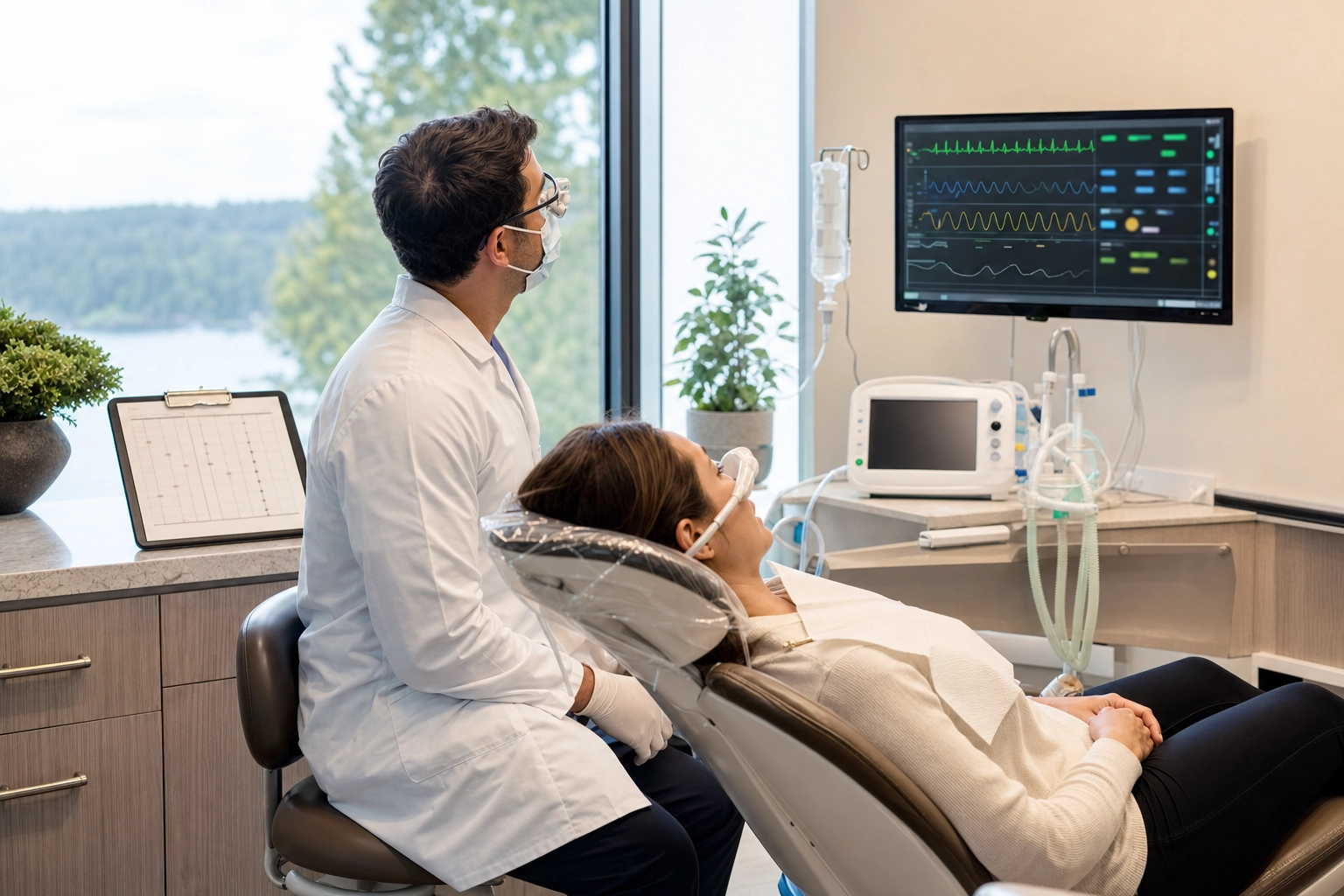
If you administer sedation in Washington, the state is specific about what has to be written down. You need a record that logs every medication with its dosage and route, documented at regular, consistent time intervals, plus your patient's blood pressure and heart rate. For moderate parenteral (IV) sedation and for general anesthesia, Washington goes further and requires vital signs recorded every five minutes. Those rules live in WAC Chapter 246-817, they are enforced by the Washington State Dental Quality Assurance Commission, and the current version took effect January 11, 2024. This guide breaks down what Washington requires you to monitor and record at each sedation level, what a compliant record actually looks like, where practices most often fall short on review, and how to make the record audit-ready.
Recent Updates
Last UpdatedNovember 16, 2026
- Verified every citation against the current (not archived) WAC Chapter 246-817 sections and the Dental Quality Assurance Commission's own anesthesia-permit page.
- Corrected the moderate parenteral vitals cadence: WAC 246-817-760 requires blood pressure, heart rate, pulse oximetry, and respiration recorded every five minutes, and the same five-minute cadence applies to general anesthesia under WAC 246-817-770.
- Added the new pediatric sedation endorsement, mandatory for moderate sedation of patients 12 and under as of January 1, 2025.
- Added a sample charting cadence and a documentation checklist showing what a compliant Washington sedation record contains.
- The core rule: WAC 246-817-724 requires the anesthesia provider or monitor to record the patient's condition, including all medications with dosages and route, documented at regular, consistent time intervals, plus blood pressure and heart rate for any patient receiving an anesthetic agent.
- IV sedation has a clock: for moderate parenteral sedation, WAC 246-817-760 requires blood pressure, heart rate, pulse oximetry, and respiration recorded every five minutes, and level of consciousness before dismissal. General anesthesia under WAC 246-817-770 adds the same five-minute cadence plus end-tidal CO2 and continuous ECG.
- Who enforces it: the Washington State Dental Quality Assurance Commission within the Department of Health, which runs on-site inspections and annual self-assessments, with disciplinary authority under the Uniform Disciplinary Act, RCW 18.130.
- Nitrous still counts: even nitrous-only analgesia carries its own record duty under WAC 246-817-740, the maximum concentration used and the start and stop (or total) times.
- The rules are current: Chapter 246-817's anesthesia rules took effect January 11, 2024, and the pediatric sedation endorsement became mandatory January 1, 2025, so a record built to older habits can fall behind the standard.

What This Guide Covers
- Who regulates sedation in Washington
- The Washington sedation permit levels
- What you must monitor at each level
- What the record must contain: the compliance core
- What compliant documentation looks like
- How Washington reviews records, and where dentists slip
- Why the record matters: penalties and exposure
- The easy button: a review-ready record
- Frequently asked questions
- Sources and citations
Who regulates sedation in Washington
Sedation and anesthesia in a Washington dental office are regulated by the Dental Quality Assurance Commission's anesthetic-agents program (DQAC), a body within the Washington State Department of Health that writes the rules, issues sedation permits, inspects offices, and takes disciplinary action against dentists. The requirements are not scattered across general dental law. They sit in one chapter of the Washington Administrative Code: WAC Chapter 246-817, which governs dentists.
That matters for compliance because your recordkeeping obligation is a named administrative rule with an exact citation, not a vague standard of care. When a reviewer asks whether your sedation record meets the requirement, the answer is measured against the specific sections of Chapter 246-817 below. It is worth being precise about the ADA here, because the point is often muddled: the American Dental Association publishes national sedation guidelines that most boards lean on, and Washington's medication-and-vitals record closely mirrors the ADA's time-oriented anesthetic record. But those guidelines are a professional standard, not law, and the ADA is not a federal agency. In Washington, the law is WAC Chapter 246-817, and the body that enforces it is the DQAC. (Federal layers still apply on top, including DEA controlled-substance logs and HIPAA, but they do not replace the state record rule.)
iSedate Insight
Most dentists call moderate sedation "Conscious Sedation," and the term is useful shorthand with patients. On a compliance record, though, what controls is the permit level and the route, enteral or parenteral, because that is what sets which vitals and intervals WAC 246-817-724, 760, and 770 require you to chart.
Source: Washington DQAC, Administration of Anesthetic Agents for Dental Procedures | WAC Chapter 246-817
The Washington sedation permit levels
Washington structures its permits by the depth and route of sedation, and the recordkeeping load rises with each one. Knowing which permit you hold tells you which monitoring and documentation rules apply. These are the levels as Chapter 246-817 defines them:
| Washington level | What it covers | Governing section |
|---|---|---|
| Nitrous oxide (no permit required) | Minimal sedation with inhaled nitrous oxide and oxygen | WAC 246-817-740 |
| Moderate Sedation with Enteral Agents permit | Moderate sedation by the enteral (oral) route | WAC 246-817-755 |
| Moderate Parenteral Sedation permit | Moderate sedation including the parenteral and IV routes | WAC 246-817-760 |
| Pediatric Endorsement | Moderate sedation of patients 12 and under; requires a valid moderate sedation permit (mandatory since January 1, 2025) | WAC 246-817-765 |
| General Anesthesia and Deep Sedation permit | General anesthesia and deep sedation, the top tier | WAC 246-817-770 |
Nitrous oxide sits at the bottom and needs no permit, though it still carries its own record requirement. Most sedation dentists hold the Moderate Sedation with Enteral Agents permit or step up to the Moderate Parenteral Sedation permit for IV cases, which asks for a heavier training base, including management of at least 20 supervised live-patient cases. The general anesthesia permit is carried most often by dental anesthesiologists and oral and maxillofacial surgeons. This guide focuses on the moderate-sedation recordkeeping standard, because that is the level most sedation dentists are permitted for and the one whose record requirements are spelled out most explicitly. If you are working out which permit to apply for or how to upgrade, that belongs in a separate process, covered in our guide to Washington sedation dentistry licensing and permit requirements.
Source: WAC 246-817-760 (Moderate Parenteral Sedation) | DQAC anesthesia-permit overview
What you must monitor at each level
In Washington, what you are required to monitor is what you are required to write down. The two are inseparable: the record rule in WAC 246-817-724 sets the baseline for every patient receiving an anesthetic agent, and the parenteral and general-anesthesia rules layer specific parameters and intervals on top. For any patient receiving an anesthetic agent, including local anesthesia or minimal sedation with nitrous oxide, the baseline is clear.
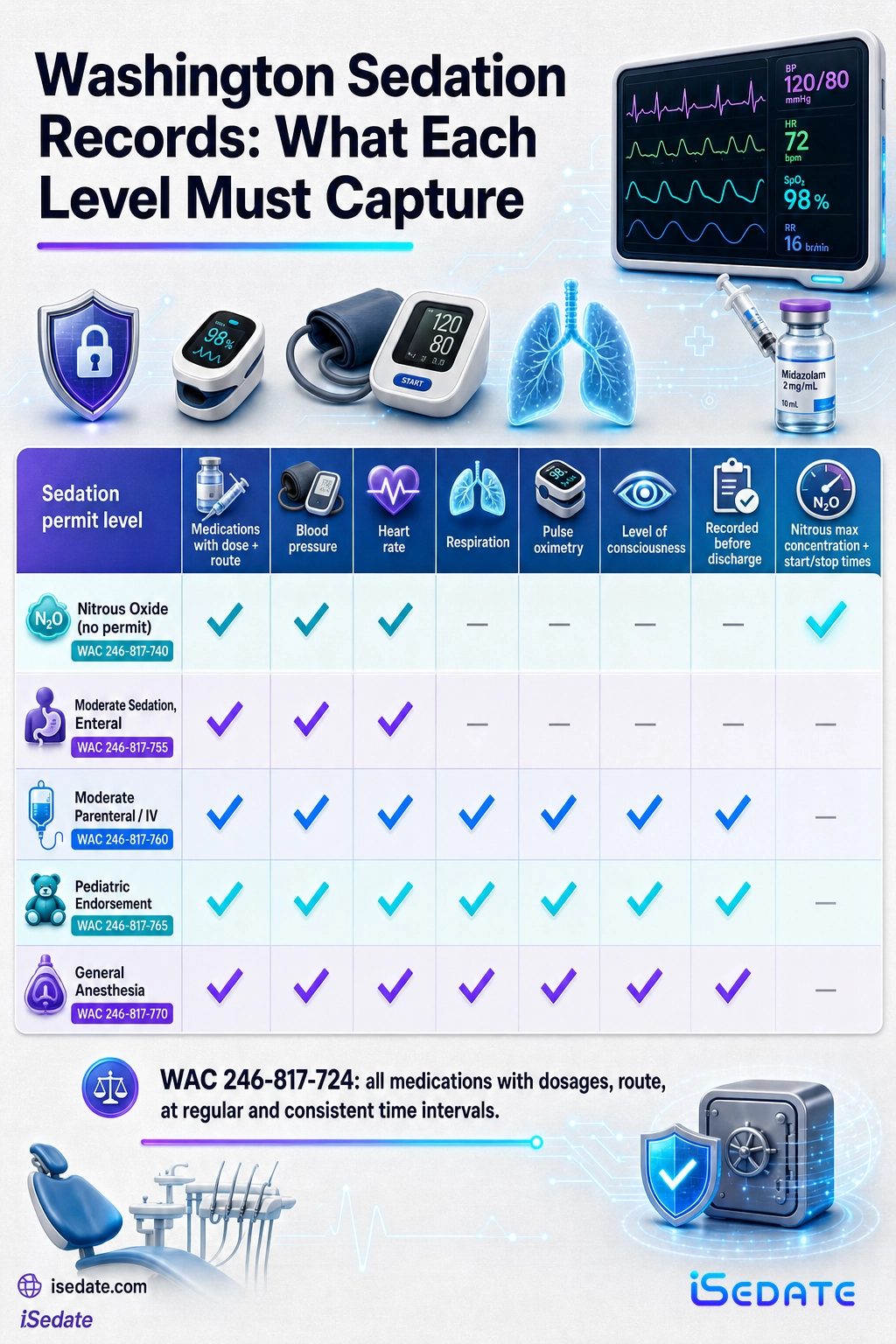
- Blood pressure and heart rate: under WAC 246-817-724, vital signs must be recorded, including blood pressure and heart rate, for any patient receiving an anesthetic agent. The rule excuses this only when patient cooperation or circumstances prevent it, and the reasons must be recorded. For ASA 1 patients age 13 and under, taking vital signs is left to the dentist's discretion.
- Pulse oximetry and respiration, every five minutes: for moderate parenteral sedation, WAC 246-817-760 requires blood pressure, heart rate, pulse oximetry, and respiration rate to be recorded every five minutes during the procedure.
- Level of consciousness before dismissal: for moderate parenteral sedation, the patient's level of consciousness must be recorded before the patient is dismissed.
- End-tidal CO2 and continuous ECG: for general anesthesia and deep sedation, WAC 246-817-770 adds end-tidal carbon dioxide and continuously displayed ECG, with blood pressure, heart rate, and respiration also recorded every five minutes.
- Medication detail: at every level, each drug must be captured with its dosage and route, documented at regular, consistent time intervals.
The jump from enteral moderate sedation to parenteral (IV) sedation is where the monitoring load increases, because the parenteral rule adds pulse oximetry and respiration on a five-minute clock on top of the baseline blood pressure and heart rate. The deeper and more invasive the route, the more parameters you are both watching and logging, and the tighter the cadence.
Myth, Busted
Myth: Washington never sets a clock, so "regular and consistent" means I decide how often to chart vitals.
Fact: The provider's discretion over intervals applies to the general records rule. For moderate parenteral sedation and for general anesthesia, WAC 246-817-760 and WAC 246-817-770 require vitals recorded every five minutes.
The confusion comes from the baseline records rule, WAC 246-817-724, which lets the provider set "regular and consistent" intervals. That flexibility does not carry up to the IV and general-anesthesia levels, which name the five-minute interval directly.
Source: WAC 246-817-724 | WAC 246-817-770
What the record must contain: the compliance core
This is the section a reviewer reads first. WAC 246-817-724 spells out exactly what the record must contain, and it has three parts worth knowing by heart.
1. A medication record at regular, consistent intervals
Under WAC 246-817-724, the anesthesia provider or anesthesia monitor must record the patient's condition, and the record must document all medications administered with dosages, the route of administration, and administration at regular, consistent time intervals. "Regular and consistent" is the operative phrase. The provider administering the sedation may determine the time intervals for the medication log, but those intervals have to be steady across the case. A note that a patient "tolerated sedation well" is not this record. A timeline of drugs, doses, routes, and times, kept at a steady cadence, is.
2. Vitals, with the five-minute cadence for IV and general anesthesia
Under WAC 246-817-724, for any patient receiving an anesthetic agent, vital signs must be recorded, including blood pressure and heart rate, unless patient cooperation or circumstances prevent it and the reasons are recorded. For moderate parenteral sedation, WAC 246-817-760 raises the bar: blood pressure, heart rate, pulse oximetry, and respiration must be recorded every five minutes. This is the detail that catches practices out. Monitoring the patient continuously but writing a reading only at the start and end of the case does not satisfy the rule; the readings have to land on the page on the clock.
3. A documented discharge assessment, plus the level-specific records
Recovery has its own documentation duty. For moderate parenteral sedation, WAC 246-817-760 requires the patient's level of consciousness to be recorded before dismissal, so the record has to show the patient was reassessed and documented at the end of the case, not only at the start. Other levels carry their own record elements: general anesthesia records under WAC 246-817-770 must list drugs administered with amounts and times, the length of the procedure, and any complications of anesthesia, and nitrous oxide records under WAC 246-817-740 must show the maximum concentration used and the start and stop (or total) times.
Source: WAC 246-817-724 | WAC 246-817-770
What compliant documentation looks like
Knowing the rule and passing a review are two different things. The gap between them is almost always the same: a record that proves what you did, in order, on the clock. Here is what a compliant Washington moderate-parenteral sedation record contains, drawn directly from WAC 246-817-724 and 246-817-760.
Washington Sedation Record Checklist
- Pre-sedation: ASA classification, baseline blood pressure and heart rate, and the consent for sedation.
- Every medication: drug name, dosage, route (oral, IV, inhaled), and the time it was given.
- Vitals on a five-minute clock: blood pressure, heart rate, pulse oximetry, and respiration logged at least every five minutes through the parenteral case.
- Level of consciousness: assessed during sedation and again before the patient is dismissed.
- Discharge: the before-dismissal level-of-consciousness reading and the time of discharge.
- Exceptions, documented: if a baseline vital could not be obtained, the reason, recorded on the chart rather than left blank.
A sample cadence makes the clock concrete. On an IV moderate-sedation case, the record should show a baseline set of vitals before the first drug, then a timed entry for each medication, then a blood-pressure, heart-rate, pulse-oximetry, and respiration reading at roughly 10:00, 10:05, 10:10, and so on through the procedure, closing with a level-of-consciousness note before dismissal. Enteral (oral) moderate sedation carries the same medication-and-vitals baseline under WAC 246-817-724, but the explicit five-minute cadence and the pulse-oximetry-and-respiration add-ons are written into the parenteral rule, which is one reason the IV record is the more demanding one to keep by hand. The required monitoring equipment follows the same logic: a pulse oximeter and a blood-pressure device are not optional for a parenteral case, because the rule asks you to record their output every five minutes.

How Washington reviews records, and where dentists slip
The record is the document a review turns on. The Dental Quality Assurance Commission regulates permit holders under WAC Chapter 246-817 and, as its anesthetic-agents program page states, conducts on-site inspections and requires an annual self-assessment from every dentist who administers anesthesia. The Commission's disciplinary authority runs through the Uniform Disciplinary Act, RCW 18.130.
Here is where dentists slip. It is rarely the clinical care that fails a review. It is the record: a drug given but not logged with its dose and route, a five-minute interval that quietly stretched to fifteen, a set of vitals captured only at the start and end, a discharge status never written down. The care can be flawless and the record can still fall short of what WAC 246-817-724 and 246-817-760 require.
Where Reviews Are Won or Lost
A reviewer does not grade your sedation on how the patient did. They grade it on whether the contemporaneous record proves what you did and when. If the medication-and-vitals record has gaps, the default assumption on review is that the monitoring had gaps too. Hold the five-minute interval on IV cases, and record every drug with its dose, route, and time.
The Commission sets its own inspection schedule and self-assessment process, and those details are administered by the DQAC and can change, so confirm the current review and inspection process directly with the Dental Quality Assurance Commission rather than relying on a figure that may be out of date.
Source: Washington DQAC inspections and self-assessment | RCW 18.130, Uniform Disciplinary Act
Why the record matters: penalties and exposure
Chapter 246-817 is backed by enforcement. The DQAC can take disciplinary action for rule violations, including recordkeeping violations, under RCW 18.130. Incomplete sedation records are not a filing technicality. They are the evidence a commission weighs when deciding whether the standard of care was met, and the same gaps that fail a review are the gaps a plaintiff's attorney looks for in a malpractice claim.
The exact disciplinary schedule, the specific adverse-event reporting triggers, and the precise penalty amounts are administered by the DQAC and can change, so confirm current details directly with the Dental Quality Assurance Commission rather than relying on a figure that may be out of date. What does not change is the exposure created by a thin record: in both a commission review and a lawsuit, the contemporaneous sedation record is the first thing requested and the hardest thing to reconstruct after the fact. For the data behind that exposure, see our research roundups on how sedation charting affects malpractice case outcomes, vital-signs monitoring and sedation safety, and documentation-error rates and chart defensibility.
See how iSedate supports dental sedation complianceThe easy button: a review-ready record
The gap between knowing the rule and passing a review is almost always the same thing: a running interval log kept by hand during a live case. When a team is managing an airway and an anxious patient, a vitals reading due every five minutes on paper is exactly where the record develops holes, a skipped interval here, a missing time stamp there, a drug given in the moment and logged later from memory.
That is the problem SedationVault by iSedate was built to remove. It connects to the vitals monitor already in your operatory and captures blood pressure, heart rate, respiration, and pulse oximetry live, on the five-minute clock, alongside the drug log, so the record writes itself as the case runs rather than being reconstructed afterward. When the DQAC asks for the chart, it exports as a one-click, review-ready sedation visit report that already carries the medications, doses, routes, times, vital signs, and the before-dismissal assessment the rule asks for. The point is not fancier charting. It is turning the exact items WAC 246-817-724 and 246-817-760 require into something the record guarantees are present and time-stamped, which is also what a time-oriented anesthesia record is for.
Book a demo and watch your Washington sedation record build itselfFrequently asked questions
Does Washington require a written sedation record?
How often must vitals be recorded during sedation in Washington?
What vital signs must a Washington sedation record include?
Who regulates sedation records in Washington?
Does Washington require a discharge note after sedation?
Did Washington's sedation rules change recently?
Licensed in a Neighboring State?
Sedation charting and reporting rules are set state by state. If you practice across the Pacific Northwest, see our companion guides:
Sources and citations
Our Sources and Verification
This guide cites Washington's primary regulatory sources. Rule text is drawn from the current Washington Administrative Code Chapter 246-817 as published by the Washington State Legislature, verified against the live (non-archived) sections in November 2026, and the regulator is the Washington State Dental Quality Assurance Commission within the Department of Health. The current anesthesia rules took effect January 11, 2024 (WSR 24-01-033). Where a detail, such as the penalty schedule, the exact inspection cadence, the board phone number, the continuing-education cycle, or application fees, is administered by the Commission and subject to change, confirm it directly with the DQAC before relying on it. This content is general information, not legal or compliance advice; consult a qualified professional for guidance specific to your situation.
- Washington DQAC: Administration of Anesthetic Agents for Dental Procedures (Department of Health)
- WAC Chapter 246-817: Dentists
- WAC 246-817-724: Recordkeeping, equipment, and emergency medications (effective January 11, 2024)
- WAC 246-817-760: Moderate sedation with parenteral agents
- WAC 246-817-740: Minimal sedation with nitrous oxide
- WAC 246-817-770: General anesthesia and deep sedation
- RCW 18.130: Uniform Disciplinary Act















