






Washington Sedation Dentistry Licensing & Permit Requirements
In Washington, your dental license alone does not let you sedate a patient. A dentist who administers moderate sedation, IV (parenteral) sedation, or general anesthesia must first hold the matching permit from the Washington State Dental Quality Assurance Commission (DQAC), issued under WAC Chapter 246-817. Getting the permit means meeting the training, certification, and patient-experience requirements for your level. Keeping it means passing a three-year renewal, an office inspection for the deeper levels, and a records review that the Commission can run at any time. This guide walks both halves: how a Washington dentist earns a sedation or anesthesia permit, and what it takes to keep it.
Recent Updates
Last UpdatedNovember 16, 2026
- Re-verified every permit level, training-hour count, and the record rule directly against the current Washington Administrative Code (WAC Chapter 246-817), not third-party course pages.
- Added the verified continuing-education hours for each permit level and the three-year renewal cycle (WAC 246-817-773 and 246-817-774).
- Added the on-site inspection and 25 percent random-audit rules that apply to IV and general-anesthesia permits (WAC 246-817-774 and 246-817-775).
- Clarified the pediatric sedation endorsement and replaced aggregator citations with direct links to the state's own rule text and the Washington Department of Health permit pages.
- Washington issues three sedation and anesthesia permits under WAC Chapter 246-817: Moderate Enteral (oral), Moderate Parenteral (IV), and General Anesthesia, plus a Pediatric Sedation Endorsement. Nitrous oxide needs no permit but still requires 14 hours of training and BLS.
- Most sedation dentists hold the Moderate Sedation with Enteral Agents permit for oral Conscious Sedation, or step up to the Moderate Parenteral permit for IV cases. General anesthesia is the top tier and largely the province of dental anesthesiologists and oral surgeons.
- The jump to IV is the big one: the enteral permit needs 16 hours of minimal plus 21 hours of moderate training and BLS; the parenteral permit needs a 60-hour course, 20 or more supervised patients, and ACLS.
- Every permit is valid for three years. Renewal requires continuing education, a declaration of 12 emergency drill scenarios run twice a year, and, for IV and general anesthesia, a declaration of a passing on-site office inspection within the last five years.
- The DQAC can review a permit holder's sedation records and randomly audit up to 25 percent of permit holders after renewal. Incomplete records are where permits get challenged.
What This Washington Permit Guide Covers
- Who issues sedation permits in Washington
- The Washington permit levels
- How to get or upgrade each permit
- What the permit requires you to monitor
- Continuing education and the three-year renewal
- Inspections and record reviews
- Keeping the permit: review-ready records
- Frequently asked questions
- Neighboring states and related guides
- Sources
Who issues sedation permits in Washington
Sedation dentistry in Washington is regulated by the Washington State Dental Quality Assurance Commission, a body within the Washington State Department of Health that licenses dentists and issues every sedation and anesthesia permit. The Commission, not any national association, decides who may sedate, runs the inspections and record reviews, and takes disciplinary action. The rules live in WAC Chapter 246-817, and every requirement below traces to a numbered section of that chapter.
To apply, you work through the Commission's own application process. The Department of Health's Administration of Anesthetic Agents for Dental Procedures page hosts the current sedation permit application and the self-inspection forms, and the fee schedule is set by rule and changes periodically, so pull the current forms and fees from the Department of Health before you file.
Important
The ADA writes the standard; the Commission writes the law. The American Dental Association publishes sedation guidelines that Washington and most states lean on, and Washington's medication-and-vitals record closely mirrors the ADA's time-oriented anesthetic record. But the ADA is a private professional association, not a government agency. It does not license you, inspect you, or discipline you. There is no "federal ADA law" that overrides the state. Your real federal layers are the DEA for controlled-substance logs and HIPAA for records. Your permit, your inspections, and your sanctions all come from the DQAC under WAC Chapter 246-817, with disciplinary authority under RCW 18.130. Treat the ADA guidelines as best practice and Chapter 246-817 as the rule you are held to.
Source: Washington DOH, Dentist Licensing | WAC Chapter 246-817
The Washington permit levels
Washington names its permits by the depth and route of sedation, not just which drug is used. Here is the full ladder, each with its governing section of Chapter 246-817.
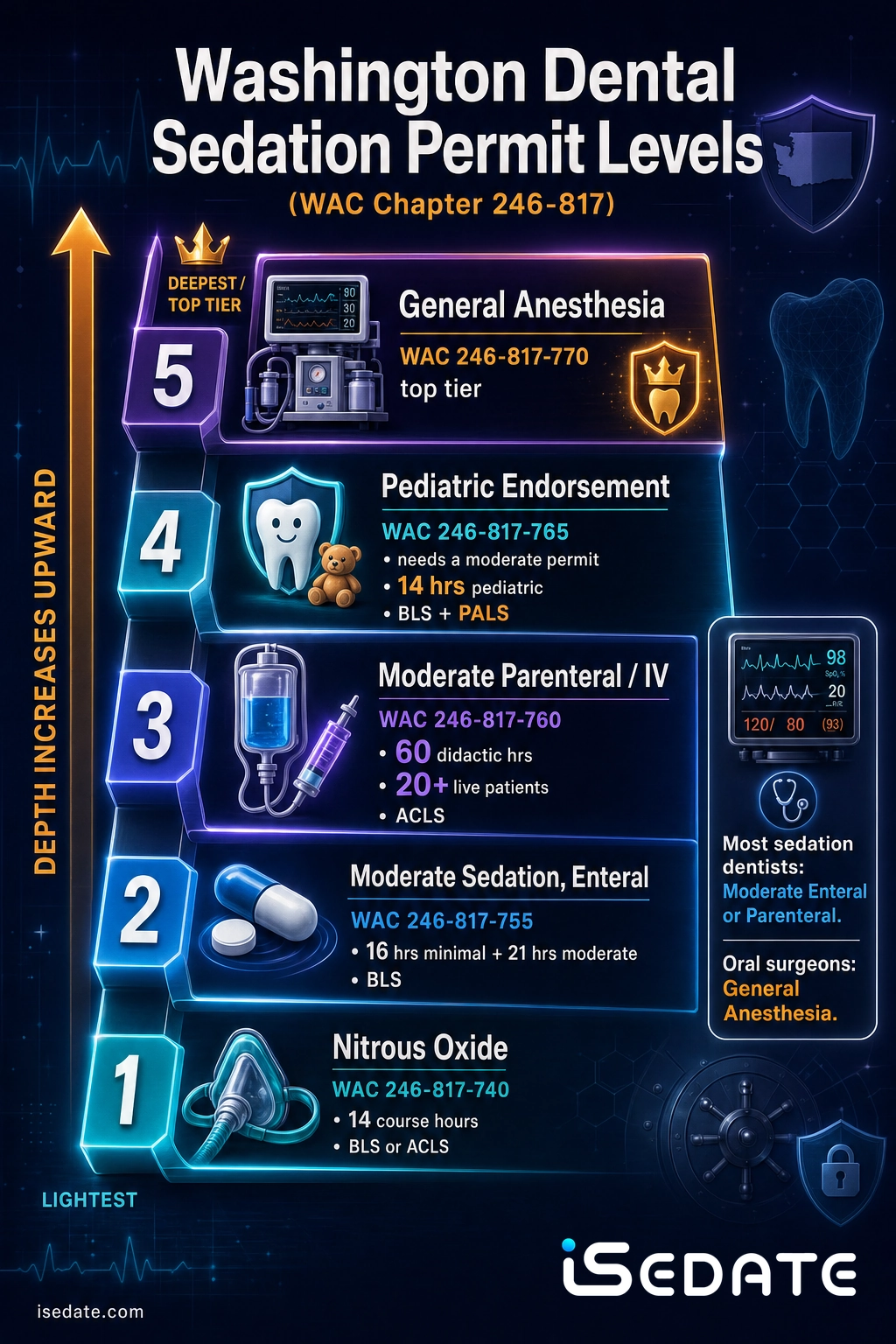
Minimal sedation with nitrous oxide (no permit required, WAC 246-817-740). The entry point. Nitrous oxide and oxygen is the lightest form of anxiety control, where the patient stays fully responsive. Washington does not require a permit, but it does require a minimum of 14 hours of education and training, current BLS, and a record of the maximum concentration used and the start and stop times.
Moderate Sedation with Enteral Agents permit (WAC 246-817-755). Authorizes moderate, or "conscious," sedation by the enteral route, meaning oral and other non-injection routes. The patient responds purposefully to verbal or tactile stimulation and keeps their own airway. This is the workhorse permit for dentists who provide genuine oral Conscious Sedation.
Moderate Sedation with Parenteral Agents permit (WAC 246-817-760). Authorizes moderate sedation that includes the parenteral route, that is, IV sedation and other injected routes. Because IV titration carries a higher risk and a faster onset, this permit sits above the enteral permit and carries heavier training, monitoring, and record requirements. This is where oral surgeons and sedation-trained dentists typically operate.
Pediatric Sedation Endorsement (WAC 246-817-765). Not a standalone permit but an endorsement added on top of a valid moderate sedation permit (enteral or parenteral), with its own pediatric-specific training. Children are not small adults when it comes to sedation, and Washington treats pediatric cases as their own qualification. Note a related age rule in the same chapter: administering sedative drugs by the intranasal route to patients over the age of 12 requires a parenteral or general anesthesia permit.
General Anesthesia and Deep Sedation permit (WAC 246-817-770). The top tier. It authorizes general anesthesia and deep sedation, where the patient is not easily aroused or is unconscious and may need airway support. The training path is substantial, generally two years of continuous full-time anesthesia training through a program such as a CODA-accredited dental anesthesiology program or an ACGME-accredited anesthesia residency. This permit is largely the province of dental anesthesiologists and oral and maxillofacial surgeons, so most general dentists operate at the nitrous and oral Conscious Sedation levels and treat general anesthesia as out of scope.
Source: WAC 246-817-760 | WAC 246-817-770
How to get or upgrade each permit
Each permit has its own bar to clear: a set number of training hours, resuscitation certification, and, for parenteral sedation, a count of supervised patients. You move up the ladder by meeting the next level's requirements and applying to the Commission. The figures below come straight from Chapter 246-817.
| Permit | Route / depth | Training | Supervised patients | Resuscitation |
|---|---|---|---|---|
| Nitrous oxide (246-817-740) | Inhalation, lightest | 14 hours | Not specified | BLS |
| Moderate Enteral (246-817-755) | Enteral (oral) | 16 hrs minimal + 21 hrs moderate | Not specified | BLS |
| Moderate Parenteral (246-817-760) | Parenteral / IV | 60-hour postdoctoral course | 20 or more | ACLS (or PALS) |
| Pediatric Endorsement (246-817-765) | Pediatric patients | 14 pediatric hrs (4+ hands-on); needs a moderate permit first | See 246-817-765 | BLS + PALS |
| General Anesthesia (246-817-770) | Deep sedation / GA | ~2 yrs full-time anesthesia training | See 246-817-770 | ACLS |
Nitrous oxide
This lightest option needs no permit, but Washington still requires a minimum of 14 hours of education and training plus current BLS under WAC 246-817-740. It is the most accessible qualification and the usual first step for a general practice adding light anxiety control.
Moderate enteral: oral Conscious Sedation
To hold the Moderate Sedation with Enteral Agents permit, you need 16 hours of minimal-sedation training plus 21 hours of moderate-sedation training and current BLS under WAC 246-817-755. This permit lets you provide genuine oral Conscious Sedation but stops short of IV.
Moderate parenteral: adding IV sedation
Upgrading to the Moderate Sedation with Parenteral Agents permit is the biggest step a general dentist or oral surgeon takes. It requires a postdoctoral course of at least 60 clock hours, supervised experience providing parenteral moderate sedation to 20 or more patients, and current ACLS under WAC 246-817-760. The patient-experience count is substantial because IV titration demands hands-on competence a classroom cannot replicate.
State Law
Pediatric endorsement
To sedate pediatric patients, you add a Pediatric Sedation Endorsement on top of a valid moderate sedation permit. The training route is either CODA postgraduate instruction or 37 hours of minimal and moderate sedation training plus an additional 14 hours in pediatric sedation, of which at least 4 hours must be hands-on. The endorsement also requires current BLS and PALS under WAC 246-817-765. Washington announced that the endorsement carries no application or renewal fee.
Required course and application
For every level, the training must come from an acceptable sedation program, and the application, the current fee schedule, and any declaration forms are set by the Commission and updated periodically. Do not rely on an hour count you read on a course provider's page. National providers such as DOCS Education's Washington sedation courses are one place to complete the required training, but the governing hour counts are the ones in Chapter 246-817, and the forms come from the Department of Health. Confirm the exact forms and current fees with the Department of Health sedation permit page before you file.
Source: WAC 246-817-755 | WAC 246-817-765
What the permit requires you to monitor
A permit is permission plus obligation. Once you hold a sedation permit, the record rule in WAC 246-817-724, whose current version took effect January 11, 2024, requires the anesthesia provider or anesthesia monitor to record the patient's condition for any patient receiving an anesthetic agent:
- Medications: every drug with its dosage and route of administration, documented at regular and consistent time intervals the provider sets.
- Blood pressure and heart rate: recorded for any patient receiving an anesthetic agent, unless cooperation or circumstances prevent it and the reasons are recorded. For ASA 1 patients age 13 and under, taking vitals is at the dentist's discretion.
- Parenteral monitoring: for moderate parenteral sedation, the patient's blood pressure, heart rate, pulse oximetry, and respiration rate must be recorded every five minutes under WAC 246-817-760.
- Level of consciousness: for moderate parenteral sedation, documented during sedation and before discharge.
State Law
Level-specific records layer on top. General anesthesia records under WAC 246-817-770 must list the drugs administered with amounts and times, the length of the procedure, and any complications. Nitrous oxide records under WAC 246-817-740 must show the maximum concentration used and the start and stop times. For the full clinical breakdown of what to chart at each depth, see the companion guide on Washington sedation vitals monitoring, charting and reporting requirements, and the national overview in our Sedation Dentistry Licensing & Permit Requirements by State hub.
Source: WAC 246-817-724 | WAC 246-817-760

Continuing education and the three-year renewal
Your sedation permit is not a one-time credential. Under WAC 246-817-774, each permit is valid for three years from the date of issuance, and you renew by filing a declaration of continuing compliance, your continuing-education hours, a declaration that at least 12 emergency drill scenarios were performed twice per year, the on-site inspection declaration where it applies, and the renewal fee. Miss a piece and the permit, not just a CE deadline, is what lapses.
Continuing education is set by permit level in WAC 246-817-773. The hours below reflect the current table; the Commission has continued to amend this section, so confirm your exact cycle with the DQAC.
Continuing Education by Permit Level (WAC 246-817-773)
- Minimal sedation with nitrous oxide: 7 hours over a five-year cycle.
- Moderate sedation with enteral agents: 7 hours over a three-year cycle.
- Moderate sedation with parenteral agents: 14 hours over a three-year cycle.
- Pediatric sedation endorsement: 14 hours over a three-year cycle.
- General anesthesia and deep sedation: 18 hours over a three-year cycle.
The continuing-education cycle for moderate, parenteral, and general anesthesia permits runs from the permit issuance date, while the minimal and nitrous cycle runs from the date sedation is first administered. Keep the documentation: these hours are one of the things the Commission can audit after renewal.
Source: WAC 246-817-773 | WAC 246-817-774
Inspections and record reviews
This is where a permit is kept or lost. The deeper the sedation, the heavier the scrutiny, because that is where the risk is. Two mechanisms matter.
On-site office inspection. Dentists holding a moderate parenteral or general anesthesia permit must provide a written declaration of an acceptable on-site inspection by a DQAC-approved organization completed within the previous five years, under WAC 246-817-774 and 246-817-775. Keep that inspection documentation for five years. The enteral and nitrous levels do not carry the on-site inspection requirement.
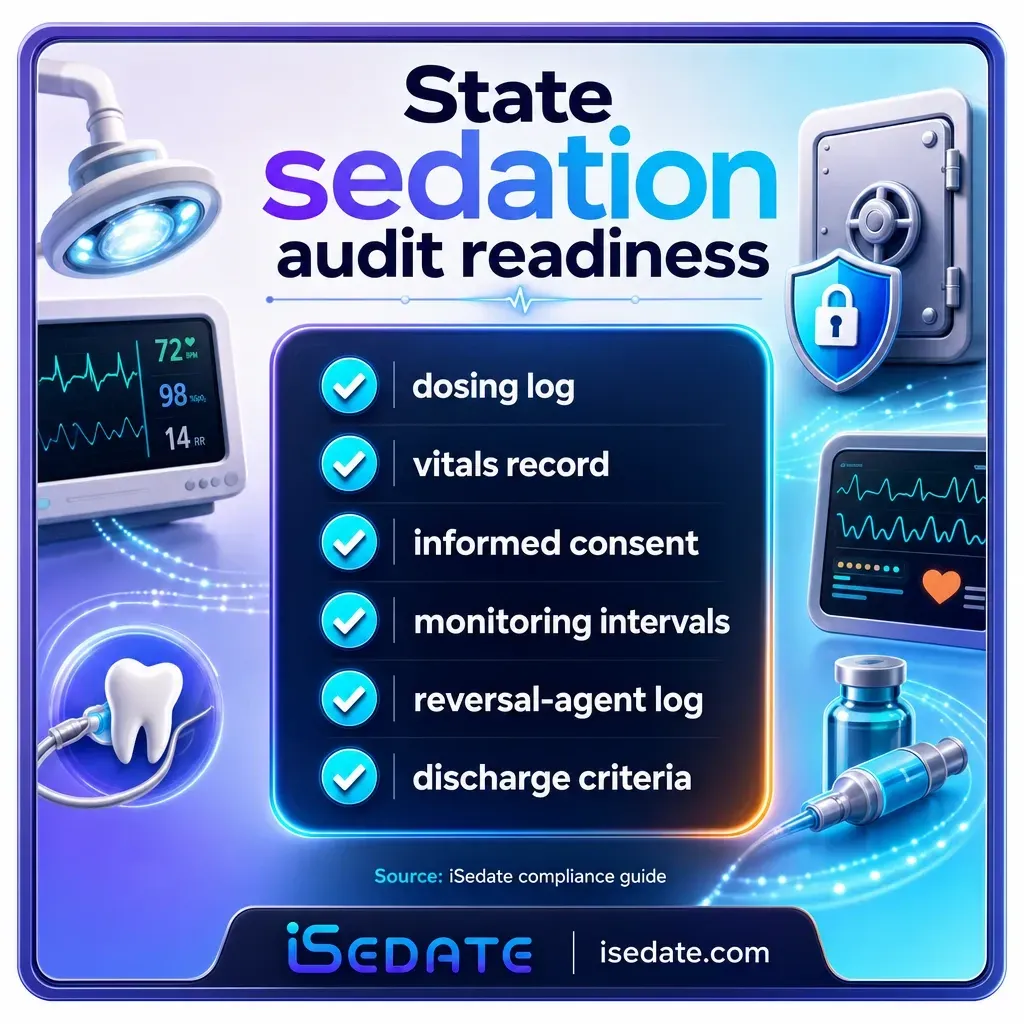
Random audit. After a permit is renewed, the Commission may randomly audit up to 25 percent of permit holders, and the same cap applies to continuing-education records and emergency-drill documentation. When a reviewer opens your file, they are checking the record, not your intentions. A review turns on whether your medication-and-vitals record is complete, contemporaneous, and kept at the required intervals.
State Law
Myth, Busted
Myth: The board only looks at your sedation records if a patient files a complaint.
Fact: Washington's renewal is a declaration-based process, and the DQAC may randomly audit up to 25 percent of permit holders after renewal, under WAC 246-817-774, with no complaint required.
In practice the dentist usually does the sedation correctly and loses on the paperwork: a drug logged without its dose or route, a set of vitals captured only at the start, a discharge status never recorded.
Source: WAC 246-817-774 | WAC 246-817-775
Keeping the permit: review-ready records
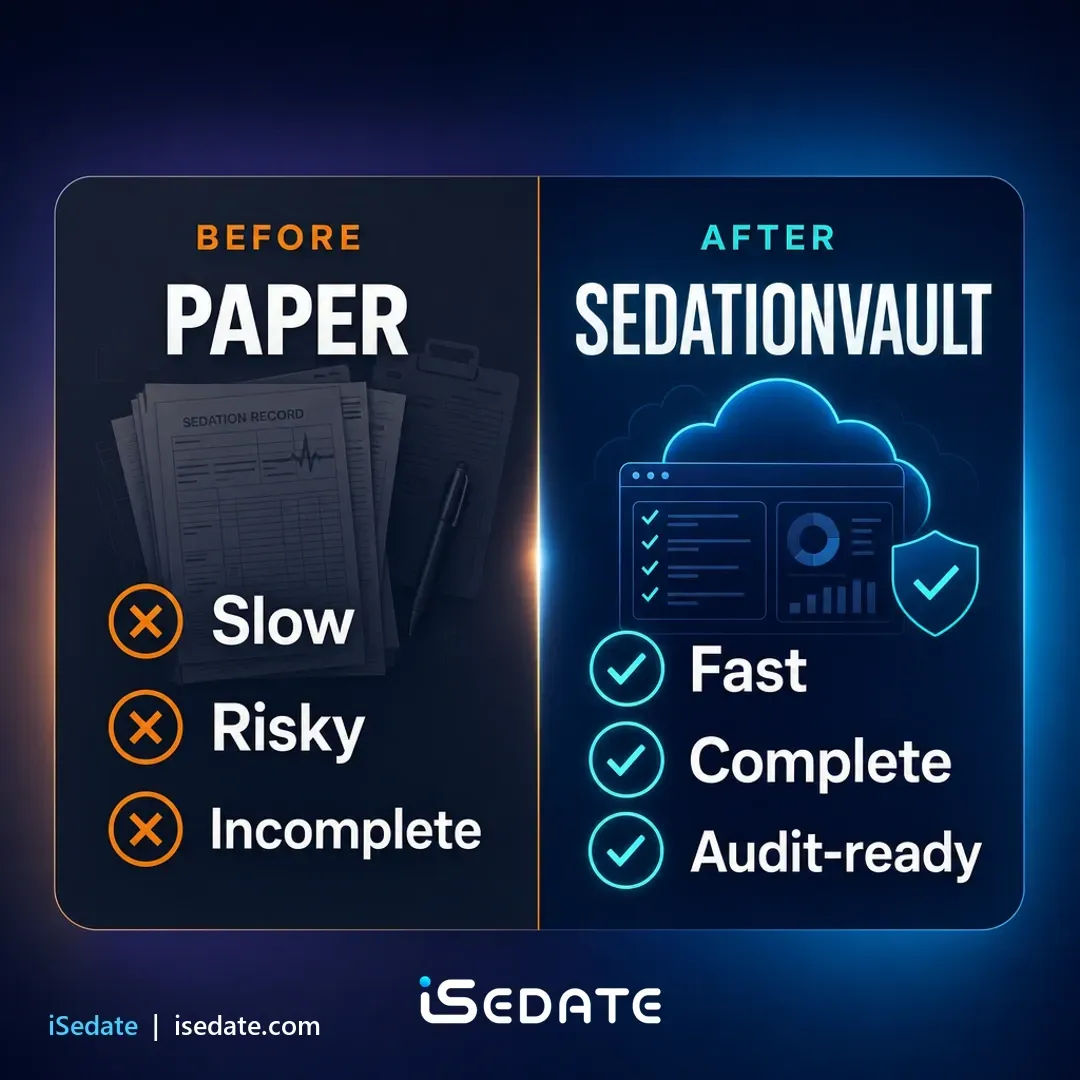
Everything above points to one truth: getting the permit is a one-time hurdle, but keeping it is a daily documentation discipline. A manual vitals log written by hand, between titrating a drug and watching an airway, is exactly where records go incomplete, and incomplete records are what a Commission audit and a malpractice claim both attack.
SedationVault removes that failure point. It captures live patient vitals and the drug log automatically into a Washington-ready record, holding the five-minute parenteral interval that WAC 246-817-760 demands and the regular, consistent interval that WAC 246-817-724 requires, so the record writes itself while you focus on the patient. When the Commission asks for the file, a complete record is a one-click export, not a scramble through paper. See how it maps to the rules on the dental sedation compliance and anesthesia record software pages.
Book a Demo of SedationVault See SedationVault PricingFrequently asked questions
What sedation permits does Washington require for dentists?
How many training hours do you need for an IV sedation permit in Washington?
How often do you renew a Washington sedation permit?
Does Washington inspect or audit dental sedation offices?
How much continuing education does a Washington sedation permit require?
Does nitrous oxide require a sedation permit in Washington?
Neighboring states and related guides
Licensed, or getting licensed, in a neighboring state? Sedation permit rules change at every state line. See our guides for Idaho sedation dentistry licensing and permit requirements and Oregon sedation dentistry licensing and permit requirements, or compare all fifty states in our Sedation Dentistry Licensing & Permit Requirements by State hub.
Sources & How We Verified This Guide
Every permit level, training-hour count, continuing-education figure, renewal rule, and record requirement on this page was verified against the current text of Chapter 246-817 WAC on the Washington State Legislature's official rules portal, and the permit and application details against the Washington State Department of Health, on November 16, 2026.
- Washington DOH, Dentist Licensing (Dental Quality Assurance Commission)
- Washington DOH, Administration of Anesthetic Agents for Dental Procedures (permit applications and inspection forms)
- WAC Chapter 246-817: Dentists
- WAC 246-817-724: Recordkeeping, equipment, and emergency medications (effective January 11, 2024)
- WAC 246-817-740: Minimal sedation with nitrous oxide
- WAC 246-817-755: Moderate sedation with enteral agents
- WAC 246-817-760: Moderate sedation with parenteral agents
- WAC 246-817-765: Pediatric sedation endorsement
- WAC 246-817-770: General anesthesia and deep sedation
- WAC 246-817-773: Continuing education for dentists administering sedation
- WAC 246-817-774: Permitting and renewal requirements
- WAC 246-817-775: On-site inspections
This guide summarizes Washington sedation permit rules for general information and is not legal advice. Requirements current as of November 2026. Application forms, fees, and the exact continuing-education cycle are set by the Washington State Dental Quality Assurance Commission and amended periodically, so verify them directly with the Commission before you act.