







California Sedation Dentistry Licensing & Permit Requirements
In California, your dental license alone does not let you sedate a patient. Any dentist who administers moderate sedation, deep sedation, or general anesthesia must first hold the matching permit from the Dental Board of California, issued under the Business and Professions Code and the board's regulations in Title 16, Article 5. California also rebuilt this system recently: SB 501 (effective January 1, 2022) retired the old Conscious Sedation permit and tightened training, monitoring, and inspection rules, and SB 1453 (effective January 1, 2025) amended it further. Getting the permit means meeting the training, certification, and case requirements for your level. Keeping it means your sedation records survive a board inspection. This guide walks both halves.
Recent Updates
Last UpdatedNovember 16, 2026
- Corrected the moderate sedation training requirement to the Dental Board of California's current figure: at least 60 hours of instruction and at least 20 moderate sedation cases (an older third-party summary had listed 10 cases).
- Separated the inspection cadence by permit: every six years for a moderate sedation permit, every five years for a general anesthesia permit.
- Replaced third-party statute aggregators with the Dental Board of California's own permit pages and official regulation text, and added the BreEZe online application and the MSP-1 and MSP-2 forms.
- After SB 501, California issues a Moderate Sedation permit (age 13 and up), two pediatric-endorsement tiers (ages 7 to 12 and under 7), and a General Anesthesia / Deep Sedation permit; nitrous oxide needs no permit.
- The old Conscious Sedation permit was retired on January 1, 2022 and is no longer issued or renewed.
- The Dental Board of California's current moderate sedation standard is at least 60 hours of instruction plus at least 20 moderate sedation cases, with ADA-based rescue and airway training.
- Permits renew every two years; from the second renewal, moderate sedation holders complete 15 hours of approved CE (general anesthesia holders complete 24 hours including ACLS).
- Keeping the permit turns on inspection: the board inspects within one year of a new permit, then every six years (moderate) or five years (general anesthesia), and refusing an inspection means denial or revocation.
What This Guide Covers
- Who issues sedation permits in California
- The California permit levels after SB 501
- How to get or upgrade each permit
- Fees and the application
- What the permit requires you to monitor
- Continuing education and renewal
- Inspections and record reviews
- Keeping the permit: audit-ready records
- Licensed in a neighboring state?
- Frequently asked questions
- Sources
Who issues sedation permits in California
Sedation dentistry in California is regulated by the Dental Board of California, the state agency that licenses dentists and issues every sedation and anesthesia permit. The board, not any national organization, decides who may sedate, runs the office inspections, and takes disciplinary action. The statutes live in the California Business and Professions Code, Division 2, Chapter 4 (sections 1646 through 1647.x and 1682), and the operational detail lives in the California Code of Regulations, Title 16, Division 10, Article 5. Two recent bills rewrote much of this. SB 501 took effect January 1, 2022, and the board's SB 1453 alert covers the amendments effective January 1, 2025.
State Law vs. National Standard
The American Dental Association publishes sedation guidelines that California and most states lean on, and the board's training rules point to them. But the ADA is a professional association, not a government agency. It does not license you, inspect you, or discipline you. Your permit, your inspections, and your sanctions all come from the Dental Board of California under the Business and Professions Code and 16 CCR Article 5. Treat the ADA guidelines as the best-practice standard and California's statutes and regulations as the rules you are actually held to.
To apply, you work through the board's own process on its permits and applications page, which routes applications through California's online BreEZe licensing system. Application forms and the current fee schedule are set by the board and change periodically, so confirm the exact forms and current fees with the board before you file.
Source: Dental Board of California, permits and applications | DBC SB 1453 alert
The California permit levels after SB 501
California names its permits by depth and patient age, and SB 501 collapsed the old structure into a cleaner moderate sedation framework with pediatric endorsements on top. Here is the ladder the board administers today, from the lightest form of anxiety control to the deepest.
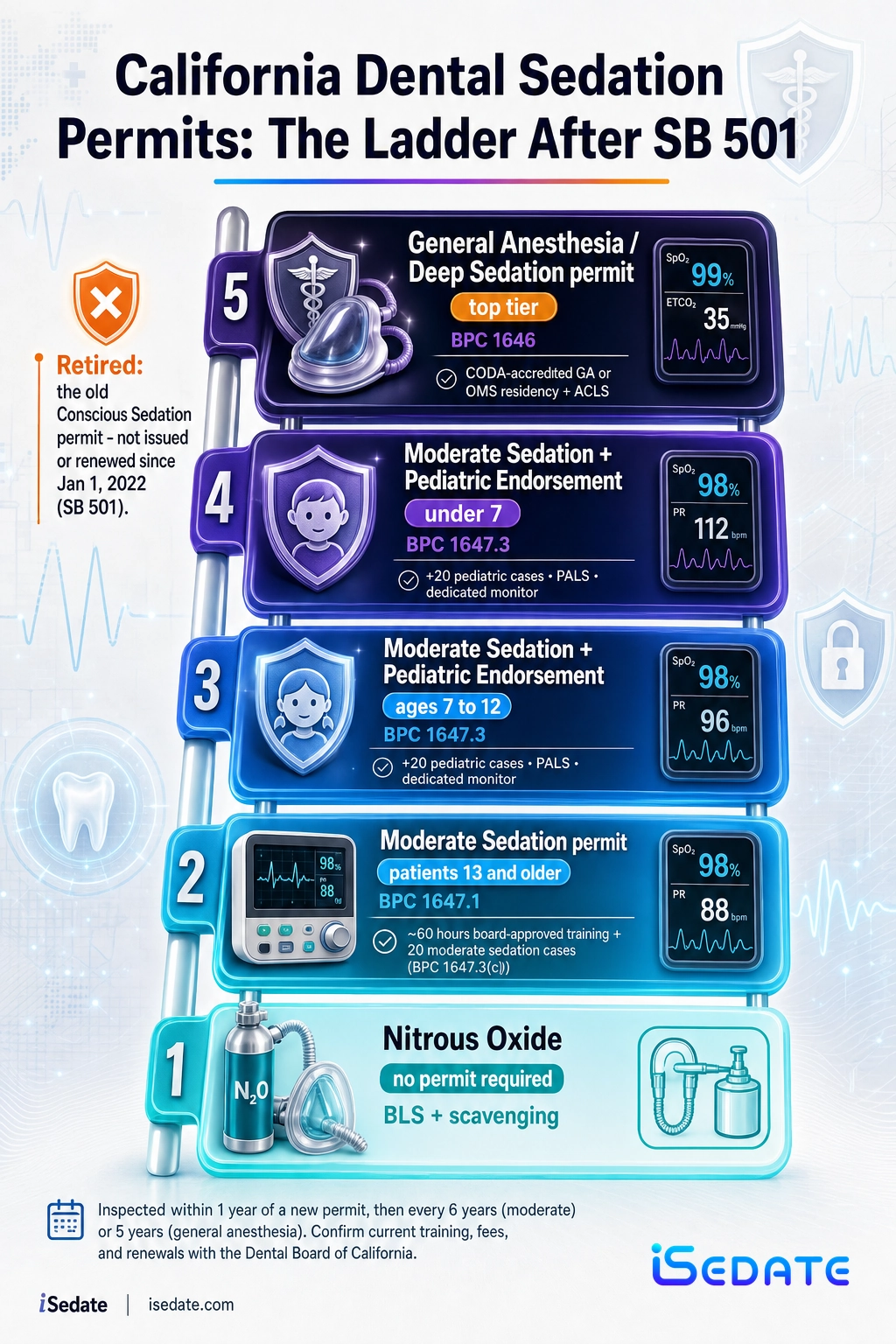
Nitrous oxide needs no permit. Inhaled nitrous oxide and oxygen, the lightest form of anxiety control, does not require a sedation permit from the board. Current BLS certification and proper gas scavenging are the standard of care.
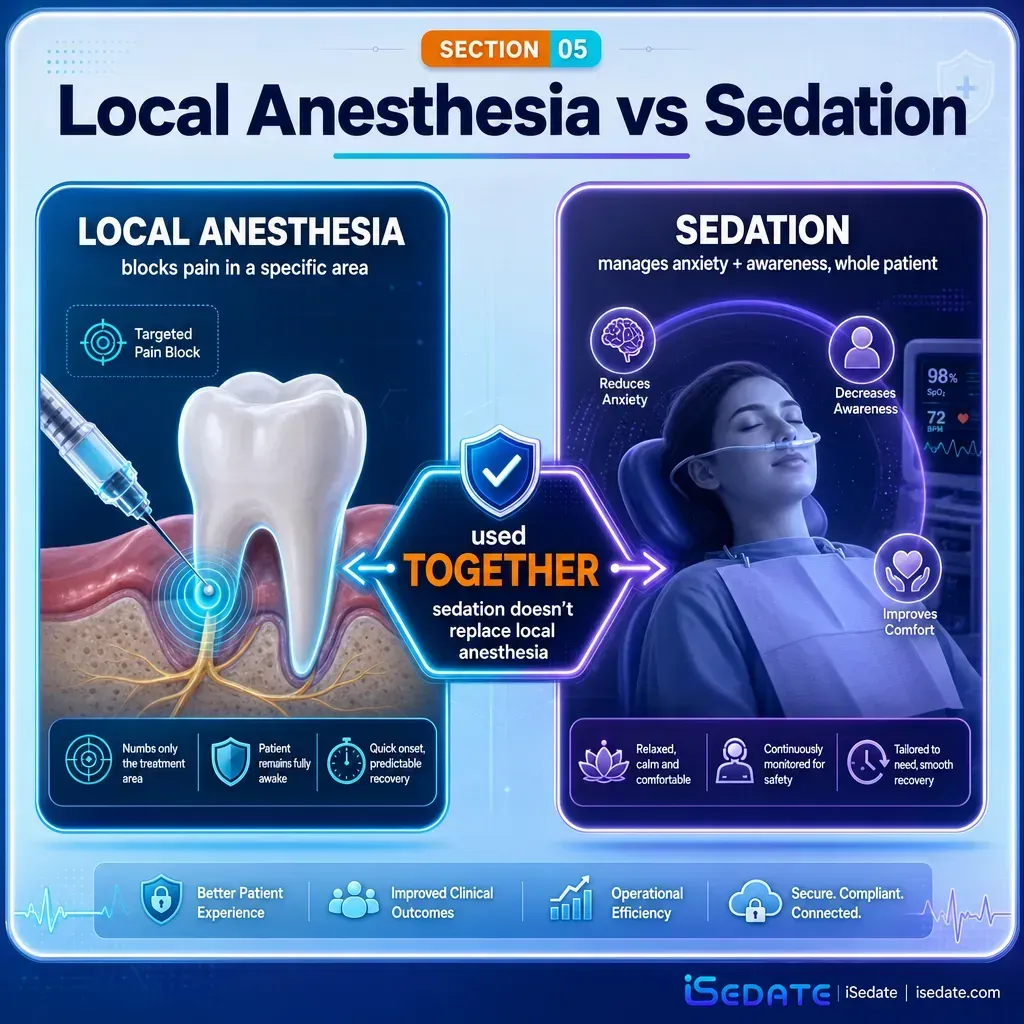
Moderate Sedation permit, patients 13 and older (BPC 1647.1). This is the workhorse permit, and it replaced the retired Conscious Sedation permit. It authorizes moderate sedation for patients 13 and older, where the patient still responds purposefully to verbal or tactile stimulation and keeps their own airway. The common clinical term for this depth is Conscious Sedation, which is why the older permit carried that name.
Moderate Sedation permit with Pediatric Endorsement, ages 7 to 12 (BPC 1647.3). A moderate sedation permit carrying an endorsement to sedate children ages 7 to 12. The endorsement adds pediatric-specific training, documented pediatric cases, and extra monitoring and staffing duties.
Moderate Sedation permit with Pediatric Endorsement, under 7 (BPC 1647.3). The most tightly controlled moderate sedation tier, authorizing sedation of children under 7, where SB 501 focused much of its tightening on monitoring and dedicated staff.
General Anesthesia / Deep Sedation permit (BPC 1646 et seq.). The top tier. It authorizes deep sedation and general anesthesia, where the patient is not easily aroused or is unconscious and may need airway support. It requires a CODA-accredited residency in general anesthesia or oral and maxillofacial surgery plus current ACLS. In practice this is the province of dental anesthesiologists and oral and maxillofacial surgeons.
Myth, Busted
Myth: "I still hold a Conscious Sedation permit, so I'm covered."
Fact: SB 501 retired the Conscious Sedation permit, and the board has not issued or renewed it since January 1, 2022. The moderate sedation framework governs today.
Existing holders could keep practicing until their permit expired, but credentialing or marketing that still says "conscious sedation" is out of date. Confirm your current permit status with the board.
iSedate Insight
For most general dentists, the practical ceiling is nitrous oxide plus a moderate sedation permit. The pediatric endorsements matter only if you sedate children, and the General Anesthesia / Deep Sedation tier is largely out of scope for general dentistry, sitting with oral surgeons and dental anesthesiologists. Decide which level your practice actually needs before you spend a cent on coursework, because the training, case counts, and renewal duties climb sharply at each step.
Source: DBC Moderate Sedation Permits | DBC General Anesthesia / Deep Sedation permit
How to get or upgrade each permit
Each permit has its own bar to clear: a set amount of training, life-support certification, and, for sedation permits, a count of managed cases. The moderate sedation and general anesthesia figures below come from the Dental Board of California's own permit pages. The lighter nitrous and oral-sedation figures come from training-program summaries; because SB 501 reshaped the permit structure, treat those as a working guide and confirm the current pathway with the board before you enroll.
| Pathway | Route / depth | Training | Cases | Life support |
|---|---|---|---|---|
| Nitrous oxide (no permit) | Inhalation, lightest | ~14 course hours plus scavenging (program summary) | Not specified | BLS |
| Adult oral sedation (program summary) | Enteral (oral) | ~25 hours of training (verify current path) | 1 live patient | BLS |
| Pediatric minimal sedation (program summary) | Minimal sedation, minors | ~24 pediatric classroom hours (verify current path) | 1 live patient | BLS (PALS for endorsement) |
| Moderate Sedation permit (BPC 1647.3(c)) | Moderate sedation, incl. IV | At least 60 hours of instruction | At least 20 moderate sedation cases | ADA-based rescue training |
| General Anesthesia / Deep Sedation (BPC 1646) | Deep sedation / GA | CODA-accredited GA or OMS residency | Per board rule | ACLS |
The moderate sedation path
The biggest step a general dentist takes is to a full moderate sedation permit, which covers the IV route. The board's moderate sedation page describes at least 60 hours of instruction and satisfactory completion of at least 20 moderate sedation cases across a variety of dental procedures, with training that follows the ADA teaching guidelines: rescuing a patient from an unintended deeper level of sedation, airway management, intravenous and intraosseous access, and reversal medications. The case requirement is where competence is proven, because titrating a sedated patient demands hands-on judgment a classroom cannot replicate. You can complete the coursework through a board-approved, ADA-recognized provider such as DOCS Education's California sedation courses; confirm that any program you choose meets the board's current requirements.
State Training Standard
California Moderate Sedation Permit: Requirements at a Glance
- Training: at least 60 hours of board-approved instruction (BPC 1647.3(c); 16 CCR 1043.8.1).
- Cases: at least 20 moderate sedation cases across a variety of dental procedures.
- Pediatric endorsement: 20 pediatric cases within the prior 24 months, plus current PALS (BPC 1647.3).
- Apply: through BreEZe with forms MSP-1 (application) and MSP-2 (training certification).
- Renew: every two years; 15 CE hours required from the second renewal (BPC 1647.5).
The pediatric endorsement
To sedate a patient under 13, a dentist must add a pediatric endorsement to the moderate sedation permit, in the right age band. The board requires documentation of 20 pediatric cases within the 24 months before the endorsement, plus current and continuous Pediatric Advanced Life Support (PALS) certification. For patients under 13, the office must also staff a one-to-one monitoring setup with a PALS-certified team member dedicated to watching the patient. These pediatric duties are where SB 501 added the most, so verify the exact age-band requirements with the board.
Source: DBC Moderate Sedation Permits | DBC official modified regulation text
Fees and the application
You apply to the Dental Board of California through the state's online BreEZe system, submitting the moderate sedation application (form MSP-1), the training certification (form MSP-2), proof of training, and evidence that your office, equipment, and staffing meet the board's standards. The board sets permit and inspection fees in 16 CCR 1021. As reported on the board's materials, the figures below apply. Fees change periodically, so confirm the current schedule on the board's permits page before you file.
| Item | Reported fee | Authority |
|---|---|---|
| Moderate Sedation permit application | $524 | 16 CCR 1021(q) |
| Pediatric Endorsement application | $532 | 16 CCR 1021(ah) |
| Biennial renewal | $325 | 16 CCR 1021(s) |
| Onsite inspection and evaluation | $2,000 | 16 CCR 1021(u) |
Source: DBC Moderate Sedation Permits (fee schedule, 16 CCR 1021)
What the permit requires you to monitor
A permit is permission plus obligation. Once you hold a moderate sedation permit, you must monitor the patient's oxygenation, ventilation, circulation, and level of consciousness, with oxygen saturation measured continuously by pulse oximetry. California layers stricter duties onto pediatric sedation: a patient under 13 must be continuously monitored with a pulse oximeter and have ventilation monitored by at least two of three methods (precordial stethoscope auscultation, capnography, or verbal communication, with verbal communication not acceptable for deep sedation or general anesthesia). A patient under 13 also requires the dentist plus at least two support personnel, one holding current PALS and dedicated to monitoring, and recovery is held to a staff-to-patient ratio no greater than three to one.
For the full clinical breakdown of what to monitor and chart at each depth, including the time-oriented record and its intervals, see our companion guide on California sedation vitals, charting, and reporting requirements.
Source: DBC official modified regulation text (BPC 1682, 1647.2)

Continuing education and renewal
A California sedation permit renews every two years, tied to the licensee's birth month and year, with renewal opening about 90 days before expiration. The continuing-education rule is staged. The first renewal is exempt from sedation CE. From the second renewal on, a moderate sedation permit holder completes 15 hours of approved moderate sedation courses (BPC 1647.5), and a general anesthesia permit holder completes 24 hours of anesthesia-related courses, including an ACLS course. Pediatric endorsement holders carry an added duty: they must maintain current PALS, document 20 pediatric cases in the 24 months before renewal, and self-certify. Because these cycles and hour counts are set by board rule and updated periodically, confirm your current renewal cycle and CE obligations with the board's permit page so your permit never lapses at renewal.
Renewal CE
Inspections and record reviews
This is where a permit is kept or lost. The Dental Board of California conducts an on-site inspection within one year of issuing an initial permit, then on a recurring cycle: every six years for a moderate sedation permit and every five years for a general anesthesia permit. The inspection covers the dentist, the facility, the equipment, the personnel, and the procedures, and refusing to submit to an inspection is an automatic ground for denial or revocation of the permit.
Onsite Inspection Fee
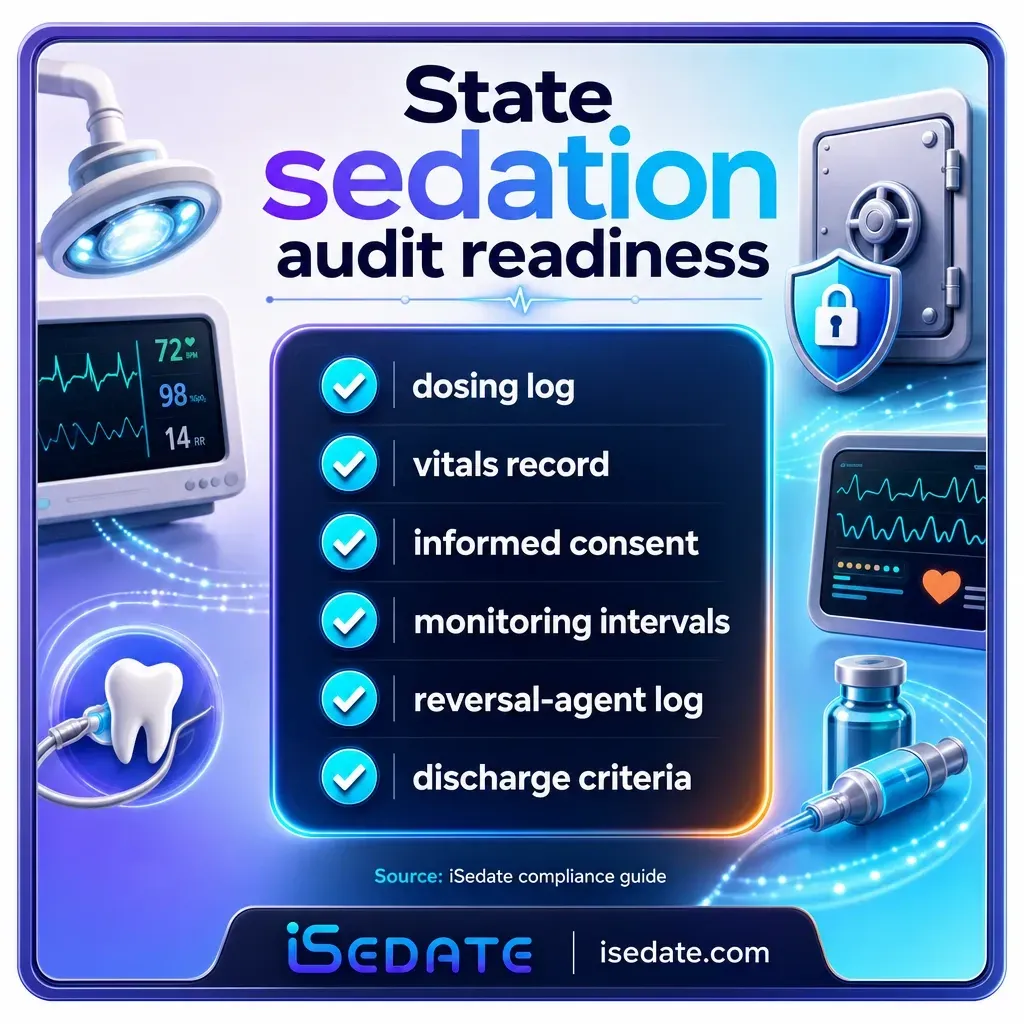
When an inspector or reviewer opens your file, they are checking the record, not your intentions. California requires a time-oriented anesthesia record that documents pulse oximetry before, during, and after the procedure, the drugs and doses given, any complications, and the patient's condition at discharge. Whether the permit survives turns on whether that record is complete, contemporaneous, and intervaled correctly. A dentist can run flawless sedation and still lose on the paperwork.
Source: DBC General Anesthesia / Deep Sedation permit (inspections) | DBC official modified regulation text (BPC 1647.7)
Keeping the permit: audit-ready records
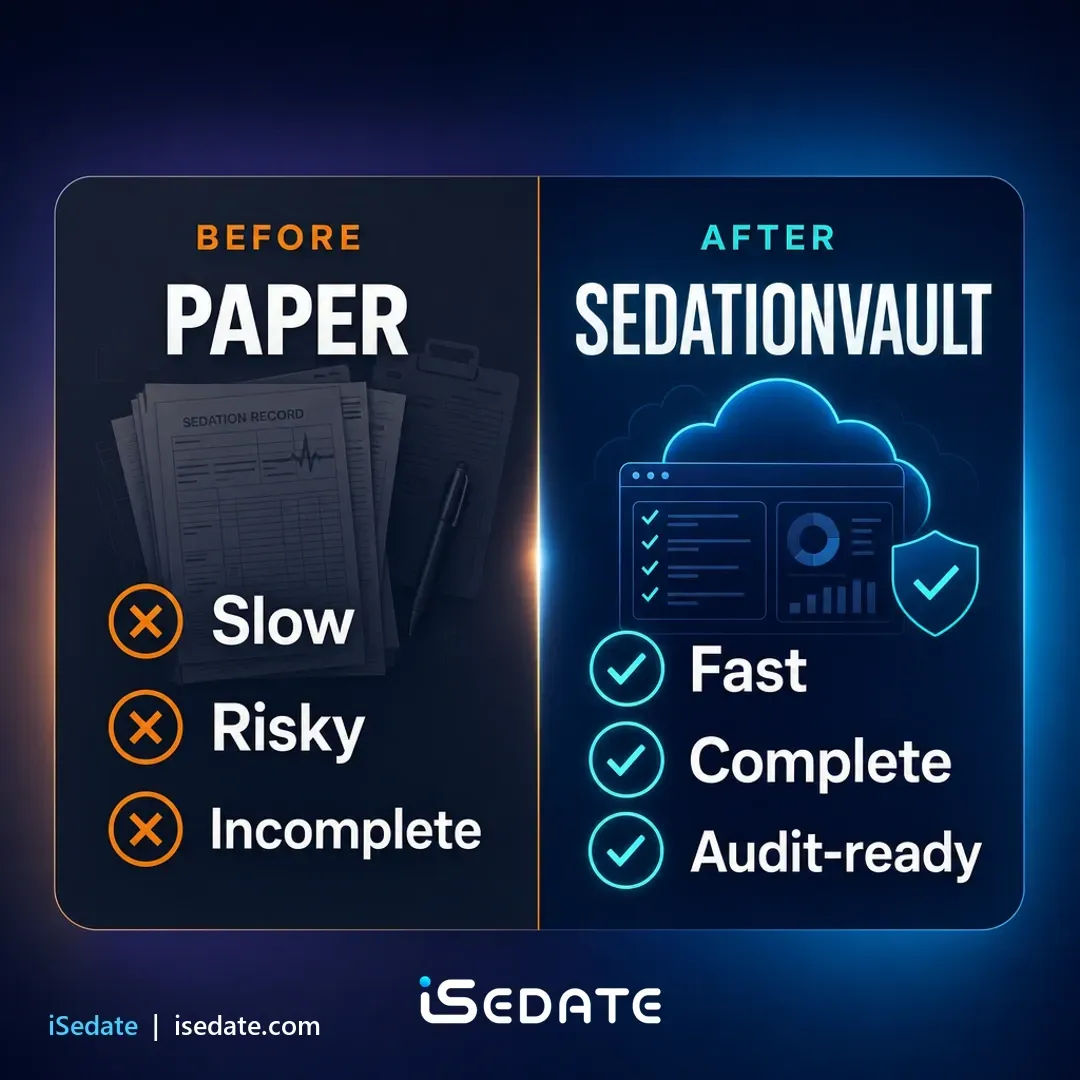
Everything above points to one truth: getting the permit is a one-time hurdle, but keeping it is a daily documentation discipline. A vitals log written every few minutes by hand, between titrating a drug and watching an airway, is exactly where records go incomplete, and incomplete records are what a board inspection and a malpractice claim both attack. California's short recording intervals only sharpen that risk.
SedationVault by iSedate removes that failure point. It captures live patient vitals and the drug log automatically into a time-oriented, California-ready anesthesia record, holding the interval the board's Article 5 rules demand, so the record writes itself while you focus on the patient. When the board inspects or asks for the file, a complete record is a one-click export, not a scramble through paper. See how it maps to California's rules on the dental sedation compliance and anesthesia record software pages.
Book a demo of SedationVault See SedationVault pricingLicensed in a neighboring state?
Sedation permit rules are set state by state, so a credential that works in California does not transfer across the border. If you practice in more than one state, or you are moving, start with the right state's guide:
- Arizona Sedation Dentistry Licensing & Permit Requirements
- Nevada Sedation Dentistry Licensing & Permit Requirements
- Oregon Sedation Dentistry Licensing & Permit Requirements
- Sedation Dentistry Licensing & Permit Requirements by State (all 50)
Frequently asked questions
What sedation permits does California offer dentists?
How many training hours and cases do you need for a California moderate sedation permit?
How do you apply for a sedation permit in California?
How often do you renew a California sedation permit?
Does California inspect sedation offices?
Is a Conscious Sedation permit still valid in California?
Related reading: the data behind these rules
The requirements on this page are the law. These research roundups are the data that explains why they exist and what happens when a practice gets charting or permitting wrong:
Sources
- DBC Moderate Sedation Permits for Licensed Dentists (training, cases, fees, renewal, inspection)
- DBC General Anesthesia / Deep Sedation permit (GA training, ACLS, five-year inspection, 24-hour CE)
- DBC permits and applications (BreEZe, forms, fee schedule)
- DBC official modified anesthesia/sedation regulation text (BPC 1646 to 1647.x, 1682; 16 CCR Article 5)
- DBC SB 1453 alert (effective January 1, 2025)
- DOCS Education California sedation courses (course provider, where to take the training)
This guide summarizes California sedation permit rules for general information and is not legal advice. The permit framework, training, monitoring, inspections, renewals, and CE are drawn from the Dental Board of California's permit pages and the California Business and Professions Code and 16 CCR Article 5 as cited. The lighter nitrous, adult-oral, and pediatric-minimal training counts come from training-program summaries and were reshaped by SB 501; application forms, exact training requirements, fees, the inspection schedule, renewal cycle, CE hours, and any disciplinary penalty schedule are set by the Dental Board of California and should be confirmed directly with the board before you act.