






Utah Sedation Dentistry Licensing & Permit Requirements
In Utah, your dental license alone does not let you sedate a patient. Any dentist who administers minimal sedation, moderate (conscious) sedation, or deep sedation and general anesthesia must first hold the matching permit from the Utah Division of Professional Licensing, issued under Utah Administrative Code R156-69. Getting the permit means meeting the training, certification, and live-case requirements for your level. Keeping it means your continuing education stays current and your sedation records survive a licensing review. This guide walks both halves: how a Utah dentist gets a sedation or anesthesia permit, and what it takes to keep it.
Recent Updates
Last UpdatedNovember 16, 2026
- Reviewed every citation against Utah Administrative Code R156-69 as amended, effective July 8, 2026.
- Added the current continuing-education and recertification requirements for each permit level (R156-69-304a).
- Replaced third-party legal-database links with Utah's official Division of Professional Licensing pages.
- Utah issues four dentist sedation and anesthesia permits under R156-69-301a: local anesthesia, minimal sedation, moderate (conscious) sedation, and deep sedation and general anesthesia.
- Most general dentists work at the minimal or moderate level; oral surgeons and dental anesthesiologists carry the deep sedation and general anesthesia permit.
- The moderate sedation permit requires at least 60 hours of didactic education and at least 20 sedation cases (R156-69-301b(4)), plus ACLS (or PALS for pediatric patients), a controlled-substance license, and DEA registration.
- The rule mandates pulse oximetry for moderate sedation and pulse oximetry plus capnography for deep sedation and general anesthesia, with an ACLS or PALS trained person in the operatory.
- Keeping the permit turns on two things: two-year continuing-education recertification (R156-69-304a) and the record, where a missing discharge entry or a failure to keep records seven years is unprofessional conduct (R156-69-502).
What This Guide Covers
- Who issues sedation permits in Utah
- The four Utah permit levels
- How to get or upgrade each permit
- The application process, forms, and fees
- What the permit requires you to monitor
- Record and reporting obligations tied to your permit
- Continuing education and recertification
- Keeping the permit: audit-ready records
- Frequently asked questions
- Sources
Who issues sedation permits in Utah
Sedation dentistry in Utah is regulated by the Division of Professional Licensing (DOPL), the agency inside the Utah Department of Commerce that administers the Dentist and Dental Hygienist Licensing Board. DOPL, not any national body, decides who may sedate, holds permit holders to account, and takes disciplinary action. The rules live in Utah Administrative Code R156-69, the Dentist and Dental Hygienist Practice Act Rule, with the enabling statute in Utah Code Title 58, Chapter 69. Every requirement below traces to a section of that rule or statute.
Myth, Busted
Myth: Utah's sedation requirements are really just the ADA's national guidelines in different wording.
Fact: The ADA and ASA standards carry the force of law in Utah only because R156-69-301a(3)(a) adopts them into the rule. Your permit, your record reviews, and any discipline all come from DOPL.
The American Dental Association is a professional association, not a government agency. It does not license, inspect, or discipline you. The real federal layers that sit alongside Utah's rule are different: DEA registration for the controlled substances you use, and HIPAA for how you store the records.
To apply for a permit, you work through the division's own process, which includes an anesthesia course letter that complies with R156-69-202. Application forms and the current fee schedule are set by the division and change periodically, so confirm the exact forms and current fees directly with DOPL before you file. The division's dentistry licensing line is (801) 530-6628.
Source: Utah DOPL dentist sedation and anesthesia permit page | Utah Admin. Code R156-69
The four Utah permit levels
Utah classifies its permits in R156-69-301a, and the level reflects how deeply the patient is sedated, not just which drug or route is used. Here is the ladder, each with its governing subsection.
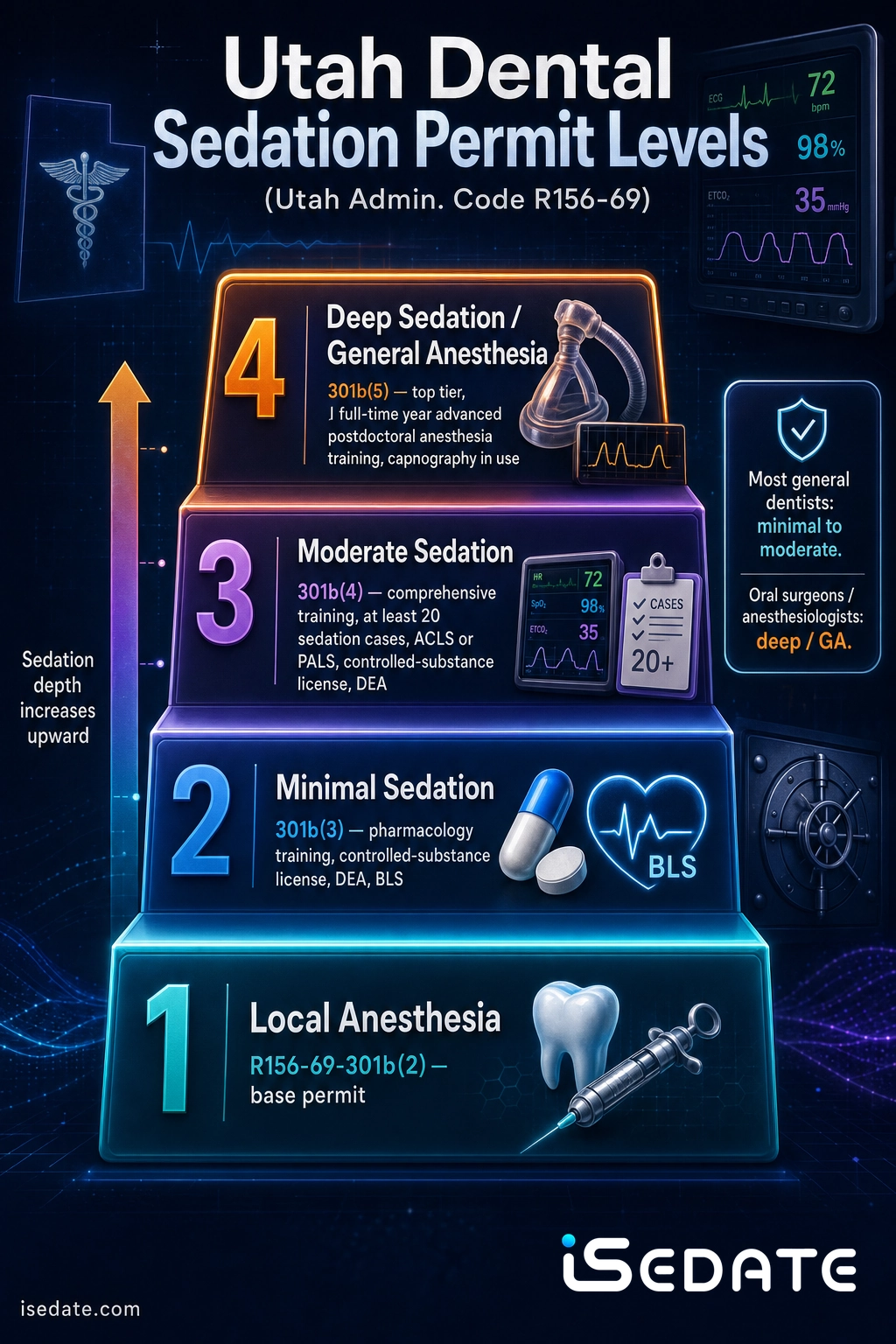
Local anesthesia permit (R156-69-301a). The base permit covering local anesthesia. It is the foundation the sedation permits build on, and DOPL labels it Class A in its licensing system.
Minimal sedation permit (R156-69-301b(3)). Authorizes minimal sedation (anxiolysis), typically a single oral drug, where the patient responds normally to verbal command and airway and cardiovascular function are unaffected. This is the common starting point for general dentists who offer light oral sedation. In DOPL's class system this is Class C, with nitrous oxide handled separately as Class B.
Moderate sedation permit (R156-69-301b(4)). Authorizes moderate sedation, commonly called Conscious Sedation, where the patient responds purposefully to verbal or tactile stimulation and keeps their own airway. This is the workhorse permit for dentists doing real oral or IV conscious sedation, labeled Class D, and it is the level where the monitoring mandates in R156-69-301a apply directly.
Deep sedation and general anesthesia permit (R156-69-301b(5)). The top tier, Class E. It authorizes deep sedation and general anesthesia, where the patient is not easily aroused or is unconscious and may need airway support. This permit is largely the province of dental anesthesiologists and oral and maxillofacial surgeons, and R156-69-301b(5) requires a full-time year of advanced postdoctoral anesthesia training. If you are pursuing it, work directly from R156-69-301b(5) with the division, as its specifics run beyond the scope of this guide.
In Plain Terms
Utah names four permit levels in the rule, but DOPL's licensing and application system still uses letters: Class A (local), Class B (nitrous oxide), Class C (minimal or oral sedation), Class D (moderate or IV sedation), and Class E (deep sedation or general anesthesia). Training providers describe the levels the same way. When you file, confirm the exact class on your application with DOPL so the permit matches what you actually administer.
Source: DOPL dentistry licensing and permit classes
How to get or upgrade each permit
Each permit has its own bar to clear: a set of training, resuscitation certification, controlled-substance credentials, and, for moderate sedation, a count of managed sedation cases. You move up the ladder by meeting the next level's requirements and applying to the division. The qualifications below come from R156-69-301b, with a didactic-hour figure for minimal sedation noted as a training-provider figure where the rule does not itself fix the number.
| Permit | Depth | Training / qualifications | Resuscitation |
|---|---|---|---|
| Minimal sedation (R156-69-301b(3)) | Minimal / anxiolysis | Minimal-sedation pharmacology training, Utah controlled-substance license, DEA registration (training providers commonly cite ~16 didactic hours) | BLS |
| Moderate sedation (R156-69-301b(4)) | Moderate (oral / IV) | At least 60 didactic hours and at least 20 sedation cases, controlled-substance license, DEA | ACLS (PALS for pediatric) |
| Deep sedation / GA (R156-69-301b(5)) | Deep sedation / general anesthesia | At least one full-time year of advanced postdoctoral anesthesia training, controlled-substance license, DEA | ACLS or PALS; capnography required in use |
The minimal sedation permit
This entry-level permit requires minimal-sedation pharmacology training, a Utah controlled-substance license, DEA registration, and current BLS under R156-69-301b(3). It is the most accessible sedation credential and the usual first step for a general practice adding light oral sedation. Training providers such as DOCS Education's Utah course listings commonly describe this as roughly 16 didactic hours, but the course must satisfy R156-69-202, so confirm the current requirement with DOPL rather than a provider's marketing page.
The moderate sedation permit
Utah's Conscious Sedation level is the biggest step most general dentists take. Under R156-69-301b(4), it requires comprehensive training that includes at least 60 hours of didactic education in sedation and at least 20 sedation cases, current ACLS certification (or PALS for a dentist who treats pediatric patients), a Utah controlled-substance license, and DEA registration. The live-case requirement is the heart of it, because safe titration demands hands-on competence a classroom cannot replicate.
Deep sedation and general anesthesia
At the top of the ladder, this permit requires at least one full-time year of advanced postdoctoral training in anesthesia under R156-69-301b(5), along with ACLS or PALS, a controlled-substance license, and DEA registration. This is the permit dental anesthesiologists and oral surgeons carry, and it is largely out of scope for a general dentist.
The application process, forms, and fees
For every level, you apply through DOPL, either online or with the division's paper forms, and you attach the credentials that prove you meet the standard for your permit. The division asks for your National Board and regional exam results, transcripts or proof of practice hours, current BLS, ACLS, or PALS certification, and an anesthesia course letter that complies with R156-69-202.
How to apply in Utah
- Apply online through DOPL, or file the division's paper application and upgrade forms. Start at the DOPL dentistry application page.
- Attach proof of your training hours, sedation cases, resuscitation certification, controlled-substance license, and DEA registration.
- Include the anesthesia course letter required by R156-69-202.
- Confirm the current fee schedule with DOPL at (801) 530-6628; fees are set by the division and change periodically.
Do not rely on a number you read on a continuing-education provider's page for the application itself. The application, the current fee schedule, and any exam requirement are set by the division and updated periodically, so confirm the exact forms and current fees with DOPL's laws and rules resources before you file.
Source: DOPL apply for a dentistry license | Utah Admin. Code R156-69
What the permit requires you to monitor
A permit is permission plus obligation. Once you hold a moderate sedation permit, R156-69-301a states the monitoring mandates directly, and the adopted ADA and ASA standards fill in the full physiological picture:
- Pulse oximetry: required for moderate sedation under R156-69-301a(2)(c)(iii).
- A trained rescuer in the room: at least one ACLS trained individual, or PALS for pediatric patients, must be present in the operatory during the sedation under R156-69-301a(2)(c)(iii).
- Capnography at the deep level: for deep sedation and general anesthesia, R156-69-301a(2)(d)(iii)(A) requires pulse oximetry and end-tidal carbon dioxide monitoring with capnography.
- Oxygenation, ventilation, and circulation: Utah Code 58-1-510 requires a description of the plan to monitor these systems, and the adopted standards require heart rate, blood pressure, and level of consciousness to be evaluated continually.
For the full clinical breakdown of what to monitor and chart at each depth, see the companion guide on Utah Sedation Vitals Monitoring, Charting & Reporting Requirements. For how Utah compares with the rest of the country, the all-50-state hub is linked at the end of this guide.
Source: Utah Admin. Code R156-69-301a
Record and reporting obligations tied to your permit
Holding a permit also means holding a set of documentation duties, and these are exactly what a licensing review examines.
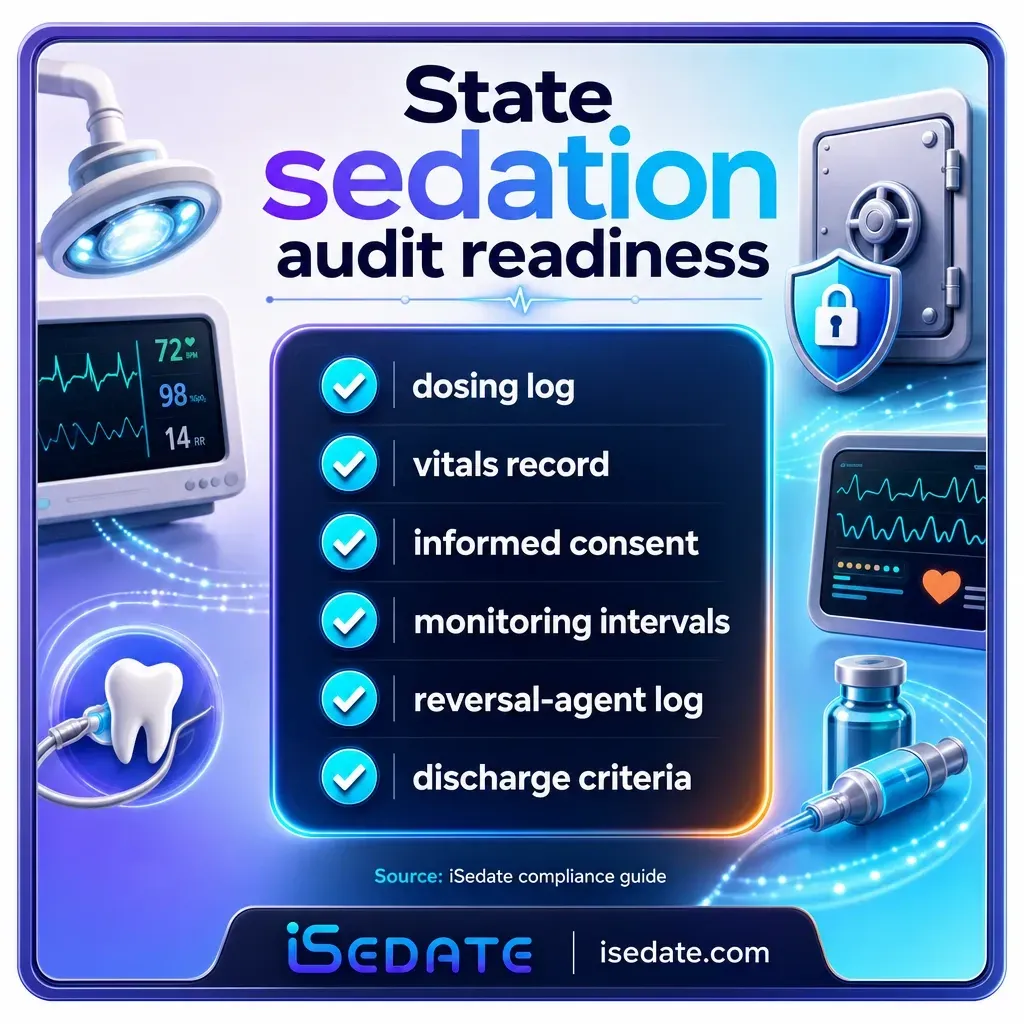
The anesthetic record. Because R156-69-301a(3)(a) requires compliance with the ADA and ASA standards, a permitted dentist must maintain a time-oriented anesthetic record for moderate sedation: the names, doses, and times of all drugs administered and the vital signs recorded continually. Utah does not fix a minute interval in its rule; the continual-recording standard comes from the adopted guidelines.
The discharge record. Under R156-69-502, it is unprofessional conduct to fail to record the time the patient was discharged and the identity of the person who discharged the patient, and that duty applies to any sedation level, including nitrous oxide. Closing the case with a documented discharge is a named duty, not an optional nicety.
Record retention and maintenance. R156-69-502 also makes it unprofessional conduct to fail to maintain patient records for at least seven years, and to fail to establish and maintain appropriate dental records. Violating the monitoring and permit rules in R156-69-301a or R156-69-301b is itself unprofessional conduct, so the recordkeeping duties are enforced the same way the clinical rules are. The exact reporting triggers for a serious adverse event and any penalty schedule are administered by the division; confirm the current requirements directly with DOPL.
Source: Utah Admin. Code R156-69-502
Continuing education and recertification
Your sedation permit is tied to your Utah dental license, and both renew on a two-year cycle. Under R156-69-304a(2), a licensed dentist completes at least 30 hours of qualified continuing professional education each renewal cycle. On top of that general requirement, each sedation level carries its own recertification, and the sedation-specific hours are spelled out in the rule rather than left vague.
Sedation recertification by level (R156-69-304a(3))
- Minimal sedation: at least 2 hours of CPE specific to enteral anesthesia pharmacology and minimal sedation.
- Moderate sedation: at least 4 didactic hours of CPE specific to moderate sedation and anesthesia, plus attestation of at least 10 sedation cases.
- Deep sedation and general anesthesia: at least 8 didactic hours of CPE specific to general anesthesia, plus attestation of at least 30 sedation cases.
These recertification hours are in addition to the renewal-cycle total, not folded into it. Keep current in ACLS or PALS at the moderate and deeper levels, and keep the certificates with your license file. The exact renewal date is set by division rule, so confirm your cycle with the DOPL dentist license renewal page so your permit never lapses at renewal.
Source: Utah Admin. Code R156-69-304a
Keeping the permit: audit-ready records
Everything above points to one truth: getting the permit is a one-time hurdle, but keeping it is a daily documentation discipline. A manual vitals log written by hand between titrating a drug and watching an airway, plus a discharge entry that is easy to forget at the end of a busy appointment, is exactly where records go incomplete. Incomplete records are what a licensing review and a malpractice claim both attack.
Why This Matters
A reviewer checks the record, not your intentions. A dentist can run the sedation correctly and still lose on the paperwork if the time-oriented record has gaps or the discharge time and discharging person are not on the page. Utah names the discharge entry and the seven-year retention directly in R156-69-502, and pulls the detailed charting standard in through the ADA and ASA guidelines it adopts. It is easy to assume Utah asks for less than it does. It does not.
SedationVault removes that failure point. It captures live patient vitals and the drug log automatically into a time-oriented anesthetic record that meets the ADA and ASA standards Utah adopts, and it captures the discharge time and discharging person that R156-69-502 names, so the record writes itself while you focus on the patient. When the division asks for the file, a complete record, retained well past the seven-year minimum, is a one-click export rather than a scramble through paper. See how it maps to Utah's rules on the dental sedation compliance and anesthesia record software pages.
Book a demo of SedationVault See SedationVault pricingFrequently asked questions
What sedation permits does Utah offer?
What does a Utah moderate sedation permit require?
How often do you renew a Utah sedation permit?
Is the ADA a federal agency that regulates Utah sedation?
Do I need a separate permit for nitrous oxide in Utah?
How do you keep a Utah sedation permit?
What to Read Next
Licensed in a neighboring state, or comparing Utah against the region? These same-silo guides break down the permit rules state by state:
- Arizona Sedation Dentistry Licensing & Permit Requirements
- Colorado Sedation Dentistry Licensing & Permit Requirements
- Idaho Sedation Dentistry Licensing & Permit Requirements
- Nevada Sedation Dentistry Licensing & Permit Requirements
- Wyoming Sedation Dentistry Licensing & Permit Requirements
- Sedation Dentistry Licensing & Permit Requirements by State (all 50 states)
Sources
- Utah DOPL: dentist sedation and general anesthesia permit (permit page, requirements, forms)
- Utah DOPL: apply for a dentistry license (application, permit classes A through E)
- Utah DOPL: dentistry laws and rules
- Utah Admin. Code R156-69: Dentist and Dental Hygienist Practice Act Rule (permit classifications 301a, qualifications 301b, recertification 304a, unprofessional conduct 502)
- Utah Code Title 58, Chapter 69: Dentist and Dental Hygienist Practice Act
- Utah Code 58-1-510: anesthesia and sedation monitoring plan
- DOCS Education: Utah sedation training course listings (training provider, confirm against the current rule)
This guide summarizes Utah sedation permit rules for general information and is not legal advice. The four permit levels, the moderate-sedation requirement of at least 60 didactic hours and at least 20 sedation cases, the recertification hours and case attestations, resuscitation certifications, monitoring mandates, and record duties are drawn from Utah Administrative Code R156-69 (as amended effective July 8, 2026) and Utah Code 58-1-510 and 58-69 as cited. The minimal-sedation didactic-hour figure is noted as a training-provider figure where the rule does not fix the number. Application forms, fees, the routine inspection schedule, exact penalty schedule, and the full deep sedation and general anesthesia training specifics are set by the Utah Division of Professional Licensing and should be confirmed directly with the division at (801) 530-6628 before you act.