







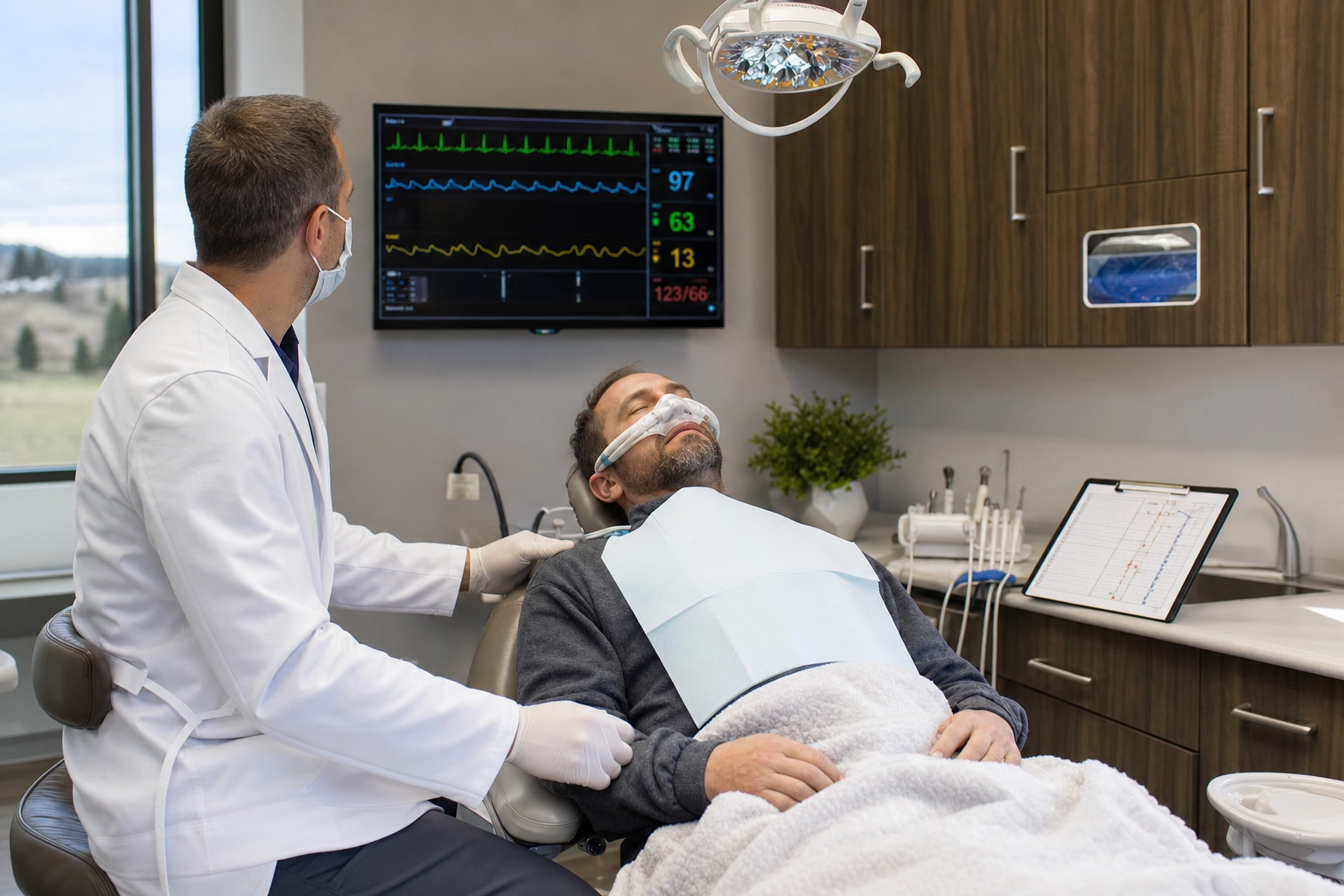
South Dakota Sedation Vitals Monitoring, Charting & Reporting Requirements
South Dakota's sedation recordkeeping rule is easy to misread, and the misread is costly. The state's own dental-records rule, ARSD 20:43:11:01, tells you to log every drug with its date, the patient name, and the dosage and amount, but it never mentions the time of administration or a vital-sign chart. The time-oriented record most dentists picture does not sit in a single South Dakota statute. It arrives through ARSD 20:43:09:14, the rule requiring any dentist who provides sedation to apply the current standard of care. The recognized national articulation of that standard, the ADA's sedation guidelines, is where the timed record of drugs, doses, and times, and continually recorded vitals, comes from, and the South Dakota Board of Dentistry holds you to it. This guide separates what the code names outright from what the standard of care requires, shows what a compliant chart actually looks like, and explains how to make the record audit-ready.
Recent Updates
Last UpdatedNovember 16, 2026
- Re-verified every rule cited against the original official source, the South Dakota Legislature's Administrative Rules, and replaced the third-party legal-database links with the state's own rule pages.
- Corrected the standard-of-care framing: ARSD 20:43:09:14 requires the "current standard of care" and does not itself name the ADA guidelines, so the guide now presents the ADA guidelines as the recognized national standard rather than a rule the code incorporates by reference.
- Added a sample time-oriented anesthesia record and an oral-versus-IV documentation breakdown showing what a compliant South Dakota chart looks like.
- Added the 2026 release of the updated ADA sedation guidelines and a note to confirm which edition the Board currently treats as the standard of care.
Key Takeaways
- What the code names outright: ARSD 20:43:11:01 requires every medication administered, dispensed, or prescribed to be recorded with the date, patient name, drug name, and the dosage and amount. By its own text it does not require the time of administration or a vitals chart.
- Where the timed record comes from: ARSD 20:43:09:14 requires the dentist to apply the current standard of care, and the recognized national standard, the ADA sedation guidelines, calls for a time-oriented anesthetic record and continually recorded vitals.
- The equipment is mandated: for general anesthesia and deep sedation, ARSD 20:43:09:13.01 requires pulse oximetry, an ECG display, a precordial or pretracheal stethoscope, capnography, and a blood-pressure monitor.
- Who enforces it: the South Dakota Board of Dentistry, through facility inspections under ARSD 20:43:09:11, with a full inspection at least once in each five-year licensure cycle.
- The honest takeaway: South Dakota has no itemized, interval-based vitals statute. The timed record is the standard of care the state requires, and the Board holds you to it.

What We Cover in This Guide
- Who regulates sedation in South Dakota
- The South Dakota sedation permit levels
- What you must monitor at each level
- What you must record: code versus standard of care
- What compliant documentation actually looks like
- Why complete sedation records matter
- How South Dakota reviews records
- The audit-ready record: an easier way
- Frequently asked questions
- Sources and verification
Who regulates sedation in South Dakota
Sedation and anesthesia in a South Dakota dental office are regulated by the South Dakota Board of Dentistry, the state body that issues anesthesia permits, inspects facilities, reviews records, and takes disciplinary action. The rules live in the Administrative Rules of South Dakota, Article 20:43, with the sedation provisions in Chapter 20:43:09 (Anesthesia and Analgesia) and the general dental-records requirements in Chapter 20:43:11.
It is worth being precise about what the ADA is here. The American Dental Association publishes national sedation guidelines that nearly every state board leans on, but those guidelines are a professional standard, not law by themselves, and the ADA is a private association, not a federal agency. It does not license you or discipline you. In South Dakota, the law is Article 20:43, and the body that issues permits, runs inspections, and disciplines is the Board of Dentistry. The federal layers that do apply sit elsewhere: the DEA governs controlled-substance logs, and HIPAA governs the privacy of the record you keep.
In Plain Terms
South Dakota's code names a medication record and specific monitoring equipment outright. It does not spell out a timed vitals chart. That piece comes from ARSD 20:43:09:14, which requires any dentist who sedates a patient to apply the current standard of care. So the ADA guidance is not law on its own, but a dentist applying the "current standard of care" is measured against contemporary professional practice, and the Board can enforce that. For the clinical "what and why" behind these rules in every state, see our Dental Sedation Vitals, Charting & Reporting Requirements by State hub.
Because the Board's exact website, phone number, and current forms were not verified for this guide, confirm those contact details directly with the South Dakota Board of Dentistry before you rely on them.
Source: ARSD 20:43:09:14 (clinical guidelines, S.D. Legislature) | ARSD 20:43:11:01 (medical record, content)
The South Dakota sedation permit levels
South Dakota uses its own permit structure under Chapter 20:43:09, and the monitoring and record obligations rise as the depth of sedation rises. Knowing which permit you hold tells you which rules apply.
| South Dakota permit | What it covers | Citation |
|---|---|---|
| Minimal sedation (no permit) | Minimal sedation (anxiolysis), subject to dosage limits | ARSD 20:43:09:06.02 |
| Nitrous Oxide Inhalation Analgesia Sedation permit | Inhaled nitrous oxide and oxygen analgesia sedation | ARSD 20:43:09:05 |
| Moderate Sedation permit | Moderate sedation, including the parenteral and IV route | ARSD 20:43:09:04 |
| General Anesthesia / Deep Sedation permit | Deep sedation or general anesthesia (the top tier) | ARSD 20:43:09:03, 20:43:09:13.01 |
| Monitoring-personnel permit | Assistants or hygienists monitoring sedated patients | ARSD 20:43:09:10 |
One feature of the South Dakota ladder is worth flagging. Minimal sedation requires no permit, but it is not unregulated: dosage limits apply under 20:43:09:06.02, and the moment a patient reaches a deeper level, the permit and monitoring rules for that level apply. Most general dentists who offer oral Conscious Sedation work at the moderate level, where the Moderate Sedation permit (20:43:09:04) applies to both the oral and IV routes; the General Anesthesia and Deep Sedation permit is the top tier, carried most often by oral and maxillofacial surgeons and dental anesthesiologists, and it carries the strictest equipment and inspection requirements. If you are working out which permit to apply for or how to upgrade, that is a separate process, covered in our guide to South Dakota Sedation Dentistry Licensing & Permit Requirements.
Source: ARSD 20:43:09:04 (moderate sedation permit, S.D. Legislature) | ARSD 20:43:09:10 (monitoring personnel permit)
What you must monitor at each level
South Dakota is explicit about the monitoring hardware, and that is the firmest ground in the whole chapter. For general anesthesia and deep sedation, ARSD 20:43:09:13.01 requires methods to monitor respiratory and cardiac function, listing five specifics:
- Oxygenation: pulse oximetry.
- Cardiac activity: an electrocardiogram display.
- Ventilation by auscultation: a precordial or pretracheal stethoscope.
- Ventilation by capnography: measurement of end-tidal carbon dioxide.
- Circulation: a blood-pressure monitor.
For moderate sedation, ARSD 20:43:09:13 requires the office to meet the applicable monitoring-equipment requirements. And 20:43:09:14 ties the whole picture together: a dentist who provides any level of sedation, or who uses a licensed anesthesia provider, must apply the current standard of care. The principle is the same one that holds in every state: what you are required to monitor is what you are required to write down.
Myth, Busted
Myth: Nitrous or a single oral pill is light, so I do not really need to monitor or chart much.
Fact: Depth of sedation, not the route or the drug, drives the requirement. Sedation levels are defined by patient response, and a patient can reach a deeper level than intended (ARSD Chapter 20:43:09).
Minimal sedation carries the lightest obligations, but the moment a patient crosses into moderate or deeper sedation, the monitoring-equipment rules and the standard-of-care record under 20:43:09:14 apply, no matter how the drug was delivered. You chart to the depth the patient actually reached, not the depth you planned.
Source: ARSD 20:43:09:13.01 (equipment, GA and deep sedation) | ARSD 20:43:09:14 (standard of care)
What you must record: code versus standard of care
This is the section a reviewer reads first, and it is also the section South Dakota structures differently from states that have a single, itemized anesthesia-record statute. South Dakota has two layers, and keeping them straight is what keeps your framing honest and your record complete.
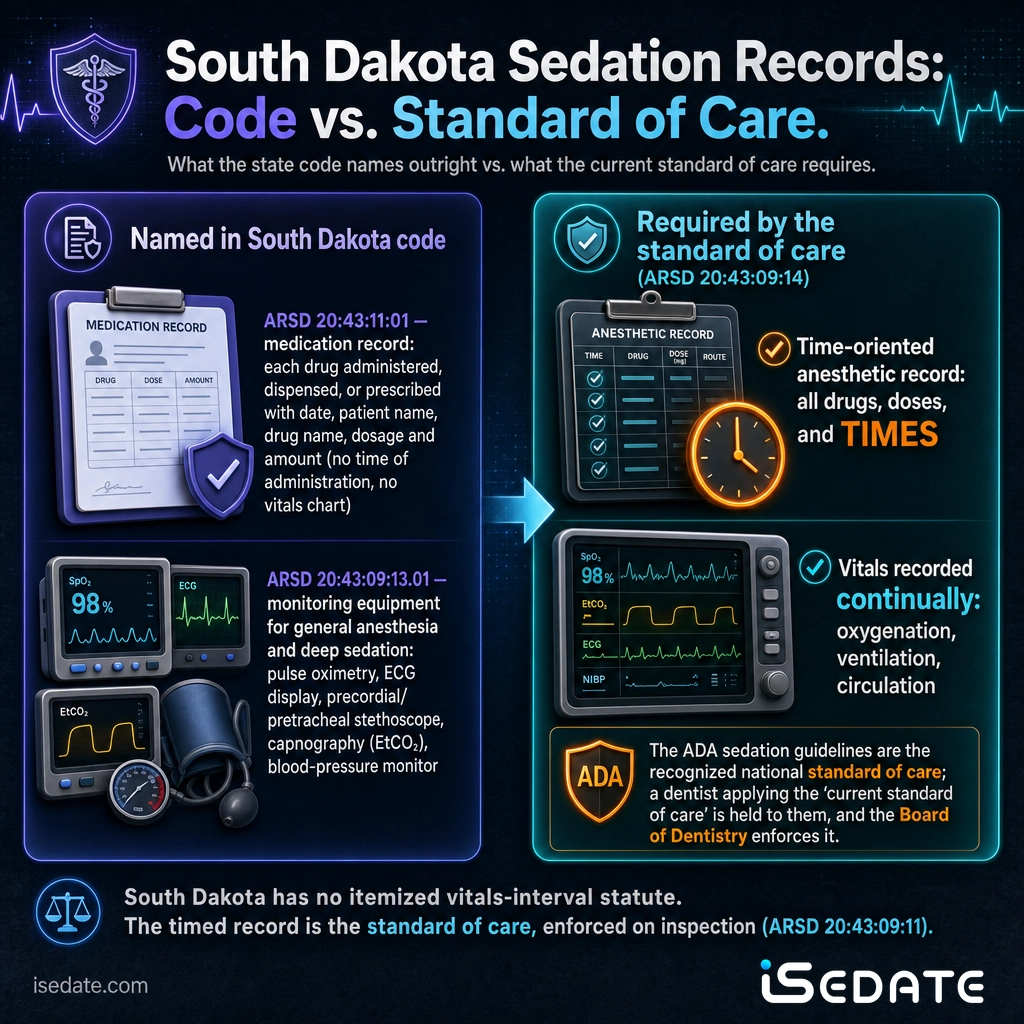
1. The medication record the code names outright
Under ARSD 20:43:11:01 ("Medical record, content"), a dentist who treats patients must maintain legible, complete, and accurate medical records. Among the required contents is a record of any medication administered or dispensed in office, or prescribed, including the date, the patient's name, the medication name, and the dosage and amount, including refills. That is a real, enforceable medication record with dosages. What it does not say, in its own text, is anything about the time each drug was given during a case, or a chart of vital signs. The companion editing rule, 20:43:11:02, governs only how an entry may be corrected.
2. The time-oriented record the standard of care requires
The timed anesthetic record and the recorded vitals do not disappear; they simply enter through a different door. Under 20:43:09:14, a dentist who provides any level of sedation shall apply the current standard of care. For dental sedation, the recognized national articulation of that standard is the ADA's "Guidelines for the Use of Sedation and General Anesthesia by Dentists." Those guidelines call for a time-oriented anesthetic record, listing the drugs with their doses and the times they were given, and for oxygenation, ventilation, and circulation to be monitored and recorded continually through moderate and deeper sedation. So the obligation is real and the Board can enforce it. It is simply sourced from the standard of care, not from an itemized South Dakota statute.
3. Why the distinction matters on review
Treat both layers as live. Charting only the medication name and dosage from 20:43:11:01 and skipping the timeline leaves you short of the standard of care the same chapter requires. A note that a patient "tolerated sedation well" is neither the medication record nor the time-oriented record. The record a reviewer wants to see is a timeline: each drug, each dose, the time it was given, the staff present, and the monitored vitals through the case and into recovery. One caution on the standard itself: the ADA adopted a comprehensive revision of its sedation guidelines in 2025 and released it publicly in 2026, so confirm which edition the Board currently treats as the standard of care.
Source: ARSD 20:43:11:01 | ADA sedation and anesthesia guidelines (2026 release)
What compliant documentation actually looks like
Knowing the two layers is one thing. Turning them into a record that survives a Board inspection is another. A compliant South Dakota sedation record is a time-oriented document: entries carry a timestamp, vitals are logged at intervals across the case, and every drug is recorded with its dose and the time it was given, alongside the medication detail 20:43:11:01 names outright. The example below shows the shape of that record for a moderate IV case.
| Time | SpO₂ / HR / RR / BP | Drug & dose | Note |
|---|---|---|---|
| Baseline | 99% / 74 / 16 / 122/78 | None | Weight recorded; NPO confirmed; consent on file |
| Induction | 99% / 76 / 15 / 124/80 | Midazolam, titrated IV | Level of consciousness: responds to voice |
| Intra-op (logged at intervals) | 98% / 72 / 14 / 118/76 | None | Stable; airway patent; supplemental O₂ running |
| Procedure end | 99% / 73 / 15 / 120/78 | None | Duration recorded; no complications |
| Discharge | 99% / 74 / 16 / 122/80 | None | Recovery criteria met; released to escort |
Why This Matters
The table above is an illustrative example, not a required interval. South Dakota sets no single numeric vitals interval in rule, so the logging cadence follows the standard of care and the ADA guidelines rather than a checklist statute. Confirm the exact expectations for your permit with the Board. What the example shows is the structure a reviewer is weighing your chart against: timestamps, a running vitals log, drugs with their doses and times, the duration, the level of consciousness, and a clean discharge entry.
Oral versus IV: the documentation deepens with the route
The medication record and the standard-of-care timeline apply to every moderate-and-deeper case, but what you have to capture grows heavier as you move up the permit ladder:
- Moderate, oral Conscious Sedation: continual assessment of consciousness, oxygenation by pulse oximetry, ventilation, and circulation, logged across the case, with each drug and dose recorded per 20:43:11:01. This is the baseline time-oriented record.
- Moderate, parenteral and IV: the same record, plus the documentation an IV adds, drugs and doses titrated and timed on the record, with the heavier intraoperative monitoring the parenteral route calls for.
- General anesthesia and deep sedation: the most intensive monitoring and the most detailed time-oriented record, backed by the full equipment list in 20:43:09:13.01 (pulse oximetry, ECG, a precordial or pretracheal stethoscope, capnography, and blood pressure).
The practical test is simple. Lay your sedation chart next to the two layers and point to where each duty is met. If the medication detail, a complete vitals timeline, the drug times, or the end-of-case duration is missing, the record is incomplete even if the clinical care was flawless. For the underlying data behind vital-signs monitoring and sedation safety, see our research roundup.

Why complete sedation records matter
Here is where dentists get burned. It is rarely the clinical care that fails a review. It is the record. A drug given but not logged with its time, a vital-signs entry that stops partway through the case, a discharge the chart never captured. The care can be flawless and the record can still fall short of the standard of care, and the same gaps that concern a Board inspector are the gaps a plaintiff's attorney looks for.
That figure is the quiet risk in a paper chart. Malpractice analysts note that documentation gaps read as a lapse in vigilance, which makes those cases harder to defend even when the care was sound. The contemporaneous sedation record is the evidence, and an incomplete one weakens a defensible case.
Important
A reviewer grades the record, not the recovery. They do not grade your sedation on how the patient did. They grade it on whether the contemporaneous record proves what you did and when. If the time-oriented record has gaps, the default assumption on review is that the monitoring had gaps too. Because the standard of care expects a complete timed record, treat both the medication detail and the timeline as duties that must be met on every moderate and deeper case.
The data behind these rules lives in our research roundups: how sedation charting affects malpractice case outcomes and documentation-error rates and chart defensibility.
Source: The Doctors Company Anesthesiology Closed Claims Study
How South Dakota reviews records
South Dakota's enforcement mechanism for sedation is the facility inspection, and it is specific. Under ARSD 20:43:09:11, applicants for a general anesthesia or deep sedation permit, a moderate sedation permit, or a host permit must pass a facility inspection at the facility where sedation will be provided before a temporary permit issues, and a temporary permit holder must pass a full inspection before the permit itself is granted. From then on, permit holders must pass a full inspection at least once in each five-year licensure cycle, and the dentist is responsible for all costs associated with an inspection.
An inspection is where your records stop being a private matter: a board-approved inspector authorized at your anesthesia level reviews whether the office, the equipment, and the documentation meet the chapter. A thin anesthetic record is exactly the kind of gap that surfaces here, which is why the time-oriented record the standard of care requires is not a nicety but part of what is being checked.
Penalties and adverse-condition reporting
Chapter 20:43:09 is backed by real consequences. Under 20:43:09:11, failing an inspection constitutes an automatic suspension of the permit and may lead to disciplinary proceedings. That is a sharp rule: a failed inspection does not start a negotiation, it suspends the permit. Separately, ARSD 20:43:09:09 requires reports of adverse conditions connected to sedation and anesthesia care, and failing to comply with those reporting requirements is itself grounds for automatic suspension of the permit.
The exact penalty schedule, the precise contents of an inspection, and the current reporting timelines are administered by the Board and can change, so confirm current details directly with the South Dakota Board of Dentistry rather than relying on a figure that may be out of date. What does not change is the exposure created by a thin record. In both a Board inspection and a malpractice claim, the contemporaneous sedation record is the first thing requested and the hardest thing to reconstruct after the fact.
Source: ARSD 20:43:09:11 (inspection, automatic suspension) | ARSD 20:43:09:09 (reports of adverse conditions)
The audit-ready record: an easier way
The gap between knowing the rule and passing an inspection is almost always the same thing: a running, timed log of vitals and drugs kept by hand during a live sedation case. When a team is managing an airway and an anxious patient, a vitals reading written down mid-case on paper is exactly where the record develops holes, a skipped reading here, a missing time stamp there, a drug given in the moment and logged later from memory. And because South Dakota's timed record is sourced from the standard of care rather than a checklist statute, a reviewer weighs your record against the full professional expectation, not a single line of code.
That is the problem SedationVault by iSedate was built to remove. It connects wirelessly to the vitals monitor already in your operatory and captures oxygen saturation, heart rate, respiratory rate, and blood pressure live, on the clock, alongside the drug log, so the time-oriented anesthetic record writes itself as the case runs rather than being reconstructed afterward. The point is not fancier charting. It is turning both of South Dakota's layers, the medication record under 20:43:11:01 and the standard-of-care timeline under 20:43:09:14, into fields the software guarantees are present and time-stamped, which is also what dental sedation compliance turns on.
See how a time-oriented anesthesia record builds itselfWhen the Board inspects, the chart exports as a one-click, audit-ready sedation visit report that already carries the times, the dosages and amounts, the staff present, and the recovery assessment.
Book a demo and see your South Dakota sedation record build itselfFrequently asked questions
Does South Dakota require a written sedation record?
How often must vitals be recorded during sedation in South Dakota?
Who reviews sedation records in South Dakota?
What are the South Dakota dental sedation permit levels?
Does South Dakota require monitoring equipment for sedation?
Related guides and neighboring states
Licensed in a neighboring state, or mapping the rules across the northern plains? These same-silo guides cover the vitals, charting, and reporting requirements next door:
- North Dakota Sedation Vitals Monitoring, Charting & Reporting Requirements
- Minnesota Sedation Vitals Monitoring, Charting & Reporting Requirements
- Iowa Sedation Vitals Monitoring, Charting & Reporting Requirements
- Nebraska Sedation Vitals Monitoring, Charting & Reporting Requirements
- Montana Sedation Vitals Monitoring, Charting & Reporting Requirements
- Wyoming Sedation Vitals Monitoring, Charting & Reporting Requirements
- The full all-50-state sedation charting & reporting hub
Sources and verification
This guide cites South Dakota's primary regulatory sources, read directly from the state's own publisher. Rule text is drawn from the Administrative Rules of South Dakota, Article 20:43, as published by the South Dakota Legislature, and the regulator is the South Dakota Board of Dentistry. South Dakota's record duty is sourced honestly: the medication record is named in ARSD 20:43:11:01, while the time-oriented anesthetic record and continually recorded vitals come from the standard of care required by ARSD 20:43:09:14, of which the ADA sedation guidelines are the recognized national articulation. Where a detail (the Board's website and phone, the exact contents of an inspection, the penalty schedule, the CE cycle, or which ADA edition the Board currently treats as the standard of care) is administered by the Board and subject to change, confirm it directly with the South Dakota Board of Dentistry before relying on it.
How We Verified This Guide
Every rule on this page was checked against the original official source below, the South Dakota Legislature's Administrative Rules, not a third-party legal database. Primary sources link to the exact rule that states each requirement.
- ARSD 20:43:11:01: Medical record, content (medications, dosage and amount) – S.D. Legislature
- ARSD 20:43:11:02: Medical record, editing – S.D. Legislature
- ARSD 20:43:09:14: Clinical guidelines (current standard of care) – S.D. Legislature
- ARSD 20:43:09:13.01: Equipment, general anesthesia and deep sedation – S.D. Legislature
- ARSD 20:43:09:11: Inspection and automatic suspension – S.D. Legislature
- ARSD 20:43:09:04: Moderate sedation permit requirements – S.D. Legislature
- ARSD 20:43:09:10: Monitoring-personnel permit requirements – S.D. Legislature
- ADA Guidelines for the Use of Sedation and General Anesthesia by Dentists (2026 release) – American Dental Association
- The Doctors Company: Anesthesiology Closed Claims Study
Disclaimer
This content is general information, not legal or compliance advice. Regulations change, and the South Dakota Board of Dentistry administers the details. Consult the Board or a qualified professional for guidance specific to your practice before relying on any requirement described here.















