






Iowa Sedation Vitals Monitoring, Charting & Reporting Requirements
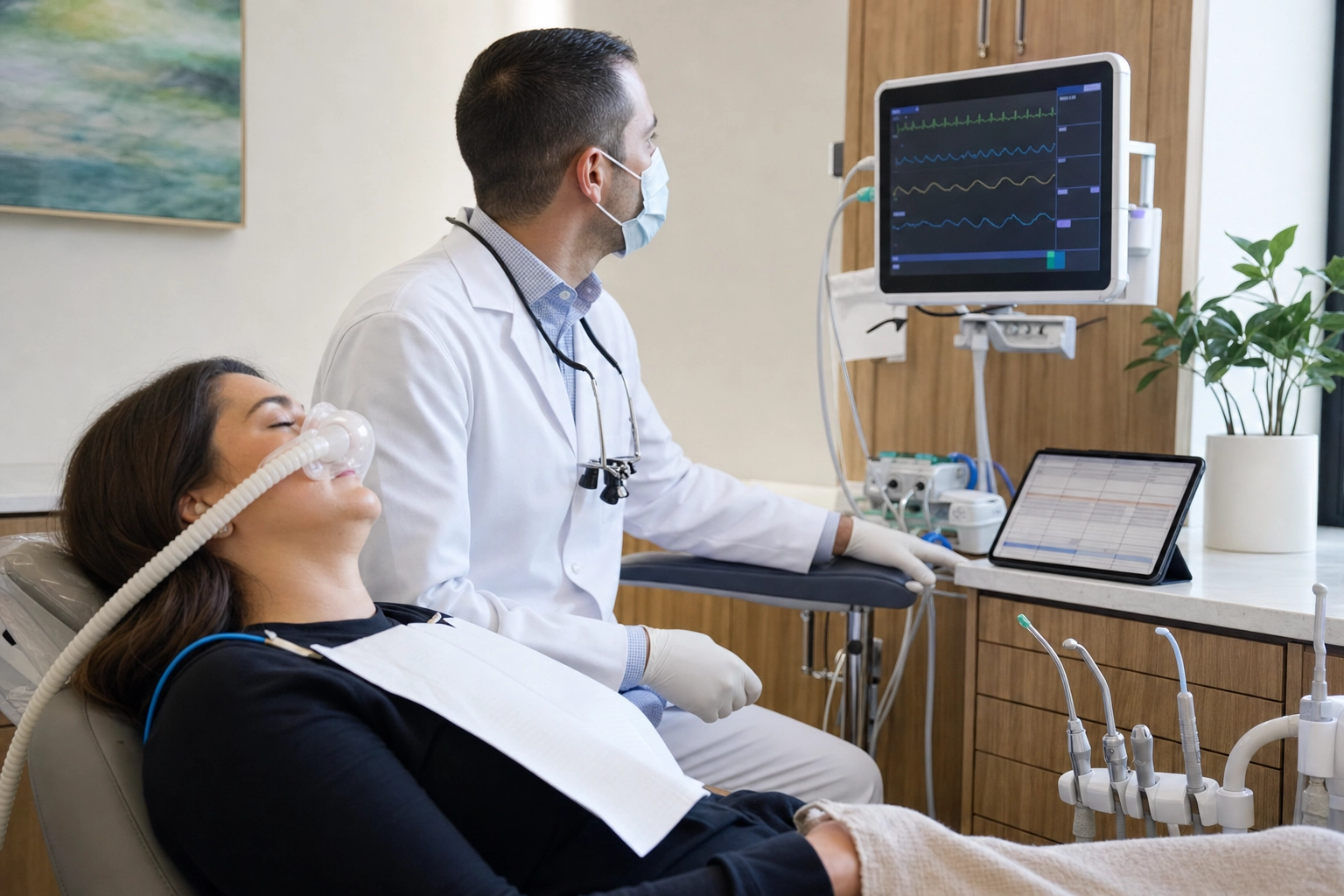
If you administer sedation in Iowa, the law is specific about what has to be written down: a time-oriented anesthesia record of every drug and dose, the physiologic data you monitored, and, for deep sedation and general anesthesia, your patient's vital signs recorded continually until they are fully ambulatory. As of April 9, 2025, that rule no longer lives in the old 650 Chapter 29. It was rescinded and rebuilt as Iowa Administrative Code 481 Chapter 579, "Sedation and Nitrous Oxide," enforced by the Iowa Dental Board. The record is the single thing a board review examines first. This guide breaks down what Iowa requires you to monitor and record at each sedation level, shows what a compliant record looks like on the page, and explains where dentists most often fall short.
Recent Updates
Last UpdatedNovember 16, 2026
- Re-verified every rule and citation against the current official Iowa Administrative Code; corrected the governing citations from the rescinded 650 Chapter 29 to the current 481 Chapter 579 (effective April 9, 2025).
- Clarified that the duty to record pulse oximetry, heart rate, respiratory rate, and blood pressure continually until fully ambulatory is stated for deep sedation and general anesthesia under 481 IAC 579.7(2).
- Replaced third-party legal-aggregator source links with the state's own official administrative code chapter and the Iowa Dental Board's DIAL licensing page.
- Added a sample intra-operative interval log showing what a compliant time-oriented record looks like.
See full history of updates to this post
UpdatedApril 2025
- Iowa rescinded 650 Chapter 29 and adopted 481 Chapter 579 (ARC 8993C, effective April 9, 2025), reorganizing the sedation, monitoring, and recordkeeping rules.
- The core rule: Iowa requires a time-oriented anesthesia record under 481 IAC 579.7 for moderate sedation, also called conscious sedation, as well as deep sedation and general anesthesia, naming every drug, dose, the anesthesia time in minutes, the monitors used, and the monitored oxygenation, ventilation, and circulation.
- The four continual vitals apply to deep sedation and general anesthesia: under 481 IAC 579.7(2), pulse oximetry, heart rate, respiratory rate, and blood pressure must be recorded continually until the patient is fully ambulatory.
- Who enforces it: the Iowa Dental Board, administered through the Iowa Department of Inspections, Appeals, and Licensing (DIAL), under 481 Chapter 579.
- The record must also name the person to whom the patient was discharged (481 IAC 579.7(3)), a line that is a frequent gap on a reconstructed chart.
- Even nitrous oxide needs a record. Under 481 IAC 579.7(1), the chart must show the nitrous concentration, the medication dosage, the duration, and the vital signs taken.

What This Guide Covers
- Who regulates sedation in Iowa
- Iowa's sedation levels and permits
- What you must monitor at each level
- What you must record: the compliance core
- What a compliant record looks like on the page
- How Iowa reviews records (and how dentists get burned)
- Why a thin record is the real exposure
- Penalties and discipline
- The easy button: an audit-ready record
- Frequently asked questions
- Sources and citations
Who regulates sedation in Iowa
Sedation and anesthesia in an Iowa dental office are regulated by the Iowa Dental Board's dental anesthesia licensing program, now administered through the Iowa Department of Inspections, Appeals, and Licensing (DIAL). The board issues sedation permits, inspects facilities, reviews records, and takes disciplinary action. The rules are not scattered across general dental law. They sit in one place: Iowa Administrative Code 481 Chapter 579, titled "Sedation and Nitrous Oxide," which implements Iowa Code section 153.13.
The exact citations changed recently, and it matters. Iowa rescinded the old 650 Chapter 29 and rebuilt these rules as 481 Chapter 579, effective April 9, 2025. If your sedation policy still cites "650 IAC 29.5," it is citing a rescinded rule. The substance is similar, but the numbers, and one meaningful detail about which vitals must be recorded continually, moved. When a reviewer asks whether your sedation record meets the requirement, the answer is measured against the current Chapter 579 rules below.
Setting the Record Straight
Myth: The ADA sets federal sedation law that overrides whatever the state says.
Fact: The American Dental Association publishes a national professional standard, not law. In Iowa, the binding authority is the 481 Chapter 579 board rules, enforced by the Iowa Dental Board.
Iowa, like most states, mirrors the ADA guidelines, so the clinical substance overlaps. But if a reviewer cites a requirement, it comes from the state rule, not the ADA document. The real federal layers that do apply are separate: DEA controlled-substance logs, HIPAA, and CMS or accreditation standards where relevant.
For the clinical reasoning behind these requirements and a national comparison, see our hub guide on Dental Sedation Vitals, Charting & Reporting Requirements by State.
Source: Iowa Dental Board (DIAL) dental anesthesia program | 481 IAC Chapter 579
Iowa's sedation levels and permits
Iowa structures its rules by the depth of sedation, and it uses its own terms, not a "Level 1 through 4" numbering. Two of the lightest categories require no permit at all, and the deeper categories require a board permit issued under 481 IAC 572.11. Knowing which category you are in tells you which monitoring and recordkeeping rules apply.
| Iowa category | What it covers | Permit? | Rule |
|---|---|---|---|
| Nitrous oxide inhalation analgesia | Inhaled nitrous oxide and oxygen | No permit required | 481 IAC 579.1 |
| Minimal sedation | Minimal sedation (anxiolysis), subject to dosage limits | No permit required | 481 IAC 579.2 |
| Moderate sedation | Moderate ("conscious") sedation | Moderate sedation permit | 481 IAC 579.4, 572.11 |
| Deep sedation / general anesthesia | Deep sedation and general anesthesia | General anesthesia permit | 481 IAC 579.5, 572.11 |
The single most important point for charting is that the recordkeeping duty does not begin only at the permit levels. Iowa attaches a record requirement to nitrous oxide and to minimal sedation as well, through 481 IAC 579.7(1) and the general patient-record rule 481 IAC 574.9. The deepest, shared standards that govern moderate sedation, deep sedation, and general anesthesia live in 481 IAC 579.3, with the recordkeeping detail in 481 IAC 579.7. If you are working out which permit to apply for, how many training hours you need, or how to upgrade, that belongs in a separate process, covered in our guide to Iowa sedation dentistry licensing and permit requirements.
Source: 481 IAC 579.1, 579.2, 579.4, 579.5
What you must monitor at each level
In Iowa, what you are required to monitor is what you are required to write down. The two are inseparable. For moderate sedation, deep sedation, and general anesthesia, the shared standard in 481 IAC 579.3(4) requires that a patient monitor remain present in the treatment room and continually monitor the patient until the patient returns to a level of minimal sedation. On top of that baseline, Iowa layers more as the sedation deepens.
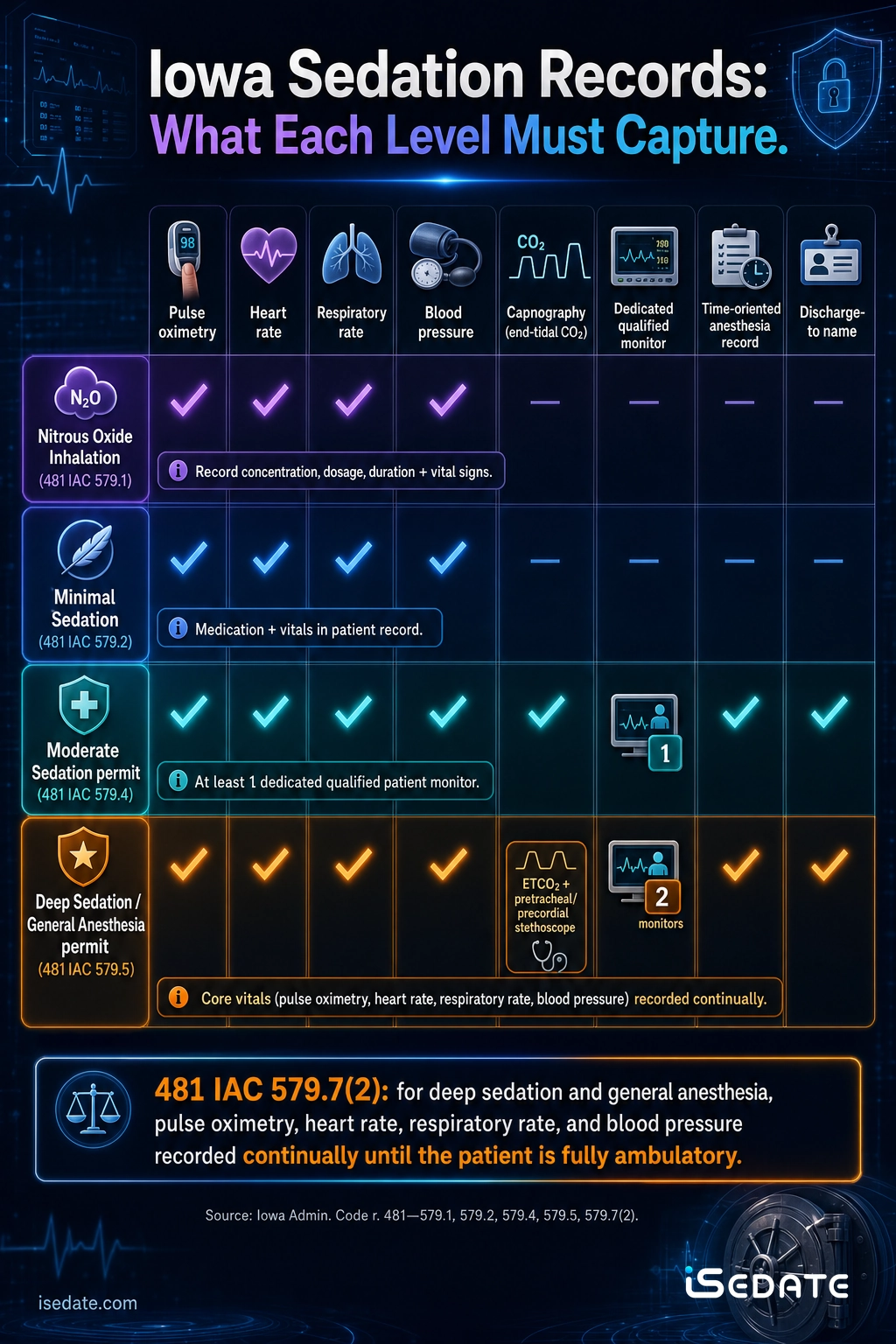
- Nitrous oxide: under 481 IAC 579.1, the patient must be continually monitored by a patient monitor, and the dentist must keep a written office protocol for taking vital signs.
- Moderate sedation, one dedicated monitor plus capnography: under 481 IAC 579.4(3), at least one patient monitor must observe the patient, and capnography must monitor end-tidal carbon dioxide unless it is precluded or invalidated, in which case a pretracheal or precordial stethoscope is used to monitor breath sounds.
- Deep sedation and general anesthesia, two monitors plus both tools: under 481 IAC 579.5(2), at least two patient monitors must observe the patient, and the team must use both capnography and a pretracheal or precordial stethoscope.
- Monitor qualifications: under 481 IAC 579.6, a monitor for deep sedation or general anesthesia must hold current ACLS, PALS, or DAANCE certification; a moderate sedation monitor may hold one of those or complete at least three hours of on-site airway-management training.
Myth, Busted
Myth: Nitrous or a single pill is light, so I don't really need a record.
Fact: Iowa disagrees. Even nitrous oxide requires the chart to show the concentration and duration administered under 481 IAC 579.7(1), and minimal sedation still falls under the general patient-record rule 481 IAC 574.9.
The depth of sedation, not the route or the drug, drives the obligation, and a patient can reach a deeper level than intended. The moment a patient reaches moderate sedation, the full 481 IAC 579.3 monitoring standard and the 579.7 record standard apply.
Source: 481 IAC 579.1, 579.3(4), 579.4(3), 579.5(2), 579.6
What you must record: the compliance core
This is the section a reviewer reads first. The recordkeeping duty lives in 481 IAC 579.7, which adds to the general patient-record requirements in 481 IAC 574.9. It has three parts worth knowing by heart.
1. A time-oriented anesthesia record
For moderate sedation, deep sedation, and general anesthesia, 481 IAC 579.7(2) requires a time-oriented anesthesia record. "Time-oriented" is the operative phrase: the record is organized against the clock, not as a single end-of-visit summary. That record must contain the preoperative and postoperative vital signs, the names of all drugs administered, including local anesthetics and nitrous oxide, the dosages, the anesthesia time in minutes, the monitors used, and the monitored physiological parameters of oxygenation, ventilation, and circulation. A note that a patient "tolerated sedation well" is not this record. A timeline of drugs, doses, times, and physiologic data is.
2. The four vitals, recorded continually, for deep sedation and general anesthesia
Here is the detail the recent renumbering sharpened. Under 481 IAC 579.7(2), when administering deep sedation or general anesthesia, pulse oximetry, heart rate, respiratory rate, and blood pressure must be recorded continually until the patient is fully ambulatory. Iowa does not reduce this to a single fixed minute interval, which makes the "continually, until fully ambulatory" standard easy to underestimate. Monitoring the patient on the machine but only writing a reading at the start and end of the case does not satisfy the rule. For moderate sedation, the time-oriented record must still capture the monitored oxygenation, ventilation, and circulation, so the physiologic data belongs on the page at every level.
3. A documented discharge, plus the nitrous and minimal record
Recovery has its own documentation duty. Under 481 IAC 579.7(3), for moderate sedation, deep sedation, and general anesthesia, the record should include the name of the person to whom the patient was discharged. That single line is a frequent gap on a reconstructed record, and it is exactly the kind of detail a reviewer checks. The duty to document does not stop at the deeper levels, either. Under 481 IAC 579.7(1), a nitrous oxide or medication case requires the chart to show the concentration of nitrous administered, the medication dosage, including any prescription for at-home unmonitored use, the duration of administration, and the vital signs taken.
What Iowa's Sedation Record Must Contain
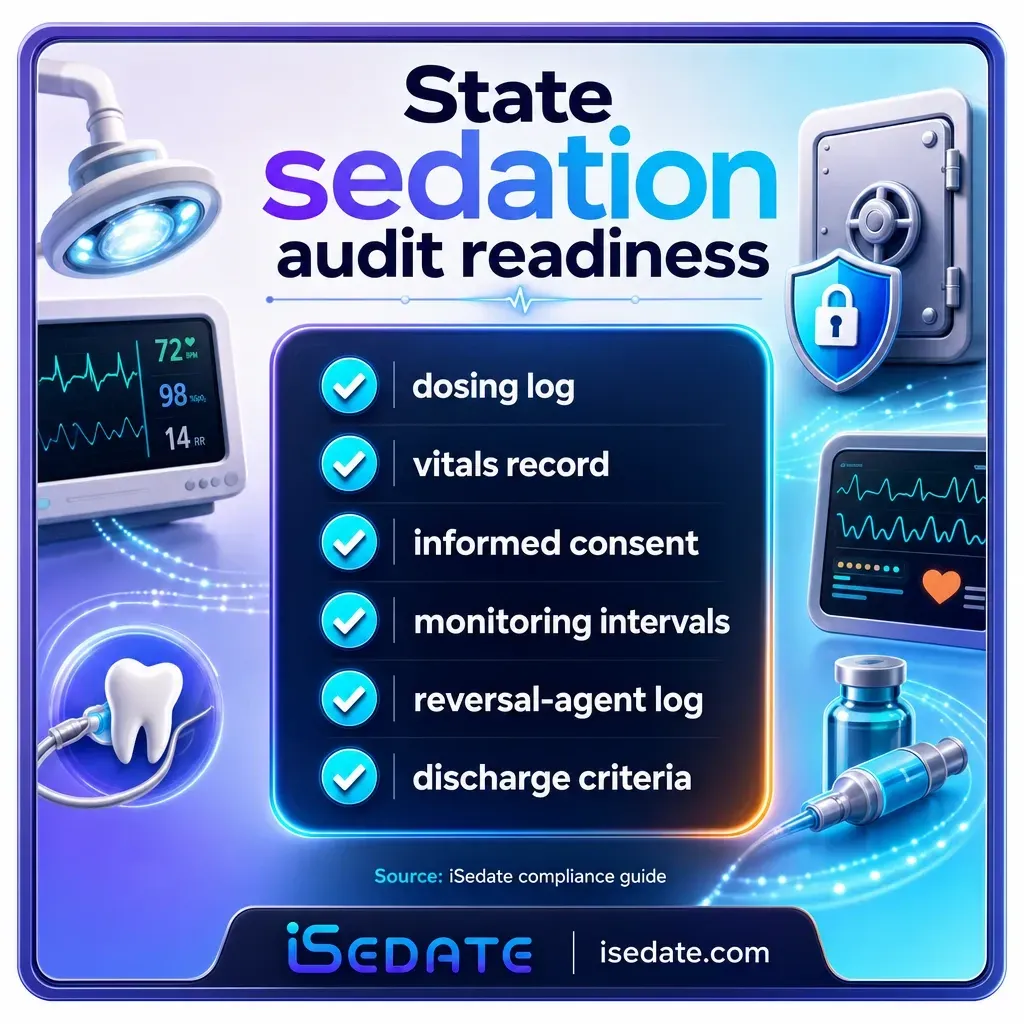
- A time-oriented anesthesia record for moderate sedation and above (481 IAC 579.7(2))
- Preoperative and postoperative vital signs
- Every drug administered, including local anesthetics and nitrous oxide, with dosages
- Anesthesia time in minutes and the monitors used
- Monitored oxygenation, ventilation, and circulation
- For deep sedation or general anesthesia: pulse oximetry, heart rate, respiratory rate, and blood pressure recorded continually until fully ambulatory
- The name of the person to whom the patient was discharged (481 IAC 579.7(3))
- For nitrous: concentration, dosage, duration, and vital signs taken (481 IAC 579.7(1))
Source: 481 IAC 579.7(1), (2), (3)
See how a time-oriented anesthesia record is built automatically
What a compliant record looks like on the page
Knowing the rule and passing a review are two different things, and the gap between them is almost always the intra-operative log. It helps to see the cadence the rule asks for. Iowa does not mandate a specific minute interval; the standard for deep sedation and general anesthesia is "recorded continually until the patient is fully ambulatory." The simplified deep-sedation example below shows how that maps onto the page: a baseline reading before the drug, close readings while the patient is sedated, and a reading in recovery, each line carrying the monitored vitals. (Values are illustrative only, not a real patient record, and the interval shown is good practice, not a statutory minimum.)
| Time | Agent / event | SpO2 | HR | Resp | BP | EtCO2 |
|---|---|---|---|---|---|---|
| 9:00 | Pre-op baseline | 99% | 74 | 16 | 126/80 | 38 |
| 9:05 | IV midazolam / fentanyl titrated | 99% | 72 | 15 | 124/78 | 37 |
| 9:10 | Procedure start | 98% | 70 | 14 | 122/76 | 39 |
| 9:15 | Monitoring | 98% | 71 | 14 | 120/76 | 40 |
| 9:20 | Monitoring | 99% | 73 | 15 | 122/78 | 38 |
| 9:35 | Procedure end | 99% | 74 | 16 | 124/80 | 37 |
| 9:50 | Fully ambulatory, discharged to spouse | 99% | 74 | 16 | 126/82 | - |
The anatomy of a compliant record is visible here: a time-oriented timeline, the drug and dose captured at the moment given, the four vitals carried continually from before the drug through full ambulation, the anesthesia time (nine o'clock to 9:35 of active anesthesia), and the discharge-to name on the final line. That last column is what turns a monitor reading into a record 481 IAC 579.7 will accept.
How Iowa reviews records (and how dentists get burned)
In Iowa, your sedation facility and records are reviewable, and the review centers on the same document you build during the case.
Under 481 IAC 572.11, before a sedation permit is issued, every facility where the applicant intends to provide sedation services must have passed a facility inspection. That is not the end of the oversight, either: under 481 IAC 579.8(1), a permit holder must notify the board in writing within 60 days of a change in location or the addition of a sedation facility, and the board retains authority to review a permit holder's records and facility. Holding a moderate sedation or general anesthesia permit comes with a standing expectation that your facility and your sedation records can be examined.
Here is where dentists get burned. It is rarely the clinical care that fails a review. It is the record: a time-oriented record that was reconstructed from memory, vitals that were charted at the start and end but not continually during a deep sedation case, an anesthesia time in minutes that was never captured, a discharge-to name that was never written down. The care can be flawless and the record can still fail.
A reviewer does not grade your sedation on how the patient did. They grade it on whether the contemporaneous record proves what you did and when. If the time-oriented record has gaps, the default assumption on review is that the monitoring had gaps too. Capture the anesthesia time, the monitors used, the monitored vitals, and the discharge-to name on every sedation case, and record the four vitals continually for deep sedation and general anesthesia.
Source: 481 IAC 572.11, 579.8(1) | Iowa Dental Board (DIAL)
Why a thin record is the real exposure
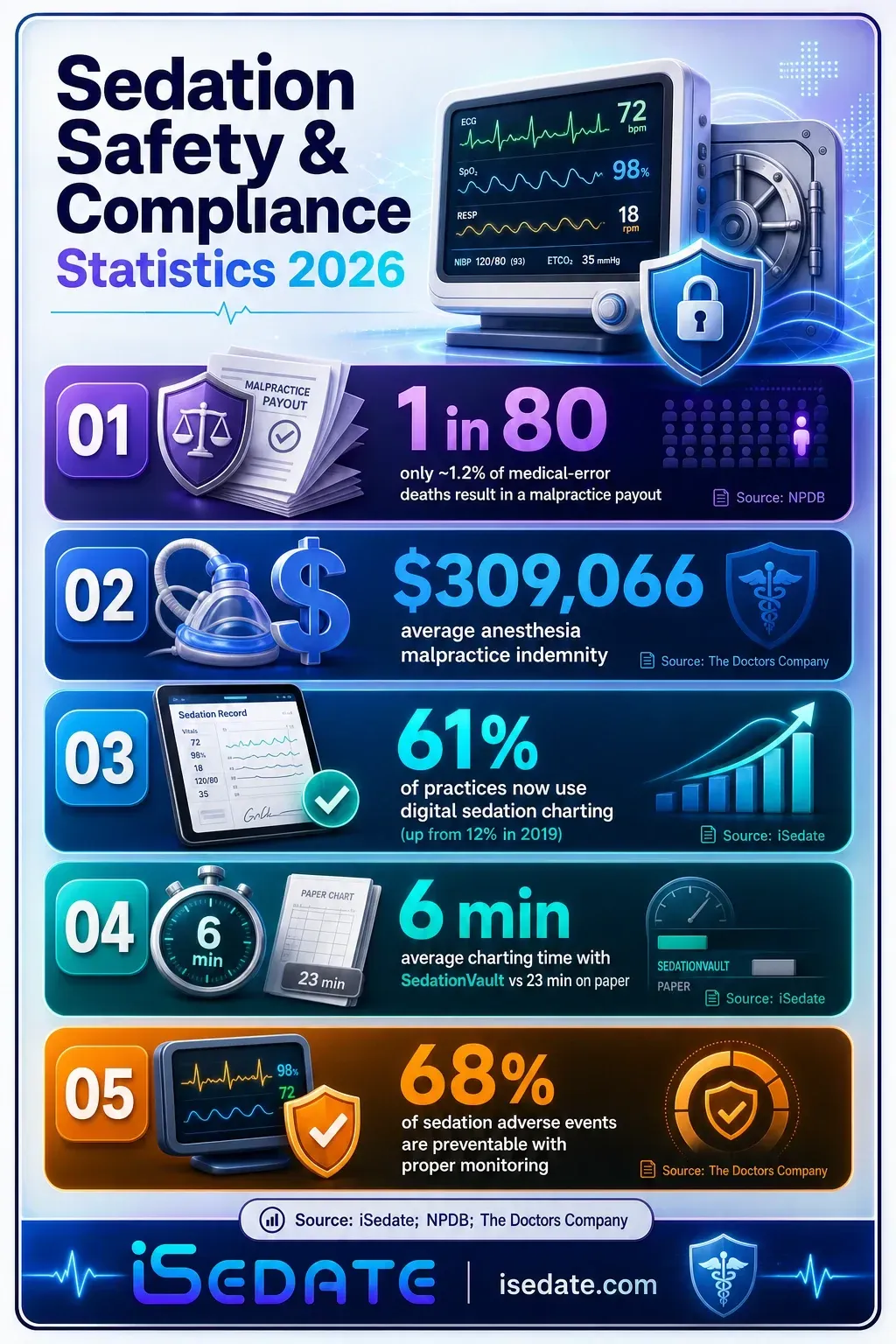
The requirement is not paperwork for its own sake. In both a board review and a malpractice claim, the contemporaneous sedation record is the first thing requested and the hardest thing to reconstruct after the fact. The same gaps that fail an inspection are the gaps a plaintiff's attorney looks for.
Related reading: the data behind these rules
The requirements on this page are the law. These research roundups are the data that explains why they exist and what happens when a practice gets charting wrong:
Penalties and discipline
Chapter 579 is backed by enforcement. Under 481 IAC 579.11, violations of the chapter may result in disciplinary measures as the Iowa Dental Board deems appropriate, and the chapter is adopted to implement Iowa Code section 153.13. Incomplete sedation records are not a filing technicality. They are the evidence a board weighs when deciding whether the standard of care was met.
The exact disciplinary schedule, the routine inspection cadence for existing permit holders, the board's current contact details, the record-retention period under 481 IAC 574.9, and any fee amounts are administered by the Iowa Dental Board and can change, so confirm current details directly with the Iowa Dental Board through DIAL rather than relying on a figure that may be out of date. What does not change is the exposure created by a thin record.
Iowa moved its sedation rules from 650 Chapter 29 to 481 Chapter 579 and, in doing so, stated the "four vitals continually until fully ambulatory" duty specifically for deep sedation and general anesthesia. The practical takeaway is not that moderate-sedation charting got easier, it is that your documentation template should cite the current rule and still carry the monitored vitals on every case, so a renumbering never becomes a review finding.
The easy button: an audit-ready record
The gap between knowing the rule and passing a review is almost always the same thing: a continual vitals log kept by hand during a live sedation case. When a team is managing an airway and an anxious patient, a record that is supposed to carry the monitored vitals through to full ambulation is exactly where holes develop, a skipped stretch here, a missing anesthesia time there, a drug given in the moment and logged later from memory.
That is the problem SedationVault by iSedate was built to remove. It connects to the vitals monitor already in your operatory and captures pulse oximetry, heart rate, respiratory rate, and blood pressure live, on the clock, alongside the drug log, so the time-oriented anesthesia record writes itself as the case runs rather than being reconstructed afterward. When the Iowa Dental Board asks for the chart, it exports as a one-click, audit-ready sedation visit report that already carries the preoperative and postoperative vitals, the dosages, the anesthesia time in minutes, the monitors used, and the discharge-to name the rule asks for. The point is not fancier charting. It is turning the exact items 481 IAC 579.7 requires into something the software guarantees are present and time-stamped, which is also what dental sedation compliance turns on.
Practices comparing options can review SedationVault pricing before they book.
Frequently asked questions
Does Iowa require a written sedation record?
When must the four vitals be recorded continually until fully ambulatory in Iowa?
Does Iowa require capnography during moderate sedation?
What does Iowa require on a nitrous oxide or minimal sedation record?
Who regulates and inspects sedation practices in Iowa?
Is 650 IAC 29.5 still the Iowa sedation recordkeeping rule?
Related guides and neighboring states
Licensed in more than one state, or practicing near the Iowa line? Documentation rules vary by state, so confirm the requirements where you provide sedation. See our same-silo guides for neighboring states:
- Illinois Sedation Vitals Monitoring, Charting & Reporting Requirements
- Minnesota Sedation Vitals Monitoring, Charting & Reporting Requirements
- Missouri Sedation Vitals Monitoring, Charting & Reporting Requirements
- Nebraska Sedation Vitals Monitoring, Charting & Reporting Requirements
- South Dakota Sedation Vitals Monitoring, Charting & Reporting Requirements
- Wisconsin Sedation Vitals Monitoring, Charting & Reporting Requirements
- Dental Sedation Vitals, Charting & Reporting Requirements by State
Sources and citations
This guide cites Iowa's primary regulatory sources directly. Rule text is drawn from the official Iowa Administrative Code 481 Chapter 579, "Sedation and Nitrous Oxide" (ARC 8993C, IAB 3/5/25, effective 4/9/25; current compile dated 9/30/2026), published by the Iowa Legislative Services Agency, with permit rules in 481 Chapter 572 and general patient-record rules in 481 Chapter 574. The regulator is the Iowa Dental Board, administered through the Iowa Department of Inspections, Appeals, and Licensing (DIAL). The predecessor chapter, 650 Chapter 29, was rescinded effective April 9, 2025. Where a detail, such as the current penalty schedule, inspection cadence, board contact information, permit fees, record-retention period, or exact training-hour counts, is administered by the board and subject to change, confirm it directly with the Iowa Dental Board before relying on it. This content is for informational purposes only and does not constitute legal or compliance advice. Consult a qualified professional for guidance specific to your situation.