







Illinois Sedation Vitals Monitoring, Charting & Reporting Requirements
If you administer moderate sedation in Illinois, the rule is specific about what has to be written down: the patient's medical history and anesthesia consent, a time-based record of blood pressure, pulse, respiration and oxygen saturation across the case, and a drug log naming every drug, dose, the person who gave it, and when. That requirement lives in 68 Illinois Administrative Code §1220.510(h), it is enforced by the Illinois Department of Financial and Professional Regulation, and it is the first thing a record review examines. This guide breaks down what Illinois requires you to monitor and record for sedation, what a compliant chart actually looks like, where dentists most often fall short, and how to make the record audit-ready.
Recent Updates
Last UpdatedNovember 16, 2026
- Rewrote every citation to point at Illinois's primary sources directly, the official 68 Ill. Adm. Code §1220.510 rule text and the IDFPR Board of Dentistry, in place of third-party legal aggregators.
- Added a "what compliant documentation looks like" section with a sample charting cadence and the oral-vs-IV drug-log difference.
- Added sourced closed-claims data showing why the sedation record matters, and clarified that Illinois sets no fixed minute interval.
Key Takeaways
- The core rule: Illinois moderate (conscious) sedation requires a time-based chart record under 68 Ill. Adm. Code §1220.510(h), capturing blood pressure, pulse, respiration and oxygen saturation preoperatively, intraoperatively and pre-discharge.
- Who enforces it: the Illinois Department of Financial and Professional Regulation (IDFPR), through its Division of Professional Regulation and the Illinois State Board of Dentistry, under the Illinois Dental Practice Act (225 ILCS 25).
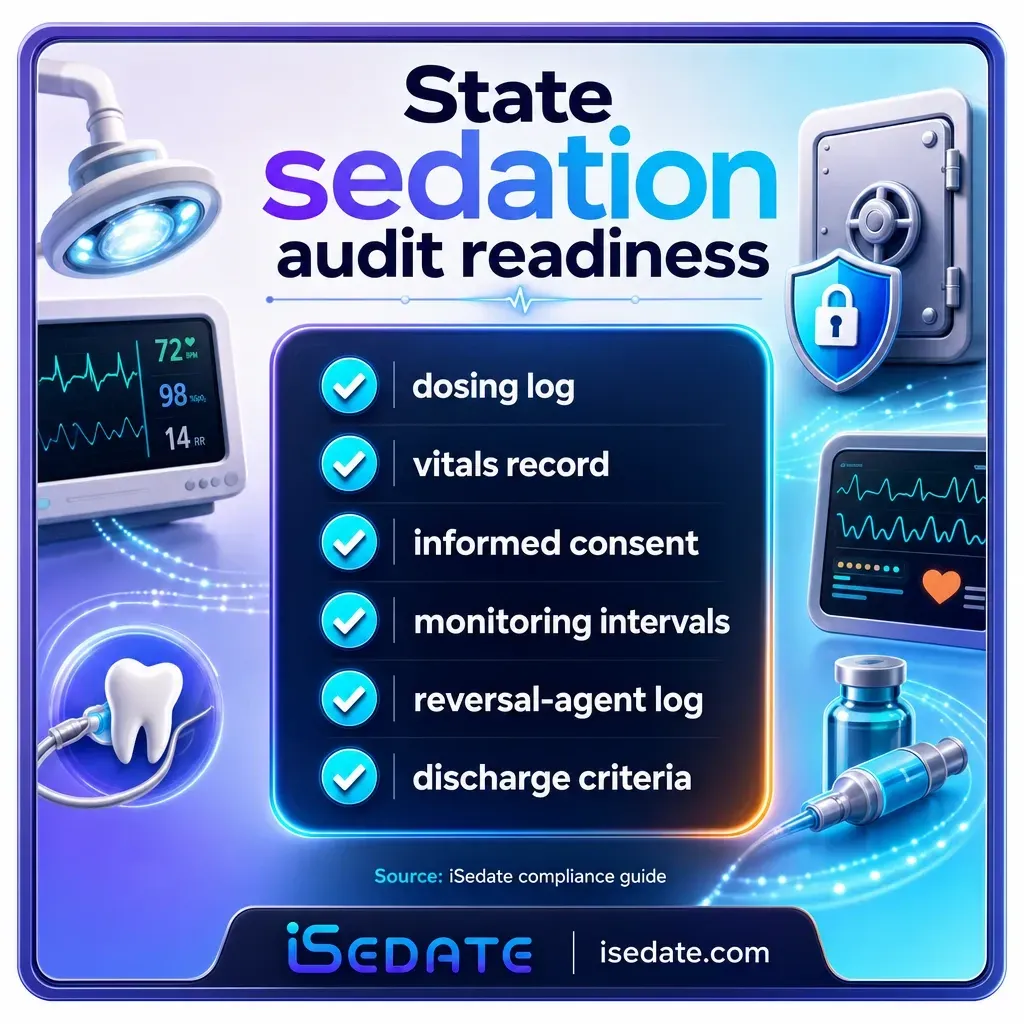
- The record must name every drug and dosage, the person who administered each drug, and the times of administration, plus the medical history and anesthesia consent taken before the procedure.
- No fixed minute interval: unlike some states, Illinois names the phases but does not set a specific minute cadence, so record the four vitals on the clock at each phase and at every drug given.
- The most common failure is a thin record: a missing time-based vitals entry, a drug given but not logged with the person and time, or no documented pre-discharge reading.

What This Guide Covers
- Who regulates sedation in Illinois
- The Illinois sedation permit levels
- What you must monitor during moderate sedation
- What the sedation record must contain
- What compliant documentation looks like
- How Illinois reviews records (and where dentists get burned)
- Why the record matters: what a charting gap can cost
- Penalties and adverse-occurrence reporting
- The audit-ready record: SedationVault
- Frequently asked questions
- Related guides and neighboring states
- Sources and citations
Who regulates sedation in Illinois
Sedation and anesthesia in an Illinois dental office are regulated by the Illinois Department of Financial and Professional Regulation (IDFPR). This is an important distinction: Illinois does not run a standalone dental board that issues permits on its own. The Illinois State Board of Dentistry sits inside IDFPR's Division of Professional Regulation, and it is IDFPR that issues anesthesia permits, reviews records, and takes disciplinary action under the Illinois Dental Practice Act (225 ILCS 25) and its rules.
Those rules are not scattered across general dental law. They sit in one place: Title 68 of the Illinois Administrative Code, Part 1220, Subpart E, "Anesthesia Permits." That matters for compliance, because it means your recordkeeping obligation is a named administrative rule with an exact citation, not a vague standard of care. It is also worth being precise about where the American Dental Association fits. The ADA publishes national sedation guidelines that most states lean on, but those guidelines are a private professional standard, not law, and the ADA is not a federal agency. In Illinois, the law is Part 1220, and the agency that enforces it is IDFPR. The federal layers that sit on top, where they apply, are the DEA for controlled-substance records, HIPAA for protected health information, and any facility accreditation you carry, not the ADA. (For the same breakdown in every other state, the all-50 hub is linked at the end of this guide.)
Source: IDFPR Illinois State Board of Dentistry | Illinois Dental Practice Act, 225 ILCS 25
The Illinois sedation permit levels
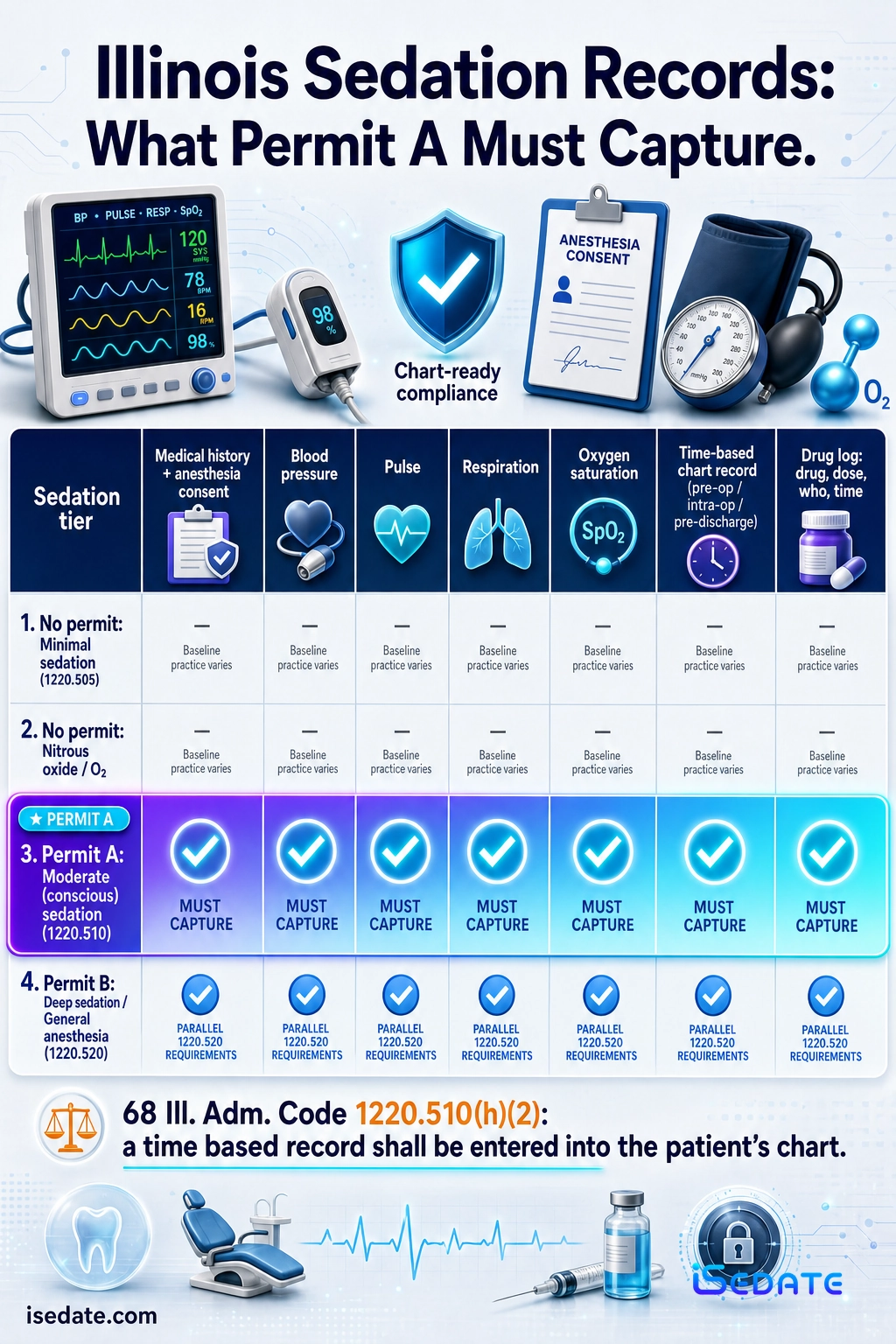
Illinois uses its own permit structure, named by letter rather than by number, and the requirements escalate with the depth of sedation. Knowing which permit you hold tells you which monitoring and recordkeeping rules apply. These are the levels as Subpart E defines them:
| Illinois tier | What it covers | Citation |
|---|---|---|
| No permit required | Minimal sedation (anxiolysis) | 68 Ill. Adm. Code §1220.505 |
| No permit required | Nitrous oxide / oxygen inhalation | 68 Ill. Adm. Code 1220, Subpart E |
| Permit A | Moderate (conscious) sedation | 68 Ill. Adm. Code §1220.510 |
| Permit B | Deep sedation or general anesthesia | 68 Ill. Adm. Code §1220.520 |
Minimal sedation and nitrous oxide carry no permit requirement, though minimal sedation must still be documented through clinical observation in the record (§1220.505). Moderate sedation, also called Conscious Sedation, is the level that triggers Permit A and the full monitoring and recordkeeping standard in §1220.510. That is where most sedation dentists operate and where the record rules are spelled out most explicitly. Deep sedation and general anesthesia sit at the top under Permit B and §1220.520, with their own requirements; a Permit B holder may also administer moderate sedation without separately holding Permit A (§1220.510(e)). This guide focuses on the moderate-sedation record standard in §1220.510. If you are working out which permit to apply for or how to upgrade, that is a separate process, covered in our guide to Illinois Sedation Dentistry Licensing & Permit Requirements.
Source: 68 Ill. Adm. Code §1220.510 (moderate sedation) | 68 Ill. Adm. Code §1220.520 (deep sedation / general anesthesia)
What you must monitor during moderate sedation
In Illinois, what you are required to monitor is what you are required to write down. The two are inseparable. For moderate (conscious) sedation, §1220.510(h)(2) names the four physiological parameters that must be watched and documented, and §1220.510(g) and (b)(2) set the facility and team conditions around that monitoring. The Permit A holder must track all four, at each phase of the case:
- Blood pressure, monitored preoperatively, intraoperatively and pre-discharge.
- Pulse, monitored preoperatively, intraoperatively and pre-discharge.
- Respiration, monitored preoperatively, intraoperatively and pre-discharge.
- Oxygen saturation, monitored preoperatively, intraoperatively and pre-discharge.
The monitoring does not happen in a vacuum. Under §1220.510(g), the facility must include a recovery area with oxygen, lighting and suction, and the Permit A holder must remain with the patient until the patient can independently maintain an airway and respond to stimulation and commands. Under §1220.510(b)(2), an anesthesia team of the dentist plus at least two trained auxiliaries must remain in the treatment room, and a trained hygienist or assistant stays with the sedated patient until the patient is no longer sedated.
Myth, Busted
Myth: Nitrous or a single oral pill is light, so the full record does not really apply.
Fact: The depth of sedation, not the route or the drug, drives the requirement. The moment a patient reaches moderate (conscious) sedation, the full §1220.510 monitoring and recording standard applies, no matter how the drug was delivered.
Sedation levels are defined by patient response, and patients can reach a deeper level than intended from an oral dose. The record has to match the depth the patient actually reached, per 68 Ill. Adm. Code §1220.510.
Source: 68 Ill. Adm. Code §1220.510(g), (h)(2), (b)(2)
What the sedation record must contain
This is the section a reviewer reads first. For moderate sedation, 68 Ill. Adm. Code §1220.510(h) spells out exactly what the record must contain, and it has three parts worth knowing by heart.
1. Medical history and anesthesia consent
Under §1220.510(h)(1), the record must include the medical history of the patient and consent for the administration of anesthesia, taken before any procedure. This is the foundation of the sedation record, and it has to be in place before the first drug is given, not reconstructed afterward. A review that finds a consent or history dated after the procedure treats it as missing.
2. A time-based record of the four vital signs
Under §1220.510(h)(2), preoperative, intraoperative and pre-discharge monitoring of blood pressure, pulse, respiration and oxygen saturation is required, and in the rule's own words, "a time based record shall be entered into the patient's chart." "Time-based" is the operative phrase: the readings are organized against the clock and captured at each phase of the case, not condensed into a single end-of-visit summary. A note that a patient "tolerated sedation well" is not this record. A timed set of blood pressure, pulse, respiration and oxygen saturation readings across the preoperative, intraoperative and pre-discharge phases is.
State Law
3. The drug log
Under §1220.510(h)(3), the record must capture the drugs and dosages used during the operative procedure, including the identification of the person administering the drugs and the times of their administration over the course of the procedure. This is a running log, not a summary line. Each drug, each dose, who gave it, and when, has to be on the page. A drug administered in the moment and logged later from memory is exactly the gap a reviewer looks for.
One more duty sits alongside the record. Under §1220.510(i), adverse occurrences connected to the sedation must be reported to the Division and Board as required by §1220.405. Deep sedation and general anesthesia under Permit B carry their own records subsection in §1220.520, parallel to the moderate-sedation standard; if you work at that level, build from §1220.520 directly and confirm the current contents with IDFPR.
Source: 68 Ill. Adm. Code §1220.510(h), (i)
See how a time-based anesthesia record is captured automaticallyWhat compliant documentation looks like
Illinois names the phases but does not fix a minute-by-minute interval the way states like Texas do. That is a freedom and a trap: there is no magic number to hit, but there is also no interval to hide behind, so the record has to show enough timed readings to prove the trend at each phase and around every drug. Here is what a clean §1220.510(h) chart looks like in practice for a single moderate (conscious) sedation case.
A Sample Compliant Charting Cadence
- Before the first drug (preoperative): medical history reviewed and anesthesia consent signed and timed; a baseline set of blood pressure, pulse, respiration and oxygen saturation entered with the clock time.
- At each drug administration: a drug-log entry naming the drug, the dose, the person who gave it, and the time, with a vitals set recorded around that point so the chart shows the patient's response to the dose.
- Through the procedure (intraoperative): the four vital signs recorded on the clock at regular points across the case, frequently enough to show the trend, not a single mid-case reading.
- Before discharge (pre-discharge): a final timed set of all four vitals, plus the note that the patient can maintain an airway and respond to stimulation and commands before release, per §1220.510(g).
Oral versus IV changes the drug log, not the vitals standard. Whether the patient reached moderate sedation from an oral regimen or an IV, the same four vital signs and the same pre-op, intra-op and pre-discharge time-based record apply. What differs is the drug log: an IV case titrated to effect produces more dose entries, each timed, while an oral case logs each tablet or dose and its time. Either way, §1220.510(h)(3) wants every dose, the person, and the time on the page.
iSedate's Take
The cleanest Illinois sedation records we see are not the ones with the most notes. They are the ones where every vitals reading and every drug entry carries a real clock time, and where the preoperative, intraoperative and pre-discharge phases are each visibly covered. A reviewer can scan that chart in under a minute and see the whole case. That is the bar to write to.
Required equipment follows from the rule, too: a device for each of the four vital signs (a pulse oximeter, a blood-pressure cuff or monitor, and a way to track respiration and pulse), plus the recovery area with oxygen, lighting and suction that §1220.510(g) requires. If a monitor is capturing the readings, the record is only compliant when those readings actually make it onto the timed chart.
Source: 68 Ill. Adm. Code §1220.510(g), (h)

How Illinois reviews records (and where dentists get burned)
When IDFPR looks at a sedation case, it is looking at the record. Holding Permit A comes with a signed facility affidavit under §1220.510(g), and the Department's authority to review a permit holder's records flows from the Dental Practice Act. The review does not grade your clinical judgment in the moment. It grades whether the contemporaneous record proves what you monitored, what you gave, and when.
Here is where dentists get burned. It is rarely the clinical care that fails a review. It is the record: a time-based vitals entry that was never made, a pre-discharge reading that is missing, a drug given but not logged with the person who administered it and the time, a consent or medical history that was not documented before the procedure. The care can be flawless and the record can still fail.
Important
A reviewer does not grade your sedation on how the patient did. They grade it on whether the time-based record and drug log prove what you did and when. If the time-based record has gaps, the default assumption on review is that the monitoring had gaps too. Enter each phase's vital signs on the clock, and log every drug with the person administering it and the time.
Source: 68 Ill. Adm. Code §1220.510(g), (h) | IDFPR Board of Dentistry
Why the record matters: what a charting gap can cost
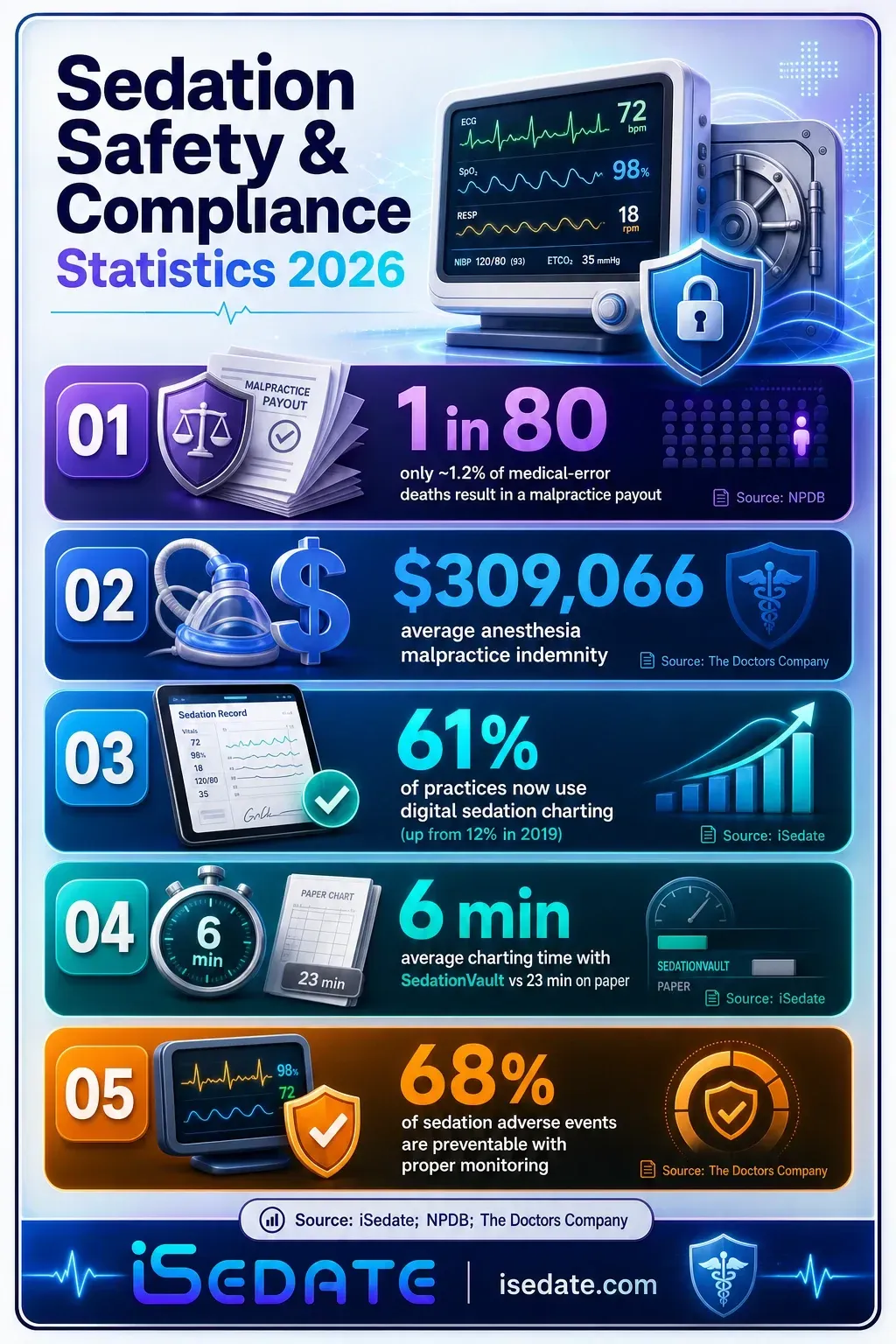
The time-based record is not paperwork for its own sake. In a board review and in a lawsuit, the contemporaneous sedation chart is the first thing requested and the hardest thing to reconstruct after the fact. The dental-anesthesia malpractice record shows why that document carries so much weight.
Industry Data
In that same review of closed malpractice claims, 13 of the 17 cases involved sedation, 71% of the adverse events happened in the dental office where care was being provided, and the authors concluded that "some practitioners are inadequately monitoring patients during sedation procedures." Monitoring and the record that proves it are the same fault line. When a case goes to a board or a courtroom, a complete, timed chart is the strongest evidence that the standard of care was met; a thin one invites the opposite inference.
For the data behind these requirements, these research roundups go deeper than any single rule can:
- how sedation charting affects malpractice case outcomes
- the data on vital-signs monitoring and sedation safety
- documentation-error rates and chart defensibility
Penalties and adverse-occurrence reporting
The record rule is backed by enforcement. Adverse-occurrence reporting is mandatory: under §1220.510(i), an adverse occurrence connected to the sedation triggers reporting to the Division and Board per §1220.405, and IDFPR can take disciplinary action under the Illinois Dental Practice Act (225 ILCS 25) for rule violations, including recordkeeping violations. Incomplete sedation records are not a filing technicality. They are the evidence IDFPR weighs when deciding whether the standard of care was met, and the same gaps that fail a review are the gaps a plaintiff's attorney looks for in a malpractice claim.
The exact disciplinary schedule, any routine office-inspection cadence for permit holders, and the precise penalty amounts are administered by IDFPR and can change, so confirm current details directly with the Illinois State Board of Dentistry at IDFPR rather than relying on a figure that may be out of date. What does not change is the exposure created by a thin record: in both an IDFPR review and a lawsuit, the contemporaneous sedation record is the first thing requested and the hardest thing to reconstruct after the fact.
Source: 68 Ill. Adm. Code §1220.510(i), §1220.405 | Illinois Dental Practice Act, 225 ILCS 25
The audit-ready record: SedationVault
The gap between knowing the rule and passing a review is almost always the same thing: a time-based vitals log and drug log kept by hand during a live sedation case. When a team is managing an airway and an anxious patient, a reading that is supposed to land on the chart at each phase is exactly where the record develops holes, a skipped pre-discharge entry here, a drug logged later from memory there.
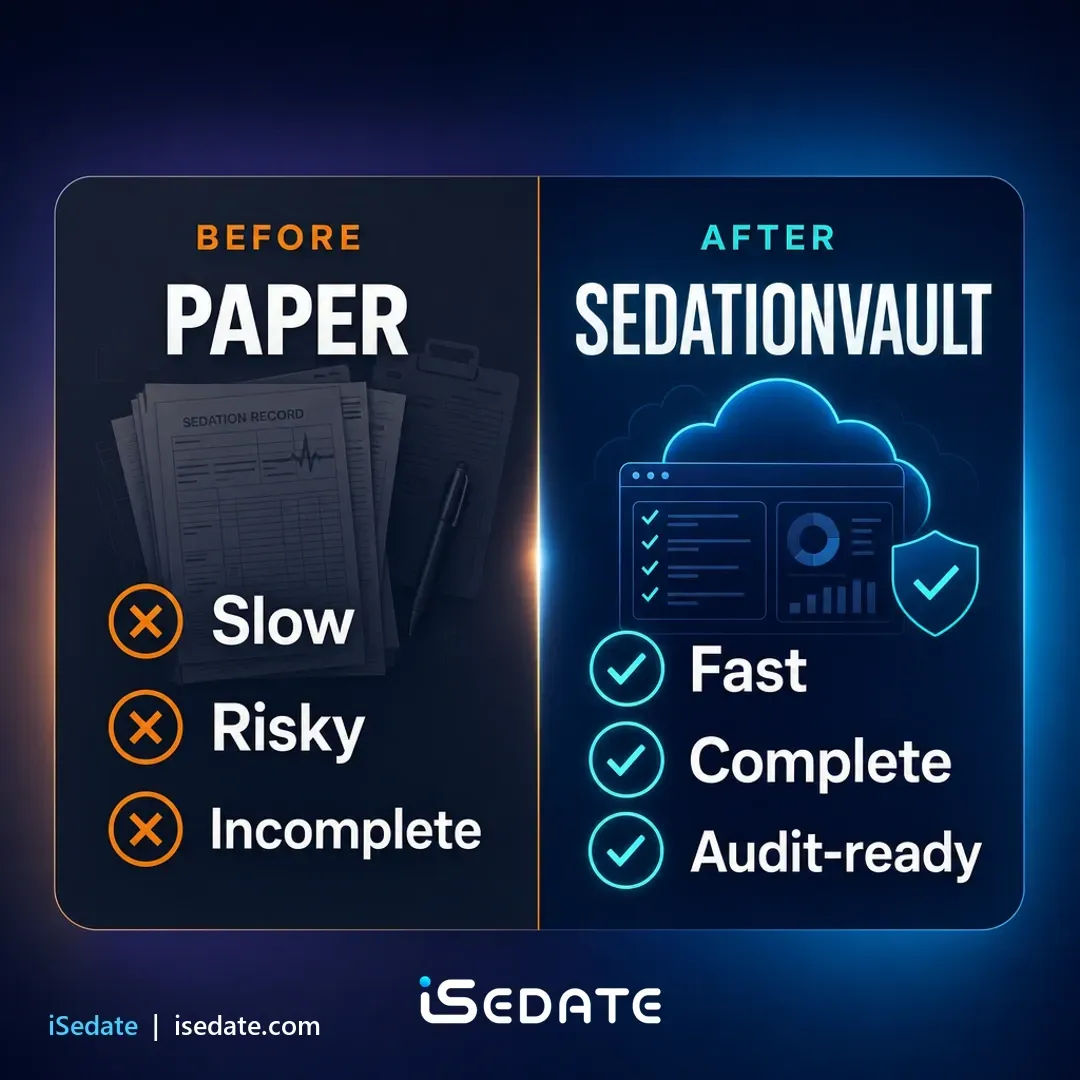
That is the problem SedationVault by iSedate was built to remove. It connects to the vitals monitor already in your operatory and captures blood pressure, pulse, respiration and oxygen saturation live, on the clock, alongside the drug log, so the time-based record writes itself as the case runs rather than being reconstructed afterward. When IDFPR asks for the chart, it exports as a one-click, audit-ready sedation visit report that already carries the preoperative, intraoperative and pre-discharge readings, the dosages, the person who administered each drug, and the times. The point is not fancier charting. It is turning the exact items §1220.510(h) requires into something the record guarantees are present and time-stamped, which is also what dental sedation compliance turns on.
See how SedationVault builds your Illinois sedation recordFrequently asked questions
Does Illinois require a written sedation record?
What vitals must be monitored during sedation in Illinois?
Does Illinois set a minute-by-minute interval for charting sedation vitals?
Who regulates sedation records in Illinois?
What are the Illinois dental sedation permit levels?
Does Illinois require a drug log during sedation?
Related guides and neighboring states
Licensed in more than one state, or planning to be? The documentation standard changes at the state line. Start with our Dental Sedation Vitals, Charting & Reporting Requirements by State hub, then see the guides for Illinois's neighbors:
- Indiana Sedation Vitals Monitoring, Charting & Reporting Requirements
- Iowa Sedation Vitals Monitoring, Charting & Reporting Requirements
- Kentucky Sedation Vitals Monitoring, Charting & Reporting Requirements
- Missouri Sedation Vitals Monitoring, Charting & Reporting Requirements
- Wisconsin Sedation Vitals Monitoring, Charting & Reporting Requirements
Sources and citations
Our Sources & Verification
This guide cites Illinois's primary regulatory sources directly. Rule text is drawn from 68 Illinois Administrative Code Part 1220, Subpart E, as published by the Illinois General Assembly's Joint Committee on Administrative Rules, and the regulator is the Illinois Department of Financial and Professional Regulation and its Illinois State Board of Dentistry. The malpractice figures come from a peer-reviewed closed-claims review. Where a detail (the current penalty schedule, inspection cadence, or the exact amendment date of §1220.510) is administered by IDFPR and subject to change, confirm it directly with the Department before relying on it.
- 68 Ill. Adm. Code §1220.510: Moderate (conscious) sedation, Permit A (monitoring and recordkeeping)
- 68 Ill. Adm. Code §1220.520: Deep sedation and general anesthesia, Permit B
- Illinois Dental Practice Act, 225 ILCS 25
- Illinois Department of Financial and Professional Regulation, Board of Dentistry
- Chicka MC, et al. Adverse events during pediatric dental anesthesia and sedation: a review of closed malpractice insurance claims. Pediatric Dentistry. 2012
This guide summarizes Illinois sedation recordkeeping rules for general information and is not legal advice. Consult a qualified professional for guidance specific to your situation. Monitoring, the time-based record, and the drug log are drawn from 68 Ill. Adm. Code §1220.510 as cited. The penalty schedule, routine inspection cadence, the exact amendment date of the rule, and the deep-sedation record contents in §1220.520 are set by IDFPR and should be confirmed directly with the Department before you act.