








Indiana Sedation Vitals Monitoring, Charting & Reporting Requirements
If you administer sedation or general anesthesia in an Indiana dental office, the state is specific about two things that have to be written down: a physical evaluation with pretreatment vital signs on the patient's chart, and a separate anesthetic record for each anesthetic. That duty lives in 828 Indiana Administrative Code 3, it is enforced by the Indiana State Board of Dentistry, and the anesthetic record is the first thing a board review reads. This guide covers what Indiana requires you to monitor and record at each sedation level, where the state's own rule stops and the ADA professional standard fills in the detail, what a compliant anesthetic record actually looks like, and how to keep it audit-ready.
Recent Updates
Last UpdatedNovember 16, 2026
- Rebuilt the guide against Indiana's current permit structure, including the named General Anesthesia-Deep Sedation Permit (828 IAC 3-1-2) and the Light Parenteral Conscious Sedation Permit (828 IAC 3-1-4).
- Replaced outdated and aggregator source links with Indiana's live official pages: the State Board of Dentistry, the dentistry licensing page, and the official Indiana Administrative Code for Title 828 Article 3.
- Added what a complete Indiana anesthetic record should contain, the federal DEA and HIPAA recordkeeping layers that sit on top of state rules, and current dental closed-claims documentation data.
Key Takeaways
- The core rule: for general anesthesia and deep sedation, 828 IAC 3-1-6.5 requires pretreatment vital signs recorded on the chart and a separate anesthetic record kept for each anesthetic.
- Who enforces it: the Indiana State Board of Dentistry, under the Indiana Professional Licensing Agency, through 828 IAC 3 and discipline under the Dental Law in Indiana Code Title 25.
- Indiana sets the duty; the ADA standard sets the detail. The code mandates the record and a dedicated vital-signs monitor but does not fix an interval, so the time-oriented drug-and-vitals log follows the ADA standard the board enforces.
- Depth drives the obligation. Minimal oral sedation and nitrous carry the lightest duties; the moment a patient reaches deeper sedation, the full standard of care and the separate anesthetic record apply.
- Before discharge, vital signs must be stable and the patient appropriately responsive, and that assessment belongs on the record.

What This Guide Covers
- Who regulates sedation in Indiana
- Indiana's sedation permit structure
- What you must monitor at each level
- What you must record: the compliance core
- The federal layers: DEA and HIPAA
- Why thin charting is the real risk
- Discipline and adverse-event reporting
- The easy button: an audit-ready record
- Frequently asked questions
- Related guides and neighboring states
- Sources and citations
Who regulates sedation in Indiana
Sedation and anesthesia in an Indiana dental office are regulated by the Indiana State Board of Dentistry, which operates under the Indiana Professional Licensing Agency. The board issues sedation permits, enforces the standard of care, and takes disciplinary action under the Dental Law. The anesthesia and sedation rules are gathered in one article of the administrative code: 828 IAC 3, Anesthesia and Sedation, adopted under the authority of the enabling statute at Indiana Code Title 25, Article 14.
That matters for compliance because your recordkeeping obligation traces to named rules with exact citations, not a vague sense of good charting. When a reviewer asks whether your sedation record meets the requirement, the answer is measured against the subsections of 828 IAC 3-1 below. It is also worth being precise about the ADA here. The American Dental Association publishes national sedation guidelines that boards across the country lean on, but those guidelines are a professional standard, not federal law. In Indiana, the law is 828 IAC 3, the permit and the discipline come from the Indiana State Board of Dentistry, and the ADA standard fills in the clinical detail the state expects without rewriting every line into statute. For the clinical reasoning behind these duties across every state, see our hub guide to Dental Sedation Vitals, Charting & Reporting Requirements by State.
Source: Indiana State Board of Dentistry | 828 IAC 3 (Anesthesia and Sedation)
Indiana's sedation permit structure
Indiana does not use a numbered Level 1 through 4 ladder. It names its sedation tiers, and the recordkeeping obligation attaches to the depth of sedation. Knowing which tier you work in tells you which standard-of-care rule your chart is measured against.
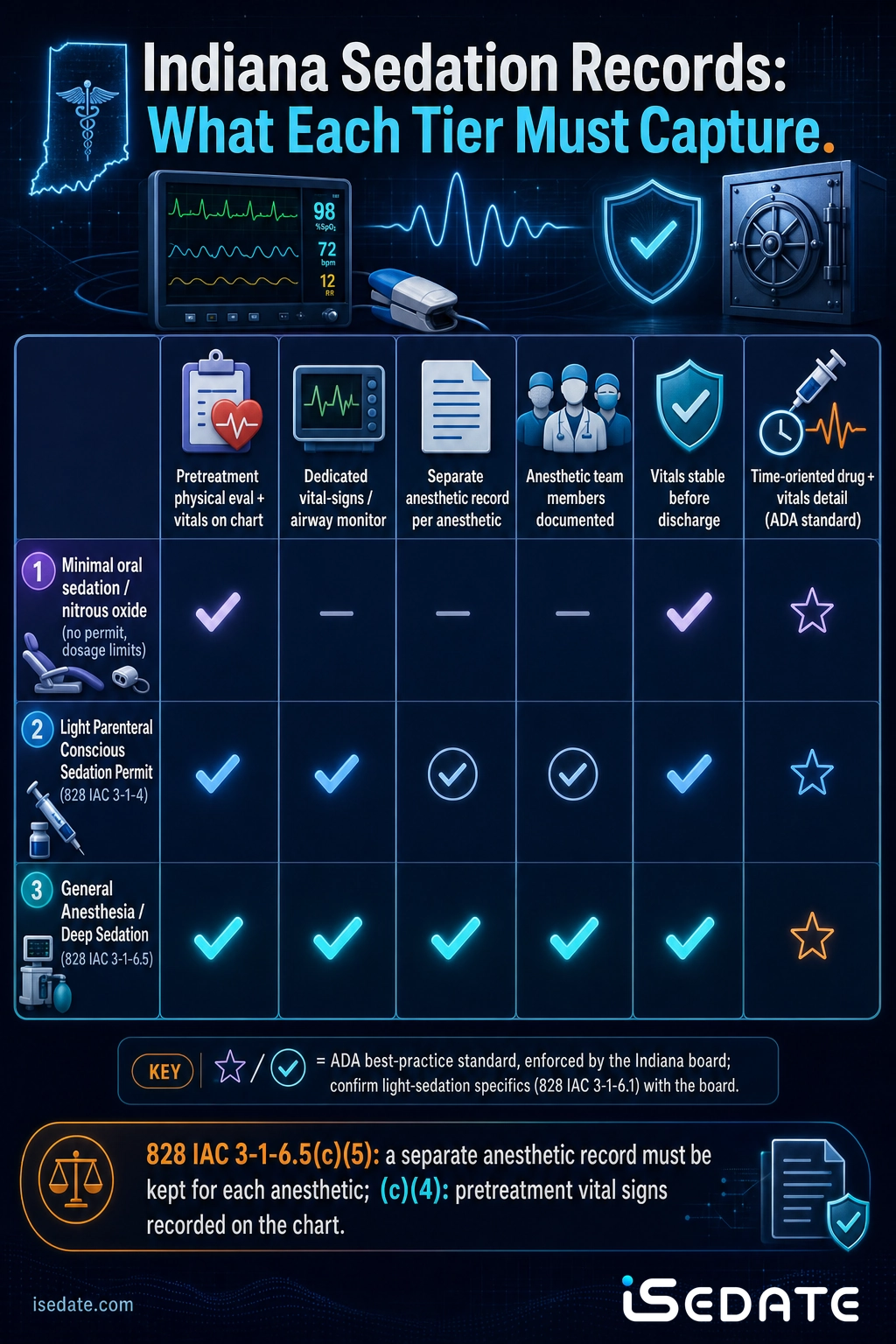
| Indiana tier | What it covers | Permit rule | Standard of care |
|---|---|---|---|
| Minimal oral sedation and nitrous oxide | Light anxiety control; no separate permit, but dosage limits apply | 828 IAC 3-1 | 828 IAC 3-1 |
| Light Parenteral Conscious Sedation Permit | Parenteral, including intravenous, Conscious Sedation | 828 IAC 3-1-4 | 828 IAC 3-1-6.1 |
| General Anesthesia-Deep Sedation Permit | Deep sedation and general anesthesia (the top tier) | 828 IAC 3-1-2 | 828 IAC 3-1-6.5 |
Two points matter for charting. First, the General Anesthesia-Deep Sedation Permit issued under 828 IAC 3-1-2 also authorizes light parenteral Conscious Sedation, so a holder does not need a separate light parenteral permit. Second, the record requirements are spelled out most explicitly in the general anesthesia and deep sedation standard of care at 828 IAC 3-1-6.5, which is the rule this guide leans on most. The light parenteral standard of care sits at 828 IAC 3-1-6.1; its itemized monitoring interval is not fully laid out in the compiled rule text, so confirm those specifics with the Indiana State Board of Dentistry. If you are working out which permit to apply for or how to upgrade, that process lives in our companion guide to Indiana Sedation Dentistry Licensing & Permit Requirements.
Source: Indiana dentistry licensing information | 828 IAC 3-1 (permit rules and standards of care)
What you must monitor at each level
In Indiana, what you are required to monitor is what you are required to write down. For general anesthesia and deep sedation, 828 IAC 3-1-6.5 is explicit about the clinical setup:
- An anesthetic team must be present during the administration of general anesthesia or deep sedation, with one assistant dedicated to monitoring vital signs and maintaining the airway. That dedicated monitor is a rule, not a courtesy.
- Pretreatment evaluation: a physical evaluation and pretreatment vital signs must be taken and recorded on the patient's chart before the anesthetic.
- Discharge: vital signs must be stable and the patient appropriately responsive before leaving the dentist's office.
- Team documentation: the presence and identity of each anesthetic team member throughout the administration must be maintained.
Indiana's code is clear that someone is assigned to watch the vitals continuously, but the compiled rule does not spell out a fixed vital-sign interval or an itemized intra-operative log for the lighter parenteral Conscious Sedation tier (828 IAC 3-1-6.1). That is where the ADA best-practice standard carries the detail. The ADA calls for continual monitoring of oxygenation by pulse oximetry, ventilation, blood pressure, heart rate, and level of consciousness at moderate sedation and above, with those parameters recorded at regular intervals. Do not import a specific interval from another state's rule; chart continuously and confirm any interval expectation with the board.
Oral versus IV: the depth, not the route, sets the duty
A single oral premedication and a titrated intravenous line are not treated the same, but the dividing line is the depth of sedation the patient actually reaches, not the drug or the route. Minimal oral sedation and nitrous oxide carry the lightest charting duties. Parenteral and intravenous Conscious Sedation adds the dedicated monitor and the formal anesthetic record. General anesthesia and deep sedation carry the full standard of care. Because sedation levels are defined by patient response, a patient given an oral or enteral regimen can drift deeper than intended, and the moment they do, the deeper tier's record requirements apply to that case.
Myth, Busted
Myth: Nitrous or a single oral pill is light, so I do not really need to chart much.
Fact: The depth of sedation, not the route or the drug, drives the obligation, and a patient can reach a deeper level than you intended. The standard of care and the separate anesthetic record attach to the depth actually achieved, per 828 IAC 3-1-6.5.
This is the single most common charting gap sedation providers get caught on: a case that was planned as light but deepened, documented as if it had stayed light.
Required monitoring and emergency equipment
Monitoring duties assume working equipment. Indiana requires minimum emergency equipment for offices that offer these techniques: 828 IAC 3-1-10 sets the equipment list for general anesthesia and deep sedation, and 828 IAC 3-1-11 sets it for light parenteral Conscious Sedation. 828 IAC 3-1-6.5 also requires that the equipment used during the procedure be in good working order and serviced and certified as necessary. For charting, that means your record should reflect that the monitors and emergency equipment were present and functional for the case, not just that a drug was given.
Source: 828 IAC 3-1-6.5, 3-1-10, and 3-1-11 (standard of care and emergency equipment) | Indiana State Board of Dentistry
What you must record: the compliance core
This is the section a reviewer reads first. For general anesthesia and deep sedation, 828 IAC 3-1-6.5 states the record duties plainly, and they have three parts worth knowing by heart.
1. Pretreatment physical evaluation and vital signs on the chart
The physical evaluation and pretreatment vital signs must be taken and recorded on the patient's chart. This is the baseline against which everything during the case is read. A chart that jumps straight to "sedation administered" with no recorded pretreatment evaluation and vitals is missing the first element the rule asks for.
2. A separate anesthetic record for each anesthetic
A separate anesthetic record must be kept for each anesthetic. This is the heart of Indiana's documentation duty. The anesthetic record is distinct from the general treatment note, and a new one is created for each anesthetic event. Indiana's rule mandates that this record exist and that the team members present be documented, but it does not itemize, line by line, the time-oriented drug and vital-sign log inside it. That granular detail follows the ADA standard the board enforces: every drug administered with its dose and time, the monitored physiological parameters, and the patient's response, all organized against the clock.
Indiana's training and education rules for these permits (828 IAC 3-1-3 for general anesthesia and deep sedation, and 828 IAC 3-1-5 for light parenteral Conscious Sedation) reinforce the same expectation, requiring competency in maintaining proper records with accurate chart entries of medical history, physical examination, vital signs, drugs administered, and patient response. The training standard and the ADA standard describe the same complete, time-oriented record, which is the practical target to chart to.
What an Indiana anesthetic record should contain
Putting the rule and the enforced standard together, a defensible Indiana anesthetic record for a deeper case reads like a timeline, not a summary written from memory afterward.
Indiana Anesthetic Record Checklist
- Pretreatment physical evaluation and a full set of baseline vital signs, recorded on the chart (828 IAC 3-1-6.5).
- Informed consent for the sedation or anesthetic.
- Every drug administered, with dose, route, and time, logged as it is given rather than reconstructed later.
- Monitored parameters recorded at regular intervals through the case: oxygen saturation, heart rate, respiratory rate or ventilation, blood pressure, and level of consciousness (ADA standard).
- The presence and identity of each anesthetic team member throughout the administration (828 IAC 3-1-6.5).
- The discharge assessment: vital signs stable and the patient appropriately responsive before leaving the office.
- Any adverse event or deviation, with the time and the response.
iSedate Insight
Read the three record duties together and a pattern emerges: Indiana does not ask you to prove the patient did well, it asks you to prove the record shows what you monitored and when. A contemporaneous, time-stamped record is the only version of events that survives a review, because it is the only one written while the case was live.
3. A documented discharge assessment
Recovery has its own duty. Vital signs must be stable and the patient appropriately responsive before the patient leaves the dentist's office, and the presence and identity of each anesthetic team member must be maintained in the record throughout. Recording the discharge assessment and the team present is how you prove, after the fact, that the case met the standard. Where Indiana's rule leaves a monitoring interval or an intra-operative log detail unstated, chart the continual, time-oriented record the ADA standard calls for and confirm any specific interval expectation with the Indiana State Board of Dentistry.
Source: 828 IAC 3-1-6.5 and 3-1-3 / 3-1-5 (standard of care and training records) | Indiana dentistry licensing information
See how a time-oriented anesthesia record is built automaticallyThe federal layers: DEA and HIPAA
Indiana's rule is not the only recordkeeping obligation on a sedation case. Two federal layers sit on top of 828 IAC 3, and a board review or a plaintiff's attorney can reach both.
First, the controlled-substance log. Most sedation drugs, including midazolam, diazepam, and the opioids used in deeper cases, are federally scheduled, so the DEA requires a separate, auditable record of what was received, administered, and wasted. That log is distinct from the anesthetic record but has to reconcile with it: the doses on your anesthetic record should match the drawdown on your controlled-substance log. Second, HIPAA. Your sedation records are protected health information, which means they must be secured, access-controlled, and retained. HIPAA requires covered entities to keep required documentation for at least six years, which functions as a practical retention floor because Indiana's anesthesia rule does not state a specific retention period for the anesthetic record.
On Retention
Keep the record well past six years. The HIPAA floor is a minimum, not a target. Indiana's statute of limitations for a malpractice claim, and the longer window for a minor patient, can both outlast a six-year purge, so confirm Indiana's current dental record-retention requirement with the board and err on the side of keeping the anesthetic record longer.
Source: U.S. Department of Health and Human Services (HIPAA) | 828 IAC 3 (Indiana anesthesia and sedation rules)

Why thin charting is the real risk
When the Indiana State Board of Dentistry opens a file, it is looking at the record, not your intentions. The separate anesthetic record, the pretreatment vitals, and the documented team members are exactly what a review examines, and they are exactly where thin charting falls apart. The pattern is the same everywhere. It is rarely the clinical care that fails a review; it is the record. A pretreatment evaluation that was done but never written down. An anesthetic record that reads like a single end-of-visit summary instead of a contemporaneous log. A discharge that happened but was never documented as "vital signs stable, patient appropriately responsive."
That gap is not hypothetical. In a review of 1,185 dental malpractice claims closed between 2010 and 2020, The Doctors Company found documentation problems in nearly one in five, with insufficient documentation the leading documentation issue. The care can be flawless and the claim can still turn on what the chart failed to capture.
Important
A reviewer does not grade your sedation on how the patient did. They grade it on whether the contemporaneous anesthetic record proves what you did and when. If the record has gaps, the default assumption on review is that the monitoring had gaps too. Keep a separate anesthetic record for each anesthetic, chart the pretreatment evaluation and vitals, and document the discharge assessment and the team present.
For the data behind why these rules exist and what charting failures cost, see our research on how sedation charting affects malpractice case outcomes, vital-signs monitoring and sedation safety, and documentation-error rates and chart defensibility.
Source: The Doctors Company: Patient Safety in Dentistry, Documentation | 828 IAC 3-1-6.5
Discipline and adverse-event reporting
828 IAC 3 is backed by enforcement. The Indiana State Board of Dentistry disciplines under the Dental Law in Indiana Code Title 25, and recordkeeping violations are grounds the board can act on. Incomplete sedation records are not a filing technicality. They are the evidence the board weighs when deciding whether the standard of care was met, and the same gaps that fail a board review are the gaps a plaintiff's attorney looks for in a malpractice claim.
The exact disciplinary schedule, any routine office-inspection cadence for permit holders, the adverse-event reporting triggers and timelines, and the current permit fees and continuing-education cycle are administered by the board and can change. Indiana's dentistry licensing page currently lists a permit application fee and a renewal fee, and anesthesia permit renewal requires anesthesia-related continuing education, but confirm the current figures and the inspection and reporting process directly with the board rather than relying on a number that may be out of date. What does not change is the exposure a thin record creates: in both a board review and a lawsuit, the contemporaneous anesthetic record is the first thing requested and the hardest thing to reconstruct after the fact.
Source: Indiana dentistry licensing information | Indiana Code Title 25, Article 14 (Dental Law)
The easy button: an audit-ready record
The gap between knowing the rule and passing a review is almost always the same thing: a time-oriented anesthetic record kept by hand during a live case. When a team is managing an airway and an anxious patient, a record built from memory afterward is exactly where holes appear. A pretreatment vital never transcribed. A drug given in the moment and logged late. A discharge assessment that was done but never written the way the rule phrases it.
That is the problem SedationVault by iSedate was built to remove. It connects to the vitals monitor already in your operatory and captures pulse oximetry, heart rate, respiratory rate, and blood pressure live, on the clock, alongside the drug log, so the separate, time-oriented anesthetic record Indiana requires writes itself as the case runs rather than being reconstructed later. When the board asks for the chart, it exports as a one-click, audit-ready sedation visit report that already carries the pretreatment evaluation and vitals, the dosages and times, the team present, and the discharge assessment the standard of care asks for. The point is not fancier charting. It is turning the exact items 828 IAC 3-1-6.5 and the ADA standard require into something the software guarantees are present and time-stamped, which is what dental sedation compliance actually turns on.
Book a demo and see your Indiana sedation record build itselfA Quick Disclaimer
This guide is for informational purposes only and does not constitute legal or compliance advice. Regulations change. Verify current requirements, fees, and reporting obligations with the Indiana State Board of Dentistry and a qualified professional before relying on them for your practice.
Frequently asked questions
Does Indiana require a written sedation record?
How often must vitals be recorded during sedation in Indiana?
Who audits dental sedation records in Indiana?
What are Indiana's dental sedation permit levels?
How long must Indiana dental sedation records be kept?
Does Indiana require a discharge assessment after sedation?
Related guides and neighboring states
Licensed in more than one state, or planning to be? Sedation charting and reporting rules change at the border. See our same-topic guides for Indiana's neighbors, and the national overview that ties them together:
- Illinois Sedation Vitals Monitoring, Charting & Reporting Requirements
- Kentucky Sedation Vitals Monitoring, Charting & Reporting Requirements
- Michigan Sedation Vitals Monitoring, Charting & Reporting Requirements
- Ohio Sedation Vitals Monitoring, Charting & Reporting Requirements
- Dental Sedation Vitals, Charting & Reporting Requirements by State (all-50 hub)
Sources and citations
Our Sources and Verification
This guide cites Indiana's primary regulatory sources and verifies every official link against the state's current live pages. The record and monitoring duties are drawn from 828 Indiana Administrative Code 3 (Anesthesia and Sedation); the regulator is the Indiana State Board of Dentistry under the Indiana Professional Licensing Agency; and the granular detail of a complete, time-oriented anesthetic record follows the ADA Guidelines for the Use of Sedation and General Anesthesia by Dentists, a professional standard the board enforces as the standard of care. The specific 828 IAC 3-1 sections are named with citations; the official Indiana Administrative Code renders Title 828 through its code viewer, linked below. Where a detail, such as the light parenteral monitoring interval under 828 IAC 3-1-6.1, the current penalty schedule, the inspection cadence, the retention period, or the continuing-education cycle, is administered by the board or not fully spelled out in the compiled rule, confirm it directly with the board before relying on it.
- Indiana State Board of Dentistry (Indiana Professional Licensing Agency)
- Indiana dentistry licensing information (anesthesia and sedation permits, fees)
- Official Indiana Administrative Code: 828 IAC 3, Anesthesia and Sedation
- Application for Permit to Administer Anesthesia and Sedation for Dentists (State Form 46159)
- Indiana Code Title 25, Article 14 (Dental Law, enabling statute)
- The Doctors Company: Patient Safety in Dentistry, Documentation (closed-claims data)
- DOCS Education Indiana (where to take the required sedation training)
- 828 IAC 3-1-2: General Anesthesia-Deep Sedation Permit
- 828 IAC 3-1-4: Light Parenteral Conscious Sedation Permit
- 828 IAC 3-1-6.5: standard of care, general anesthesia and deep sedation (pretreatment vitals on the chart; separate anesthetic record per anesthetic; dedicated vital-signs monitor; discharge assessment)
- 828 IAC 3-1-6.1: standard of care, light parenteral Conscious Sedation
- 828 IAC 3-1-3 and 3-1-5: training and education programs (accurate chart entries of history, exam, vital signs, drugs, and patient response)
- 828 IAC 3-1-10 and 3-1-11: required emergency equipment
- ADA Guidelines for the Use of Sedation and General Anesthesia by Dentists (professional best-practice standard)
- HIPAA documentation retention: 45 CFR 164.316 (U.S. Department of Health and Human Services)















