







Michigan Sedation Vitals Monitoring, Charting & Reporting Requirements
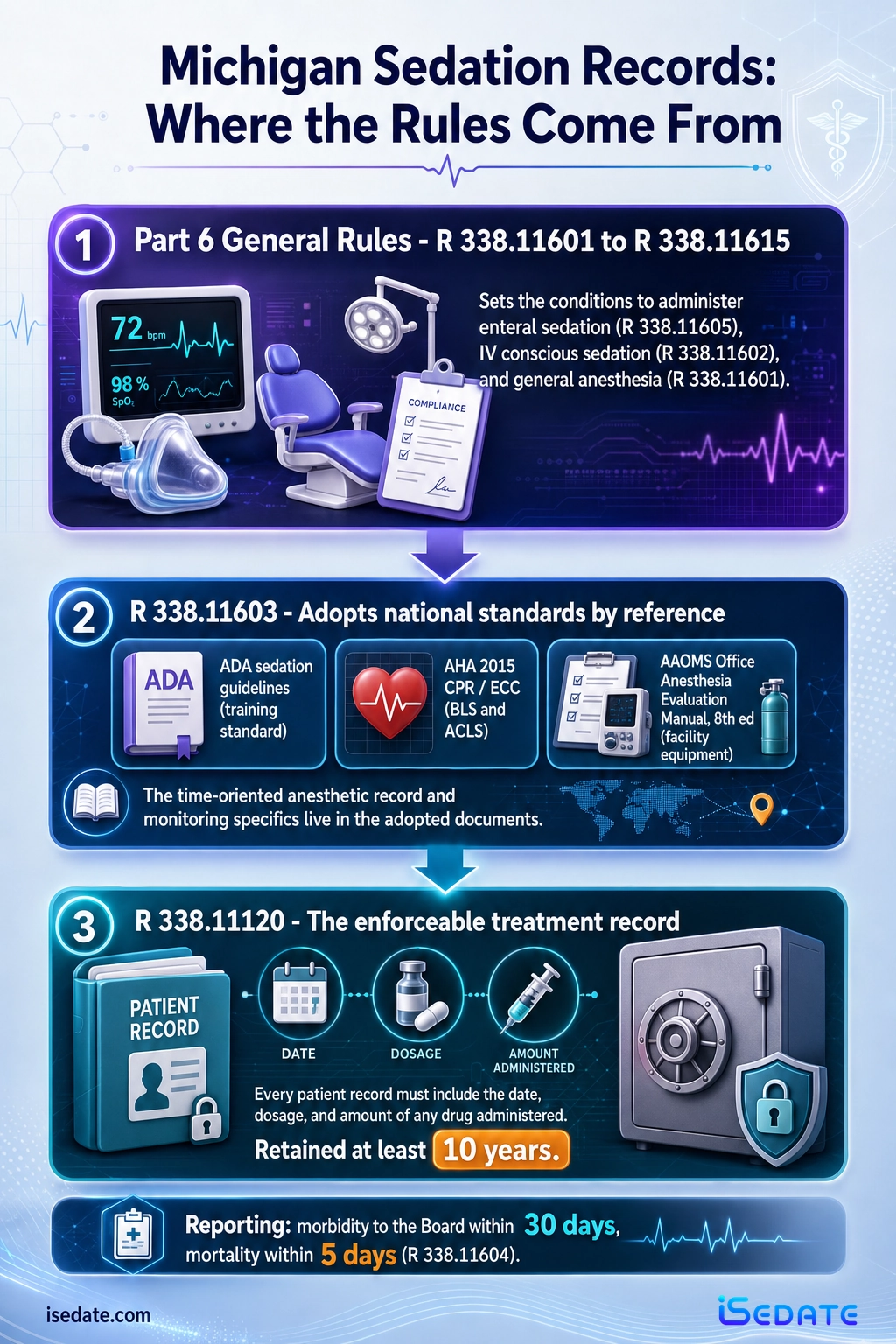
If you sedate patients in Michigan, the documentation rule is not where most dentists expect to find it. The Michigan Board of Dentistry does not publish a standalone sedation-charting statute that names a vitals interval the way some states do. Instead, its sedation rules in Part 6 of the Board's General Rules adopt the national ADA and AAOMS standards by reference, and the enforceable record duty sits in the Board's general dental-treatment-record rule, which requires the date, dosage, and amount of every drug you administer, kept for at least 10 years. This guide breaks down what Michigan actually requires you to monitor and record during sedation, exactly where each duty comes from, what a compliant anesthetic record looks like, and how to keep it audit-ready.
Recent Updates
Last UpdatedNovember 16, 2026
- Rebuilt the guide against Michigan's current rule text, including the dental treatment-record rule R 338.11120 as amended effective October 2, 2023 (now naming the ASA physical-status classification as a required field).
- Replaced aggregator source links with Michigan's official pages: the LARA Board of Dentistry page and the Public Health Code, MCL 333.16221, on the Michigan Legislature site.
- Added the controlled-substance inventory layer (R 338.11121), the federal DEA and HIPAA recordkeeping layers, a complete Michigan anesthetic-record checklist, and current dental closed-claims documentation data.
Key Takeaways
- Where the rule lives: Michigan's sedation rules sit in Part 6 of the Board of Dentistry General Rules (R 338.11601 and following), enforced by the Board within LARA under the Public Health Code, MCL 333.16221.
- No numeric interval in the code: Michigan does not spell out a vital-sign interval in its own rule text. R 338.11603 adopts the ADA sedation guidelines and the AAOMS Office Anesthesia Evaluation Manual by reference, and those documents carry the time-oriented monitoring and record specifics.
- The enforceable record duty: R 338.11120 requires every patient's dental treatment record to include the date, dosage, and amount of any drug administered, retained not less than 10 years.
- Reporting is time-bound: under R 338.11604, a morbidity report is due to the Board within 30 days and a mortality report within 5 days.
- The ADA is the standard, not the law: LARA, not the ADA, issues the authority to sedate, reviews records, and disciplines. The ADA guidelines are a professional benchmark Michigan chose to incorporate.

What This Guide Covers
- Who regulates sedation in Michigan
- Michigan's sedation categories
- What you must monitor during sedation
- What you must record: the compliance core
- The federal layers: DEA and HIPAA
- Why thin charting is the real risk
- How Michigan reviews records and reports adverse events
- The easy button: an audit-ready record
- Frequently asked questions
- Related guides and neighboring states
- Sources and citations
Who regulates sedation in Michigan
Sedation and anesthesia in a Michigan dental office are regulated by the Michigan Board of Dentistry, which sits inside the Department of Licensing and Regulatory Affairs (LARA). The Board, not any national body, sets the conditions to sedate, reviews records, and takes disciplinary action. The sedation rules live in one place: Part 6 of the Board of Dentistry General Rules, "General Anesthesia and Sedation," beginning at R 338.11601, with their enabling authority in the Public Health Code at MCL 333.16221.
That structure matters for compliance, because Michigan builds its sedation standard in a way many dentists misread. It is worth being precise about the ADA here. The American Dental Association publishes national sedation guidelines that most boards lean on, but those guidelines are a professional standard, not law. In Michigan, the law is Part 6 of the Board's General Rules plus the general records rule, and the body that enforces it is LARA. The ADA document matters only because Michigan's own rule chose to adopt it by reference, which we come back to below. For the clinical reasoning behind these duties across every state, see our hub guide to Dental Sedation Vitals, Charting & Reporting Requirements by State.
Source: Michigan Board of Dentistry (LARA) | Public Health Code, MCL 333.16221
Michigan's sedation categories
Michigan does not label its credentials "permits" or number them as "levels." Instead, Part 6 sets conditions a dentist must meet to administer each category of sedation, and the obligations escalate with depth. Knowing which category you work in tells you which rule governs your practice. These are the categories as Part 6 defines them:
| Michigan category | What it covers | Governing rule |
|---|---|---|
| Enteral sedation | Sedation by the enteral (oral) route | R 338.11605 |
| Intravenous Conscious Sedation | Moderate sedation by the IV route | R 338.11602 |
| General anesthesia and deep sedation | The deepest category | R 338.11601 |
Most general dentists who offer sedation work in enteral sedation or move up into intravenous Conscious Sedation. General anesthesia under R 338.11601 is the top category, carried most often by dental anesthesiologists and oral and maxillofacial surgeons, and it carries the heaviest conditions, including a rule that the dentist stay physically present with the patient until consciousness is regained and remain on the premises until the patient is dischargeable. This guide focuses on what every category shares: the monitoring standard Michigan adopts and the record it holds you to. If you are working out which category you qualify for or how to move up, that belongs in a separate process, covered in our companion guide to Michigan Sedation Dentistry Licensing & Permit Requirements.
Source: Board of Dentistry General Rules, Part 6 (R 338.11601, 11602, 11605)
What you must monitor during sedation
Here is the feature of Michigan's rules that trips practices up: the code does not print a per-category list of vital signs and a numeric monitoring interval in its own text. It regulates by reference. Under R 338.11603, the Board adopts three outside documents, and the patient-monitoring and anesthetic-record specifics live inside them:
- The ADA sedation guidelines: R 338.11603 adopts the ADA "Guidelines for Teaching Pain Control and Sedation to Dentists and Dental Students" (October 2012 edition) as the training standard.
- The AHA resuscitation standard: it adopts the 2015 American Heart Association CPR and ECC guidelines for BLS and ACLS.
- The AAOMS facility manual: it adopts the AAOMS "Office Anesthesia Evaluation Manual," eighth edition, for the equipment a facility must have, which is where the monitoring hardware expectation is set.
Because Michigan incorporates the national ADA framework, the operative professional standard for moderate sedation and above is a time-oriented anesthetic record with oxygenation by pulse oximetry, ventilation, blood pressure, heart rate, and level of consciousness assessed continually, with the facility equipment to support it. On top of that, R 338.11601 adds an explicit Michigan duty for general anesthesia: the dentist must be physically present with the patient until consciousness is regained and remain on the premises until the patient is dischargeable. The deeper the category, the more parameters you are both watching and responsible for having documented. Michigan's own rule text does not fix a specific interval, so do not import a minute count from another state's rule; chart continually and confirm any interval expectation with the Board.
Myth, Busted
Myth: Michigan has no 10-minute rule, so my sedation notes can be lighter.
Fact: The absence of a numeric interval does not make the record optional or thin. By adopting the ADA and AAOMS standards under R 338.11603, Michigan holds you to a time-oriented anesthetic record, and R 338.11120 independently requires the date, dosage, and amount of every drug you administer, kept for 10 years.
A sparse note that reads "tolerated sedation well" fails both the adopted professional standard and the citable treatment-record rule. This is the single most common gap a records review turns up.
Source: R 338.11601 and R 338.11603 (physical-presence duty and adopted standards)
What you must record: the compliance core
This is the section a reviewer reads first, and it is where Michigan differs from a state like Texas. Michigan's Part 6 rules do not contain a separate, itemized, time-oriented anesthetic-record statute that you can point to with a single citation. The record duty is built from two layers that stack together, and you are held to both.
1. The standards Michigan adopts by reference
By adopting the ADA sedation guidelines and the AAOMS Office Anesthesia Evaluation Manual under R 338.11603, Michigan makes those documents' expectations the operative standard for a Michigan sedation practice. The ADA professional standard for moderate sedation and above is a time-oriented anesthetic record: all drugs and dosages, the times they were given, and the monitored vital signs recorded continually against the clock. That is the benchmark a Michigan reviewer measures a sedation record against, because the Board's own rule chose to adopt it.
2. The enforceable Michigan treatment-record rule
The citation you can hold in your hand is R 338.11120, the dental treatment-record rule, amended effective October 2, 2023. It requires a dentist or dental therapist to make and maintain a dental treatment record for each patient, and it spells out what that record must contain: the patient's medical and dental history; the current condition of the mouth and any diagnostic aids used; the patient's current health status under the American Society of Anesthesiologists (ASA) physical-status classification; the diagnosis and treatment plan; each procedure performed with its date and the name of the person who performed it; progress notes; and, in the rule's own words, "the date, dosage, and amount of any medication or drug prescribed, dispensed, or administered to the patient." Radiographic and photographic images are included. The whole record must be retained for not less than 10 years after the date of last treatment.
Read together, the two layers answer the question every dentist asks: yes, Michigan requires you to document sedation thoroughly. The drug detail is a hard, citable rule under R 338.11120, and the time-oriented monitoring record is the adopted professional standard under R 338.11603. The ASA physical-status field is a quiet tell that the rule has sedation in mind, because ASA class is exactly the pre-sedation risk assessment a reviewer expects to see before any anesthetic.
What a Michigan anesthetic record should contain
Putting the citable rule and the adopted standard together, a defensible Michigan sedation record for a deeper case reads like a timeline, not a summary written from memory afterward.
Michigan Anesthetic Record Checklist
- A pre-sedation physical evaluation and the patient's ASA physical-status classification, recorded before the anesthetic (R 338.11120).
- A full set of baseline vital signs taken before sedation begins.
- Informed consent for the sedation or anesthetic.
- Every drug administered, with its dose, route, and time, logged as it is given rather than reconstructed later (R 338.11120).
- Monitored parameters recorded continually through the case: oxygen saturation, heart rate, respiratory rate or ventilation, blood pressure, and level of consciousness (ADA standard adopted under R 338.11603).
- A discharge assessment showing vital signs stable and the patient appropriately responsive before leaving the office.
- Any adverse event or deviation, with the time and the response taken.
iSedate Insight
Read Michigan's two record layers together and a pattern emerges: the state does not ask you to prove the patient did well, it asks you to prove the record shows what you gave and what you monitored, moment by moment. A contemporaneous, time-stamped record is the only version of events that survives a review, because it is the only one written while the case was live. The note written after the patient walks out is the one a reviewer discounts.
Source: R 338.11120 (dental treatment record) and R 338.11603 (adopted standards)
See how a time-oriented anesthesia record is built automaticallyThe federal layers: DEA and HIPAA
Michigan's rule is not the only recordkeeping obligation on a sedation case. Two layers sit on top of Part 6, and a board review or a plaintiff's attorney can reach both.
First, the controlled-substance log. Most sedation drugs, including midazolam, diazepam, and the opioids used in deeper cases, are federally scheduled. Michigan adds its own duty here: R 338.11121 requires a scheduled controlled-substances inventory record in addition to the treatment record, and the federal DEA requires a separate, auditable record of what was received, administered, and wasted. That log is distinct from the anesthetic record but has to reconcile with it, because the doses on your anesthetic record should match the drawdown on your controlled-substance log. Second, HIPAA. Your sedation records are protected health information, which means they must be secured, access-controlled, and retained. HIPAA requires covered entities to keep required documentation for at least six years, which functions as a practical federal floor underneath Michigan's 10-year treatment-record retention.
On Retention
Keep the record past the 10-year mark for a minor patient. Michigan's 10-year rule runs from the date of last treatment, and HIPAA's six-year floor is a minimum, not a target. The statute of limitations for a malpractice claim, and the longer window that can apply to a patient who was a minor at the time of treatment, can both outlast a routine purge, so err on the side of keeping the sedation record longer and confirm any profession-specific retention question with the Board.
Source: U.S. Department of Health and Human Services (HIPAA) | R 338.11120 and R 338.11121 (Michigan treatment and controlled-substance records)

Why thin charting is the real risk
When LARA or a plaintiff's attorney asks to see your sedation records in Michigan, they are looking at the same document, and they are not grading how the patient felt. They are grading whether the contemporaneous record proves what you gave, when you gave it, and what you monitored. Two things make the record the point of failure. First, Michigan ties the authority to sedate to meeting the conditions in Part 6, and administering general anesthesia or IV Conscious Sedation without meeting those conditions is a direct violation of MCL 333.16221(1)(h). Second, the drug-detail requirement in R 338.11120 is specific and unforgiving: a dose given in the moment and logged later from memory, a missing time, a drug administered but not tied to the record, these are exactly the gaps that turn a clean clinical case into a documentation finding.
That gap is not hypothetical. In a review of 1,185 dental malpractice claims closed between 2010 and 2020, The Doctors Company found documentation issues in 19 percent of claims, the fifth-leading causal factor its analysts identified. The care can be flawless and the claim can still turn on what the chart failed to capture.
Important
A reviewer does not reconstruct your care from your intentions. If the record has gaps, the default assumption on review is that the monitoring had gaps too. Chart the pre-sedation evaluation and ASA status, log every drug with its dose and time as it is given, record the monitored vitals continually, and document the discharge assessment. The record is the only part of the case you can still improve after the fact, and only if you build it while the case is live.
For the data behind why these rules exist and what charting failures cost, see our research on how sedation charting affects malpractice case outcomes, vital-signs monitoring and sedation safety, and documentation-error rates and chart defensibility.
Source: The Doctors Company: Patient Safety in Dentistry, Documentation
How Michigan reviews records and reports adverse events
Part 6 is backed by enforcement, and the reporting duties are time-bound. Under R 338.11604, a dentist must file a morbidity report with the Board within 30 days of a reportable event and a mortality report within 5 days, and failure to file is a violation of MCL 333.16221(1)(g). Separately, sedating outside the conditions the rules set is a violation of MCL 333.16221(1)(h). Both are grounds for board disciplinary action under the Public Health Code.
| Reportable event | Report due to the Board within | Rule |
|---|---|---|
| Sedation-related morbidity | 30 days | R 338.11604 |
| Sedation-related mortality | 5 days | R 338.11604 |
Incomplete sedation records are not a filing technicality. They are the evidence the Board weighs when deciding whether the standard of care was met, and the same gaps that fail a records review are the gaps a malpractice claim is built on. The exact disciplinary schedule, any routine office-inspection cadence for sedation providers, the current permit fees, and the continuing-education cycle are administered by the Board and can change, and the compiled rule text does not state a routine inspection schedule, so confirm those specifics directly with the Michigan Board of Dentistry rather than relying on a figure that may be out of date. What does not change is the exposure a thin record creates.
Source: R 338.11604 (morbidity and mortality reporting) | Public Health Code, MCL 333.16221
The easy button: an audit-ready record
The gap between knowing Michigan's rules and surviving a review is almost always the same thing: a monitoring log and a drug log kept by hand during a live sedation case. When a team is managing an airway and an anxious patient, a vitals reading written by hand and a dose logged from memory are exactly where the record develops holes, the holes that R 338.11120 and the adopted ADA standard both turn on.
That is the problem SedationVault by iSedate was built to remove. It connects to the vitals monitor already in your operatory and captures pulse oximetry, heart rate, respiratory rate, and blood pressure live, on the clock, alongside the drug log, so the time-oriented anesthetic record writes itself as the case runs rather than being reconstructed afterward. Every drug carries its date, dosage, and amount, which is exactly the detail R 338.11120 names, and the controlled-drug entries give you the figures your R 338.11121 and DEA logs have to reconcile with. When the Board asks for the chart, it exports as a one-click, audit-ready sedation visit report that already carries the drug log, the monitored vitals, the ASA status, and the discharge assessment. The point is not fancier charting. It is turning the exact items Michigan holds you to into something the software guarantees are present and time-stamped, which is what dental sedation compliance actually turns on.
Book a demo and see your Michigan sedation record build itselfA Quick Disclaimer
This guide is for informational purposes only and does not constitute legal or compliance advice. Regulations change. Verify current requirements, rule text, fees, and reporting obligations with the Michigan Board of Dentistry and a qualified professional before relying on them for your practice.
Frequently asked questions
Does Michigan require a written sedation record?
Does Michigan set a 10-minute vitals interval for sedation like some states?
How long must Michigan dental records be kept?
Who regulates sedation records in Michigan?
What sedation adverse events must be reported in Michigan, and how quickly?
Does Michigan require a controlled-substance record for sedation drugs?
Related guides and neighboring states
Licensed in more than one state, or planning to be? Sedation charting and reporting rules change at the border. See our same-topic guides for Michigan's neighbors, and the national overview that ties them together:
- Indiana Sedation Vitals Monitoring, Charting & Reporting Requirements
- Ohio Sedation Vitals Monitoring, Charting & Reporting Requirements
- Wisconsin Sedation Vitals Monitoring, Charting & Reporting Requirements
- Dental Sedation Vitals, Charting & Reporting Requirements by State (all-50 hub)
Sources and citations
Our Sources and Verification
This guide cites Michigan's primary regulatory sources and verifies every official link against the state's current live pages. The record and reporting duties are drawn from the Michigan Board of Dentistry General Rules, Part 6 (General Anesthesia and Sedation) and the dental treatment-record rule R 338.11120, with enabling authority in the Public Health Code, MCL 333.16221. The regulator is the Michigan Board of Dentistry within LARA. Michigan regulates sedation monitoring and the anesthetic record largely by adopting the ADA "Guidelines for Teaching Pain Control and Sedation to Dentists and Dental Students" (October 2012 edition) and the AAOMS "Office Anesthesia Evaluation Manual," eighth edition, by reference under R 338.11603, a professional standard the Board enforces as the standard of care. Where a detail is administered by the Board or held in an external document, such as the current board contact details, the internal field list and monitoring intervals inside the adopted AAOMS manual, a routine office-inspection cadence, the penalty schedule, the permit fees, or the continuing-education cycle, confirm it directly with the Michigan Board of Dentistry before relying on it. Michigan's rules have been amended more than once in recent years, so verify the current text of any specific Part 6 rule with the Board.
- Michigan Board of Dentistry, Department of Licensing and Regulatory Affairs (LARA): the official board page, which links the Public Health Code and the Dentistry General Rules
- Public Health Code, MCL 333.16221 (grounds for disciplinary action, on the Michigan Legislature site)
- HIPAA documentation retention: 45 CFR 164.316 (U.S. Department of Health and Human Services)
- The Doctors Company: Patient Safety in Dentistry, Documentation (closed-claims data)
- DOCS Education Michigan (where to take the sedation training the rules require)
- R 338.11601: general anesthesia and deep sedation, conditions (training, BLS/ACLS, facility equipment, physical-presence duty)
- R 338.11602: intravenous Conscious Sedation, conditions
- R 338.11603: adoption of the ADA, AHA, and AAOMS standards by reference
- R 338.11604: morbidity report within 30 days; mortality report within 5 days
- R 338.11605: enteral sedation, conditions
- R 338.11120: dental treatment record (medical history, ASA physical-status classification, date/dosage/amount of any drug, 10-year retention), amended effective October 2, 2023
- R 338.11121: scheduled controlled-substances inventory record
- ADA Guidelines for Teaching Pain Control and Sedation to Dentists and Dental Students (October 2012 edition, adopted by reference)
- AAOMS Office Anesthesia Evaluation Manual, eighth edition (facility equipment standard, adopted by reference)















