






Michigan Sedation Dentistry Licensing & Permit Requirements
In Michigan, you cannot sedate a patient on your dental license alone. Any dentist who administers enteral (oral) sedation, intravenous conscious sedation, or general anesthesia must first meet the matching conditions set by the Michigan Board of Dentistry under Part 6 of the Board's General Rules, enforced by the Department of Licensing and Regulatory Affairs (LARA). Qualifying means clearing the training, resuscitation-certification, clinical-case, and facility requirements for your category. Keeping that standing means your dental treatment record survives a board review. This guide walks both halves: how a Michigan dentist qualifies to sedate, and what it takes to keep that authority, grounded in the current rule text.
Recent Updates
Last UpdatedNovember 16, 2026
- Fact-checked every rule, figure, and citation against the current Michigan Administrative Code (Board of Dentistry General Rules, last amended 2021 MR 8).
- Corrected the adopted standards: the ADA teaching guidelines are the October 2016 edition and the AAOMS facility manual is the ninth edition (R 338.11603).
- Noted that the former standalone morbidity and mortality reporting rule, R 338.11604, was rescinded effective April 26, 2021.
- Clarified that both general anesthesia and IV conscious sedation require current BLS and ACLS certification for healthcare providers.
- Replaced third-party links with the official Michigan Board of Dentistry source.
- Michigan does not issue numbered "permits." Part 6 of the Board's General Rules sets conditions to administer three categories: enteral sedation (R 338.11605), intravenous conscious sedation (R 338.11602), and general anesthesia (R 338.11601).
- Most general dentists who sedate work in enteral sedation, then step up to IV conscious sedation, the common name for moderate Conscious Sedation. General anesthesia is the top category, carried mainly by dental anesthesiologists and oral surgeons.
- The jump to IV: R 338.11602 requires at least 60 hours of training, including 40 hours of supervised clinical experience with at least 20 sedated cases, plus current BLS and ACLS and a facility meeting the adopted equipment standard.
- General anesthesia under R 338.11601 requires at least one year of advanced training, current BLS and ACLS, an adopted-standard facility, and the dentist physically present until the patient regains consciousness.
- Keeping the authority turns on documentation. R 338.11120 requires a full dental treatment record, including the date, dosage, and amount of every drug administered, kept at least 10 years.

What This Michigan Sedation Guide Covers
Who authorizes sedation in Michigan
Sedation dentistry in Michigan is regulated by the Michigan Board of Dentistry, which publishes the Board of Dentistry General Rules inside the Department of Licensing and Regulatory Affairs (LARA). The Board, not any national body, sets the conditions under which a dentist may sedate, reviews records, and takes disciplinary action. The sedation and anesthesia rules live in Part 6 of the General Rules, with their enabling authority in the Public Health Code, MCL 333.16221.
One structural point to get right from the start: Michigan does not call these credentials "permits," and it does not number them "Level 1" through "Level 4." Part 6 instead sets conditions to administer each category of sedation. The practical effect is the same, since you must meet the requirements for your category before you sedate, but the Michigan vocabulary is categories and conditions, not permit levels. Application forms and the current fee schedule are set by the Board and change periodically, so confirm the exact forms and current fees through the Board's "Apply or Renew Online" service before you file.
Myth, Busted
Myth: The ADA is a federal law that overrides your state's sedation rules.
Fact: The ADA is a private professional association, not a government agency. In Michigan, your authority to sedate, your facility standard, and any sanction all come from the Board of Dentistry under Part 6 of its General Rules.
The confusion is understandable: Michigan adopts the ADA's teaching guidelines by reference in R 338.11603, which is exactly why the ADA document matters here. It carries weight because the Board chose to incorporate it, not because the ADA licenses, inspects, or disciplines anyone. The real federal layers that sit on top of state rules are the DEA for controlled-substance logs, HIPAA for records, and accreditation bodies for facilities, not the ADA.
Michigan's three sedation categories
Michigan names its sedation authority by category, and the category reflects how deeply the patient is sedated and by which route. Here is the ladder, from the lightest genuine-sedation category to the deepest, each with its governing rule in Part 6. Lighter nitrous oxide analgesia is handled separately and does not carry the Part 6 conditions below; confirm the current nitrous-oxide certification specifics with the Board.
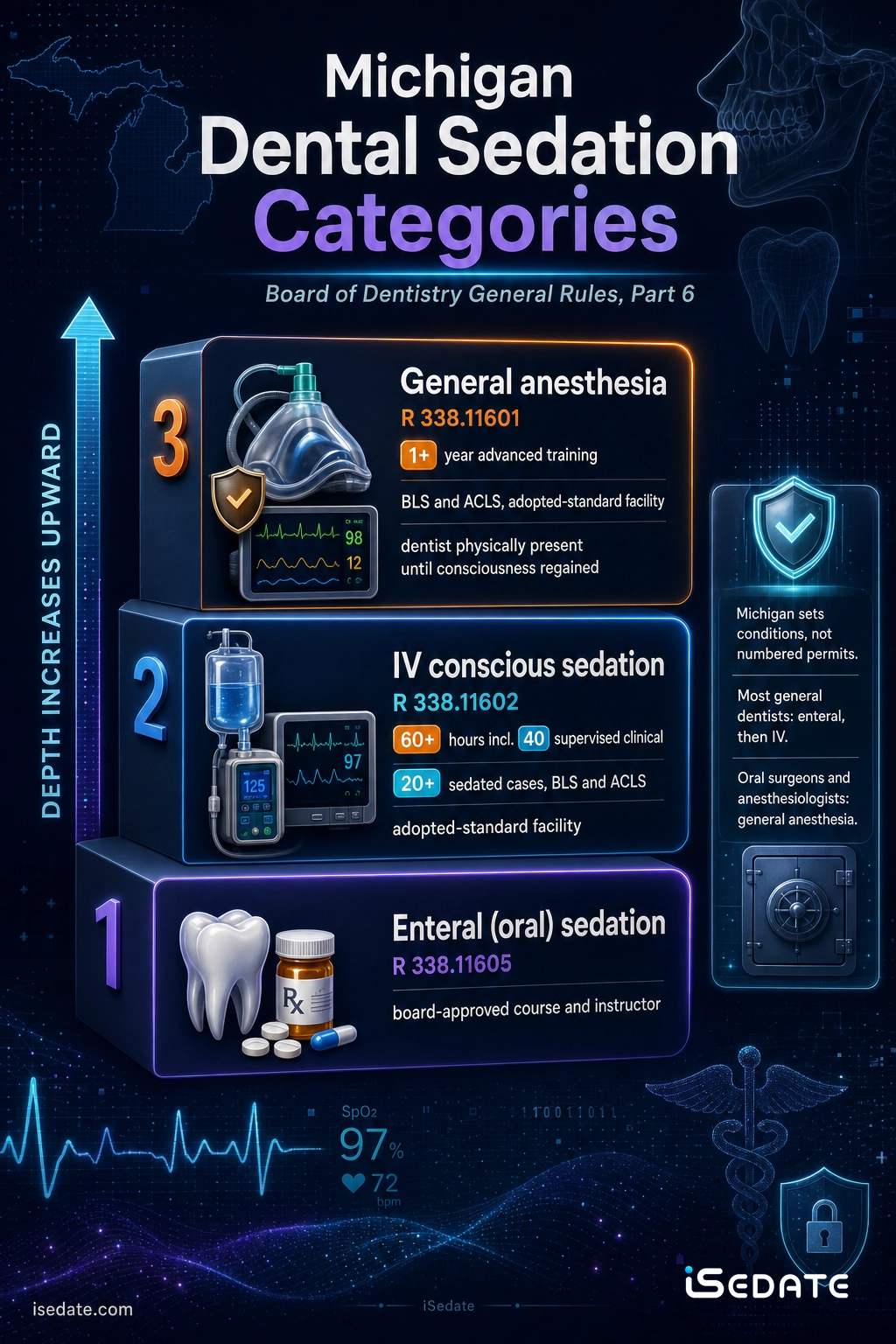
Enteral sedation (R 338.11605). The entry category for genuine sedation, covering sedation given by the enteral (oral) route. R 338.11605 requires the dentist's training to come through a board-approved course and instructor whose objectives, content, duration, and faculty are consistent with the enteral sedation course standards in the ADA's teaching guidelines (October 2016 edition). A CODA-certified program meeting those standards is approved. This is the usual first step for a general practice adding oral sedation.
Intravenous conscious sedation (R 338.11602). The step up to the IV route, and the common clinical meaning of moderate Conscious Sedation. Because IV sedation carries higher risk and faster onset, R 338.11602 imposes heavier conditions: at least 60 hours of training, including at least 40 hours of supervised clinical instruction managing at least 20 sedated cases, plus current BLS and ACLS and a facility meeting the adopted equipment standard. This is where sedation-trained general dentists and oral surgeons typically operate.
General anesthesia (R 338.11601). The deepest category and the highest bar. R 338.11601 requires at least one year of advanced training in general anesthesia and pain control through a program meeting the standards in R 338.11603, current BLS and ACLS, and a facility meeting the adopted equipment standard. It also adds an explicit Michigan safety duty: the dentist must be physically present with the patient until consciousness is regained and remain on the premises until the patient is dischargeable. A dentist who lacks that training may provide general anesthesia only by associating with a qualifying physician anesthesiologist or a qualifying dentist. General anesthesia is largely the province of dental anesthesiologists and oral and maxillofacial surgeons.
How to qualify for each category
Each category has its own bar to clear: a defined amount of training, resuscitation certification, and, for IV conscious sedation, a count of supervised sedated cases. You move up by meeting the next category's conditions. The figures below come straight from Part 6 of the General Rules.
| Category | Route / depth | Training | Clinical cases | Resuscitation |
|---|---|---|---|---|
| Enteral sedation (R 338.11605) | Enteral (oral) | Board-approved course and instructor | Per the approved course | Confirm with board |
| IV conscious sedation (R 338.11602) | Intravenous | At least 60 hours, incl. 40 supervised clinical | At least 20 sedated cases | BLS and ACLS |
| General anesthesia (R 338.11601) | General anesthesia, deepest | At least 1 year advanced training | Per the advanced program | BLS and ACLS |
Enteral sedation
To administer enteral sedation, a dentist completes a board-approved course that meets R 338.11605, including the instructor-approval conditions. The specific course hours and any case count are defined by the approved program rather than stated as a number in the rule, so confirm the current approved-course requirements with the Board. National CE providers such as DOCS Education's Michigan sedation training are a common place dentists complete this coursework; the Board, not the provider, decides whether a given course qualifies.
IV conscious sedation
Upgrading to intravenous conscious sedation is the biggest step a general dentist or oral surgeon takes. Under R 338.11602, it requires at least 60 hours of training, of which at least 40 hours are supervised clinical instruction, during which the dentist manages at least 20 sedated cases, plus current BLS and ACLS and a facility meeting the adopted equipment standard. A CODA-accredited advanced dental education program also satisfies the rule. The supervised clinical count exists because IV titration demands hands-on competence a classroom cannot replicate.
General anesthesia
The top category, general anesthesia, requires the most. Under R 338.11601, a dentist needs at least one year of advanced training in general anesthesia and pain control through a qualifying program, current BLS and ACLS, and an adopted-standard facility, along with the physical-presence duty described above. If you are pursuing general anesthesia, work directly from R 338.11601 with the Board, because the advanced-training specifics run beyond the scope of this guide.
For every category, the application, the current fee schedule, and any exam requirement are set by the Board and updated periodically. Do not rely on a number you read on a CE provider's page. Confirm the exact forms and current fees with the Michigan Board of Dentistry before you file.

The standards your credential adopts
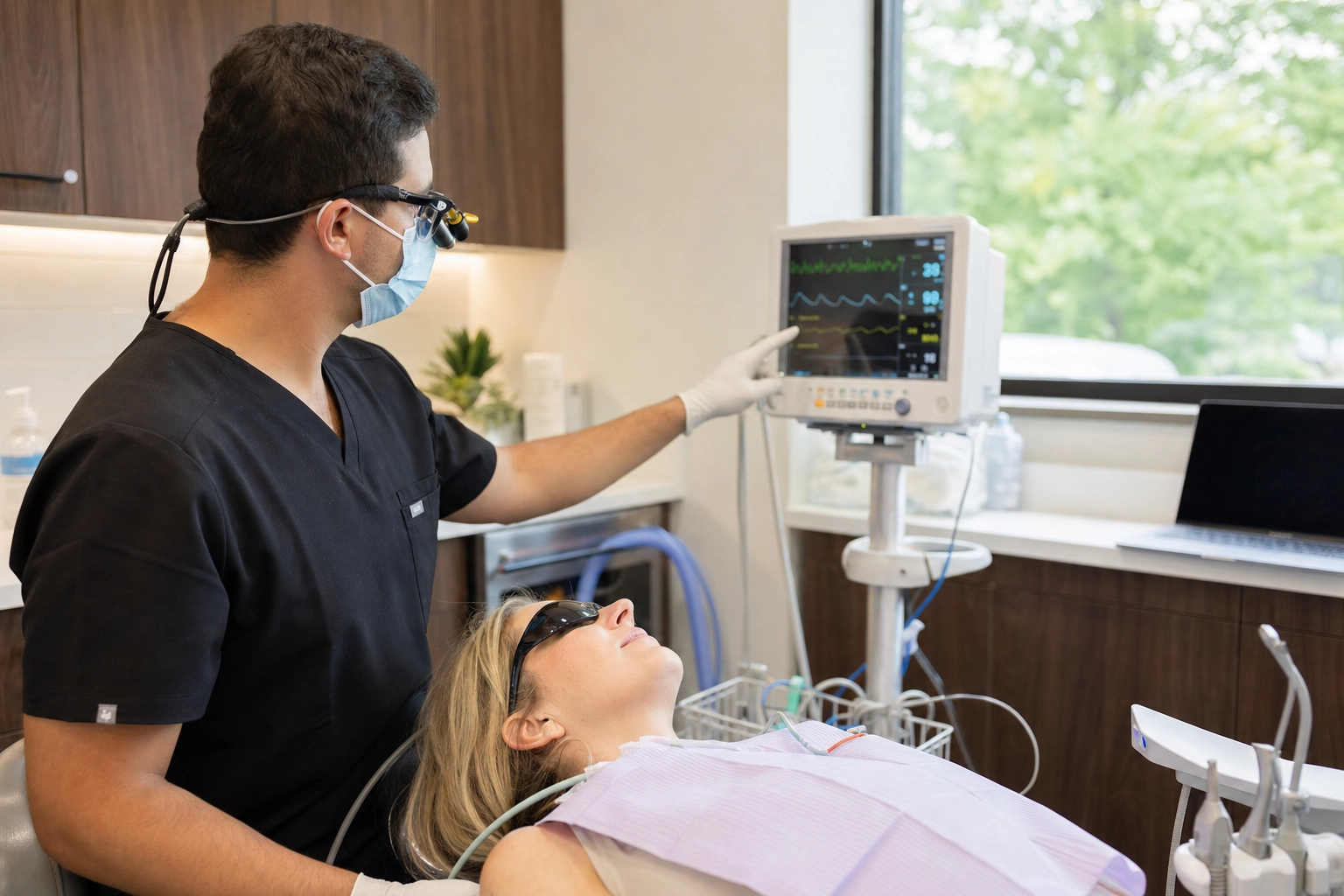
Qualifying to sedate is permission plus obligation. Michigan regulates the monitoring and facility standard by reference: under R 338.11603, the Board adopts the ADA "Guidelines for Teaching Pain Control and Sedation to Dentists and Dental Students" (October 2016 edition) as the training standard, the 2015 American Heart Association CPR and ECC guidelines (with their 2017 and 2018 updates) for BLS and ACLS, and the AAOMS "Office Anesthesia Evaluation Manual," ninth edition, for facility equipment. The monitoring and anesthetic-record specifics live inside those adopted documents, which makes the time-oriented anesthetic record, with pulse oximetry, heart rate, respiratory rate, blood pressure, and level of consciousness assessed continually, the operative professional standard for moderate sedation and above.
Michigan then adds its own explicit duty at the deepest category: under R 338.11601, a general-anesthesia provider must be physically present with the patient until consciousness is regained and stay on the premises until the patient is dischargeable. For the full clinical breakdown of what to monitor and chart at each depth, see the companion guide on Michigan sedation vitals monitoring, charting, and reporting requirements.
In Plain Terms
Michigan's rule text is short because it points outward. The hard specifics, how often you record a vital sign, what your operatory must stock, and what your anesthetic record must contain, are not spelled out in Part 6. They sit in the ADA, AHA, and AAOMS documents the Board adopted in R 338.11603. That means "following the rule" in Michigan means following those adopted standards, and a board reviewer will measure your records against them.
Recordkeeping and reporting duties
Holding sedation authority in Michigan also means holding a documentation duty, and that record is exactly what a board review examines.
The dental treatment record. Under R 338.11120, a dentist must make and maintain a treatment record for each patient that includes the medical and dental history, the patient's physical status under the American Society of Anesthesiologists classification, the diagnosis and treatment plan, each procedure with its date and the identity of the person who performed it, progress notes, and the date, dosage, and amount of any drug prescribed, dispensed, or administered. The record must be retained for not less than 10 years after the last treatment. This rule was most recently amended in 2023 and remains in force.
Important
The old standalone morbidity and mortality reporting rule was rescinded. R 338.11604, which once set a 30-day morbidity report and a 5-day mortality report, was rescinded effective April 26, 2021, so that specific deadline rule no longer applies. Adverse-event and licensing-related reporting duties can still arise under the Public Health Code and other board rules. Do not assume there is no duty to report a serious event, and do not rely on an outdated 30-day or 5-day figure. Confirm the current reporting triggers and timelines directly with the Michigan Board of Dentistry.
Staying inside your category. Administering general anesthesia or IV conscious sedation without meeting the Part 6 conditions is a violation of MCL 333.16221(1)(h) and a basis for disciplinary action. The specific penalty schedule is set by the Board, so confirm the current sanctions directly with the Michigan Board of Dentistry.
Keeping it: audit-ready records
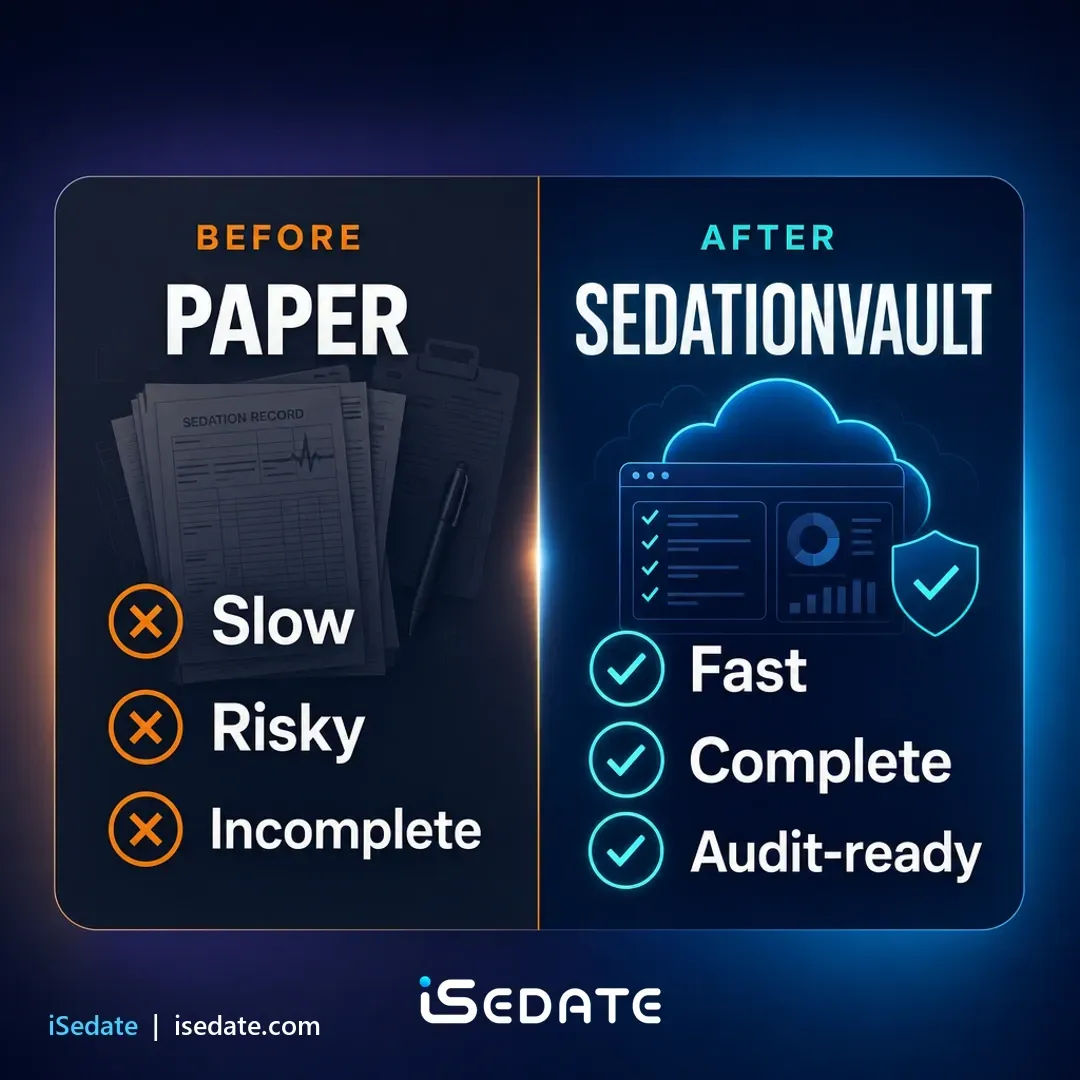
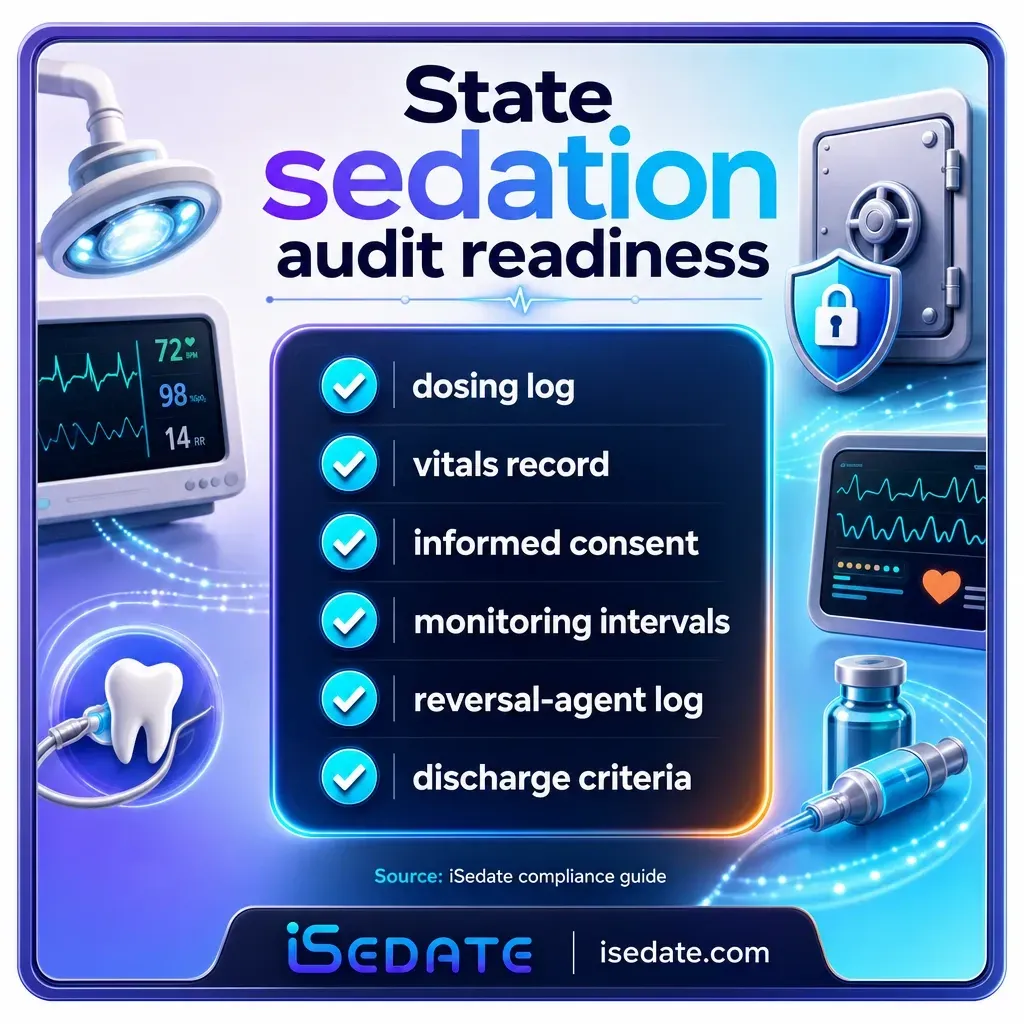
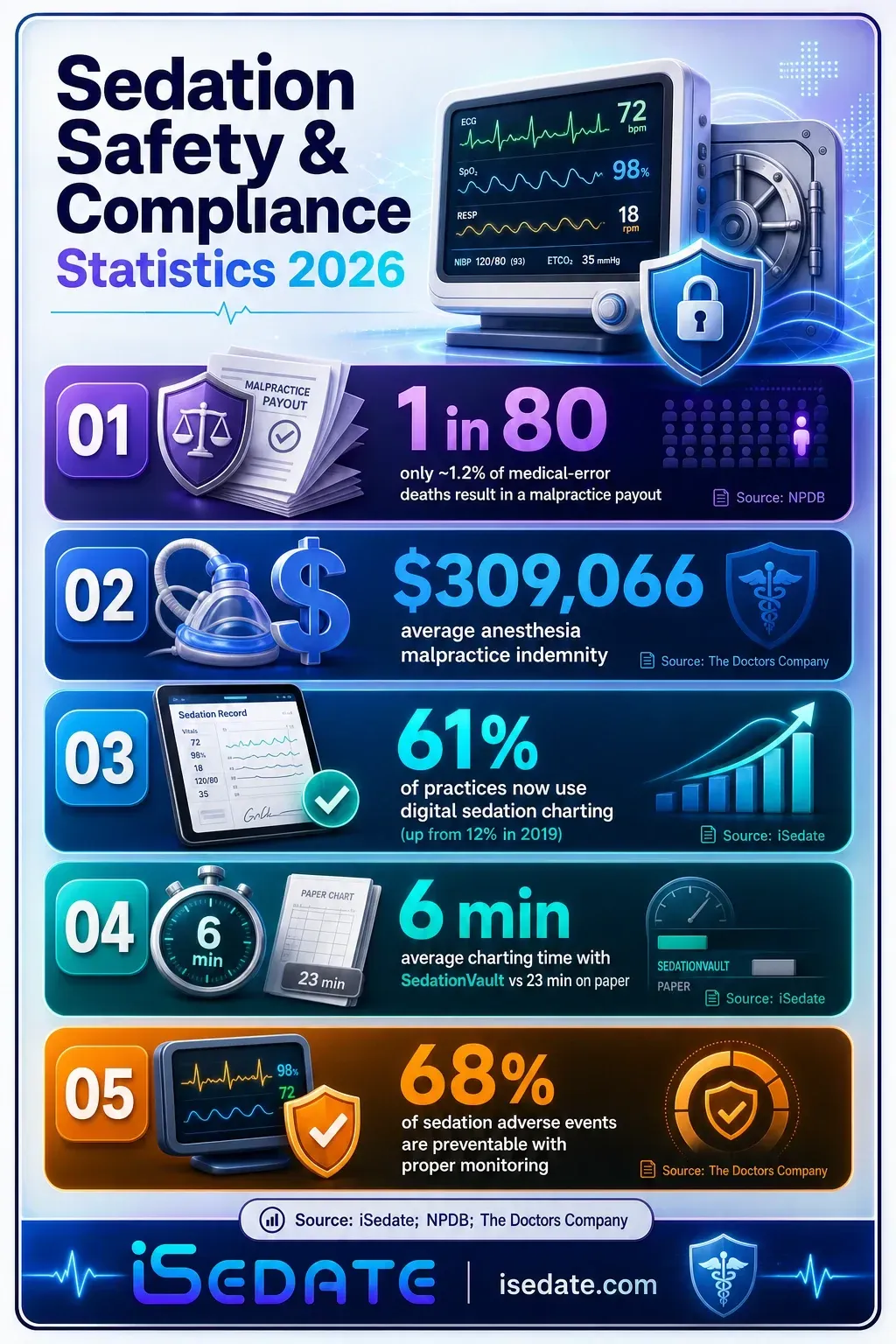
Everything above points to one truth: qualifying to sedate is a one-time hurdle, but keeping that standing is a daily documentation discipline. A manual vitals log and a drug log written by hand, between titrating a drug and watching an airway, are exactly where records go incomplete, and incomplete records are what a board review and a malpractice claim both attack. A dentist can perform the sedation flawlessly and still lose on the paperwork: a dose logged from memory, a missing time, a monitoring gap.
SedationVault removes that failure point. It captures live patient vitals and the drug log automatically into a time-oriented anesthetic record, carrying the date, dosage, and amount of every drug that R 338.11120 names, so the record writes itself while you focus on the patient. When the Board asks for the file, a complete record is a one-click export, not a scramble through paper. See how it maps to the rules on the dental sedation compliance and anesthesia record software pages.
Book a demo of SedationVault See SedationVault pricingRelated guides and neighboring states
Licensed in a neighboring state, or practicing across a border? Sedation rules change at every state line, so check the matching guide for each state where you sedate:
- Indiana Sedation Dentistry Licensing & Permit Requirements
- Ohio Sedation Dentistry Licensing & Permit Requirements
- Wisconsin Sedation Dentistry Licensing & Permit Requirements
- Sedation Dentistry Licensing & Permit Requirements by State (all 50 states)
Frequently asked questions
What sedation credentials does Michigan require?
How many hours do you need for IV conscious sedation in Michigan?
What is required for a general anesthesia credential in Michigan?
Does Michigan still require a morbidity and mortality report for sedation?
Sources & How We Verified This Guide
Every rule, figure, and citation on this page was checked against the current Michigan Administrative Code (Board of Dentistry General Rules), last amended 2021 MR 8, and R 338.11120, last amended 2023.
- Michigan Board of Dentistry (LARA), official page for licensing, the General Rules, and the "Apply or Renew Online" application service. Board office: 611 West Ottawa, P.O. Box 30670, Lansing, MI 48909.
- Michigan Administrative Code, Board of Dentistry General Rules, Part 6, "General Anesthesia and Sedation," R 338.11601 (general anesthesia), R 338.11602 (intravenous conscious sedation), R 338.11603 (adopted standards: ADA October 2016 teaching guidelines, 2015 AHA CPR/ECC guidelines, AAOMS Office Anesthesia Evaluation Manual ninth edition), and R 338.11605 (enteral sedation). Available from the Michigan Board of Dentistry.
- Michigan Administrative Code R 338.11120 (dental treatment record; 10-year retention).
- DOCS Education, Michigan sedation training, a national CE provider where dentists complete sedation coursework (board approval of any specific course rests with the Board).
- Michigan Public Health Code, MCL 333.16221 (enabling statute and grounds for disciplinary action).
This guide summarizes Michigan sedation rules for general information and is not legal advice. Training, supervised-case counts, resuscitation requirements, adopted facility and monitoring standards, and the treatment record are drawn from Part 6 of the Board of Dentistry General Rules and R 338.11120 as cited and current as of November 2026. Application forms, fees, the routine inspection schedule, renewal cycle, continuing-education hours, exact penalty schedule, approved-course specifics, current reporting triggers, and nitrous-oxide certification details are set by the Michigan Board of Dentistry and should be confirmed directly with the Board before you act.