






Ohio Sedation Dentistry Licensing & Permit Requirements
In Ohio, your dental license does not by itself let you provide moderate sedation. Any dentist who administers moderate sedation, long known as Conscious Sedation, by any route, including IV, must first hold a Moderate Sedation permit from the Ohio State Dental Board, issued under Ohio Administrative Code 4715-5-07. Deep sedation and general anesthesia fall under a separate, stricter rule, OAC 4715-5-05. Getting the permit means meeting a training, certification, and live-patient bar, then passing an onsite evaluation of your facility. Keeping it means your sedation records survive the board's quality-assurance audit at renewal, or any time in between. This guide walks both halves: how an Ohio dentist earns a moderate sedation permit, and what it takes to keep it.
Recent Updates
Last UpdatedNovember 16, 2026
- Re-verified every rule citation against the authenticated Ohio Administrative Code on the State of Ohio's own site (codes.ohio.gov) and the Ohio State Dental Board's posted rule copy.
- Added the verified renewal cycle (biennial) and the board's continuing-education requirement (at least six hours on sedation emergencies, with quarterly drills).
- Added provisional moderate sedation privileges (up to one year while the onsite facility evaluation is completed) and the general-anesthesia-permit exemption under 4715-5-07(I).
- Replaced third-party aggregator citations with the original official sources.
- Ohio draws its permit line at moderate sedation. Nitrous oxide (any age) and adult oral minimal sedation need no anesthesia permit; moderate sedation, including IV, needs a Moderate Sedation permit under OAC 4715-5-07.
- Treating patients under 13 requires a pediatric endorsement. Deep sedation and general anesthesia require a separate general anesthesia permit under OAC 4715-5-05, and that permit also lets you provide moderate sedation.
- The published training pathway for the moderate permit is 60 didactic hours, at least 20 managed live patients, and current ACLS. The board can grant provisional privileges for up to one year while your onsite facility evaluation is scheduled.
- The permit renews biennially and requires at least six hours of board-approved CE on sedation emergencies plus quarterly emergency drills. The Ohio State Dental Board, not the ADA, issues and audits it.
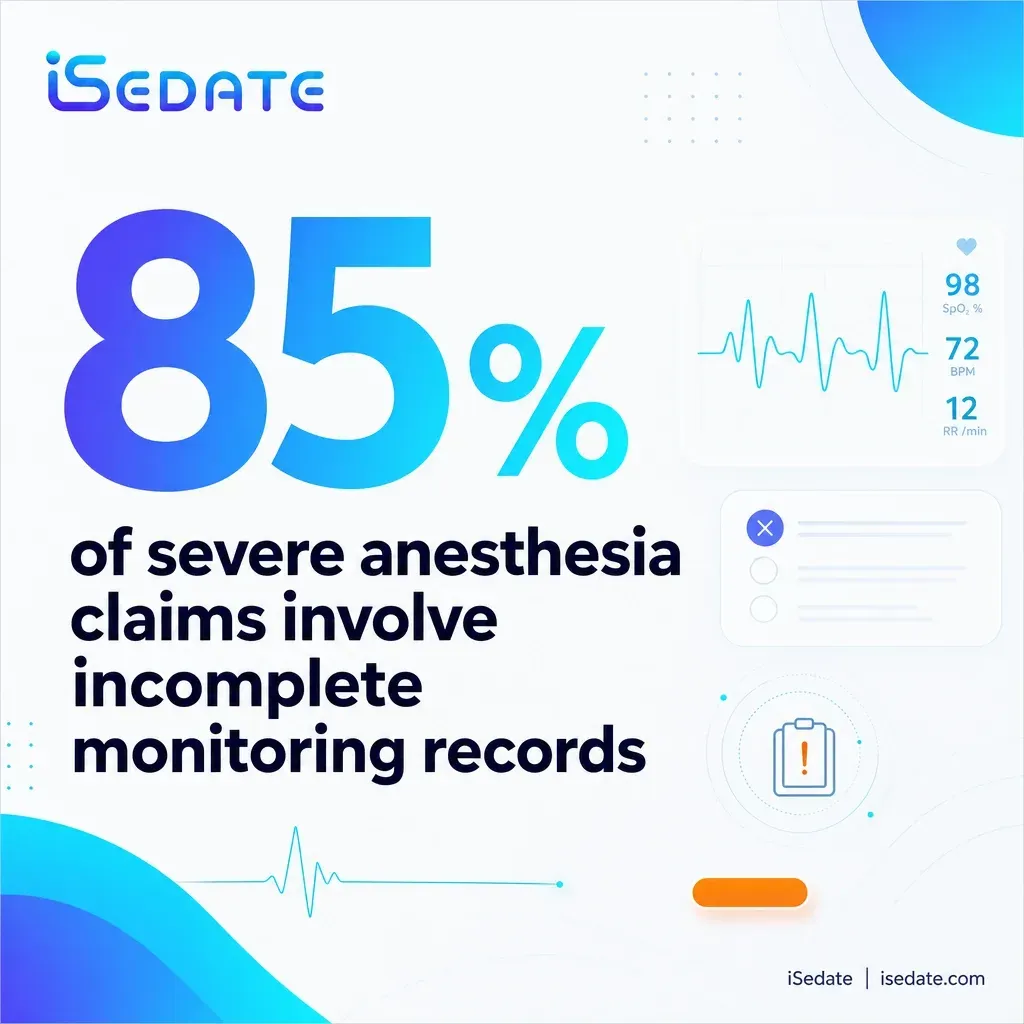
- Under OAC 4715-5-07(O), the board can audit your pre-sedation, sedation, recovery, and discharge records at any time. Incomplete records are where permits get challenged.
What This Ohio Permit Guide Covers
- Do you need a sedation permit in Ohio?
- Who regulates sedation permits in Ohio
- The Ohio sedation permit map
- How to get an Ohio moderate sedation permit
- What your permit requires you to monitor and staff
- Recordkeeping and reporting duties
- Renewal, CE, and keeping the permit current
- Audits and record reviews
- What happens if you skip the permit
- Keeping the permit: audit-ready records
- Neighboring states and related guides
- Frequently asked questions
- Sources
Do You Need a Sedation Permit in Ohio?
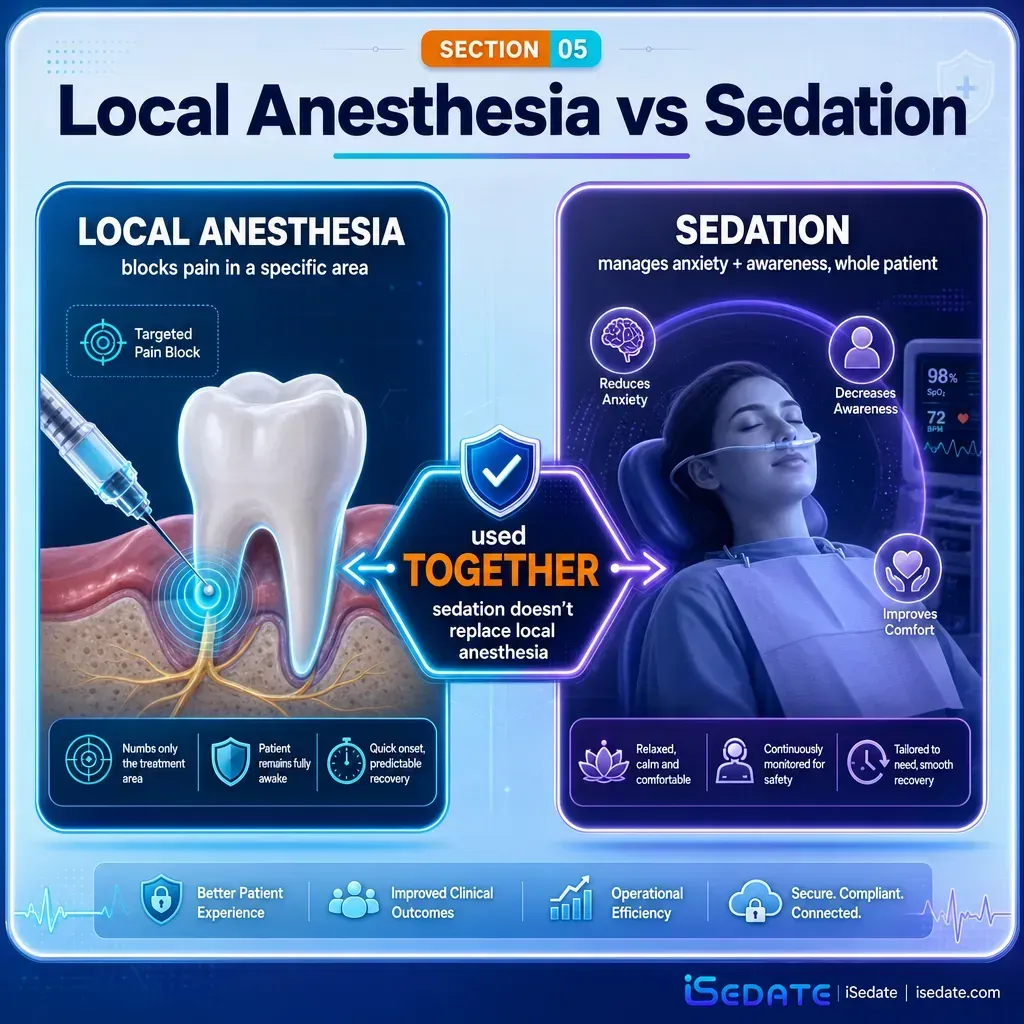
It depends on how deep you sedate. Ohio does not use a numbered Level 1 through Level 4 ladder. It groups sedation around a single line: moderate sedation. Below that line, no anesthesia permit is required. At or above it, a permit is. Nitrous oxide and oxygen for patients of any age, and enteral minimal sedation (anxiolysis) for patients 13 and older, sit below the line and need no permit, though the board's dosage limits apply. The moment a patient crosses into moderate sedation, the Moderate Sedation permit and the full obligations of OAC 4715-5-07 apply, regardless of the route or the single drug used. Deep sedation and general anesthesia require a separate general anesthesia permit under OAC 4715-5-05.
Ohio Moderate Sedation Permit at a Glance
- Governing rule: OAC 4715-5-07 (Use of moderate sedation), effective April 1, 2024
- Issuing authority: Ohio State Dental Board
- Permit line: moderate sedation and above
- Training pathway (published): 60 didactic hours, 20+ managed live patients, current ACLS
- Provisional privileges: up to one year, pending the onsite facility evaluation
- Renewal: biennial, with at least six hours of CE on sedation emergencies and quarterly drills
Who Regulates Sedation Permits in Ohio
Sedation dentistry in Ohio is regulated by the Ohio State Dental Board, the state agency that licenses dentists and issues the moderate sedation permit. The board, not any national body, decides who may sedate, evaluates the facility, runs the record audits, and takes disciplinary action. The rules live in Ohio Administrative Code Chapter 4715-5: OAC 4715-5-07 governs moderate sedation, OAC 4715-5-05 governs general anesthesia and deep sedation, and 4715-5-06 governs reports of adverse occurrences. The current anesthesia and sedation rules took effect April 1, 2024.
Myth, Busted
Myth: The ADA sets federal law that overrides the Ohio dental board.
Fact: The American Dental Association is a private professional association, not a government agency. It does not license, audit, or discipline you. Your permit, your facility evaluation, and any sanctions all come from the Ohio State Dental Board under OAC Chapter 4715-5.
OAC 4715-5-07 incorporates the ADA sedation guidelines by reference, so the ADA writes the clinical standard the board has adopted. The board writes the law. The real federal layers that sit on top are the DEA (controlled-substance logs), HIPAA, and, for accredited settings, CMS and the Joint Commission, not the ADA.
To apply, you work through the board's own application process and show the training, certification, and live-patient experience the rule requires for your level, then pass an onsite evaluation of your facility. The application forms and the current fee schedule are set by the board and change periodically, so confirm the exact forms and current fees directly with the Ohio State Dental Board before you file.
Source: OAC 4715-5-07 (State of Ohio) | Ohio State Dental Board rule copy
The Ohio Sedation Permit Map
Here is the full map, each tier with its governing rule. The line to watch is moderate sedation: everything below it needs no anesthesia permit, everything at or above it does.
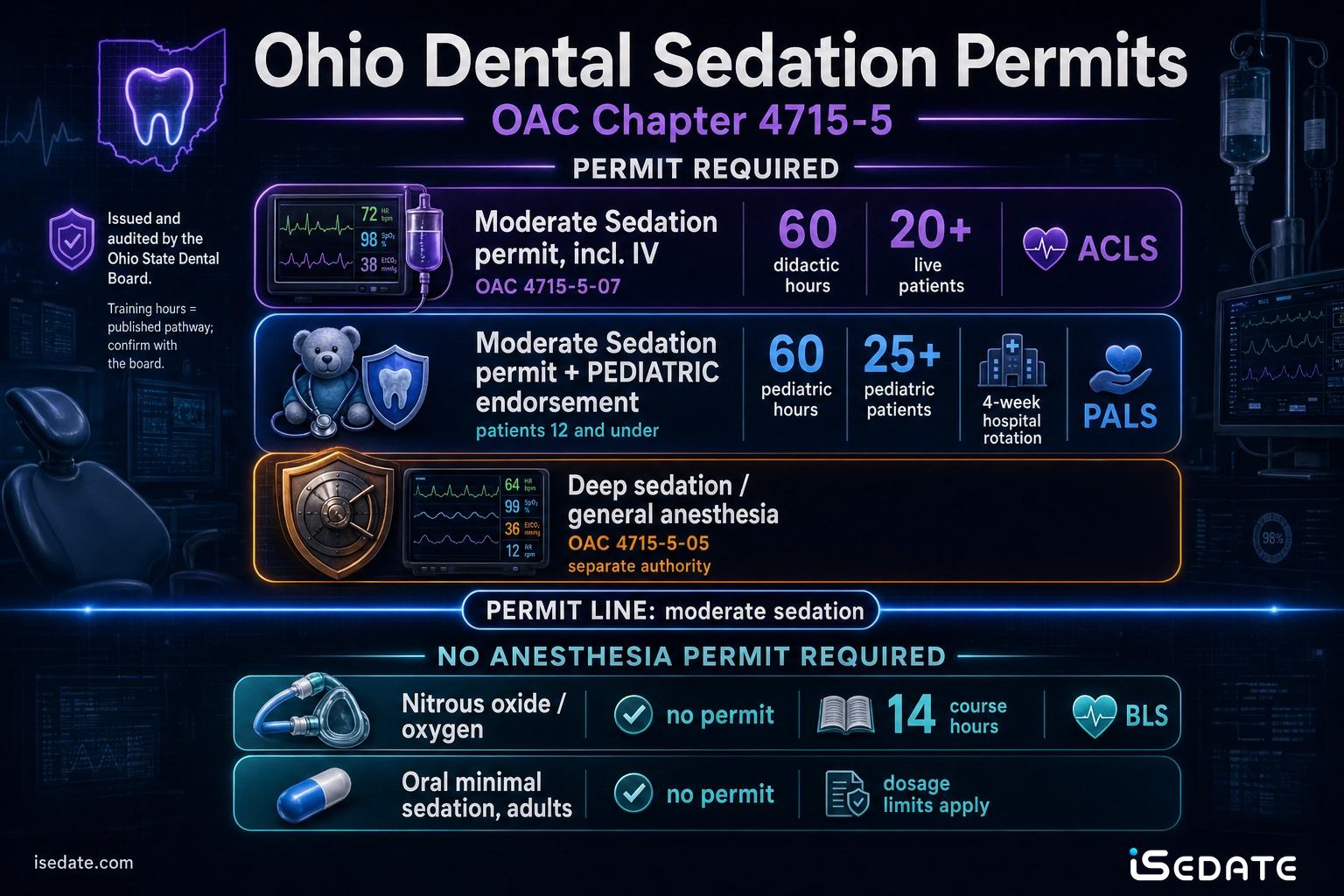
Nitrous oxide and oxygen. No anesthesia permit is required to administer nitrous oxide and oxygen, the lightest form of anxiety control, where the patient stays fully responsive. A dedicated nitrous training course (commonly cited as 14 hours) plus current BLS is the usual preparation, but this sits below the permit line for patients of any age.
Adult oral minimal sedation (anxiolysis). No anesthesia permit is required for enteral minimal sedation of patients 13 and older, where a single drug relaxes an anxious patient who still responds normally to verbal command. Dosage limits apply, and exceeding minimal sedation pushes you into moderate sedation and the permit requirement.
Moderate sedation, including IV (Moderate Sedation permit, OAC 4715-5-07). This is the workhorse permit. It authorizes moderate, or "Conscious," sedation, including the IV route, where the patient responds purposefully to verbal or tactile stimulation and keeps their own airway. It is the permit most sedation dentists and oral surgeons hold, and the one whose monitoring, recordkeeping, and audit obligations are written out in OAC 4715-5-07.
Moderate sedation for patients under 13 (pediatric endorsement). Sedating younger patients carries higher risk and its own training. Under OAC 4715-5-07(A)(4), treating a patient under 13 requires a pediatric endorsement on the moderate sedation permit (or on a general anesthesia permit). Onsite evaluations for children under 13 follow the AAP pediatric monitoring guidelines rather than the adult ADA parameters, per 4715-5-07(D)(1).
Deep sedation and general anesthesia (OAC 4715-5-05). The deepest tier, where the patient is not easily aroused or is unconscious and may need airway support, is governed by the separate rule OAC 4715-5-05, with its own, stricter requirements and its own permit. Most general dentists operate at nitrous and moderate sedation; general anesthesia is largely the province of oral surgeons and is beyond the scope of this moderate sedation guide. One important crossover: under OAC 4715-5-07(I), a dentist who already holds a general anesthesia permit may administer moderate sedation without a separate Moderate Sedation permit.
Source: OAC 4715-5-07 | OAC 4715-5-05
How to Get an Ohio Moderate Sedation Permit
Each step up carries its own bar: a set amount of training, resuscitation certification, and, for moderate sedation, a count of managed live patients, followed by an onsite evaluation of your office. The figures below reflect the widely published training pathway built on the ADA teaching standard that Ohio adopts. Because the board administers the detailed requirements and updates them periodically, treat the table as the pathway to confirm with the board, not as a substitute for the board's current application packet.
| What you administer | Ohio permit | Training (published pathway) | Live patients | Resuscitation |
|---|---|---|---|---|
| Nitrous oxide and oxygen | No anesthesia permit | 14 course hours (commonly cited) | Not specified here | BLS |
| Adult oral minimal sedation (13+) | No permit (dosage limits apply) | No stated hour requirement | Not specified here | BLS |
| Moderate sedation, incl. IV | Moderate Sedation permit (4715-5-07) | 60 didactic hours | At least 20 live patients | BLS-HCP + ACLS |
| Moderate sedation, patients under 13 | Moderate Sedation permit + pediatric endorsement | 60 pediatric didactic hours + 4-week hospital rotation | 25 live pediatric patients + 25 added experiences | BLS-HCP + PALS |
| Deep sedation / general anesthesia | General anesthesia permit (4715-5-05) | See OAC 4715-5-05 (confirm with board) | See OAC 4715-5-05 | Per 4715-5-05 |
The IV moderate sedation permit, step by step
This is the big step for a general dentist or oral surgeon. The published pathway is 60 hours of didactic instruction, clinical management of at least 20 live patients, and current ACLS on top of BLS for healthcare providers. Qualifying training generally must be completed within two years before you apply. You then file the board's prescribed application, indicate whether you are seeking to sedate patients 13 and older, patients under 13, or both, and pay the board's fee.
Ohio does not simply read your certificate and mail a permit. Under OAC 4715-5-07(C)(1), the board can issue provisional moderate sedation privileges that let you begin while a board-appointed consultant completes an onsite evaluation of your facility, equipment, personnel, and techniques under 4715-5-07(D)(1). Those provisional privileges are valid for up to one year, and an extension request is due at least 90 days before they expire. The applicant pays up to $400 for the onsite evaluation. Only after the evaluation is satisfied does the full permit issue.
Adding the pediatric endorsement
To treat patients under 13, you add a pediatric endorsement. The published pathway layers substantial pediatric training on top of the moderate permit: 60 hours of pediatric didactic instruction, at least 25 live pediatric patients plus 25 additional sedation experiences, a four-week hospital anesthesiology rotation, and current PALS. Because pediatric airways and dosing carry their own risks, Ohio holds pediatric sedation to a visibly higher bar, and onsite evaluations for children under 13 are judged against the AAP pediatric monitoring guidelines.
For every permit, the application, the current fee schedule, and any exam requirement are set by the board and updated periodically. Do not rely on a number you read on a course provider's page. You can take the qualifying coursework through providers such as DOCS Education's Ohio sedation courses, but confirm the exact forms, current requirements, and fees with the Ohio State Dental Board before you file.
Source: OAC 4715-5-07(B), (C), (D)

What Your Permit Requires You to Monitor and Staff
A permit is permission plus obligation. Once you hold the Moderate Sedation permit, OAC 4715-5-07(B)(5) requires adequate monitoring, personnel, emergency equipment, and drugs as recommended in the ADA sedation guidelines and the AAOMS Office Anesthesia Evaluation Manual. Ohio adopts the ADA parameter list by reference rather than printing it, and under that standard you monitor four systems continually: consciousness, oxygenation (pulse oximetry), ventilation, and circulation (blood pressure and heart rate).
Ohio adds its own staffing and readiness rules. Under OAC 4715-5-07(L), during sedation the provider and a person certified in BLS for healthcare providers must both be physically present in the room and caring exclusively for the patient. Under 4715-5-07(M), the provider must remain on the premises until every moderate sedation patient has been discharged. The board's emergency-drill competency under 4715-5-07(F)(2) includes recognizing and managing the loss of a capnography tracing, airway obstruction, and unexpected loss of consciousness. For the full clinical breakdown of what to monitor and chart, see our companion guide on Ohio sedation vitals monitoring, charting, and reporting requirements, and the national overview in our hub, Sedation Dentistry Licensing & Permit Requirements by State.
Source: OAC 4715-5-07(B)(5), (F)(2), (L), (M)
Recordkeeping and Reporting Duties
Holding a permit also means holding a set of documentation and reporting duties, and these are exactly what a board audit examines.
The complete sedation record. Under OAC 4715-5-07(B)(3), the permit holder must maintain complete records of moderate sedation for all patients treated, along with records of instruction, clinical experience, and certifications of competence. The detailed content of that record, a time-oriented anesthetic record of drugs, doses, administration times, and continually recorded vitals, comes from the ADA guidelines incorporated at 4715-5-07(B)(5). The Ohio code requires the complete record; the ADA standard it imports defines what "complete" contains.
The case log. Ohio uses a per-case moderate sedation log. Under OAC 4715-5-07(H), a reciprocity applicant submits a log of all moderate sedation cases from the prior three years, and the board may request complete records of cases selected from it. The board publishes a Moderate Sedation Log form for this purpose; confirm the current form directly with the board, as its posted location changes.
New facilities and discharge. Under OAC 4715-5-07(K), you must notify the board in writing before providing sedation at any new facility. Under 4715-5-07(M), the provider remains on the premises until the patient is discharged, and 4715-5-07(O) lists documentation of appropriateness for discharge among the records an audit may review. Reports of adverse occurrences are governed by OAC 4715-5-06, and rule violations can lead to board disciplinary action. Confirm the current adverse-event reporting triggers, timelines, and penalty schedule directly with the board.
Source: OAC 4715-5-07(B)(3), (H), (K), (M), (O)
Renewal, CE, and Keeping the Permit Current
Your Moderate Sedation permit is tied to your Ohio dental license and renews on a biennial cycle under OAC 4715-5-07(F). To renew, you attest to current BLS for healthcare providers plus ACLS (or PALS for the pediatric endorsement), to completing the required continuing education, and to running your emergency drills.
Under OAC 4715-5-07(F)(1)(c), the holder must complete at least six hours of board-approved CE devoted specifically to managing or preventing emergencies that can arise from moderate sedation. Under 4715-5-07(F)(2), emergency drills must be held at least quarterly and logged, with annual scenarios covering hypotensive, hypertensive, bradycardic, and tachycardic emergencies, airway obstruction, and unexpected loss of consciousness. The Ohio State Dental Board has announced that anesthesia-permit renewal is moving to a separate process on the Ohio eLicense system rather than riding along with dental license renewal, so confirm the current renewal mechanism, cycle, and CE total with the board so your permit never lapses.
Source: OAC 4715-5-07(F)
Audits and Record Reviews
This is where a permit is kept or lost. The Moderate Sedation permit comes with a standing review power written into the rule itself. Under OAC 4715-5-07(O), the board may order a reevaluation based on factors such as complaints, adverse occurrences, and random quality-assurance audits, and those audits may include a review of documentation of pre-sedation evaluations, sedation and recovery records, and documentation of appropriateness for discharge. The permit holder pays up to $400 for the reevaluation. For general anesthesia and deep sedation under 4715-5-05, the board may request complete records of cases selected from the provider's case log.
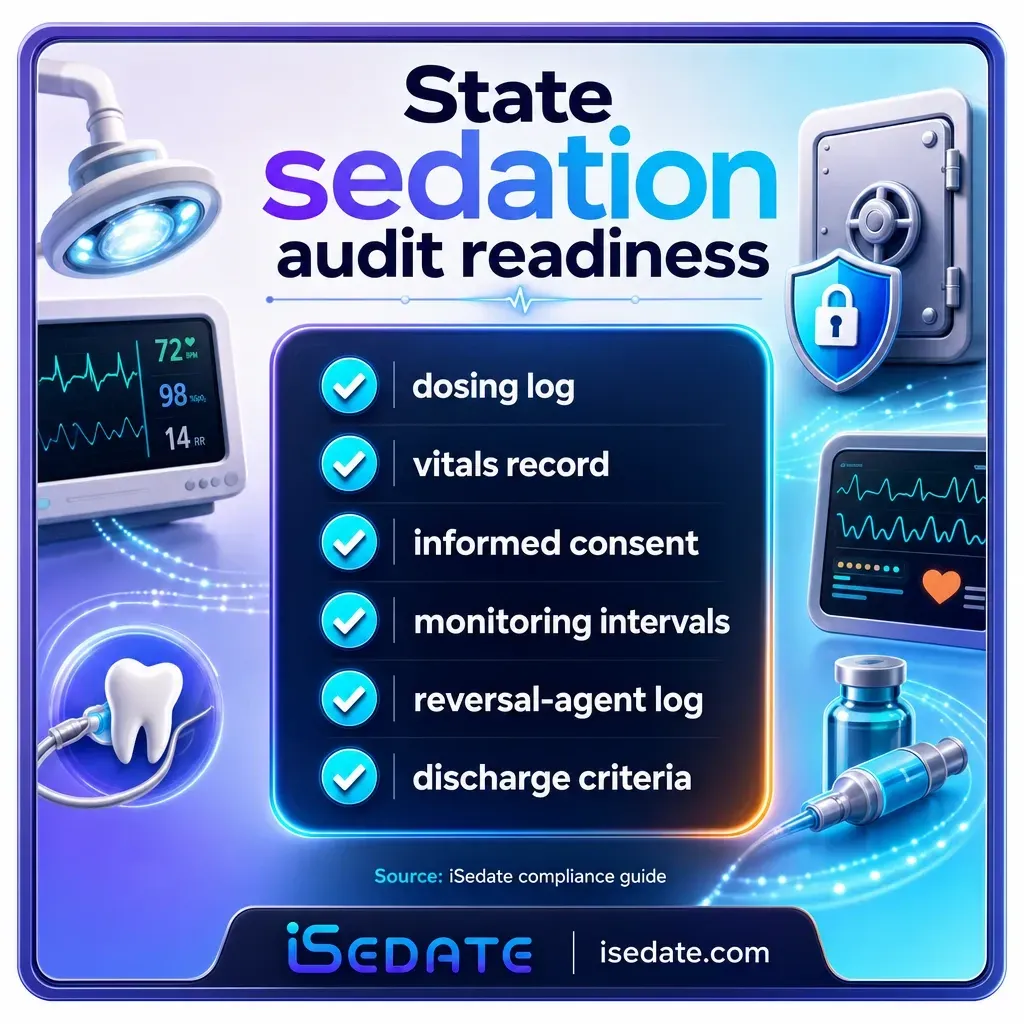
When a reviewer opens your file, they are checking the record, not your intentions. The four documents named in 4715-5-07(O), the pre-sedation evaluation, the sedation record, the recovery record, and the discharge determination, are the audit's checklist. A permit holder can deliver textbook sedation and still fail the review if any of the four is missing or incomplete. The audit turns on whether your contemporaneous records are complete, not on how the appointment felt.
Source: OAC 4715-5-07(O) | OAC 4715-5-05
What Happens If You Skip the Permit
Important
Administering moderate sedation without the permit, or letting one lapse, is a rule violation, not a paperwork oversight. OAC 4715-5-07 forbids a dentist from administering moderate sedation without the permit or provisional privileges, and non-compliance exposes you to Ohio State Dental Board disciplinary action under Chapter 4715-5 and the adverse-occurrence rule, OAC 4715-5-06. On the practical side, an unpermitted or lapsed sedation is exactly the fact a malpractice plaintiff and a professional-liability carrier look for first, because it converts a clinical question into a licensing one. The exact penalty schedule is set by the board; confirm it directly before you assume a given sanction applies.
Keeping the Permit: Audit-Ready Records
Everything above points to one truth: getting the permit is a one-time hurdle, but keeping it is a daily documentation discipline. A manual sedation record written by hand, between titrating a drug and watching an airway, is exactly where records go incomplete, and incomplete records are what a quality-assurance audit and a malpractice claim both attack. Because Ohio's audit looks at four documents at once, every one of them has to hold up.
SedationVault removes that failure point. It captures live patient vitals and the drug log automatically into a time-oriented, audit-ready anesthetic record built to the ADA standard Ohio incorporates, so the record writes itself while you focus on the patient. When the board asks for the file, a complete pre-sedation, sedation, recovery, and discharge record is a one-click export, not a scramble through paper. See how it maps to Ohio's rules on the dental sedation compliance and anesthesia record software pages.
Book a Demo of SedationVault See SedationVault PricingNeighboring States and Related Guides
Licensed, or planning to practice, in a state that borders Ohio? Sedation permit rules change at every state line. See our guides for Indiana, Kentucky, Michigan, Pennsylvania, and West Virginia, or compare all fifty in our hub, Sedation Dentistry Licensing & Permit Requirements by State.
Frequently Asked Questions
Do you need a permit for sedation in Ohio?
How do you get an IV moderate sedation permit in Ohio?
How often do you renew an Ohio sedation permit?
Does an Ohio general anesthesia permit cover moderate sedation?
What age line does the Ohio pediatric endorsement use?
What records does Ohio require a sedation permit holder to keep?
Is the ADA a federal agency that regulates Ohio sedation?
Sources
- OAC 4715-5-07, Use of moderate sedation (State of Ohio, codes.ohio.gov): permit, training, provisional privileges, onsite evaluation, monitoring, recordkeeping, renewal, CE, audits
- OAC 4715-5-05, Use of general anesthesia and deep sedation (State of Ohio)
- Ohio State Dental Board, posted copy of rule 4715-5-07, effective April 1, 2024
- DOCS Education, Ohio sedation training courses (course provider for the qualifying coursework, not the licensing authority)
- ADA Guidelines for the Use of Sedation and General Anesthesia by Dentists, and the AAOMS Office Anesthesia Evaluation Manual (incorporated by reference at OAC 4715-5-07(B)(5) and (D)(1))
This guide summarizes Ohio sedation permit rules for general information and is not legal advice. The permit structure, provisional privileges, onsite evaluation, monitoring, recordkeeping, renewal, continuing education, and audit obligations are drawn from OAC Chapter 4715-5 as cited, verified against codes.ohio.gov on November 16, 2026. The training hours and live-patient counts reflect the widely published ADA-standard training pathway and should be verified against the board's current application packet. Application forms, the exact application fee, the current Moderate Sedation Log form, the exact renewal mechanism and CE total, the penalty schedule, the full general anesthesia and deep sedation specifics under 4715-5-05, and the current adverse-event reporting triggers are set by the Ohio State Dental Board and should be confirmed directly with the board before you act.