







Pennsylvania Sedation Dentistry Licensing & Permit Requirements
In Pennsylvania you cannot sedate a patient on your dental license alone. Before administering nitrous oxide/oxygen analgesia, Conscious Sedation, deep sedation, or general anesthesia, a dentist must hold the matching anesthesia permit from the Pennsylvania State Board of Dentistry, issued under 49 Pa. Code Chapter 33, Subchapter E. There are three standing permit levels plus a one-year temporary permit, and each level has its own training path spelled out in the rule. This guide walks both halves of the job: how a Pennsylvania dentist gets a sedation or anesthesia permit, and what it takes to keep it through renewals, inspections, and record reviews.
Recent Updates
Last UpdatedNovember 16, 2026
- Corrected the permit scopes to match 49 Pa. Code §33.333: a Restricted Permit II covers nitrous oxide/oxygen analgesia only, a Restricted Permit I covers conscious sedation, and a separate one-year temporary permit exists.
- Added the verified training path for every level: 14 hours for Restricted Permit II, 60 hours for Restricted Permit I, and a two-year residency or board-certification route for the Unrestricted Permit.
- Added the ACLS/PALS certification, 15-hour continuing-education, and six-year office-evaluation requirements that apply at renewal.
- Replaced third-party legal mirrors with direct links to the official Pennsylvania Code and the State Board of Dentistry.
- Pennsylvania issues four anesthesia permits under 49 Pa. Code Chapter 33: Unrestricted, Restricted Permit I, Restricted Permit II, and a one-year Temporary Permit.
- Scope runs by depth: the Unrestricted Permit (§33.333(1)) covers the full range including general anesthesia; Restricted Permit I (§33.333(2)) covers Conscious Sedation or nitrous; Restricted Permit II (§33.333(3)) covers nitrous oxide/oxygen analgesia only.
- The training is set in the rule: 14 hours for Restricted Permit II (§33.337), 60 hours for Restricted Permit I (§33.336), and a two-year anesthesiology residency or qualifying board certification for the Unrestricted Permit (§33.335).
- You apply and renew online through the Board's PALS system; Unrestricted and Restricted I renewals require current ACLS or PALS certification, 15 hours of anesthesia CE, and an office inspection plus clinical evaluation every six years.
- Keeping the permit turns on the record: §33.209 requires a complete anesthesia record retained at least five years, and §33.341(b) requires reporting a death or an incident needing medical care within 30 days.

What This Guide Covers
- Who issues sedation permits in Pennsylvania
- The four Pennsylvania permit levels
- How to qualify for each permit
- The application process
- What the permit requires you to monitor
- Records and reporting tied to your permit
- CE, ACLS, and renewal
- Inspections and record reviews
- Keeping the permit: audit-ready records
- Frequently asked questions
- Related guides and neighboring states
- Sources
Who issues sedation permits in Pennsylvania
Sedation dentistry in Pennsylvania is regulated by the Pennsylvania State Board of Dentistry, part of the Department of State's Bureau of Professional and Occupational Affairs. The Board, not any national body, licenses dentists, issues every anesthesia permit, inspects offices, reviews records, and takes disciplinary action. The rules live in 49 Pa. Code Chapter 33, with the anesthesia permits and duties in Subchapter E. Under §33.332, a dentist may not administer or supervise general anesthesia, deep sedation, Conscious Sedation, or nitrous oxide/oxygen analgesia in a dental office without the matching permit.
Who Sets the Standard vs. Who Sets the Law
The American Dental Association publishes sedation guidelines, revised most recently in October 2025, that Pennsylvania and most states lean on. The ADA is a private professional association, not a federal agency: it does not license you, inspect you, or discipline you. Your permit, your inspections, and your sanctions all come from the Pennsylvania State Board of Dentistry under Chapter 33. Pennsylvania goes further than most states and pulls the professional standard into its own rule, so for permit holders the guideline is also the law. The federal layers that still apply are separate: the DEA for controlled-substance registration and sedative drug logs, and HIPAA for how you store and release the record.
Source: Pennsylvania State Board of Dentistry, Resources and Documents | 49 Pa. Code §33.332
The four Pennsylvania permit levels
Pennsylvania names its permits Unrestricted and Restricted, not by number tier or by the minimal and moderate labels used elsewhere. Scope reflects how deeply the patient may be sedated. Here is the full ladder from §33.333, each with the modalities it authorizes.
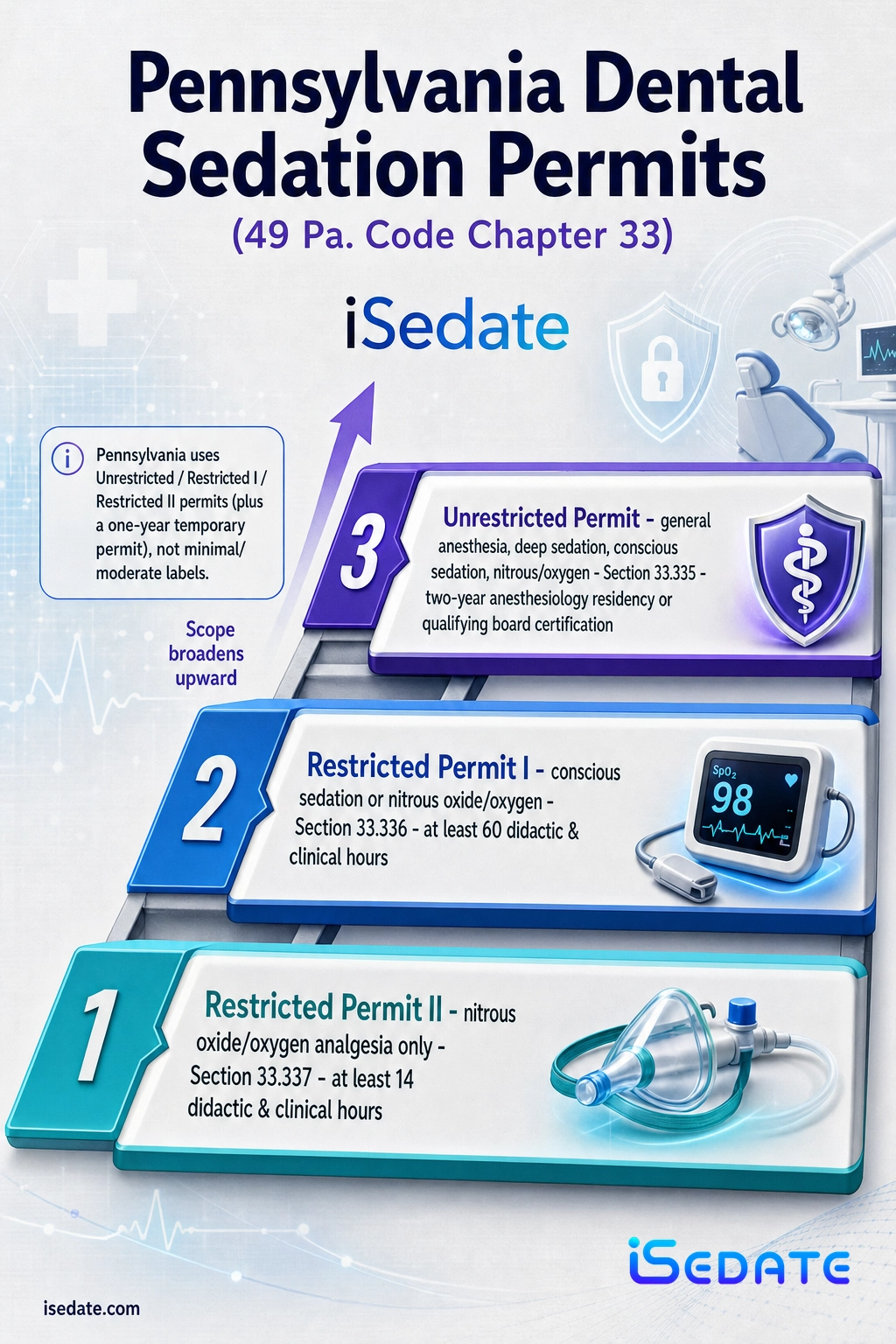
Restricted Permit II (§33.333(3)). The lightest permit. It authorizes nitrous oxide/oxygen analgesia only, the entry point for a general practice offering light inhaled anxiety control.
Restricted Permit I (§33.333(2)). The middle permit. It authorizes Conscious Sedation or nitrous oxide/oxygen analgesia. This is the level a general dentist reaches to add moderate sedation, including a nitrous-plus-oral-sedative combination that takes a patient to conscious sedation.
Unrestricted Permit (§33.333(1)). The broad grant. It authorizes general anesthesia, deep sedation, Conscious Sedation, or nitrous oxide/oxygen analgesia, the full range of anesthesia services. It is largely the province of oral and maxillofacial surgeons and dentist anesthesiologists, and it carries the heaviest training, monitoring, and record obligations.
Temporary Permit (§33.333(4)). A permit limited to one year that lets an applicant for any of the three standing permits administer the matching anesthesia while final qualification is pending.
Myth, Corrected
Myth: Pennsylvania's lightest permit lets a dentist combine nitrous oxide with an oral sedative.
Fact: A Restricted Permit II authorizes nitrous oxide/oxygen analgesia only under 49 Pa. Code §33.333(3).
Adding an oral sedative so the patient reaches conscious (moderate) sedation moves the case into the Restricted Permit I scope, which requires the 60-hour Conscious Sedation course. The two are different permits with different training floors, so confirm which one your practice actually needs before you apply.
Source: 49 Pa. Code §33.333
How to qualify for each permit
Each permit has its own education bar, and Pennsylvania spells the figures out in the rule rather than leaving them to a national summary. The lighter the depth, the shorter the course; the Unrestricted Permit is a residency-level qualification.
| Permit | Authorized scope | Governing section | Training required |
|---|---|---|---|
| Restricted Permit II | Nitrous oxide/oxygen analgesia only | §33.337 | Nitrous oxide/oxygen course, at least 14 hours didactic and clinical |
| Restricted Permit I | Conscious Sedation or nitrous oxide/oxygen | §33.336 | Conscious sedation course, at least 60 hours didactic and clinical |
| Unrestricted Permit | General anesthesia, deep sedation, Conscious Sedation, or nitrous | §33.335 | Two years of postgraduate anesthesiology training, or qualifying board certification |
Restricted Permit II: nitrous oxide/oxygen analgesia
Under §33.337, a dentist must complete a nitrous oxide/oxygen analgesia course of at least 14 hours of undergraduate or postgraduate didactic instruction and clinical experience, in a program that conforms to the ADA's teaching guidelines for pain and anxiety control. The applicant also certifies the make, model, and serial number of the nitrous equipment, that it is calibrated, maintained, and fail-safe, and that the office has written procedures for administration and emergencies.
Restricted Permit I: conscious sedation
Under §33.336, a dentist must complete a Conscious Sedation course of at least 60 hours of didactic instruction and clinical experience, again in a program conforming to the ADA teaching guidelines. This is the training a general dentist needs to offer moderate sedation, whether by an oral regimen, a nitrous-plus-oral combination, or another conscious-sedation technique.
Unrestricted Permit: deep sedation and general anesthesia
The Unrestricted Permit is a residency-level credential. Under §33.335, a dentist qualifies one of two ways: by completing at least two years of a postgraduate program in advanced anesthesiology training that conforms to the ADA teaching guidelines, or by holding qualifying board credentials, such as current certification as a Diplomate of the American Board of Oral and Maxillofacial Surgery, Fellowship in the American Association of Oral and Maxillofacial Surgeons or the American Dental Society of Anesthesiology, or eligibility for the oral and maxillofacial surgery board examination. For most general dentists this level is out of reach and out of scope, which is why nitrous and conscious sedation cover the large majority of office-based sedation in Pennsylvania.
Source: 49 Pa. Code §33.335 | §33.336 | §33.337
The application process
Pennsylvania runs anesthesia permitting through its online licensing system. You do not mail a paper permit application; you file it in the Pennsylvania Licensing System (PALS), the same portal where you renew your dental license. The Board's own Resources and Documents page lists the three anesthesia permit types and directs applicants to apply online.
What a Permit Application Involves
- Where you file: online through PALS, reached from the State Board of Dentistry's licensing pages (§33.334, application for permit).
- What you submit: proof of the didactic and clinical training for your level, equipment certification, and, for the higher permits, resuscitation certification and the office inspection and clinical evaluation described below.
- The fee: the application and renewal fees are set by the Board's current fee schedule and change periodically. Confirm the exact amount in PALS or with the Board before you file, rather than relying on a figure that may be out of date.
- Office inspection and clinical evaluation: initial Unrestricted and Restricted I permits require a satisfactory office inspection and clinical evaluation through a Board-approved peer evaluation organization (§33.336a(a)).
Source: Pennsylvania State Board of Dentistry, Resources and Documents | 49 Pa. Code §33.334

What the permit requires you to monitor
A permit is permission plus obligation. Once you hold an Unrestricted Permit, §33.340 sets out the monitoring equipment that must be present and whose use must be documented during general anesthesia, deep sedation, and Conscious Sedation:
- Oxygenation: a pulse oximeter, with a capnograph for intubated patients.
- Circulation: an electrocardiograph and a blood-pressure monitoring device.
- Emergency readiness: a defibrillator and a stethoscope.
- Suited to the patient: monitoring, procedures, and documentation matched to the patient's age, size, and condition, following the cited AAOMS and ADA/AAPD guidelines.
That equipment must be maintained, calibrated, and in use during administration. Restricted Permit I holders carry parallel duties under §33.340a, and Restricted Permit II holders under §33.340b. A dentist who is not a permit holder but who has general anesthesia administered in the office must obtain written certification that the required monitoring equipment is present and in use (§33.341). For the clinical breakdown of what to chart at each depth, see our companion guide to Pennsylvania Sedation Vitals Monitoring, Charting & Reporting Requirements.
Source: 49 Pa. Code §33.340 | §33.341
Records and reporting tied to your permit
Holding a permit also means holding documentation and reporting duties, and these are exactly what a Board review examines.
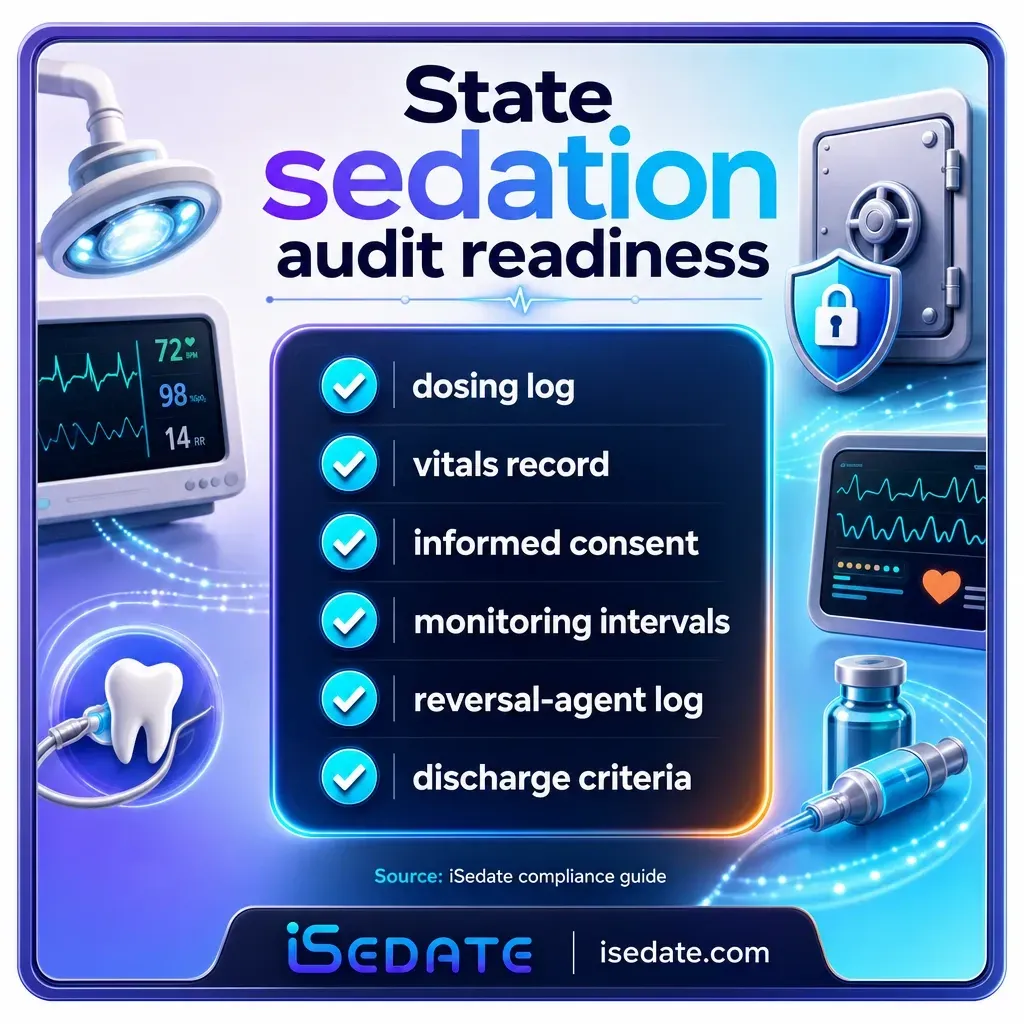
The anesthesia record. Under §33.209, the patient record must document each use of local anesthesia, nitrous oxide/oxygen analgesia, Conscious Sedation, deep sedation, or general anesthesia, including the results of the preanesthesia physical evaluation and medical history and the anesthesia procedures used, along with every medication prescribed, administered, or dispensed. Section 33.340 ties the monitoring documentation back to §33.209 and to the incorporated ADA/AAPD and AAOMS guidelines, which call for a time-oriented record of drugs, doses, times, and recorded vitals.
Adverse-event reporting. Under §33.341(b), a death or an incident requiring medical care must be reported to the Board in writing within 30 days. Failure to comply with the anesthesia duties is treated as unprofessional conduct subject to discipline.
Source: 49 Pa. Code §33.209 | §33.341(b)
CE, ACLS, and renewal
Your anesthesia permit is tied to your Pennsylvania dental license and renews with it. Under §33.338, the permit may be renewed biennially at the same time as the dental license, and the renewal is more than a fee.
Renewal Requirements for Unrestricted and Restricted I Permits
- Resuscitation certification: proof of current certification in ACLS for adult patients or PALS for pediatric patients, or both, as the practice requires.
- Continuing anesthesia education: 15 hours of Board-approved courses, in general anesthesia and deep sedation for Unrestricted holders, or in Conscious Sedation for Restricted I holders (§33.336a(d)).
- Office inspection and clinical evaluation: completed once every six years through a Board-approved peer evaluation organization (§33.336a(a)).
- Equipment attestation: every permit holder, including Restricted II, attests that the anesthesia equipment is installed, calibrated, maintained, and fail-safe.
Confirm your renewal deadline and current fee in PALS so a permit never lapses between cycles. Source: 49 Pa. Code §33.338 | §33.336a
Inspections and record reviews
This is where a permit is kept or lost. The Board inspects dental offices under §33.342, and the six-year peer office evaluation under §33.336a adds a second scheduled checkpoint for the sedation permits. When a reviewer opens your file, they are checking the record, not your intentions. Section 33.209 asks for a chart that accurately, legibly, and completely reflects the evaluation and treatment of the patient, which for sedation means the preanesthesia evaluation, the medications, the anesthesia procedures, and the monitored vitals all have to be there. A dentist can handle the sedation perfectly and still lose on the paperwork.
Source: 49 Pa. Code §33.342 | §33.336a
Keeping the permit: audit-ready records
Everything above points to one truth: getting the permit is a one-time hurdle, but keeping it is a daily documentation discipline. A vitals log written by hand, between titrating a drug and watching an airway, is exactly where records go incomplete, and incomplete records are what a Board review and a malpractice claim both attack.
SedationVault removes that failure point. It captures live patient vitals and the drug log automatically into a time-oriented anesthetic record that follows the guidelines Pennsylvania incorporates through §33.340, carries the preanesthesia evaluation and medications §33.209 requires, and holds the record for the five-year retention the rule demands. When the Board asks for a file, a complete record is a one-click export, not a scramble through paper. See how it maps to Pennsylvania's rules on the dental sedation compliance and anesthesia record software pages.
Book a Demo of SedationVault See SedationVault PricingFrequently asked questions
Do you need a permit to offer sedation in a Pennsylvania dental office?
What sedation permits does Pennsylvania issue?
How many training hours does each Pennsylvania sedation permit require?
Does Pennsylvania's lightest permit allow nitrous oxide combined with an oral sedative?
How do you renew a Pennsylvania anesthesia permit?
How long must a Pennsylvania dentist keep sedation records?
Is the American Dental Association a federal agency that regulates dental sedation?
Related guides and neighboring states
What to Read Next
Pair this permit guide with the clinical companion for Pennsylvania, and if you practice across state lines, each neighboring state sets its own permit scheme.
- Pennsylvania Sedation Vitals Monitoring, Charting & Reporting Requirements
- Sedation Dentistry Licensing & Permit Requirements by State (the all-50 hub)
Licensed in a neighboring state? See our guides for Delaware Sedation Dentistry Licensing & Permit Requirements, Maryland Sedation Dentistry Licensing & Permit Requirements, New Jersey Sedation Dentistry Licensing & Permit Requirements, New York Sedation Dentistry Licensing & Permit Requirements, Ohio Sedation Dentistry Licensing & Permit Requirements, and West Virginia Sedation Dentistry Licensing & Permit Requirements.
Sources
- Pennsylvania State Board of Dentistry, Resources and Documents (board, permit forms, apply via PALS)
- 49 Pa. Code, Chapter 33 (official Pennsylvania Code index, State Board of Dentistry)
- 49 Pa. Code §33.333: Types of permits (Unrestricted, Restricted I, Restricted II, Temporary)
- 49 Pa. Code §33.335: Requirements for an unrestricted permit
- 49 Pa. Code §33.336: Requirements for restricted permit I (conscious sedation)
- 49 Pa. Code §33.336a: Continuing education, office inspection, and clinical evaluation
- 49 Pa. Code §33.337: Requirements for restricted permit II (nitrous oxide/oxygen analgesia)
- 49 Pa. Code §33.338: Expiration and renewal of permits
- 49 Pa. Code §33.340: Duties of unrestricted permit holders (monitoring and documentation)
- 49 Pa. Code §33.341: Duties of non-permit holders and the 30-day incident report
- 49 Pa. Code §33.209: Preparing, maintaining, and retaining patient records
- American Dental Association: Anesthesia and Sedation guidelines (national professional standard, updated 2025)
This guide summarizes Pennsylvania sedation permit rules for general information and is not legal advice. The permit scheme, training hours, monitoring duties, recordkeeping, retention, renewal, ACLS/PALS, and continuing-education requirements are drawn from 49 Pa. Code Chapter 33 as cited, verified against the official Pennsylvania Code on November 16, 2026. Current application forms, the fee schedule, and the Board's contact details are set by the Pennsylvania State Board of Dentistry and are completed in PALS, so confirm the exact forms and fees with the Board before you file.