






Maryland Sedation Dentistry Licensing & Permit Requirements
In Maryland, you cannot sedate a patient on your dental license alone. A dentist who administers moderate sedation, deep sedation, or general anesthesia must first hold the matching permit from the Maryland State Board of Dental Examiners, issued under COMAR 10.44.12, "Anesthesia and Sedation." Anxiolysis is the only level a general dentist can give with no permit. Everything deeper is permitted by class, and the class depends on how deeply the patient is sedated and by what route. Getting the permit means meeting the training and evaluation requirements for your class. Keeping it means passing facility inspections and making sure your anesthesia records survive a Board review. This guide walks both halves: how a Maryland dentist gets a sedation or anesthesia permit, and what it takes to keep it.
Recent Updates
Last UpdatedNovember 16, 2026
- Verified every permit class and training requirement against the original COMAR 10.44.12 text published by the Maryland Division of State Documents.
- Corrected the Class I, II, and III training requirements to the exact COMAR 10.44.12.08 language: Class I is 24 didactic hours plus 20 clinical experiences, Class II is 60 didactic hours plus management of 20 dental patients, and Class III requires an advanced or CODA-accredited anesthesia program rather than a fixed hour count.
- Replaced aggregator citations with the original Maryland administrative code and the Board's own official rule and fee documents.
- Added the per-location permit rule (COMAR 10.44.12.07) and expanded the application and renewal detail.
- Maryland issues sedation permits by class under COMAR 10.44.12.05: anxiolysis (no permit), Class I (nonparenteral moderate, or oral conscious sedation), Class II (parenteral or IV moderate), and Class III (deep sedation or general anesthesia).
- Training scales with the class under COMAR 10.44.12.08: Class I needs 24 didactic hours plus 20 clinical experiences, Class II needs 60 didactic hours plus management of 20 dental patients, and Class III needs an advanced or CODA-accredited anesthesia program, not a set hour count.
- Every permit requires passing a Board administration evaluation and facility evaluation before it issues (COMAR 10.44.12.09 through 10.44.12.11), and a permit is tied to each specific office (10.44.12.07).
- Permits run a 5-year term (10.44.12.19). Renewal needs at least 24 classroom CE hours in sedation or anesthesia, maintained CPR and BLS, and emergency or airway certification (10.44.12.29); Class I and II also need equipment-inspection verification (10.44.12.20).
- The facility must keep anesthesia records, including monitoring and discharge records (10.44.12.11), and retain administering-dentist records for 5 years; the Board can inspect, including unannounced visits on a complaint (10.44.12.26, 10.44.12.27).

What This Guide Covers
- Who issues sedation permits in Maryland
- The Maryland permit classes
- How to get or upgrade each permit
- What the permit requires you to monitor
- Reporting obligations tied to your permit
- CE and recertification
- Inspections and record reviews
- Keeping the permit: audit-ready records
- Related guides and neighboring states
- Frequently asked questions
- Sources
Who issues sedation permits in Maryland
Sedation dentistry in Maryland is regulated by the Maryland State Board of Dental Examiners, a unit of the Maryland Department of Health and the agency that licenses dentists and issues every sedation and anesthesia permit. The Board, not any national body, decides who may sedate, runs the facility and administration evaluations, and takes disciplinary action. The rules live in COMAR 10.44.12, Maryland's official Anesthesia and Sedation regulation, adopted under the Maryland Health Occupations Article, and every requirement below traces to a section in that chapter. You can also read the Board's own copy of the full COMAR 10.44.12 chapter (PDF).
Myth, Busted
Myth: The ADA is the federal authority, so meeting its sedation guidelines is what keeps you legal.
Fact: The American Dental Association is a professional association, not a government agency. Your permit, your inspections, and any discipline all come from the Maryland State Board of Dental Examiners under COMAR 10.44.12.
Maryland and most states lean on the ADA's sedation guidelines as the standard of care, and real federal layers exist (the DEA for controlled-substance logs, HIPAA for records). But the ADA does not license you or evaluate your facility. Treat the ADA guidelines as best practice and COMAR 10.44.12 as the law you are held to.
A Maryland sedation permit is also tied to a place, not just a person. Under COMAR 10.44.12.07, the permit authorizes sedation at a specific practice location, so a dentist who sedates at more than one office needs the facility cleared for each one. To apply, you work through the Board's own application process, which includes an administration evaluation and a facility evaluation before the permit issues. Application forms and the fee schedule, set under COMAR 10.44.20 (the Board's fee schedule), are updated periodically, so download the current form and confirm the exact fee directly with the Maryland State Board of Dental Examiners before you file.
Source: COMAR 10.44.12.06 (permit required) | COMAR 10.44.12.07 (location requirement)
The Maryland permit classes
Maryland names its permits by class, and the class reflects how deeply the patient is sedated and by what route, not just which drug is used. Here is the full ladder, each rung with its governing section in COMAR 10.44.12.
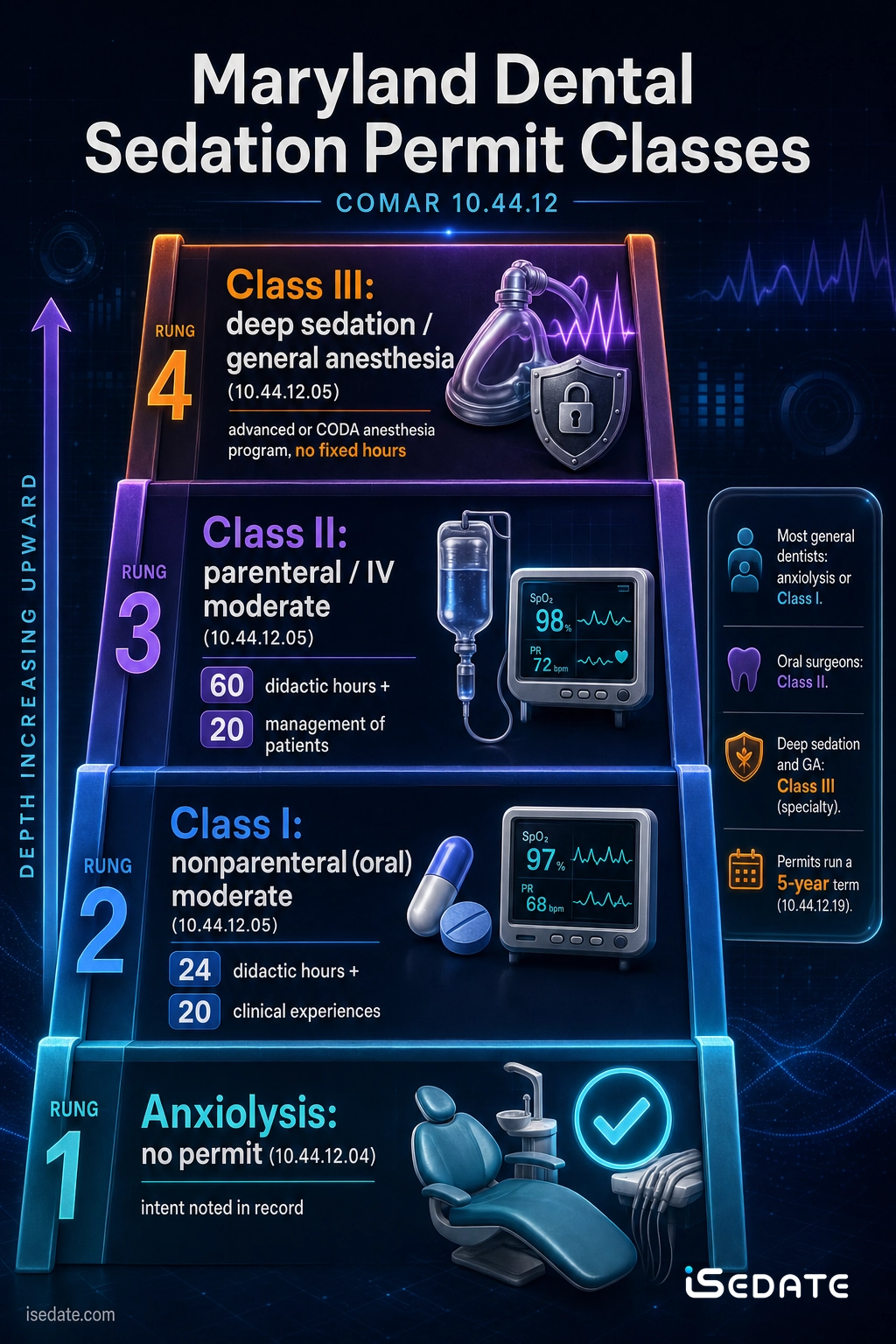
Anxiolysis needs no permit (COMAR 10.44.12.04). The lightest level. A dentist who intends only anxiolysis, minimal sedation where the patient stays fully responsive, does not need a sedation permit but must note that intent in the patient's record.
Class I permit (COMAR 10.44.12.05). Authorizes a nonparenteral technique, such as the oral or enteral route, to attain moderate sedation, where the patient responds purposefully and keeps their own airway. This is the common starting point for general dentists who offer oral conscious sedation.
Class II permit (COMAR 10.44.12.05). Authorizes a parenteral technique, that is IV sedation and other injected routes, to attain moderate sedation, and it includes Class I procedures. Because the parenteral route carries higher risk and faster onset, Class II sits above Class I and carries heavier training requirements. This is where oral surgeons and sedation-trained dentists typically operate.
Class III permit (COMAR 10.44.12.05). The top tier. It authorizes a technique to attain deep sedation or general anesthesia, where the patient is not easily aroused or is unconscious and may need airway support, and it includes Class I and Class II procedures. Class III is largely the province of dental anesthesiologists and oral and maxillofacial surgeons, and is generally out of scope for the typical general dentist. Maryland also recognizes a Class III dental school facility permit, plus separate certificates that let a physician, another dentist, or a certified registered nurse anesthetist administer, and that let a dentist treat at another location.
Source: COMAR 10.44.12.05 (permit classes) | COMAR 10.44.12.04 (anxiolysis)
How to get or upgrade each permit
Each permit has its own bar to clear: a board-approved course with a set training path, and a successful Board evaluation. You move up the ladder by meeting the next class's requirements and applying to the Board. The training requirements below come straight from COMAR 10.44.12.08.
| Permit | Route / depth | Training (COMAR 10.44.12.08) | Required to issue |
|---|---|---|---|
| Anxiolysis (10.44.12.04) | Minimal; intent noted in record | No sedation permit course specified | Note intent in patient record |
| Class I (10.44.12.05) | Nonparenteral (oral) moderate | 24 didactic hours + 20 clinically oriented experiences (or CODA postdoctoral program) | Successful Board evaluation |
| Class II (10.44.12.05) | Parenteral / IV moderate | 60 didactic hours + management of 20 dental patients (or CODA postdoctoral program) | Successful Board evaluation |
| Class III (10.44.12.05) | Deep sedation / general anesthesia | Advanced anesthesia training program beyond the dental curriculum, or a CODA postdoctoral program | Successful Board evaluation |
Class I: oral conscious sedation
To hold a Class I permit, a dentist completes a board-approved course documenting at least 24 hours of didactic education plus 20 clinically oriented patient experiences, or an equivalent CODA-accredited postdoctoral program, then passes the Board's evaluation under COMAR 10.44.12.08 and 10.44.12.09. This permit authorizes genuine oral moderate sedation by a nonparenteral route but stops short of the parenteral, or IV, route.
Class II and III: adding IV sedation and deeper anesthesia
Upgrading to a Class II permit (parenteral or IV) is the biggest step a general dentist or oral surgeon takes. Under COMAR 10.44.12.08, Class II requires a board-approved course of at least 60 hours of didactic instruction plus the management of at least 20 dental patients, or an equivalent CODA-accredited postdoctoral program, and a successful Board evaluation. The hands-on load jumps from Class I because the parenteral route demands a competence a classroom cannot replicate.
A Class III permit (deep sedation and general anesthesia) does not run on a fixed hour count at all. Instead, COMAR 10.44.12.08 requires an advanced training program in anesthesia and related subjects beyond the undergraduate dental curriculum and approved by the Board, or a CODA-accredited postdoctoral program, reflecting that deep sedation and general anesthesia are a specialty qualification rather than a short course.
iSedate Pro Tip
Take your board-approved course from a provider the Board recognizes, such as a sedation training organization like DOCS Education's Maryland course listings, and keep the completion documentation with your application. The exact clinical-experience counts and course approvals are set by the Board and the course, so verify them against the rule rather than a marketing page.
For every class, the application form and the current fee schedule are set by the Board and updated periodically, so do not rely on a number you read on a course provider's page. Confirm the current forms and fees with the Maryland State Board of Dental Examiners before you file.
Source: COMAR 10.44.12.08 (qualifications and training) | COMAR 10.44.12.09 (administration evaluation)
What the permit requires you to monitor
A permit is permission plus obligation. Once you hold a sedation permit, the facility-evaluation criteria in COMAR 10.44.12.11 require specific monitoring equipment to be in place and in working order, including "monitoring equipment, including pulse oximeter and blood pressure monitoring," a recovery area with oxygen and suction, and visual and electronic monitoring. Pediatric deep sedation or general anesthesia adds a pulse oximeter plus a precordial or pretracheal stethoscope.
COMAR 10.44.12.14 then governs the act of inducing sedation. It requires the treating dentist plus two individuals competent in basic life support, and it provides that the dentist may not leave the patient until the patient is conscious, spontaneously breathing, has stable vital signs, is ambulatory with assistance, and is in the care of a responsible adult, with the same conditions met before inducing sedation in a second patient. For the full clinical breakdown of what to monitor and chart at each depth, see the companion guide on Maryland Sedation Vitals Monitoring, Charting & Reporting Requirements.
Source: COMAR 10.44.12.11 (facility evaluation criteria) | COMAR 10.44.12.14 (inducing a level of sedation)
Reporting obligations tied to your permit
Holding a permit also means holding a set of documentation and reporting duties, and these are exactly what a Board review examines.
Maryland Permit Recordkeeping Duties
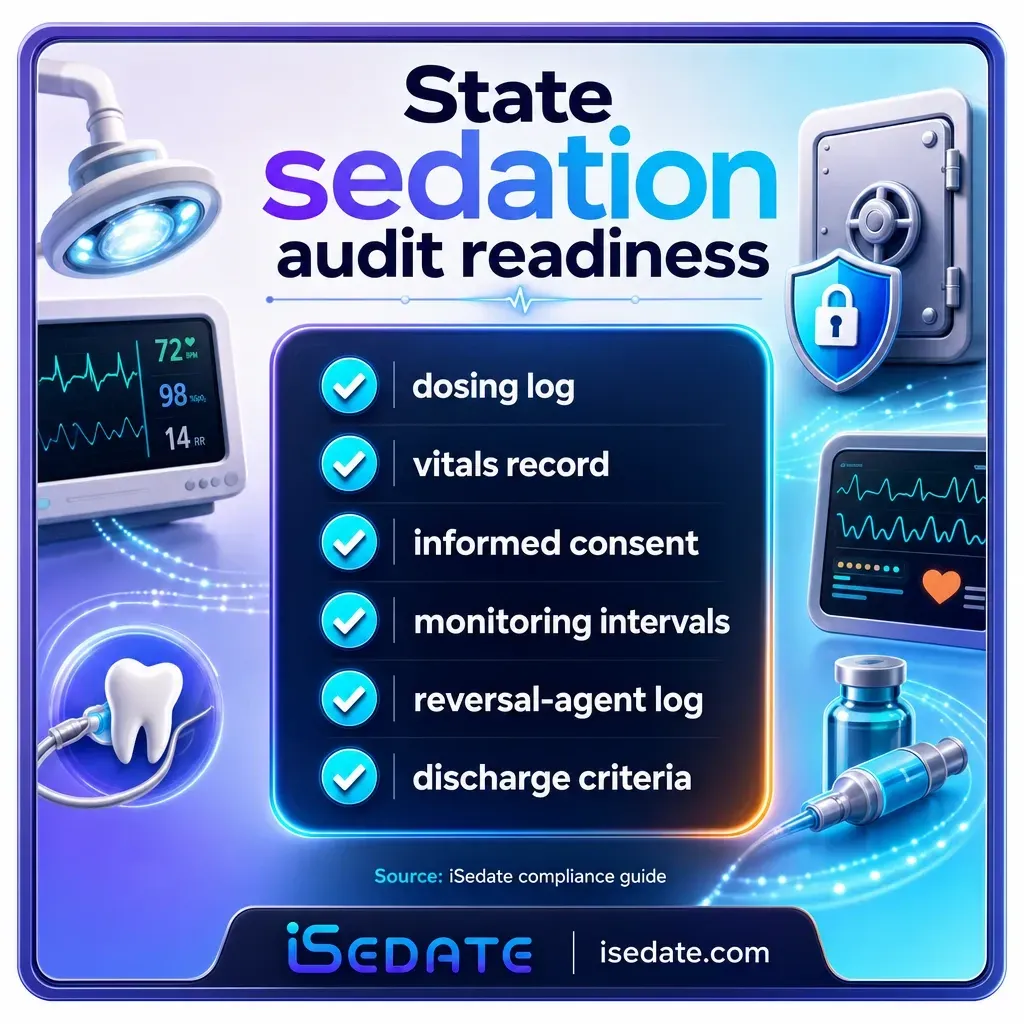
- The anesthesia record. Under COMAR 10.44.12.11, the facility must maintain anesthesia records, including monitoring and discharge records, plus a preoperative medical history and physical evaluation form. Maryland sets no fixed minute interval for the charting cadence, so the moment-to-moment, time-oriented detail follows the ADA standard of care, under which the monitored parameters are recorded continually during moderate sedation.
- Record retention. Under COMAR 10.44.12.26, every facility must maintain, for 5 years and for Board inspection, the name and license number of each dentist who administered anesthesia or sedation.
- Discharge documentation. Under COMAR 10.44.12.14, the dentist may not leave the patient until the patient is conscious, spontaneously breathing, and has stable vital signs, which the anesthesia record's discharge record is where you demonstrate.
- Morbidity and mortality reporting. Under COMAR 10.44.12.36, any death caused by anxiolysis, moderate sedation, deep sedation, or general anesthesia must be reported to the Board in writing within 7 days, and a complication that hospitalizes a patient within 15 days. The report carries a defined content list, including the drugs and dosages, the techniques, and the adverse occurrence.
Source: COMAR 10.44.12.26 (facility records) | COMAR 10.44.12.36 (morbidity and mortality reports)

CE and recertification
Maryland sedation and anesthesia permits run a 5-year term under COMAR 10.44.12.19, and renewal is where many permits are quietly put at risk. Under COMAR 10.44.12.29, renewal requires not less than 24 hours of clinical continuing education related to sedation or anesthesia, in a classroom setting, during the 5-year term, plus maintained CPR and BLS. For Class I, II, and III, renewal also requires a board-approved medical-emergency and airway course of at least 4 hours, or maintained ACLS or PALS certification.
Maryland adds a step most states do not. Under COMAR 10.44.12.20, Class I and Class II renewals require written verification that a recognized service company inspected the anesthesia and monitoring equipment. In other words, your equipment has its own paper trail at renewal, not just your CE. Confirm your renewal cycle, CE hours, and certification requirements directly with the Maryland State Board of Dental Examiners so your permit never lapses at renewal.
Source: COMAR 10.44.12.29 (renewal CE) | COMAR 10.44.12.20 (equipment-inspection verification)
Inspections and record reviews
This is where a permit is kept or lost. To obtain a permit, a dentist passes an administration evaluation under COMAR 10.44.12.09, an office inspection and clinical evaluation of the ability to administer sedation and respond to emergencies, and a facility evaluation under COMAR 10.44.12.10 and 10.44.12.11, an on-site review of equipment, medications, and clinical records. A renewal evaluation repeats the on-site inspection before the permit renews.
Beyond the scheduled evaluations, the Board reserves the right to show up. Under COMAR 10.44.12.27, the Board or its designee may make an unannounced inspection visit during business hours when there is a complaint plus reason to believe sedation was administered without a permit or in violation of the chapter, and it issues a written report within 30 days. When a reviewer opens your file, they are checking the record, not your intentions. A permit holder who did the sedation correctly can still lose on the paperwork if the anesthesia record is missing its monitoring or discharge detail.
Source: COMAR 10.44.12.10 (facility evaluation) | COMAR 10.44.12.27 (unannounced inspection visits)
Keeping the permit: audit-ready records
Everything above points to one truth: getting the permit is a one-time hurdle, but keeping it is a daily documentation discipline. A monitoring log written by hand, between titrating a drug and watching an airway, is exactly where records go incomplete, and incomplete records are what a Board review and a malpractice claim both attack. Maryland makes this sharper by not handing you a fixed charting interval to lean on, which means the anesthesia record has to carry the monitoring and discharge detail COMAR 10.44.12.11 names and the continual record the standard of care expects.
SedationVault removes that failure point. It captures live patient vitals and the drug log automatically into a time-oriented, audit-ready anesthesia record that carries the monitoring and discharge detail the rule requires, so the record writes itself while you focus on the patient. When the Board asks for the file, a complete record is a one-click export, not a scramble through paper. See how it maps to Maryland's rules on the dental sedation compliance and anesthesia record software pages.
Book a demo of SedationVault See SedationVault pricingRelated guides and neighboring states
Maryland's permit classes are part of our national Sedation Dentistry Licensing & Permit Requirements by State hub. Licensed near a border, or planning to add a second location across state lines? See our same-silo guides for the neighboring states:
- Delaware Sedation Dentistry Licensing & Permit Requirements
- Pennsylvania Sedation Dentistry Licensing & Permit Requirements
- Virginia Sedation Dentistry Licensing & Permit Requirements
- West Virginia Sedation Dentistry Licensing & Permit Requirements
Frequently asked questions
What sedation permits does Maryland offer?
How many training hours do you need for an IV sedation permit in Maryland?
How often do you renew a Maryland sedation permit?
Do you need a separate Maryland permit for each office?
Does a Maryland dentist need a permit for nitrous oxide or anxiolysis?
Sources
- COMAR 10.44.12.04: Anxiolysis
- COMAR 10.44.12.05: Classifications of Permits and Certificates
- COMAR 10.44.12.06: Permit Required
- COMAR 10.44.12.07: Location Requirement
- COMAR 10.44.12.08: Qualifications for Obtaining a Permit (training)
- COMAR 10.44.12.09: Administration Evaluation
- COMAR 10.44.12.11: Facility Evaluation Criteria
- COMAR 10.44.12.14: Inducing a Level of Sedation
- COMAR 10.44.12.19: Issuance and Expiration of Permits (5-year term)
- COMAR 10.44.12.20: Renewal of Class I and Class II Permits (equipment inspection)
- COMAR 10.44.12.26: Facility Records (5-year retention)
- COMAR 10.44.12.27: Unannounced Inspection Visits
- COMAR 10.44.12.29: Continuing Education Requirements for Renewal
- COMAR 10.44.12.36: Morbidity and Mortality Reports
- Maryland Board of Dental Examiners: full COMAR 10.44.12 chapter (PDF)
- COMAR 10.44.20: Board fee schedule (PDF)
This guide summarizes Maryland sedation permit rules for general information and is not legal advice. Permit classes, training, monitoring, recordkeeping, renewal terms, and continuing education are drawn from COMAR 10.44.12 as cited, verified against the Maryland Division of State Documents' official regulation text. Application forms, current fees, the precise penalty schedule, the routine inspection cadence beyond the complaint trigger, and the Board's current contact details are set by the Maryland State Board of Dental Examiners and should be confirmed directly with the Board before you act.