







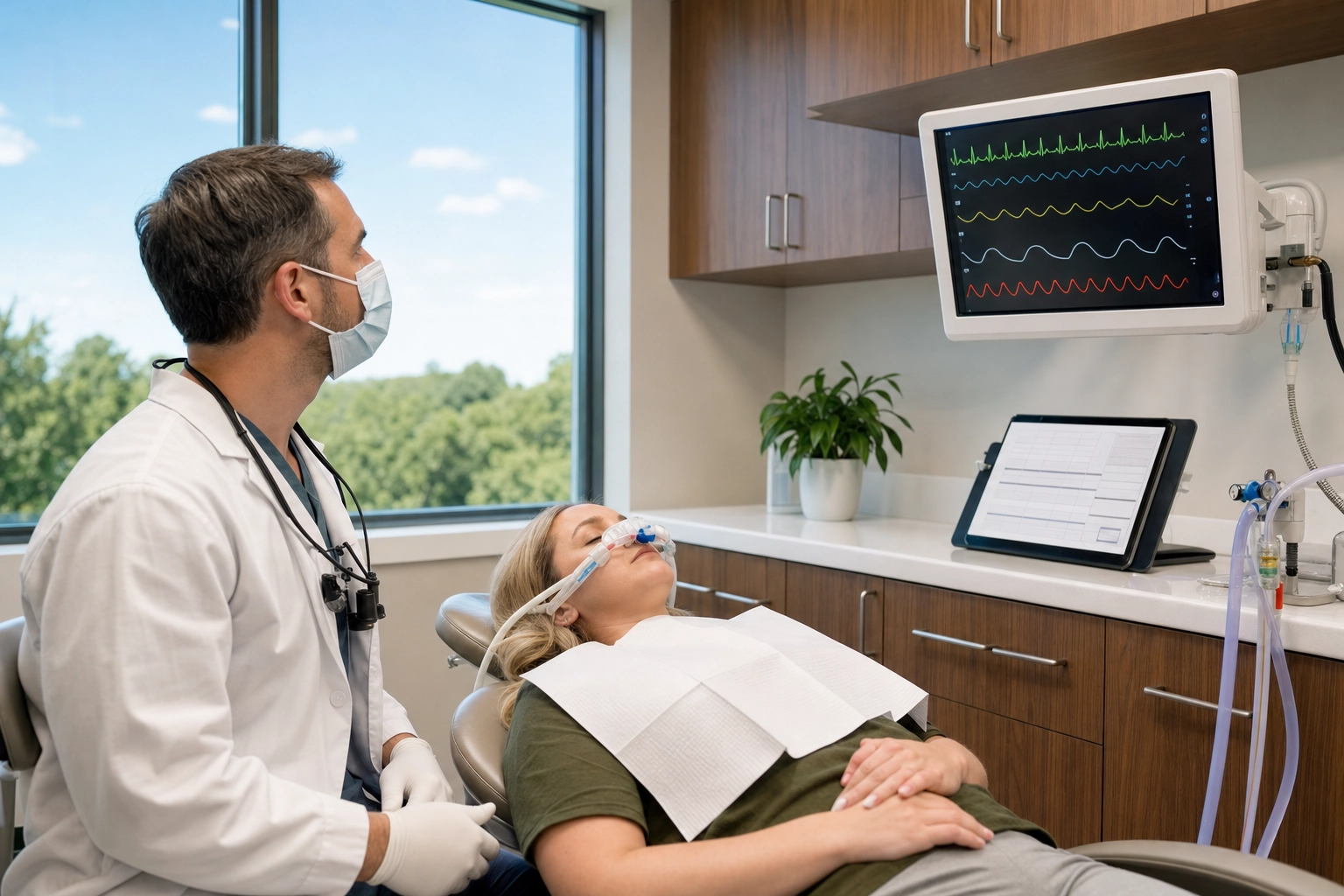
Maryland Sedation Vitals Monitoring, Charting & Reporting Requirements
If you sedate patients in Maryland, the state is blunt about one thing: your facility has to keep an anesthesia record, and that record has to include monitoring and discharge records. That requirement lives in COMAR 10.44.12, the Maryland State Board of Dental Examiners chapter on Anesthesia and Sedation, and it is the first document a board reviewer asks to see. What Maryland does not do is dictate a minute-by-minute charting interval the way some states do, which leaves the granular cadence to the ADA standard of care. Getting that distinction right is the whole point of this guide. Below is what Maryland requires you to monitor and record at each sedation level, what a defensible chart looks like, where thin records get dentists burned, and how to keep the record audit-ready.
Recent Updates
Last UpdatedNovember 16, 2026
- Re-verified every citation against the current official COMAR 10.44.12 chapter PDF published by the Maryland State Board of Dental Examiners.
- Corrected the adverse-event citations: the death report lives in Section .36 (within 7 days), and the same section adds a separate 15-day report for a complication requiring hospital admission over 24 hours.
- Clarified that the discipline-and-unprofessional-conduct language applies to permit holders under Section .37 (and to facility owners under Section .28), not a single penalties section.
- Replaced aggregator citations with the Board's own official COMAR source, and clarified that the ADA is a national professional standard, not a government agency or federal law.
- Added the staffing rule (Section .14), the facility equipment list (Section .11), and the unannounced-inspection process (Section .27).
Key Takeaways
- The core rule: COMAR 10.44.12.11(12) requires each sedation facility to maintain anesthesia records, including monitoring and discharge records, plus a preoperative medical history and physical evaluation form.
- Who enforces it: the Maryland State Board of Dental Examiners, a unit of the Maryland Department of Health, through COMAR 10.44.12, not the ADA.
- The honest nuance: Maryland does not print a "record vitals every X minutes" cadence. The record must capture monitoring; the moment-to-moment detail follows the ADA standard of care Maryland dentists are held to clinically.
- Records are retained for 5 years: under COMAR 10.44.12.26, the facility keeps the name and license number of every dentist who administered sedation for Board inspection.
- Deaths are reportable within 7 days and hospitalizing complications within 15 days, to the Board under COMAR 10.44.12.36.

Table of Contents
- Who regulates sedation in Maryland
- The Maryland sedation permit classes
- What you must monitor at each level
- What the record must contain: the compliance core
- What compliant documentation looks like
- How Maryland reviews records and reports events
- Why a thin record is the real exposure
- The audit-ready record, handled
- Related guides and neighboring states
- Frequently asked questions
- Our sources and fact-checking
Who regulates sedation in Maryland
Sedation and anesthesia in a Maryland dental office are regulated by the Maryland State Board of Dental Examiners, a unit of the Maryland Department of Health. The Board issues sedation permits, evaluates facilities, and takes disciplinary action. The rules are gathered in one place: COMAR 10.44.12, Anesthesia and Sedation, adopted under the authority of the Maryland Health Occupations Article, Section 4-205.
That matters for compliance because your recordkeeping obligation is a named regulation with an exact citation, not a vague standard of care. When a reviewer asks whether your sedation record meets the requirement, the answer is measured against the specific regulations of COMAR 10.44.12 below. It is also worth being precise about the ADA. The American Dental Association publishes the national sedation guidelines most boards lean on, but the ADA is a private professional association, not a government agency, and its guidelines are a professional standard, not law. The federal layers that do apply are different ones: the DEA for controlled-substance records, HIPAA for records privacy and security, and CMS or accreditation bodies where they reach an office. In Maryland, the law that governs your sedation record is COMAR 10.44.12, and the body that enforces it is the Maryland State Board of Dental Examiners. For the clinical "what and why" behind every state's version of these duties, see our Dental Sedation Vitals, Charting & Reporting Requirements by State hub.
Source: COMAR 10.44.12 (Maryland State Board of Dental Examiners)
The Maryland sedation permit classes
Maryland uses its own permit structure, and the duties escalate with each class. Knowing which permit you hold tells you which monitoring and recordkeeping rules apply. These are the levels as COMAR 10.44.12.05 defines them, with the anxiolysis tier from 10.44.12.04:
| Maryland level | What it covers | Citation |
|---|---|---|
| Anxiolysis (no permit) | Minimal sedation; a permit is not required, but the intent to give anxiolysis is noted in the patient's record | COMAR 10.44.12.04 |
| Class I permit | A nonparenteral (for example oral or enteral) technique to attain moderate sedation | COMAR 10.44.12.05 |
| Class II permit | A parenteral technique, including IV, to attain moderate sedation, plus any Class I procedure | COMAR 10.44.12.05 |
| Class III permit | A technique to attain deep sedation or general anesthesia, plus any Class I or Class II procedure | COMAR 10.44.12.05 |
Most general dentists work at anxiolysis or a Class I permit, with Class II adding the parenteral, including IV, route. Moderate sedation, the level long known as Conscious Sedation, is where a Board permit and the full monitoring and record duties attach, and it is the level most sedation dentists are permitted for. Class III, which authorizes deep sedation and general anesthesia, is the top tier and is carried most often by dental anesthesiologists and oral and maxillofacial surgeons. Maryland also issues a Class III dental school facility permit and separate certificates that let a physician, another dentist, or a certified registered nurse anesthetist administer, and that let a dentist treat at another location. This guide focuses on the moderate-sedation recordkeeping standard. Working out which permit to apply for, or how to upgrade, is its own process, covered in our companion Maryland Sedation Dentistry Licensing & Permit Requirements guide.
Source: COMAR 10.44.12.04 and .05 (permit classes)
What you must monitor at each level
In Maryland, what you are required to monitor sets up what you are required to write down. The facility-evaluation criteria in COMAR 10.44.12.11 define the equipment that must be in place, and the recordkeeping item in the same regulation requires the anesthesia record to include monitoring records. Under Section .11, a sedation facility must have, among other equipment:
- Pulse oximeter and blood pressure monitoring: the rule lists monitoring equipment including a pulse oximeter and blood pressure monitoring.
- A recovery area with oxygen and suction: plus visual and electronic monitoring in that area.
- Equipment in working order: anesthesia and monitoring equipment must be kept in proper working order and is checked at the facility evaluation.
- Pediatric deep sedation or general anesthesia: adds a precordial or pretracheal stethoscope alongside the pulse oximeter.
On top of the equipment, COMAR 10.44.12.14 governs the act of inducing sedation. It requires at least three appropriately trained people to be present for moderate, deep, or general anesthesia cases: the treating dentist, one individual competent in basic life support to assist, and a second BLS-competent individual in close proximity. The same section provides that the dentist may not leave the site until the patient is conscious, spontaneously breathing, has stable vital signs, is ambulatory with assistance, and is in the care of a responsible adult, and that none of those conditions may be skipped before inducing a second patient. That "stable vital signs" language is the hinge: to establish that vital signs are stable, you have to be watching and recording them.
Myth, Busted
Myth: Maryland does not set a charting interval, so a reading at the start and one at the end is enough.
Fact: The absence of a fixed minute interval is not the absence of a duty to document.
COMAR still requires the anesthesia record to include monitoring records, and Section .14 requires you to confirm stable vital signs before you leave the patient. The ADA standard of care Maryland dentists are held to clinically calls for the monitored parameters to be recorded continually during moderate sedation. A two-reading record cannot demonstrate any of that.
Source: COMAR 10.44.12.11 and .14
What the record must contain: the compliance core
This is the section a reviewer reads first. COMAR 10.44.12.11(12) spells out what the facility's records must contain, and Sections .26 and .36 add the retention and reporting duties. There are three parts worth knowing by heart.
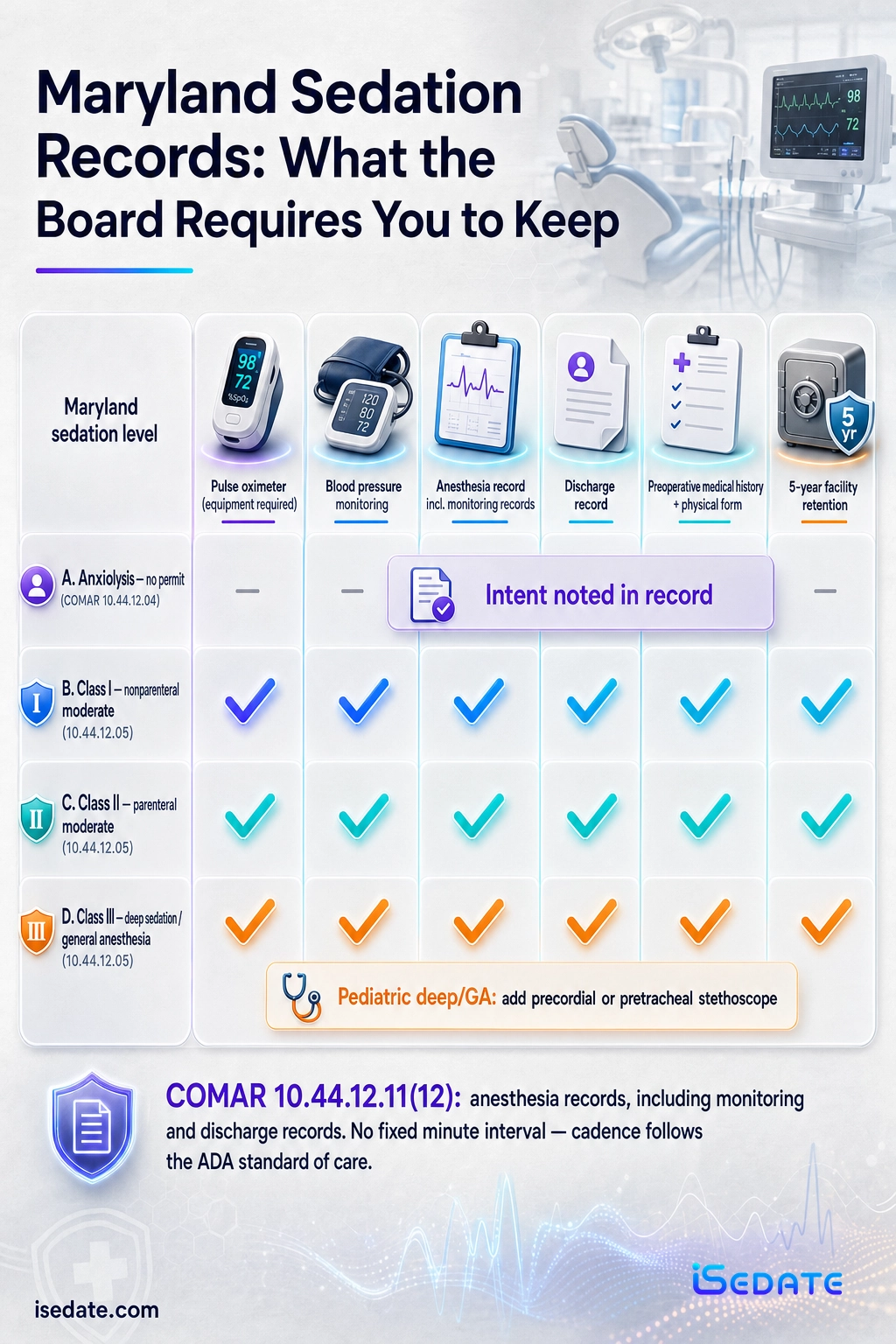
An anesthesia record that includes monitoring and discharge records
Under COMAR 10.44.12.11(12), the facility-evaluation criteria require each facility to maintain anesthesia records, including monitoring and discharge records, alongside a preoperative medical history and physical evaluation form under Section .11(11). The phrase "including monitoring and discharge records" is the operative language: the anesthesia record is not a single end-of-visit note. It has to carry the monitoring detail through the case and the assessment at discharge. A note that a patient "tolerated sedation well" is not this record. A record of drugs, doses, the monitored parameters, and a documented discharge assessment is. For a dentist intending only anxiolysis, COMAR 10.44.12.04 adds a narrower duty: the intent to administer anxiolysis must be noted in the patient's record. Even at the lightest level, Maryland wants a contemporaneous note in the chart.
The time-oriented detail follows the ADA standard of care
Here is the honest distinction Maryland dentists need to understand. Unlike some states, COMAR 10.44.12 does not quantify a specific "document vitals every ten minutes" interval in its text. It requires the anesthesia record to include monitoring records, and it mandates the monitoring equipment, but it does not put a number on the cadence. That granular, time-oriented charting detail is governed by the ADA standard of care, the national professional benchmark Maryland dentists are measured against clinically. Under that standard, pulse oximetry, heart rate, respiratory rate, blood pressure, and level of consciousness are recorded continually during moderate sedation, with end-tidal carbon dioxide and continuous ECG added as depth increases. Maryland cites the record; the standard of care fills in how densely it has to be populated. Because the cadence is a clinical standard rather than a printed rule, never borrow a minute-by-minute interval from another state's regulation and assume it is Maryland law.
Maryland Law
Facility retention and the preoperative form
COMAR 10.44.12.26 sets the retention floor. Every facility must maintain, for 5 years and for inspection by the Board, the name of each dentist who has administered anesthesia or sedation and the license number of each dentist who has administered it. Paired with the preoperative medical history and physical evaluation form from Section .11(11), these are the records a Board evaluator expects to find on site. The whole sedation record should be built to survive that inspection, not reconstructed after a request arrives.
Source: COMAR 10.44.12.11(12) and .26
What compliant documentation looks like
Knowing the record must exist is not the same as knowing what a defensible one looks like. The gap between the two is where most review findings live. Here is the concrete shape of a Maryland sedation record that holds up.
Oral and IV sedation are documented the same way, in different depth
The format does not change with the route. A Class I oral moderate case and a Class II IV moderate case both produce a time-oriented record of drugs, doses, times, and monitored vitals. What changes is how much there is to capture. An IV case carries titrated doses given in the moment, so the drug-and-time log is longer and the monitoring is denser, and the deeper the intended plane, the more parameters, such as end-tidal carbon dioxide and continuous ECG, the standard of care expects you to track and therefore to chart. The record has to reflect the case that actually happened, not the case you planned.
A sample charting cadence
Maryland does not print an interval, so this is an illustration of a defensible rhythm, not a quoted rule. A clean moderate-sedation record typically shows a baseline set of vitals before the first drug; the drug name, dose, route, and time for every agent given; vital signs captured at a steady interval through the procedure and at each change in depth or dose; any airway or rescue intervention with its time; and a final set of vitals with the documented discharge assessment and who released the patient to a responsible adult. The through-line is simple: a reader should be able to reconstruct the whole case, from baseline to discharge, from the chart alone.
The equipment the record assumes
Section .11 prints the hardware that must be present, and a good record implicitly proves it was in use. A monitoring value in your chart, an oxygen-saturation trend or a blood pressure, should be consistent with the pulse oximeter and blood pressure monitoring the rule requires on site, and a recovery note should match the required recovery area with oxygen, suction, and monitoring. When a monitoring value or a discharge observation appears in your record, it should line up with the equipment the facility criteria require you to have on hand and keep in working order.
Maryland Law
Source: COMAR 10.44.12.11 and .14
See how a time-oriented anesthesia record builds itself
How Maryland reviews records and reports events
Two obligations govern what happens around a sedation case in Maryland: the Board's power to evaluate and inspect your facility and records, and your duty to report serious events.
To obtain a permit, a dentist passes an administration evaluation under COMAR 10.44.12.09, an office and clinical evaluation of the ability to administer sedation and manage emergencies, and a facility evaluation under Sections .10 and .11, an on-site review of equipment, medications, and clinical records. The Board also reserves the power to show up unannounced: under COMAR 10.44.12.27, during reasonable business hours the Board or its designee may conduct an unannounced inspection when it has received or initiated a complaint and has reason to believe sedation was administered without a permit or in violation of the chapter, and the inspectors submit a written report within 30 days.
On reporting, Section .36 sets hard deadlines. A dentist must report to the Board in writing, within 7 days, any death caused by or resulting from the administration of anxiolysis, moderate sedation, deep sedation, or general anesthesia. A complication or disabling incident requiring hospital admission for more than 24 hours, or for a purpose other than observation, must be reported in writing within 15 days. These are among the few sedation timelines Maryland prints directly in its rule text.
Maryland Law
Build the record as the case runs, not from memory afterward. A reviewer does not grade your sedation on how the patient did. They grade it on whether the contemporaneous anesthesia record proves what you monitored and when, and whether the discharge record is there. If the anesthesia record has gaps, the default assumption on review is that the monitoring had gaps too. Maryland's requirement that the record include monitoring and discharge records is exactly the part a thin chart cannot satisfy.
Source: COMAR 10.44.12.09, .10, .11, .27, and .36
Why a thin record is the real exposure
COMAR 10.44.12 is backed by enforcement. Under Section .37, after an opportunity for a hearing the Board may revoke or suspend a Class I, Class II, or Class III permit, or take disciplinary action under the Health Occupations Article, Section 4-315, if the permit holder violates the chapter or the facility is inadequate, and failure to comply constitutes unprofessional conduct. Section .28 places a parallel duty on the facility owner or operator, and Section .39 lets the Board summarily suspend a permit when needed to protect the public. Incomplete sedation records are not a filing technicality. They are the evidence the Board weighs when deciding whether the standard of care was met, and the same gaps that fail a board review are the gaps a plaintiff's attorney looks for in a malpractice claim.
The disciplinary schedule, the detail of the Board's evaluation items, and current permit fees are administered by the Board and can change, so confirm current details directly with the Maryland State Board of Dental Examiners before relying on a figure that may be out of date. What does not change is the exposure created by a thin record: in both a board review and a lawsuit, the contemporaneous sedation record is the first thing requested and the hardest thing to reconstruct after the fact. The research below is the data behind why these rules exist:
The Data Behind These Rules
The requirements on this page are the law. These research roundups explain why they exist and what happens when a practice gets charting wrong:
The audit-ready record, handled
The gap between knowing the rule and passing a review is almost always the same thing: a monitoring log kept by hand during a live sedation case. When a team is managing an airway and an anxious patient, a vitals reading written down by hand is exactly where the record develops holes, a skipped entry here, a missing discharge note there, a drug given in the moment and logged later from memory. Maryland does not hand you a fixed interval to lean on, which makes a dense, contemporaneous record even more important, because the standard you are measured against is the ADA's "recorded continually," not a convenient two readings.
That is the problem SedationVault by iSedate was built to remove. It connects wirelessly to the vitals monitor already in your operatory and captures pulse oximetry, heart rate, respiratory rate, and blood pressure live, on the clock, alongside the drug log, so the time-oriented anesthetic record writes itself as the case runs rather than being reconstructed afterward. When the Board asks for the chart, it exports as a one-click, audit-ready sedation visit report that already carries the monitoring detail, the dosages, and the discharge assessment COMAR 10.44.12.11(12) asks for. The point is not fancier charting. It is turning the exact items the rule requires into something the software keeps present, contemporaneous, and time-stamped, which is also what dental sedation compliance turns on. If you want to see what it costs before you commit, our SedationVault pricing is published up front.
Book a demo and watch your Maryland sedation record build itselfRelated guides and neighboring states
Licensed in more than one state, or practicing near the Maryland line? The documentation duties rhyme from state to state, but the citations and deadlines do not. See the same guide for a neighboring state, or the full map:
- Delaware sedation vitals, charting and reporting requirements
- Pennsylvania sedation vitals, charting and reporting requirements
- Virginia sedation vitals, charting and reporting requirements
- West Virginia sedation vitals, charting and reporting requirements
- Our 50-state sedation charting and reporting hub
Frequently asked questions
Does Maryland require a written sedation record?
How often must vitals be recorded during sedation in Maryland?
How long must Maryland sedation records be kept?
What are the Maryland dental sedation permit levels?
Does Maryland require reporting a sedation death?
What does the Maryland board actually look at in a sedation record?
Our Sources and Fact-Checking
This guide cites Maryland's primary regulatory source, verified against the current rule text. Rule text is drawn from COMAR 10.44.12, Anesthesia and Sedation, as published by the Maryland State Board of Dental Examiners, a unit of the Maryland Department of Health, under the authority of the Health Occupations Article, Section 4-205. The recordkeeping rule is confirmed verbatim: Section .11(12) requires anesthesia records, including monitoring and discharge records, plus the Section .11(11) preoperative medical history and physical evaluation form; Section .26 requires 5-year facility retention of each administering dentist's name and license number; and Section .36 sets the 7-day death report and the 15-day hospitalization report. COMAR does not print a per-interval intra-operative vitals cadence; that granular charting follows the ADA standard of care, which is described here as the national clinical standard most sedation training is built around, not as Maryland law. Where a detail, such as the current penalty schedule, the routine inspection cadence beyond the Section .27 complaint trigger, permit fees, or the Board's current contact details, is administered by the Board and subject to change, confirm it directly with the Maryland State Board of Dental Examiners before relying on it. This guide is general information, not legal advice.
- COMAR 10.44.12: Anesthesia and Sedation (full chapter, Maryland State Board of Dental Examiners)
- COMAR 10.44.20: Board of Dental Examiners fee schedule
- ADA Guidelines for the Use of Sedation and General Anesthesia by Dentists, referenced as the national clinical standard sedation training follows, not as Maryland law.















