






Delaware Sedation Dentistry Licensing & Permit Requirements
In Delaware, your dental license alone does not let you sedate a patient. Any dentist who administers nitrous oxide, IV Conscious Sedation, deep sedation, or general anesthesia must first hold the matching permit from the Delaware Board of Dentistry and Dental Hygiene, issued under 24 Delaware Administrative Code 1100, Section 7.0, the state's anesthesia regulations. Getting the permit means meeting the training, clinical-experience, and resuscitation requirements for your level, paying the $96 fee, and passing an office inspection. Keeping it means practicing to the ADA standard Delaware adopts by reference and filing the reports the rule demands. This guide walks both halves: how a Delaware dentist gets a sedation permit, and what it takes to keep it.
Recent Updates
Last UpdatedNovember 16, 2026
- Re-verified every permit requirement against the Delaware Board of Dentistry and Dental Hygiene's own anesthesia-permit pages and the current Section 7.0 on the state regulations site.
- Added the verified $96 application fee, the DELPROS application process, the per-location office inspection, and the biennial (May 31 even-year) renewal cycle.
- Replaced third-party aggregator citations with the original Delaware state sources.
- Delaware names its permits rather than numbering them: Restricted Permit II (nitrous), Restricted Permit I (Conscious Sedation including IV), and the Unrestricted Permit (deep sedation and general anesthesia), all under 24 Del. Admin. Code §1100, Section 7.0.
- The names mislead on purpose: Restricted Permit II is the lighter nitrous-only authorization, and Restricted Permit I is the broader conscious-sedation permit that includes IV.
- The jump to IV is real: Restricted Permit I requires 60 hours of instruction and management of at least 20 patients (§7.2.2.1), versus 14 instructional hours for nitrous (§7.2.4).
- Each permit costs $96 to apply, is filed through the DELPROS portal, needs a per-location office inspection, and renews biennially on May 31 of even years.
- The permit carries a hard duty: a complete adverse-event report to the Board within 30 days (§7.5.1). Non-compliance is unprofessional conduct and can cost the permit (§7.5.2).

What This Guide Covers
- Who issues sedation permits in Delaware
- The Delaware permit levels
- How to get or upgrade each permit
- What the permit requires you to monitor
- Reporting duties tied to your permit
- Facility, renewal, and continuing education
- What happens if you skip the permit
- Keeping the permit: audit-ready records
- Related guides and neighboring states
- Frequently asked questions
- Sources
Who issues sedation permits in Delaware
Sedation dentistry in Delaware is regulated by the Delaware Board of Dentistry and Dental Hygiene, part of the Division of Professional Regulation in the Department of State. The Board, not any national body, licenses dentists, issues every sedation and anesthesia permit, inspects facilities, and takes disciplinary action. The rules live in Section 7.0 of the Delaware Administrative Code, Title 24, Chapter 1100, and every requirement below traces to a provision of that section.
Myth, Busted
Myth: Federal ADA law sets the sedation rules, so meeting the ADA guidelines is all that matters.
Fact: The American Dental Association is a private professional association, not a government agency. It does not license you, inspect your facility, or discipline you. Your permit, your office inspection, and any sanction all come from the Delaware Board under Section 7.0, which incorporates the ADA guideline by reference (§7.4.3.1).
The real federal layers that sit on top of the state rule are different agencies entirely: the DEA for controlled-substance records, HIPAA for patient data, and CMS or The Joint Commission where they apply. Treat the ADA guideline as the practice standard and Section 7.0 as the law you are held to.
To apply, you work through the Board's online portal and meet the requirements for the permit you are seeking. Applications are filed through DELPROS, Delaware's professional-licensing portal, and you have six months to finish an application once you start it. Each office location needs its own application and its own satisfactory office inspection by the Board's Anesthesia Advisory Committee before a permit issues.
Source: 24 Del. Admin. Code 1100, Section 7.0 | Delaware Board of Dentistry anesthesia permit pages
The Delaware permit levels
Delaware names its permits rather than numbering them one through four, and the permit reflects the depth and route of sedation you intend to provide. Here is the full ladder, each with its governing provision of Section 7.0.
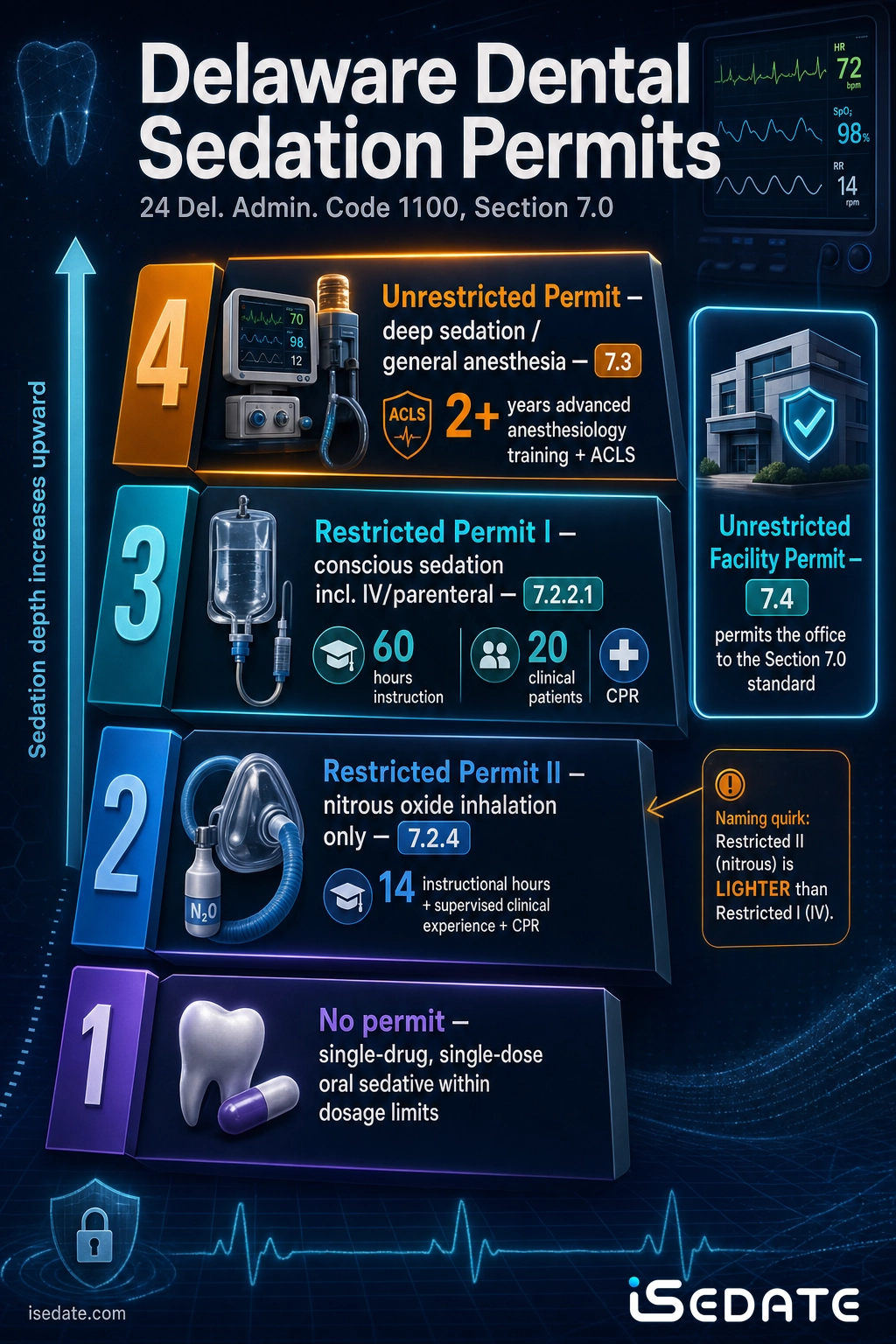
No permit: single-dose oral sedative. A single-drug, single-dose pre-operative oral sedative given within dosage limits does not require a sedation permit. This is a narrow exception, not a license to titrate oral medication to effect.
Restricted Permit II, Conscious Sedation (§7.2.4). The lighter restricted permit. It authorizes nitrous oxide and oxygen inhalation only, the lightest form of anxiety control, where the patient stays responsive. Note the naming: despite the "II," this is the more limited of the two restricted permits.
Restricted Permit I, Conscious Sedation (§7.2.2.1). The broader restricted permit. It authorizes Conscious Sedation by the parenteral, enteral, and rectal routes plus nitrous oxide inhalation, but not deep sedation or general anesthesia. Because IV sedation carries higher risk and faster onset, Restricted Permit I sits above Restricted Permit II and carries much heavier training and clinical-experience requirements. This is where general dentists doing genuine IV Conscious Sedation operate.
Unrestricted Permit (§7.3). The top permit. The Unrestricted Permit-Individual authorizes deep sedation and general anesthesia and also covers all conscious-sedation techniques. Deep sedation and general anesthesia put the patient in a state that is not easily aroused and may require airway support, so this permit is largely the province of dental anesthesiologists and oral and maxillofacial surgeons. A separate Unrestricted Permit-Facility covers an office where a board-certified anesthesiologist administers the anesthesia. For most general dentists, the Unrestricted Permit is out of scope, so if you are pursuing it, work directly from §7.3 with the Board.
Source: 24 Del. Admin. Code 1100, Section 7.0
How to get or upgrade each permit
Each permit has its own bar to clear: a set number of training hours, resuscitation certification, and, for IV Conscious Sedation, a count of managed clinical patients. You move up the ladder by meeting the next permit's requirements and applying to the Board. The figures below come from Section 7.0 and the Board's own permit pages.
| Permit | Route / depth | Training | Clinical patients | Resuscitation | Fee |
|---|---|---|---|---|---|
| Restricted Permit II (§7.2.4) | Nitrous oxide inhalation only | 14 instructional hours with supervised clinical experience | Supervised clinical experience | CPR | $96 |
| Restricted Permit I (§7.2.2.1) | Conscious Sedation incl. IV / parenteral | 60 hours of instruction | At least 20 patients | CPR | $96 |
| Unrestricted Permit (§7.3) | Deep sedation / general anesthesia | 2 years advanced anesthesiology training, an OMFS residency, ABOMS Diplomate, or ADSA Fellow | See §7.3 (confirm with Board) | ACLS | $96 |
Restricted Permit II: nitrous oxide
The nitrous-only Restricted Permit II requires 14 instructional hours in a course designed to achieve competency in nitrous oxide inhalation sedation, with supervised clinical experience, plus current CPR, under §7.2.4. It is the most accessible sedation permit and the usual first step for a general practice adding inhalation sedation. You can take the required course through a provider such as DOCS Education's Delaware sedation training, then apply to the Board.
State Law
Restricted Permit I: adding IV Conscious Sedation
Upgrading to Restricted Permit I for IV Conscious Sedation is the biggest step a general dentist takes. Under §7.2.2.1, it requires a minimum of 60 hours of instruction, clinical management of at least 20 patients, and current CPR, with an adequately equipped and staffed facility. The clinical-patient count is substantial because IV titration demands hands-on competence a classroom cannot replicate. The Board's Restricted Permit I page spells out the documents you upload in DELPROS.
State Law
The Unrestricted Permit: deep sedation and general anesthesia
The Unrestricted Permit under §7.3 sits at the top. The Board's Unrestricted Permit page lists the qualifying training paths: two years of advanced anesthesiology training, satisfactory completion of an oral and maxillofacial surgery residency approved by the ADA Council on Dental Education, Diplomate status with the American Board of Oral and Maxillofacial Surgeons, or Fellow of the American Dental Society of Anesthesiology, plus current ACLS. Because these pathways are detailed and candidate-specific, work directly from §7.3 with the Board.
How Delaware Processes a Permit Application
- Where: file through DELPROS, the state's professional-licensing portal.
- Fee: $96 for the Restricted Permit I, Restricted Permit II, or Unrestricted Permit (Board fee schedule).
- Deadline: you have six months to submit once you begin an application, or you restart it.
- Per location: a separate application and a satisfactory office inspection by the Anesthesia Advisory Committee for each office where sedation is given.
- Renewal: anesthesia permits expire May 31 of even-numbered years, renewing with the dentist license.
Application forms, the current fee, and any exam requirement are set by the Board and updated periodically. The $96 fee and the biennial cycle above are current on the Board's pages as of this writing, but confirm the exact forms and current fees in DELPROS before you file.
Source: Delaware Board of Dentistry fee schedule | Restricted Permit II requirements

What the permit requires you to monitor
A permit is permission plus obligation. Once you hold a Delaware sedation permit, the monitoring standard you are held to is the ADA sedation guideline that Section 7.0 adopts by reference under §7.4.3.1, "or any current update thereof." For Conscious (moderate) Sedation, that incorporated standard calls for continual monitoring of four systems:
- Consciousness: level of consciousness and response to verbal command, continually assessed.
- Oxygenation: color of skin and mucosa evaluated, with oxygen saturation monitored continuously by pulse oximetry.
- Ventilation: chest excursion observed and ventilation evaluated continually, with end-tidal carbon dioxide as sedation deepens.
- Circulation: blood pressure and heart rate evaluated continually, with continuous ECG expected at deep sedation and general anesthesia.
Delaware's rule reinforces the equipment side in §7.2.3, which lists the emergency drugs and equipment the permit holder must have on hand, including airway and intravenous equipment and agents to manage hypotension, bradycardia, and seizures. For the full clinical breakdown of what to monitor and chart at each depth, see the companion guide on Delaware sedation vitals monitoring, charting, and reporting requirements, and the national overview in our Sedation Dentistry Licensing & Permit Requirements by State hub.
Source: 24 Del. Admin. Code 1100, Section 7.0 (§7.2.3, §7.4.3.1)
Reporting duties tied to your permit
Holding a Delaware permit also means holding a set of documentation and reporting duties, and these are exactly what a Board matter examines.
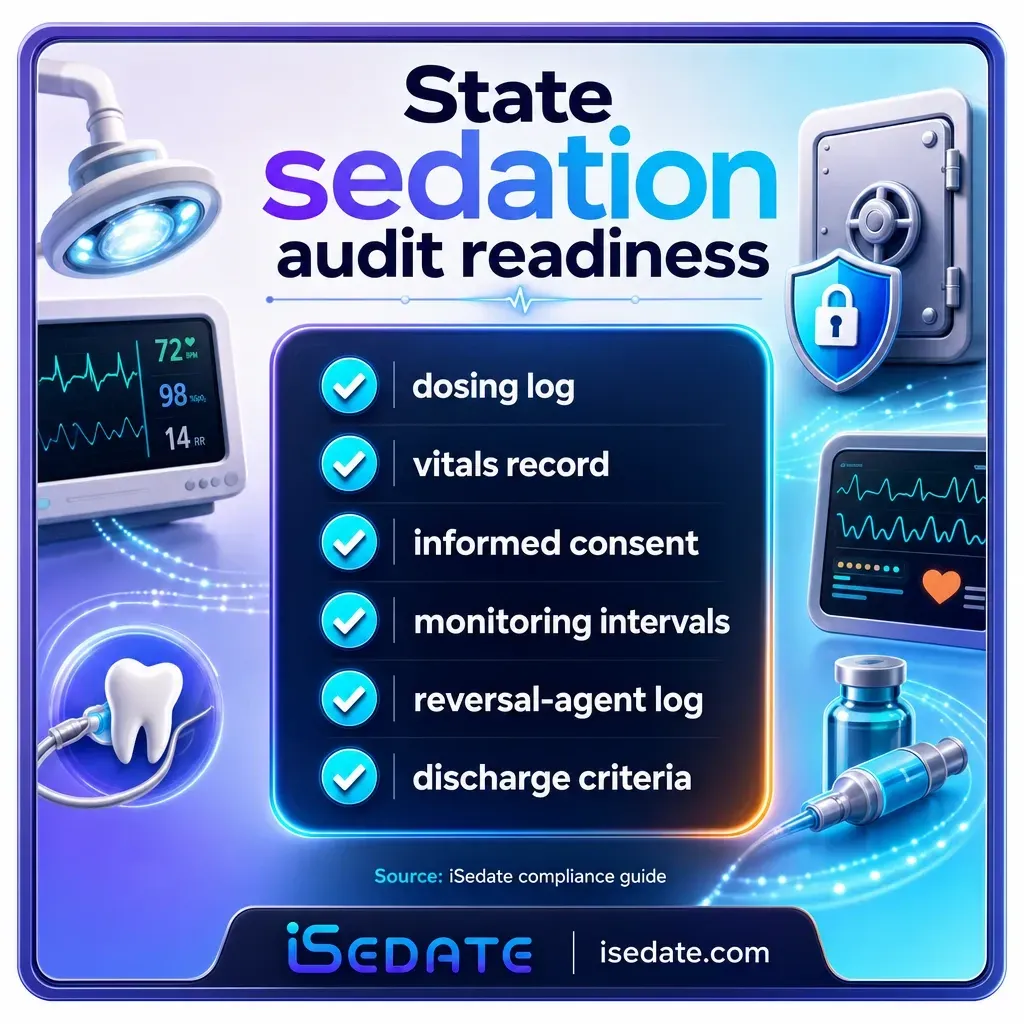
The anesthetic record. Because Delaware incorporates the ADA guidelines under §7.4.3.1, a permit holder providing moderate or deeper sedation is expected to keep the ADA's time-oriented anesthetic record: all drugs and dosages, their administration times, and continually recorded vital signs, through to a documented discharge assessment. Delaware does not restate this as its own itemized subsection; it binds you to it by reference.
The 30-day adverse-event report. This is the one reporting duty written expressly into the Delaware rule. Under §7.5.1, the dentist must submit a complete report to the Board within 30 days of any death, or any incident causing injury requiring hospitalization, that occurs during or as a direct result of Conscious Sedation, deep sedation, or general anesthesia.
State Law
The teeth behind it. Under §7.5.2, failing to comply with the anesthesia rule, including the reporting duty, is considered unprofessional conduct and may result in loss of the permit. The reporting obligation is not a filing technicality; it is a permit-level condition.
Source: 24 Del. Admin. Code 1100, Section 7.0 (§7.5.1, §7.5.2)
Facility, renewal, and continuing education
Delaware's anesthesia rule attaches requirements to the facility as well as the individual. The facility provisions in Section 7.0 govern the practice setting, the Anesthesia Advisory Committee inspects each office before a permit issues, and the Unrestricted Permit-Facility ties the office itself to the standard.
On renewal, the Board's own page confirms that anesthesia permits expire May 31 of even-numbered years, renewing on the same biennial cycle as the dentist license, and that permit holders attest to completing their continuing professional education and maintaining current CPR. What Section 7.0 does not publish in its own text is a numeric sedation-specific continuing-education cycle, which the Board administers under its general continuing-education rules (Section 6.0) and updates periodically. Confirm your current renewal continuing-education requirement and your resuscitation-certification renewals directly with the Board so your permit never lapses.
Source: Delaware Board of Dentistry license and permit renewal
What happens if you skip the permit
Important
Sedating without the matching permit is unprofessional conduct. Section 7.0 is explicit that no dentist may employ Conscious Sedation, Restricted Permit I or II, deep sedation, or general anesthesia without the Board-issued permit. Practicing a level above your permit, or with no permit at all, exposes you to Board discipline and the loss of your permit under §7.5.2, and it is the first thing a malpractice attorney and a liability carrier look for after an adverse event. A single-drug, single-dose oral sedative within dosage limits is the only exception, and it is narrow: titrating oral medication to effect, stacking doses, or adding nitrous crosses into permit territory. When in doubt, hold the appointment and confirm your scope with the Board rather than sedate outside it.
Keeping the permit: audit-ready records
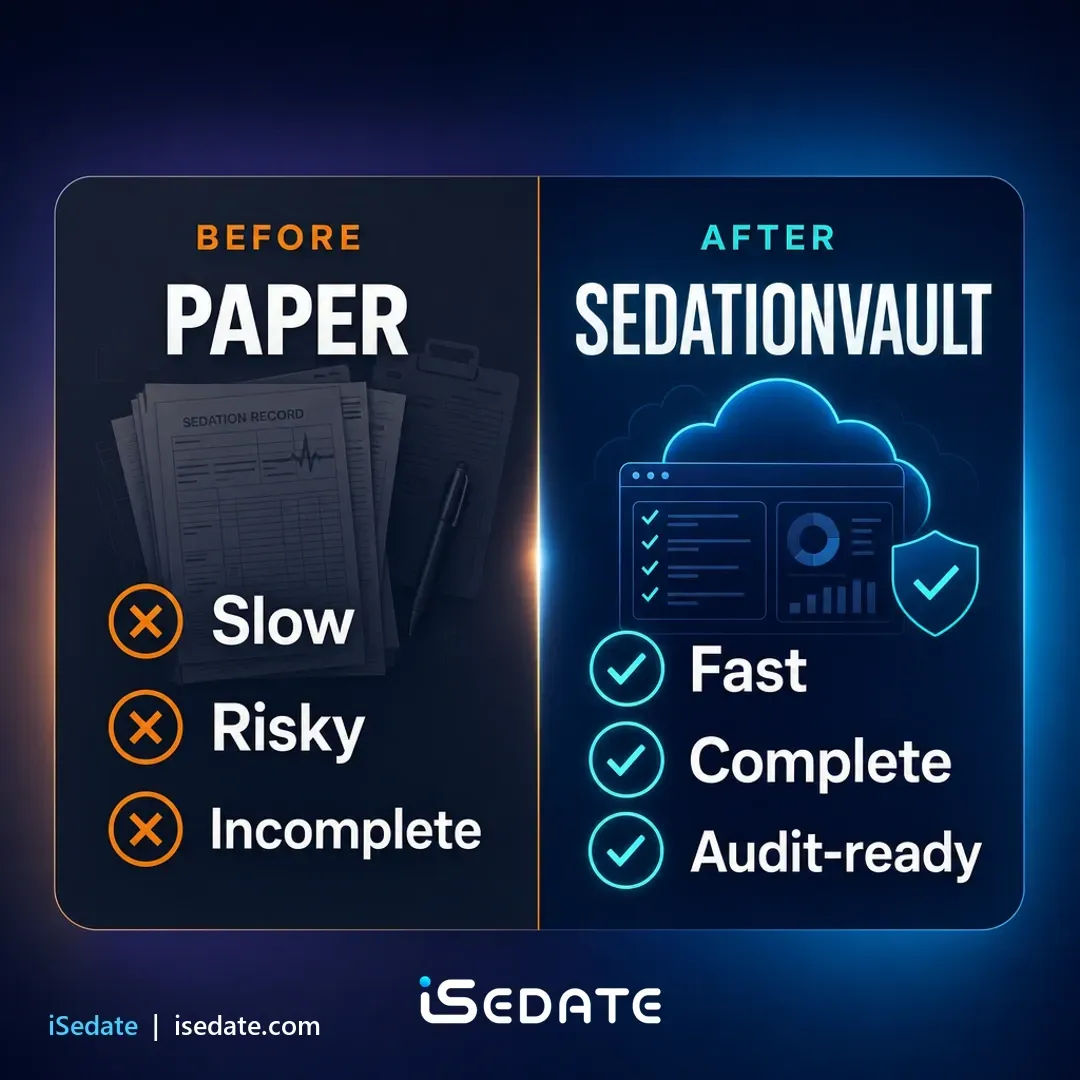
Everything above points to one truth: getting the permit is a one-time hurdle, but keeping it is a daily documentation discipline. A continual vitals log written by hand, between titrating a drug and watching an airway, is exactly where records go incomplete, and in Delaware an incomplete record undermines both the incorporated ADA standard you practice to and any 30-day adverse report you might have to file. Incomplete records are what a Board matter and a malpractice claim both attack.
SedationVault removes that failure point. It captures live patient vitals and the drug log automatically into a time-oriented anesthetic record that matches the ADA standard Delaware adopts, so the record writes itself while you focus on the patient. When the Board asks for the file, or when a complete report has to be assembled on a deadline, a full record is a one-click export rather than a scramble through paper. See how it maps to the rules on the dental sedation compliance and anesthesia record software pages.
Book a Demo of SedationVault See SedationVault PricingRelated guides and neighboring states
Licensed in a neighboring state, or comparing requirements across the region? Each state writes its own sedation-permit rule, so start with the matching guide:
- Maryland Sedation Dentistry Licensing & Permit Requirements
- New Jersey Sedation Dentistry Licensing & Permit Requirements
- Pennsylvania Sedation Dentistry Licensing & Permit Requirements
- Sedation Dentistry Licensing & Permit Requirements by State (all 50)
For the clinical companion in Delaware, see our guide to Delaware sedation vitals monitoring, charting, and reporting requirements.
Frequently asked questions
What sedation permits does Delaware require?
How many hours do you need for an IV sedation permit in Delaware?
How much does a Delaware dental sedation permit cost, and how often do you renew it?
Do you need a permit for oral sedation in Delaware?
What does a Delaware sedation permit require you to report?
Sources & How We Verified This Guide
Every figure in this guide was confirmed against the Delaware Board of Dentistry and Dental Hygiene's own permit pages and the current Section 7.0 on the state regulations site, not a third-party aggregator.
- 24 Del. Admin. Code 1100, Section 7.0: Anesthesia Regulations (permit levels, §7.2.2.1, §7.2.4, §7.3; ADA incorporation §7.4.3.1; 30-day report §7.5.1; enforcement §7.5.2).
- Delaware Board of Dentistry: Restricted Permit I requirements (60 hours, 20 patients, CPR, DELPROS process).
- Delaware Board of Dentistry: Restricted Permit II requirements (14 instructional hours, CPR).
- Delaware Board of Dentistry: Unrestricted Permit requirements (advanced-training paths, ACLS).
- Delaware Board of Dentistry fee schedule ($96 per anesthesia permit).
- Delaware Board of Dentistry license and permit renewal (biennial, May 31 even years).
- DELPROS: Delaware professional-licensing portal (application filing).
- American Dental Association, Guidelines for the Use of Sedation and General Anesthesia by Dentists (the professional standard Delaware incorporates by reference under §7.4.3.1, not Delaware law on its own).
This guide summarizes Delaware sedation permit rules for general information and is not legal advice. Requirements are current as of November 2026. Application forms, the exact fee, the routine inspection schedule, the detailed Unrestricted Permit clinical specifics, and the sedation-specific continuing-education cycle are set by the Delaware Board of Dentistry and Dental Hygiene and should be confirmed directly with the Board, through DELPROS, before you act.