






New Jersey Sedation Dentistry Licensing & Permit Requirements
In New Jersey, your dental license alone does not let you sedate a patient. A dentist who administers oral sedation, intravenous sedation, deep sedation, or general anesthesia must first hold the matching permit from the New Jersey State Board of Dentistry, issued under N.J.A.C. Title 13, Chapter 30, Subchapter 8. Getting the permit means meeting the training, certification, and live-patient requirements for your route and depth. Keeping it means your office passes its five-year inspection and your sedation records survive a board review. This guide walks both halves: how a New Jersey dentist gets a sedation or anesthesia permit, and what it takes to keep one.
Recent Updates
Last UpdatedNovember 16, 2026
- Re-verified every permit, training, inspection, continuing-education, and recordkeeping figure against the current rule text of N.J.A.C. 13:30 Subchapter 8.
- Added the per-location permit and biennial renewal rule, the five-year office-inspection cycle, and the rule that a general anesthesia or parenteral conscious sedation permit lets you use enteral sedation without a separate enteral permit.
- Replaced third-party statute links with the New Jersey State Board of Dentistry's own statutes, regulations, and application pages.
- New Jersey issues sedation and anesthesia permits under N.J.A.C. 13:30 Subchapter 8, from enteral (oral) sedation up to deep sedation and general anesthesia. Each permit is tied to one practice location and renews every two years.
- Most general dentists who sedate work in enteral (oral) sedation (13:30-8.4) and, when they add the IV route, parenteral conscious sedation (13:30-8.2). Deep sedation (13:30-8.1A) and general anesthesia (13:30-8.3) sit above and are largely the province of oral surgeons and dental anesthesiologists.
- The jump to IV: enteral sedation calls for at least 40 hours of didactic training, while parenteral conscious sedation calls for at least 60 didactic hours, management of at least 20 live patients, and ACLS.
- Offices that provide parenteral conscious sedation are inspected once every five years, and permit holders complete 20 hours of sedation continuing education every two years.
- The permit comes with a recordkeeping promise. Under 13:30-8.2 you must keep accurate, contemporaneous anesthetic records of agents, dosages, duration, vital signs, and patient responses, held at least seven years. Incomplete records are where permits get challenged.

What This Guide Covers
- Who issues sedation permits in New Jersey
- The four New Jersey permit types
- How to get or upgrade each permit
- What the permit requires you to monitor
- Recordkeeping obligations tied to your permit
- Inspections, CE, and renewal
- Keeping the permit: audit-ready records
- Related guides and neighboring states
- Frequently asked questions
- Sources
Who issues sedation permits in New Jersey
Sedation dentistry in New Jersey is regulated by the New Jersey State Board of Dentistry's statutes and regulations, within the Division of Consumer Affairs. The Board licenses dentists, issues every sedation and anesthesia permit, runs the office inspections, and takes disciplinary action. No national association decides who may sedate in New Jersey. The rules live in N.J.A.C. Title 13, Chapter 30, Subchapter 8, "Anesthesia and Sedation," and every requirement below traces to a section of that subchapter.
Myth, Busted
Myth: The ADA sets federal sedation law that overrides whatever the state requires.
Fact: The American Dental Association is a private professional association, not a government agency. It publishes sedation guidelines that New Jersey and most states lean on, but it does not license you, inspect you, or discipline you. Your permit, your five-year office inspection, and any sanction all come from the New Jersey State Board of Dentistry under N.J.A.C. 13:30 Subchapter 8.
Real federal layers sit alongside the state rule, not above it: the DEA governs controlled-substance logs, HIPAA governs patient privacy, and accreditation or payer rules may add their own documentation duties. Treat the ADA guidelines as best practice and Subchapter 8 as the law you are held to.
To apply for a permit, you work through the Board's own application process and demonstrate the training, certification, and live-patient experience for the route and depth you want. Applications are provided by the Board rather than printed in the rule, so download the current forms from the Board's applications page and confirm the current fee schedule before you file, because forms and fees are set by the Board and change periodically.
The four New Jersey permit types
New Jersey names its permits by route and depth, and the requirement reflects how deeply the patient is sedated, not just which drug is used. A permit is specific to a single practice location and renews every two years. Here is the ladder, each rung with its governing section of Subchapter 8.
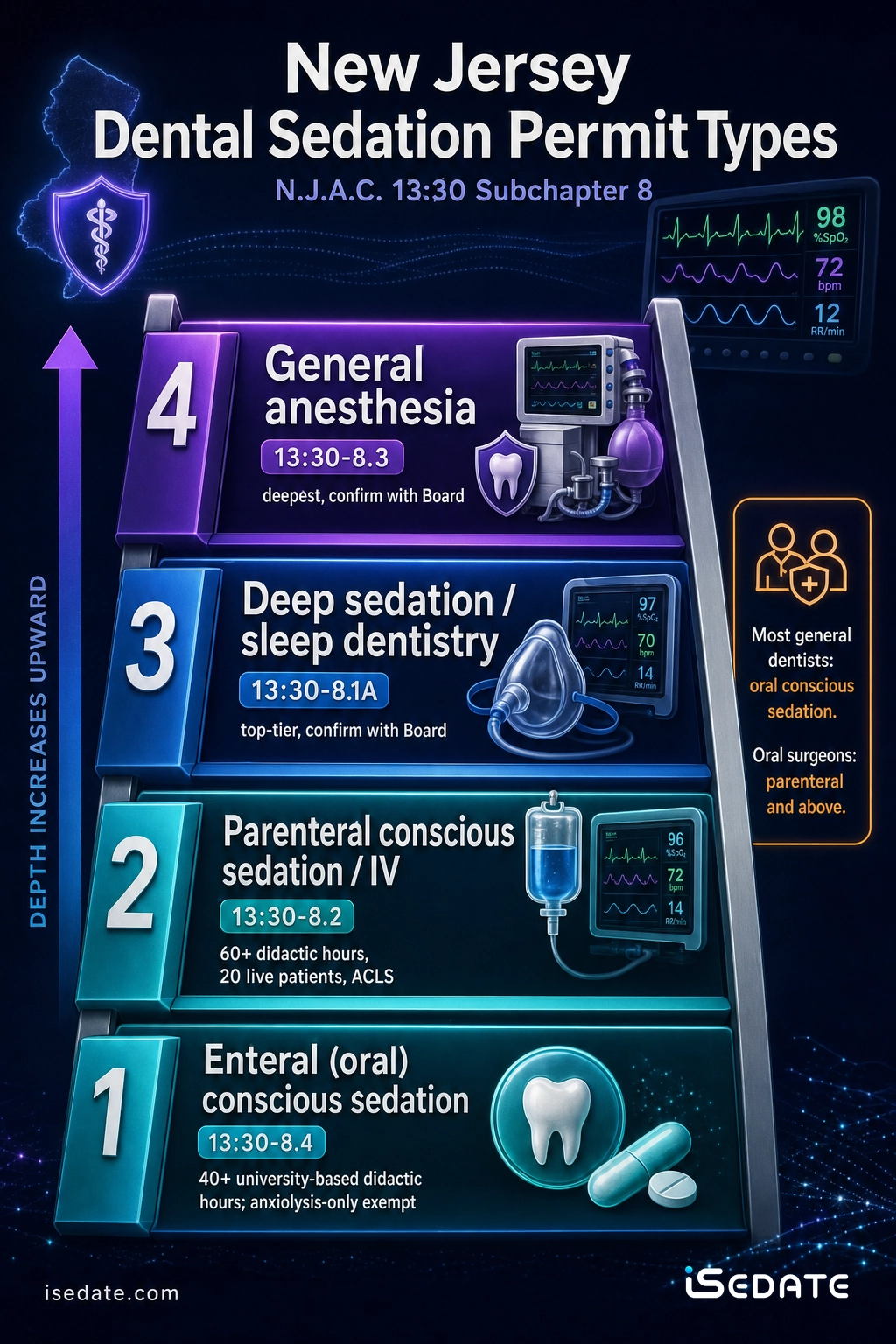
Enteral (oral) sedation permit (N.J.A.C. 13:30-8.4). Authorizes sedation taken by the enteral (oral) route. Under 13:30-8.4, a permit is required for any agent given at a dose that can inhibit a patient's response beyond anxiolysis; true anxiolysis-only use falls outside the permit requirement. This is the common starting point for general dentists who offer oral conscious sedation. One useful shortcut is written into the rule: a dentist who already holds a general anesthesia or parenteral conscious sedation permit may use enteral sedation without a separate enteral permit.
Parenteral Conscious Sedation permit (N.J.A.C. 13:30-8.2). Authorizes conscious sedation delivered by injection, including the intravenous route. Because the parenteral route carries faster onset and higher risk, parenteral conscious sedation sits above oral sedation and carries heavier training, monitoring, and record requirements, including a full mechanical monitoring standard. This is where sedation-trained general dentists and oral surgeons typically operate.
Deep sedation permit, sleep dentistry (N.J.A.C. 13:30-8.1A). Authorizes deep sedation, where the patient is not easily aroused. Deep sedation sits above conscious sedation and is largely the province of dental anesthesiologists and oral and maxillofacial surgeons. Its full training and monitoring rules sit in 13:30-8.1A, so if you are pursuing it, work directly from that section with the Board.
General anesthesia permit (N.J.A.C. 13:30-8.3). The top tier. It authorizes general anesthesia, where the patient is unconscious and may need airway support. General anesthesia is carried most often by oral and maxillofacial surgeons and dental anesthesiologists, and its specifics run beyond the scope of this guide. Level 4 anesthesia like this is largely out of scope for the general dentist, so confirm the current requirements for this level directly with the Board.
Source: New Jersey State Board of Dentistry statutes and regulations (N.J.A.C. 13:30 Subchapter 8)
How to get or upgrade each permit
Each permit has its own bar to clear: a set amount of training, resuscitation certification, and, for parenteral conscious sedation, a count of managed live patients. You move up the ladder by meeting the next level's requirements and applying to the Board for that location. The figures below reflect New Jersey's published sedation training requirements; always confirm the current numbers and forms with the Board before you file.
| Permit | Route / depth | Training | Live patients | Resuscitation | Renewal |
|---|---|---|---|---|---|
| Enteral (oral) sedation (13:30-8.4) | Oral conscious sedation | At least 40 didactic hours | Confirm with Board | Confirm with Board | Every 2 years, per location |
| Parenteral conscious sedation (13:30-8.2) | Parenteral / IV conscious sedation | At least 60 didactic hours (board-approved) | At least 20 live patients | ACLS | Every 2 years, per location |
| Deep sedation (13:30-8.1A) | Deep sedation / sleep dentistry | See 13:30-8.1A (confirm with Board) | See 13:30-8.1A | Confirm with Board | Every 2 years, per location |
| General anesthesia (13:30-8.3) | General anesthesia | See 13:30-8.3 (confirm with Board) | See 13:30-8.3 | Confirm with Board | Every 2 years, per location |
Oral (enteral) sedation
To provide enteral (oral) sedation under 13:30-8.4, a dentist completes at least 40 hours of didactic training through approved post-doctoral coursework, covering basic enteral sedation, physical evaluation, complication management, and patient monitoring, and holds the permit for that location. Two nuances live in the rule itself. First, the permit requirement is dose-based: it applies once an agent can inhibit a patient's response beyond anxiolysis, so genuine conscious sedation needs the permit while true anxiolysis does not. Second, if you already hold a general anesthesia or parenteral conscious sedation permit, you may use enteral sedation without a separate enteral permit.
Parenteral conscious sedation: adding the IV route
Upgrading to a parenteral conscious sedation permit (13:30-8.2) is the biggest step a general dentist or oral surgeon takes. New Jersey's published path calls for board-approved training of at least 60 hours of didactic instruction, management of at least 20 live patients, and current ACLS certification. The live-patient requirement is substantial because IV titration demands hands-on competence a classroom cannot replicate, and the permit carries the full mechanical monitoring standard in 13:30-8.2.
For every level, the application, the current fee schedule, and any additional requirement are set by the Board and updated periodically. Do not rely on a number you read on a continuing-education provider's page. Download the current forms and confirm the fees on the Board's applications page before you file. The required didactic coursework is taken through approved post-doctoral programs; one widely used option is DOCS Education's New Jersey sedation training, which should be confirmed as board-approved for your permit level.
Source: N.J.A.C. 13:30-8.2 and 13:30-8.4 (training and permit requirements) | New Jersey State Board of Dentistry applications
What the permit requires you to monitor
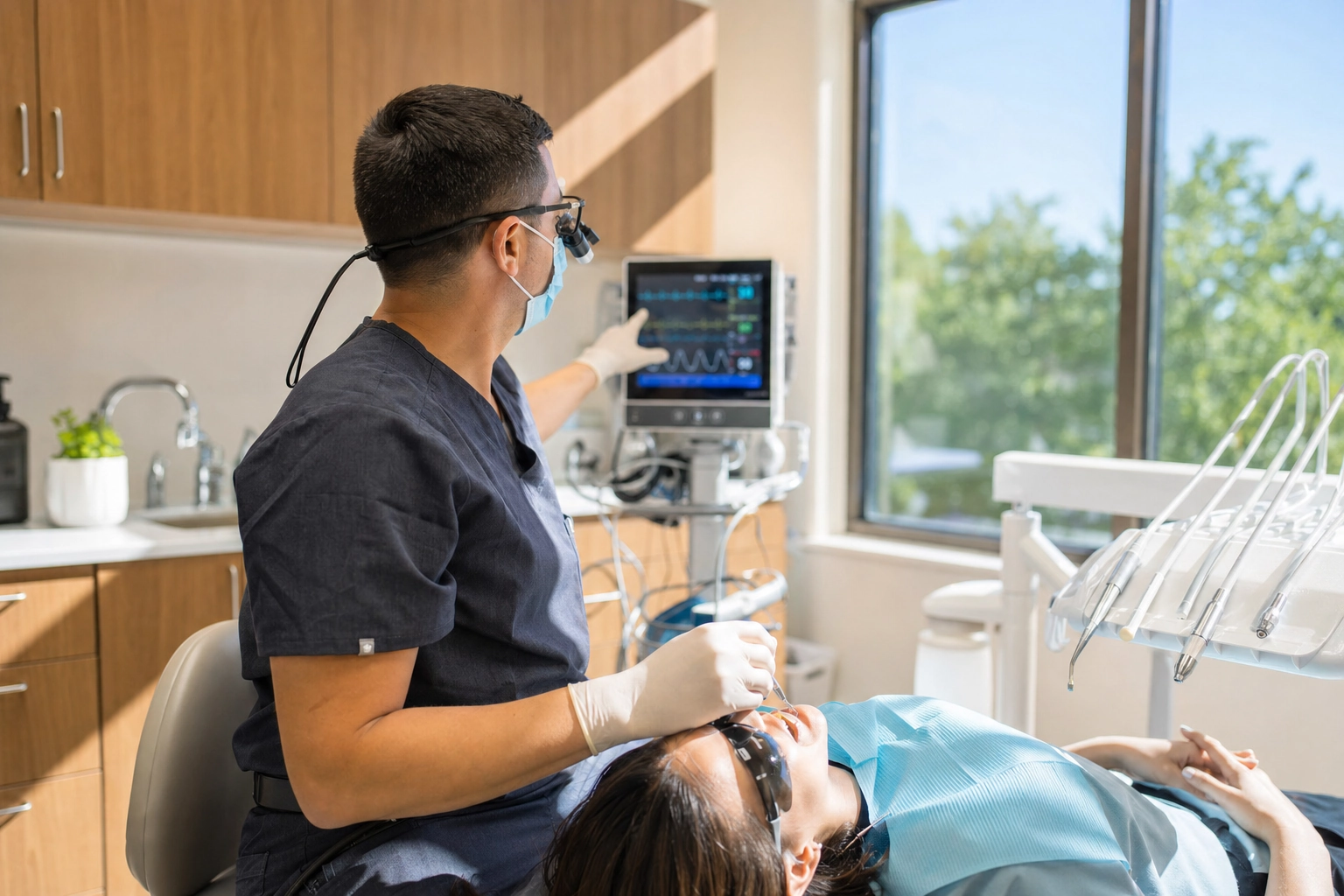
A permit is permission plus obligation. Once you hold a parenteral conscious sedation permit, 13:30-8.2 requires you to monitor the patient using clinical evaluation and mechanical means, watching four systems:
- Consciousness: the patient's level of sedation and responses are assessed and documented throughout the case.
- Oxygenation: oxygen saturation is monitored with a pulse oximeter.
- Ventilation: respiration is watched with respiration monitoring equipment and a capnogram, so exhaled carbon dioxide is tracked.
- Circulation: blood pressure is measured with a blood pressure monitoring device, and an EKG monitor tracks cardiac rhythm.
The equipment standard is explicit. Under 13:30-8.2(f)(4), monitoring is done using clinical evaluations and mechanical means, including an EKG monitor, pulse oximeter, and capnogram, and 13:30-8.2(i) requires the operatory to be equipped with a blood pressure monitoring device, EKG monitor, pulse oximeter, respiration monitoring equipment, and a capnometer. At least one assisting staff member must be capable of monitoring vital signs. For the full clinical breakdown of what to monitor, chart, and report during a case, see the companion guide on New Jersey sedation vitals monitoring, charting, and reporting requirements.
Source: N.J.A.C. 13:30-8.2(f)(4), (h), (i)
Recordkeeping obligations tied to your permit
Holding a permit also means holding a set of documentation duties, and these are exactly what a board review examines.
The anesthetic record. Under 13:30-8.2(m), specific contemporaneous records on the use of parenteral conscious sedation must be kept as part of every patient chart, including the agents used, the dosage, and the duration of sedation. Subsection (f)(6) requires accurate and contemporaneous anesthetic records, and the applicant rule requires a permit holder to maintain accurate records of drug dosages, vital signs, and patient responses.
Discharge documentation. Under 13:30-8.2, the dentist must manage patients post-operatively and assess their suitability for discharge, and the recovery area must be equipped with oxygen and monitoring equipment. The record should show that the recovery and discharge assessment actually happened.
Retention. Patient histories must be kept at least seven years under 13:30-8.2(m), consistent with the general dental-records rule in 13:30-8.7(d), which requires records retained at least seven years from the last entry.
New Jersey Sedation Permit Quick Facts
- Per location: a permit covers one practice location; a dentist who sedates at two offices needs a permit for each (13:30-8.2(c), 13:30-8.4(c)).
- Renewal: permits are renewed every two years.
- Office inspection: parenteral conscious sedation offices are inspected once every five years; mobile equipment at least once every three years (13:30-8.2(e), (l)).
- Continuing education: at least 20 hours of board-approved sedation CE each two-year period (13:30-8.2(n)).
- Records: contemporaneous anesthetic record in every chart, retained at least seven years (13:30-8.2(m)).
Source: N.J.A.C. 13:30-8.2(c), (e), (f)(6), (l), (m), (n) | N.J.A.C. 13:30-8.7 (records and seven-year retention)

Inspections, CE, and renewal
This is where a permit is kept or lost. The permits that authorize parenteral conscious sedation and deeper anesthesia carry the heaviest scrutiny, because that is where the risk is.
Office inspection. Under 13:30-8.2(e), an office where parenteral conscious sedation is administered is inspected and approved once every five years by the State Board of Dentistry or its designee. If you use mobile equipment, that equipment is inspected not less than once every three years under 13:30-8.2(l). Passing the inspection is part of holding the permit, not a one-time hurdle at application.
Continuing education and renewal. Permits renew every two years, and renewal is conditioned on staying current. Under 13:30-8.2(n), a parenteral conscious sedation permit holder certifies completion of at least 20 hours of board-approved continuing education devoted to sedation during the previous two-year period. The enteral permit carries a comparable 20-hour continuing-education expectation. Confirm your exact renewal cycle, CE hours, and any resuscitation-certification intervals directly with the New Jersey State Board of Dentistry so your permit never lapses at renewal.
Important
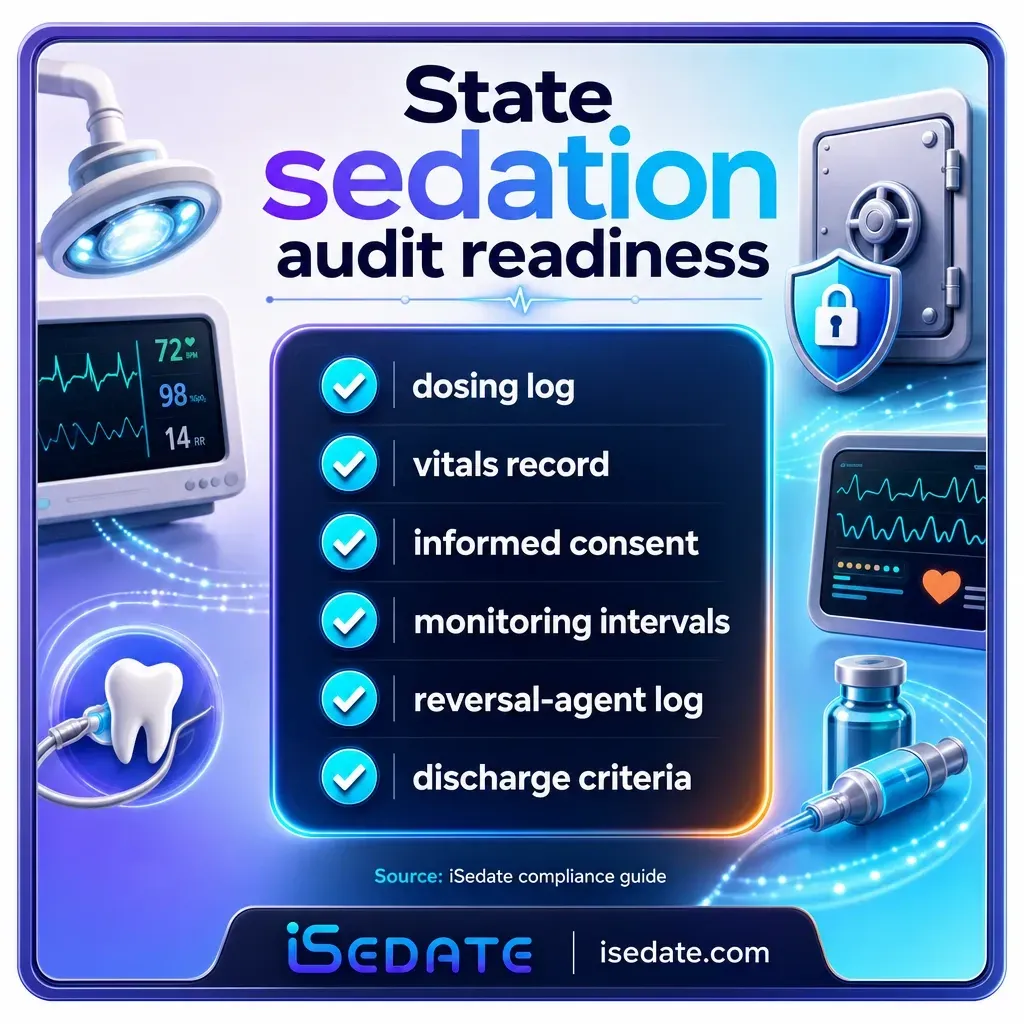
A board review turns on the record, not your intentions. When a reviewer opens your file, they check whether your contemporaneous anesthetic record is complete, retained within the seven-year window, and consistent with the agents, dosages, duration, vital signs, and patient responses that 13:30-8.2 names. The sedation can be clinically flawless and the permit can still be challenged on the paperwork. The same incomplete record that fails a board review is what a malpractice claim attacks.
Source: N.J.A.C. 13:30-8.2(e), (l), (m), (n)
Keeping the permit: audit-ready records
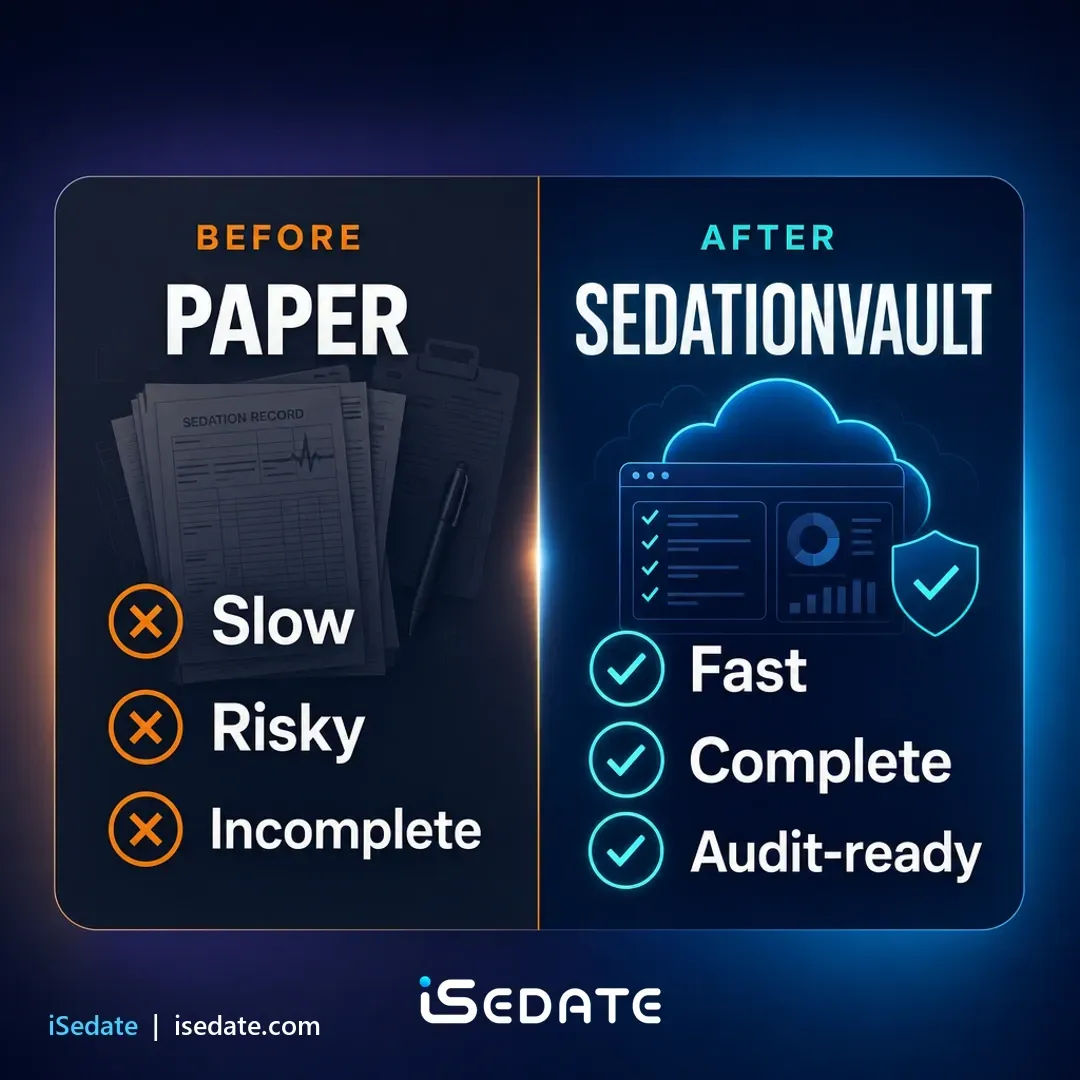
Everything above points to one truth: getting the permit is a one-time hurdle, but keeping it is a daily documentation discipline. A manual anesthetic record written by hand during a live case, between titrating a drug and watching an airway, is exactly where records go incomplete, and incomplete records are what a board review and a malpractice claim both attack.
SedationVault removes that failure point. It captures live patient vitals and the drug log automatically into an accurate, contemporaneous, New Jersey-ready anesthetic record that holds the agents, dosages, duration, vital signs, and patient responses 13:30-8.2 demands, so the record writes itself while you focus on the patient. When the Board asks for the file at a five-year inspection or a record review, a complete record held within the seven-year window is a one-click export, not a scramble through paper. See how it maps to New Jersey rules on the dental sedation compliance and anesthesia record software pages.
Book a demo of SedationVault See SedationVault pricingRelated guides and neighboring states
Sedation permit rules are set state by state, so a permit in one state does not transfer to another. Licensed in a neighboring state, or practicing across a border? See our companion guides:
- New York sedation dentistry licensing and permit requirements
- Pennsylvania sedation dentistry licensing and permit requirements
- Delaware sedation dentistry licensing and permit requirements
- Sedation Dentistry Licensing & Permit Requirements by State, our all-50-state hub.
Frequently asked questions
What sedation permits does New Jersey require?
How many training hours do you need for an IV sedation permit in New Jersey?
Do you need a separate oral sedation permit if you already hold a general anesthesia or parenteral conscious sedation permit?
Is a permit required for oral sedation at anxiolysis-only doses?
How often are New Jersey sedation offices inspected?
How long must New Jersey sedation records be kept, and how often is continuing education required?
Related reading: the data behind these rules
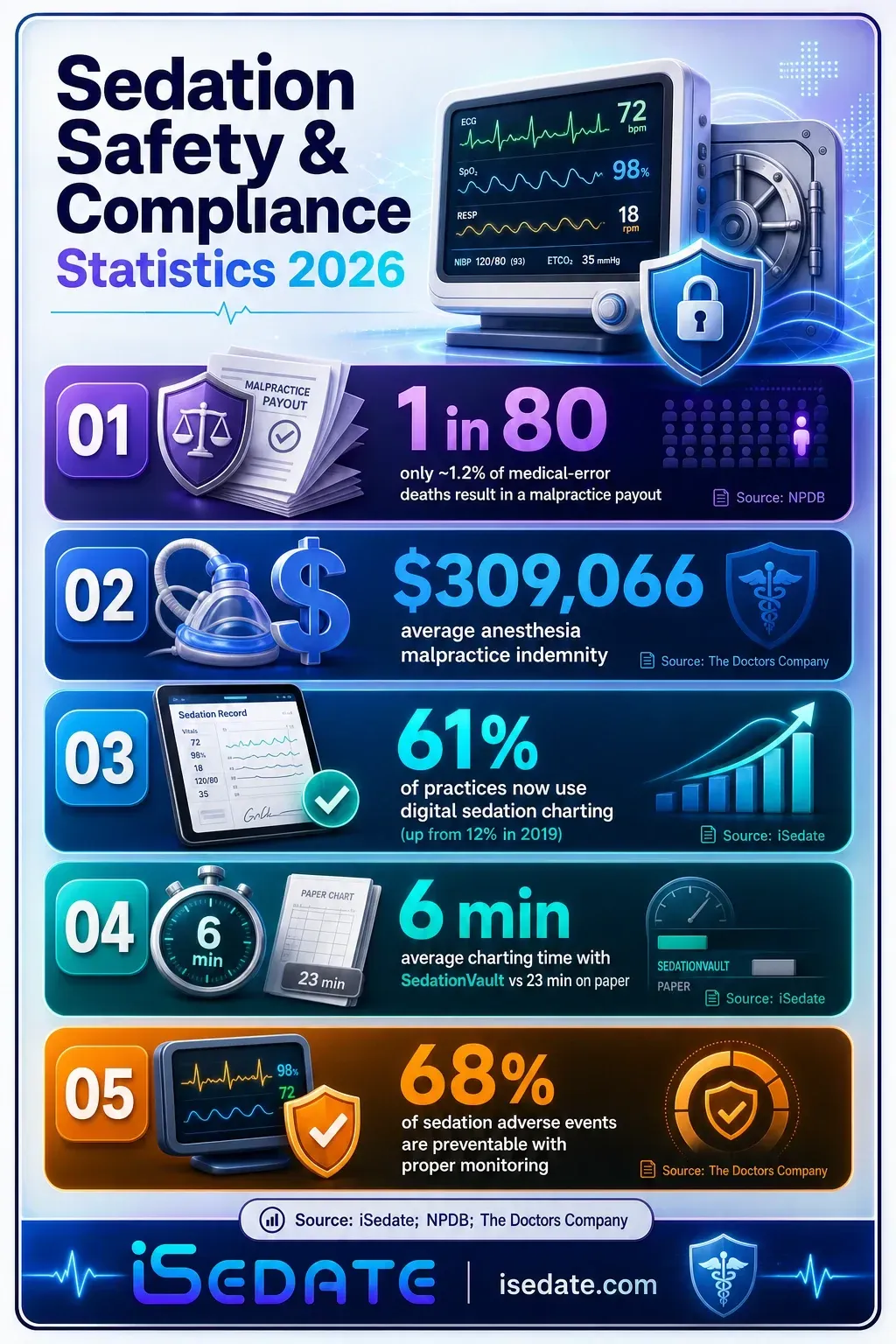
The requirements on this page are the law. These research roundups are the data that explains why they exist and what happens when a practice gets charting or permitting wrong:
Sources
- New Jersey State Board of Dentistry, Statutes and Regulations (N.J.A.C. Title 13, Chapter 30, Subchapter 8, "Anesthesia and Sedation")
- New Jersey State Board of Dentistry, Applications and Forms
- New Jersey State Board of Dentistry, Licensing FAQ
- DOCS Education, New Jersey sedation training overview (continuing-education provider; confirm board approval for your permit level)
This guide summarizes New Jersey sedation permit rules for general information and is not legal advice. Permit types, per-location and biennial renewal, the five-year office inspection, 20-hour continuing-education requirement, monitoring equipment, and recordkeeping and seven-year retention are drawn from N.J.A.C. 13:30 Subchapter 8 (sections 8.2 and 8.4) and New Jersey's published sedation training requirements as cited. The 60-hour, 20-live-patient, and ACLS figures for parenteral conscious sedation reflect New Jersey's published training path; the Board's exact application forms, current fees, specific exam requirements, penalty schedule, adverse-event reporting triggers, and the full deep sedation (13:30-8.1A) and general anesthesia (13:30-8.3) training specifics are set by the New Jersey State Board of Dentistry and should be confirmed directly with the Board before you act. Requirements current as of November 2026.