





New York Sedation Dentistry Licensing & Permit Requirements
In New York, your dental license alone does not let you sedate a patient. A dentist who administers Conscious Sedation (moderate sedation), deep sedation, or general anesthesia anywhere other than a general hospital must first hold a dental anesthesia certificate issued by the New York State Education Department, under Education Law §6605-a and the rule at 8 NYCRR 61.10. New York issues five of these certificates, split by sedation route and patient age. This guide covers both halves of the job: how a New York dentist earns the right certificate, and what it takes to keep it when a reviewer pulls your records.
Recent Updates
Last UpdatedNovember 16, 2026
- Corrected the certificate structure to New York's full five dental anesthesia certificates. Both the parenteral and the enteral route are each available for adults 13 and older and for children 12 and younger, not one route per age band.
- Added the verified requirements for each certificate, sourced directly to the NYSED Office of the Professions: the 60 clock hours, the live-patient counts, ACLS and PALS, the $100 triennial fee, and the application path through the Division of Professional Licensing Services.
- Replaced third-party statute links with New York's own official sources.
- New York issues a dental anesthesia certificate, not a numbered "permit," under 8 NYCRR 61.10 and Education Law §6605-a.
- There are five certificates: general anesthesia; parenteral Conscious Sedation for 13 and older; parenteral for 12 and younger; enteral Conscious Sedation for 13 and older; and enteral for 12 and younger.
- No certificate is required for minimal sedation or nitrous oxide alone. Every deeper level outside a general hospital requires the matching certificate.
- The adult IV (parenteral) certificate requires ACLS, at least 60 clock hours of coursework, and no fewer than 20 live IV patients, 13 and older.
- Each certificate costs $100 and renews every three years, and keeping it turns on one thing a review examines: the time-oriented anesthesia record.
What This Guide Covers
- Who issues sedation certificates in New York
- The five New York dental anesthesia certificates
- How to earn each certificate: training and live patients
- Fees, application, renewal, and endorsement
- What the certificate requires you to monitor
- The time-oriented anesthesia record
- Record reviews and enforcement
- Keeping the certificate: audit-ready records
- Licensed in a neighboring state?
- Frequently asked questions
- Sources
Who issues sedation certificates in New York
Sedation dentistry in New York is regulated by the New York State Board for Dentistry, which operates inside the New York State Education Department's Office of the Professions. That structure is different from most states. New York does not have a standalone, self-governing dental board. Dentistry is one of the professions the State Education Department oversees, and it is the department, through its Division of Professional Licensing Services, that issues the dental anesthesia certificate, reviews records, and takes disciplinary action. The governing rule is 8 NYCRR 61.10, a section of the Regulations of the Commissioner of Education, with its statutory basis in Education Law §6605-a.
Important
The ADA writes the standard; the state writes the law. The American Dental Association publishes sedation guidelines that New York and most states lean on, but the ADA is a professional association, not a government agency. It does not certify you, review you, or discipline you. Your certificate, your record reviews, and any sanctions all come from the New York State Education Department under 8 NYCRR 61.10 and Education Law §6605-a. The federal layers that do apply sit elsewhere: the DEA governs your controlled-substance logs and HIPAA governs the records. Treat the ADA guidelines as best practice and the New York rule as the law you are held to.
The trigger for needing a certificate is set by statute. Under Education Law §6605-a, a licensed dentist "shall not employ conscious sedation, deep sedation or general anesthesia in the practice of dentistry" at any location other than a general hospital without a dental anesthesia certificate issued by the department. Inside a general hospital, the hospital's own anesthesia privileging governs. Everywhere else, which means essentially every private office and surgery center, the certificate is the gatekeeper.
Source: NYSED Office of the Professions, dental anesthesia / sedation certification | New York Education Law §6605-a
The five New York dental anesthesia certificates
New York names its sedation authority by certificate, and the certificate reflects three things at once: how deeply the patient is sedated, the route of the drug (enteral or parenteral), and the age band of the patients you want to treat. There are five separate certificates. Here is the full structure, each tied to 8 NYCRR 61.10 and Education Law §6605-a.
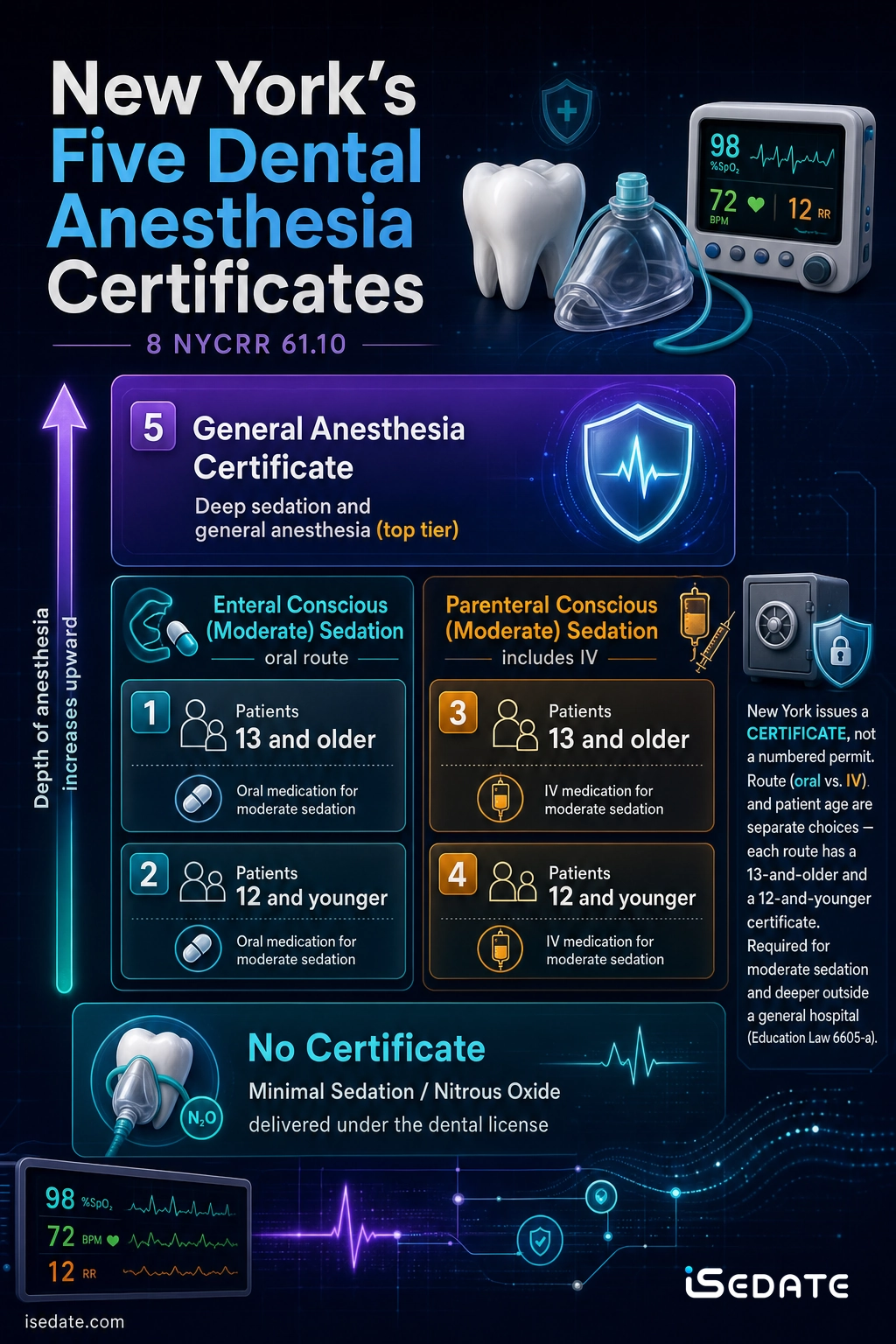
No certificate: minimal sedation and nitrous oxide. Minimal sedation (anxiolysis) and nitrous oxide / oxygen inhalation sedation do not require a dental anesthesia certificate in New York. These are the lightest forms of anxiety control, where the patient stays fully responsive, and they are delivered under the general dental license and the standard of care. "No certificate" does not mean "no standard," though: the clinical duties attach the moment a patient drifts deeper than intended.
Enteral Conscious (Moderate) Sedation, 13 and older, and 12 and younger. An enteral certificate authorizes moderate ("conscious") sedation by the enteral route only, meaning oral or other non-injection routes, with or without inhalation agents. New York issues this certificate in two age versions: one for patients 13 years old and older, and one for patients 12 years old and younger. The younger version, because it qualifies you on the harder pediatric cohort, authorizes sedation on patients of all ages.
Parenteral Conscious (Moderate) Sedation, 13 and older, and 12 and younger. A parenteral certificate authorizes moderate sedation that includes the parenteral route, which covers intravenous (IV) sedation and other injected routes, and it also covers the enteral route. New York again issues it in two age versions, 13 and older and 12 and younger. Because the parenteral route carries a faster onset and a higher risk, this is the heavier moderate-sedation credential and the one most sedation-focused general dentists and oral surgeons pursue for adult IV sedation.
General anesthesia certificate. The top tier. Under Education Law §6605-a, deep sedation and general anesthesia, where the patient is not easily aroused or is unconscious and may need airway support, require the general anesthesia certificate, which also authorizes moderate sedation by either route. This is largely the province of dental anesthesiologists and oral and maxillofacial surgeons. A general dentist adding sedation almost always operates in the enteral or parenteral conscious-sedation band, not here.
Myth, Corrected
Myth: In New York the enteral certificate is for children and the parenteral certificate is for adults.
Fact: Route and age are two separate axes. New York issues both the enteral and the parenteral certificate in a 13-and-older version and a 12-and-younger version, per the NYSED certification requirements.
The certificate you need is set by how you deliver the drug (oral vs. injected) and the ages you treat, not by one locking the other.
Source: NYSED Office of the Professions, dental anesthesia / sedation certification | Education Law §6605-a
How to earn each certificate: training and live patients
Each certificate has its own bar to clear: a block of approved coursework, the right life-support certification, and documented experience on live patients. You move up by meeting the next certificate's requirements and applying to the Education Department. Unlike many states, New York publishes these requirements in detail, so you can plan against real numbers rather than guesswork.
| New York certificate | Route / depth | Coursework | Live-patient experience | Life support |
|---|---|---|---|---|
| No certificate (minimal / nitrous) | Minimal sedation, nitrous oxide | None required by rule | None | Standard of care (BLS) |
| Enteral conscious (moderate), 13 and older | Enteral (oral) moderate sedation | ≥60 clock hours | ≥10 live patients, 13+ | ACLS |
| Enteral conscious (moderate), 12 and younger | Enteral (oral) moderate sedation | ≥60 clock hours | ≥15 patients 12&under + 5 patients 13+ | ACLS + PALS |
| Parenteral conscious (moderate), 13 and older | Parenteral / IV moderate sedation | ≥60 clock hours | ≥20 live IV patients, 13+ | ACLS |
| Parenteral conscious (moderate), 12 and younger | Parenteral / IV moderate sedation | ≥60 clock hours | ≥15 IV patients 12&under + 5 patients 13+ | ACLS + PALS |
| General anesthesia certificate | Deep sedation / general anesthesia | CODA residency (OMS or dental anesthesiology) | Per the accredited program | ACLS (+ PALS for 12&under) |
Source: NYSED dental anesthesia / sedation certification requirements (8 NYCRR 61.10)
Nitrous oxide and minimal sedation
These two lightest options sit outside the certificate system. No certificate is issued for either one, which makes nitrous the usual first step for a general practice adding light anxiety control. Continuing-education providers such as DOCS Education's New York course listing commonly package nitrous instruction as a short course with basic life support, but the key point stands: the certificate requirement begins at Conscious Sedation, not below it.
Enteral Conscious Sedation
The enteral certificate is New York's credential for moderate oral sedation. For the adult version (13 and older), the published requirements are current ACLS plus a formal course of at least 60 clock hours of approved coursework, followed by a clinical experience managing no fewer than 10 live patients, 13 and older. The pediatric version (12 and younger) adds PALS on top of ACLS and raises the clinical experience to no fewer than 15 patients 12 and younger plus 5 patients 13 and older. The 60 clock hours are not generic lecture time: they must cover patient evaluation and monitoring, management of emergencies, rescue from deep sedation, adult and pediatric airway management, cardiac and pulmonary anatomy and physiology, pharmacology, and the control of pain and anxiety.
Parenteral Conscious Sedation: adding IV
Upgrading to the parenteral certificate, which covers IV moderate sedation, is the biggest step a general dentist or oral surgeon takes. For the adult version (13 and older), New York requires current ACLS, at least 60 clock hours of the same approved coursework, and a clinical experience demonstrating the successful use of parenteral Conscious Sedation by the IV route on no fewer than 20 live patients, 13 and older, in a one-to-one doctor-to-patient ratio. The pediatric version (12 and younger) adds PALS and requires 15 IV patients 12 and younger plus 5 patients 13 and older. The live-patient floor reflects a clinical truth: IV titration demands hands-on competence a classroom cannot replicate, which is exactly why the rule puts a real patient count behind it.
Minimum live-patient clinical experience by certificate (8 NYCRR 61.10)
General anesthesia
The general anesthesia certificate is a different animal. New York requires an accredited residency, not a weekend pathway: as of January 1, 2019, at least three years of post-doctoral anesthesia education (two years for programs completed before that date), or a graduate-level oral and maxillofacial surgery program, plus ACLS, and PALS if you anesthetize patients 12 and younger. For most general dentists this tier is out of scope, which is why the practical decision for a sedation-focused practice is enteral or parenteral Conscious Sedation.
Source: NYSED dental anesthesia / sedation certification requirements (8 NYCRR 61.10)

Fees, application, renewal, and endorsement
You apply through the Education Department's Division of Professional Licensing Services. You must already be a New York licensed dentist, currently registered, and you file the application for certification plus the forms indicated for your category, along with the fee.
New York Certificate: Fee & Renewal Facts
- Fee: $100 per dental anesthesia/sedation certificate, paid to the Division of Professional Licensing Services.
- Renewal: triennial, every three years, under Education Law §6605-a (the statute sets the fee at "one hundred dollars" on a triennial renewal basis).
- Prerequisite: a current New York dental license and registration.
- Endorsement: available for a certificate held in another U.S. or Canadian jurisdiction, with a certificate of good standing and proof you met the matching requirements.
Endorsement from another state. If you already hold a sedation certificate elsewhere, New York offers certification through endorsement. You must be registered to practice in New York and submit a certificate of good standing, plus evidence that you met the requirements for the certificate you want. For general anesthesia that means a Commission on Dental Accreditation (CODA) accredited oral and maxillofacial surgery or dental anesthesiology residency; for parenteral conscious sedation, the Department asks for a set of your anesthesia records and an account of any adverse outcomes. Fees and the exact forms are set by the department and change periodically, so confirm the current forms with the New York State Board for Dentistry before you file.
Source: Education Law §6605-a | NYSED certification requirements and endorsement
What the certificate requires you to monitor
A certificate is permission plus obligation. Once you hold a Conscious Sedation certificate, 8 NYCRR 61.10 requires you to maintain and monitor the clinical states that keep a sedated patient safe: a patent airway, adequate ventilation, and maintained cardiovascular function. In practice, that means continually watching and documenting the systems those states depend on:
- Oxygenation: oxygen saturation by pulse oximetry, with clinical observation of color.
- Ventilation: chest excursion and breathing, evaluated continually.
- Circulation: blood pressure and heart rate, evaluated continually, with electrocardiographic monitoring at the deeper levels.
- Consciousness: the patient's level of sedation and responsiveness, continually assessed.
The practice requirements in 8 NYCRR 61.10(d) set the monitoring floor that every training program must meet and every certificate holder must follow. For the full clinical breakdown of what to monitor and chart at each level, see the companion guide on New York sedation vitals monitoring, charting, and reporting requirements, and the national overview in our Sedation Dentistry Licensing & Permit Requirements by State hub.
Source: NYSED Office of the Professions, sedation certification Q&A (8 NYCRR 61.10)
The time-oriented anesthesia record
Holding a certificate also means holding a documentation duty, and it is exactly what a record review examines.
What the record must contain. Under 8 NYCRR 61.10, a dentist who sedates must maintain a time-oriented anesthesia record that documents, at appropriate time intervals, the drugs and doses administered and the physiologic data obtained through patient monitoring. That same record is what every training program has its students keep, which is why the clinical-experience requirement specifies the student's name on the anesthesia record as the person administering the drugs and documenting the findings.
Recovery is a documented phase. The record has to reach through recovery, so the monitoring and documentation do not stop when the procedure ends. Physiologic data continues into the recovery period until the patient is ready for discharge, and that stretch has to appear on the record. A chart that goes quiet at "procedure complete" is an incomplete record.
Enforcement sits behind it. Practicing the certified levels outside a general hospital without the matching certificate is prohibited under Education Law §6605-a, and documentation and practice-rule violations are subject to professional-misconduct enforcement through the Office of the Professions. The specific penalty schedule and any adverse-event reporting triggers are administered by the Education Department and can change, so confirm the current reporting duties and timelines directly with the Board.
Source: NYSED sedation certification Q&A (8 NYCRR 61.10) | Education Law §6605-a
Record reviews and enforcement
This is where a certificate is kept or lost. New York's sedation records are the evidence in any professional-conduct review by the Office of the Professions, and the certificates that authorize deeper sedation carry the heaviest scrutiny, because that is where the risk is.
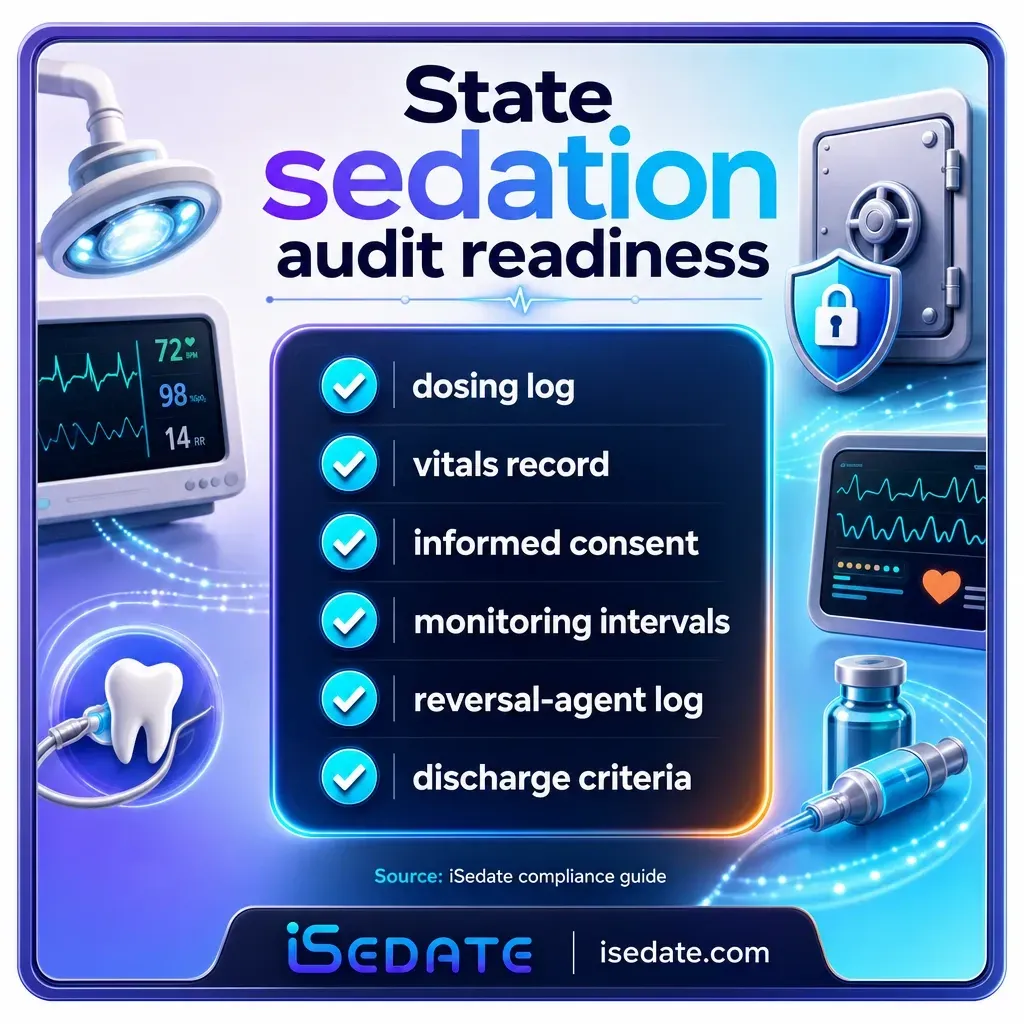
When a reviewer opens your file, they are checking the record, not your intentions. A conduct review turns on whether your time-oriented anesthesia record is complete, contemporaneous, and intervaled correctly across all three stages. The common failure is not the clinical care, it is the paperwork: a missing time stamp, a drug given but not logged, a recovery phase that never made it onto the page. The sedation can be flawless and the record can still fail. The routine inspection regime for certificate holders is administered by the Education Department and is not spelled out in the published certification guidance, so confirm whether and how your practice may be inspected directly with the Board.
Source: New York State Board for Dentistry, Office of the Professions
Keeping the certificate: audit-ready records
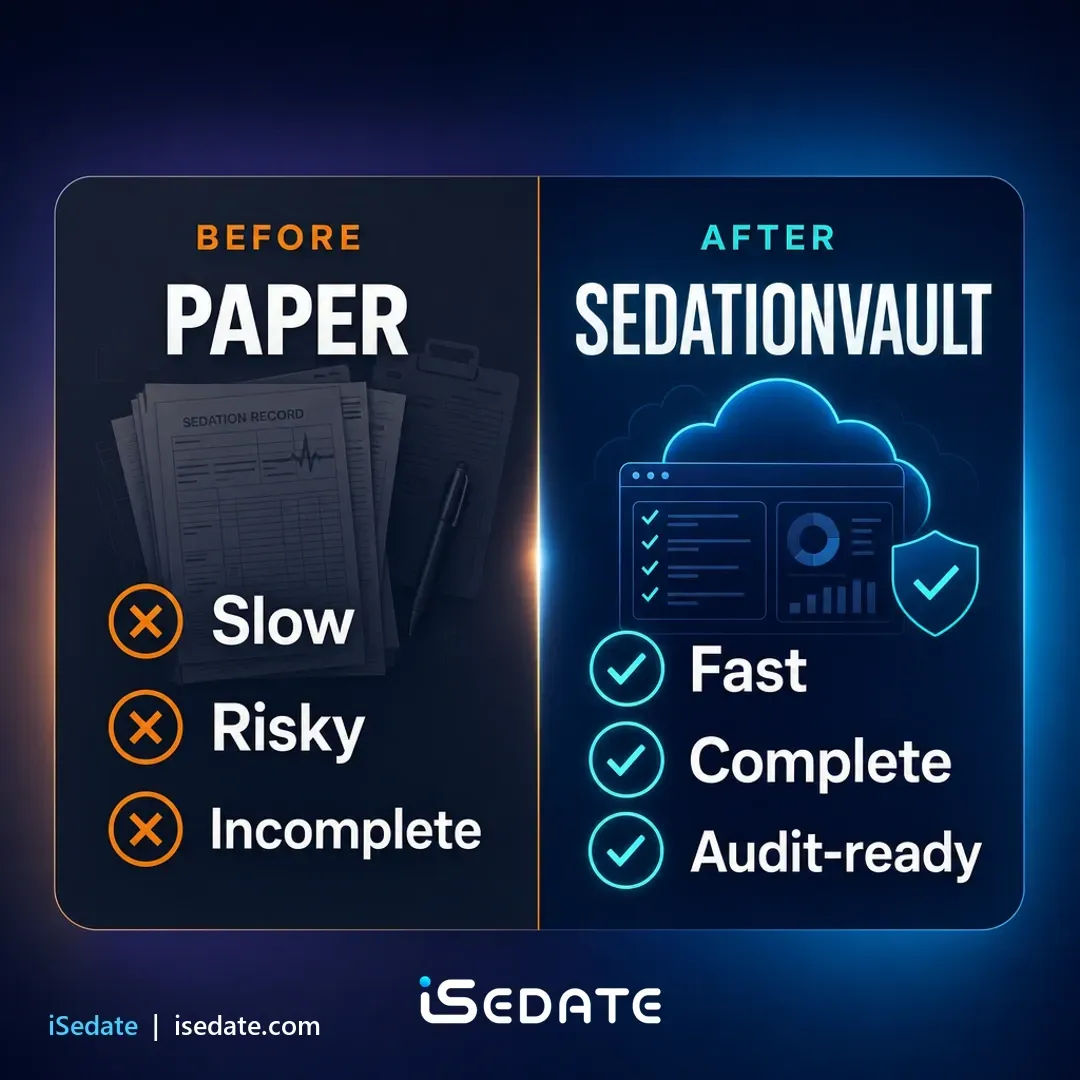
Everything above points to one truth: earning the certificate is a one-time hurdle, but keeping it is a daily documentation discipline. A manual anesthesia log written by hand during a live case, between titrating a drug and watching an airway, is exactly where records go incomplete, and incomplete records are what a conduct review and a malpractice claim both attack.
SedationVault removes that failure point. It captures live patient vitals and the drug log automatically into a time-oriented, New York-aligned anesthesia record that spans the preoperative, intraoperative, and recovery stages 8 NYCRR 61.10 names, so the record writes itself while you focus on the patient. When the Education Department or your own counsel asks for the file, a complete record is a one-click export, not a scramble through paper. See how it maps to New York's requirements on the dental sedation compliance and anesthesia record software pages.
Book a demo of SedationVault See SedationVault pricingLicensed in a neighboring state?
Sedation rules change at the state line, and the certificate structure, training hours, and record duties that apply in New York do not carry across it. If you practice near the border or hold a license in more than one state, start with the guide for that state, then confirm the current rule with its board:
- Connecticut Sedation Dentistry Licensing & Permit Requirements
- Massachusetts Sedation Dentistry Licensing & Permit Requirements
- New Jersey Sedation Dentistry Licensing & Permit Requirements
- Pennsylvania Sedation Dentistry Licensing & Permit Requirements
- Vermont Sedation Dentistry Licensing & Permit Requirements
- All 50 states: Sedation Dentistry Licensing & Permit Requirements by State
Frequently asked questions
What dental sedation certificates does New York issue?
Do you need a certificate for IV sedation in New York?
How much does a New York dental anesthesia certificate cost?
Does New York accept an out-of-state sedation certificate?
How do you keep a New York dental anesthesia certificate?
Related Reading: The Data Behind These Rules
The requirements on this page are the law. These research roundups are the data that explains why they exist and what happens when a practice gets charting or permitting wrong:
Sources & How We Verified This Guide
- NYSED Office of the Professions: Dental Anesthesia / Sedation Certification (the five certificates, education and clinical requirements, fee, application, and endorsement)
- NYSED Office of the Professions: Dental Anesthesia / Sedation Certification Q&A (the time-oriented anesthesia record and monitoring duties under 8 NYCRR 61.10)
- New York Education Law §6605-a (the certificate requirement, the $100 fee, and triennial renewal)
- 8 NYCRR 61.10, Regulations of the Commissioner of Education (certificate categories, practice requirements in 61.10(d), and the time-oriented anesthesia record). The full rule text is administered by the New York State Education Department; the certification pages above reproduce its operative requirements.
Figures on this page, including the 60 clock hours, the live-patient counts, the $100 fee, and the triennial renewal, are drawn from the official NYSED certification pages and Education Law §6605-a as cited and were verified against those sources. This guide summarizes New York sedation certificate rules for general information and is not legal advice. The routine office-inspection regime, the exact penalty schedule, and adverse-event reporting triggers are administered by the New York State Education Department and should be confirmed directly with the New York State Board for Dentistry before you act.