






Connecticut Sedation Dentistry Licensing & Permit Requirements
In Connecticut, your dental license alone does not let you sedate a patient. Any dentist who uses moderate sedation (conscious sedation), deep sedation, or general anesthesia must first hold the matching permit from the Connecticut Department of Public Health (DPH), under Conn. Gen. Stat. §20-123b and the implementing regulation RCSA §§20-123b-1 to 20-123b-9. Getting the permit means meeting a qualification pathway, holding current advanced cardiac life support, paying the $200 fee, and passing an on-site evaluation. Keeping it means your anesthesia records survive that evaluation, which recurs at least every five years. This guide walks both halves: how a Connecticut dentist gets a sedation permit, and what it takes to keep it.
Recent Updates
Last UpdatedNovember 16, 2026
- Updated the permit names to Connecticut's current terminology: the Permit to Administer Dental Moderate Sedation and the Permit to Administer Dental Anesthesia and Deep Sedation, reflecting the 2024 statutory amendments (Public Act 24-68).
- Added the verified $200 permit and annual renewal fee and the DPH Dental Sedation Permits contact line.
- Verified every citation against the current Connecticut statute and the live DPH permit pages, and replaced aggregator links with the original official sources.
Key Takeaways
- Connecticut requires a DPH permit for moderate sedation, deep sedation, or general anesthesia (Conn. Gen. Stat. §20-123b). Minimal sedation and nitrous oxide need no permit, though dosage limits apply to minimal sedation.
- There are two permits: the Permit to Administer Dental Moderate Sedation (conscious sedation by the parenteral route) and the Permit to Administer Dental Anesthesia and Deep Sedation (the top tier).
- The regulator is the Department of Public Health, not a standalone dental board, with the Dental Commission consulted on credentials.
- Both permits require current ACLS, staff BLS, a passed on-site evaluation, and a $200 fee; the permit runs 12 months and renews annually.
- An on-site evaluation must have been completed within the preceding five years for the permit to renew, and the team reviews your anesthesia records. Incomplete records are where permits get challenged.
What This Guide Covers
- Who issues sedation permits in Connecticut
- The two Connecticut sedation permits
- How to qualify for each permit
- What your permit requires you to monitor
- Recordkeeping obligations tied to your permit
- Fees, ACLS, and renewal
- The on-site evaluation, every five years
- Keeping the permit: audit-ready records
- Frequently asked questions
- Sources
Who issues sedation permits in Connecticut
Sedation dentistry in Connecticut is regulated by the Connecticut Department of Public Health, through its Practitioner Licensing and Investigations function, with the state's Dental Commission consulted on credentials. This is a structural difference from many states: Connecticut has no separate dental board that issues anesthesia permits. DPH decides who may sedate, runs the on-site evaluations, and acts on deficiencies. The rules live in two layers that you read together. The statute, Conn. Gen. Stat. §20-123b, sets the permit requirement itself; the implementing regulation, RCSA §§20-123b-1 through 20-123b-9, sets the detailed qualification, monitoring, record, and evaluation rules below.
The ADA writes the standard, the state writes the law. The American Dental Association publishes sedation guidelines that Connecticut and most states lean on, and the DPH pathways reference the ADA's structure directly. But the ADA is a professional association, not a government agency. It does not license you, evaluate you, or discipline you. Your permit, your on-site evaluation, and any sanction all come from DPH under §20-123b. The federal layers that do touch your practice are different again: the DEA for controlled-substance logs, HIPAA for records, and any hospital or payer accreditation you hold. Treat the ADA guidelines as best practice and §20-123b as the rule you are held to.
One terminology note affects how you read the permits. A 2015 statute moved Connecticut to minimal, moderate, and deep sedation definitions (now in Conn. Gen. Stat. §20-123a), and the 2024 amendments in Public Act 24-68 refined the permit framework further. DPH now titles its permits "Moderate Sedation" and "Anesthesia and Deep Sedation," while the older implementing regulation still carries the earlier "conscious sedation" language. The two track the same thing: moderate sedation is conscious sedation. Where this guide names a requirement, it names the exact section it comes from, and points you to the DPH permit page for the current application packet.
Source: Connecticut DPH, Dentist Licensing | Conn. Gen. Stat. Ch. 379, §20-123b
The two Connecticut sedation permits
Connecticut sets its permits by how deeply the patient is sedated and by what route. Here is the full ladder, from the techniques that need no permit up to general anesthesia, each with its governing section.
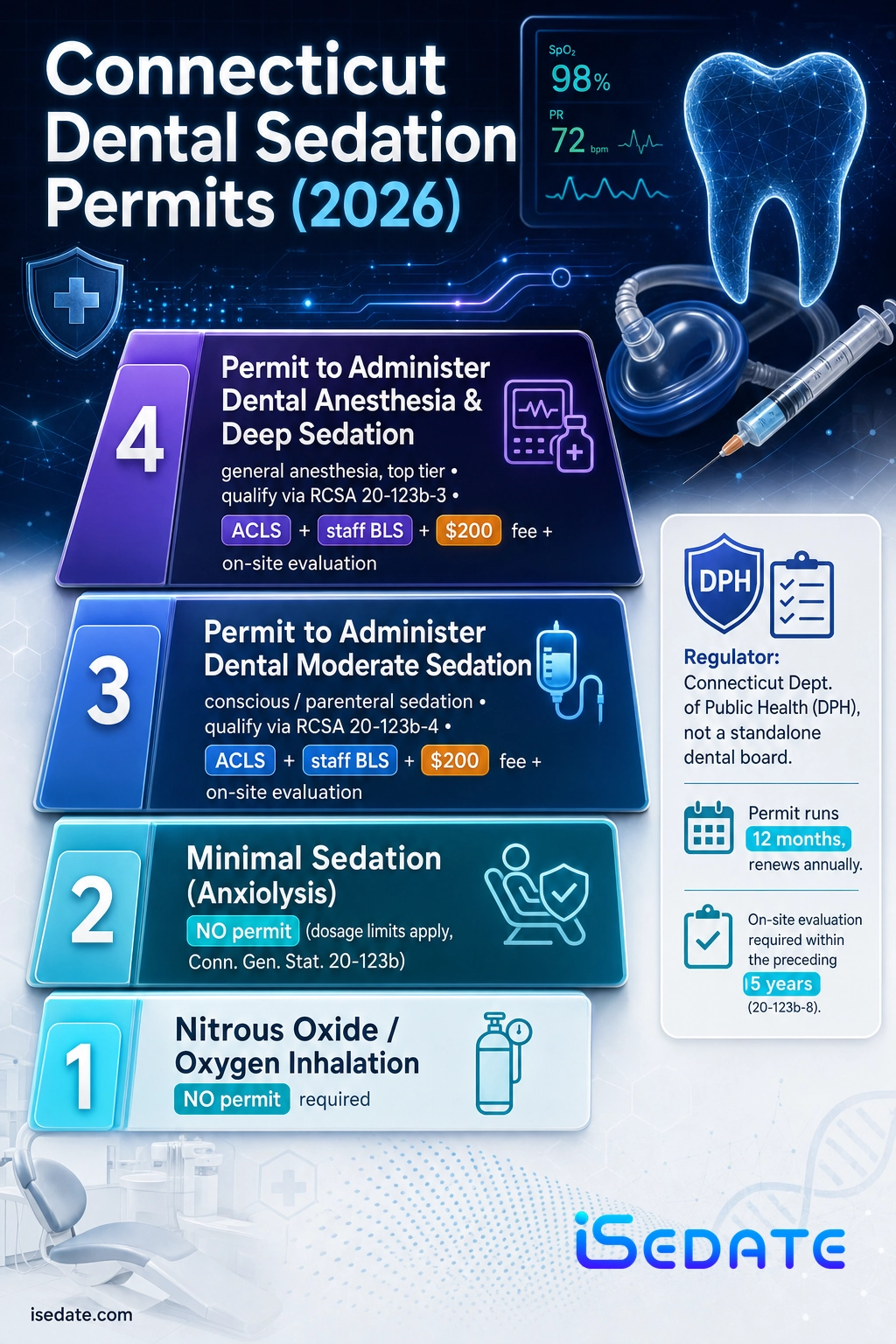
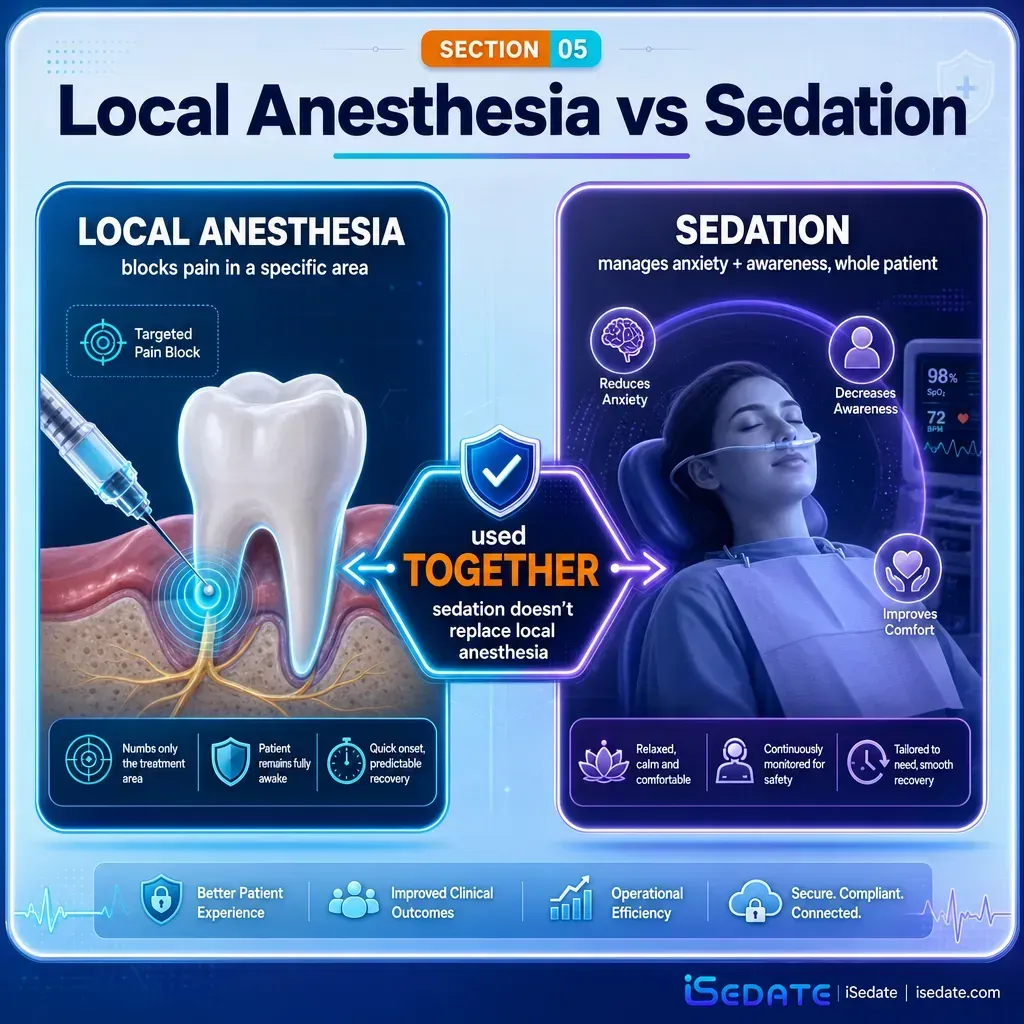
No permit: nitrous oxide and oxygen inhalation. Inhaled nitrous oxide and oxygen, the lightest form of anxiety control, requires no DPH permit. The patient stays fully responsive.
No permit: minimal sedation. Minimal sedation (anxiolysis) requires no permit, though dosage limits apply under Conn. Gen. Stat. §20-123b and the definitions in §20-123a. The patient responds normally to verbal command, and airway and cardiovascular function are unaffected.
Permit to Administer Dental Moderate Sedation (conscious sedation; qualifications RCSA §20-123b-4). This permit authorizes moderate, or conscious, sedation delivered by the parenteral route, meaning IV and other injected routes. Because the parenteral route carries a higher risk and a faster onset than oral or inhaled techniques, it is the first permitted tier, with its own qualification pathway and the full monitoring and record standard of §20-123b-9. This is the workhorse permit for general dentists who provide real IV conscious sedation.
Permit to Administer Dental Anesthesia and Deep Sedation (general anesthesia; qualifications RCSA §20-123b-3). The top tier. It authorizes deep sedation and general anesthesia, where the patient may be rendered unconscious and may need airway support. This permit is largely the province of oral and maxillofacial surgeons and dental anesthesiologists, and its qualification pathway in §20-123b-3 is the most demanding. For a general dentist, this tier is usually out of scope; most general dentists operate at nitrous plus moderate (conscious) sedation.
Source: DPH, Permit to Administer Dental Moderate Sedation | DPH, Permit to Administer Dental Anesthesia and Deep Sedation
Myth, Busted
Myth: A Connecticut dental license already covers IV or moderate sedation, so no extra permit is needed.
Fact: Moderate sedation, deep sedation, and general anesthesia each require a separate DPH permit under Conn. Gen. Stat. §20-123b; only minimal sedation and nitrous oxide are exempt.
The confusion is common because minimal sedation (anxiolysis) genuinely needs no permit. The line Connecticut draws is the depth and route of sedation, not whether you are a licensed dentist.
How to qualify for each permit
Each permit has its own bar to clear. Connecticut qualifies applicants through named education and experience pathways, current advanced cardiac life support, staff basic life support, and a passed on-site evaluation, rather than a single fixed hour count. The pathways below come straight from the DPH permit pages and RCSA §20-123b.
| Permit | Qualification pathway (one of) | Resuscitation | Fee & evaluation |
|---|---|---|---|
| Moderate Sedation / Conscious Sedation (§20-123b-4) | 12+ in-office parenteral sedation procedures per year for each of the 3 prior years plus 24+ hrs relevant CE; or a recent CODA-accredited graduate (within 2 years) with a didactic course plus a 4-week hospital anesthesia rotation or 10 documented parenteral cases; or a qualifying intensive, supplemental, or refresher course per ADA Part Three; or meeting the deep-sedation pathway | Current ACLS + BLS; all staff current BLS | $200; pass on-site evaluation |
| Anesthesia & Deep Sedation / General Anesthesia (§20-123b-3) | Complete a full CODA-approved OMFS post-doctoral program; or 1+ year full-time anesthesiology post-doctoral training; or qualify as an ABOMS diplomate under the stated grandfathering (graduation no later than 1966); or OMFS-limited practice for 10+ years | Current ACLS + BLS; all staff current BLS | $200; pass on-site evaluation |
The Moderate Sedation (conscious sedation) permit
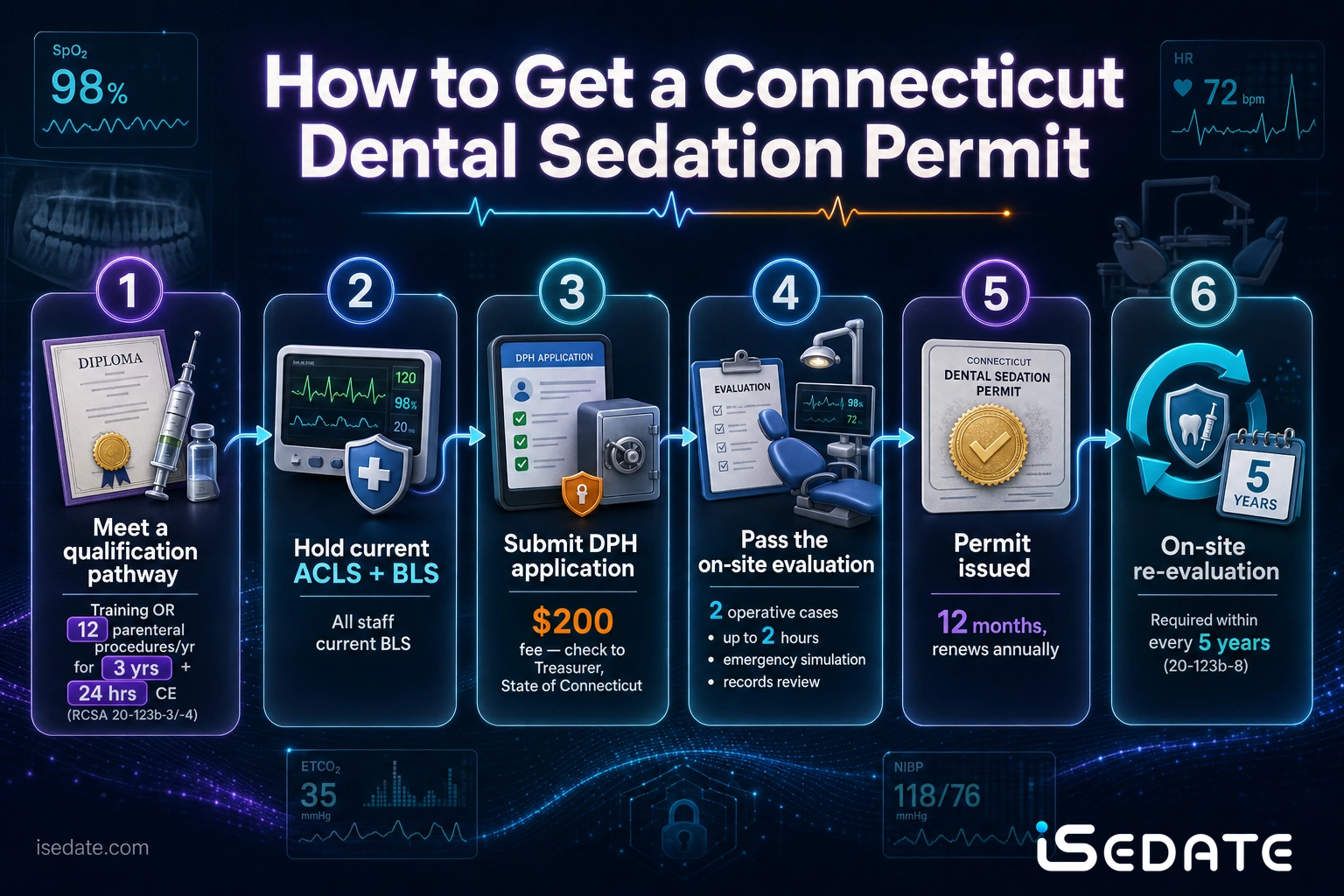
Under §20-123b-4 and the DPH Moderate Sedation permit page, you qualify by meeting any one of several pathways. The most common for an established dentist is documenting at least 12 in-office parenteral sedation procedures per year for each of the three prior years, together with at least 24 hours of continuing education in anesthesia, parenteral conscious sedation, or emergency medicine during that same period. A recent graduate (within two years) of a CODA-accredited program can qualify through a sedation didactic course plus a four-week full-time hospital operating-room anesthesia rotation, or through 10 documented parenteral cases. A qualifying intensive, supplemental, or refresher course structured per Part Three of the ADA guidelines is another route. All pathways require current ACLS, staff BLS, and passing the on-site evaluation.
The Anesthesia and Deep Sedation permit
Under §20-123b-3, the top permit is built for practitioners with formal anesthesia training. You qualify by completing a full CODA-approved oral and maxillofacial surgery post-doctoral program, or at least one year of full-time post-doctoral anesthesiology training structured per the ADA guidelines, or by qualifying as an American Board of Oral and Maxillofacial Surgery diplomate under the regulation's grandfathering provision, or through oral and maxillofacial surgery limited practice for at least ten years. As with the moderate permit, you must hold current ACLS, your staff must hold current BLS, pay the $200 fee, and pass the on-site evaluation.
Connecticut Sedation Permit Requirements at a Glance
- Regulator: Connecticut Department of Public Health (DPH), Dental Sedation Permits unit, not a standalone dental board.
- Permits: Moderate Sedation (conscious sedation) and Anesthesia & Deep Sedation (general anesthesia). Minimal sedation and nitrous need no permit.
- Resuscitation: dentist holds current ACLS and BLS; all staff hold current BLS.
- Fee: $200, by bank check or money order to the Treasurer, State of Connecticut.
- Term: issued for 12 months, renewable annually; on-site evaluation required within the preceding 5 years to renew.
- Apply / confirm: DPH Dental Sedation Permits, (860) 509-7603, [email protected], 410 Capitol Ave., MS #12 APP, P.O. Box 340308, Hartford, CT 06134.
For either permit, the application forms, any supplemental requirement, and the current fee are set by the department. Do not rely on a figure you read on a continuing-education provider's page. Download the current application and verify the fee on the DPH Moderate Sedation permit page before you file.
Source: DPH, Moderate Sedation permit requirements | RCSA §§20-123b-3, 20-123b-4

What your permit requires you to monitor
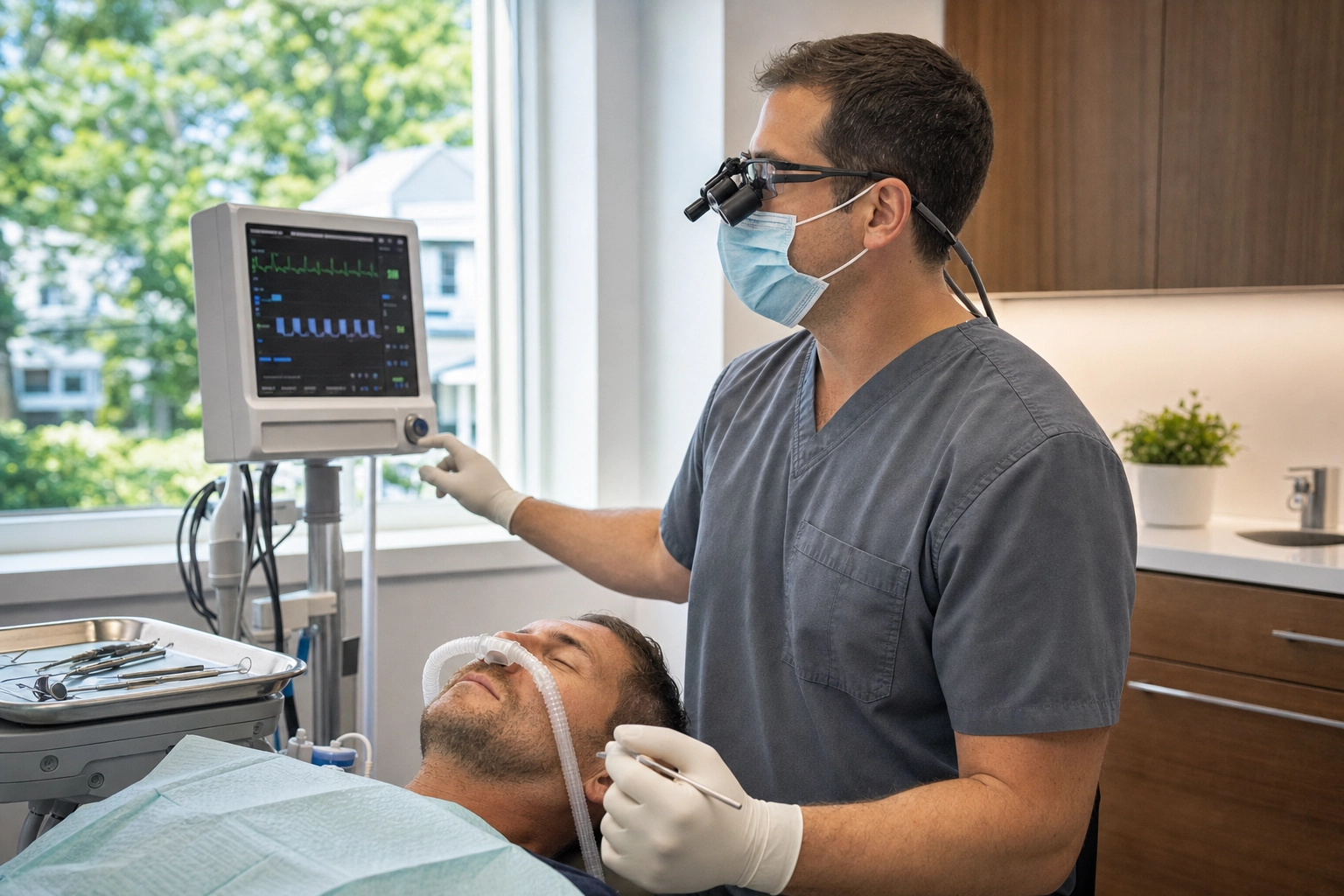
A permit is permission plus obligation. Once you hold either permit, the monitoring-equipment standard in §20-123b-9(b) defines what you must be able to follow continuously during administration. For conscious (moderate) sedation, that means a means of monitoring heart rate (ECG, pulsemeter, pretracheal or precordial stethoscope, or direct palpation), a means of following respirations and oxygenation (stethoscope, capnography, or direct observation of the chest, plus a pulse oximeter), and a means of monitoring blood pressure for both child and adult patients. Deep sedation and general anesthesia carry the same framework with tighter respiratory options. The equipment list in §20-123b-9(a) also requires blood pressure cuffs, an electrocardiograph, a defibrillator, 100 percent oxygen in all rooms, airways, and suction.
For the full clinical breakdown of what to monitor and record at each technique, see our companion guide on Connecticut Sedation Vitals Monitoring, Charting & Reporting Requirements, and the national overview in our Sedation Dentistry Licensing & Permit Requirements by State hub.
Source: RCSA §20-123b-9(a)–(b)
Recordkeeping obligations tied to your permit
Holding a permit also means holding a set of documentation duties, and these are exactly what the on-site evaluation examines.
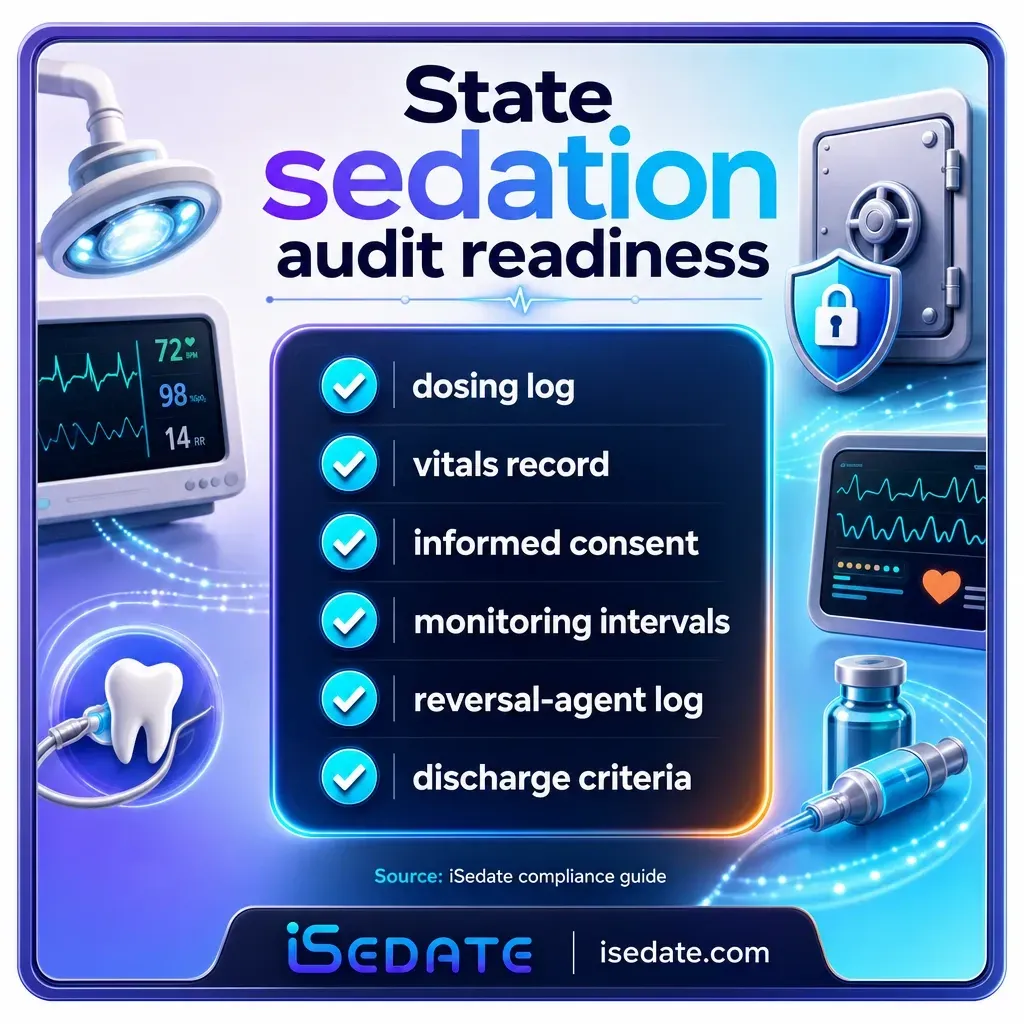
The anesthesia record. Under §20-123b-9(d), every practitioner must maintain anesthesia or conscious sedation records that include the date of procedure, nothing-by-mouth (NPO) status, availability of a responsible adult escort, allergies, vital signs, and the drugs and doses administered. Notably, the regulation lists these elements but sets no numeric interval for recording vital signs, so documenting continuously is the defensible practice. The ADA's national guideline, by contrast, calls for a time-oriented record with continually recorded vitals, which is the bar a careful Connecticut practice holds itself to even though the state regulation is less prescriptive.
Records reviewed on evaluation. Under §20-123b-6(c), the on-site evaluation team reviews office equipment, emergency drugs, and anesthesia records to determine full compliance with §20-123b-9. Your records are an explicit object of the evaluation, not a side document.
Emergency management and staff certification. The applicant demonstrates an exact simulation of medical-emergency management with full staff participation, and the practitioner and entire staff must hold current basic life support certification.
Source: RCSA §§20-123b-6, 20-123b-9
Fees, ACLS, and renewal
Your sedation permit is tied to your Connecticut dental license, and both the statute and the DPH permit pages set the money and the cycle. The fee is $200, paid by bank check or money order to the Treasurer, State of Connecticut. The permit is issued initially for twelve months and renews annually for the same $200. To renew, an on-site evaluation must have been completed within the preceding five years, and a late renewal must be filed within three months after expiration (Conn. Gen. Stat. §20-123b(c)).
On certifications, the regulation is explicit that you keep them current. The practitioner must maintain current ACLS, and the practitioner plus the entire staff must maintain current basic life support. The experience pathway to the moderate permit also requires at least 24 hours of continuing education in the prior three years under §20-123b-4. The ongoing continuing-education cycle for license renewal is set by the department and is not reproduced here to avoid stating a figure that may change. Confirm your current renewal cycle, continuing-education hours, and resuscitation requirements directly with the Connecticut DPH Dentist Licensing office, or call the Dental Sedation Permits unit at (860) 509-7603, so your permit never lapses at renewal.
Source: DPH, Anesthesia and Deep Sedation permit (fee and certifications) | Conn. Gen. Stat. §20-123b(c)
The on-site evaluation, every five years
This is where a permit is kept or lost. Under RCSA §20-123b-6, the on-site evaluation for initial issuance and reinstatement has the evaluation team observe your technique during at least two operative cases totaling no more than two hours, while you demonstrate emergency management with full staff participation and sit for an exit interview. The evaluation team, under §20-123b-5, is made up of two office anesthesia evaluators recommended by the Connecticut Society of Oral and Maxillofacial Surgeons, or one such evaluator plus a fellow of the American Dental Society of Anesthesiology.
Crucially, §20-123b-6(c) makes your anesthesia records part of what the team judges, checking them for full compliance with §20-123b-9. And under the renewal rule in Conn. Gen. Stat. §20-123b(c) and §20-123b-8, an on-site evaluation must have been completed within the preceding five years, measured from the last day of the calendar quarter in which the office was last evaluated. In other words, a complete and contemporaneous record is not a one-time hurdle. It is what a recurring, scheduled review turns on.
If the office fails any part of the evaluation, §20-123b-7 is unforgiving: the permit is denied, and the practitioner may reapply only after completing a Commissioner-approved continuing-education course in the area of deficiency. If an evaluator believes the practitioner is unfit, incompetent, or negligent, the evaluator shall file a petition with DPH under Conn. Gen. Stat. §19a-14.
Source: RCSA §§20-123b-5 to 20-123b-8 | Conn. Gen. Stat. Ch. 379
Keeping the permit: audit-ready records
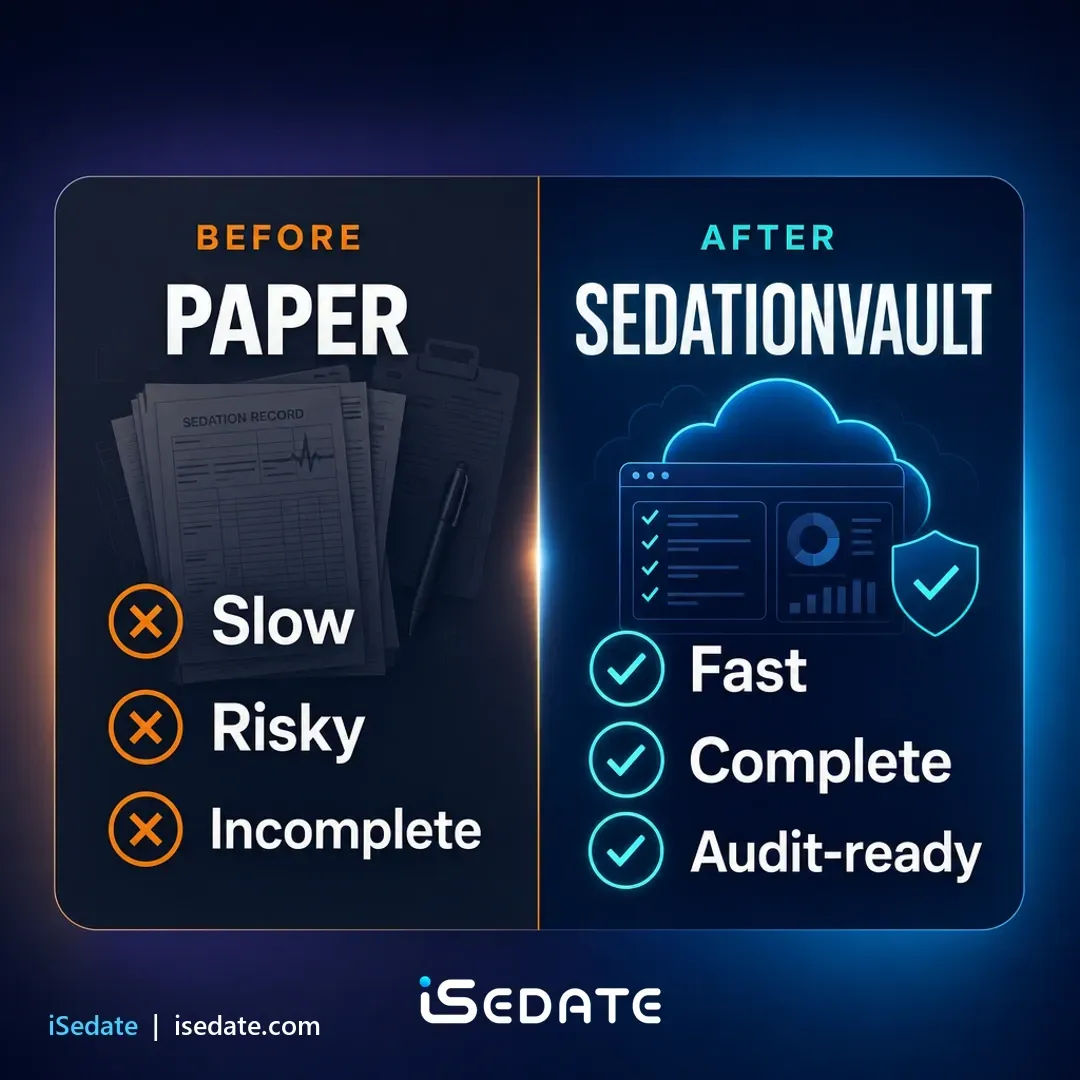
Everything above points to one truth: qualifying for the permit is a one-time hurdle, but keeping it is a daily documentation discipline that a scheduled evaluation will test. A manual vitals and drug log written by hand, between titrating a drug and watching an airway, is exactly where records go incomplete, and under §20-123b-6(c) an incomplete record is a direct compliance finding, not a footnote. Connecticut names six elements the record must carry, and it sets no interval that does the remembering for you.
SedationVault removes that failure point. It captures live patient vitals and the drug log automatically into a Connecticut-ready anesthesia record, with the date, NPO status, responsible-adult-escort, allergy, vital-sign, and drug-and-dose fields that §20-123b-9(d) requires captured as structured entries, so the record writes itself while you focus on the patient. When the evaluation team asks for the file, a complete record is a one-click export, not a scramble through paper. See how it maps to the Connecticut rules on our dental sedation compliance and anesthesia record software pages.
Book a Demo of SedationVault See SedationVault PricingFrequently asked questions
What sedation permits does Connecticut require?
How much does a Connecticut dental sedation permit cost?
What do you need to qualify for the Connecticut Moderate Sedation permit?
Does a Connecticut general dentist need the top anesthesia permit?
How often is a Connecticut sedation office inspected?
Licensed in a Neighboring State?
If you practice across the Connecticut line, the permit, record, and evaluation rules change at the border. See our same-silo guides for the neighboring states, plus the national overview:
The Data Behind These Rules
The requirements on this page are the law. These research roundups are the data that explains why they exist and what happens when a practice gets permitting or charting wrong:
Sources & Verification
- Connecticut DPH, Dentist Licensing (regulator, applications, permit links)
- DPH, Permit to Administer Dental Moderate Sedation (fee, pathways, application)
- DPH, Permit to Administer Dental Anesthesia and Deep Sedation
- RCSA §§20-123b-1 to 20-123b-9: Administration and Use of Anesthesia and Conscious Sedation in Dentistry (full regulation text)
- Conn. Gen. Stat. Chapter 379, §20-123b (Dentistry), as amended by Public Acts 24-68 and 25-97
This guide summarizes Connecticut sedation permit rules for general information and is not legal advice. Qualification pathways, ACLS and BLS requirements, monitoring, the on-site evaluation, recordkeeping, the $200 fee, and the twelve-month term are drawn from Conn. Gen. Stat. §20-123b and RCSA §20-123b as cited, verified against the live Connecticut statute and DPH permit pages in November 2026. Application forms, the ongoing license-renewal continuing-education cycle, and any requirement adopted after that date are administered by the Connecticut Department of Public Health (Dental Sedation Permits, (860) 509-7603, [email protected]) and should be confirmed with the department before you act.