






Rhode Island Sedation Dentistry Licensing & Permit Requirements
In Rhode Island, your dental license alone does not let you sedate a patient. Before the first dose of nitrous oxide, oral minimal sedation, moderate (conscious) IV sedation, or deeper anesthesia, you must hold the matching Individual Anesthesia Permit from the Rhode Island Board of Examiners in Dentistry, and your office must hold a facility permit, both issued under 216-RICR-40-05-2. Getting permitted means meeting the training and certification bar for your level. Keeping it means your sedation records survive a board review. This guide walks both halves, with every requirement tied to its section of the regulation.
Recent Updates
Last UpdatedNovember 16, 2026
- Re-verified every permit name and citation against the official 216-RICR-40-05-2 on the Rhode Island Secretary of State's regulations site.
- Corrected the moderate sedation requirement to the regulation's exact wording: 60 hours of training plus at least 20 adult case experiences and current ACLS (2.11.3(D)).
- Added the facility permit requirement (2.11.4 and 2.13.3) and the on-site office evaluation, which the prior version did not cover.
- Replaced third-party reprints with direct links to the official statute, the board's licensing page, and the state application forms, and added the board's contact details.
- Rhode Island issues named Individual Anesthesia Permits under 216-RICR-40-05-2.11.3, from nitrous oxide up through general anesthesia, each with its own training pathway.
- You need two permits, not one: the individual permit qualifies the dentist, and a separate facility permit qualifies each office site.
- Most general dentists work at the nitrous and minimal levels; the moderate sedation permit adds the IV and parenteral route and the heaviest requirements.
- Moderate sedation requires 60 training hours, at least 20 adult case experiences, a high-fidelity simulation course, and current ACLS (2.11.3(D)).
- Once permitted, you must keep a time-oriented anesthetic record of every drug, dose, and physiologic reading. Incomplete records are where permits get challenged.

What This Guide Covers
- Who issues sedation permits in Rhode Island
- The Rhode Island sedation permit levels
- Two permits: individual and facility
- How to qualify for each permit
- Fees, exams, and how to apply
- What your permit requires you to monitor
- Documentation duties tied to your permit
- CE and renewal
- Facility standards and office evaluations
- Keeping the permit: audit-ready records
- Frequently asked questions
- Related guides and neighboring states
- Sources
Who issues sedation permits in Rhode Island
Sedation dentistry in Rhode Island is regulated by the Rhode Island Board of Examiners in Dentistry, which sits inside the Rhode Island Department of Health. Rhode Island does not run a separate standalone dental board; licensing and sedation oversight live within the Department of Health. The board, not any national organization, decides who may sedate, sets the facility standards, and takes disciplinary action. The rules live in 216-RICR-40-05-2, which governs dentists, dental hygienists, and dental assistants, and every requirement below traces to a section of that regulation.
Myth, Busted
Myth: An ADA-recognized sedation course is all you need to start sedating patients in Rhode Island.
Fact: A course is training, not authority. You still need the matching individual anesthesia permit and a facility permit from the board before you administer, under 216-RICR-40-05-2.
Rhode Island incorporates the American Dental Association's sedation guidelines by reference, but the ADA is a professional association, not a government agency. It does not license, inspect, or discipline you. The board does.
Board Contact and Governing Rule
- Regulator: Rhode Island Board of Examiners in Dentistry, within the Rhode Island Department of Health.
- Governing rule: 216-RICR-40-05-2 (Dentists, Dental Hygienists and Dental Assistants).
- Address: Room 104, 3 Capitol Hill, Providence, RI 02908-5097.
- Phone: (401) 222-2828.
- Who it covers: every dentist administering nitrous oxide, minimal, moderate, deep, or general anesthesia in Rhode Island.
Source: Rhode Island Department of Health, Board of Examiners in Dentistry | 216-RICR-40-05-2
The Rhode Island sedation permit levels
Rhode Island names its permits by the type and depth of sedation rather than by a numbered ladder. Each is an Individual Anesthesia Permit, and the level reflects how deeply the patient is sedated and by which route. Section 2.11.2 lists the permits, and the qualification criteria follow in 2.11.3.
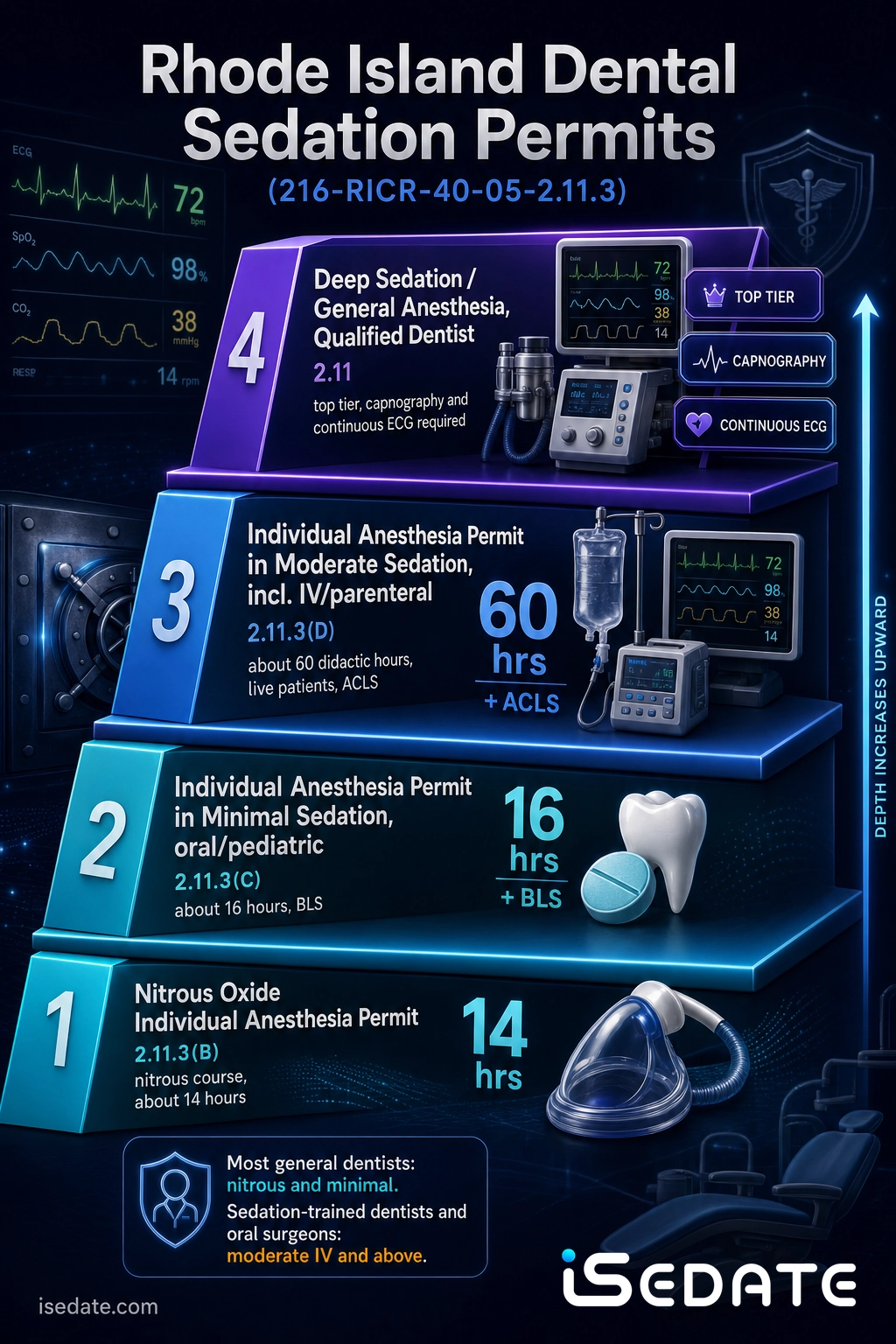
Individual Anesthesia Permit, Nitrous Oxide (2.11.3(B)). The entry permit. It authorizes nitrous oxide and oxygen inhalation sedation, the lightest form of anxiety control, where the patient stays fully responsive.
Individual Anesthesia Permit, Minimal Sedation (2.11.3(C)). Authorizes minimal sedation, typically by the oral route, where the patient responds normally to verbal command and airway and cardiovascular function are unaffected. This is the common starting point for general dentists adding light oral sedation.
Individual Anesthesia Permit, Moderate Sedation (2.11.3(D)). Authorizes moderate, or Conscious Sedation, including the enteral and parenteral (IV) routes. The patient responds purposefully to verbal or tactile stimulation and keeps their own airway. Because the IV route carries higher risk and faster onset, this permit sits above minimal and carries the heaviest training, monitoring, and record requirements. A separate pediatric moderate sedation permit (2.11.3(E)) covers patients under 13.
Individual Anesthesia Permit, General Anesthesia/Deep Sedation (2.11.3(F)). The top tier. Deep sedation and general anesthesia, where the patient is not easily aroused or is unconscious and may need airway support, carry the strictest monitoring standard, including continuous ECG and continuous end-tidal carbon dioxide. This tier is largely the province of dental anesthesiologists and oral and maxillofacial surgeons, with pediatric (2.11.3(G)) and portable (2.11.3(H)) variants for specific practice settings.
Most general dentists operate at the nitrous and minimal levels. Oral surgeons and sedation-trained dentists typically carry the moderate permit, and general anesthesia is largely out of scope for a general dental practice. Match the permit to the care you actually provide, and do not sedate beyond the permit you hold.
Source: 216-RICR-40-05-2.11.2 and 2.11.3 (permits and qualifications)
Two permits: individual and facility
Here is the step most sedation guides miss. Rhode Island licenses the clinician and the location separately, so a fully qualified dentist still cannot sedate in an office that is not itself permitted.
The individual anesthesia permit qualifies the dentist to administer a given level of sedation. The facility permit, required under 216-RICR-40-05-2.13.3, applies to the office site: each location where anesthesia services are administered must hold its own facility permit. For moderate sedation and deeper, the facility permit involves an on-site office evaluation by a board-approved team, which checks that the room, the equipment, and the emergency readiness meet the standard before patients are sedated there.
iSedate Pro Tip
If you practice at more than one location or host a visiting anesthesia provider, each site needs its own facility permit. Plan the office evaluation early, because it gates when you can actually start sedating, not just whether your training is complete.
Source: 216-RICR-40-05-2.11.4 and 2.13.3 (facility permits) | Rhode Island dental anesthesia facility permit application
How to qualify for each permit
Each permit has its own bar: a defined amount of training, a resuscitation certification, and, for moderate sedation, a count of managed clinical cases. You move up by meeting the next permit's requirements and applying to the board. The figures below come straight from 216-RICR-40-05-2.11.3 where the regulation states them.
| Permit | Route / depth | Training required by the rule | Resuscitation |
|---|---|---|---|
| Nitrous Oxide (2.11.3(B)) | Inhalation, lightest | 14 hours of nitrous oxide sedation training (CODA, PACE, or CERP approved) | Current BLS |
| Minimal Sedation (2.11.3(C)) | Oral, minimal | ADA-guideline minimal sedation training plus a high-fidelity manikin respiratory rescue course (no fixed hour count in the rule) | Current BLS |
| Moderate Sedation (2.11.3(D)) | Enteral and parenteral / IV, moderate | 60 hours of moderate sedation training, at least 20 adult case experiences, and a board-approved high-fidelity simulation course | Current ACLS |
| General Anesthesia / Deep Sedation (2.11.3(F)) | Deep sedation / general anesthesia | Advanced anesthesia training or an accredited post-doctoral program (OMFS or dental anesthesiology) plus a high-fidelity simulation course | Current ACLS (ACLS/PALS for pediatric) |
The nitrous and minimal permits
The Individual Anesthesia Permit in Nitrous Oxide follows a 14-hour nitrous oxide sedation training program from a CODA, PACE, or CERP approved provider, with current BLS. The Individual Anesthesia Permit in Minimal Sedation follows minimal sedation training that meets the ADA guidelines (as a planning reference, the ADA guideline is in the range of 16 hours), plus current BLS and a high-fidelity manikin respiratory rescue course. Note that the Rhode Island rule does not fix a minimal-sedation hour count of its own; it points to the ADA-guideline training standard. These are the most accessible permits and the usual first step for a general practice.
Moderate sedation: adding IV
Upgrading to the Individual Anesthesia Permit in Moderate Sedation is the biggest step a general dentist or oral surgeon takes, because it adds the IV and parenteral route. Under 2.11.3(D), moderate sedation requires 60 hours of moderate sedation training, management of at least 20 adult case experiences, a board-approved high-fidelity simulation course, and current ACLS. The live-case requirement exists because IV titration demands hands-on competence a classroom cannot replicate.
State Law
Case Requirement
For every permit, the application, the current fee schedule, and any exam requirement are set by the board and updated periodically. Do not rely on a figure you read on a continuing-education provider's page for anything outside what the regulation itself states. Confirm the exact forms and current requirements with the Rhode Island Department of Health before you apply.
Source: 216-RICR-40-05-2.11.3 (qualifications)
Fees, exams, and how to apply
You apply to the Rhode Island Board of Examiners in Dentistry through the Department of Health. The practical paperwork sits in a few official forms:
- Your underlying dental license, via the Rhode Island dentist license application.
- The anesthesia facility permit, via the dental anesthesia facility permit application, which lists the current permit application fees and credential checklist by level.
- For a moderate sedation office, the on-site evaluation documented on the moderate sedation office evaluation form.
Budget for two kinds of cost: the board's permit application fee (the current amount is printed on the facility application linked above) and a separate Rhode Island Controlled Substance Registration if you will store or administer controlled drugs. Because these figures change, read them off the current application rather than a secondary source. You complete the required training at an accredited provider; where to take a Rhode Island sedation training course is one starting point for course options, though it is a course provider, not the rulemaking authority.
Source: Rhode Island dental anesthesia facility permit application | Rhode Island Department of Health

What your permit requires you to monitor
A permit is permission plus obligation. Once you hold a minimal or moderate sedation permit, 216-RICR-40-05-2.11 requires the dentist to ensure the patient is monitored across four things:
- Direct clinical observation: the patient is observed directly throughout the administration of anesthesia.
- Oxygenation: oxygen saturation is monitored continuously by pulse oximetry.
- Ventilation: chest excursion is observed and breath sounds auscultated, or end-tidal carbon dioxide is monitored.
- Circulation: blood pressure and heart rate are continually evaluated.
Deep sedation and general anesthesia add continuous ECG, continuous end-tidal carbon dioxide with a precordial or pretracheal stethoscope, continuous respiratory rate, continual blood pressure, and a temperature-monitoring device readily available. Staffing scales with depth too: moderate sedation requires trained support staff with ACLS, and deeper anesthesia requires additional ACLS and PALS-certified team members. For the full clinical breakdown of what to monitor and chart at each depth, see the companion guide on Rhode Island sedation vitals, charting, and reporting requirements.
Source: 216-RICR-40-05-2.11 (Monitoring and Documentation)
Documentation duties tied to your permit
Holding a permit also means holding a set of documentation duties, and these are exactly what a board review examines.
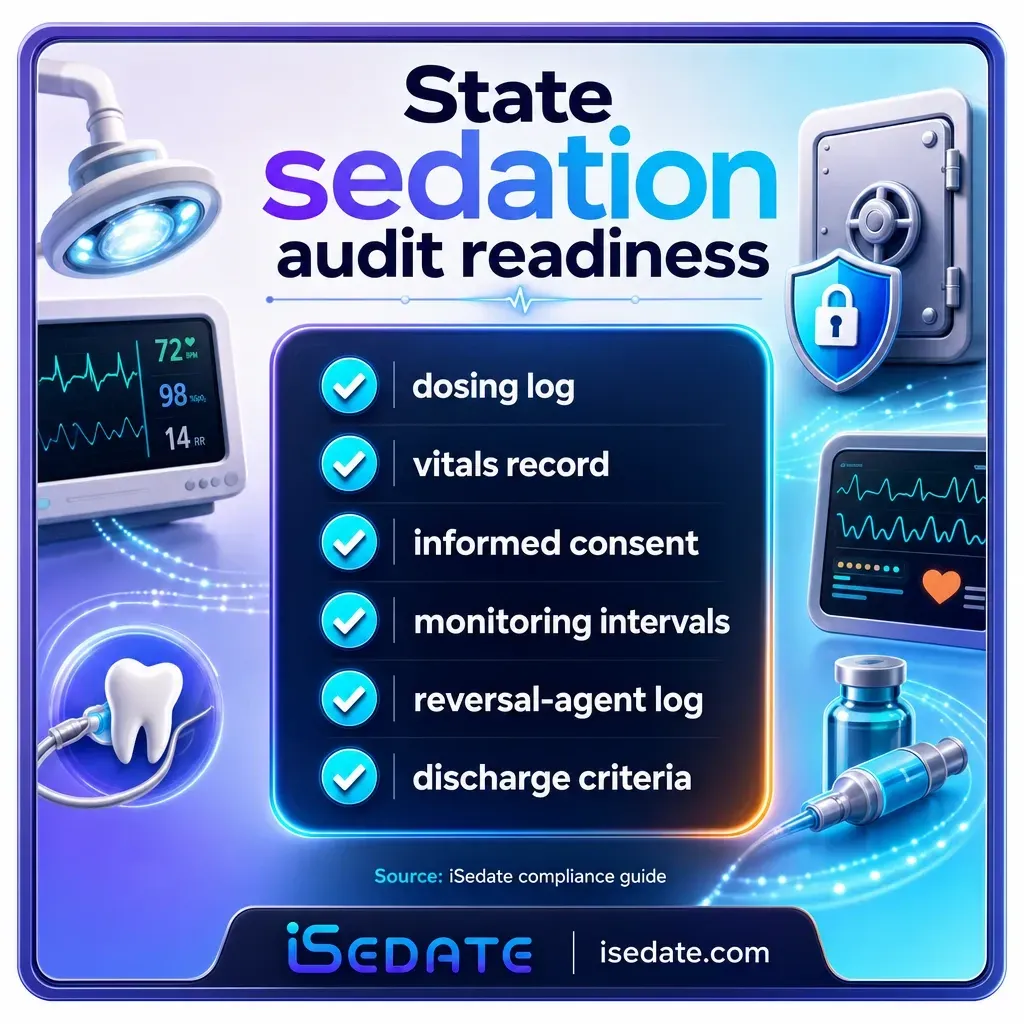
The anesthetic record. Under 216-RICR-40-05-2.11, an appropriate time-oriented anesthetic record must be maintained, and the dentist must document the individuals present during the administration of anesthesia. Rhode Island defines a time-oriented anesthesia record at 2.2 as documentation, at appropriate time intervals, of the drugs, doses, and physiologic data obtained during patient monitoring. For deep sedation and general anesthesia, the record must include the names of all drugs, their dosages and administration times, including local anesthetics, and the monitored physiological parameters.
State Law
Discharge documentation. Under the same section, the dentist must continually monitor blood pressure, heart rate, oxygenation, and level of consciousness during recovery, and must determine and document that oxygenation, ventilation, and circulation are stable before discharge, along with the post-operative instructions given.
Responsibility and enforcement. The anesthesia permit holder is responsible under 2.11 for anesthetic management, facility adequacy, and emergency treatment, and rule violations can lead to Department of Health disciplinary action. The specific penalty schedule and any reporting triggers are set by the board; confirm the current details directly with the Rhode Island Department of Health. SedationVault keeps these duties straightforward by writing a compliant record automatically, which you can read more about on the anesthesia record software page.
Source: 216-RICR-40-05-2.11 and 2.2 (definitions)
CE and renewal
Your sedation permit is tied to your Rhode Island dental license, and the board expects permit holders to stay current in the resuscitation certifications and continuing education appropriate to their level. The Department of Health sends renewal notices well before expiration. The exact renewal cycle and the number of sedation-specific continuing-education hours required for each permit are set by Department of Health rule and updated periodically, and they are not reproduced here to avoid stating a figure that may be out of date. Confirm your current renewal cycle, continuing-education hours, and resuscitation-certification requirements directly with the Rhode Island Department of Health so your permit never lapses at renewal.
Facility standards and office evaluations
This is where a permit is kept or lost. The permits that authorize moderate and deeper sedation carry the heaviest scrutiny, because that is where the risk is. The facility and equipment standard in 216-RICR-40-05-2.13 sets the equipment and baseline vital-sign requirements your office must meet, including weight, height, blood pressure, pulse, respiration, and oxygen saturation, and the moderate sedation facility passes an on-site office evaluation by a board-approved team before it is permitted. The Department of Health holds the authority to review a permit holder's compliance; the routine inspection cadence and who conducts it are administered by the board, so confirm the current schedule directly with the board.
When a reviewer opens your file, they are checking the record, not your intentions. A review turns on whether your time-oriented anesthetic record is complete, contemporaneous, and logged at appropriate intervals, with every drug, dose, and administration time captured and the discharge documented as stable. The sedation can be clinically correct and the permit can still be challenged on the paperwork. See how SedationVault maps to these rules on the dental sedation compliance page.
Source: 216-RICR-40-05-2.13 (Physical Facility, Equipment and Safety)
Keeping the permit: audit-ready records
Everything above points to one truth: getting the permit is a one-time hurdle, but keeping it is a daily documentation discipline. A vitals log written by hand, between titrating a drug and watching an airway, is exactly where records go incomplete, and incomplete records are what a board review and a malpractice claim both attack.
SedationVault removes that failure point. It captures live patient vitals and the drug log automatically into a time-oriented, Rhode Island-compliant anesthetic record, holding the appropriate-interval documentation that 216-RICR-40-05-2.11 demands, so the record writes itself while you focus on the patient. When the board asks for the file, a complete record is a one-click export, not a scramble through paper.
Book a demo of SedationVault See SedationVault pricingFrequently asked questions
What sedation permits does Rhode Island offer?
How do you get an IV (moderate) sedation permit in Rhode Island?
Do you need a facility permit as well as an individual permit in Rhode Island?
Who issues and renews sedation permits in Rhode Island?
Does an ADA sedation certificate let me sedate patients in Rhode Island?
Related guides and neighboring states
This guide is part of our state-by-state series on sedation licensing. Licensed in a neighboring state, or comparing requirements across the region? See our guides for Connecticut sedation dentistry licensing and permit requirements and Massachusetts sedation dentistry licensing and permit requirements, the companion Rhode Island sedation vitals, charting, and reporting requirements, and the full sedation dentistry licensing and permit requirements by state hub.
Sources
- 216-RICR-40-05-2: Dentists, Dental Hygienists and Dental Assistants (official Rhode Island Code of Regulations, incl. 2.2 definitions, 2.11 Monitoring and Documentation, 2.11.2 and 2.11.3 permits, 2.11.4 and 2.13.3 facility permits, 2.13 facility and equipment)
- Rhode Island Department of Health, Board of Examiners in Dentistry (licensing page)
- Rhode Island dental anesthesia facility permit application (official form)
- Moderate sedation office evaluation form (official form)
This guide summarizes Rhode Island sedation permit rules for general information and is not legal advice. Permit types, training requirements, monitoring, and recordkeeping duties are drawn from 216-RICR-40-05-2 as cited. Application forms, current fees, any exam, the routine inspection schedule, renewal cycle, continuing-education hours, and the exact penalty schedule are set by the Rhode Island Department of Health and should be confirmed directly with the board before you act. Requirements current as of November 2026.