








Rhode Island Sedation Vitals Monitoring, Charting & Reporting Requirements
If you administer sedation in Rhode Island, the rules are explicit about what has to be written down. The state requires a time-oriented anesthetic record: a log, organized against the clock, of every drug, every dose, and the physiologic data pulled from your monitors throughout the case. That requirement lives in 216-RICR-40-05-2, the dental regulation issued by the Rhode Island Department of Health, and the record is the first thing a reviewer reads. This guide breaks down what you must monitor and record at each permit level, how long to keep the record, what a compliant chart actually looks like, and where Rhode Island dentists most often get burned on review.
Recent Updates
Last UpdatedNovember 16, 2026
- Re-verified every rule against the Rhode Island Secretary of State's official, active text of 216-RICR-40-05-2.
- Added the record-retention requirement: five years from the last dental visit under 216-RICR-40-05-2.14.
- Replaced third-party aggregator citations with direct links to the original Rhode Island regulation and the Department of Health's dental board page.
- Added a sample charting cadence and an oral-versus-IV documentation comparison.
Key Takeaways
- The core rule: Rhode Island requires an appropriate time-oriented anesthetic record under 216-RICR-40-05-2.11, defined as documentation at appropriate time intervals of drugs, doses, and physiologic data.
- Who enforces it: the Rhode Island Board of Examiners in Dentistry, under the Rhode Island Department of Health, not the ADA.
- The record must capture every drug and dose, and for deep sedation and general anesthesia the drug names, dosages, administration times (including local anesthetics), and the monitored physiologic parameters.
- There is no single fixed minute interval: Rhode Island requires documentation at appropriate time intervals, with oxygenation, ventilation, and circulation evaluated continuously or continually.
- Keep it five years: written records and radiographs must be retained a minimum of five years from the last visit under 216-RICR-40-05-2.14, and longer for minors.

What This Guide Covers
- Who regulates sedation in Rhode Island
- The Rhode Island sedation permit levels
- What you must monitor at each level
- What the record must contain: the compliance core
- What a compliant chart looks like: a sample cadence
- How long you must keep the record
- Why a thin record is so costly
- Enforcement and responsibility
- Making the record audit-ready
- Related guides and neighboring states
- Frequently asked questions
- Sources and citations
Who regulates sedation in Rhode Island
Sedation and anesthesia in a Rhode Island dental office are regulated by the Rhode Island Board of Examiners in Dentistry, which operates under the Rhode Island Department of Health. Unlike states that run a standalone dental board, Rhode Island places dental licensing and sedation oversight inside the Department of Health, and the governing rules are a Department of Health regulation: 216-RICR-40-05-2, covering dentists, dental hygienists, and dental assistants.
That matters for compliance because your recordkeeping obligation is a named administrative rule with an exact citation, not a vague standard of care. When a reviewer asks whether your sedation record meets the requirement, the answer is measured against the specific sections of 216-RICR-40-05-2 below.
It is also worth being precise about the role of the ADA. Rhode Island's rule incorporates the American Dental Association's Guidelines for the Use of Sedation and General Anesthesia by Dentists by reference, but the ADA is a professional association that publishes a national standard, not a government agency. It does not license you, audit you, or discipline you. Federal law adds its own layers for sedation providers, primarily DEA controlled-substance recordkeeping and HIPAA, but neither of those is the ADA, and neither overrides the state rule. In Rhode Island, the law is 216-RICR-40-05-2, and the body that enforces it is the Board of Examiners in Dentistry under the Department of Health.
Myth, Busted
Myth: The ADA guidelines are federal law, so meeting the national standard is enough to pass a Rhode Island review.
Fact: The ADA is a private association, not a federal agency. What a reviewer grades you against is Rhode Island's own rule, 216-RICR-40-05-2, which adopts the ADA guidelines by reference but is enforced by the state Board of Examiners in Dentistry.
The distinction matters on review: the citation on a deficiency notice is a state regulation number, and "we followed the ADA guideline" is not a defense to a gap in what 2.11 specifically requires.
Source: 216-RICR-40-05-2 (RI Secretary of State, active rule) | RI Department of Health, Board of Examiners in Dentistry
The Rhode Island sedation permit levels
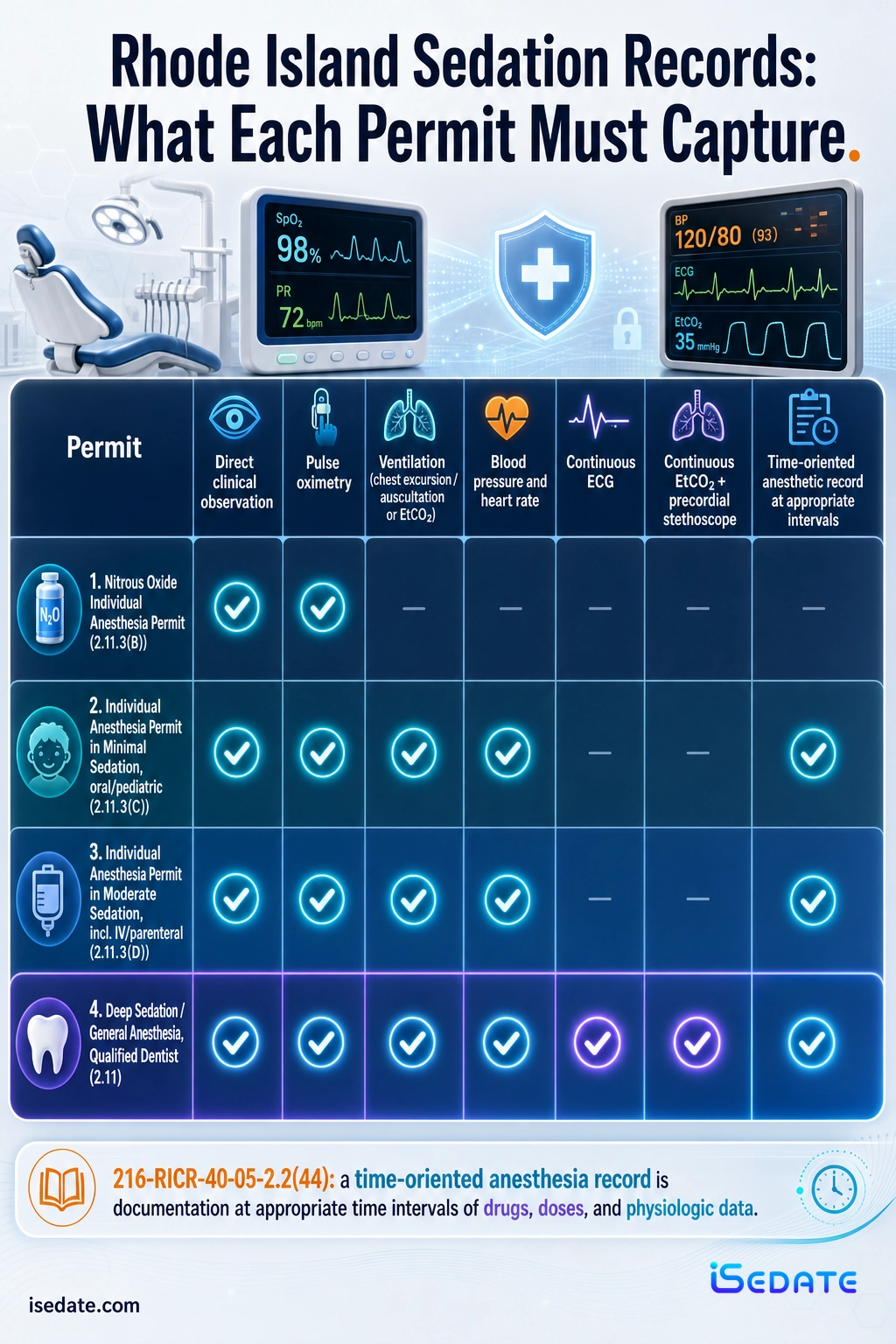
Rhode Island does not use a numbered "Level 1 through Level 4" ladder. It issues named Individual Anesthesia Permits, and the requirements escalate with the depth and route of sedation. Knowing which permit you hold tells you which monitoring and recordkeeping rules apply. These are the permits as 216-RICR-40-05-2.11.3 defines them:
| Rhode Island permit | What it covers | Citation |
|---|---|---|
| Nitrous Oxide Individual Anesthesia Permit | Inhaled nitrous oxide and oxygen sedation | 216-RICR-40-05-2.11.3(B) |
| Individual Anesthesia Permit in Minimal Sedation | Minimal sedation, oral and pediatric | 216-RICR-40-05-2.11.3(C) |
| Individual Anesthesia Permit in Moderate Sedation | Moderate sedation (Conscious Sedation), including the IV and parenteral route | 216-RICR-40-05-2.11.3(D) |
| Deep Sedation / General Anesthesia (Qualified Dentist) | Deep sedation and general anesthesia, the top tier | 216-RICR-40-05-2.11 (monitoring and documentation) |
Most general dentists work with the nitrous and minimal sedation permits, with the moderate sedation permit adding the IV and parenteral route. Moderate sedation is what most clinicians still call Conscious Sedation: the patient keeps a patent airway and responds to verbal or light tactile stimulation, but they are sedated enough that the full monitoring and documentation standard applies. Deep sedation and general anesthesia sit at the top of the structure and are addressed through the regulation's Qualified Dentist provisions, which carry the strictest requirements.
This guide focuses on the monitoring and recordkeeping standard in 216-RICR-40-05-2.11, because that section defines the record every permit holder must maintain. If you are working out which permit to apply for or how to upgrade, that is a separate process, covered in our guide to Rhode Island sedation dentistry licensing and permit requirements.
Source: 216-RICR-40-05-2.11.3 (permits)
What you must monitor at each level
In Rhode Island, what you are required to monitor is what you are required to write down. The two are inseparable: the monitoring standard in 216-RICR-40-05-2.11 defines the physiological parameters, and the documentation provision in the same section requires them to be recorded. For minimal and moderate sedation, the rule requires the dentist to ensure continuous and continual monitoring of four things:
- Direct clinical observation: the patient is observed directly throughout the administration of anesthesia.
- Oxygenation: oxygen saturation is monitored continuously by pulse oximetry.
- Ventilation: chest excursion is observed and breath sounds are auscultated, or end-tidal carbon dioxide is monitored.
- Circulation: blood pressure and heart rate are continually evaluated.
Deep sedation and general anesthesia, performed by a Qualified Dentist, add a heavier monitoring load. Under 216-RICR-40-05-2.11, that tier requires continuous pulse oximetry; continuous end-tidal carbon dioxide (for intubated and non-intubated patients unless invalidated) plus a precordial or pretracheal stethoscope; continuous respiratory rate; continuous ECG for heart rate and rhythm along with pulse rate by oximetry; continual blood pressure; and a temperature-monitoring device readily available, used continuously when malignant-hyperthermia triggering agents are in use. The deeper the sedation, the more parameters you are both watching and logging.
Myth, Busted
Myth: Nitrous or a single oral pill is light, so monitoring and charting barely apply.
Fact: Depth of sedation, not the drug or the route, drives the requirement. Rhode Island defines sedation levels by the patient's response, and a patient can reach a deeper level than intended. The moment a patient reaches moderate sedation, the full monitoring and documentation standard in 216-RICR-40-05-2.11 applies, no matter how the drug was delivered.
This is exactly how an oral or nitrous case develops a record gap: the team charts it like a light appointment, the patient drifts deeper, and the time-oriented record that moderate sedation requires was never being kept.
Source: 216-RICR-40-05-2.11 (Monitoring and Documentation)
What the record must contain: the compliance core
This is the section a reviewer reads first. Rhode Island spells out exactly what the record must be, and it has three parts worth knowing by heart.
1. An appropriate time-oriented anesthetic record
Under 216-RICR-40-05-2.11, "an appropriate time-oriented anesthetic record shall be maintained," and the dentist must document the individuals present during the administration of anesthesia. "Time-oriented" is the operative phrase, and Rhode Island defines it directly. In the definitions at 216-RICR-40-05-2.2, definition 44, a time-oriented anesthesia record is "documentation at appropriate time intervals of drugs, doses and physiologic data obtained during patient monitoring." The record is organized against the clock, not as a single end-of-visit summary. A note that a patient "tolerated sedation well" is not this record. A timeline of drugs, doses, physiologic data, and the people in the room is.
State Law
2. Vitals documented at appropriate time intervals
Rhode Island does not set a single fixed number of minutes in its general sedation rule. Instead, the definition itself carries the standard: documentation at appropriate time intervals of the drugs, doses, and physiologic data obtained while the patient is monitored. In practice that means the oxygenation, ventilation, and circulation parameters you monitor continuously or continually must land on the record at intervals appropriate to the depth and length of the case, not just at the start and the end. Monitoring continuously but writing a reading only at the beginning and the end does not produce a time-oriented record.
3. Drug detail, discharge, and the facility rules
For deep sedation and general anesthesia, Rhode Island is even more explicit about contents. The time-oriented anesthetic record must be maintained "including the names of all the drugs, dosages and their administration times, including local anesthetics and monitored physiological parameters," along with a documented pre-procedure equipment check and maintenance. Recovery has its own documentation duty: the dentist must continually monitor blood pressure, heart rate, oxygenation, and level of consciousness, and must determine and document that oxygenation, ventilation, and circulation are stable before discharge, plus document the post-operative instructions given.
On top of the record itself, the facility and equipment standard in 216-RICR-40-05-2.13 sets baseline vital-sign requirements captured at the preoperative evaluation: body weight, height, blood pressure, pulse rate, respiration rate, and blood oxygen saturation by pulse oximetry unless invalidated by the patient, procedure, or equipment, with body temperature measured when clinically appropriate.
Source: 216-RICR-40-05-2.11, 2.2(44), and 2.13 | RI DOH filed regulation (full PDF)
See how a time-oriented anesthesia record is built automaticallyWhat a compliant chart looks like: a sample cadence
Because Rhode Island sets an "appropriate interval" rather than a fixed minute count, the safest way to read the rule is to chart at the interval a reviewer would expect for your depth of sedation, and to never let the record go quiet while the patient is sedated. The following is a practical cadence that satisfies the time-oriented standard. It is an illustration of the rule, not a figure taken from the regulation, which leaves the exact interval to clinical judgment.
| Phase of the case | What goes on the time-oriented record |
|---|---|
| Pre-procedure | Baseline weight, height, blood pressure, pulse, respiration, and SpO2; ASA status; airway assessment; NPO status; consent; pre-procedure equipment check. |
| Each drug given | Drug name, dose, route, and the exact administration time, including local anesthetics. |
| During sedation | SpO2, heart rate, blood pressure, and respiratory status logged at regular, appropriate intervals against the clock, not just at the ends; the individuals present during administration. |
| Recovery | Continued blood pressure, heart rate, oxygenation, and level of consciousness until stable. |
| Discharge | A documented determination that oxygenation, ventilation, and circulation are stable, plus the post-operative instructions given and to whom. |
Oral and nitrous versus IV and deeper: what changes on the page
The structure of the record is the same at every level, but the content load climbs with depth. For an oral or nitrous minimal sedation case, the four monitored parameters (direct observation, oxygenation, ventilation, circulation) and the drug log carry most of the record. For moderate or conscious sedation and above, the record has to carry every drug name, dose, and administration time (local anesthetics included), the full physiologic parameter set, the equipment check, and the discharge determination. Deep sedation and general anesthesia add the continuous ECG, continuous end-tidal CO2, and temperature documentation on top. The deeper you go, the less the record tolerates a blank interval.
Source: 216-RICR-40-05-2.11 (Monitoring and Documentation)
How long you must keep the record
A time-oriented record only protects you if it still exists when it is asked for, and Rhode Island sets a hard floor. Under 216-RICR-40-05-2.14, the dentist must keep the written dental record and radiographs for a minimum of five years from the date of the last dental visit, in accordance with R.I. Gen. Laws 23-3-26. For minors, the clock runs longer: records must be kept at least five years after the minor reaches the age of eighteen. The same section lists what the record must contain at a minimum, including the patient's name, address, and date of birth, the medical history, and the medications administered with their dates, dosages, and amounts.
State Law
Retention matters most in exactly the situation you least want: a board inquiry or a malpractice claim that lands years after the appointment. Because the time-oriented record is contemporaneous, it cannot be recreated later; if it was not kept, or not kept long enough, there is nothing to produce. A clean retention policy is part of the compliance story, not an afterthought to it.
Source: 216-RICR-40-05-2.14 (record keeping and retention)

Why a thin record is so costly
When the Board of Examiners in Dentistry or the Department of Health opens your file, they are checking the record, not your intentions. The anesthesia permit holder is responsible under 216-RICR-40-05-2.11 for anesthetic management, facility adequacy, and emergency treatment, and the time-oriented anesthetic record is the document that proves the standard was met.
Here is where dentists get burned. It is rarely the clinical care that fails a review. It is the record: a drug given but not logged with its administration time, physiologic data that was monitored but never recorded at appropriate intervals, a discharge that was never documented as stable, a pre-procedure equipment check with no note behind it. The care can be flawless and the record can still fall short of what 216-RICR-40-05-2.11 requires.
A reviewer grades the record, not the outcome. They judge whether the contemporaneous, time-oriented record proves what you did and when. If the record has gaps, the default assumption on review is that the monitoring had gaps too. Log every drug, every dose, and every administration time, and record the physiologic data at appropriate intervals across the whole case.
The exposure is not only a board review. The same gaps that fail a records review are the gaps a plaintiff's attorney looks for in a malpractice claim, where the contemporaneous record is the first thing requested and the hardest thing to reconstruct after the fact. The data behind that pattern is covered in our research roundups on how sedation charting affects malpractice case outcomes, vital-signs monitoring and sedation safety, and documentation-error rates and chart defensibility.
iSedate Insight
In practice, a charting failure almost never looks like negligence in the moment. It looks like a busy team managing an airway and an anxious patient, writing a reading a minute late, or logging a drug from memory after recovery. The rule asks for a contemporaneous time-oriented record precisely because that is the one thing a stretched team cannot reliably produce by hand. Removing the manual step is the most reliable way to close the gap.
Source: 216-RICR-40-05-2.11
Enforcement and responsibility
216-RICR-40-05-2 is backed by the Department of Health's disciplinary authority over licensees. The anesthesia permit holder carries direct responsibility for anesthetic management, the adequacy of the facility, and emergency treatment, which means an incomplete sedation record is not a filing technicality. It is the evidence a board weighs when deciding whether the standard of care was met.
The exact disciplinary schedule, any routine office-inspection cadence for permit holders under 216-RICR-40-05-2.13, and the precise penalty specifics are administered by the Board of Examiners in Dentistry and can change, so confirm current details directly with the Rhode Island Department of Health rather than relying on a figure that may be out of date. What does not change is the exposure created by a thin record: in both a board review and a lawsuit, the contemporaneous time-oriented record is the first thing requested and the hardest thing to reconstruct after the fact.
Source: 216-RICR-40-05-2.11 | RI Department of Health, Board of Examiners in Dentistry
Making the record audit-ready
The gap between knowing the rule and passing a review is almost always the same thing: a time-interval vitals log kept by hand during a live sedation case. When a team is managing an airway and an anxious patient, a reading written by hand is exactly where the record develops holes, a skipped interval here, a missing administration time there, a drug given in the moment and logged later from memory.
That is the problem SedationVault by iSedate was built to remove. It connects to the vitals monitor already in your operatory and captures pulse oximetry, heart rate, respiratory rate, and blood pressure live, on the clock, alongside the drug log, so the time-oriented anesthetic record writes itself as the case runs rather than being reconstructed afterward. When the Board of Examiners in Dentistry asks for the chart, it exports as a one-click, audit-ready sedation visit report that already carries the drug names, dosages, administration times, physiologic data, and the discharge assessment the rule asks for. The point is not fancier charting. It is turning the exact items 216-RICR-40-05-2.11 requires into something the record guarantees are present and time-stamped, which is also what dental sedation compliance turns on.
Book a demo and see your Rhode Island sedation record build itselfRelated guides and neighboring states
This page is part of our state-by-state series on sedation documentation. For the clinical "what and why" behind these requirements across every state, start with the hub: Dental Sedation Vitals, Charting & Reporting Requirements by State. Licensed in a neighboring state? See our guides for Connecticut sedation vitals, charting & reporting requirements and Massachusetts sedation vitals, charting & reporting requirements. For the Rhode Island licensing and permit process itself, see our companion guide to Rhode Island sedation dentistry licensing and permit requirements.
Frequently asked questions
Does Rhode Island require a written sedation record?
How often must vitals be recorded during sedation in Rhode Island?
How long must Rhode Island dental sedation records be kept?
Who regulates sedation records in Rhode Island?
What are the Rhode Island dental sedation permit levels?
Does Rhode Island require a discharge note after sedation?
Sources & Verification
This guide cites Rhode Island's primary regulatory sources, re-verified against the Rhode Island Secretary of State's official, active text of the rule. Rule text is drawn from 216-RICR-40-05-2, the dental regulation issued by the Rhode Island Department of Health, including the time-oriented anesthesia record definition at 2.2(44), the monitoring and documentation provisions at 2.11 and the permits at 2.11.3, the physical facility and equipment standard at 2.13, and the record-keeping and retention rule at 2.14 (which ties retention to R.I. Gen. Laws 23-3-26). The regulator is the Rhode Island Board of Examiners in Dentistry under the Department of Health. The American Dental Association guidelines are a private national standard incorporated by reference, not law. Where a detail (a routine inspection cadence, the exact penalty schedule, the deep-sedation training-hour count, or current board contact information) is administered by the board and subject to change, confirm it directly with the Rhode Island Department of Health; those items are flagged rather than stated, because they could not be verified from the primary rule text.
- 216-RICR-40-05-2: Dentists, Dental Hygienists and Dental Assistants (RI Secretary of State, active rule, incl. 2.2 definitions, 2.11 Monitoring and Documentation, 2.11.3 permits, 2.13 facility, 2.14 records and retention)
- Rhode Island Department of Health, filed regulation 216-RICR-40-05-2 (full PDF)
- Rhode Island Department of Health, Board of Examiners in Dentistry (Dental Professionals)
This guide summarizes Rhode Island sedation recordkeeping rules for general information and is not legal advice. Confirm current board contact details, inspection cadence, and penalty specifics directly with the Rhode Island Department of Health before you act.















