







New York Sedation Vitals Monitoring, Charting & Reporting Requirements
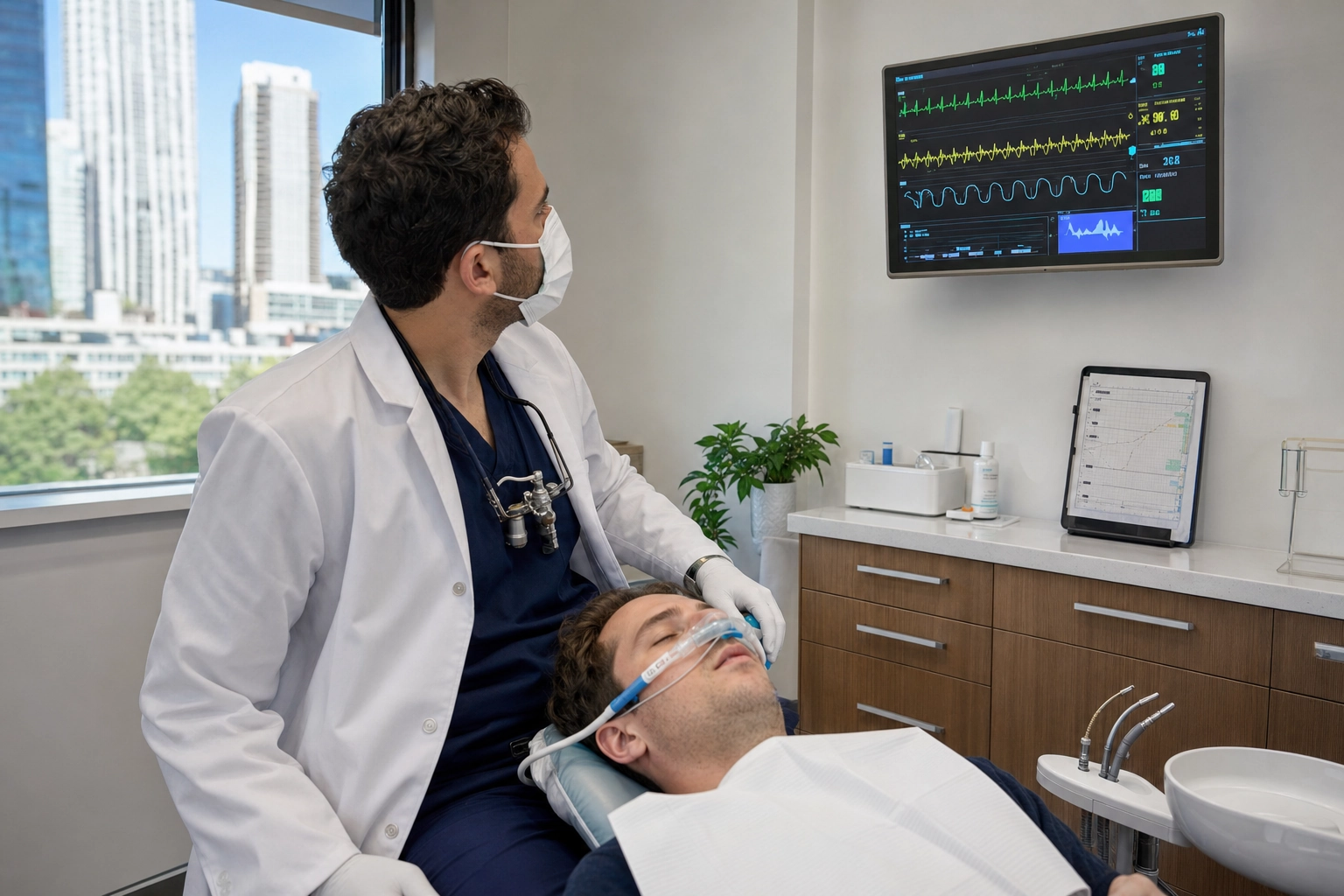
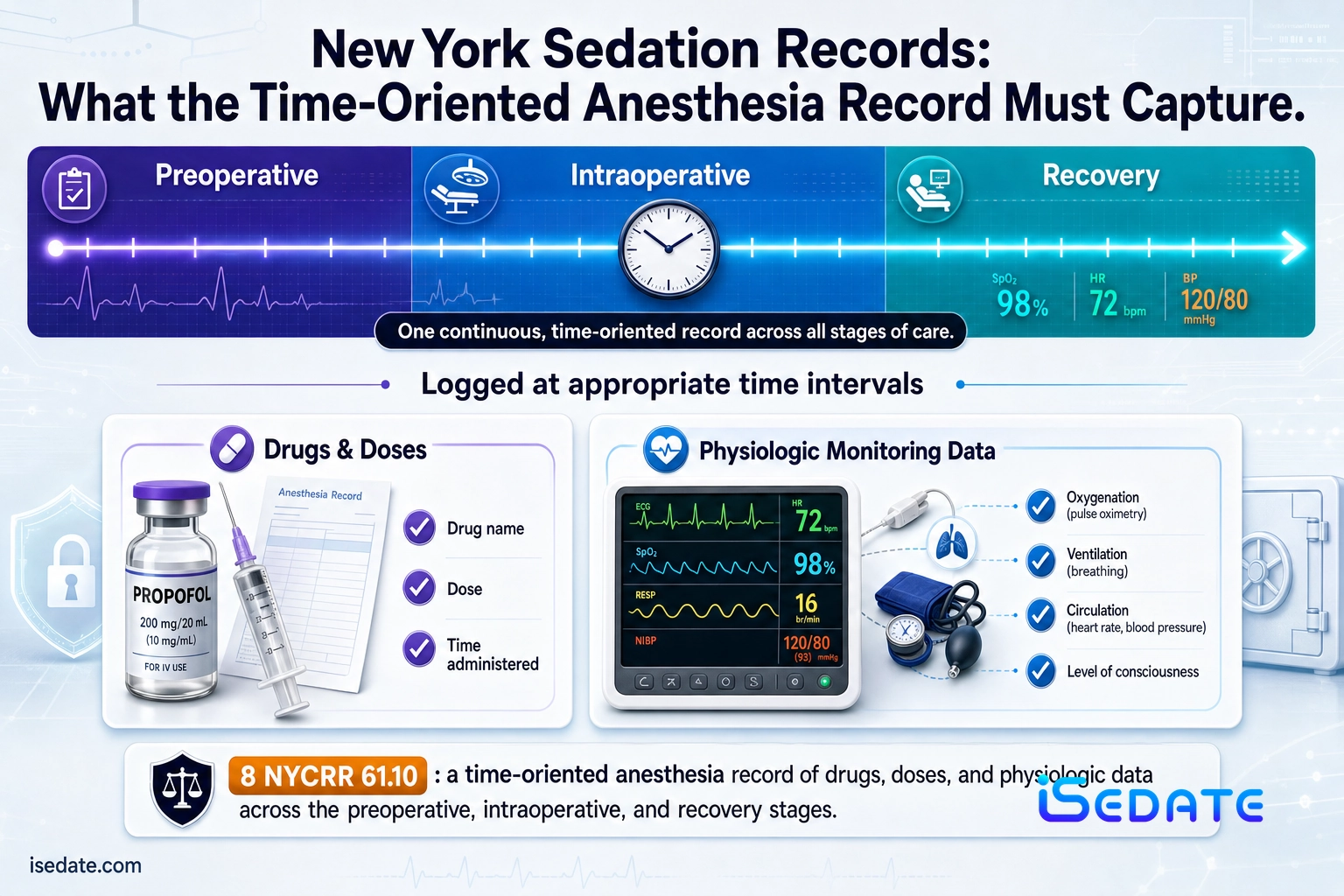
If you sedate patients in New York, the state is exact about what has to be written down: a time-oriented anesthesia record that shows, at appropriate time intervals, every drug and dose you administered and the physiologic data you obtained from monitoring the patient, across the preoperative, intraoperative, and recovery stages. That requirement lives in 8 NYCRR 61.10, it sits under Education Law 6605-a, and it is enforced by the New York State Board for Dentistry through the Education Department's Office of the Professions. Unlike many states, New York publishes the full charting checklist in its rule, so this guide walks through exactly what you must monitor, the fields the record has to contain, what compliant documentation looks like for Conscious Sedation versus IV cases, and how to keep the chart audit-ready.
Recent Updates
Last UpdatedNovember 16, 2026
- Verified every requirement against the current, official full text of 8 NYCRR 61.10 on the New York State Education Department's own site, replacing earlier aggregator citations.
- Added the complete field-by-field record checklist from 8 NYCRR 61.10(d)(8) and the exact monitoring parameters for conscious (moderate) sedation versus deep sedation and general anesthesia.
- Corrected the certificate structure to the five titles New York has issued since January 1, 2018, including the pediatric (12 and younger) certificates.
- Added the six-year record-retention rule, the 30-day adverse-event reporting duty, and current malpractice documentation data.
- The core rule: 8 NYCRR 61.10 requires a time-oriented anesthesia record that logs, at appropriate time intervals, the drugs and doses given and the physiologic data from monitoring.
- Three stages, one record: the record must span the preoperative, intraoperative, and recovery periods, not just chair time, and 61.10(d)(8) lists the exact fields it must contain.
- Monitoring is defined, not vague: New York spells out continual and continuous monitoring of consciousness, oxygenation, ventilation, and circulation, with ECG and end-tidal CO2 required at the deeper levels.
- Who enforces it: the New York State Board for Dentistry under the Education Department's Office of the Professions, backed by a 30-day adverse-event report and a six-year record-retention duty.
- The ADA is a professional standard, not law. Your record is held to 8 NYCRR 61.10 and Education Law 6605-a.

What This Guide Covers
- Who regulates sedation in New York
- The five New York dental anesthesia certificates
- What you must monitor during sedation
- What the time-oriented anesthesia record must contain
- What compliant documentation looks like
- Why the record matters: review and malpractice exposure
- The easy button: an audit-ready record
- Frequently asked questions
- Sources and citations
Who regulates sedation in New York
Sedation and anesthesia in a New York dental office are regulated by the New York State Board for Dentistry, which operates under the New York State Education Department's Office of the Professions. This is a structural difference worth understanding. Unlike many states, New York does not regulate dentistry through a standalone, self-governing dental board. Dentistry is one of the professions overseen by the State Education Department, and the Board for Dentistry advises on licensing, practice standards, and professional conduct within that department.
The sedation rules are precise and citable. The operating rule is 8 NYCRR 61.10, a section of the Regulations of the Commissioner of Education, and its statutory backbone is Education Law 6605-a, part of Article 133. That matters for compliance because your recordkeeping obligation is a named regulation with an exact citation, not a vague standard of care. It is also worth being precise about the ADA here: the American Dental Association publishes national sedation guidelines that most states lean on, but those guidelines are a professional standard, not law. In New York, the law is 8 NYCRR 61.10 and Education Law 6605-a, and the body that enforces it is the State Board for Dentistry under the Office of the Professions. For the clinical "what and why" behind these duties across every state, see our Dental Sedation Vitals, Charting & Reporting Requirements by State hub.
One detail signals how current this rule is. 8 NYCRR 61.10 was amended by the Board of Regents in December 2016, with the changes taking effect July 1, 2017 and January 1, 2018. The amendment aligned New York's anesthesia definitions with current American Society of Anesthesiologists physical-status classifications and American Dental Association terminology, added the definition of a time-oriented anesthesia record, and created new conscious (moderate) sedation certificates, including separate pediatric certificates. This is not a dusty rule from decades past. It reflects the modern sedation framework the rest of this guide describes.
Source: 8 NYCRR Part 61, Regulations of the Commissioner of Education (section 61.10) | New York Education Law 6605-a
The five New York dental anesthesia certificates
New York does not use numbered sedation "permits." The Education Department issues a dental anesthesia certificate, and since January 1, 2018 the certificate comes in five titles that reflect both the depth of sedation and, for moderate sedation, the route and the patient's age. Knowing which certificate you hold tells you which monitoring and recordkeeping duties apply. Each certificate is issued for a three-year term. These are the titles exactly as 8 NYCRR 61.10 defines them:
| New York certificate | What it authorizes |
|---|---|
| Dental general anesthesia | Conscious (moderate) sedation (enteral or parenteral, with or without inhalation agents), deep sedation, and general anesthesia |
| Dental parenteral conscious (moderate) sedation, patients 13 and older | Moderate sedation by the parenteral or enteral route (with or without inhalation) on patients 13 and older |
| Dental parenteral conscious (moderate) sedation, patients 12 and younger | The same parenteral moderate sedation authority extended to all patients, including children 12 and younger |
| Dental enteral conscious (moderate) sedation, patients 13 and older | Enteral-route moderate sedation (with or without inhalation) on patients 13 and older |
| Dental enteral conscious (moderate) sedation, patients 12 and younger | The same enteral moderate sedation authority extended to all patients, including children 12 and younger |
Two features surprise dentists coming from other states. First, the certificate requirement attaches to sedation performed anywhere other than a general hospital: under Education Law 6605-a and 8 NYCRR 61.10, a dentist needs the matching dental anesthesia certificate to employ conscious (moderate) sedation, deep sedation, or general anesthesia outside a hospital setting. Second, New York splits its moderate sedation authority by both route and age, and the certificate for patients 12 and younger is the more demanding one to earn because the state wants additional pediatric training and sample records behind it. No certificate is required for local anesthesia, nitrous oxide alone, or minimal sedation. If you are deciding which certificate to pursue or how to add one, that process belongs in a separate workflow, covered in our guide to New York Sedation Dentistry Licensing & Permit Requirements.
Myth, Busted
Myth: Minimal sedation and nitrous are light, so the record barely matters.
Fact: The obligation tracks the depth of sedation, not the drug or the route. Once a patient reaches conscious (moderate) sedation, the full 8 NYCRR 61.10 monitoring and time-oriented record standard applies, however the agent was delivered.
New York requires no certificate for minimal sedation or nitrous oxide alone, but that is about authority to administer, not documentation discipline. A single oral drug can carry an anxious patient deeper than intended, which is exactly when a thin record becomes a liability.
Source: NYSED Office of the Professions, dental anesthesia / sedation certification
What you must monitor during sedation
In New York, what you are required to monitor is what feeds the record you are required to keep, and the rule does not leave it to interpretation. 8 NYCRR 61.10(d) lists the specific physiologic systems you must watch, and it does so separately for conscious (moderate) sedation and for deep sedation and general anesthesia. Two defined terms carry a lot of weight: "continual" means repeated regularly and frequently in a steady succession, and "continuous" means prolonged without any interruption in time. The rule uses each deliberately.
Conscious (moderate) sedation
For moderate sedation, 8 NYCRR 61.10(d) requires the dentist to monitor four systems:
- Consciousness: level of consciousness, such as responsiveness to verbal command, continually assessed.
- Oxygenation: color of mucosa, skin, or blood evaluated continually, and oxygen saturation evaluated continuously by pulse oximetry.
- Ventilation: chest excursions observed continually, and ventilation monitored by auscultation of breath sounds, end-tidal CO2, or verbal communication with the patient.
- Circulation: blood pressure and heart rate evaluated continually. During enteral moderate sedation, continuous ECG is required when a finding of cardiovascular disease warrants it. During parenteral moderate sedation, the dentist must continuously evaluate heart rate and rhythm via ECG and pulse rate via pulse oximetry.
Deep sedation and general anesthesia
The deeper levels raise the bar, because airway and cardiovascular function are more likely to be impaired. 8 NYCRR 61.10(d) requires:
- Oxygenation: color evaluated continually, oxygen saturation evaluated continuously by pulse oximetry.
- Ventilation: for an intubated patient, end-tidal CO2 continuously monitored; for a non-intubated patient, breath sounds by auscultation and/or end-tidal CO2 continuously monitored; respiration rate continually monitored. When agents implicated in malignant hyperthermia are used, end-tidal CO2 is continuously monitored.
- Circulation: heart rate and rhythm continuously evaluated via ECG throughout the procedure, pulse rate via pulse oximetry, and blood pressure continually evaluated.
- Temperature: a device capable of measuring body temperature readily available, with continuous temperature monitoring when malignant-hyperthermia agents are used.
Notice what the rule does, and does not, say. It specifies which parameters and how closely (continual versus continuous), and it ties the record to "appropriate time intervals" rather than naming a fixed number of minutes. The honest answer to "how often do I chart a reading" is therefore: often enough that the record reflects continual and continuous monitoring and shows no unexplained gap, with the baseline, intraoperative, and pre-discharge findings all captured.
Source: 8 NYCRR 61.10(d), monitoring requirements for dental sedation and anesthesia
What the time-oriented anesthesia record must contain
This is the section a reviewer reads first. New York's documentation requirement is not a soft "standard of care" gesture: 8 NYCRR 61.10(d)(8) enumerates the fields the record must contain, so the chart is graded against a checklist, not an impression. The record is a timeline, and it covers three stages.
A note that a patient "tolerated sedation well" is not this record. A chronological log of agents, doses, times, and physiologic data is. Here is what 8 NYCRR 61.10(d)(8) actually requires the record to contain.
What a New York Time-Oriented Anesthesia Record Must Contain
- Date of treatment.
- Demographics: patient name; age, height, and weight; nothing-by-mouth (NPO) status; medical conditions; allergies; medications; diagnosis; and treatment proposed or performed.
- Pre-treatment evaluation: results of a focused examination and airway evaluation, plus the patient's ASA physical-status classification.
- Clinical care: all enteral, parenteral, and inhalation agents administered; the dose of each according to the time given preoperatively, intraoperatively, and during in-office recovery; type and placement of intravenous access; type and total amount of IV fluids; type of advanced airway management used; and all types of monitoring used.
- Physiologic findings at baseline, intraoperatively, and pre-discharge, including blood pressure, heart rate, respiratory rate, end-tidal CO2, temperature and ECG rhythm if monitored, and oxygen saturation. If a parameter cannot be monitored, the reason must appear on the record.
- Procedure details: the time a throat pack or throat drape is placed and removed, and the persons present providing care or assisting.
- Recovery accountability: the name of the certificate holder responsible for recovery and discharge, and any irreversible morbidity during treatment or the in-office recovery period.
- Supporting records: the patient's medical history and informed consent obtained before the procedure, plus any physician consultations documented before, during, or within 24 hours after.
The record does not end when the handpiece stops. New York requires documented discharge criteria in the patient's chart: the patient is alert and responsive, can maintain and support the airway without intervention, has vital signs including oxygen saturation on room air within acceptable limits, is ambulatory with assistance, has a responsible adult escort present, and has received written and verbal instructions that include how to reach the anesthesia provider in an emergency. The dentist must also assess and document pain and post-operative nausea and vomiting before discharge. Recovery is a documented phase with its own monitoring, not an afterthought, and a record that goes quiet the moment the procedure finishes leaves exactly the gap a reviewer looks for.
See how a time-oriented anesthesia record builds itself
What compliant documentation looks like
Knowing the fields is half the job. The other half is a record that actually demonstrates continual and continuous monitoring across the whole case. A compliant New York sedation chart reads as a clock-driven timeline, not a summary written from memory at the end.
A sample charting cadence
Think of the record in four bands, each time-stamped:
- Preoperative: NPO status, focused exam and airway evaluation, ASA class, baseline vital signs (blood pressure, heart rate, respiratory rate, oxygen saturation), and informed consent, all recorded before the first agent. If behavior prevents a baseline reading, that fact is noted on the record rather than left blank.
- Induction and drug administration: every agent, its dose, and the exact time, entered as it is given, not reconstructed afterward.
- Intraoperative: physiologic readings entered at appropriate time intervals, tight enough that the timeline shows continuous oximetry and ECG (where required) with no unexplained gap. Any parameter that cannot be monitored carries a reason on the chart.
- Recovery and discharge: continued monitoring, the pain and nausea assessment, the discharge-criteria checklist, the escort, and the name of the certificate holder who released the patient.
Oral (enteral) versus IV (parenteral) differences
The two routes are not charted identically. For enteral Conscious Sedation, ECG is required only when a cardiovascular finding warrants it, and there is a narrow exception: if the patient's conduct prevents monitoring oxygen saturation and blood pressure, those readings are not required as long as the record documents that fact. For parenteral sedation, continuous ECG and pulse oximetry are mandatory, and an intravenous line that is secured throughout the procedure must be established (or, if it cannot be maintained, the record must say so). The deeper you go, the more the record has to prove.
Equipment and staffing the record assumes
New York ties the chart to a properly equipped, properly staffed operatory. Every facility using moderate sedation, deep sedation, or general anesthesia must be equipped and staffed for administration, monitoring, and emergencies, must allow ready access for emergency equipment, must post an emergency protocol in each treatment and recovery area, and must have an automatic external defibrillator or other defibrillator on site. Staffing minimums are specific: at least three people in the operatory for deep sedation or general anesthesia (the qualified dentist or physician plus two individuals with current basic life support certification), and at least two for conscious (moderate) sedation (the qualified provider plus one BLS-certified individual). A chart that names the persons present should match those minimums.
Source: 8 NYCRR 61.10(d), practice, equipment, and recordkeeping requirements
Why the record matters: review and malpractice exposure
In New York, your sedation record is the evidence in any professional-conduct review and in any lawsuit. The Office of the Professions can request time-oriented anesthesia records to verify compliance, and it does so both on request and at certificate renewal. The pattern that burns dentists is the same in every state: it is rarely the clinical care that fails a review, it is the record. A missing time stamp, an interval that stretched too long, a drug given but not logged, a recovery phase that was never documented. The care can be flawless and the record can still fall short, because a reviewer grades whether the contemporaneous, time-oriented record proves what you did across all three stages.
The malpractice data tells the same story. In closed medical professional liability cases analyzed in the Candello 2024 Benchmarking Report, documentation failures played a part in roughly one in five cases each year, and in anesthesiology specifically, cases with documentation failures were far more likely to involve severe patient injury.
Anesthesiology malpractice claims: share involving high-severity injury
Source: CRICO, Candello 2024 Benchmarking Report, reported in CRICO's "For the Record: Key Documentation Lessons to Take Into 2025."
Important
A gap in the record reads as a gap in the monitoring. On review, the default assumption is that if a reading is not in the time-oriented anesthesia record, the monitoring behind it did not happen either. New York's standard asks for drugs, doses, and physiologic data at appropriate time intervals across the preoperative, intraoperative, and recovery periods. Document each phase contemporaneously, with times, so the chart stands on its own long after the appointment.
New York also backs the record with two hard deadlines. Mortality or irreversible morbidity that occurs during, within 48 hours following, or otherwise related to sedation must be reported in writing to the Education Department within 30 days. And the record itself has to survive for years: 8 NYCRR 61.10(d)(8) requires sedation records to be kept per 8 NYCRR 29.2(a)(3), which sets a minimum of at least six years (and, for minors, at least six years and until one year after the patient turns 21).
These are also the gaps a plaintiff's attorney looks for, which is why strong dental sedation compliance turns on the record being complete and time-stamped while the case is live, not afterward.
Source: CRICO (Harvard risk management), documentation lessons from the Candello 2024 Benchmarking Report | 8 NYCRR 29.2, record-retention rule
The easy button: an audit-ready record
The gap between knowing the rule and passing a review is almost always the same thing: a time-oriented log kept by hand during a live case. When a team is managing an airway and an anxious patient, a vitals entry written at intervals on paper is exactly where the record develops holes, a skipped reading here, a missing time stamp there, a drug given in the moment and logged later from memory, a recovery phase that never made it onto the page.
That is the problem SedationVault by iSedate was built to remove. It connects wirelessly to the vitals monitor already in your operatory and captures oxygen saturation, heart rate, blood pressure, and the rest of the physiologic data live, on the clock, alongside the drug and dose log, so the time-oriented anesthesia record builds itself as the case runs rather than being reconstructed afterward. It carries the record across all three stages the rule names, preoperative, intraoperative, and recovery, so recovery is documented instead of forgotten, and it captures digital intake and consent in the same chart. When the Office of the Professions or your own counsel asks for the record, it exports as a one-click, audit-ready sedation visit report that already carries the times, the doses, and the monitoring data 8 NYCRR 61.10(d)(8) asks for. The point is not fancier charting. It is turning the exact fields New York requires into something the software makes sure are present and time-stamped.
Book a demo and see your New York sedation record build itselfFrequently asked questions
Does New York require a written sedation record?
What is a time-oriented anesthesia record in New York?
What vital signs must be charted during sedation in New York?
How often do I have to record vitals during sedation?
How long must New York dental sedation records be kept?
Does New York require reporting a sedation death or serious injury?
Who regulates dental sedation records in New York?
Related guides and neighboring states
Licensed in more than one state, or practicing near the New York line? The documentation rules differ at every border. See our same-silo guides for neighboring states, or compare all 50 on the national hub:
- Connecticut Sedation Vitals Monitoring, Charting & Reporting Requirements
- Massachusetts Sedation Vitals Monitoring, Charting & Reporting Requirements
- New Jersey Sedation Vitals Monitoring, Charting & Reporting Requirements
- Pennsylvania Sedation Vitals Monitoring, Charting & Reporting Requirements
- Vermont Sedation Vitals Monitoring, Charting & Reporting Requirements
- Dental Sedation Vitals, Charting & Reporting Requirements by State (all 50)
Sources and citations
This guide cites New York's primary regulatory sources, verified against the current official text on the New York State Education Department's own site. The regulator is the New York State Board for Dentistry, under the Education Department's Office of the Professions. The monitoring and recordkeeping requirements are drawn directly from 8 NYCRR 61.10, the certificate requirement from Education Law 6605-a, and the retention rule from 8 NYCRR 29.2(a)(3). Malpractice documentation figures are from CRICO's reporting on the Candello 2024 Benchmarking Report. Requirements change, so confirm the current rule text and any detail specific to your practice directly with the New York State Board for Dentistry (518-474-3817 ext. 550, [email protected]). This guide is general information, not legal or compliance advice; consult a qualified professional for guidance specific to your situation.
- 8 NYCRR Part 61, Regulations of the Commissioner of Education, section 61.10 (dental anesthesia certification, monitoring, and recordkeeping)
- NYSED Office of the Professions: Dental Anesthesia / Sedation Certification Q&A
- NYSED Office of the Professions: Dental Anesthesia / Sedation Certification
- New York Education Law 6605-a (dental anesthesia certificate requirement)
- 8 NYCRR Part 29, Rules of the Board of Regents (section 29.2, patient-record retention)
- CRICO, "For the Record: Key Documentation Lessons to Take Into 2025" (Candello 2024 Benchmarking Report)















