








Vermont Sedation Vitals Monitoring, Charting & Reporting Requirements
If you administer sedation in Vermont, the recordkeeping rule is not written out line by line in the state code, and that trips up a lot of dentists. Vermont's current Board of Dental Examiners rules, effective October 15, 2025, do not print their own itemized vitals-and-record list. Instead, Part 8-6 requires you to practice "in accordance with" the current ADA sedation guideline, and that guideline is what demands a time-oriented anesthetic record of every drug and dose plus continually recorded vital signs. The practical effect is the same as a hard statute: the ADA record standard is enforceable as Vermont law, and the Vermont board, not the ADA, is the body that reviews your chart. This guide breaks down what Vermont requires you to monitor and record, what a compliant record actually looks like on the page, and how to make it audit-ready instead of a liability.
Recent Updates
Last UpdatedNovember 16, 2026
- Re-verified every rule citation against the current official Administrative Rules of the Vermont Board of Dental Examiners, effective October 15, 2025 (Part 8).
- Replaced third-party legal-aggregator source links with the Vermont Secretary of State's own official Office of Professional Regulation document pages.
- Added a sample time-oriented record showing what a compliant Vermont charting cadence looks like on the page.
See full history of updates to this post
UpdatedOctober 2025
- Incorporated Vermont's reorganized rules effective October 15, 2025, which moved sedation into Part 8 and retired the older "Conscious Sedation Endorsement" and Part 5 framing.
- The core rule: Vermont's 2025 rules (Part 8-6) require practice per the current ADA sedation guideline, which means a time-oriented anesthetic record of all drugs, doses, and times, with vitals recorded continually.
- Who enforces it: the Vermont Board of Dental Examiners, within the Office of Professional Regulation (OPR) at the Secretary of State. The ADA writes the standard; the Vermont board holds you to it.
- The timeliness hook: Part 8-6 points to the ADA guideline "most current at the time of practice," so the ADA update adopted in October 2025 applies automatically, without Vermont rewriting its rule.
- Incident reporting is mandatory: under Part 11-1(d), a dentist must report sedation and anesthesia incidents and adverse outcomes, and the report includes a copy of the patient's medical record of the procedure.
- Audit readiness is built in: qualifying for a sedation specialty requires compliance with the AAOMS self-inspection checklist (Part 8-4, 8-5), so your records are expected to stand up to review.

What This Guide Covers
- Who regulates sedation in Vermont
- How Vermont's rule works: adoption by reference
- The Vermont sedation specialty levels
- What you must monitor at each level
- What you must record: the compliance core
- What a compliant record looks like on the page
- How Vermont reviews records
- Why a thin record is the real exposure
- Incident reporting and enforcement
- The easy button: an audit-ready record
- Frequently asked questions
- Sources and citations
Who regulates sedation in Vermont
Sedation and anesthesia in a Vermont dental office are regulated by the Vermont Board of Dental Examiners document library, which sits within the Office of Professional Regulation (OPR) at the Vermont Secretary of State. The board issues sedation and anesthesia specialties, reviews records, and takes disciplinary action. The rules were reorganized in a recent update: the current Administrative Rules of the Board of Dental Examiners took effect October 15, 2025, and sedation now lives in Part 8, "Dentist Sedation and Anesthesia Specialties."
That distinction matters for compliance. If you are working from older material, be careful: earlier references to a "Conscious Sedation Endorsement" or to Part 5 of the prior code are outdated. The 2025 rules moved sedation into Part 8, and that is the version a reviewer measures you against today.
Setting the Record Straight
Myth: The ADA sets federal sedation law that overrides whatever the state says.
Fact: The American Dental Association publishes a national professional standard, not law. In Vermont, that standard becomes binding only because Part 8-6 of the Board of Dental Examiners rules adopts it by reference, and the Vermont board, not the ADA, enforces it.
What makes Vermont unusual is that its rule expressly pulls the ADA guideline in by reference, which we cover next. The real federal layers that do apply are separate: DEA controlled-substance logs, HIPAA, and CMS or accreditation standards where relevant.
For the clinical "what and why" behind these requirements and a national comparison, see our hub guide on Dental Sedation Vitals, Charting & Reporting Requirements by State.
Source: Vermont Board of Dental Examiners (OPR) | 2025 Board rules, Part 8
How Vermont's rule works: adoption by reference
This is the single most important thing to understand about Vermont. Unlike states that print an exact itemized list of what the record must contain, Vermont does not. Part 8-6, the "Standard-of-Care Requirements for Sedation and Anesthesia," reads that dentists employing sedation or anesthesia "shall practice in accordance with" the current national guideline:
The Two Guidelines Vermont Adopts
- the ADA's Guidelines for the Use of Sedation and General Anesthesia by Dentists, or its successor publication most current at the time of practice; and
- for younger patients, the AAPD's Guidelines for Monitoring and Management of Pediatric Patients Before, During, and After Sedation, or its most current successor.
In plain terms: Vermont has made the ADA (and, for children, AAPD) guideline its legal standard of care. So when the ADA guideline says a moderate (conscious) sedation case needs a time-oriented anesthetic record with continually recorded vitals, that is not a suggestion in Vermont. It is the rule, enforceable by the Vermont board.
The phrase "most current at the time of practice" is worth circling: Vermont's standard updates itself. The ADA guideline update adopted in October 2025 flows into Vermont's requirement automatically, with no need for the board to rewrite its rule, so the record standard you are held to is always the newest ADA version, not a frozen older one.
Myth, Busted
Myth: Vermont doesn't spell out a record rule, so there isn't a hard requirement.
Fact: The opposite is true. By adopting the ADA guideline by reference under Part 8-6, Vermont imports the full ADA documentation standard, time-oriented anesthetic record and all, and makes it enforceable.
The absence of a printed list in the Vermont code is not a loophole; it is a pointer to a national standard a reviewer will hold you to in full. A record built to a lighter "local" assumption is measured against the complete ADA standard, not a shorter one.
Source: 2025 Board rules, Part 8-6
The Vermont sedation specialty levels
Vermont organizes sedation into two specialties plus a nitrous carve-out. Knowing which one you hold tells you which slice of the ADA monitoring and recordkeeping standard applies to you.
| Vermont category | What it covers | Citation |
|---|---|---|
| Nitrous oxide (no specialty) | Nitrous oxide alone, or with a single oral dose at or below the FDA maximum and no titration | Part 8-3(b) |
| Minimal and Moderate Sedation Specialty | Minimal sedation (anxiolysis) and moderate, or conscious, sedation, in one combined specialty | Part 8-2(a), 8-4 |
| Deep Sedation and General Anesthesia Specialty | Deep sedation or general anesthesia, the top tier | Part 8-2(b), 8-5 |
Two structural points matter. First, Vermont combines minimal and moderate sedation into a single specialty, rather than splitting them into separate permit tiers the way some states do. Second, nitrous oxide gets a narrow exemption: used on its own, or with a single oral dose at or below the FDA maximum and with no titration, it needs no specialty at all. Dental therapists are not eligible under Part 8-2(c). This guide focuses on the record standard for minimal and moderate sedation. If you are deciding which specialty to apply for, the training, and how to apply, that is covered in our guide to Vermont Sedation Dentistry Licensing & Permit Requirements.
Source: 2025 Board rules, Part 8-2 through 8-5
What you must monitor at each level
In Vermont, what you are required to monitor and what you are required to write down both come from the same place: the ADA guideline Part 8-6 incorporates. Because the depth of sedation, not the route or the drug, drives the obligation, the monitoring load climbs as the patient goes deeper. Under the ADA standard Vermont adopts, the requirements break down like this:
- Consciousness: the patient's level of sedation and responsiveness is continually assessed.
- Oxygenation: oxygen saturation is monitored continuously by pulse oximetry, and color of mucosa, skin, or blood is evaluated.
- Ventilation: chest excursion and ventilation are evaluated continually; at deeper levels, end-tidal carbon dioxide (capnography) is used.
- Circulation: blood pressure and heart rate are evaluated continually, with continuous ECG added for deep sedation and general anesthesia.
In short, a minimal or moderate sedation case under Vermont's standard calls for continuous pulse oximetry plus continually recorded heart rate, respiratory rate, blood pressure, and level of consciousness. The Deep Sedation and General Anesthesia Specialty adds capnography and continuous ECG on top. The deeper you go, the more parameters you are both watching and logging, and the more equipment has to be running in the operatory and feeding the record.
Debate Settled
Myth: Vermont has no printed interval, so a reading at the start and end of the case is enough.
Fact: The adopted ADA standard calls for the monitored parameters to be recorded continually through the case, not just at the endpoints, per Part 8-6.
"Continually" is a higher bar than a single numeric interval, not a lower one. Because Vermont does not state a fixed "every ten minutes," confirm your charting cadence against the current ADA guideline and the board rather than assume a lighter standard.
Source: 2025 Board rules, Part 8-6 (ADA/AAPD guidelines incorporated by reference)
What you must record: the compliance core
This is the section a reviewer reads first. Because Vermont's record duty flows from the ADA guideline, the items below are the ADA documentation standard that Part 8-6 makes enforceable in Vermont. There are three parts worth knowing by heart.
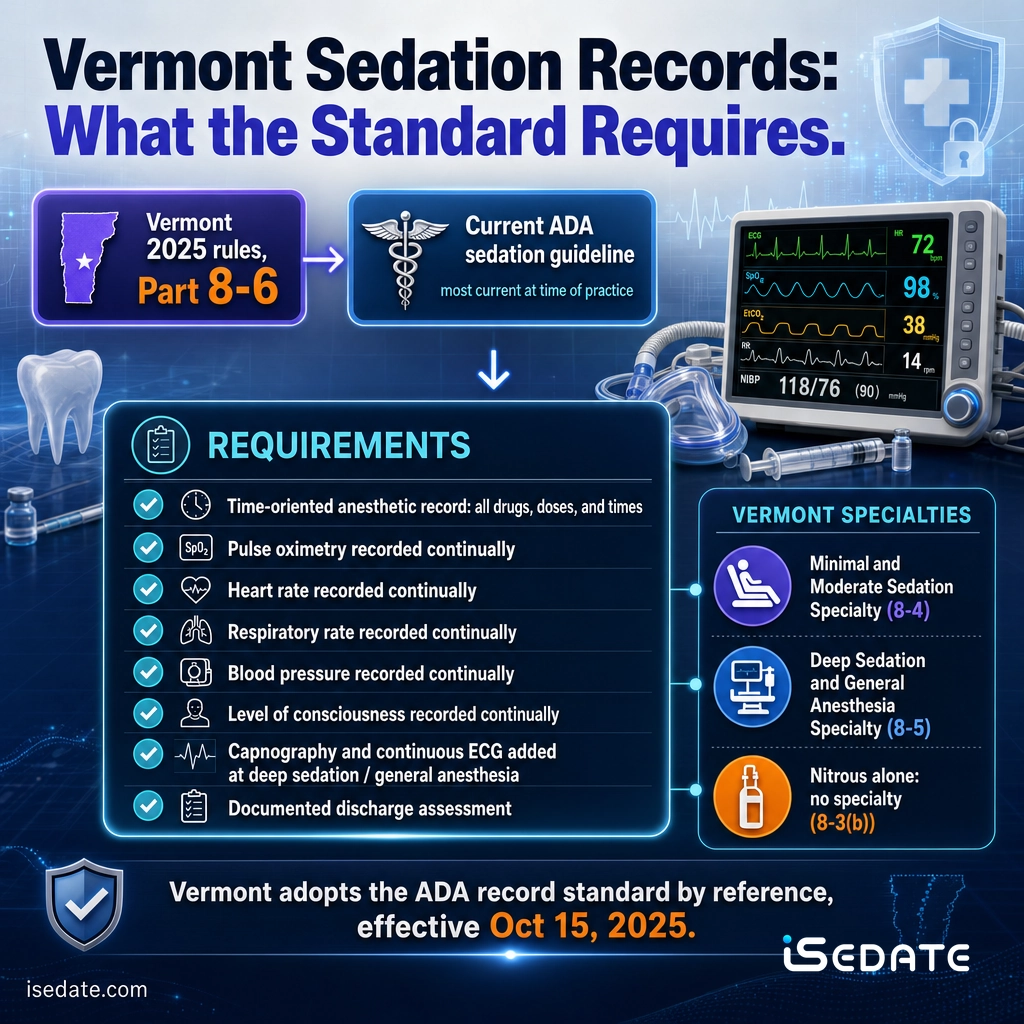
1. A time-oriented anesthetic record
For moderate (conscious) sedation, the ADA guideline Vermont adopts calls for a time-oriented anesthetic record. "Time-oriented" is the operative phrase: the record is organized against the clock, not written as a single end-of-visit summary. It must capture all drugs administered, their doses, the administration times, and any local anesthetics given. A note that a patient "tolerated sedation well" is not this record. A timeline of drugs, doses, and times is.
2. Vitals recorded continually
Under the ADA standard Vermont incorporates, the monitored parameters are recorded continually during the case: pulse oximetry, heart rate, respiratory rate, blood pressure, and level of consciousness for moderate sedation, with capnography and continuous ECG at the deep and general anesthesia level. Note the careful wording. Vermont does not state a fixed numeric interval such as "every ten minutes" in its rule, the way some states do. The standard is continual recording tied to the ADA guideline, so chart against that guideline rather than guess at an interval, and confirm cadence against the current ADA guideline and the Vermont board.
3. A documented discharge assessment
Recovery carries its own documentation duty under the ADA guideline Vermont adopts: the dentist must determine and document that the patient's consciousness, oxygenation, ventilation, and circulation are satisfactory before discharge. Taken together, the time-oriented drug log, the continually recorded vitals, and the documented discharge assessment are the three things a Vermont chart must show to match the standard the state has adopted.
What Vermont's Sedation Record Must Contain
- A time-oriented anesthetic record organized against the clock, not a single end-of-visit note
- All drugs administered, their doses, administration times, and any local anesthetics given
- Continually recorded vitals: oxygen saturation, heart rate, respiratory rate, blood pressure, and level of consciousness
- For deep sedation and general anesthesia: capnography (end-tidal CO2) and continuous ECG added on top
- A documented discharge assessment confirming consciousness, oxygenation, ventilation, and circulation are satisfactory
- For an incident: a copy of the patient's medical record of the procedure, filed with the Part 11-1(d) report
Source: 2025 Board rules, Part 8-6
See how a time-oriented anesthesia record is built automaticallyWhat a compliant record looks like on the page
Knowing the rule and passing a review are two different things, and the gap between them is almost always the continually updated vitals log. Because Vermont points to "continual" recording rather than a printed interval, it helps to see the cadence the adopted standard asks for. The simplified example below shows how a moderate sedation record maps onto Vermont's requirement: a baseline reading before the drug, readings logged on a tight recurring cadence while the patient is sedated, and a documented discharge assessment in recovery, each line carrying the monitored parameters. (Values are illustrative only, not a real patient record.)
| Time / interval | BP | HR | Resp | SpO2 | LOC | Drug / dose logged |
|---|---|---|---|---|---|---|
| Pre-op baseline | 124/78 | 72 | 16 | 99% | Alert | Midazolam 5 mg PO, time stamped |
| Intra-op (ongoing) | 118/74 | 70 | 14 | 98% | Responds to voice | Readings logged continually |
| Intra-op (ongoing) | 116/72 | 68 | 13 | 98% | Responds to voice | Readings logged continually |
| Intra-op (ongoing) | 120/76 | 71 | 14 | 99% | Responds to voice | Readings logged continually |
| Discharge assessment | 122/78 | 73 | 16 | 99% | Alert, oriented | Criteria met, documented |
A real case runs longer, and the full drug log and the signed consent sit alongside this grid. But the shape is the point: a reviewer can look at a record like this and see, line by line, that the patient was monitored and that the monitoring was documented against the clock. A record with a single pre-op reading and a single post-op reading, and nothing in between, does not match a "recorded continually" standard no matter how carefully the case was actually monitored.
iSedate Insight
The difference between a defensible chart and a vulnerable one is rarely clinical skill. In an adoption-by-reference state like Vermont, it is whether the contemporaneous record proves, moment by moment, what was monitored against the full ADA standard, not a lighter local assumption. The practices that pass reviews treat "continual" as a hard duty, log every drug and dose as it is given, and document the discharge assessment rather than carrying it in their heads.
How Vermont reviews records
Enforcement in Vermont runs through the Board of Dental Examiners and OPR, and two features of the 2025 rules tell you how seriously the record is taken. First, qualifying for a sedation or anesthesia specialty requires compliance with the AAOMS self-inspection and assessment checklist for that specialty under Part 8-4(c) and Part 8-5(c), which builds an expectation of audit-ready records into the credential itself. Second, under Part 11-1(d), a dentist must report sedation and anesthesia incidents and adverse outcomes, and the report includes a copy of the patient's medical record of the procedure. The moment something goes wrong, your contemporaneous chart is handed directly to the board.

Here is where dentists get burned. A reviewer does not grade your sedation on how the patient did. They grade it on whether the contemporaneous record proves what you did and when. If the time-oriented record has gaps, the default assumption on review is that the monitoring had gaps too. The care can be flawless and a thin record can still fail, especially in a state where the record standard is the full ADA guideline rather than a short local list.
Chart continually, log every drug and dose as it is given, and document the discharge assessment on the chart. Vermont's routine office-inspection schedule for sedation providers, if any, is administered by the board and is not something to assume. If you need the current inspection cadence, confirm it directly with the Vermont Board of Dental Examiners rather than relying on a figure from a third party.
Source: 2025 Board rules, Part 8-4, 8-5, 11-1(d)
Why a thin record is the real exposure
An incomplete sedation record is not a filing technicality. It is the evidence a board weighs when deciding whether the standard of care was met, and the same gaps that fail a review are the gaps a plaintiff's attorney looks for in a malpractice claim. In both a board review and a lawsuit, the contemporaneous sedation record is the first thing requested and the hardest thing to reconstruct after the fact. When the chart does not prove continual monitoring, the provider is left arguing memory against a document, and the document wins.
The data behind why these rules exist, and what a documentation failure actually costs when a case goes sideways, lives in our research roundups:
The Data Behind the Rule
Incident reporting and enforcement
Vermont's rules are backed by the board's disciplinary authority through OPR. Incident-report failures and standard-of-care violations, which include recordkeeping that does not meet the adopted ADA guideline, are grounds for board action. Incomplete sedation records are not a filing technicality. They are the evidence a board weighs when deciding whether the standard of care was met, and the same gaps that fail a review are the gaps a plaintiff's attorney looks for in a malpractice claim.
The exact disciplinary schedule, the specific penalty amounts, and any routine inspection cadence are administered by the board and can change, so confirm current details directly with the Vermont Board of Dental Examiners rather than relying on a figure that may be out of date. What does not change is the exposure created by a thin record: under Part 11-1(d) that record travels to the board with the incident report itself.
Source: 2025 Board rules, Part 11-1(d) | Vermont Board of Dental Examiners (OPR)
The easy button: an audit-ready record
The gap between knowing the rule and passing a review is almost always the same thing: a continually updated vitals log kept by hand during a live sedation case. When a team is managing an airway and an anxious patient, a vitals reading written down in the moment is exactly where the record develops holes, a skipped reading here, a missing time stamp there, a drug given in the moment and logged later from memory. In Vermont, where the governing standard is the full ADA time-oriented record rather than a lighter local list, those holes are measured against a high bar.
That is the problem SedationVault by iSedate was built to remove. It connects wirelessly to the vitals monitor already in your operatory and captures pulse oximetry, heart rate, respiratory rate, and blood pressure live, on the clock, alongside the drug log, so the time-oriented anesthetic record writes itself as the case runs. When the Vermont board asks for the chart, whether as part of an incident report under Part 11-1(d) or any other review, it exports as a one-click, audit-ready sedation visit report carrying the drug timeline, the continually recorded vitals, and the discharge assessment the adopted standard asks for. The point is not fancier charting. It is turning the exact items the ADA guideline requires, and that Part 8-6 makes Vermont law, into something the software guarantees are present and time-stamped, which is also what dental sedation compliance turns on.
Book a demo and see your Vermont sedation record build itselfFrequently asked questions
Does Vermont require a written sedation record?
How often must vitals be recorded during sedation in Vermont?
Who regulates and reviews sedation records in Vermont?
What are Vermont's dental sedation specialty levels?
Does Vermont require a discharge assessment after sedation?
Related guides and neighboring states
Licensed in more than one state, or practicing near the Vermont line? Documentation rules vary by state, so confirm the requirements where you provide sedation. See our charting and reporting guides for neighboring states:
- Massachusetts Sedation Vitals Monitoring, Charting & Reporting Requirements
- New Hampshire Sedation Vitals Monitoring, Charting & Reporting Requirements
- New York Sedation Vitals Monitoring, Charting & Reporting Requirements
- All 50 states: Dental Sedation Vitals, Charting & Reporting Requirements by State
Sources and citations
This guide cites Vermont's primary regulatory sources directly. Rule text is drawn from the Administrative Rules of the Vermont Board of Dental Examiners, effective October 15, 2025, Part 8, as published by the Vermont Secretary of State's Office of Professional Regulation. The record and monitoring standard is set by reference to the ADA's Guidelines for the Use of Sedation and General Anesthesia by Dentists (and, for children, the AAPD guidelines), which Part 8-6 adopts. Where a detail such as the current penalty schedule, routine inspection cadence, board contact information, specialty fees, or exact charting interval is administered by the board or set by the current ADA guideline and subject to change, confirm it directly with the Vermont Board of Dental Examiners before relying on it. This guide is general information, not legal advice.
- Vermont Board of Dental Examiners, Office of Professional Regulation (OPR) document library
- Administrative Rules of the Board of Dental Examiners, effective October 15, 2025 (Part 8: Dentist Sedation and Anesthesia Specialties; Part 11: incident reports)
- Vermont Conscious Sedation Specialty Form (official OPR application form)
This guide summarizes Vermont sedation recordkeeping rules for general information and is not legal advice. The monitoring and record standard is set by reference to the current ADA sedation guideline under Part 8-6; confirm the exact current requirements with the Vermont Board of Dental Examiners and the current ADA guideline before you act.















