







New Jersey Sedation Vitals Monitoring, Charting & Reporting Requirements
If you provide parenteral conscious sedation in a New Jersey dental office, the law is specific about what has to be written down: accurate, contemporaneous anesthetic records of every drug and agent, the dosage, the duration of sedation, the vital signs, and the patient's responses, kept as part of every patient chart and held for at least seven years. That duty lives in N.J.A.C. 13:30-8.2, it is enforced by the New Jersey State Board of Dentistry, and the record is the first thing a board review or a malpractice claim pulls. This guide breaks down what New Jersey requires you to monitor and chart at each sedation level, what compliant documentation actually looks like, how the Board inspects and reviews records, and how to make the record audit-ready.
Recent Updates
Last UpdatedNovember 16, 2026
- Replaced third-party legal-aggregator citations with the New Jersey State Board of Dentistry's own official regulation and application pages.
- Added the Board's current office-inspection cycle and who performs the inspection.
- Added sourced data on what a sedation documentation gap costs in a malpractice claim.
- Re-verified the N.J.A.C. 13:30-8.2 recordkeeping and seven-year retention rules against the current (2022) rule text.
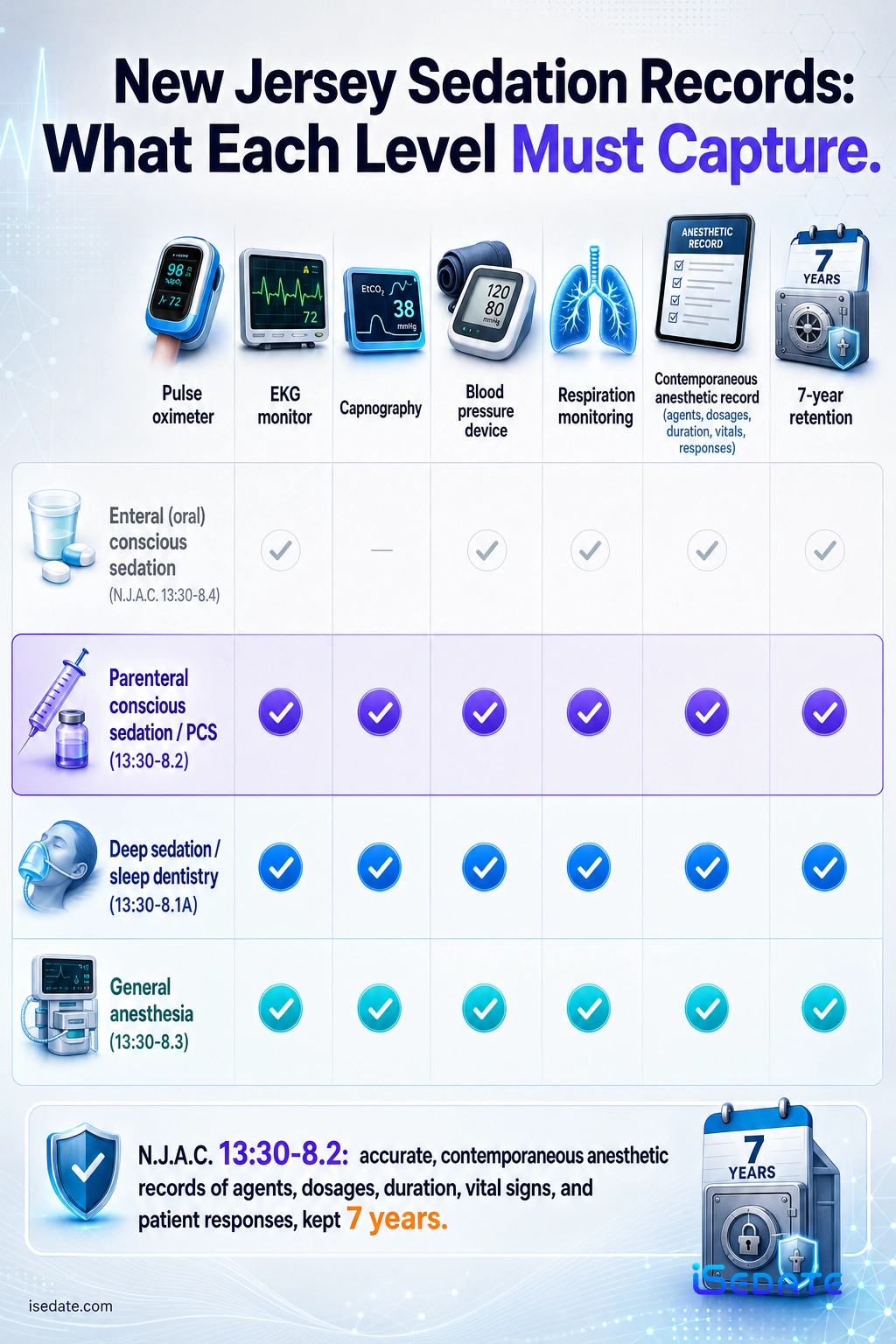
- The core rule: New Jersey parenteral conscious sedation requires accurate, contemporaneous anesthetic records under N.J.A.C. 13:30-8.2(f)(6) and (m), documenting the agents used, dosages, duration of sedation, vital signs, and patient responses.
- Who enforces it: the New Jersey State Board of Dentistry, within the Division of Consumer Affairs, under N.J.A.C. Title 13, Chapter 30, Subchapter 8.
- The monitoring is rigorous: parenteral conscious sedation requires an EKG monitor, pulse oximeter, capnography, a blood pressure device, and respiration monitoring equipment under 13:30-8.2(f)(4) and (i).
- Records are kept seven years: patient histories must be retained at least seven years under 13:30-8.2(m), consistent with the general records rule in 13:30-8.7(d).
- Offices get inspected: a fixed-office sedation inspection is valid for five years, so a review of your records is not a question of if, but when.

What This Guide Covers
- Who regulates sedation records in New Jersey
- The New Jersey sedation permit structure
- What you must monitor at each level
- What your sedation record must contain
- What compliant documentation looks like
- How New Jersey inspects and reviews records
- Why this matters: what a charting gap costs
- The easy button: an audit-ready record
- Related guides and neighboring states
- Frequently asked questions
- Sources and citations
Who regulates sedation records in New Jersey
Sedation and anesthesia in a New Jersey dental office are regulated by the New Jersey State Board of Dentistry, the body within the Division of Consumer Affairs that issues sedation permits, inspects offices, reviews records, and takes disciplinary action. The rules are not scattered across general dental law. They sit in one place: N.J.A.C. Title 13, Chapter 30, Subchapter 8, which covers anesthesia and sedation, published on the New Jersey State Board of Dentistry's statutes and regulations page.
That matters for compliance because it means your recordkeeping obligation is a named administrative rule with an exact citation, not a vague standard of care. When a reviewer asks whether your sedation record meets the requirement, the answer is measured against the specific subsections of Subchapter 8 below. It is also worth being precise about what the ADA is here: the American Dental Association publishes national sedation guidelines that most boards lean on, but those guidelines are a private professional standard, not a federal law. No federal agency writes your sedation charting rule. The federal layers that do apply sit alongside the state rule: the DEA governs controlled-substance logs, HIPAA governs record privacy and access, and accreditation or payer bodies may add their own documentation terms. In New Jersey, the licensing law is Chapter 30, Subchapter 8, and the body that enforces it is the New Jersey State Board of Dentistry, reachable at (973) 504-6405.
Source: New Jersey State Board of Dentistry, statutes and regulations
The New Jersey sedation permit structure
New Jersey uses its own permit structure, named by route and depth rather than by numbered "levels." Knowing which permit you hold tells you which monitoring and recordkeeping rules apply. These are the modalities as Subchapter 8 defines them, from lightest to deepest:
| New Jersey permit | What it covers | Citation |
|---|---|---|
| Enteral (oral) conscious sedation | Oral conscious sedation; a permit is required for adults, but not when the intent is anxiolysis only | N.J.A.C. 13:30-8.4 |
| Parenteral conscious sedation (PCS) | Conscious sedation by injection, including the intravenous route | N.J.A.C. 13:30-8.2 |
| Deep sedation (sleep dentistry) | Deep sedation, where the patient is not easily aroused | N.J.A.C. 13:30-8.1A |
| General anesthesia | General anesthesia (the top tier) | N.J.A.C. 13:30-8.3 |
Most general dentists who sedate work in enteral (oral) conscious sedation under 13:30-8.4, while parenteral conscious sedation under 13:30-8.2 adds the intravenous and other injected routes. Deep sedation (13:30-8.1A) and general anesthesia (13:30-8.3) are the top tiers, carried most often by dental anesthesiologists and oral and maxillofacial surgeons. This guide focuses on the parenteral conscious sedation standard in 13:30-8.2, because that is the New Jersey sedation rule whose monitoring and record requirements are spelled out most explicitly and verbatim, and it is the standard most sedation dentists are held to. If you are working out which permit to apply for or how to upgrade, that belongs in a separate process, covered in our guide to New Jersey Sedation Dentistry Licensing & Permit Requirements, and the Board posts the application itself on its applications and forms page.
Source: N.J.A.C. 13:30 Subchapter 8 (New Jersey State Board of Dentistry)
What you must monitor at each level
In New Jersey, what you are required to monitor is what you are required to write down. The two are inseparable: the monitoring standard in 13:30-8.2(f)(4) and the required-equipment standard in 13:30-8.2(i) define the physiological parameters, and the recordkeeping rule in 13:30-8.2(f)(6) and (m) requires them to be documented. For parenteral conscious sedation, the dentist must monitor the patient using clinical evaluation and mechanical means, watching four systems:
- Consciousness: the patient's level of sedation and responses are assessed and documented throughout the case.
- Oxygenation: oxygen saturation is measured with a pulse oximeter, which the rule lists as required monitoring equipment.
- Ventilation: respiration is watched with respiration monitoring equipment and a capnograph, so exhaled carbon dioxide is tracked, not just estimated.
- Circulation: blood pressure is measured with a blood pressure monitoring device, and an EKG monitor tracks cardiac rhythm.
The equipment list is explicit. Under 13:30-8.2(f)(4), the dentist monitors using clinical evaluation and mechanical means, including an EKG monitor, pulse oximeter, and capnograph, plus interpretation of the readings, and 13:30-8.2(i) requires the operatory to be equipped with a blood pressure monitoring device, EKG monitor, pulse oximeter, respiration monitoring equipment, and a capnometer. Subsection (h) requires at least one assisting staff member capable of monitoring vital signs. The requirement to track exhaled carbon dioxide with capnography at the conscious-sedation level is more demanding than many dentists assume, so build it into both your setup and your record.
Myth, Busted
Myth: Parenteral sedation is still conscious sedation, so a pulse oximeter is enough monitoring.
Fact: New Jersey's parenteral conscious sedation rule requires an EKG monitor, a pulse oximeter, capnography, a blood pressure device, and respiration monitoring, even while the patient stays responsive, under N.J.A.C. 13:30-8.2(f)(4) and (i).
The depth and route drive the obligation, not how awake the patient looks. A single pulse oximeter satisfies none of the rest of the equipment standard.
One honest point about intervals. New Jersey's rule requires continual monitoring and contemporaneous records, but it does not state a specific number of minutes between recorded readings, and it does not use the phrase "time-oriented record." That continually recorded, clock-aligned standard comes from the ADA national guidelines, which most boards treat as best practice. Documenting vitals at frequent, regular intervals is the defensible way to satisfy the "contemporaneous" requirement, but do not rely on a fixed interval that New Jersey's text does not actually impose.
Source: N.J.A.C. 13:30-8.2(f)(4), (h), (i)
What your sedation record must contain
This is the section a reviewer reads first. For parenteral conscious sedation, N.J.A.C. 13:30-8.2 spells out what the record must contain, and it has three parts worth knowing by heart.
1. Accurate, contemporaneous anesthetic records in every chart
Under 13:30-8.2(m), specific contemporaneous records on the use of parenteral conscious sedation must be kept as part of every patient chart, and those records must include the agents used, the dosage, and the duration of sedation. Subsection (f)(6) reinforces it: the dentist must keep accurate and contemporaneous anesthetic records including drugs, dosages, vital signs, and patient responses. "Contemporaneous" is the operative word. The record is made as the case runs, not reconstructed from memory afterward. A note that a patient "tolerated sedation well" is not this record. A documented account of the agents, doses, duration, vital signs, and the patient's responses is.
2. Seven-year retention
New Jersey ties a retention period directly to the sedation record. Under 13:30-8.2(m), patient histories must be kept at least seven years, and the Board's general dental-records rule, 13:30-8.7(d), requires patient records to be retained at least seven years from the date of the last entry. A complete record that cannot be produced years later is no better than no record at all when a review or a claim arrives.
3. A documented discharge assessment and recovery
Recovery has its own duty. Under 13:30-8.2(f)(5), the dentist must manage patients post-operatively and assess their suitability for discharge, and 13:30-8.2(e)(2) requires a recovery area equipped with oxygen and monitoring equipment. The applicant-side rule, 13:30-8.2(d)(9), also requires a permit holder to maintain accurate anesthetic records of drug dosages, vital signs, and patient responses, so the recordkeeping duty is written into holding the permit itself. Taken together, the chart has to show not only what happened during sedation but that the patient was assessed and judged ready for discharge.
Source: N.J.A.C. 13:30-8.2(d)(9), (e)(2), (f)(5), (f)(6), (m) and 13:30-8.7
What compliant documentation looks like
Knowing the rule is one thing. Here is what a defensible New Jersey sedation record actually contains, section by section, and where oral and IV cases differ. New Jersey sets the "what," and the ADA national standard supplies the "how often" that most reviewers expect to see.
Elements of a Compliant Sedation Record
- Pre-sedation: health history and physical status, airway assessment, medications and allergies, informed consent for Conscious Sedation, and baseline vital signs recorded before the first drug is given.
- The drug log: every agent, the exact dose, the route, and the time it was administered, entered as it is given, not totaled at the end.
- The vitals record: oxygen saturation, heart rate, respiratory rate, blood pressure, and the capnography trace, recorded at regular intervals through the case.
- Patient responses: level of consciousness and responsiveness noted at intervals, plus any complication and how it was managed.
- Recovery and discharge: post-operative vitals, the discharge criteria met, the time of discharge, and who the patient was released to.
- Duration: start and end times of sedation, which 13:30-8.2(m) names directly.
A concrete, defensible cadence looks like this: baseline vitals charted before induction, then a vitals reading and any drug entry logged every few minutes while the patient is sedated, consciousness and response noted at each reading, and a final set of recovery vitals before discharge. New Jersey does not mandate that exact interval, but a record built on the clock this way is what satisfies the "accurate and contemporaneous" standard and what a reviewer hopes to find.
Oral and IV cases are documented on the same principles, with a different equipment and monitoring floor:
| Record element | Enteral (oral) conscious sedation (13:30-8.4) | Parenteral conscious sedation / IV (13:30-8.2) |
|---|---|---|
| Monitoring documented | Clinical monitoring plus pulse oximetry; permit required for adults | EKG, pulse oximeter, capnography, blood pressure, respiration, all required and charted |
| Drug log | Agents, doses, and times | Agents, doses, times, and duration of sedation |
| Vital-sign cadence | Regular readings through sedation and recovery | Continual monitoring with contemporaneous readings through sedation and recovery |
| Discharge note | Post-operative assessment and discharge criteria | Post-operative management, discharge suitability, recovery-area documentation |
| Retention | At least seven years | At least seven years |
Source: N.J.A.C. 13:30-8.2 and 13:30-8.4 (New Jersey State Board of Dentistry) | New Jersey Dental Association anesthesia and sedation program requirements

How New Jersey inspects and reviews records
New Jersey does not wait for a complaint to look at a sedation practice. Permit holders for parenteral conscious sedation and general anesthesia undergo an office inspection, and the record is central to what the inspector checks. According to the New Jersey Dental Association's 2025 guidance on the inspection process, a fixed-office inspection for general anesthesia or parenteral conscious sedation is valid for five years from the date of inspection, and a mobile inspection is valid for three years. The inspections are performed by the Board's appointed agents and are coordinated through the Anesthesia Committee of the New Jersey Society of Oral and Maxillofacial Surgeons. Renewing a permit does not automatically trigger a new inspection; one is required when the inspection cycle ends.
Here is where dentists get burned. It is rarely the clinical care that fails a review. It is the record: a drug given but not logged with its dose, a vital sign watched on the monitor but never written down, a recovery and discharge that happened but was never documented, a chart that cannot be produced within the seven-year window. The care can be flawless and the record can still fail, because a reviewer grades the contemporaneous record, not the memory of a procedure that went fine.
A reviewer does not grade your sedation on how the patient did. They grade it on whether the contemporaneous record proves what you did: the agents, the dosages, the duration, the vital signs, and the patient responses that 13:30-8.2 names. Record each agent and dose as it is given, and document the discharge assessment every time. If the anesthetic record has gaps, the default assumption on review is that the monitoring had gaps too.
The exact disciplinary schedule and penalty amounts are administered by the Board and can change, so confirm current details directly with the New Jersey State Board of Dentistry rather than relying on a figure that may be out of date. What does not change is the exposure created by a thin record.
Source: New Jersey Dental Association, GA and PCS inspection process (2025) | New Jersey State Board of Dentistry licensing information
Why this matters: what a charting gap costs
A documentation gap is not a filing technicality. It is the evidence a board weighs, and it is the opening a plaintiff's attorney looks for. The data on sedation-related claims makes the stakes concrete.
Those numbers are national, not New Jersey specific, but they describe the exact failure mode New Jersey's rule exists to prevent. A landmark peer-reviewed review of closed malpractice claims in pediatric dental anesthesia found that of the sedation claims examined, only one involved any physiologic monitoring record, and the authors concluded that some practitioners were monitoring patients inadequately during sedation (Chicka et al., Pediatric Dentistry, 2012). The through-line across every one of these sources is the same: when a case goes to review, the monitoring you did only counts if the record proves it.
iSedate Insight
Read the three figures together and a pattern emerges that New Jersey's rule anticipates. Sedation claims are expensive, they get far more expensive when a patient is harmed, and documentation is one of the few factors a dentist controls completely before anything goes wrong. The contemporaneous anesthetic record that 13:30-8.2 requires is not just a compliance box; it is the single best piece of evidence you can build in your own defense, and it is built during the case or not at all.
Source: CNA 2025 Dental Professional Liability Claim Report | The Doctors Company Anesthesiology Closed Claims Study
The easy button: an audit-ready record
The gap between knowing the rule and passing a review is almost always the same thing: an anesthetic record kept by hand during a live sedation case. When a team is managing an airway and an anxious patient, a vitals reading and a drug entry written down in the moment are exactly where the record develops holes, a missed reading here, a dose logged later from memory there, a discharge assessment that happened but never made it onto the page.
That is the problem SedationVault by iSedate was built to remove. It connects to the vitals monitor already in your operatory and captures pulse oximetry, heart rate, respiratory rate, and blood pressure live, on the clock, alongside the drug log, so the contemporaneous anesthetic record for a Conscious Sedation case writes itself as the case runs rather than being reconstructed afterward. When the New Jersey State Board of Dentistry asks for the chart, it exports as a one-click, audit-ready sedation visit report that already carries the agents, dosages, duration, vital signs, and patient responses that 13:30-8.2 names, held in a record you can still produce seven years later. The point is not fancier charting. It is turning the exact items 13:30-8.2(f)(6) and (m) require into something the software guarantees are present and time-stamped, which is also what dental sedation compliance turns on.
See how a contemporaneous anesthesia record is built automatically Book a demo and see your New Jersey sedation record build itselfWeighing the cost against what one thin chart can cost in a claim? You can see SedationVault pricing before you commit to anything.
Related guides and neighboring states
Sedation charting rules change at the state line, so match the guide to where you are licensed. This page is part of our state-by-state series, anchored by the Dental Sedation Vitals, Charting & Reporting Requirements by State hub. Licensed in a neighboring state, or practicing across the line? See our guides for:
- New York Sedation Vitals Monitoring, Charting & Reporting Requirements
- Pennsylvania Sedation Vitals Monitoring, Charting & Reporting Requirements
- Delaware Sedation Vitals Monitoring, Charting & Reporting Requirements
Still in New Jersey and sorting out which permit you need first? Start with New Jersey Sedation Dentistry Licensing & Permit Requirements.
Frequently asked questions
Does New Jersey require a written sedation record?
How long must New Jersey dentists keep sedation records?
Does New Jersey set a required interval for recording vitals during sedation?
How often does New Jersey inspect a sedation office?
Who regulates sedation records in New Jersey?
What must a New Jersey parenteral conscious sedation record include?
Sources and citations
This guide cites New Jersey's primary regulatory sources first. Rule text for anesthesia and sedation is N.J.A.C. Title 13, Chapter 30, Subchapter 8, published by the New Jersey State Board of Dentistry within the Division of Consumer Affairs; the recordkeeping and retention provisions of 13:30-8.2 were re-verified against the current rule text, which was rewritten effective April 19, 2021 and most recently amended effective January 3, 2022. Office-inspection details come from the New Jersey Dental Association's 2025 guidance. Malpractice figures come from the insurers' and researchers' own published closed-claims studies. Where a detail (such as the current penalty schedule, permit fees, or any future change to the inspection cycle) is administered by the Board and subject to change, confirm it directly with the New Jersey State Board of Dentistry at (973) 504-6405 before relying on it.
- New Jersey State Board of Dentistry: statutes and regulations (N.J.A.C. 13:30, Subchapter 8)
- New Jersey State Board of Dentistry: applications and forms (sedation and anesthesia permits)
- New Jersey State Board of Dentistry: licensing information
- New Jersey Dental Association: anesthesia and sedation program requirements
- New Jersey Dental Association: renewal process for GA and PCS permit holders, inspections (2025)
- CNA and Dentist's Advantage: 2025 Dental Professional Liability Claim Report
- The Doctors Company: Anesthesiology Closed Claims Study
- Chicka et al., "Adverse events during pediatric dental anesthesia and sedation," Pediatric Dentistry (2012)
This guide summarizes New Jersey sedation recordkeeping rules for general information and is not legal or compliance advice. Consult the New Jersey State Board of Dentistry or a qualified professional for guidance specific to your practice.















