








Minnesota Sedation Vitals Monitoring, Charting & Reporting Requirements
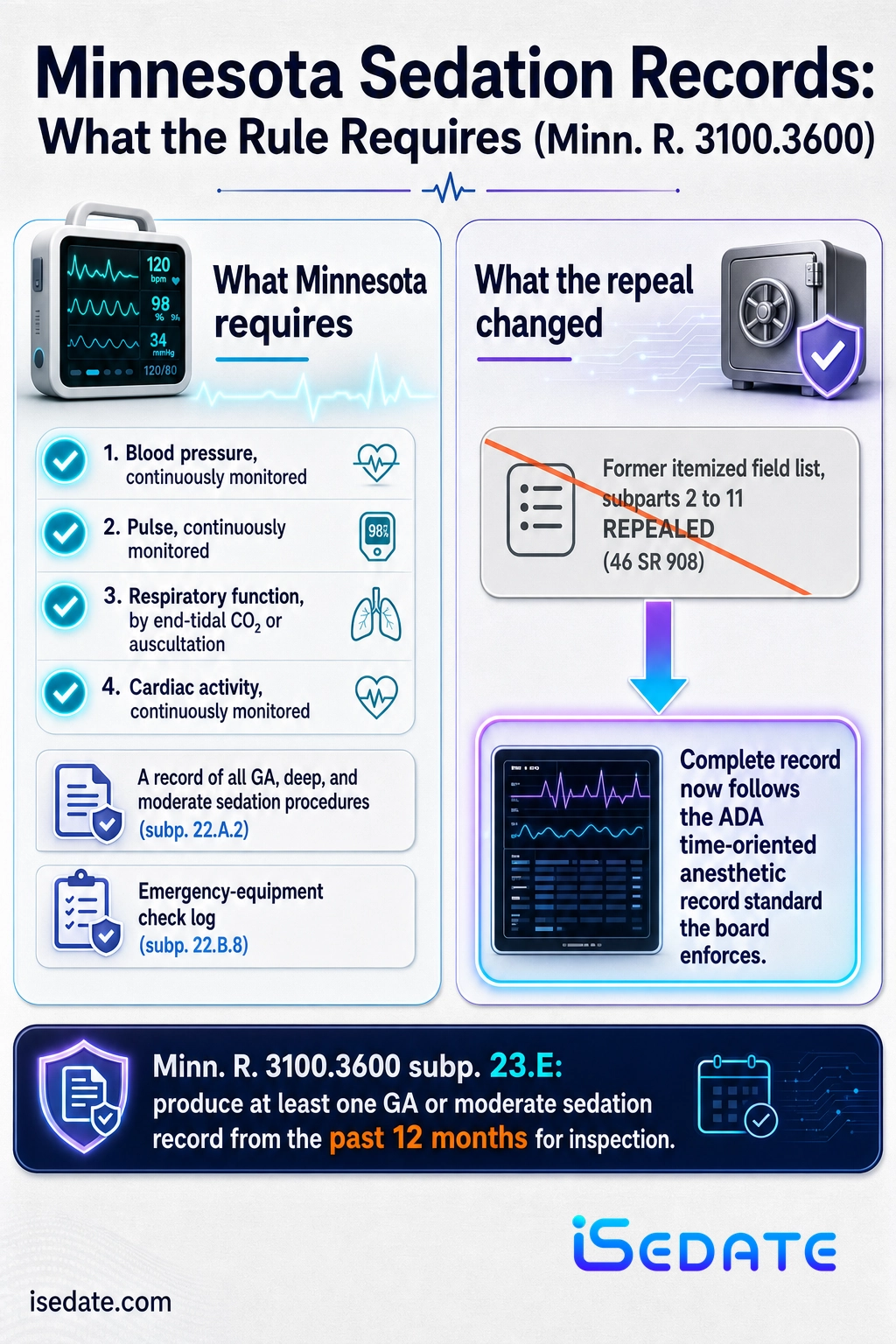
If you administer sedation in Minnesota, the state's rule is short, but it is not optional: you must keep a record of every general anesthesia, deep sedation, and moderate sedation procedure performed in your facility, and you must continuously monitor and record the patient's blood pressure, pulse, respiratory function, and cardiac activity while you do it. That duty lives in Minnesota Rules part 3100.3600, it is enforced by the Minnesota Board of Dentistry, and it is the first thing a board inspection looks at. There is a twist worth understanding up front: the old itemized list of exactly which fields a sedation record must contain was repealed, which makes it more important, not less, to know what a complete record looks like. This guide breaks down what Minnesota requires you to monitor and record, shows what a compliant time-oriented record looks like line by line, explains how the repeal changed the picture, and covers how to keep the whole thing audit-ready.
Recent Updates
Last UpdatedNovember 16, 2026
- Re-verified every Minnesota rule citation on this page against the Office of the Revisor of Statutes (Minn. R. 3100.3600), including the monitoring, record, inspection, and certificate subparts.
- Added a sample time-oriented sedation record so you can see what compliant charting actually looks like, plus a breakdown of how the duty applies to oral versus IV cases and the equipment the rule assumes.
- Clarified that the itemized drug, dose, and time field list (former subparts 2 through 11) was repealed under 46 SR 908, which points a defensible record to the ADA national standard the board relies on.
Key Takeaways
- The core rule: Minnesota requires a dentist to keep a record of all general anesthesia, deep sedation, and moderate sedation procedures performed in the facility, under Minn. R. 3100.3600 subp. 22.A.2.
- What must be monitored: under subp. 22.A.1, blood pressure, pulse, respiratory function, and cardiac activity must be continuously monitored and evaluated, with respiratory function tracked by end-tidal carbon dioxide or auscultation of breath sounds.
- The repeal that matters: the itemized drug, dose, and time field list in former subparts 2 through 11 was repealed (46 SR 908) and not replaced, so a complete record now follows the ADA national time-oriented record standard the board relies on.
- Depth, not route, drives the duty: the subpart 22 obligations apply to moderate sedation and deeper whether the agent is oral or IV, the moment the patient reaches that depth.
- Who enforces it: the Minnesota Board of Dentistry, which under subp. 23.E can require you to produce at least one general anesthesia or moderate sedation patient record from the past 12 months for inspection.

What This Guide Covers
- Who regulates sedation in Minnesota
- Minnesota's sedation certificates
- What you must monitor during sedation
- What you must record: the compliance core
- What a compliant Minnesota sedation record looks like
- The repealed field list, and what fills the gap
- Oral vs. IV, and the equipment the rule assumes
- How Minnesota reviews your records
- Why a thin record is the real risk
- Incident reporting and enforcement
- The easy button: an audit-ready record
- Frequently asked questions
- Sources and citations
Who regulates sedation in Minnesota
Sedation and anesthesia in a Minnesota dental office are regulated by the Minnesota Board of Dentistry, the state agency that issues sedation certificates, inspects records, and takes disciplinary action. The rules are not scattered across general dental law. They sit in one place: Minnesota Rules, part 3100.3600, which governs the administration of general anesthesia, deep sedation, moderate sedation, and minimal sedation.
That matters for compliance because your recordkeeping obligation is a named administrative rule with an exact citation, not a vague standard of care. When a reviewer asks whether your sedation record meets the requirement, the answer is measured against the subparts of part 3100.3600 below. It is also worth being precise about what the ADA is here. The American Dental Association publishes national sedation guidelines that most boards lean on, but those guidelines are a professional standard, not law, and the ADA is a private national association, not a federal agency. In Minnesota, the law is part 3100.3600 and the body that enforces it is the Minnesota Board of Dentistry. The ADA does not issue your certificate, inspect your office, or discipline you. The board does. For the clinical "what and why" behind these requirements across the country, see our Dental Sedation Vitals, Charting & Reporting Requirements by State hub.
Source: Minn. R. 3100.3600 (Minnesota Board of Dentistry)
Minnesota's sedation certificates
Minnesota does not number its permits "Level 1" through "Level 4." It issues certificates by the depth of sedation being administered, and the monitoring and recordkeeping duties below attach to the deeper levels. Knowing which certificate applies tells you which rules you are held to. Note that moderate sedation is the modern name for what clinicians still commonly call Conscious Sedation, so an older "conscious sedation" form and the current moderate sedation certificate describe the same depth of care.
| Minnesota certificate | What it covers | Citation |
|---|---|---|
| General anesthesia certificate | Administration of general anesthesia, deep sedation, or moderate sedation | Minn. R. 3100.3600 subp. 18.A.1 |
| Moderate sedation certificate | Administration of moderate sedation (commonly called Conscious Sedation) | subp. 18.A.2 |
| Certificate with a contracted sedation provider | General anesthesia or moderate sedation where a qualified contracted professional administers | subp. 21.A |
| Minimal sedation | No certificate under this part (minimal sedation is defined, not certificated) | def. at 3100.0100 subp. 13a |
Two points follow from that structure. First, the monitoring and record duties in subpart 22 reach general anesthesia, deep sedation, and moderate sedation alike, so a deep-sedation case carries the same recording obligation as general anesthesia even though the certificate the board issues is framed around general anesthesia and moderate sedation. Second, minimal sedation does not have a certificate level in part 3100.3600, so the heavy monitoring-and-record machinery in subpart 22 is written for moderate sedation and above. If you are working out which certificate to hold or add, that is a separate process, covered in our guide to Minnesota Sedation Dentistry Licensing & Permit Requirements.
Source: Minn. R. 3100.3600 subp. 18, subp. 21
What you must monitor during sedation
In Minnesota, what you are required to monitor is the backbone of what your record has to prove. The monitoring standard in subpart 22.A.1 defines the parameters, and the record requirement in subpart 22.A.2 expects them to be captured. For general anesthesia, deep sedation, and moderate sedation, every dentist must continuously monitor and evaluate four things:
- Blood pressure — continuously monitored and evaluated throughout the procedure.
- Pulse — continuously monitored and evaluated.
- Respiratory function — monitored with equipment that monitors end-tidal carbon dioxide, or by auscultation of breath sounds.
- Cardiac activity — continuously monitored and evaluated.
The respiratory standard is worth reading closely, because it is specific: the rule names end-tidal carbon dioxide monitoring or auscultation of breath sounds, not a generic instruction to "watch the airway." That is the one place Minnesota tells you exactly what equipment or technique satisfies the duty. The monitoring also does not stop when the drilling does. Under subpart 22.A.3, a qualified person in charge must remain in the operatory room to continuously monitor the patient, and before the patient is discharged they must be assessed for the risk of cardiorespiratory depression and released to a responsible adult.
Myth, Busted
Myth: A deep-sedation case is not general anesthesia, so the record rule is lighter.
Fact: The record duty in subpart 22.A.2 applies to general anesthesia, deep sedation, and moderate sedation by name.
The depth of sedation, not the label on your certificate, drives the obligation, and a patient can reach a deeper level than intended. The moment a patient is in moderate sedation or deeper, the full subpart 22 monitoring and record standard applies.
Source: Minn. R. 3100.3600 subp. 22.A.1, 22.A.3
What you must record: the compliance core
This is the section a reviewer reads first. Minnesota's recordkeeping rule is brief, and understanding what it says, and does not say, is the whole game.
A record of all sedation procedures
Under subpart 22.A.2, the dentist must keep "a record of all general anesthesia, deep sedation, or moderate sedation procedures performed in the facility." That is the operative sentence. It is a duty to document every qualifying case, every time, in the facility where it happened. A note that a patient "tolerated sedation well" is not this record. A contemporaneous account of the sedation, tied to the monitored parameters above, is.
The monitored vitals are the record's spine
Because subpart 22.A.1 requires continuous monitoring and evaluation of blood pressure, pulse, respiratory function, and cardiac activity, those parameters are, in practice, what a record of the procedure has to carry. Monitoring continuously but capturing only a reading at the start and the end leaves a record that cannot demonstrate the continuous evaluation the rule requires. The record and the monitoring are two halves of the same obligation.
The emergency-equipment log
There is a second documentation duty that sits alongside the patient record. Under subpart 22.B.8, the office must keep an emergency cart or kit available and readily accessible, and the emergency equipment and drugs must be checked and maintained on a regular schedule. This is a standing record, not a per-patient one, and it is exactly the kind of routine log that is easy to let slip and easy for a reviewer to ask for.
Source: Minn. R. 3100.3600 subp. 22.A.2, 22.B.8
What a compliant Minnesota sedation record looks like
Because Minnesota mandates continuous monitoring but no longer itemizes the record fields, the practical question becomes: what does a record that survives a review actually contain? The answer is the ADA time-oriented anesthetic record, organized against the clock rather than written as a single end-of-visit summary. It carries three layers: a pre-sedation layer that proves the patient was a candidate, an intra-operative layer that logs vitals and drugs on a timeline, and a recovery layer that proves a safe discharge.
The Three Layers of a Defensible Sedation Record
- Pre-sedation: health history and ASA status, airway assessment, NPO status, the informed-consent discussion, baseline blood pressure, pulse, and oxygen saturation, and the planned agents and target depth.
- Intra-operative (the time-oriented core): each drug, its dose, and the exact time it was given, plus blood pressure, pulse, respiratory function, and cardiac activity logged continually through the case, not just at the start and the end.
- Recovery and discharge: post-procedure vitals, the assessment for cardiorespiratory depression that subpart 22.A.3 requires, the recovery timeline, and release to a named responsible adult.
The intra-operative layer is where records most often fail, so it is worth seeing what "on the clock" means. A compliant timeline looks like the sample below, with entries at regular intervals and at every drug administration, so the record proves the continuous evaluation the rule demands.
| Time | BP | Pulse | Resp / EtCO2 | Event |
|---|---|---|---|---|
| Baseline | 122/78 | 72 | 14 / 36 | Baseline vitals recorded; consent confirmed |
| +0 min | 120/76 | 74 | 14 / 37 | Sedation agent administered (dose and time logged) |
| +5 min | 118/74 | 70 | 13 / 38 | Patient at target depth; monitoring continuous |
| +10 min | 116/74 | 68 | 12 / 39 | Procedure underway; vitals stable |
| +15 min | 118/76 | 71 | 13 / 38 | Next scheduled entry |
| Discharge | 120/78 | 73 | 14 / 37 | Assessed for cardiorespiratory depression; released to responsible adult |
Illustrative sample of a time-oriented record structure, shown to demonstrate compliant cadence. The values are examples, not clinical guidance; your intervals and parameters follow your clinical judgment and the ADA standard.
iSedate Charting Advice
A reviewer cannot see what you monitored, only what you wrote. Record a vitals entry at a regular interval and at every drug administration, so a straight line of timestamps proves continuous evaluation. A record that jumps from "start" to "end" invites the assumption that the monitoring jumped too.
Source: Minn. R. 3100.3600 subp. 22.A.1, 22.A.3 | ADA Guidelines for the Use of Sedation and General Anesthesia by Dentists (2025)
See how a time-oriented anesthesia record is built automaticallyThe repealed field list, and what fills the gap
Here is the part that trips up dentists who look up the rule expecting a checklist. Minnesota's current recordkeeping rule does not enumerate the specific fields a sedation record must contain. It used to. The granular drug, dose, and time content list lived in former subparts 2 through 11 of part 3100.3600, and those subparts were repealed (46 SR 908) and were not replaced. On the official revisor.mn.gov rule text, each of those subparts now carries the note "Repealed, 46 SR 908."
So the honest picture is this: Minnesota requires the record and mandates the monitoring, but it no longer itemizes the content. That does not make the content optional. It means the detail that makes a record defensible now follows the national best-practice standard the board and the profession rely on: the ADA Guidelines for the Use of Sedation and General Anesthesia by Dentists, updated by the ADA House of Delegates in 2025. The ADA standard describes a time-oriented anesthetic record organized against the clock rather than written as a single end-of-visit summary, listing the drugs and dosages administered, the times they were given, and the monitored vital signs recorded continually through the case, exactly the structure in the sample above.
Important
Do not read the repeal of the field list as permission to chart less. Minnesota still requires a record of the procedure and continuous monitoring of four parameters. With no state checklist to point to, the standard your record is measured against defaults to the ADA national best practice, which is a complete, time-oriented anesthetic record. Chart to that standard and you are covered for both the Minnesota rule and the ADA guideline the board relies on.
Source: Minn. R. 3100.3600 (repealed subparts 2 to 11, 46 SR 908) | ADA Guidelines for the Use of Sedation and General Anesthesia by Dentists (2025)
Oral vs. IV, and the equipment the rule assumes
A common question is whether an oral sedation case is held to a lighter standard than an IV case. In Minnesota, it is not. Part 3100.3600 keys the subpart 22 duties to the depth of sedation, not the route of the drug. An oral moderate sedation case and an IV moderate sedation case both require continuous monitoring of blood pressure, pulse, respiratory function, and cardiac activity, and both require a record of the procedure. If anything, the oral route deserves extra attention, because an oral agent is harder to titrate and can carry a patient deeper than planned, at which point the full subpart 22 standard is already in force.
The monitoring standard also tells you, indirectly, what equipment the rule assumes is in the room. To satisfy subpart 22.A.1 and 22.B.8, a compliant operatory needs the tools to capture and resuscitate, not just observe:
Equipment the Minnesota Rule Assumes
- Blood pressure monitoring capable of continuous evaluation through the case (subp. 22.A.1).
- Pulse and cardiac monitoring, typically pulse oximetry and an ECG for deeper levels (subp. 22.A.1).
- Respiratory monitoring by capnography that monitors end-tidal carbon dioxide, or auscultation of breath sounds (subp. 22.A.1, named explicitly).
- An emergency cart or kit that is available and readily accessible, with the drugs and equipment to resuscitate a non-breathing, unconscious patient, checked on a regular schedule (subp. 22.B.8).
The through-line is that the equipment exists to be documented. A capnography line that runs but never makes it into the record does not help you on review. The record is the proof, which is why the charting and the monitoring are treated as one duty.
Source: Minn. R. 3100.3600 subp. 22.A.1, 22.B.8

How Minnesota reviews your records
The record is not just for your file. It is for the board. Under subpart 23.E, a dentist must make available for inspection the office equipment, emergency medications, and the record of at least one patient who received general anesthesia or moderate sedation care within the past 12 months. That is a concrete, named obligation: on request, you produce a qualifying sedation record from the last year, and it has to stand on its own.
This is where the lesson from every state board applies: a reviewer does not grade your sedation on how the patient did. They grade it on whether the contemporaneous record proves what you monitored and when. If the record has gaps, the default assumption on review is that the monitoring had gaps too. The care can be flawless and the record can still fail, which is precisely why the time-oriented standard matters even though Minnesota no longer spells the fields out. The full periodic-inspection schedule and the sedation inspector's checklist are set and updated by the board, so confirm the current inspection cadence and forms directly with the Minnesota Board of Dentistry.
Source: Minn. R. 3100.3600 subp. 23.E
Why a thin record is the real risk
It is tempting to treat charting as paperwork that follows the real work. On a sedation case, the record is the real work in the eyes of a board or a court, because it is the only contemporaneous evidence of what you did. Two numbers from the Minnesota rule itself show how little it takes to put you on the spot, and both are documentation triggers rather than clinical ones.
The same gaps that fail a board inspection are the gaps a plaintiff's attorney looks for in a malpractice claim. When the care is questioned months or years later, the contemporaneous sedation record is the first thing requested and the hardest thing to reconstruct after the fact. For the data behind why documentation drives these outcomes, see our research on how sedation charting affects malpractice case outcomes, the data on vital-signs monitoring and sedation safety, and documentation-error rates and chart defensibility.
Incident reporting and enforcement
Minnesota's rule is backed by enforcement, and part of that is a duty to report. A dentist must report to the board incidents arising from the administration of general anesthesia, deep sedation, moderate sedation, or minimal sedation. Incomplete sedation records are not a filing technicality. They are the evidence the board weighs when deciding whether the standard of care was met.
The precise reporting triggers and timelines, the disciplinary and penalty schedule under the Dental Practice Act, and the routine office-inspection cadence are administered by the board and can change, so confirm current details directly with the Minnesota Board of Dentistry rather than relying on a number that may be out of date. What does not change is the exposure created by a thin record. In both a board review and a lawsuit, the contemporaneous sedation record is the first thing requested and the hardest thing to reconstruct after the fact. Keeping the record complete and time-stamped as the case runs is the single most reliable protection, which is covered in our broader guide to dental sedation compliance.
Source: Minn. R. 3100.3600 (incident reporting and board enforcement)
The easy button: an audit-ready record
The gap between knowing the rule and passing a review is almost always the same thing: a continuous vitals log kept by hand during a live sedation case. When a team is managing an airway and an anxious patient, a reading written by hand is exactly where the record develops holes, a skipped stretch here, a missing time stamp there, a drug given in the moment and logged later from memory. Minnesota's repeal of the itemized field list makes this riskier, not safer, because there is no state checklist to fall back on.
That is the problem SedationVault by iSedate was built to remove. It connects to the vitals monitor already in your operatory and captures blood pressure, pulse, respiratory function, and cardiac activity live, on the clock, alongside the drug log, so the time-oriented anesthetic record writes itself as the case runs rather than being reconstructed afterward. When the board asks for a qualifying record under subpart 23.E, it exports as a one-click, audit-ready sedation visit report carrying the times, the dosages, the monitored vitals, and the discharge assessment. The point is not fancier charting. It is turning the record of all procedures that subpart 22.A.2 requires, charted to the ADA standard the board relies on, into something the software guarantees is present and time-stamped, whether the case is general anesthesia, deep sedation, or moderate sedation, which is still commonly called Conscious Sedation.
Frequently asked questions
Does Minnesota require a written sedation record?
What vitals must be monitored during sedation in Minnesota?
Does Minnesota still have an itemized sedation-record field list?
Does the Minnesota record duty depend on whether sedation is oral or IV?
Who reviews sedation records in Minnesota?
Does Minnesota require monitoring until discharge?
Related guides and neighboring states
Licensed in a neighboring state, or managing sedation documentation across a region? Each state writes its own monitoring and record rules, so see our same-silo guides for the states bordering Minnesota, plus the national hub:
- Iowa Sedation Vitals Monitoring, Charting & Reporting Requirements
- North Dakota Sedation Vitals Monitoring, Charting & Reporting Requirements
- South Dakota Sedation Vitals Monitoring, Charting & Reporting Requirements
- Wisconsin Sedation Vitals Monitoring, Charting & Reporting Requirements
- Dental Sedation Vitals, Charting & Reporting Requirements by State (all 50 states)
Sources and citations
Our Research & Fact-Checking Process
This guide cites Minnesota's primary regulatory source. The rule text is drawn from Minnesota Rules part 3100.3600 as published by the Minnesota Office of the Revisor of Statutes, re-verified against the official rule page on November 16, 2026, and the regulator is the Minnesota Board of Dentistry. The national documentation standard referenced is the ADA Guidelines for the Use of Sedation and General Anesthesia by Dentists (2025), a professional standard rather than law. The sample record above is an illustrative structure built to that standard, not a Minnesota statutory template. Where a detail (the current penalty schedule, inspection cadence, reporting timelines, certificate fees, or board contact information) is administered by the board and subject to change, confirm it directly with the Minnesota Board of Dentistry before relying on it.
- Minn. R. 3100.3600: administration of general anesthesia, deep sedation, moderate sedation, and minimal sedation (monitoring subp. 22.A.1; record subp. 22.A.2; operatory monitoring and discharge subp. 22.A.3; emergency-equipment log subp. 22.B.8; certificates subp. 18 and subp. 21; records inspection subp. 23.E; repealed subparts 2 to 11 marked 46 SR 908)
- Minnesota Board of Dentistry (certificates, inspections, incident reporting, and enforcement). Confirm current forms, fees, inspection cadence, penalty schedule, and board contact details with the board directly.
- ADA Guidelines for the Use of Sedation and General Anesthesia by Dentists, adopted by the ADA House of Delegates, 2025 (national professional standard for the time-oriented anesthetic record)















