






Tennessee Sedation Dentistry Licensing & Permit Requirements
In Tennessee, you cannot sedate a patient on your dental license alone. A dentist who administers oral Conscious Sedation, IV sedation, or deep sedation and general anesthesia must first hold the matching permit from the Tennessee Board of Dentistry, issued under Tenn. Comp. R. & Regs. 0460-02-.07. Getting the permit means meeting the training, certification, and patient-experience requirements for your level. Keeping it means your sedation records survive a board review. This guide walks both halves, with links to the Board's own application, instructions, and facility-permit documents so you never have to go hunting.
Recent Updates
Last UpdatedNovember 16, 2026
- Replaced third-party legal-aggregator citations with the Tennessee Board of Dentistry's own official sources: the Board's dental sedation permit instructions, the dental facility permit form, and the Board's rulemaking record.
- Added direct pointers to the Board's licensure and application pages plus the Board phone line, so a dentist can confirm current forms and fees at the source.
- Added a dedicated facility-permit and office-inspection section, and expanded the FAQs.
- Re-verified the permit levels, monitoring duties, and time-oriented record rules against Tenn. Comp. R. & Regs. 0460-02-.07(6) and (7).
Key Takeaways
- Tennessee issues its sedation permits under rule 0460-02-.07: a Limited Conscious Sedation Permit (oral), a Board Approved Comprehensive Conscious Sedation permit (IV), and a Deep Sedation / General Anesthesia permit.
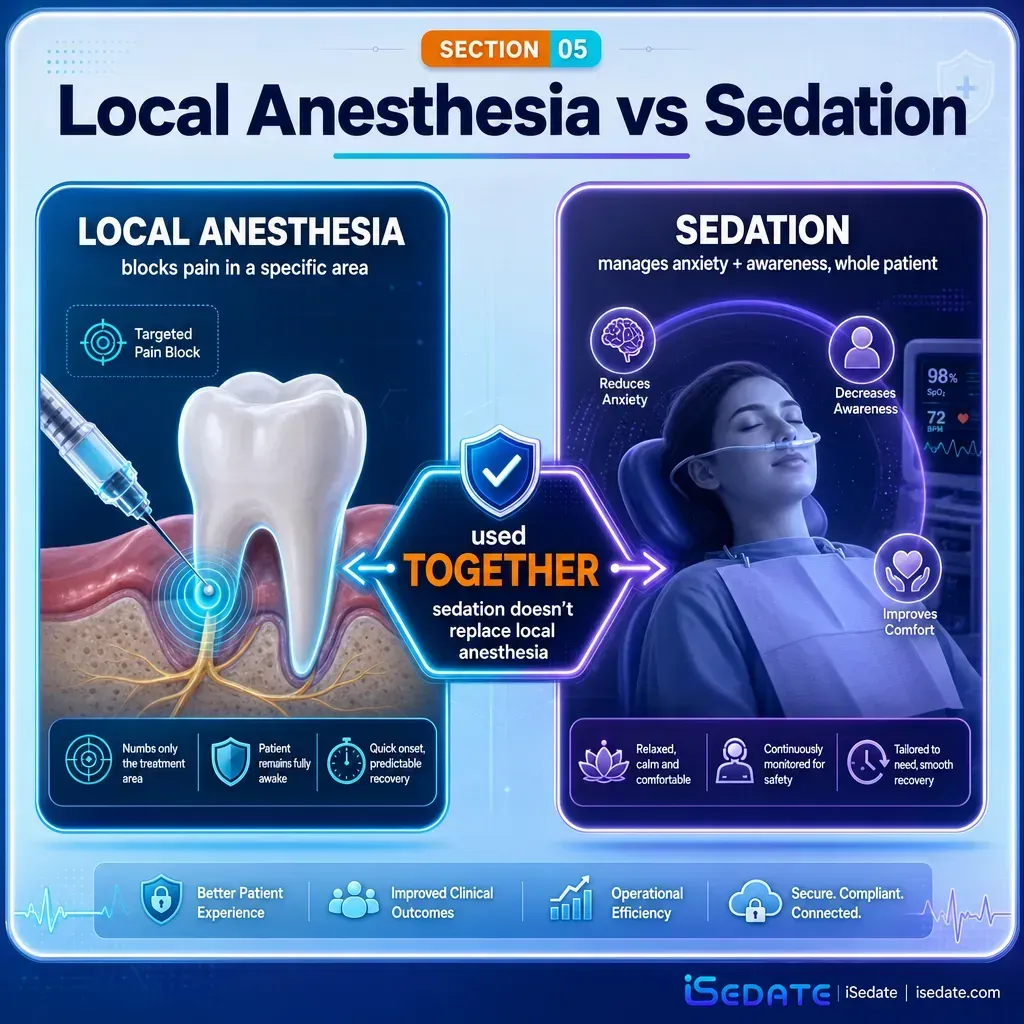
- Tennessee uses its own terms, limited and comprehensive Conscious Sedation, not "moderate" and not numbered "Level 1 through 4." Nitrous oxide needs no separate dentist sedation permit.
- The jump to IV is real: the limited (oral) permit generally runs on roughly 24 training hours and 10 patient experiences, while the comprehensive (IV) permit generally runs on roughly 60 didactic hours and 20 live patients. Confirm current figures with the Board.
- Your sedating office also needs its own dental facility permit, separate from your individual permit, and it can be inspected against the rule's equipment and monitoring requirements.
- Once permitted, Tennessee requires a time-oriented anesthesia record of the drugs and dosage administered (0460-02-.07(6)(b)4.(iv)), with interval blood pressure and pulse written into the record at the deep level (7)(b)4.(iv). Incomplete records are where permits get challenged.

What This Guide Covers
- Who issues sedation permits in Tennessee
- The Tennessee permit levels
- How to get or upgrade each permit
- What the permit requires you to monitor
- Records and reporting tied to your permit
- The dental facility permit and inspections
- CE and renewal
- Keeping the permit: audit-ready records
- Frequently asked questions
- Related guides and neighboring states
- Sources and how this guide was verified
Who issues sedation permits in Tennessee
Sedation dentistry in Tennessee is regulated by the Tennessee Board of Dentistry, the licensing board within the Tennessee Department of Health that issues every sedation and anesthesia permit. The Board, not any national body, decides who may sedate, can review a permit holder's records, and takes disciplinary action. The rules live in Tenn. Comp. R. & Regs. 0460-02-.07, "Anesthesia and Sedation," and every requirement below traces to a part of that rule.
Tennessee Sedation Permit Snapshot
- Governing rule: Tenn. Comp. R. & Regs. 0460-02-.07 (Anesthesia and Sedation)
- Issuing board: Tennessee Board of Dentistry (Tennessee Department of Health)
- Permit ladder: Nitrous oxide (no permit) → Limited Conscious Sedation (oral) → Comprehensive Conscious Sedation (IV) → Deep Sedation / General Anesthesia
- Also required to sedate: a separate dental facility permit for the office
- Board phone: (615) 532-3202 (confirm current contact, forms, and fees with the Board)
The Board writes the law; the ADA only writes a standard. The American Dental Association publishes sedation guidelines that Tennessee and most states lean on, but the ADA is a private professional association, not a government agency. It does not license you, audit you, or discipline you. Your permit, your record reviews, and your sanctions all come from the Tennessee Board of Dentistry under rule 0460-02-.07. The real federal layers that sit on top of state law are the DEA (controlled-substance logs for your sedation drugs), HIPAA (protected health information in the record), and, where they apply, CMS or accreditation bodies, not any "federal ADA law."
Myth, Busted
Myth: The ADA sets a federal sedation law that overrides Tennessee's permit rules.
Fact: There is no federal ADA law. Tennessee's own Board licenses, audits, and disciplines sedation providers under the Tennessee Board of Dentistry's authority and rule 0460-02-.07.
The confusion is common because many states incorporate ADA guidelines by reference. Treat the ADA guidelines as best practice and 0460-02-.07 as the rule you are actually held to.
To apply for a permit, you work through the Board's own application process. The Board publishes a dental sedation permit instructions document and application that spell out the required coursework, resuscitation certification, and patient experience for each level, and a separate facility permit form for the office. The forms, any required exam, and the current fee schedule are set by the Board and change periodically, so confirm the exact forms and current fees directly with the Board before you file. Rule 0460-02-.07 was the subject of a 2021 rulemaking hearing amending parts of the sedation subsections, with further dentistry rulemaking filed in 2026, a reminder to work from the current official text.
Source: Tennessee Board of Dentistry | Board dental sedation permit instructions (PDF)
The Tennessee permit levels
Tennessee names its permits by sedation depth and route, and it uses its own vocabulary: limited and comprehensive Conscious Sedation, then deep sedation and general anesthesia. Here is the full ladder, each with its governing part of rule 0460-02-.07.
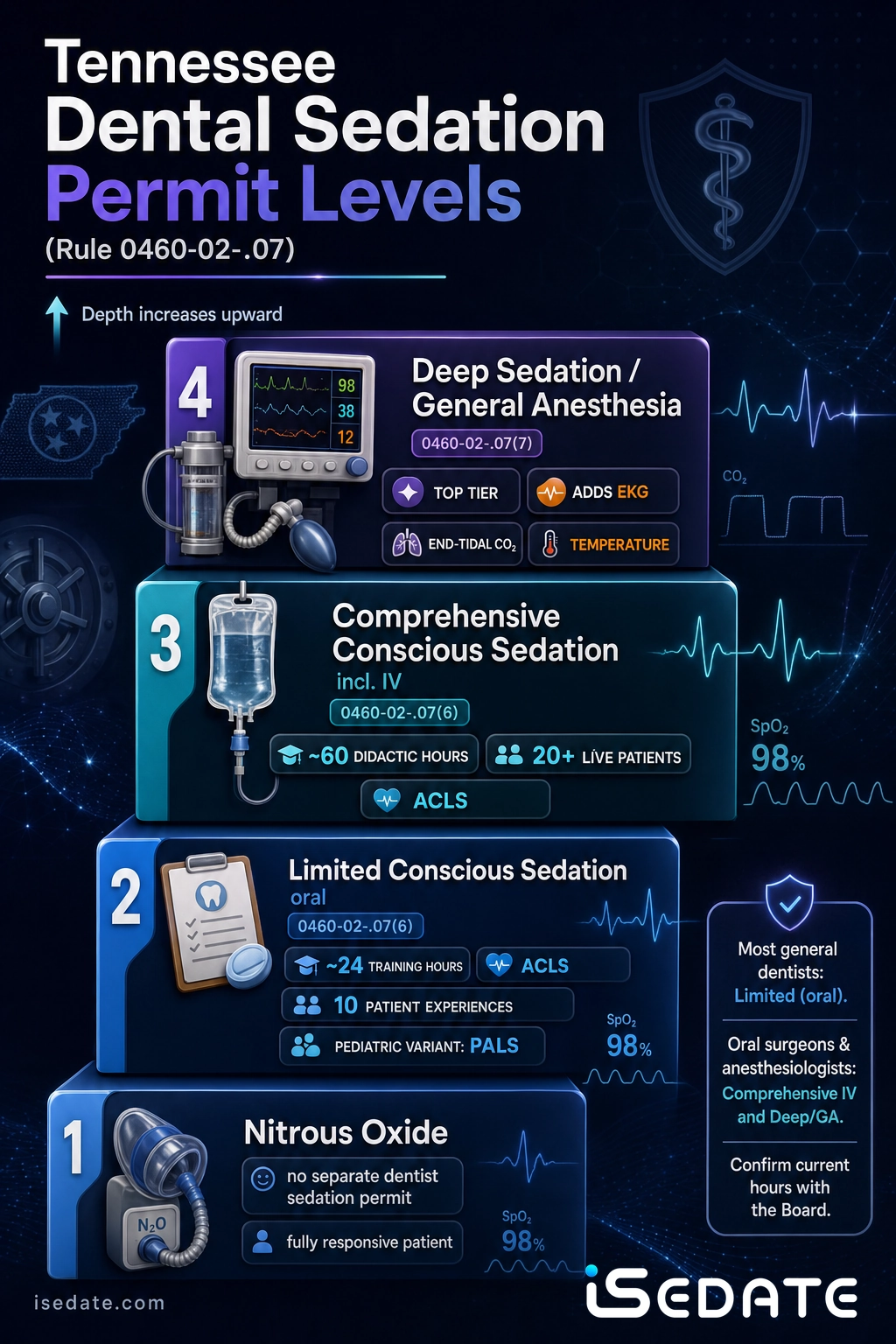
Nitrous oxide. The lightest form of anxiety control, where the patient stays fully responsive. In Tennessee, nitrous oxide inhalation analgesia does not require a separate sedation permit for the dentist, and antianxiety premedication is handled outside the permit tiers as well. Dental assistants and hygienists who monitor nitrous have their own certification rules. It is the entry point for anxiety control, below the permitted sedation levels.
Limited Conscious Sedation Permit (0460-02-.07(6)). Authorizes Conscious Sedation by the oral route, where the patient responds purposefully and maintains their own airway. This is the common starting point for general dentists who offer real oral Conscious Sedation. Tennessee also recognizes a pediatric variant of the limited conscious sedation permit for sedating children.
Board Approved Comprehensive Conscious Sedation permit (0460-02-.07(6)). Authorizes Conscious Sedation that includes the parenteral route, that is, IV sedation. Because IV sedation carries a higher risk and a faster onset, the comprehensive permit sits above the limited permit and carries heavier training, monitoring, and record requirements. This is where sedation-trained dentists and oral surgeons typically operate. A dentist who uses a Certified Registered Nurse Anesthetist to administer the sedation must hold a valid comprehensive permit.
Deep Sedation / General Anesthesia permit (0460-02-.07(7)). The top tier. It authorizes deep sedation and general anesthesia, where the patient is not easily aroused or is unconscious and may need airway support. This permit is largely the province of dental anesthesiologists and oral and maxillofacial surgeons, so for most general dentists it is out of scope. Its monitoring and record rules sit in subsection (7), which adds continuous EKG, end-tidal carbon dioxide monitoring, and temperature monitoring when malignant-hyperthermia-triggering agents are used. If you are pursuing this permit, work directly from 0460-02-.07(7) with the Board, as the subsection (7) training and patient-count specifics are not reproduced here.
Source: Tennessee Board of Dentistry dental sedation permit instructions (PDF)
How to get or upgrade each permit
Each permit has its own bar to clear: a set amount of board-approved training, resuscitation certification, and, for the sedation permits, a count of managed patient experiences. You move up the ladder by meeting the next level's requirements and applying to the Board. The figures below reflect the board-approved sedation-training standards that apply to these Tennessee permits. Because the application, exact hour counts, exams, and fees are set and updated by the Board, treat the table as a planning guide and confirm current requirements with the Board before you file.
| Permit | Route / depth | Training (confirm with Board) | Patient experiences | Resuscitation |
|---|---|---|---|---|
| Nitrous oxide | Inhalation, lightest | No separate dentist sedation permit | n/a | n/a |
| Limited Conscious Sedation (oral) | Oral Conscious Sedation | ~24 hrs board-approved sedation coursework | 10 patient experiences | ACLS |
| Limited Conscious, pediatric | Conscious Sedation of children | ~24 hrs pediatric sedation training | 10 patient experiences | PALS |
| Comprehensive Conscious Sedation (IV) | Conscious Sedation incl. IV | ~60 didactic hours | 20+ live patients | ACLS |
| Deep Sedation / General Anesthesia | Deep sedation / general anesthesia | See 0460-02-.07(7) (confirm with Board) | See 0460-02-.07(7) | ACLS |
The limited conscious (oral) permit
The Limited Conscious Sedation Permit for the oral route generally runs on about 24 hours of board-approved sedation coursework, current ACLS certification, and roughly 10 patient experiences, some of which may be completed through simulated or video-based cases. This is the usual first step for a general practice adding genuine oral Conscious Sedation. Tennessee's pediatric limited conscious permit mirrors that structure with pediatric-specific sedation training and PALS certification in place of ACLS, because sedating children carries its own airway and dosing considerations. You can take board-approved sedation coursework through providers such as DOCS Education's Tennessee sedation courses; confirm that any course you choose is currently Board-approved before you enroll.
The comprehensive conscious (IV) permit
Upgrading to a Board Approved Comprehensive Conscious Sedation permit that includes IV is the biggest step a general dentist or oral surgeon takes in Tennessee. It generally requires on the order of 60 hours of didactic training, clinical management of 20 or more live patients, and current ACLS. The live-patient count roughly doubles because IV titration demands hands-on competence that a classroom cannot replicate.
For every level, the application, any exam, the current fee schedule, and the exact training and patient-experience counts are set by the Board and updated periodically. Do not rely on a number you read on a course provider's page. Confirm the exact forms, current fees, and current requirements using the Board's dental sedation permit instructions and the Board's licensure page before you file.
Source: Tennessee Board of Dentistry licensure and applications

What the permit requires you to monitor
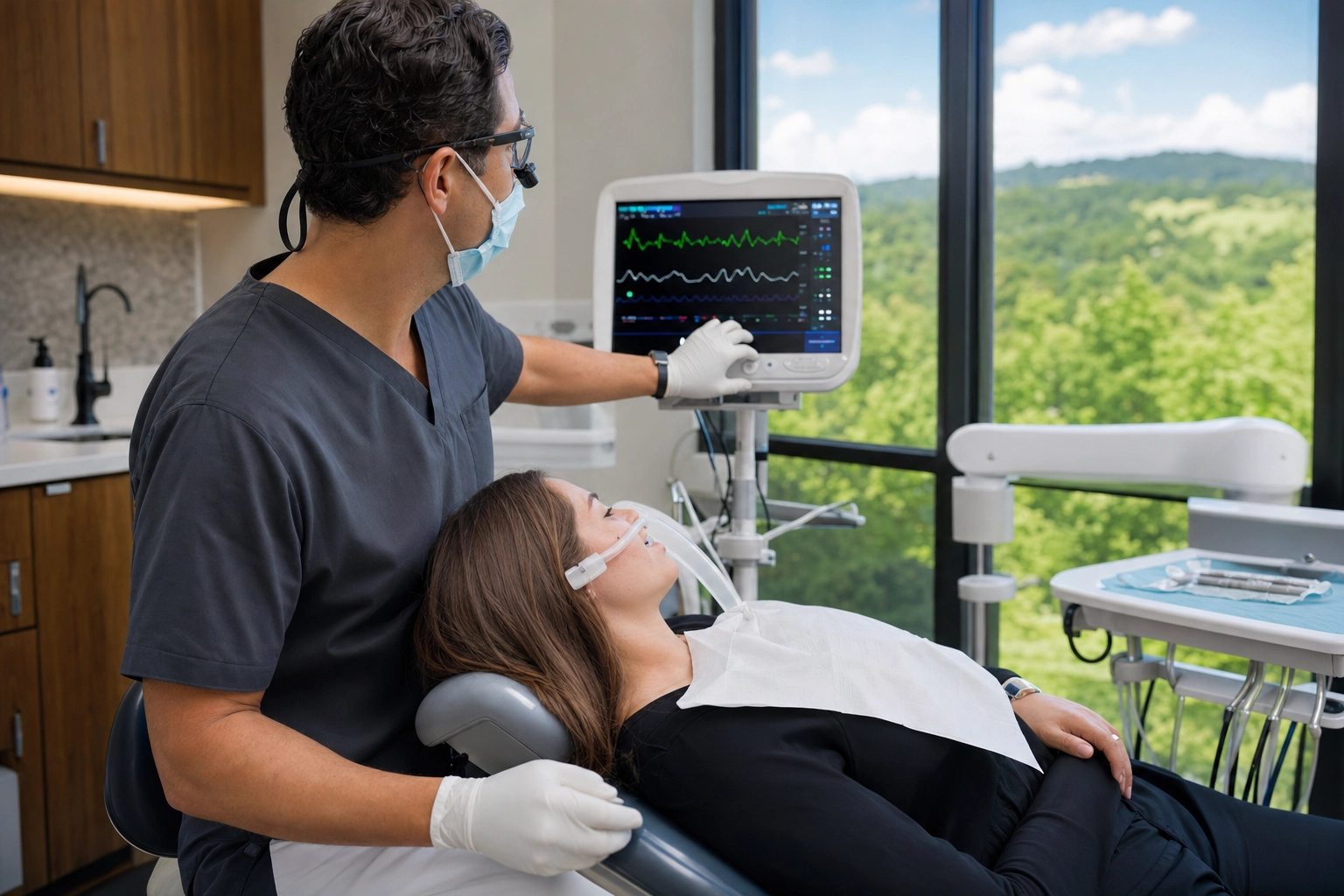
A permit is permission plus obligation. Once you hold a Conscious Sedation permit, 0460-02-.07(6)(b)5 requires you to watch the patient the whole way through:
- Continuous clinical observation: the patient is under continuous direct clinical observation throughout the procedure.
- Blood pressure and pulse: recorded at intervals during the case.
- Oxygenation: oxygen saturation checked continuously by pulse oximeter.
- Recovery: the patient is monitored by trained personnel in recovery until stable.
The deep sedation and general anesthesia permit raises the bar under 0460-02-.07(7)(b)5, adding continuous EKG by electrocardioscope, respirations monitored by end-tidal carbon dioxide unless precluded or invalidated, and continuous temperature monitoring when malignant-hyperthermia-triggering agents are used. For the full clinical breakdown of what to monitor and chart at each depth, see the companion guide on Tennessee sedation vitals monitoring, charting, and reporting requirements.
Source: Tennessee Board of Dentistry dental sedation permit instructions (PDF)
Records and reporting tied to your permit
Holding a permit also means holding a set of documentation duties, and these are exactly what a board review examines.
The anesthesia record. Under 0460-02-.07(6)(b)4.(iv), a time-oriented anesthesia record that includes the drugs and dosage administered must be maintained for Conscious Sedation. Baseline blood pressure and pulse are captured before sedation under 0460-02-.07(6)(b)4.(iii), and blood pressure and pulse are recorded at intervals during the case under (6)(b)5.
The deeper record. For deep sedation and general anesthesia, 0460-02-.07(7)(b)4.(iv) requires that the time-oriented anesthesia record include the drugs and dosage administered and an interval recording of blood pressure and pulse. Baseline vital signs for this level under (7)(b)4.(iii) also include temperature.
Recovery documentation. Under 0460-02-.07(6)(b)5, the patient must be monitored by trained personnel in recovery until stable, which is part of the record of the visit.
Adverse-event reporting and enforcement. Serious adverse events and rule violations fall under the Tennessee Board of Dentistry's disciplinary authority. The specific reporting triggers, timelines, and penalty schedule are set by the Board and can change, so confirm the current reporting requirements directly with the Board.
Source: Tennessee Board of Dentistry dental sedation permit instructions (PDF)
The dental facility permit and inspections
One piece general dentists often miss: the individual sedation permit is not the only permit the Board requires. Separate from your personal permit, Tennessee requires a dental facility permit for the office where a sedation or anesthesia permit holder practices and provides those services. The facility permit is about the room and its equipment, your personal permit is about you, and you need both to sedate.
The Board's facility permit guidance states that a facility that is not in compliance with the equipment and monitoring requirements of 0460-02-.07(6)(b) or (7)(b) must stop administering anesthesia or sedation until every deficiency is corrected. That is the practical teeth behind the monitoring list above: the emergency equipment, the pulse oximeter, and the monitoring capability are not just chart items, they are conditions of the facility permit. The current facility permit form, its fee, and the Board's routine inspection practice are administered by the Board and are not published as a fixed cadence in the rule, so confirm the current facility requirements and inspection practice with the Board.
Source: Tennessee Board of Dentistry dental facility permit requirements (PDF)
CE and renewal
Your sedation permit is tied to your Tennessee dental license, and the Board expects permit holders to stay current in the resuscitation certifications and continuing education appropriate to their level. The Board also audits permit holders' continuing education periodically. The exact renewal cycle and the number of sedation-specific continuing-education hours required for each permit are set by Board rule and updated periodically, and they are not reproduced here to avoid stating a figure that may be out of date. Confirm your current renewal cycle, CE hours, and resuscitation-certification requirements directly with the Tennessee Board of Dentistry so your permit never lapses at renewal.
Keeping the permit: audit-ready records
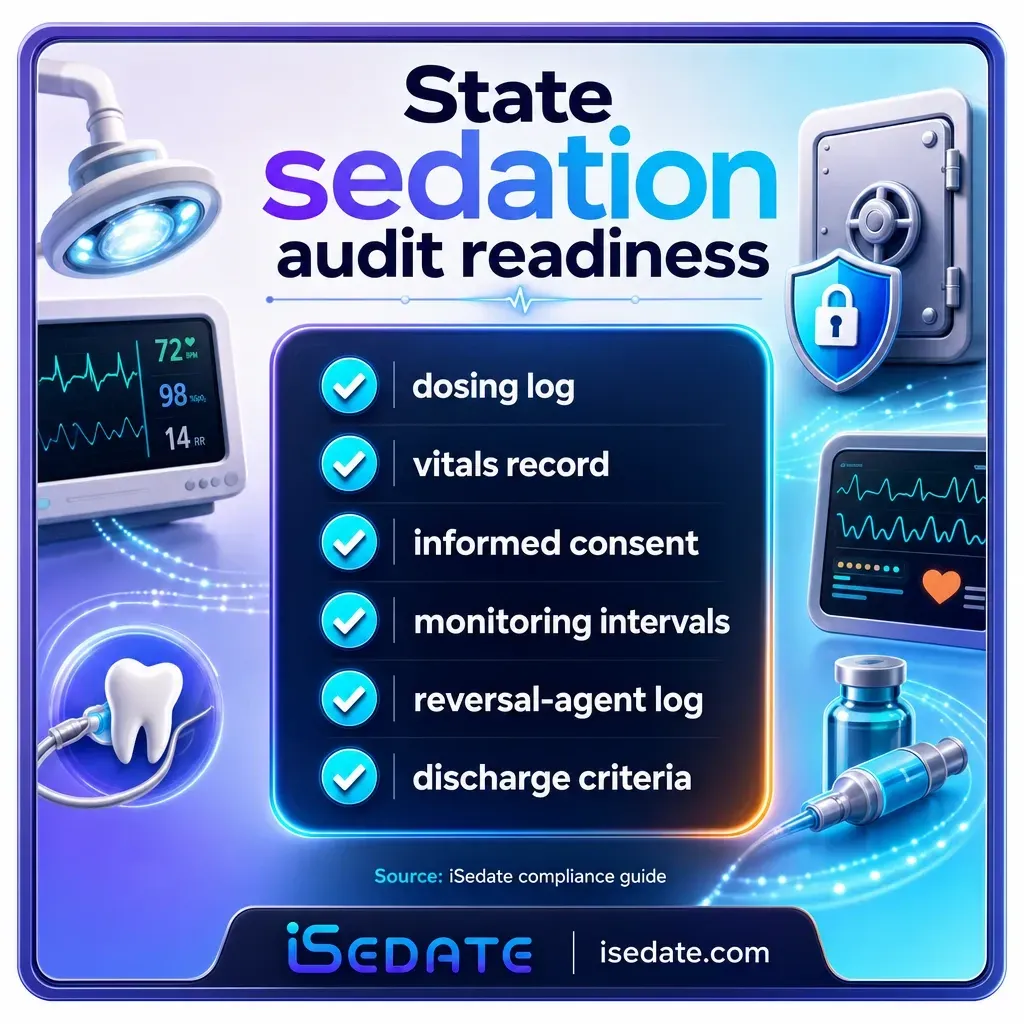
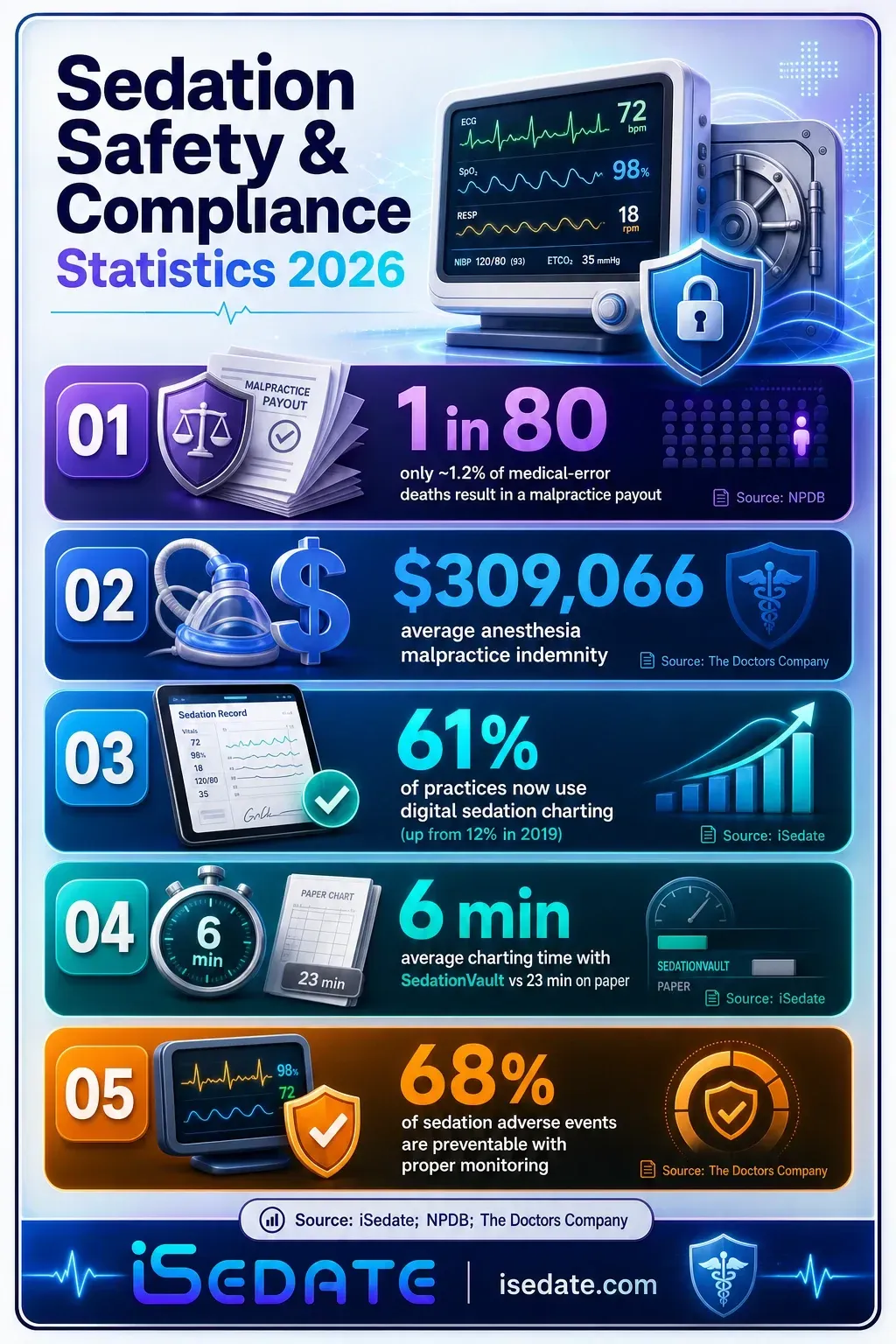
Everything above points to one truth: getting the permit is a one-time hurdle, but keeping it is a daily documentation discipline. When a reviewer opens your file, they are checking the record, not your intentions. A review turns on whether your time-oriented anesthesia record is complete, contemporaneous, and consistent across the case: the drugs and doses logged against the clock, the interval vitals present, the recovery monitoring noted. In practice, dentists lose these reviews on the paperwork, not the clinical care. The sedation was handled correctly, but the record could not prove it after the fact.
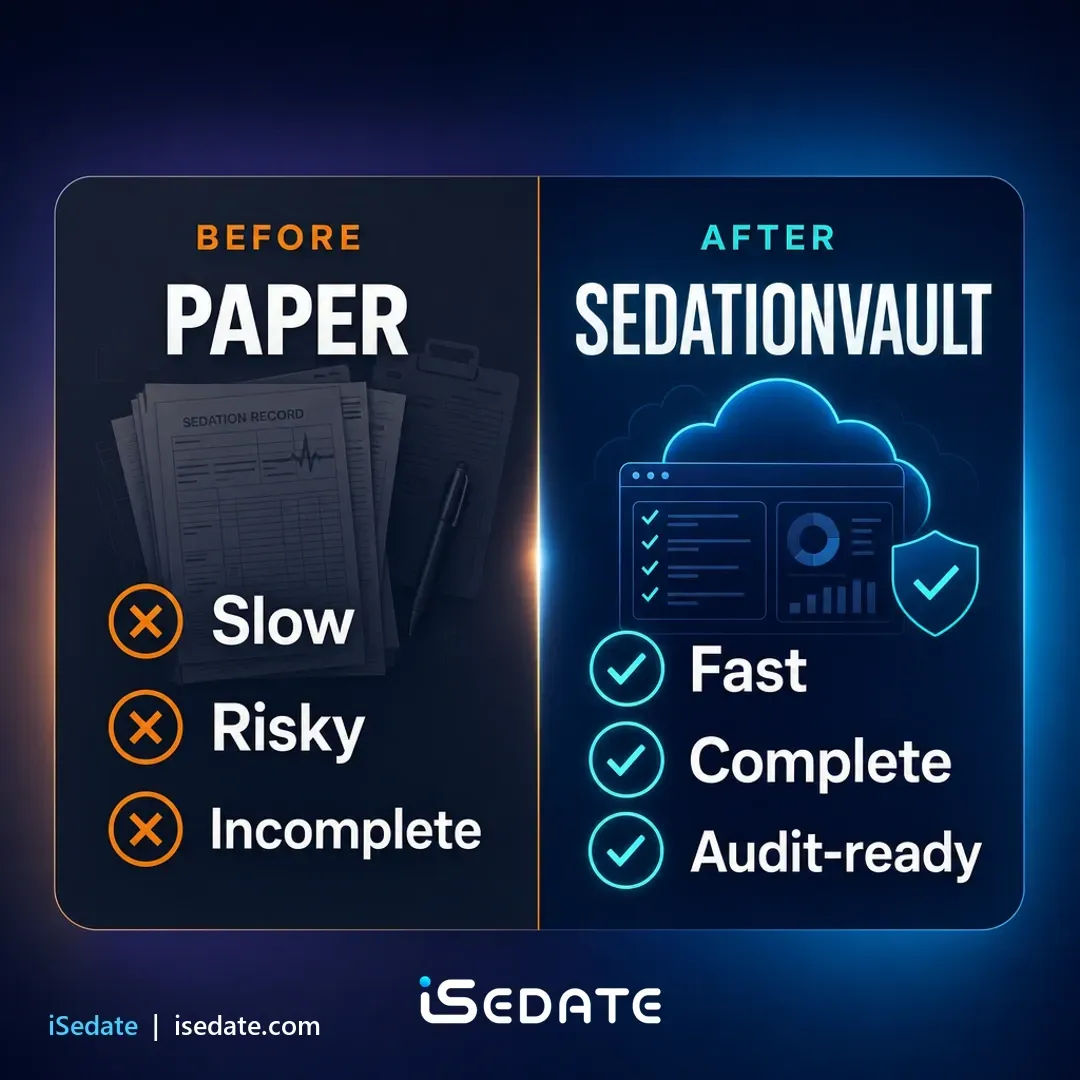
A manual vitals log and drug log written by hand, between titrating a drug and watching an airway, is exactly where records go incomplete, and incomplete records are what a board review and a malpractice claim both attack. SedationVault by iSedate removes that failure point. It captures live patient vitals and the drug log automatically into a time-oriented anesthesia record, holding the interval vitals that rule 0460-02-.07 requires, so the record writes itself while you focus on the patient. When the Board asks for the file, a complete record is a one-click export, not a scramble through paper. See how it maps to Tennessee rules on the dental sedation compliance and anesthesia record software pages.
Book a Demo of SedationVault See SedationVault PricingFrequently asked questions
What sedation permits does Tennessee offer?
What does it take to get an IV sedation permit in Tennessee?
Does nitrous oxide require a sedation permit in Tennessee?
Does a Tennessee dental office need a facility permit for sedation?
What records does Tennessee require for conscious sedation?
How often do you renew a Tennessee sedation permit?
Related guides and neighboring states
This page is part of the iSedate state-by-state series on sedation licensing and documentation. For the clinical companion to this licensing guide, see Tennessee sedation vitals monitoring, charting, and reporting requirements, or start from the national overview in our Sedation Dentistry Licensing & Permit Requirements by State hub.
Licensed in a neighboring state? See our sedation licensing and permit guides for the states around Tennessee:
- Alabama Sedation Dentistry Licensing & Permit Requirements
- Arkansas Sedation Dentistry Licensing & Permit Requirements
- Georgia Sedation Dentistry Licensing & Permit Requirements
- Kentucky Sedation Dentistry Licensing & Permit Requirements
- Missouri Sedation Dentistry Licensing & Permit Requirements
- Mississippi Sedation Dentistry Licensing & Permit Requirements
- North Carolina Sedation Dentistry Licensing & Permit Requirements
- Virginia Sedation Dentistry Licensing & Permit Requirements
Sources and how this guide was verified
- Tennessee Board of Dentistry (Tennessee Department of Health): board authority, licensure, and permits
- Tennessee Board of Dentistry: dental sedation permit instructions and application (PDF)
- Tennessee Board of Dentistry: dental facility permit requirements (PDF)
- Tennessee Board of Dentistry: licensure and application forms
- Tennessee Board of Dentistry: 2021 rulemaking hearing notice amending rule 0460-02-.07 (PDF)
- DOCS Education: Tennessee sedation coursework (where to take board-approved sedation training)
This guide summarizes Tennessee sedation permit rules for general information and is not legal advice. Requirements are current as of November 2026. The permit structure, monitoring, and record requirements are drawn from Tenn. Comp. R. & Regs. 0460-02-.07 (subsections (6) and (7)) as cited, verified against the Tennessee Board of Dentistry's own published materials. Training hours and patient-experience counts reflect the board-approved sedation-training standards for these permits and should be confirmed with the Board. The application forms, exams, fees, routine facility-inspection schedule, renewal cycle, continuing-education hours, exact penalty schedule, and the deep sedation / general anesthesia (subsection (7)) training specifics are set by the Tennessee Board of Dentistry and should be confirmed directly with the Board before you act.