






Alabama Sedation Dentistry Licensing & Permit Requirements
In Alabama, your dental license alone does not let you sedate a patient. A dentist who administers oral conscious sedation, IV (parenteral) sedation, or general anesthesia must first hold the matching permit from the Board of Dental Examiners of Alabama (BDEA), under the Dental Practice Act (Code of Alabama, Title 34, Chapter 9) and the board's sedation rules in Chapter 270-X-2 of the Alabama Administrative Code. Earning the permit means clearing the training and certification bar for your category. Keeping it means your office passes an on-site inspection, your sedation records survive a board review, and your continuing education stays current. This guide walks both halves, with every requirement traced to the current rule.
Recent Updates
Last UpdatedNovember 16, 2026
- Rewrote every requirement against the current official Alabama Administrative Code (Chapter 270-X-2 and Rule 270-X-4-.04), replacing third-party summaries with the board's own rule text.
- Added the verified continuing-education and renewal rule (Rule 270-X-4-.04) and the adverse-occurrence reporting timelines (7 and 30 business days, Rule 270-X-2-.20), both previously listed as "confirm with the board."
- Corrected the intra-operative charting interval: every 5 minutes for patients 14 and older, every 10 minutes for patients under 14 (Rule 270-X-2-.21).
- Added direct links to the board's permit applications, fee schedule, and continuing-education pages.
- Alabama regulates sedation through the Board of Dental Examiners of Alabama under Title 34, Chapter 9 and Chapter 270-X-2 of the Administrative Code. Permits are named by the type of sedation, not a numbered Level 1 to 4 ladder.
- The permits are Oral Conscious Sedation (Rule 270-X-2-.21), Parenteral Sedation (Rules 270-X-2-.16 and 270-X-2-.17), and General Anesthesia (Rule 270-X-2-.17). A general anesthesia permit covers you for oral conscious sedation too.
- Oral conscious sedation needs at least 16 hours of training plus in-person ACLS; parenteral (IV) sedation needs 60 hours of Board-approved instruction plus live-case management and a passed on-site facility inspection.
- Oral conscious sedation requires continuous monitoring of blood pressure, respiration, heart rate, SpO2, end-tidal CO2, and EKG, with intra-operative vitals charted every 5 minutes for patients 14 and older (every 10 minutes under 14).
- The permit is kept with the paperwork: on-site inspections, a 7-business-day adverse-event notice, 20 CE units a year, and a sedation record that survives a board review.
What This Guide Covers
- Who issues sedation permits in Alabama
- The Alabama sedation permit categories
- How to earn or upgrade each permit
- What the permit requires you to monitor
- Documentation and reporting duties
- Continuing education and renewal
- Inspections and keeping the permit
- Frequently asked questions
- Related guides and neighboring states
- Sources
Who issues sedation permits in Alabama
Sedation dentistry in Alabama is regulated by the Board of Dental Examiners of Alabama, the state agency that licenses dentists and issues every sedation and anesthesia permit. The board, not any national body, decides who may sedate, appoints the examiners who inspect offices, and takes disciplinary action. Two bodies of law work together: the Dental Practice Act in the Code of Alabama, Title 34, Chapter 9, and the board's rules in Chapter 270-X-2 of the Alabama Administrative Code. Every requirement below traces to one of them.
Important
The ADA writes the standard; the board writes the law. The American Dental Association publishes sedation guidelines that Alabama leans on, and the board's own rules point to the ADA Council on Dental Education for parenteral training. But the ADA is a professional association, not a government agency. It does not license you, inspect you, or discipline you. Your permit, your office inspection, and any sanction come from the BDEA under Title 34 and the 270-X-2 rules. Treat the ADA guidelines as best practice and the Alabama rules as the law you are held to. The real federal layers are separate: the DEA for controlled-substance logs, HIPAA for records, and your facility's accreditation body.
To apply, you work through the board's own process. The current permit and license applications and the board fee schedule are published on the BDEA site and are updated periodically, so pull the current form and fee directly from the board before you file rather than trusting a number on a CE provider's page.
Source: Board of Dental Examiners of Alabama | Alabama Administrative Code, Chapter 270-X-2
The Alabama sedation permit categories
Alabama names its permits by the type of sedation delivered, and the category reflects how deeply the patient is sedated, not just which drug is used. Here is the ladder, each rung with its governing rule.
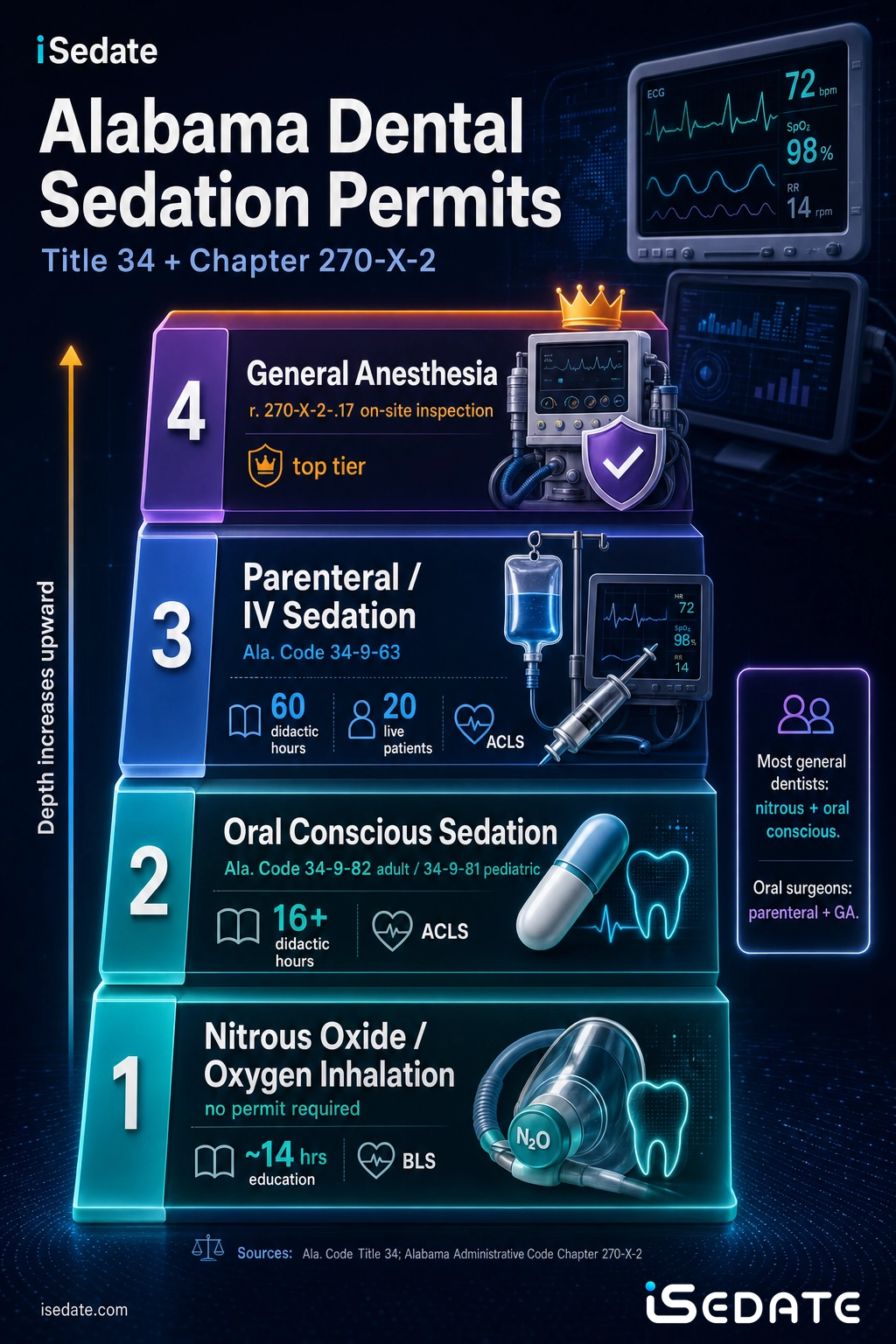
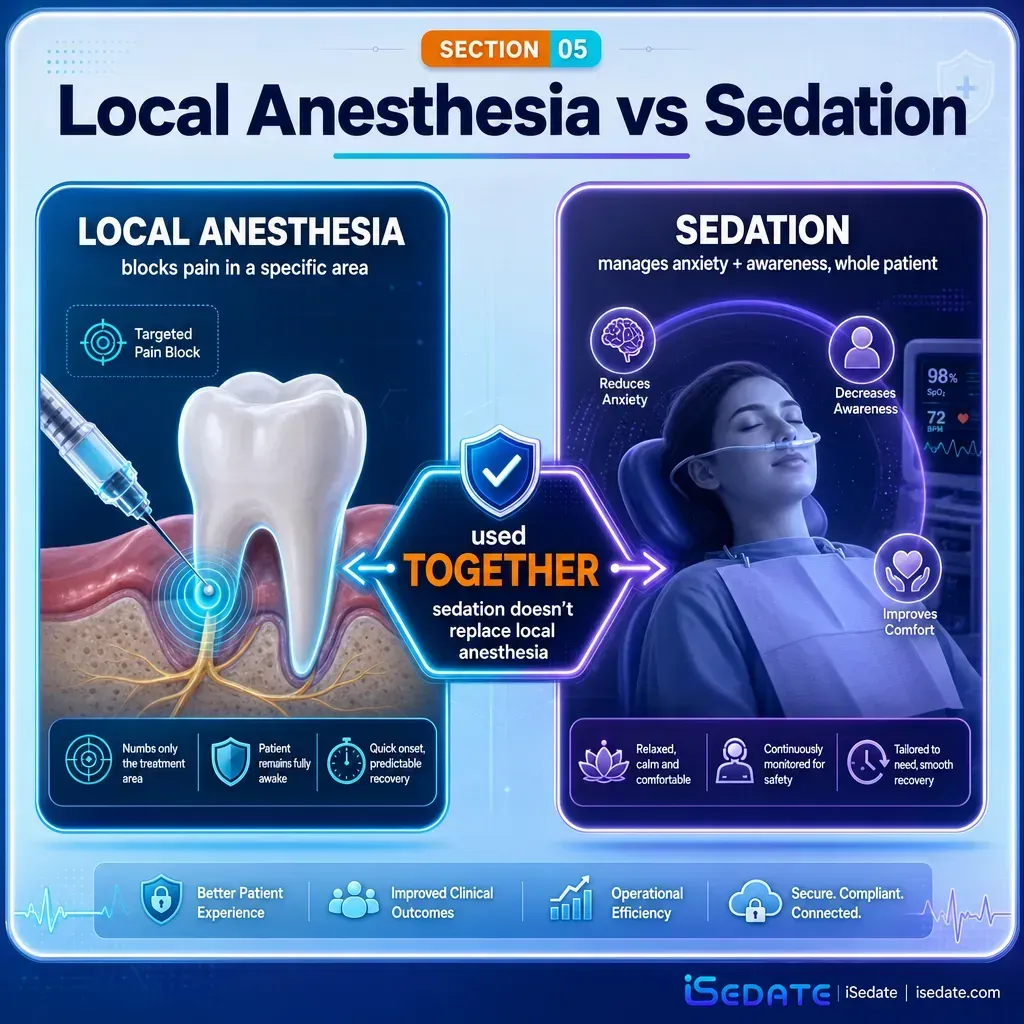
Nitrous oxide / oxygen inhalation. Nitrous oxide is the lightest form of anxiety control, where the patient stays fully responsive. It sits below the oral conscious sedation, parenteral, and general anesthesia permit rules covered here. If nitrous oxide alone is all you offer, confirm the current practice standard and any training expectation directly with the BDEA rather than assuming it maps to the permits below.
Oral Conscious Sedation permit (Rule 270-X-2-.21). Authorizes oral (enteral) conscious sedation, where the patient responds purposefully and keeps their own airway. This is the common starting point for a general practice adding real sedation. The rule sets the training, resuscitation, monitoring, documentation, and emergency-kit requirements, and treats pediatric patients (under 14) under the American Academy of Pediatric Dentistry guidelines. Conscious Sedation is the term Alabama and the ADA use for this moderate level.
Parenteral Sedation permit (Rules 270-X-2-.16 and 270-X-2-.17). Authorizes moderate sedation by the parenteral route, meaning IV sedation and other injected routes. Because IV titration carries a higher risk and a faster onset, this permit sits above oral conscious sedation, carries a heavier training path, and puts the office under the board's on-site inspection rule. This is where oral surgeons and sedation-trained dentists typically operate.
General Anesthesia permit (Rule 270-X-2-.17). The top tier. It authorizes deep sedation and general anesthesia, where the patient is not easily aroused or is unconscious and may need airway support. Like parenteral sedation, it is governed by the on-site inspection rule and is largely the province of dental anesthesiologists and oral and maxillofacial surgeons. Per the board, a dentist approved for a general anesthesia permit does not also need an oral conscious sedation permit. For most general dentists, general anesthesia is out of scope, so work directly from the board's rules if you are pursuing it.
Source: Ala. Admin. Code r. 270-X-2-.21 | Ala. Admin. Code r. 270-X-2-.17
How to earn or upgrade each permit
Each category has its own bar: a set number of training hours, resuscitation certification, and, for IV sedation, clinical patient management plus a facility inspection. You move up the ladder by meeting the next category's requirements and applying to the board. The figures below come straight from the current rules.
| Permit | Route / depth | Training required | Resuscitation | Facility inspection |
|---|---|---|---|---|
| Oral Conscious Sedation (r. 270-X-2-.21) | Oral / enteral, moderate | At least 16 hours of training (or an ADA-accredited residency that included it) | In-person ACLS (PALS for a declared pediatric specialty) | Board may inspect before issuing |
| Parenteral Sedation (r. 270-X-2-.16, .17) | IV / parenteral, moderate | 60 hours of Board-approved instruction plus ADA-recommended live-case management | ACLS; advanced life support training | Required on-site inspection |
| General Anesthesia (r. 270-X-2-.17) | Deep sedation / general anesthesia | Confirm the current training path with the board | ACLS; emergency-drug and airway standards | Required on-site inspection |
Oral conscious sedation: the first permit
The first true permit most general dentists pursue is the Oral Conscious Sedation permit. Under Rule 270-X-2-.21, you must complete a minimum of 16 hours of training in oral conscious sedation, or an ADA-accredited postgraduate general-dentistry or specialty residency that included that training, covering set topics from patient evaluation and sedative pharmacology to monitoring, documentation, and emergency management. You must also hold current in-person ACLS (a pediatric-specialty dentist may substitute PALS), stock a defined medical-emergency kit, and have at least one trained allied team member present. You submit the application and fee, and the permit must be in hand before you sedate.
Adding IV sedation: the parenteral permit
Upgrading to the Parenteral Sedation permit is the biggest step a general dentist or oral surgeon takes. Rule 270-X-2-.16 requires a minimum of 60 hours of instruction plus management of at least the number of patients recommended by the ADA Council on Dental Education, and the training program itself must be approved by the board. The instruction has to cover patient evaluation and medical-risk assessment, management of medical emergencies including advanced life support, and parenteral conscious sedation technique. Clearing the coursework is only half of it: before the permit issues, your office has to pass the on-site facility inspection in Rule 270-X-2-.17.
Myth, Busted
Myth: A dental license and a weekend course are enough to start offering IV sedation in Alabama.
Fact: Parenteral sedation needs a Board-approved 60-hour training path and a passed on-site facility inspection before the permit issues, per Rule 270-X-2-.16 and Rule 270-X-2-.17.
The gap between oral conscious sedation and IV sedation is where dentists most often misjudge the requirements, because the IV step adds both a longer training path and a facility evaluation the lighter permit never triggers.
For every category, the application, the current fee, and any exam requirement are set by the board and change periodically. Confirm the exact forms and current requirements with the board's permit applications page before you file. If your charting system also handles oral and IV sedation records, the iSedate anesthesia record software is built to match these permit categories.
Source: Ala. Admin. Code r. 270-X-2-.16 | Ala. Admin. Code r. 270-X-2-.21

What the permit requires you to monitor
A permit is permission plus obligation. Once you hold an Oral Conscious Sedation permit, Rule 270-X-2-.21 requires continuous monitoring and documentation of the patient's vital signs:
- Blood pressure
- Respiration, via end-tidal CO2 capnography (patients 14 and older) and/or a precordial stethoscope (patients under 14)
- Heart rate
- Oxygen saturation (SpO2)
- End-tidal carbon dioxide (capnography)
- EKG (patients 14 and older; may be excepted for younger patients given the patient, procedure, or equipment)
Alabama's inclusion of end-tidal CO2 and EKG for oral conscious sedation is stricter than many states, where those parameters are reserved for deeper levels. The monitoring must be documented in the pre-operative, intra-operative, and post-operative intervals, and the intra-operative readings have to be recorded on a set clock.
For general anesthesia and parenteral sedation, Rule 270-X-2-.17 requires mechanical monitoring of blood pressure, cardiac rate, oxygen saturation, end-tidal CO2 (capnography), and EKG across the pre-sedation, intra-operative, and post-operative intervals, with the monitoring equipment kept at each permitted location. For the full clinical breakdown of what to monitor and how to chart it, see the companion guide on Alabama sedation vitals monitoring, charting, and reporting requirements.
Source: Ala. Admin. Code r. 270-X-2-.21 | Ala. Admin. Code r. 270-X-2-.17
Documentation and reporting duties
Holding a permit also means holding a set of documentation and reporting duties, and these are exactly what a board review examines.
What the sedation record must contain
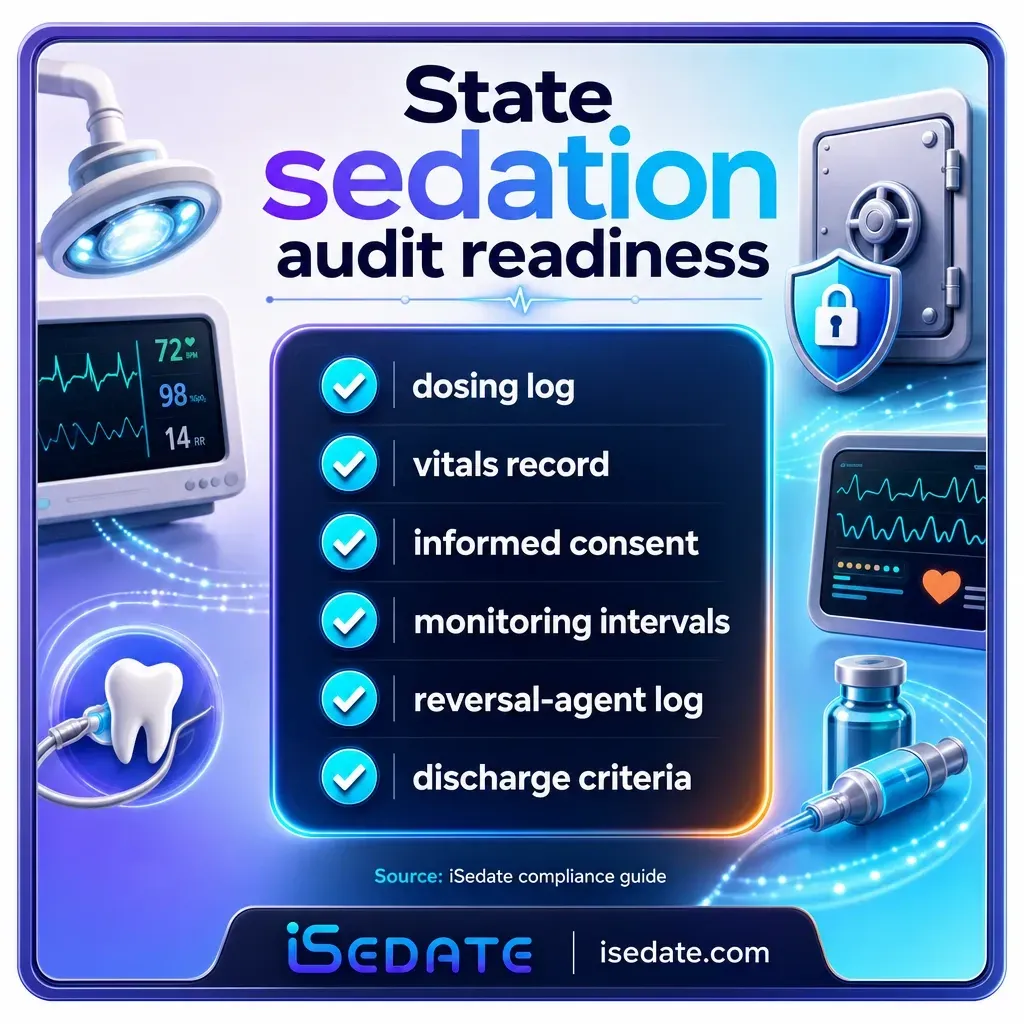
- The sedation record, consent forms, and monitoring record, retained in the patient chart (r. 270-X-2-.21).
- Pre-, intra-, and post-operative vital signs, with intra-operative readings on the 5-minute (or 10-minute) interval.
- All medications and dosages used during sedation, plus the anesthetic agents and amounts given for parenteral sedation and general anesthesia (r. 270-X-2-.17).
- Any complications or unusual reactions, the start and end times of anesthesia, and the people present during the procedure.
Reporting an adverse occurrence. Rule 270-X-2-.20 sets a hard clock. A dentist must notify the board of any mortality or significant injury (a physical injury that results in hospital admission) occurring during or directly related to a dental procedure within 7 business days of first becoming aware of it, then submit a complete written report within 30 business days. The report has to describe the procedure, the patient's preoperative condition and recorded vitals, the drugs and dosages, the techniques used, the adverse occurrence and its symptoms, the treatment, and the patient's response.
Source: Ala. Admin. Code r. 270-X-2-.20 | Ala. Admin. Code r. 270-X-2-.21
Continuing education and renewal
Your sedation permit is tied to your Alabama dental license: under Rule 270-X-2-.21, the oral conscious sedation permit carries the same renewal requirements and expiration date as the license itself. Continuing education is set by Rule 270-X-4-.04, which a dentist completes at a rate of 20 CE units per 12-month period of the renewal cycle.
iSedate Renewal Tip
A dentist with any active sedation permit has two extra CE duties under Rule 270-X-4-.04: keep a current ACLS certification (or PALS for a declared pediatric specialty), and complete at least one CE unit in the subject of sedation or anesthesia each renewal cycle. The board can randomly audit your CE and expects records produced within 14 days, so log every sedation course as you go. Confirm the current cycle details on the board's continuing-education page.
Source: Ala. Admin. Code r. 270-X-4-.04 | BDEA Continuing Education
Inspections and keeping the permit
This is where a permit is kept or lost. The permits that authorize parenteral sedation and general anesthesia carry the heaviest scrutiny, because that is where the risk is. Under Rule 270-X-2-.17, examiners appointed by the board conduct an on-site inspection: they observe two live cases, simulate a defined list of emergencies, and check the facility, equipment, emergency drugs, monitoring, personnel, and records. A satisfactory preliminary facility evaluation earns a temporary permit valid for up to 90 days pending a full evaluation, and the examining team files its report within 14 days. If the initial evaluation is unsatisfactory, the anesthesia certificate is immediately suspended and the dentist must reapply with a new application and fee. The board may also require an on-site inspection before issuing an oral conscious sedation permit.
When a reviewer opens your file, they are checking the record, not your intentions. A board review turns on whether your sedation record is complete, contemporaneous, and intervaled correctly: the pre-, intra-, and post-operative vitals, the timed intra-operative readings, the retained monitoring record, the consent forms, and every drug and dose. In other words, the dentist can perform the sedation flawlessly and still lose on the paperwork.
That is the failure point worth engineering out. A vitals log written by hand every five minutes, between titrating a drug and watching an airway, is exactly where records go incomplete, and incomplete records are what a board inspection and a malpractice claim both attack. SedationVault captures live patient vitals and the drug log automatically into a timed, Alabama-aware sedation record, holding the 5-minute (and 10-minute) intra-operative interval that Rule 270-X-2-.21 demands and keeping the monitoring data with the record instead of on a separate strip that can go missing. When the board asks for the file, a complete record is a one-click export. See how it maps to the Alabama rules on the dental sedation compliance page.
Book a demo of SedationVault See SedationVault pricingSource: Ala. Admin. Code r. 270-X-2-.17 | Board of Dental Examiners of Alabama
Frequently asked questions
What sedation permits does Alabama require?
How many training hours do you need for a sedation permit in Alabama?
How often do you renew an Alabama sedation permit?
Does Alabama inspect sedation offices?
What must an Alabama dentist report after a sedation complication?
Does nitrous oxide need a permit in Alabama?
Related guides and neighboring states
This guide is part of the iSedate state-by-state series on sedation licensing. For the companion Alabama guide, see the Alabama sedation vitals monitoring, charting, and reporting requirements. Licensed in a neighboring state? See our guides for Florida sedation dentistry licensing and permit requirements, Georgia sedation dentistry licensing and permit requirements, Mississippi sedation dentistry licensing and permit requirements, and Tennessee sedation dentistry licensing and permit requirements, or start from the full Sedation Dentistry Licensing & Permit Requirements by State hub.
Sources
- Board of Dental Examiners of Alabama (board, applications, fee schedule, continuing education, inspections)
- Ala. Admin. Code r. 270-X-2-.21 (Oral Conscious Sedation; amended effective April 14, 2025)
- Ala. Admin. Code r. 270-X-2-.16 (Training and Educational Requirements for Parenteral Sedation)
- Ala. Admin. Code r. 270-X-2-.17 (On-Site Inspection for General Anesthesia and Parenteral Sedation; amended effective April 13, 2026)
- Ala. Admin. Code r. 270-X-2-.20 (Reporting of Adverse Occurrences; amended effective April 13, 2026)
- Ala. Admin. Code r. 270-X-4-.04 (Mandatory Continuing Education)
- Code of Alabama, Title 34, Chapter 9 (Dental Practice Act)
This guide summarizes Alabama sedation permit rules for general information and is not legal advice. Permit categories, training, monitoring, recordkeeping, reporting, and continuing education are drawn from the Alabama Administrative Code rules cited above and the Code of Alabama, Title 34, Chapter 9, current as of November 2026. Application forms, fees, exam requirements, and the exact training path for a general anesthesia permit are set by the Board of Dental Examiners of Alabama and should be confirmed directly with the board before you act.