






Georgia Sedation Dentistry Licensing & Permit Requirements
In Georgia, your dental license alone does not let you provide moderate sedation. Any dentist who administers enteral (oral) or parenteral (IV) Conscious Sedation must first hold the matching permit from the Georgia Board of Dentistry, issued under Ga. Comp. R. & Regs. Chapter 150-13. Minimal sedation and nitrous oxide need no permit, but the moment you move to moderate sedation, the training hours, resuscitation certification, patient-experience counts, and facility inspection all apply. Getting the permit means meeting those requirements for your route. Keeping it means your sedation practice survives a Board review and your renewal never lapses. This guide walks both halves: how a Georgia dentist gets a sedation permit, and what it takes to keep it, with every form, rule, and fee schedule linked at the source.
Recent Updates
Last UpdatedNovember 16, 2026
- Re-verified every citation against the live text of Ga. Comp. R. & Regs. Chapter 150-13 (rules 150-13-.01, -.02, and -.03).
- Replaced general homepage and third-party links with the Board's own Applications and Forms page and direct permit-application PDFs.
- Added the Board's current fee schedule and the site-change notification form as direct links.
- Noted the Board's July 2026 clarification that each live-patient encounter counts toward only one dentist, the "sole primary operator."
Key Takeaways
- Georgia issues Conscious Sedation permits under Chapter 150-13: a Moderate Enteral Conscious Sedation Permit and a Moderate Parenteral Conscious Sedation Permit. Minimal sedation and nitrous oxide require no permit.
- Most general dentists offering oral sedation hold the Enteral permit; those adding IV move to the Parenteral permit, which also covers the enteral and inhalation routes. Deep sedation and general anesthesia sit under a separate rule, 150-13-.02, largely out of scope for general dentists.
- The jump to IV: the Enteral permit needs at least 24 didactic hours and 10 adult patient experiences; the Parenteral permit needs at least 60 didactic hours and 20 adult patient experiences. Both require ACLS; all staff need BLS.
- Georgia's rule mandates continuous blood-pressure and heart-rate monitoring, a pulse oximeter, and continual end-tidal CO2 for Conscious Sedation under 150-13-.01(6).
- Permits renew biennially (Dec 31 of odd years) with 4 CE hours every 2 years. Facilities face on-site inspection, and any sedation morbidity or mortality must be reported within 30 days.
What This Guide Covers
- Who issues sedation permits in Georgia
- The Georgia Conscious Sedation permit levels
- How to get or upgrade each permit
- What the permit requires you to monitor
- Reporting and facility obligations
- CE, renewal, and keeping the permit
- Related guides and neighboring states
- Frequently asked questions
- Sources
Who issues sedation permits in Georgia
Sedation dentistry in Georgia is regulated by the Georgia Board of Dentistry, the state agency that licenses dentists and issues every Conscious Sedation permit. The Board, not any national body, decides who may sedate, inspects sedation facilities, and takes disciplinary action. The rules live in Ga. Comp. R. & Regs. Chapter 150-13, "Sedation Permits," enacted under the Georgia Dental Practice Act (O.C.G.A. §43-11), and every requirement below traces to a section of that chapter. You download the forms themselves from the Board's Applications and Forms page.
The ADA writes the standard; the Board writes the law. The American Dental Association publishes sedation guidelines that Georgia and most states lean on, and Georgia's own rule points to the AAP/AAPD guidelines for pediatric monitoring. But the ADA is a private professional association, not a federal agency. It does not license you, inspect your facility, or discipline you, and no "federal ADA law" overrides Chapter 150-13. The real federal layers that sit on top of state rules are the DEA (controlled-substance logs), HIPAA (patient privacy), and payer or accreditation bodies such as CMS and the Joint Commission. Your permit, your inspections, and your sanctions all come from the Georgia Board of Dentistry. Treat the ADA guidelines as best practice and Chapter 150-13 as the rule you are held to.
To apply, you work through the Board's own process: the correct permit application for your route, proof of training and resuscitation certification, and agreement to an on-site inspection of your facility. Application forms and the current fee amounts are set by the Board under 150-13-.01(9) through (11) and change periodically, so pull the current PDF and the Board fee schedule before you file rather than relying on a number you read on a CE provider's page.
Source: Georgia Board of Dentistry Applications and Forms | Ga. Comp. R. & Regs. Chapter 150-13
The Georgia Conscious Sedation permit levels
Georgia names its permits by the depth and route of sedation, and the level reflects how deeply the patient is sedated, not just which drug is used. Here is the full ladder, each rung with its governing section of Chapter 150-13.
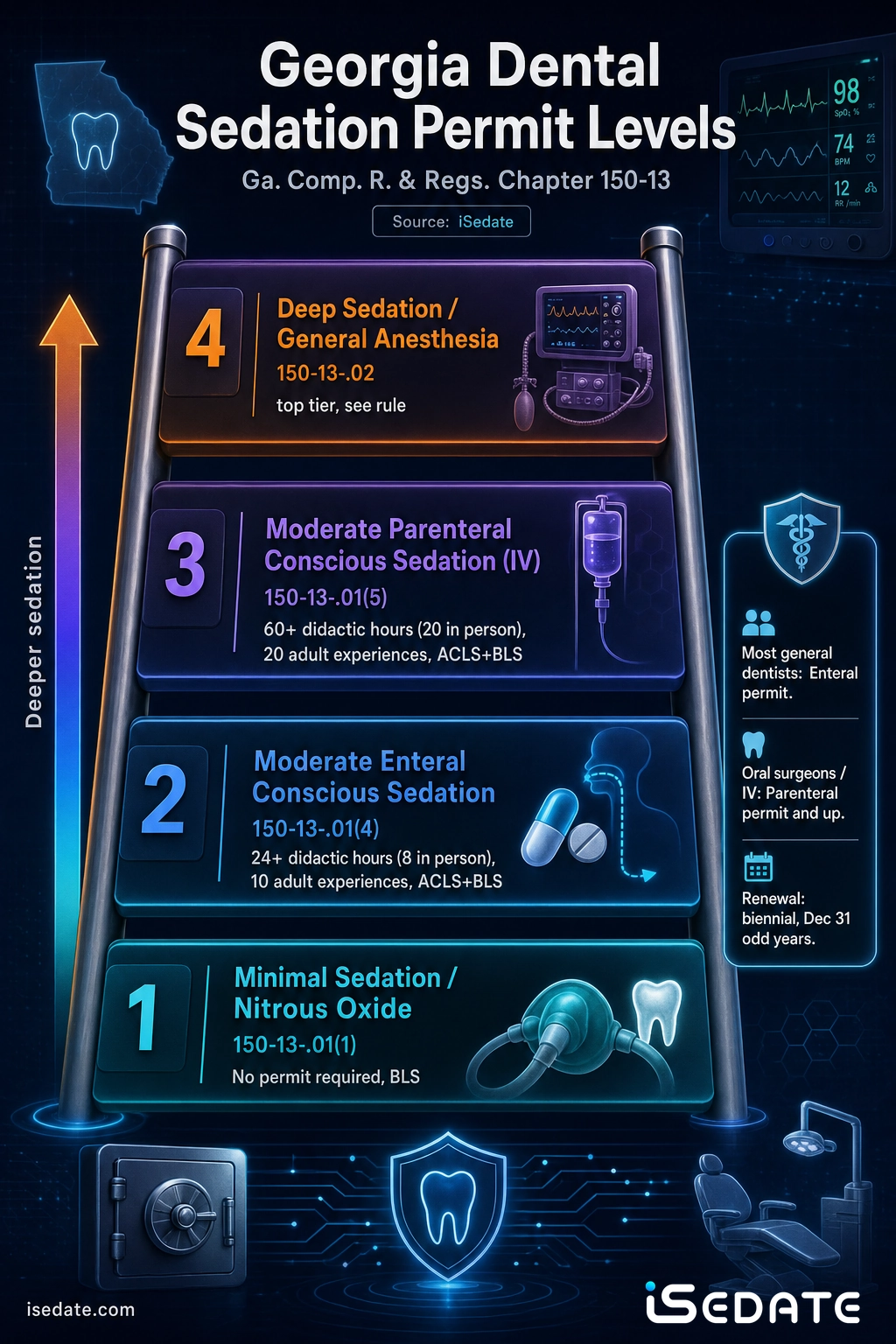
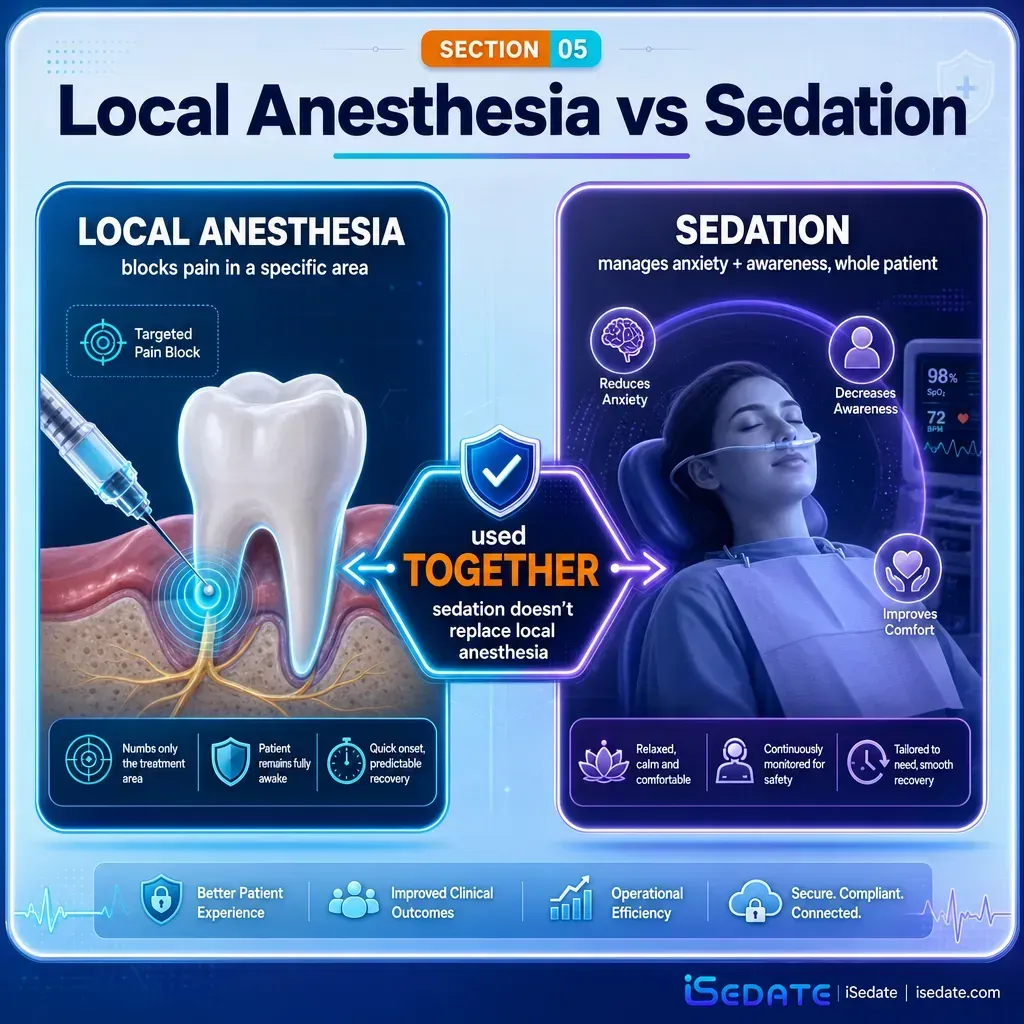
Minimal sedation (anxiolysis) and nitrous oxide require no permit (150-13-.01(1)). The lightest forms of anxiety control, where the patient stays fully responsive, need no sedation permit in Georgia. For pediatric minimal sedation, the rule references the AAP/AAPD monitoring guidelines (150-13-.01(1)(b)).
Moderate Enteral Conscious Sedation Permit (150-13-.01(4)). Authorizes moderate ("conscious") sedation by the enteral route, meaning oral and other non-injection routes. The patient responds purposefully to stimulation and keeps their own airway. This is the workhorse permit for general dentists who do real oral Conscious Sedation. A pediatric version for patients age 12 and under carries its own requirements under 150-13-.01(4)(b).
Moderate Parenteral Conscious Sedation Permit (150-13-.01(5)). Authorizes moderate sedation that includes the parenteral route, that is, IV sedation and other injected routes, and once held it also covers the enteral and inhalation routes. Because IV sedation carries higher risk and faster onset, the Parenteral permit sits above the Enteral permit and carries heavier training and patient-experience requirements. This is where oral surgeons and sedation-trained dentists typically operate, with a pediatric version under 150-13-.01(5)(b).
Deep Sedation / General Anesthesia (r. 150-13-.02). The top tier authorizes deep sedation and general anesthesia, where the patient is not easily aroused or is unconscious and may need airway support. This level is largely the province of dental anesthesiologists and oral and maxillofacial surgeons, and is generally out of scope for general dentists. Its full training, monitoring, and facility-inspection rules sit in r. 150-13-.02, which carries its own documentation of ACLS completion under 150-13-.02(2)(c). If you are pursuing deep sedation or general anesthesia, work directly from that rule with the Board.
Myth, Busted
Myth: A Georgia dental license, or an oral sedation permit, lets you start an IV line and titrate sedation.
Fact: IV sedation requires a separate Moderate Parenteral Conscious Sedation Permit under 150-13-.01(5), and the Enteral permit does not authorize the parenteral route.
This trips up dentists who complete a weekend oral-sedation course and assume IV is a small add-on. In Georgia it is a separate permit with roughly double the training hours and patient experiences, because titrated IV sedation can slip into deeper planes faster than the oral route.
Source: Ga. Comp. R. & Regs. r. 150-13-.01 | r. 150-13-.02
How to get or upgrade each permit
Each permit has its own bar to clear: a set number of training hours, resuscitation certification, and a count of managed patient experiences. You qualify by completing an ADA-accredited postdoctoral program or board-approved training that meets the level's requirements, then applying to the Board with the correct form. The figures below come straight from Chapter 150-13.
| Permit | Route / depth | Training | Patient experiences | Resuscitation |
|---|---|---|---|---|
| Minimal / Nitrous (150-13-.01(1)) | Lightest; no permit | No permit required | Not applicable | BLS (all staff) |
| Moderate Enteral (150-13-.01(4)) | Enteral (oral) | ADA postdoc OR 24+ didactic hrs (8 in person) | 10 adult (may include simulated) | ACLS + BLS |
| Moderate Parenteral (150-13-.01(5)) | Parenteral / IV (also enteral, inhalation) | ADA postdoc OR 60+ didactic hrs (20 in person) | 20 adult | ACLS + BLS |
| Deep Sedation / GA (r. 150-13-.02) | Deep sedation / general anesthesia | See 150-13-.02 (confirm with Board) | See 150-13-.02 | ACLS + BLS |
The minimal and nitrous tier
Minimal sedation (anxiolysis) and nitrous oxide require no sedation permit in Georgia. They remain subject to the general standard of care, and every dentist and support-staff member is expected to hold current BLS, but there is no separate permit application or facility inspection for these lightest forms of sedation.
Moderate Enteral: oral Conscious Sedation
To hold a Moderate Enteral Conscious Sedation Permit, you complete an ADA-accredited postdoctoral program or board-approved training of at least 24 hours of didactic instruction (at least 8 in person), document at least 10 adult patient experiences (which may include simulated cases), and hold current ACLS, under 150-13-.01(4). This permit lets you provide genuine oral Conscious Sedation but stops short of IV. Download the form from the Board's Moderate Enteral Conscious Sedation Permit application.
Enteral Training
Moderate Parenteral: adding IV sedation
Upgrading to a Moderate Parenteral Conscious Sedation Permit is the biggest step a general dentist or oral surgeon takes. It requires an ADA-accredited postdoctoral program or at least 60 hours of didactic training (at least 20 in person), documented management of at least 20 adult patient experiences, and current ACLS, under 150-13-.01(5). The patient-experience count doubles because IV titration demands hands-on competence a classroom cannot replicate. The parenteral form is on the Board's Applications and Forms page alongside the enteral and deep-sedation applications.
Parenteral Training
A staffing rule applies across every Conscious Sedation case: at least two BLS-certified support personnel must be present during the procedure, in addition to the dentist (150-13-.01(6)(d)). For pediatric patients, the Parenteral permit requires pediatric-specific training and supervised live cases (5 enteral or 10 parenteral) plus PALS, under 150-13-.01(4)(b) and (5)(b).
Counting Your Patient Experiences
In a July 2026 notice, the Board clarified how patient-experience cases are counted: for each case, only one dentist can be the "sole primary operator" who handles assessment, drug delivery, treatment, monitoring, discharge, and emergency management, and that case counts toward only that dentist's requirement. Two dentists cannot both claim the same case. Document your role on each experience accordingly, or the Board may defer your application or ask for more information.
Source: Ga. Comp. R. & Regs. 150-13-.01(4), (5) | GA Moderate Enteral Permit application
What the permit requires you to monitor
A permit is permission plus obligation. Once you hold a Conscious Sedation permit, 150-13-.01(6) requires your facility to have the equipment to monitor the patient throughout the case, watching these systems:
- Circulation: equipment to continuously monitor blood pressure and heart rate.
- Oxygenation: a pulse oximeter measuring oxygen saturation.
- Ventilation: continual monitoring of end-tidal CO2 (expired carbon dioxide), unless invalidated by the nature of the patient, procedure, or equipment.
- Emergency readiness: positive-pressure oxygen ventilation, suction, a defibrillator (AED or manual), and ACLS/PALS emergency drugs.
Georgia defines "continual" as repeated regularly and frequently in steady, rapid succession. The rule mandates the monitoring equipment and parameters, but it does not prescribe a written chart format, which makes the completeness of your own record the thing a Board review actually examines. For the full clinical breakdown of what to monitor and how to document it, see the companion guide on Georgia Sedation Vitals Monitoring, Charting & Reporting Requirements.
Source: Ga. Comp. R. & Regs. 150-13-.01(6)
Reporting and facility obligations
Holding a permit also means holding a set of reporting and notice duties, and these are exactly what a Board review checks.
Reporting Deadline
Report a serious event within 30 days. Under 150-13-.01(15)(a), any sedation-related morbidity or mortality, or injury requiring hospitalization, must be reported to the Board no later than 30 days, with disclosure limits under O.C.G.A. §43-11-47(h)(2). This is a mandatory duty tied directly to your permit, not an optional courtesy.
Give 30 days' notice before a facility change. Under 150-13-.01(6)(b), you must give the Board 30 days' advance written notice before relocating your facility, adding a facility, or making a significant change to it, using the Board's sedation site-change notification form. Rule violations can lead to Board disciplinary action; the specific penalty schedule is set by the Board, so confirm the current reporting triggers and timelines directly with it.
Source: Ga. Comp. R. & Regs. 150-13-.01(6), (15)

CE, renewal, and keeping the permit
Your sedation permit is tied to your Georgia dental license and renews biennially, by December 31 of odd-numbered years, under r. 150-13-.03. Permit holders must complete at least 4 hours of continuing education every 2 years in pharmacology, anesthesia, emergency medicine, or sedation, counted within the 40-hour license-renewal requirement and certified at renewal (150-13-.01(8)(a)). BLS must be updated at least every 2 years, and you must maintain the ACLS, or PALS for pediatric, appropriate to your permit level. A permit is administratively revoked for failure to renew.
Inspections and record reviews
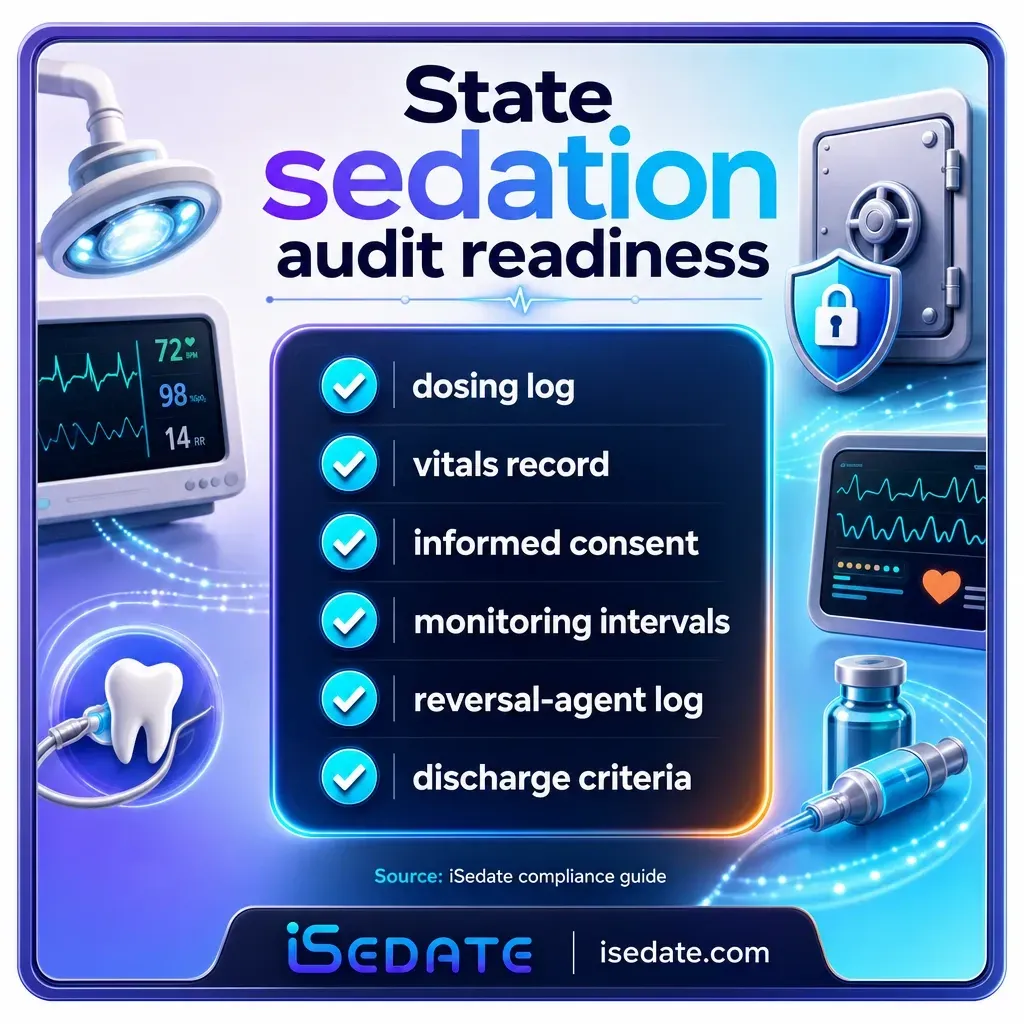
This is where a permit is kept or lost. A permit applicant's facility is subject to an on-site inspection under 150-13-.01(8), deep-sedation and general-anesthesia facilities have their own inspection provisions under 150-13-.02(3) and (4), and a former permit holder may also be inspected prior to renewal under 150-13-.03(1). When the Board reviews a case, whether through an inspection or after a reported incident, it is checking the record, not your intentions. Because Georgia's chapter mandates the monitoring but leaves the chart format to you, the completeness of your contemporaneous record is what proves the required monitoring actually happened. A dentist can have sedated correctly and still be exposed by a thin record.
Keeping the permit: audit-ready records
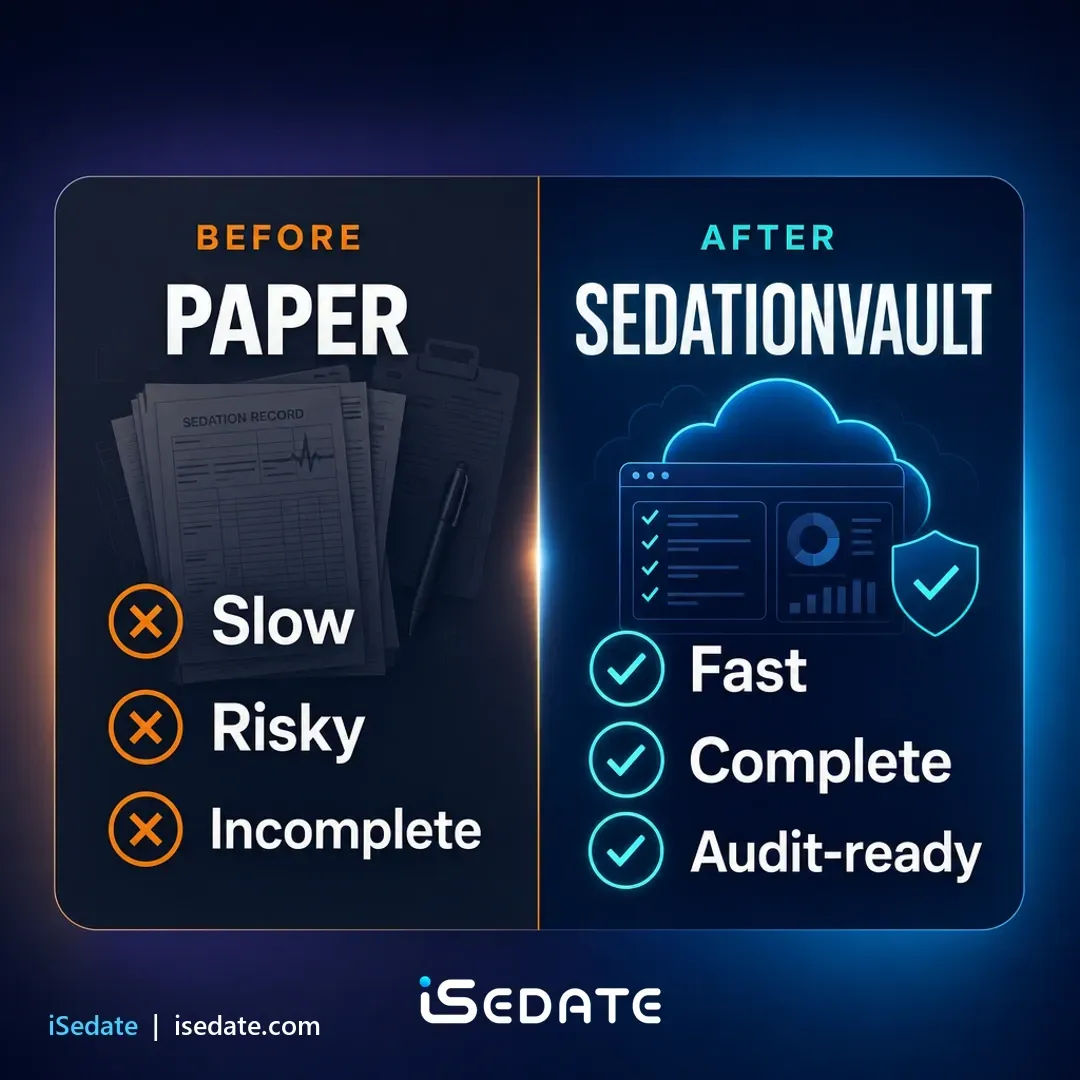
Getting the permit is a one-time hurdle; keeping it is a daily documentation discipline. A vitals log written by hand, between titrating a drug and watching an airway, is exactly where records go incomplete, and in Georgia, where the rule requires the monitoring but leaves the chart format to you, incomplete records are what a Board review and a malpractice claim both attack.
SedationVault removes that failure point. It captures live patient vitals, blood pressure, heart rate, oxygen saturation, and end-tidal CO2, plus the drug log, into a time-oriented record automatically, so the chart writes itself while you focus on the patient. If a complication ever triggers the 30-day Board report, or the Board asks for the file, a complete record is a one-click export, not a scramble through paper. See how it maps to Georgia's rules on the dental sedation compliance and anesthesia record software pages.
Book a demo of SedationVault See SedationVault pricingRelated guides and neighboring states
Licensed in a neighboring state, or practicing across state lines? Sedation permit rules are set state by state, so start with the guide for your Board:
- Alabama Sedation Dentistry Licensing & Permit Requirements
- Florida Sedation Dentistry Licensing & Permit Requirements
- North Carolina Sedation Dentistry Licensing & Permit Requirements
- South Carolina Sedation Dentistry Licensing & Permit Requirements
- Tennessee Sedation Dentistry Licensing & Permit Requirements
- Sedation Dentistry Licensing & Permit Requirements by State (all 50 states)
Frequently asked questions
What sedation permits does Georgia offer?
Does a Georgia dentist need a permit to give IV sedation?
How many hours do you need for a parenteral IV sedation permit in Georgia?
Do you need a permit for nitrous oxide or minimal sedation in Georgia?
How often do you renew a Georgia sedation permit?
Sources
Sources & How We Verified This Guide
Every requirement above was checked against the live text of Chapter 150-13 on the Georgia Secretary of State's official rules site and the Georgia Board of Dentistry's own forms. Training hours, patient-experience counts, resuscitation requirements, monitoring, the renewal cycle, and CE hours are drawn from Ga. Comp. R. & Regs. Chapter 150-13 as cited. Exact fee amounts, the penalty schedule, the routine inspection cadence, and deep-sedation/general-anesthesia training specifics under 150-13-.02 are administered by the Board and should be confirmed directly before you act. This guide is general information, not legal advice.
- Ga. Comp. R. & Regs. Chapter 150-13, "Sedation Permits"
- r. 150-13-.01 (Conscious Sedation Permits)
- r. 150-13-.02 (Deep Sedation and General Anesthesia Permits)
- r. 150-13-.03 (renewal and inspection)
- Georgia Board of Dentistry Applications and Forms
- GA Moderate Enteral Conscious Sedation Permit application (PDF)
- GA Deep Sedation / General Anesthesia Permit application (PDF)
- Georgia Board of Dentistry fee schedule (PDF)
- Georgia Board of Dentistry, July 2026 notice on sedation patient-experience requirements