






Florida Sedation Dentistry Licensing & Permit Requirements
In Florida, you cannot provide moderate or deeper sedation on your dental license alone. A dentist who administers moderate (conscious) sedation, deep sedation, or general anesthesia must first hold the matching permit from the Florida Board of Dentistry, issued under Fla. Admin. Code Chapter 64B5-14 and authorized by Section 466.017, Florida Statutes. Getting the permit means meeting training, certification, and live-patient requirements for your category and paying the board's fee. Keeping it means passing a facility inspection and renewing with the right continuing education, while your sedation records survive a Department of Health review. This guide walks both halves: how a Florida dentist gets a sedation or anesthesia permit, and what it takes to keep it.
Recent Updates
Last UpdatedNovember 16, 2026
- Rebuilt against the current Chapter 64B5-14 rules, several of which took effect August 19, 2026 (including Rule 64B5-14.009 Moderate Sedation and the application and inspection rules).
- Replaced third-party legal-aggregator citations with the Florida Board of Dentistry's own permit pages, the official Florida Administrative Code on flrules.org, and Section 466.017, Florida Statutes.
- Added the verified application fee ($300), renewal fee ($200), and the biennial four-hour Medical Emergencies continuing-education requirement (Rule 64B5-14.004).
- Florida regulates sedation under Chapter 64B5-14, with permits issued by the Florida Board of Dentistry under the Department of Health and authorized by Section 466.017, Florida Statutes.
- Nitrous oxide and minimal sedation need no dedicated permit (minimal sedation has dosage limits); a Moderate Sedation Permit, a Pediatric Moderate Sedation Permit, and a General Anesthesia / Deep Sedation Permit each require their own.
- The Moderate Sedation Permit (Rule 64B5-14.009) is the step most general dentists take: a minimum of 60 didactic hours, at least 20 live patients, current ACLS or ATLS, and a $300 application fee.
- Florida requires continuous pulse oximetry and capnography for moderate sedation, with vitals recorded at least every 5 minutes (Rule 64B5-14.009).
- Keeping the permit means a biennial four-hour Medical Emergencies CE course (Rule 64B5-14.004) and passing Board of Dentistry inspections, where incomplete records are what fail the review.
What This Florida Permit Guide Covers
- Who issues sedation permits in Florida
- Do you need a permit? Florida's sedation categories
- How to get each Florida sedation permit
- What your permit requires you to monitor and document
- CE and renewal: keeping the permit current
- Inspections: where permits are kept or lost
- Keeping the permit: audit-ready records
- Licensed in a neighboring state?
- Frequently asked questions
- Sources
Who Issues Sedation Permits in Florida
Sedation dentistry in Florida is regulated by the Florida Board of Dentistry, which operates under the Florida Department of Health. The board, not any national body, decides who may sedate, issues each anesthesia permit, runs the inspection program, and takes disciplinary action. Its authority comes from Section 466.017, Florida Statutes, which directs the board to adopt rules defining anesthesia, set minimum training and certification standards, and verify compliance. Those rules live in Fla. Admin. Code Chapter 64B5-14, "Anesthesia", and every requirement below traces to a section of that chapter.
The ADA writes the standard; the board writes the law. The American Dental Association publishes sedation guidelines that Florida and most states lean on, but the ADA is a professional association, not a government agency. It does not license you, inspect you, or discipline you. Your permit, your inspections, and your sanctions all come from the Florida Board of Dentistry under Chapter 64B5-14 and Section 466.017. The federal layers that do apply are separate: the DEA for controlled-substance records, HIPAA for patient data, and any accreditation or payer body you work with. Treat the ADA guidelines as best practice and Florida's rules as the law you are held to.
To hold a sedation or anesthesia permit, you work through the board's own application process under Rule 64B5-14.0025 (Application for Permit), meeting the training and certification bar for your category and submitting the board's forms online through the MQA Services Portal. Florida law gives the board 30 days to review an initial application. Application forms, exam-equivalent inspections, and the current fee schedule are set by rule and can change, so confirm the exact forms and current fees directly with the Florida Board of Dentistry before you file.
Source: Florida Board of Dentistry sedation permit page | Section 466.017, F.S.
Do You Need a Permit? Florida's Sedation Categories
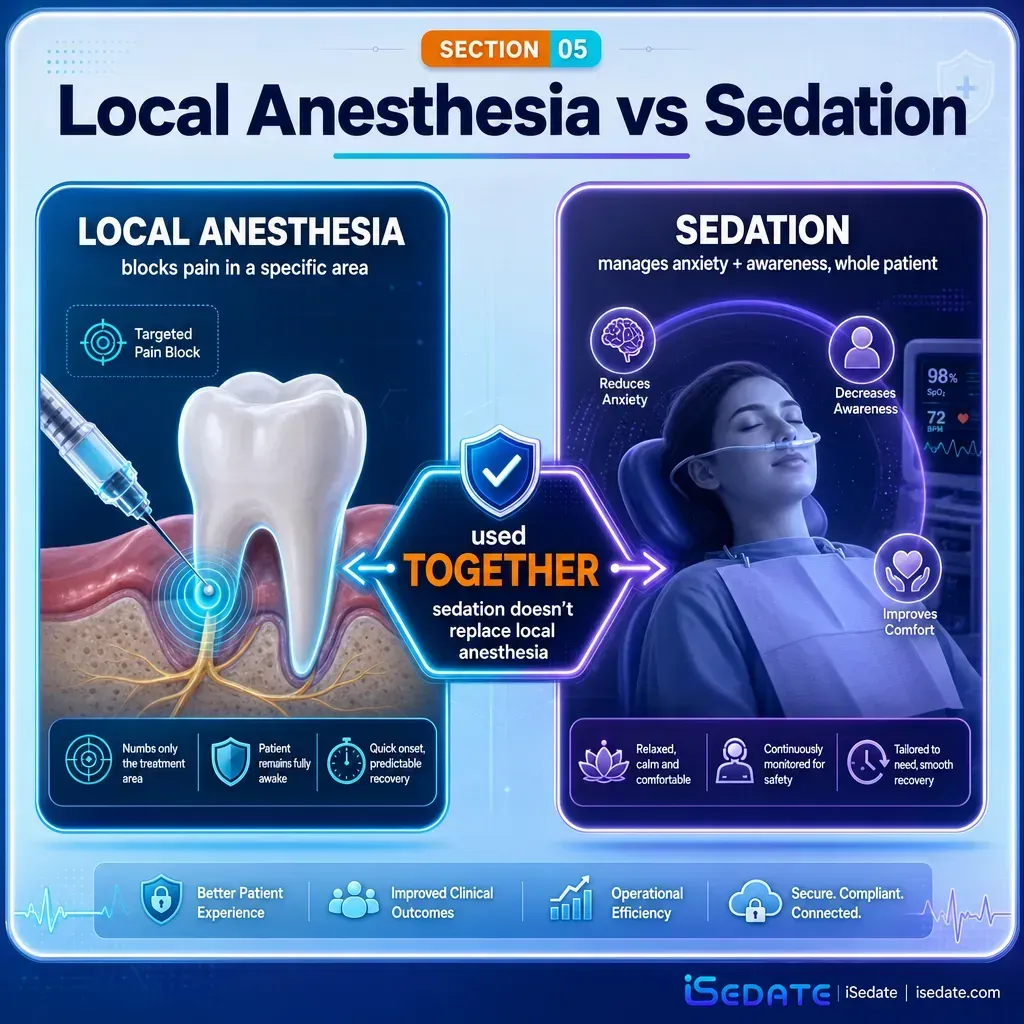
The quick answer: it depends on how deep you sedate. Florida does not number its permits by level the way some states do. It names them by the type of sedation administered, and it uses a single Moderate Sedation Permit that covers moderate (conscious) sedation rather than splitting enteral and parenteral routes into separate permits. Here is the full structure, each with its governing section of Chapter 64B5-14.
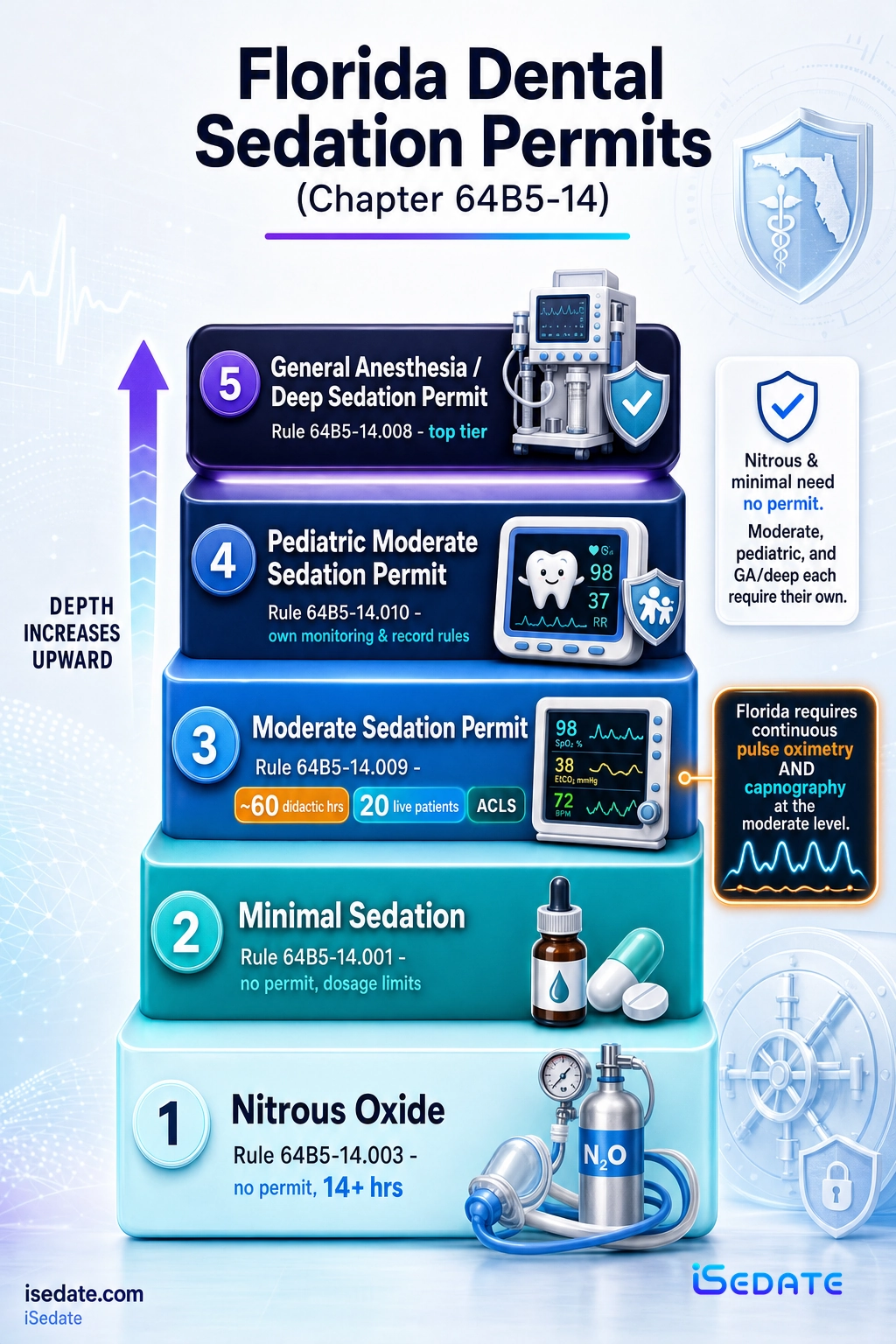
Nitrous oxide inhalation. The lightest form of anxiety control, where the patient stays fully responsive. Nitrous oxide does not require a dedicated anesthesia permit in Florida, though the board and the ADA teaching guidelines set training expectations for it.
Minimal sedation (anxiolysis). Typically a single oral drug where the patient responds normally to verbal command and airway and cardiovascular function are unaffected. Florida does not require a dedicated permit for minimal sedation, but it is bound by dosage limits in the board's definitions. Exceed those limits and you have crossed into moderate sedation, which does require a permit.
Moderate Sedation Permit (Rule 64B5-14.009). The workhorse permit. It authorizes moderate sedation, which Florida's own board page calls Conscious Sedation, where the patient responds purposefully to verbal or tactile stimulation and maintains their own airway. This is the level whose monitoring and record requirements the rule spells out most explicitly, including the continuous pulse oximetry and capnography and the five-minute vitals interval discussed below.
Pediatric Moderate Sedation Permit (Rule 64B5-14.010). A separate permit for moderate sedation of pediatric patients, with its own monitoring and record rules and its own pediatric permit application. Sedating children carries different physiology and risk, which is why Florida gives it its own rule.
General Anesthesia / Deep Sedation Permit (Rule 64B5-14.008). The top tier. It authorizes deep sedation and general anesthesia, where the patient is not easily aroused or is unconscious and may need airway support. This permit is largely the province of dental anesthesiologists and oral and maxillofacial surgeons. Its full training and monitoring rules sit in Rule 64B5-14.008, and if you are pursuing it, work directly from that rule with the board.
Source: Rule 64B5-14.009 | Rule 64B5-14.010 | Rule 64B5-14.008
How to Get Each Florida Sedation Permit
Each permit has its own bar to clear: a set amount of training, resuscitation certification, and, for moderate sedation, a count of managed live patients. You move up by meeting the next category's requirements and applying to the board. The figures below come from the Florida Board of Dentistry's own permit pages and the training rule, Rule 64B5-14.003.
| Permit / category | Depth | Training | Live patients | Resuscitation |
|---|---|---|---|---|
| Nitrous oxide (no permit) | Inhalation, lightest | ADA teaching guidelines (about 14+ hours) | Not specified | BLS / CPR |
| Minimal sedation (no permit) | Minimal / anxiolysis | Per board rule; dosage limits apply | Not specified | BLS / CPR |
| Moderate Sedation Permit (64B5-14.009) | Moderate / conscious | 60+ didactic hours (accredited program) | At least 20 | Current ACLS or ATLS + BLS |
| Pediatric Moderate Sedation (64B5-14.010) | Moderate, pediatric | Per Rule 64B5-14.010 / .003 | Per rule | CPR per 64B5-14.003; ACLS/ATLS |
| General Anesthesia / Deep Sedation (64B5-14.008) | Deep sedation / GA | CODA residency or ABOMS/AAOMS path | Per residency | Current ACLS or ATLS + BLS |
Nitrous Oxide and Minimal Sedation
Nitrous oxide training follows the ADA teaching guidelines, commonly about 14 or more hours, and neither nitrous oxide nor minimal sedation requires a dedicated anesthesia permit in Florida. Minimal sedation is still bound by the board's dosage limits, and staying inside those limits is what keeps a case classified as minimal rather than moderate. These are the usual first step for a general practice adding light anxiety control.
The Moderate Sedation Permit
This is the significant step most general dentists take, and the board page spells out the bar. Training must come from an accredited dental school, program, or teaching hospital that certifies your competence, with a minimum of 60 didactic hours. That total includes four hours of didactic airway-management instruction and three hours of hands-on clinical training in managing a simulated compromised airway. On the clinical side, you must personally administer sedation to at least 20 patients, and a patient counts only if you stay with that patient from the pre-anesthetic evaluation through discharge. Florida's single moderate permit covers conscious sedation, so a dentist who earns it is not required to hold a separate parenteral-route permit the way dentists in some other states are.
State Law
You also need basic life support CPR certification (covering one- and two-person CPR, infant resuscitation, and obstructed airway, updated at least every two years), training in an automated external defibrillator, and current ACLS or ATLS. There is no separate written board exam; instead, a board-contracted anesthesia consultant observes you administering sedation to a patient and inspects your office for the required drugs and equipment before the permit issues.
Permit Fee
Applications are submitted online through the MQA Services Portal under Rule 64B5-14.0025, with fingerprinting through an FDLE-approved Livescan provider. Fees and forms are set by the board and can change, so do not rely on a number from a CE provider's page. If you want the classroom and clinical training itself, the board recognizes accredited programs, and providers such as DOCS Education's Florida sedation courses are one place to take the required coursework. Confirm the exact forms and current fees with the board's moderate sedation permit page before you file.
The Pediatric and General Anesthesia Permits
The Pediatric Moderate Sedation Permit under Rule 64B5-14.010 has its own application and its own monitoring and record rules; the pediatric application also carries a $300 fee and points to the CPR requirements in Rule 64B5-14.003. The General Anesthesia / Deep Sedation Permit sits above both. Rather than a didactic-hours count, it requires completion of a CODA-accredited dental anesthesiology residency of at least one year or an oral and maxillofacial surgery residency, or board certification, eligibility, or membership with the American Board or American Association of Oral and Maxillofacial Surgeons. It also requires a properly equipped facility, positive-pressure oxygen capability, and at least three trained people in the room (the operating dentist, a dedicated patient monitor, and an assistant). This is why Level 4 general anesthesia is largely out of scope for general dentists, and most general practices operate at nitrous oxide and the Moderate Sedation (Conscious Sedation) level.
Source: Florida Board of Dentistry general anesthesia permit page | Rule 64B5-14.003

What Your Permit Requires You to Monitor and Document
A permit is permission plus obligation. Once you hold a Moderate Sedation Permit, Rule 64B5-14.009 requires continuous monitoring throughout the procedure, and Florida's standard is stricter than many states:
- Continuous pulse oximetry: a pulse oximeter providing continuous monitoring of pulse and oxygen saturation must be used during each procedure.
- Capnography: the patient must be continuously monitored intraoperatively by pulse oximetry and capnography, with a precordial or pretracheal stethoscope available. Florida requires capnography at the moderate level, not just for deep sedation.
- Vital signs: baseline vital signs including blood pressure and pulse must be recorded, and vital signs must be monitored continuously and recorded at a minimum of every five-minute intervals during the procedure.
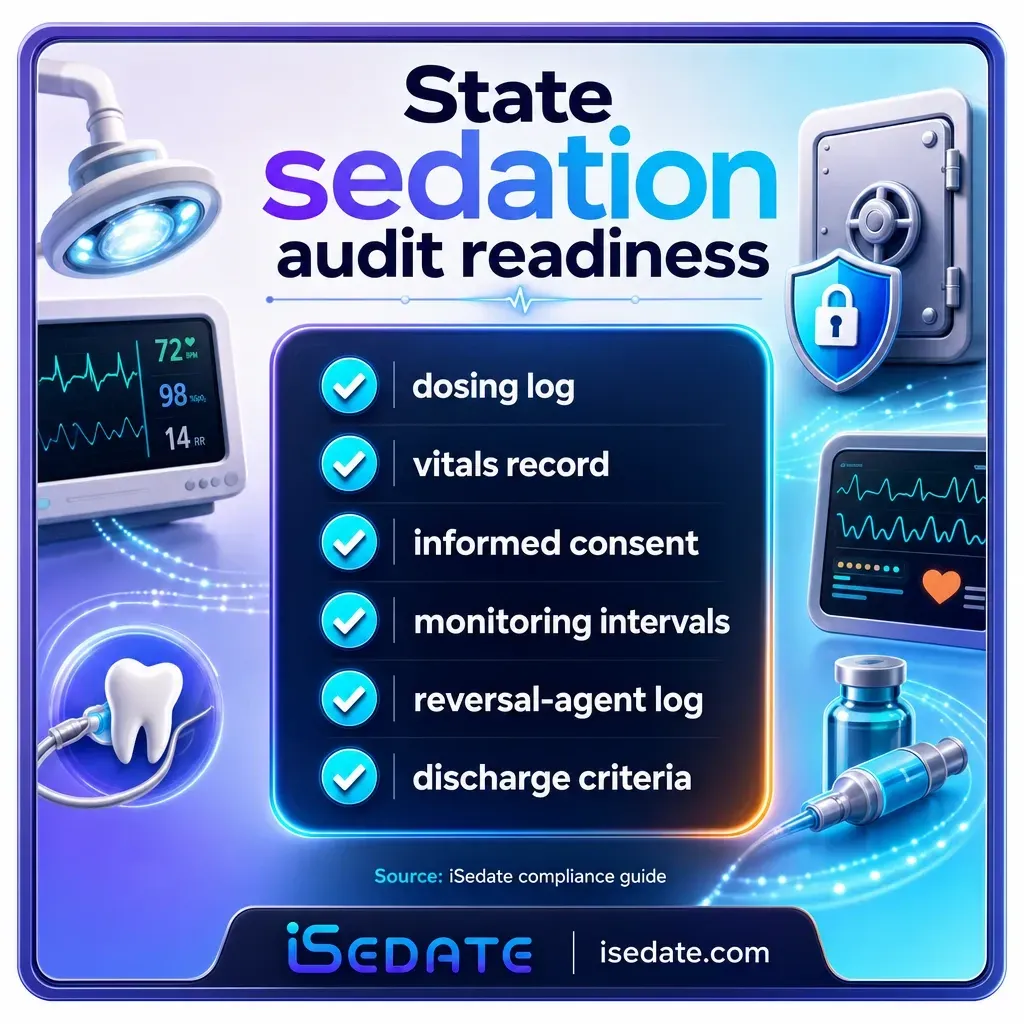
Holding a permit also means holding a set of documentation duties, and these are exactly what an inspection examines. Under Rule 64B5-14.009(7), a sedation record must document continuous vital-sign monitoring at least every five minutes, every drug with its route, dosage, and the time and sequence of each dose, the procedure start and finish times, any complications or morbidity, the patient's discharge status and the person to whom they were discharged, and the names of participating personnel, along with the patient's medical history and a physical examination with airway evaluation. Complications trigger adverse-occurrence reporting under Rule 64B5-14.006.
State Law
For the full clinical breakdown of what to monitor and chart, including the drug log and discharge criteria, see the companion guide on Florida sedation vitals monitoring, charting, and reporting requirements, and the national overview in our sedation dentistry licensing and permit requirements by state hub.
Source: Rule 64B5-14.009 | Rule 64B5-14.006
CE and Renewal: Keeping the Permit Current
Your sedation permit is a qualification on your Florida dental license, so it renews when the license renews, on the biennial cycle. What keeps it active is the right continuing education. Under Rule 64B5-14.004, every dentist holding an active sedation permit of any level must complete, each biennium, a four-hour, board-approved continuing education course in Medical Emergencies, taken through a board-approved provider and including a hands-on airway management component.
State Law
The good news is overlap: those four hours may be included in the 30 continuing-education hours Florida already requires for license renewal under Section 466.0135, Florida Statutes, so the sedation CE does not have to be entirely on top of your regular total. A renewal fee applies as well.
Renewal Fee
Confirm your current renewal cycle, CE hours, and resuscitation-certification requirements directly with the board's sedation permit renewal page so your permit never lapses at renewal.
Source: Rule 64B5-14.004 | Florida Board of Dentistry renewal page
Inspections: Where Permits Are Kept or Lost
This is where a permit is kept or lost. Under Rule 64B5-14.007 (Inspection of Facilities and Demonstration of Sedation Technique), an applicant's sedation technique and office are inspected before the permit issues, and anyone failing that initial inspection is denied the permit. After that, every permit holder, moderate, pediatric moderate, or general anesthesia, is subject to announced or unannounced routine inspection and evaluation by a board inspection consultant, using the inspection checklist the Florida Department of Health publishes for each permit type.
Myth, Busted
Myth: The board only reviews your sedation records after a complaint or an adverse event.
Fact: Routine inspections are built into the rule. Under Rule 64B5-14.007, permit holders face announced or unannounced routine inspections, independent of any complaint.
A clean record of care is not a defense if the paperwork has gaps. An inspector checks whether the records reflect that the patient was monitored adequately, not your intentions.
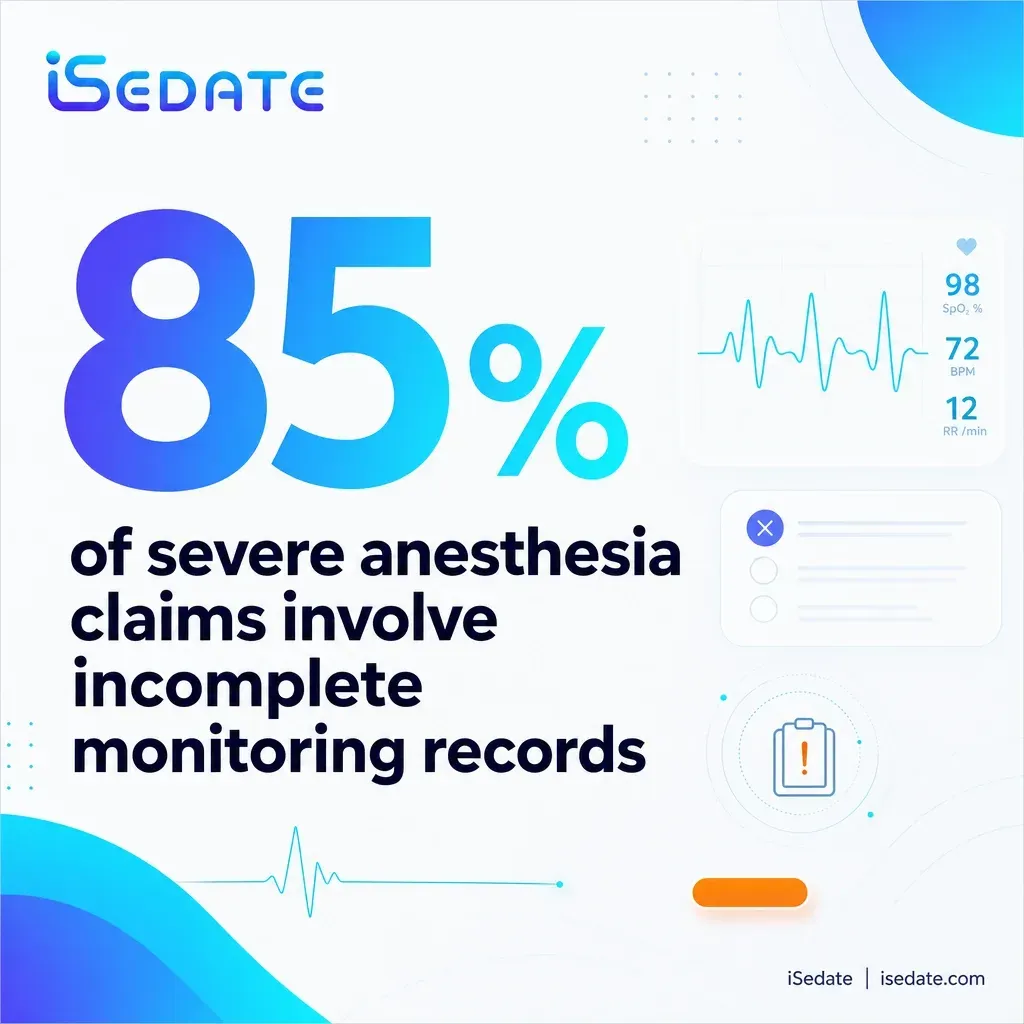
When an inspector opens your file, they are checking the record, not your intentions. A permit holder who performs sedation flawlessly but keeps a vitals log with gaps, a missed five-minute interval, an uncharted capnography reading, or an undocumented discharge can still fail the review. In other words, the dentist did the sedation correctly but lost on the paperwork. A Florida inspection turns on whether your sedation record is complete, contemporaneous, and intervaled correctly at five minutes.
Source: Rule 64B5-14.007
Keeping the Permit: Audit-Ready Records
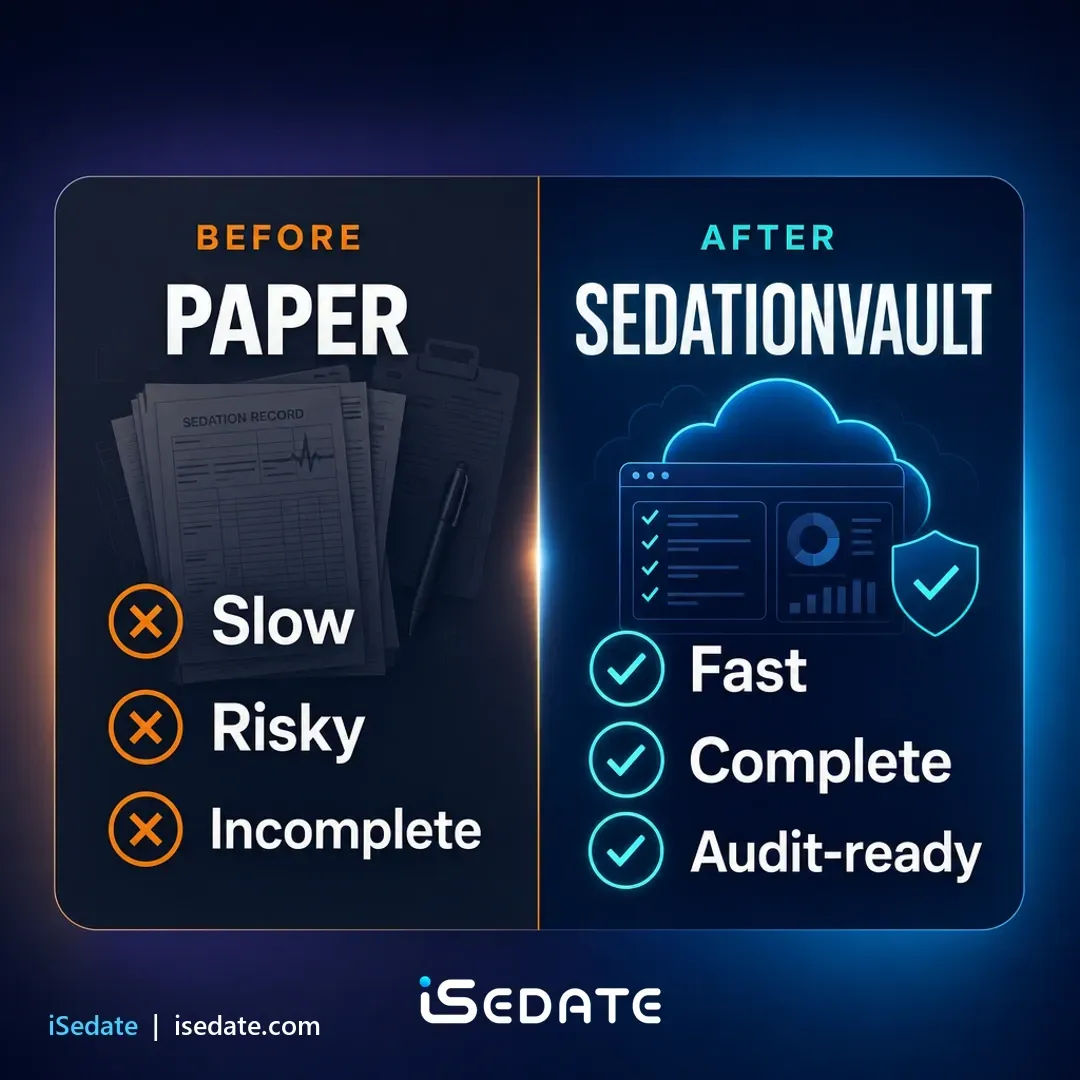
Everything above points to one truth: getting the permit is a one-time hurdle, but keeping it is a daily documentation discipline. A manual vitals log written every five minutes by hand, now with capnography to chart alongside the pulse oximetry, between titrating a drug and watching an airway, is exactly where records go incomplete, and incomplete records are what a board inspection and a malpractice claim both attack.
iSedate Insight
Across state rules, the thing that fails a sedation inspection is almost never the clinical care. It is the record: a missed interval, an unlogged dose, a discharge no one charted. Florida makes that explicit by requiring capnography and a five-minute vitals interval at the moderate level, which is more to capture, by hand, on exactly the schedule the rule demands.
SedationVault removes that failure point. It captures live patient vitals, including pulse oximetry and capnography, straight from your monitor and builds the drug log into a Florida-compliant sedation record, holding the five-minute interval that Rule 64B5-14.009 demands, so the record writes itself while you focus on the patient. When the Department of Health asks for the file, a complete, audit-ready record is one click away, not a scramble through paper. See how it maps to Florida's rules on the dental sedation compliance and anesthesia record software pages.
Book a demo of SedationVault See SedationVault pricingLicensed in a Neighboring State?
Sedation rules change at the state line. If you practice near Florida's borders or hold a license elsewhere, see our state guides for the neighbors, each with its own permit categories, training hours, and record rules:
- Alabama sedation dentistry licensing and permit requirements
- Georgia sedation dentistry licensing and permit requirements
- The all-50-state sedation licensing and permit hub
Frequently Asked Questions
What sedation permits does Florida require?
How many hours do you need for a moderate sedation permit in Florida?
How much does a Florida sedation permit cost?
How often do you renew a Florida sedation permit, and what CE is required?
Does nitrous oxide require a permit in Florida?
Can a general dentist provide general anesthesia in Florida?
Related Reading: The Data Behind These Rules
The requirements on this page are the law. These research roundups are the data that explains why they exist and what happens when a practice gets charting or permitting wrong:
Sources
- Florida Board of Dentistry: Sedation Permit for Moderate Sedation (training, fee, inspection)
- Florida Board of Dentistry: Sedation Permits for General Anesthesia
- Florida Board of Dentistry: Moderate Sedation Permit Renewal (CE, renewal fee)
- Florida Board of Dentistry: Pediatric Moderate Sedation Permit application
- Section 466.017, Florida Statutes (Prescription of drugs; anesthesia)
- Fla. Admin. Code Chapter 64B5-14, "Anesthesia" (official FAC index)
- Rule 64B5-14.0025 (Application for Permit)
- Rule 64B5-14.003 (Training, Education, Certification, Issuance)
- Rule 64B5-14.004 (Continuing Education Requirement)
- Rule 64B5-14.006 (Reporting Adverse Occurrences)
- Rule 64B5-14.007 (Inspection of Facilities)
- Rule 64B5-14.008 (General Anesthesia / Deep Sedation)
- Rule 64B5-14.009 (Moderate Sedation)
- Rule 64B5-14.010 (Pediatric Moderate Sedation)
This guide summarizes Florida sedation permit rules for general information and is not legal advice. Permit categories, monitoring, recordkeeping, training, fees, CE, and inspections are drawn from Fla. Admin. Code Chapter 64B5-14 and the Florida Board of Dentistry permit pages as cited, current as of November 2026; several rules took effect August 19, 2026. Fees, forms, and figures are set by the board and can change. Confirm current requirements directly with the Florida Board of Dentistry before you act.