






Florida Sedation Vitals Monitoring, Charting & Reporting Requirements
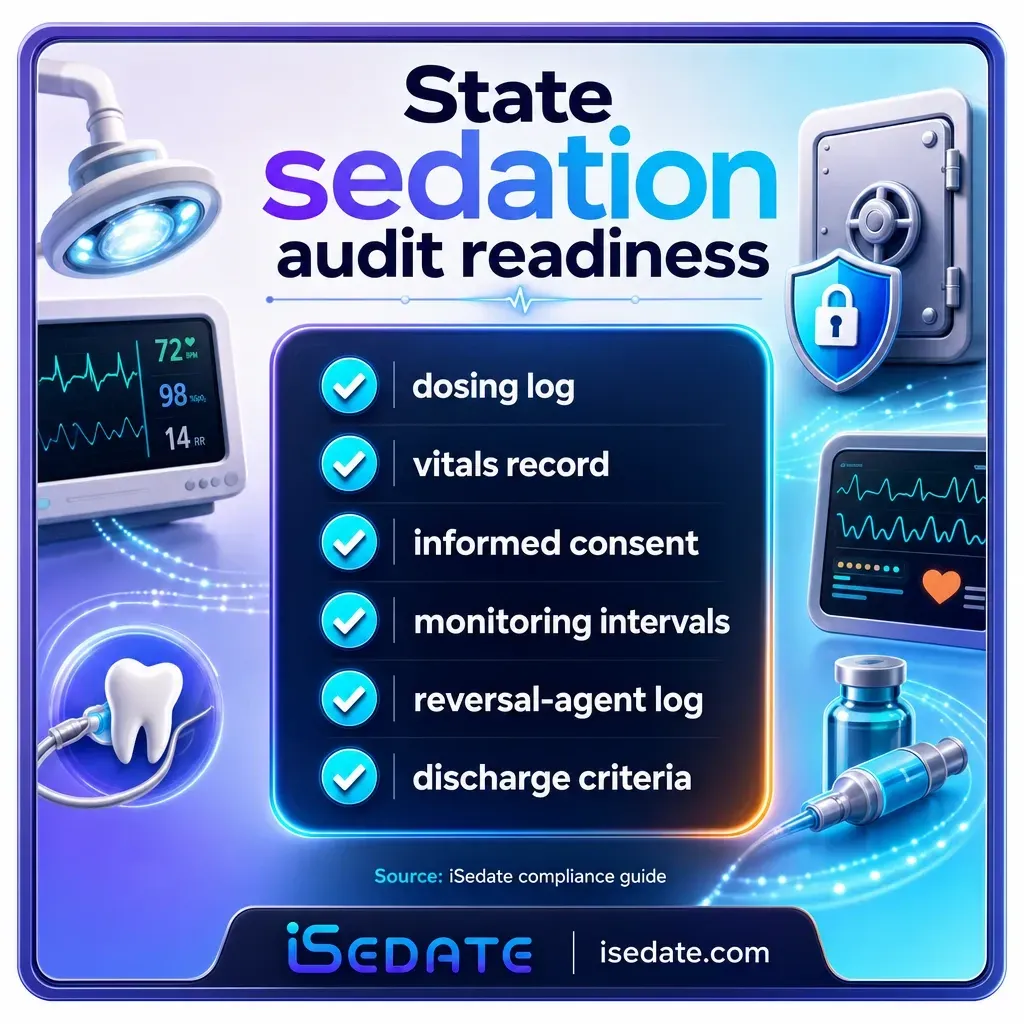
If you administer moderate sedation in Florida, the rule is specific about what has to be written down: a sedation record that logs vital signs at least every five minutes, every drug with its route, dose, time, and sequence, the procedure start and finish times, the discharge status, and the staff in the room. That standard lives in Fla. Admin. Code R. 64B5-14.009, it is enforced by the Florida Board of Dentistry under the Department of Health, and it is the first document an inspector or disciplinary review examines. Florida also goes further than many states: during moderate (conscious) sedation it requires continuous EKG, pulse oximetry, and capnography, not just the pulse oximeter. This guide breaks down what Florida requires you to monitor and record, what a compliant sedation record actually looks like, where dentists most often fall short, and how to make the record audit-ready.
Recent Updates
Last UpdatedNovember 16, 2026
- Rewritten against Florida's current anesthesia rules, which were amended effective August 19, 2026 (Chapter 64B5-14).
- Added the EKG requirement now named in the continuous-monitoring standard, Rule 64B5-14.009(8) (EKG, pulse oximetry, and capnograph together).
- Added a sample sedation-record cadence, the oral-versus-IV charting difference, and the four-year record-retention rule (64B5-17.002).
- Replaced third-party legal aggregators with the official Florida Administrative Code (flrules.org) and Florida Board of Dentistry sources.
- The core rule: Florida moderate (conscious) sedation requires a sedation record under Rule 64B5-14.009(7), with vital signs documented at a minimum of every 5-minute intervals.
- Florida is stricter on monitoring: moderate sedation must be continuously monitored by EKG, pulse oximetry, and capnography under Rule 64B5-14.009(8), where many states require capnography only for deep sedation.
- Who enforces it: the Florida Board of Dentistry under the Florida Department of Health, through a dental anesthesia inspection program with initial and routine inspections (Rule 64B5-14.007).
- The record must capture every drug and dose with route, time, and sequence, the procedure start and finish times, any complications, the discharge status and who the patient was released to, and the names of participating personnel.
- Retention and reporting: keep the record at least four years (Rule 64B5-17.002), report adverse occurrences under Rule 64B5-14.006, and expect incomplete records to be where sedation permits are challenged.

What This Guide Covers
- Who regulates sedation in Florida
- Florida's sedation permit structure
- What you must monitor
- What you must record: the compliance core
- What a compliant sedation record looks like
- How long you must keep the record
- How Florida audits records (and how dentists get burned)
- Why a thin record is expensive
- The easy button: an audit-ready record
- Related guides and neighboring states
- Frequently asked questions
- Sources and citations
Who regulates sedation in Florida
Sedation and anesthesia in a Florida dental office are regulated by the Florida Board of Dentistry, which operates under the Florida Department of Health. The board issues anesthesia permits, runs the inspection program, and takes disciplinary action. The rules are not scattered across general dental law. They sit in one place: Florida Administrative Code Chapter 64B5-14, "Anesthesia", and the moderate-sedation recordkeeping standard is Rule 64B5-14.009.
That matters for compliance because your recordkeeping obligation is a named administrative rule with an exact citation, not a vague standard of care. When an inspector asks whether your sedation record meets the requirement, the answer is measured against the specific subsections of Rule 64B5-14.009 below. One point worth being precise about: the chapter was substantially amended effective August 19, 2026, so the version your record is now measured against is the current rule, not the 2020 text many older checklists still reference.
Where the ADA Fits, and Where It Doesn't
The American Dental Association publishes national sedation guidelines that most boards lean on, and Florida's rules track them closely. But those guidelines are a professional standard, not federal law. The ADA is a private association, not a federal agency, so it does not override or replace Florida's rule. In Florida, the law is Chapter 64B5-14 and the body that enforces it is the Florida Board of Dentistry. The genuine federal layers that sit alongside the state rule are different animals: the DEA governs controlled-substance logs, and HIPAA governs how the record is stored and shared.
Source: Fla. Admin. Code R. 64B5-14.009 | Florida Board of Dentistry, moderate sedation permit
Florida's sedation permit structure
Florida does not number its sedation permits by level the way some states do. It names them by the type of sedation administered, and the monitoring and recordkeeping obligations escalate with the depth of sedation. Knowing which permit applies tells you which rule governs your record.
| Florida category | What it covers | Governing rule |
|---|---|---|
| Nitrous oxide inhalation | Nitrous oxide and oxygen; no separate anesthesia permit required | Rule 64B5-14.003 |
| Minimal sedation | Minimal sedation (anxiolysis); no permit, dosage limits apply | Rule 64B5-14.001 |
| Moderate Sedation Permit | Moderate (conscious) sedation, oral or IV | Rule 64B5-14.009 |
| Pediatric Moderate Sedation Permit | Moderate sedation of pediatric patients, with its own record and monitoring rules | Rule 64B5-14.010 |
| General Anesthesia / Deep Sedation Permit | Deep sedation or general anesthesia (the top tier) | Rule 64B5-14.008 |
Nitrous oxide and minimal sedation do not require a dedicated anesthesia permit, though minimal sedation is bound by dosage limits. The Moderate Sedation Permit is the workhorse for dentists who provide genuine conscious sedation, and it is the level whose record requirements Rule 64B5-14.009 spells out most explicitly, so it is the focus of this guide. Pediatric moderate sedation sits under its own rule, Rule 64B5-14.010, with its own monitoring and record rules, and deep sedation and general anesthesia sit under Rule 64B5-14.008. If you are working out which permit to apply for or how to upgrade, that is a separate process, covered in our guide to Florida sedation dentistry licensing and permit requirements.
State Law
Source: Rule 64B5-14.009 (Moderate Sedation) | Rule 64B5-14.008 (General Anesthesia / Deep Sedation)
What you must monitor
In Florida, what you are required to monitor is what you are required to write down. For moderate sedation, Rule 64B5-14.009 defines the physiological parameters, and the recordkeeping subsection requires them to be documented. Three monitoring requirements set Florida apart from the more common standard.
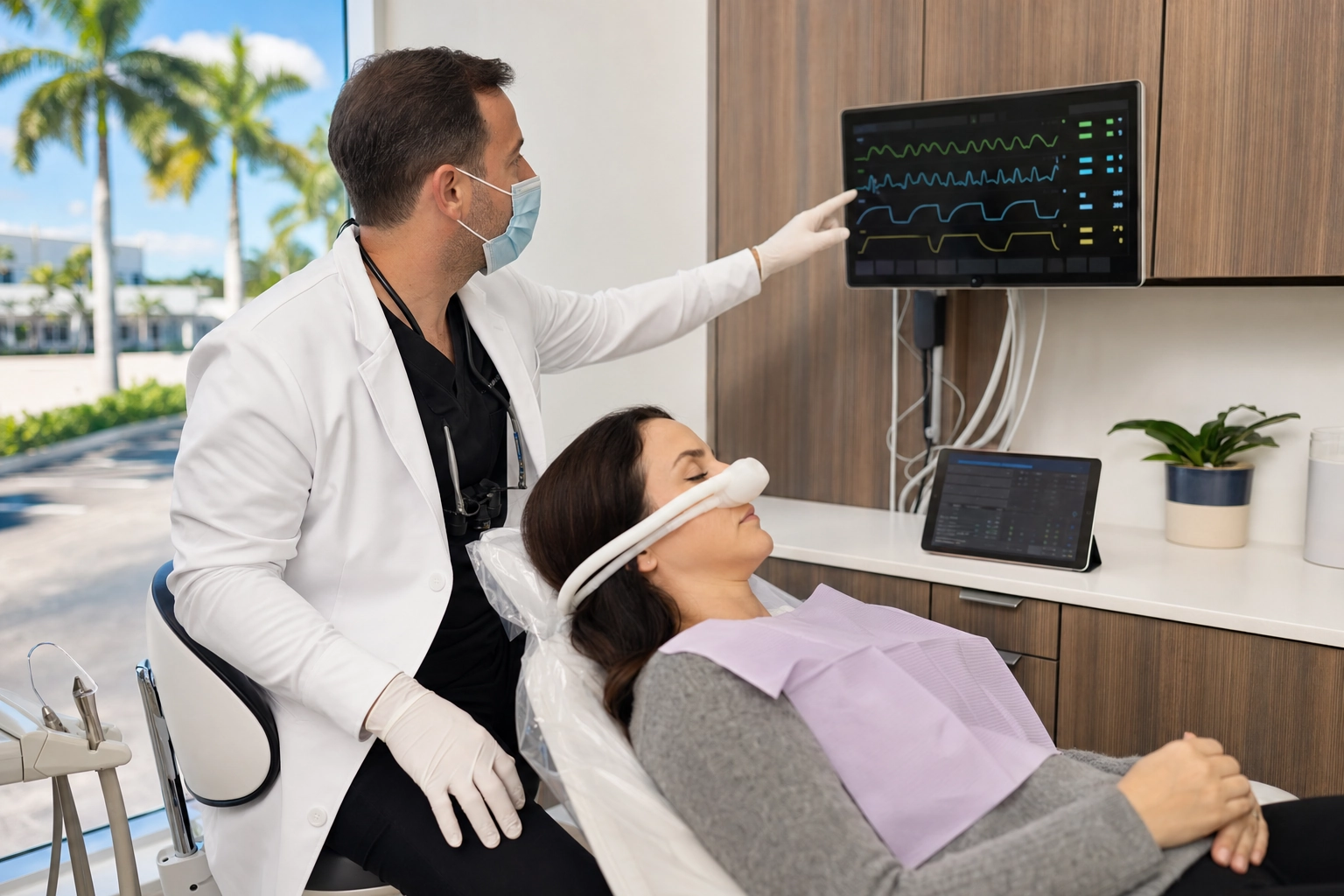
- Continuous EKG, pulse oximetry, and capnography. Under Rule 64B5-14.009(8), a patient administered a drug for moderate sedation must be continuously monitored intraoperatively by electrocardiograph (EKG), pulse oximetry, and capnograph. A precordial or pretracheal stethoscope must also be available to monitor heart rate and ventilation.
- Pulse oximetry on every case. Under Rule 64B5-14.009(3)(d), a pulse oximeter providing continuous monitoring of pulse and oxygen saturation shall be used during each procedure, and the capnograph is listed as standard operatory equipment.
- Baseline and ongoing vital signs. Under Rule 64B5-14.009(7)(c), baseline vital signs including blood pressure and pulse must be recorded, and under Rule 64B5-14.009(7)(d)1 the vital signs must be continuously monitored and recorded through the procedure.
The capnography requirement is the headline. In many states, capnography (end-tidal carbon dioxide monitoring) becomes mandatory only at the deep-sedation or general-anesthesia level. Florida requires it at the moderate level, and the current rule names EKG alongside it. If your operatory is set up to monitor a pulse oximeter alone during conscious sedation, your equipment does not meet the Florida standard. Pediatric moderate sedation under Rule 64B5-14.010 carries the same continuous pulse oximetry and capnograph expectation.
State Law
Myth, Busted
Myth: Capnography is only for IV or deep cases, so moderate sedation is fine with a pulse ox.
Fact: Not in Florida. Rule 64B5-14.009(8) requires continuous capnography (plus EKG) for moderate sedation regardless of route.
The depth of sedation, not the drug or the delivery method, drives the requirement, and a patient can reach a deeper plane than intended. The capnograph is what catches a ventilation problem before the pulse oximeter does.
Source: Rule 64B5-14.009(8), (3)(d), (7)(c)
What you must record: the compliance core
This is the section an inspector reads first. For moderate sedation, Rule 64B5-14.009(7) spells out exactly what the record must contain. It has three parts worth knowing by heart.
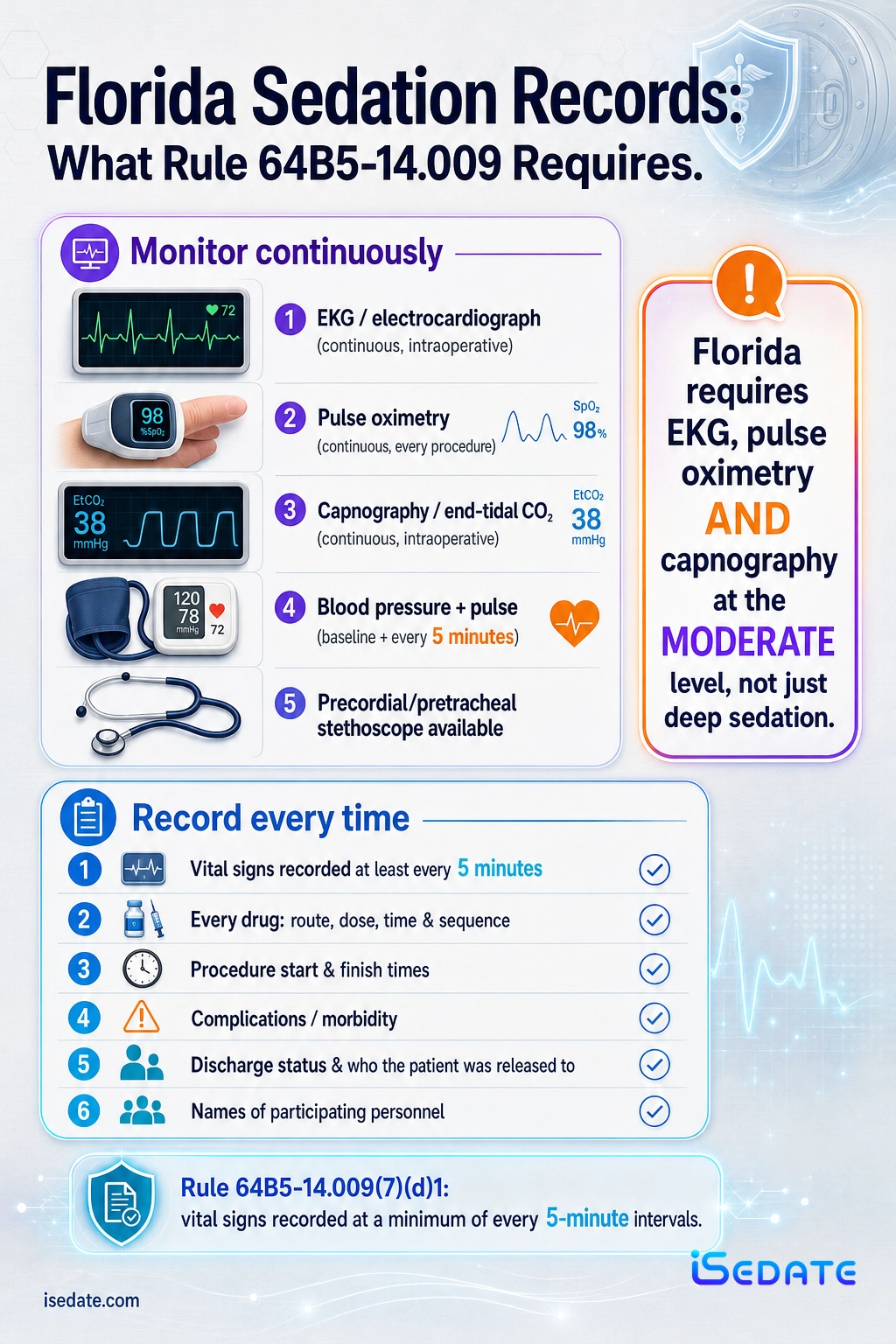
1. A sedation record with vitals every 5 minutes
Under Rule 64B5-14.009(7)(d)1, vital signs must be continuously monitored and recorded at a minimum of every 5-minute intervals during the procedure. This is the interval that catches practices out, and Florida's five-minute standard is tighter than the ten-minute interval allowed in many other states. Monitoring continuously but only writing a reading at the start and end of the case does not satisfy the rule. The documentation itself has to land on the page at least every five minutes.
State Law
2. The drug log and procedure times
Under Rule 64B5-14.009(7)(d)2, the record must list the drugs administered during the procedure, including the route of administration, dosage, and the time and sequence of each dose. A note that a patient "tolerated sedation well" is not this record. A timeline of drugs, doses, routes, times, and sequence is. Rule 64B5-14.009(7)(d)3 then requires the procedure duration, including the start and finish times. Those timestamps are the backbone an inspector uses to confirm the five-minute intervals were actually held.
3. History, complications, discharge, and personnel
The record wraps around the whole visit. Under Rule 64B5-14.009(7)(a), the patient's current written medical history, including known allergies and previous surgery, must be in the record, and under Rule 64B5-14.009(7)(b) a physical examination with airway evaluation and risk assessment (the rule names examples such as Mallampati classification, body mass index, and ASA classification). Under Rule 64B5-14.009(7)(d)4, any complications or morbidity must be documented, with adverse occurrences reported under Rule 64B5-14.006. Under Rule 64B5-14.009(7)(d)5, the record must document the patient's status at discharge and the person to whom the patient was discharged, and under Rule 64B5-14.009(7)(d)6 it must name the participating personnel.
State Law
Source: Rule 64B5-14.009(7) | Rule 64B5-14.006
See how a time-stamped anesthesia record is built automaticallyWhat a compliant sedation record looks like
Knowing the rule is one thing. Seeing what satisfies it is another. The elements of Rule 64B5-14.009(7) come together as a time-ordered record: a baseline before the first drug, a vitals reading at least every five minutes, each drug stamped as it is given, and a clean close-out at discharge. The sample below is an illustrative cadence, not fixed values. Your readings are your readings, but the shape and spacing are what an inspector checks.
| Clock | What lands on the record | Rule tie |
|---|---|---|
| T-0 (pre-op) | Medical history and allergies confirmed; airway and risk assessment (Mallampati, BMI, ASA); baseline BP, pulse, SpO2 | (7)(a), (7)(b), (7)(c) |
| Start time logged | Procedure start time; monitors on: EKG, pulse oximetry, capnography running | (7)(d)3, (8) |
| First dose | Drug, route, dose, and exact time of administration | (7)(d)2 |
| Every 5 min | BP, pulse, SpO2, end-tidal CO2 recorded on the clock, each interval, with no gaps | (7)(d)1 |
| Any added dose | Each incremental dose stamped with its own time and sequence number | (7)(d)2 |
| Finish time logged | Procedure finish time; any complication or morbidity noted | (7)(d)3, (7)(d)4 |
| Discharge | Discharge status, and the named person the patient was released to; participating personnel listed | (7)(d)5, (7)(d)6 |
Oral versus IV: the drug log is where they differ
The monitoring and vitals requirements are the same whether you reach moderate sedation by mouth or by vein, because Florida attaches them to the depth of sedation, not the route. The practical difference is the drug log. Oral conscious sedation often means a defined regimen, so the log may carry a small number of timed entries. IV sedation is titrated, so the record should show each incremental dose with its own time and sequence, exactly as Rule 64B5-14.009(7)(d)2 reads. The failure mode is the same in both: doses given in the moment and reconstructed from memory afterward, which is precisely what a time-stamped record is meant to prevent.
Source: Rule 64B5-14.009(7), (8)
How long you must keep the record
Charting the visit correctly is only half of it. The record then has to survive. The sedation record is part of the patient's written dental record, and under Rule 64B5-17.002 a Florida dentist must keep that record for at least four years from the date the patient was last examined or treated. The Board of Dentistry's own guidance states the same four-year floor and notes that malpractice exposure and HIPAA obligations can make a longer retention period the safer choice.
State Law
Four years is a floor, not a ceiling. A sedation case that later becomes a claim can surface well after the retention window, which is one reason a durable, time-stamped electronic record beats a paper chart filed in a box: it is still legible, still complete, and still exportable years later.
Source: Rule 64B5-17.002 (Written Dental Records; Minimum Content; Retention)

How Florida audits records (and how dentists get burned)
Holding a Florida anesthesia permit comes with a standing exposure to inspection. Under Rule 64B5-14.007, the Department of Health appoints consultants to inspect facilities, requires a passing initial inspection before a permit is issued, and subjects every moderate, pediatric, and general-anesthesia permit holder to announced or unannounced routine inspection. The published Department of Health inspection forms are specific. A moderate-sedation inspection asks, in plain terms, whether the records reflect that the patient was monitored adequately. That is not a question about whether the sedation went well. It is a question about whether the paper proves it.
Here is where dentists get burned. It is rarely the clinical care that fails an inspection. It is the record: a five-minute interval that stretched to eight, a capnography reading that was watched but never charted, a drug given in the moment and logged later from memory, a discharge that was never documented, the person the patient left with never named. The care can be flawless and the record can still fail.
An inspector does not grade your sedation on how the patient did. They grade it on whether the contemporaneous record proves what you did and when. If the vital-sign log has gaps, the default assumption is that the monitoring had gaps too. Hold the five-minute interval, chart the capnography and EKG alongside the pulse oximetry, and document start and finish times for every drug and every phase of the case.
Source: Rule 64B5-14.007 (Inspection of Facilities) | Florida DOH inspection forms
Why a thin record is expensive
Chapter 64B5-14 is backed by enforcement. Adverse-occurrence reporting is mandatory: complications and morbidity connected to sedation trigger reporting obligations under Rule 64B5-14.006, and the Board of Dentistry and Department of Health can take disciplinary action for rule violations, including recordkeeping violations. Incomplete sedation records are not a filing technicality. They are the evidence a board weighs when deciding whether the standard of care was met, and the same gaps that fail an inspection are the gaps a plaintiff's attorney looks for in a malpractice claim.
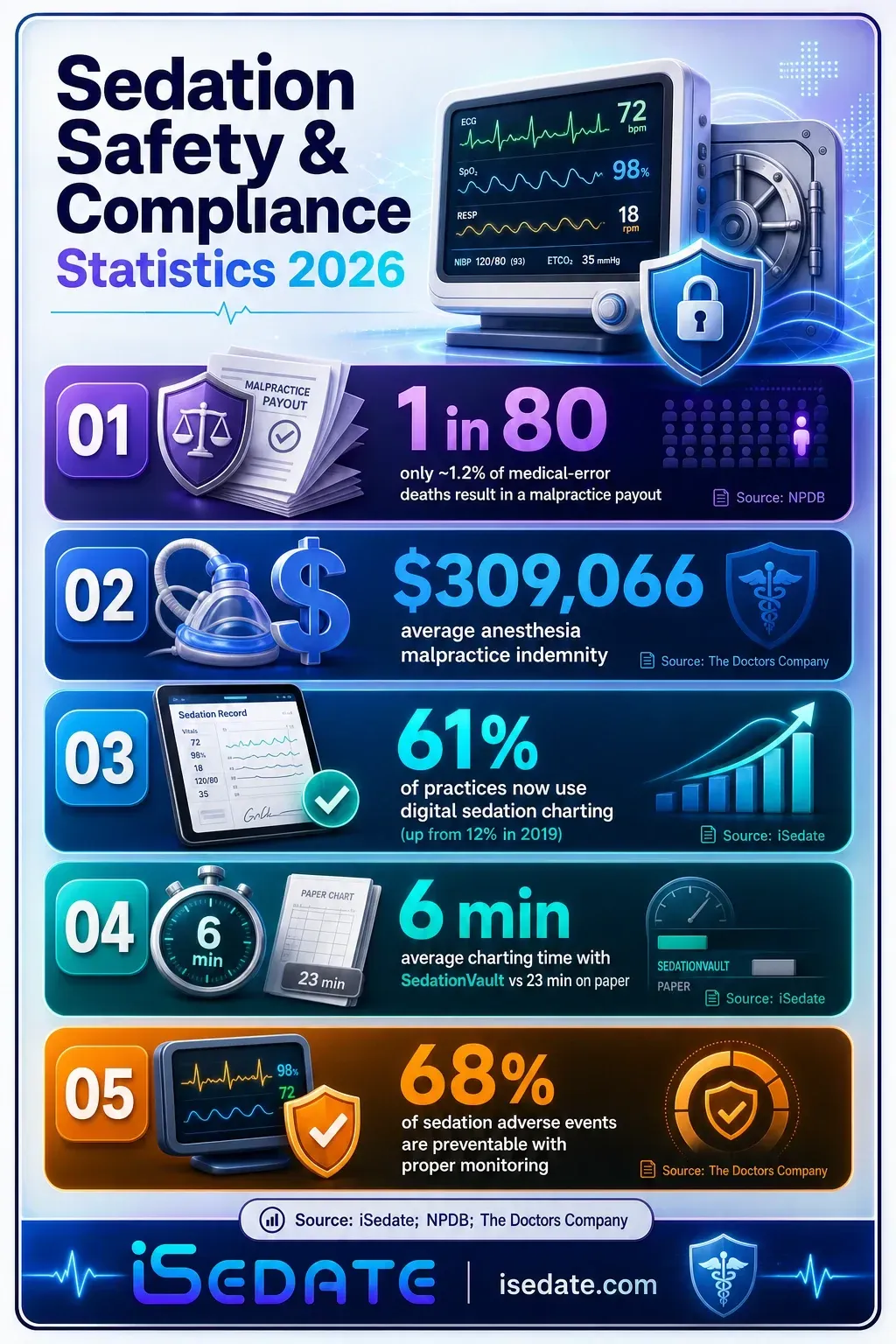
The data behind that exposure is worth reading in full. Our research roundups cover how sedation charting affects malpractice case outcomes, the data on vital-signs monitoring and sedation safety, and documentation-error rates and chart defensibility. The through-line in all three is the same: in both a board review and a lawsuit, the contemporaneous sedation record is the first thing requested and the hardest thing to reconstruct after the fact.
The exact disciplinary schedule, the specific penalty amounts, and the current inspection cadence for permit holders are administered by the Board of Dentistry and can change, so confirm current details directly with the Florida Board of Dentistry rather than relying on a figure that may be out of date. What does not change is the exposure created by a thin record.
Source: Fla. Admin. Code Chapter 64B5-14 | Rule 64B5-14.006
The easy button: an audit-ready record
The gap between knowing the rule and passing an inspection is almost always the same thing: a five-minute interval log kept by hand during a live sedation case, now with EKG and capnography readings to chart alongside the pulse oximetry. When a team is managing an airway and an anxious patient, a vitals reading written every five minutes on paper is exactly where the record develops holes: a skipped interval here, a missing time stamp there, a drug given in the moment and logged later from memory.
That is the problem SedationVault by iSedate was built to remove. It connects to the vitals monitor already in your operatory and captures EKG, pulse oximetry, capnography, pulse, and blood pressure live, on the clock, alongside the drug log, so the sedation record writes itself as the conscious sedation case runs rather than being reconstructed afterward. When a Florida inspector asks for the chart, it exports as a one-click, audit-ready sedation visit report that already carries the five-minute intervals, the dosages with route and sequence, the start and finish times, the discharge status, and the personnel the rule asks for. The point is not fancier charting. It is turning the exact items Rule 64B5-14.009(7) requires into something the software guarantees are present and time-stamped, which is also what dental sedation compliance turns on.
Book a demo and see your Florida sedation record build itselfRelated guides and neighboring states
This page is the documentation half of Florida sedation compliance; the permit side is covered in the companion licensing guide linked earlier. Licensed in a neighboring state, or practicing across state lines? See our charting and reporting guides for Alabama sedation vitals, charting and reporting requirements and Georgia sedation vitals, charting and reporting requirements, or start from the full Dental Sedation Vitals, Charting & Reporting Requirements by State hub.
Frequently asked questions
Does Florida require a written sedation record?
How often must vitals be recorded during sedation in Florida?
Does Florida require capnography for moderate sedation?
How long must Florida dentists keep sedation records?
What is the difference between charting oral and IV sedation in Florida?
Who audits sedation records in Florida?
Does Florida require a discharge note after sedation?
Sources and citations
Our Sources and Fact-Checking
This guide cites Florida's primary regulatory sources. Rule text is drawn from the official Florida Administrative Code as published by the Florida Department of State at flrules.org, verified against the current versions amended effective August 19, 2026. The regulator is the Florida Board of Dentistry under the Florida Department of Health, and the inspection guidance is from the Department of Health MQA inspection program. Where a detail (such as the current penalty schedule, inspection cadence, board phone number, or application fees) is administered by the board and subject to change, confirm it directly with the Florida Board of Dentistry before relying on it. This article is general information, not legal advice.
- Fla. Admin. Code Chapter 64B5-14: Anesthesia (official index)
- Rule 64B5-14.009: Moderate Sedation Requirements (monitoring and recordkeeping)
- Rule 64B5-14.008: General Anesthesia / Deep Sedation Requirements
- Rule 64B5-14.010: Pediatric Moderate Sedation Requirements
- Rule 64B5-14.007: Inspection of Facilities and Demonstration of Sedation Technique
- Rule 64B5-14.006: Reporting Adverse Occurrences
- Rule 64B5-17.002: Written Dental Records; Minimum Content; Retention
- Florida Board of Dentistry: Sedation Permit for Moderate Sedation
- Florida Department of Health: MQA inspection forms