







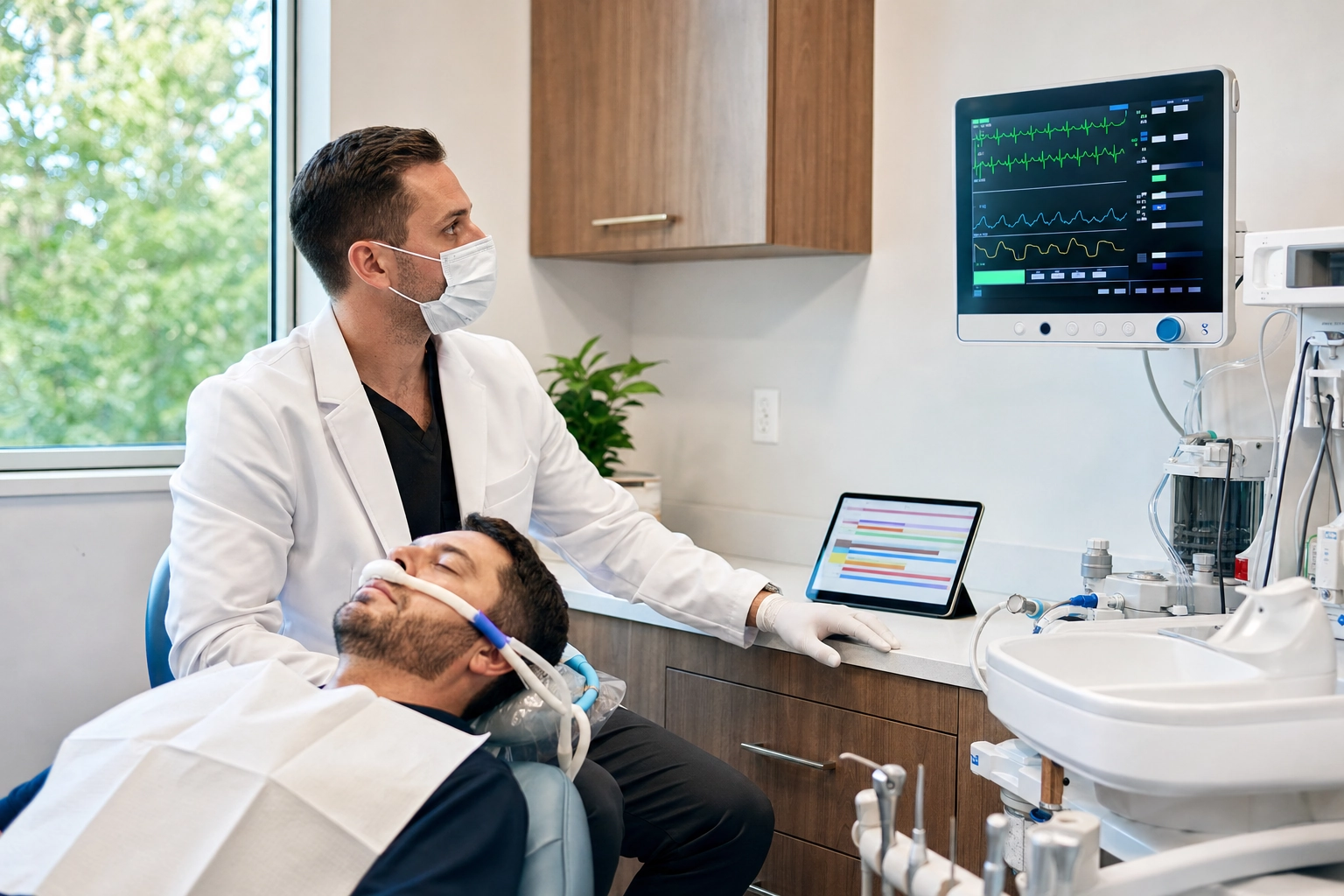
Georgia Sedation Vitals Monitoring, Charting & Reporting Requirements
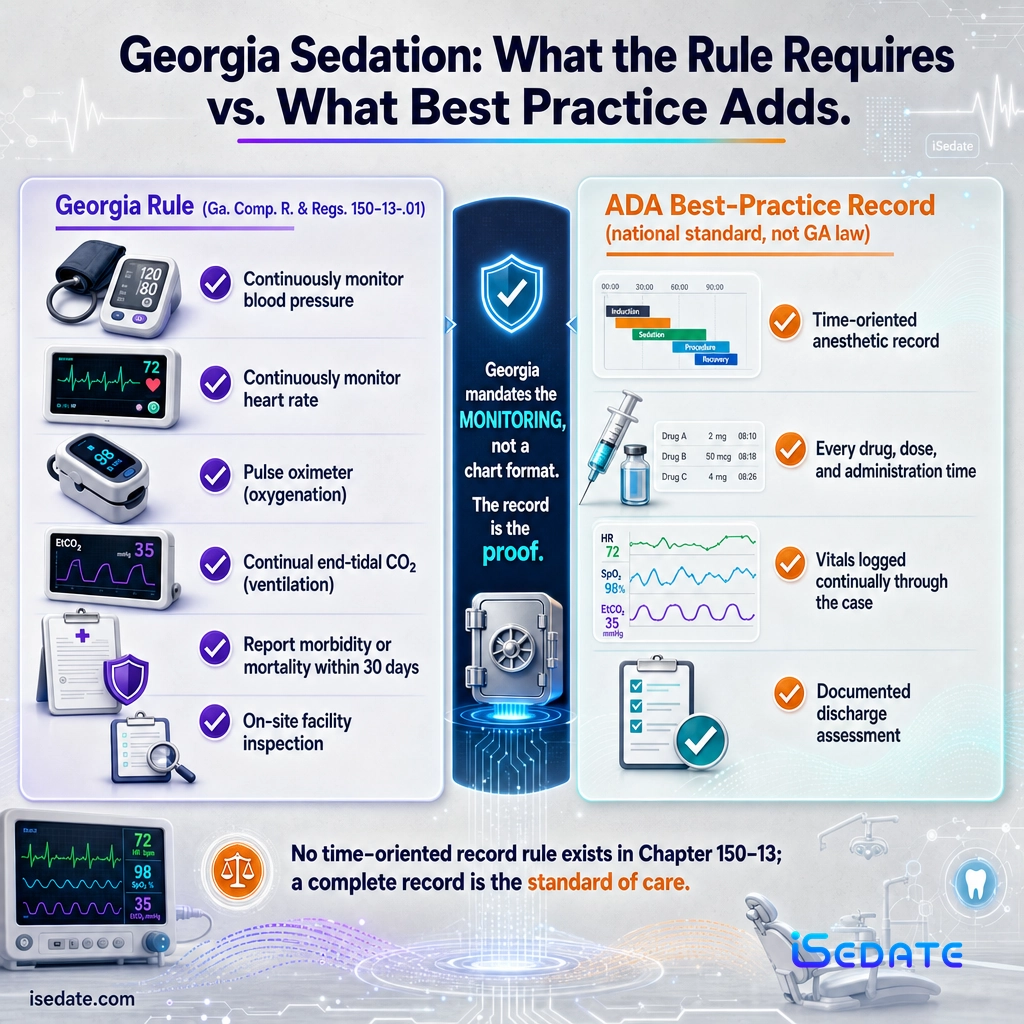
If you provide conscious sedation in a Georgia dental office, the honest starting point is this: Georgia's sedation rules are built around what you must monitor and what you must report, not a line-by-line charting statute. Ga. Comp. R. & Regs. Chapter 150-13, administered by the Georgia Board of Dentistry, requires equipment that continuously monitors blood pressure and heart rate, a pulse oximeter, continual end-tidal CO2, and a report to the Board within 30 days if a sedation case goes wrong. No Georgia rule spells out a time-oriented drug-and-vitals log the way some states do, which makes the record you keep a standard-of-care decision rather than a box to check, and raises the stakes rather than lowering them. This guide breaks down exactly what Georgia requires you to monitor and report, where the record duty actually comes from, what a compliant sedation chart looks like, and how to keep one that survives a board or malpractice review.
Recent Updates
Last UpdatedNovember 16, 2026
- Reviewed the full text of Georgia Chapter 150-13 (150-13-.01, -.02, -.03) against the current Board rules for accuracy.
- Replaced aggregator citations with Georgia's own official administrative code and the Georgia Board of Dentistry's own pages.
- Added a sample intra-op charting cadence and oral-versus-IV documentation guidance, so the guide shows what a compliant record looks like, not just that one is required.
- Added sourced data on what a monitoring or charting gap costs in a sedation malpractice claim.
- The core rule: Georgia's sedation chapter (Ga. Comp. R. & Regs. §150-13-.01(6)) mandates monitoring equipment and parameters, equipment to continuously monitor blood pressure and heart rate, a pulse oximeter, and continual end-tidal CO2, not a prescribed written record format.
- The honest gap: Chapter 150-13 contains no explicit time-oriented anesthetic-record subsection. The record duty traces to the monitoring mandate plus the ADA national standard, so a complete chart is a standard-of-care call, not a statutory checkbox.
- The hard reporting rule: any sedation-related morbidity, mortality, or injury requiring hospitalization must be reported to the Georgia Board of Dentistry within 30 days (§150-13-.01(15)(a)).
- Who enforces it: the Georgia Board of Dentistry, through Chapter 150-13 under the authority of O.C.G.A. §43-11, including on-site facility inspections.
- Best practice fills the gap: the ADA guidelines call for a time-oriented record of every drug, dose, time, and vital sign, which is what a reviewer or a plaintiff's attorney will expect even though Georgia's rule does not itemize it.

What This Guide Covers
- Who regulates sedation in Georgia
- The Georgia sedation permit levels
- What you must monitor during sedation
- What your sedation record must contain
- What compliant documentation looks like (oral vs IV)
- The 30-day report and facility inspections
- Why a thin record costs you
- Penalties and enforcement
- The easy button: an audit-ready record
- Frequently asked questions
- Related guides and neighboring states
- Sources and citations
Who regulates sedation in Georgia
Sedation and anesthesia in a Georgia dental office are regulated by the Georgia Board of Dentistry, the state agency that issues sedation permits, inspects facilities, and takes disciplinary action. The governing rules sit in one place: Ga. Comp. R. & Regs. Chapter 150-13, Sedation Permits, enacted under the authority of the Georgia Dental Practice Act (O.C.G.A. §43-11).
That matters for compliance because your obligations are measured against a named administrative rule, not a vague standard. When a reviewer asks whether your sedation practice meets the requirement, the answer is measured against the specific subsections of Chapter 150-13 below. It is also worth being precise about the ADA here: the American Dental Association publishes national sedation guidelines that most boards lean on, and Georgia's rule itself points to the AAP and AAPD pediatric sedation guidelines for monitoring young patients. But those guidelines are a private professional standard, not federal law, and the ADA is not a government agency. In Georgia, the law is Chapter 150-13, the body that enforces it is the Georgia Board of Dentistry, and the federal layers that sit on top are separate (the DEA for controlled-drug logs, HIPAA for records privacy, and accreditation bodies where they apply).
Source: Ga. Comp. R. & Regs. Chapter 150-13 | Georgia Board of Dentistry, Applications and Forms
The Georgia sedation permit levels
Georgia names its permits by the depth and route of sedation, and the requirements escalate as you move up. Knowing which permit you hold tells you which monitoring rules apply. These are the levels as Chapter 150-13 defines them:
| Georgia level | What it covers | Citation |
|---|---|---|
| Minimal sedation (anxiolysis) | Light anxiety control; no permit required | §150-13-.01(1) |
| Nitrous oxide / oxygen | Inhaled nitrous oxide; no permit required | Ch. 150-13 |
| Moderate Enteral Conscious Sedation Permit | Moderate conscious sedation by the enteral (oral) route | §150-13-.01(4) |
| Moderate Parenteral Conscious Sedation Permit | Moderate conscious sedation including IV and parenteral (also enteral, inhalation) | §150-13-.01(5) |
| Deep Sedation / General Anesthesia | Deep sedation or general anesthesia (the top tier) | r. 150-13-.02 |
Minimal sedation and nitrous oxide require no permit in Georgia. The two conscious-sedation permits are where most sedation dentists operate: a Moderate Enteral Conscious Sedation Permit for oral sedation, and a Moderate Parenteral Conscious Sedation Permit, which covers IV and parenteral routes (and, once you hold it, enteral and inhalation as well). Deep sedation and general anesthesia sit under a separate rule, 150-13-.02, carried most often by dental anesthesiologists and oral and maxillofacial surgeons. This guide focuses on the moderate conscious-sedation standard in 150-13-.01, because that is the level most sedation dentists are permitted for. If you are working out which permit to apply for or how to upgrade, that belongs in a separate process, covered in our guide to Georgia sedation licensing and permit requirements.
Source: Ga. Comp. R. & Regs. r. 150-13-.01 | r. 150-13-.02 (Deep Sedation / General Anesthesia)
What you must monitor during sedation
This is the heart of Georgia's sedation rule. For conscious (moderate) sedation, §150-13-.01(6) frames the requirement as a facility-and-equipment mandate: the office must be equipped to watch specific physiological parameters throughout the case. The permit holder's facility must have:
- Circulation: equipment to continuously monitor blood pressure and heart rate.
- Oxygenation: a pulse oximeter to measure oxygen saturation.
- Ventilation: continual monitoring of end-tidal CO2 (expired carbon dioxide), unless invalidated by the nature of the patient, procedure, or equipment.
- Emergency readiness: positive-pressure oxygen ventilation, suction, a defibrillator (AED or manual), and ACLS or PALS emergency drugs on hand, with at least two BLS-certified support personnel present during any conscious sedation procedure.
Georgia is specific about what "continual" means. The rule defines it as repeated regularly and frequently in steady rapid succession, which sets the pace for end-tidal CO2 monitoring. Blood pressure and heart rate carry the stronger word, continuously. For pediatric minimal sedation, the rule points directly to the AAP and AAPD "Guidelines for Monitoring and Management of Pediatric Patients During and After Sedation" (§150-13-.01(1)(b)), so young patients get a nationally recognized monitoring standard baked into Georgia law.
Myth, Busted
Myth: Georgia has no charting rule, so my record does not really matter.
Fact: Chapter 150-13 does require you to monitor blood pressure, heart rate, oxygenation, and ventilation throughout the case, and a parameter you are required to monitor is a parameter a reviewer expects to see documented. See Ga. Comp. R. & Regs. r. 150-13-.01(6).
The absence of a prescribed format is not permission to keep a thin record. It shifts the burden onto you to prove, through your chart, that the monitoring the rule requires actually happened.
Source: Ga. Comp. R. & Regs. §150-13-.01(6)
What your sedation record must contain
Here is where honesty matters. Georgia's sedation chapter does not contain a subsection that enumerates a written, time-oriented anesthetic record of drugs, doses, times, and vital-sign readings. The full text of Chapter 150-13, including 150-13-.02 for deep sedation and general anesthesia, mandates monitoring equipment without separately requiring that the readings be written into a formal chart. So the right way to state the record duty in Georgia is in three layers.
1. The documentation Georgia does name
The chapter's explicit documentation requirements are credential- and incident-focused, not a patient vitals log. Georgia requires you to document successful completion of advanced cardiac life support (150-13-.02(2)(c)), to provide the Board documentation of training on the drugs you use (150-13-.01(11)), to certify continuing education at renewal (150-13-.01(8)(a)), and, critically, to submit a complete report of any sedation-related morbidity or mortality within 30 days (150-13-.01(15)(a)). None of these is a routine chart entry, which is exactly why the next two layers matter.
2. The record implied by the monitoring mandate
Because §150-13-.01(6) requires you to continuously monitor blood pressure and heart rate, to use a pulse oximeter, and to continually monitor end-tidal CO2, the practical way to prove you did so is to record those parameters as the case runs. The monitoring mandate is the de facto basis of Georgia's sedation record: if the rule requires the monitoring, your chart is the evidence it occurred. A note that a patient "tolerated sedation well" does not demonstrate continuous monitoring. A timeline of readings does.
3. The ADA standard that fills the gap
The national reference is explicit where Georgia's rule is silent. The ADA Guidelines for the Use of Sedation and General Anesthesia by Dentists, updated by the ADA House of Delegates in October 2025, call for a time-oriented anesthetic record for moderate sedation, listing all drugs, doses, administration times, local anesthetics, and the monitored parameters, with pulse oximetry, heart rate, respiratory rate, blood pressure, and level of consciousness recorded continually. That is a professional standard rather than Georgia law, but it is the standard of care a board or a court will measure you against. In a state without a prescribed format, following the ADA record is the safest possible position.
Source: Ga. Comp. R. & Regs. r. 150-13-.01 | ADA Guidelines for the Use of Sedation and General Anesthesia by Dentists (adopted October 2025; a national professional standard, not Georgia law)
See how a time-oriented anesthesia record builds itselfWhat compliant documentation looks like (oral vs IV)
Because Georgia leaves the format open, the useful question is not "what is the minimum," it is "what does a chart that proves the required monitoring actually look like." Here is a concrete model that satisfies the ADA time-oriented standard and demonstrates everything §150-13-.01(6) asks you to monitor.
A Compliant Conscious Sedation Record, Point by Point
- Pre-sedation: baseline blood pressure, heart rate, oxygen saturation, and end-tidal CO2; ASA physical status; airway (Mallampati) assessment; confirmed NPO status; weight-based dosing calculation; a signed informed-consent form specific to sedation.
- Drugs and doses: every agent, the dose, the route, and the exact time given, including local anesthetics and any reversal agent (flumazenil or naloxone) if used.
- Intra-operative vitals: blood pressure, heart rate, oxygen saturation, and end-tidal CO2 recorded at regular, time-stamped intervals through the whole case, with the level of consciousness noted alongside.
- Supplemental oxygen: flow rate and delivery method, since supplemental oxygen can keep oxygen saturation looking normal while ventilation is failing, which is why the capnography trace matters.
- Recovery and discharge: return of vitals toward baseline, a documented discharge assessment against objective criteria, the responsible adult escorting the patient, and written post-op instructions given.
- Staff and equipment: the personnel present (including the two required BLS-certified support staff) and confirmation that emergency equipment and drugs were checked and available.
On cadence, Georgia does not set a number. The rule requires continuous blood pressure and heart rate monitoring and continual end-tidal CO2, and defines continual as "repeated regularly and frequently in steady rapid succession." The widely accepted standard of care under the ADA guidelines is a time-stamped entry at regular intervals, and many sedation providers chart vitals at least every five minutes during moderate sedation so the record visibly shows the monitoring happened. The interval is your judgment call; the time stamps are not optional if you want the chart to prove anything.
The oral versus IV difference lives in the drug record more than the monitoring. Enteral (oral) conscious sedation under the Moderate Enteral permit and parenteral (IV) sedation under the Moderate Parenteral permit carry the same §150-13-.01(6) monitoring duties, but IV sedation is titrated in real time, so the record has to capture each incremental dose and its time, plus the venous access. Because an IV agent reaches effect faster, the time-oriented log is where you demonstrate that titration was deliberate and monitored, not retrospective.
iSedate Insight
In a state that mandates the monitoring but not the chart format, the record you choose to keep becomes the standard you are judged against. There is no floor beneath you and no ceiling above you, which means the completeness of your chart is entirely your decision, and it is the one piece of evidence that exists after the appointment is over. Build the record you would want a reviewer to find.
Source: Ga. Comp. R. & Regs. §150-13-.01(6) | iSedate dental sedation compliance
The 30-day report and facility inspections
Two parts of Georgia's rule put your records directly in front of the Board.
First, the incident report. Under §150-13-.01(15)(a), you must submit a complete report to the Georgia Board of Dentistry of any sedation-related morbidity or mortality, or injury requiring hospitalization, no later than 30 days after the event. Disclosure limits apply under O.C.G.A. §43-11-47(h)(2). When that report is filed, the quality of your contemporaneous sedation record is what the Board reviews to understand what happened. A thin or reconstructed chart turns a reportable complication into a records problem on top of a clinical one.
Second, facility inspections. A sedation permit applicant's facility is subject to an on-site inspection under §150-13-.01(8); deep-sedation and general-anesthesia facilities carry their own inspection provisions under 150-13-.02(3) and (4); and a former permit holder may also be subject to an on-site inspection prior to renewal under 150-13-.03(1). Georgia also requires 30 days' advance written notice to the Board before relocating a facility or making a significant change (§150-13-.01(6)(b)). Any routine inspection cadence beyond these named provisions is administered by the Board and can change, so confirm the current schedule with the Georgia Board of Dentistry rather than assuming one.
Build the Record Before You Need It
A reviewer does not grade your sedation on how the patient felt afterward. They grade it on whether your contemporaneous record proves what you monitored and when. In a state without a prescribed chart format, a complete, time-stamped record is the only thing that demonstrates the monitoring Chapter 150-13 required of you. Keep a time-oriented record of every drug, dose, time, and vital sign, even though the rule does not itemize it.
Source: Ga. Comp. R. & Regs. §150-13-.01(8), (15) | r. 150-13-.03 (renewal and inspection)

Why a thin record costs you
Georgia's open format is not a license to document less. The reason is in the data on where sedation goes wrong, and on what a missing record does to a claim. The largest analysis of monitored-anesthesia-care liability, drawn from the ASA Closed Claims Project, found that respiratory depression after an absolute or relative overdose of sedative or opioid drugs was the single most common mechanism of injury, and that nearly half of those claims were judged preventable by better monitoring, such as capnography or pulse oximetry and improved vigilance.
That last finding is exactly why Georgia names end-tidal CO2. Capnography tracks ventilation, while a pulse oximeter tracks oxygenation, and hypoxia is a late sign, especially when supplemental oxygen keeps the saturation reading normal during hypoventilation. A meta-analysis of procedural-sedation studies found respiratory depression was roughly 18 times more likely to be detected when capnography was used than when it was not. The parameter Georgia tells you to monitor continually is the one that catches trouble earliest, and the chart is what shows you were watching it.
Put the two together and the lesson is plain: the events that generate the most severe sedation claims are largely monitoring events, and a contemporaneous record is both your clinical early-warning system and your legal defense. The same gaps that complicate a Board review are the gaps a plaintiff's attorney looks for in a malpractice claim. A chart that shows regular, time-stamped vitals, including the capnography trace, is the difference between demonstrating the standard of care and arguing about it after the fact.
Source: Bhananker et al., ASA Closed Claims analysis of monitored anesthesia care, Anesthesiology (2006) | Meta-analysis of respiratory-event detection during procedural sedation (2011)
See how a live sedation visit record captures every readingPenalties and enforcement
Chapter 150-13 is backed by enforcement. The Georgia Board of Dentistry can take disciplinary action for rule violations, a permit is administratively revoked for failure to renew under 150-13-.03, and the 30-day incident-reporting duty is mandatory. Incomplete sedation records are not a filing technicality. They are the evidence a board weighs when deciding whether the standard of care was met.
The exact disciplinary schedule, any routine office-inspection cadence beyond the provisions above, and the current permit fee schedule are administered by the Board and can change, so confirm current details directly with the Georgia Board of Dentistry's applications and forms page rather than relying on a figure that may be out of date. What does not change is the exposure created by a thin record: Georgia's rule, by not prescribing a format, puts the entire weight of proof on the chart you chose to keep.
Source: Ga. Comp. R. & Regs. Chapter 150-13 | r. 150-13-.03 (renewal and revocation)
The easy button: an audit-ready record
The gap between knowing Georgia's rule and surviving a review is almost always the same thing: a vitals log kept by hand during a live sedation case. When a team is managing an airway and an anxious patient, a reading written down by hand is exactly where the record develops holes, a missing time stamp here, a drug given in the moment and logged later from memory. In a state that mandates continuous monitoring but does not hand you a required chart, those holes are your liability to carry.
That is the problem SedationVault by iSedate was built to remove. It connects wirelessly to the vitals monitor already in your operatory and captures pulse oximetry, heart rate, respiratory rate, blood pressure, and end-tidal CO2 live, on the clock, alongside the drug log, so a time-oriented anesthetic record (the ADA standard Georgia's rule leaves to best practice) writes itself as the case runs rather than being reconstructed afterward. If a complication ever triggers the 30-day Board report, or a reviewer asks for the chart, it exports as a one-click, audit-ready sedation visit report that already carries the continuous vitals, the dosages, the staff present, and the discharge assessment. The point is not fancier charting. It is turning the monitoring Chapter 150-13 requires into a contemporaneous record you can prove.
Book a demo and watch your Georgia sedation record build itselfWant to see the numbers first? Review SedationVault pricing and bring your questions to the demo.
Frequently asked questions
Does Georgia require a written sedation record?
What vital signs must Georgia dentists monitor during conscious sedation?
Does Georgia require reporting a sedation complication?
How often should vitals be charted during sedation in Georgia?
What are the Georgia dental sedation permit levels?
Is the ADA time-oriented record required in Georgia?
Related guides and neighboring states
Sedation charting and reporting rules are set state by state, so the duties change the moment you cross a border. Licensed in a neighboring state, or practicing in more than one? See our vitals, charting, and reporting guides for each:
- Alabama sedation vitals monitoring, charting & reporting requirements
- Florida sedation vitals monitoring, charting & reporting requirements
- North Carolina sedation vitals monitoring, charting & reporting requirements
- South Carolina sedation vitals monitoring, charting & reporting requirements
- Tennessee sedation vitals monitoring, charting & reporting requirements
For the clinical "what and why" behind these rules across every state, start with our hub: Dental Sedation Vitals, Charting & Reporting Requirements by State.
Sources and citations
Our Sourcing and Fact-Checking Process
This guide cites Georgia's primary regulatory sources. Rule text is drawn from Ga. Comp. R. & Regs. Chapter 150-13 as published by the Georgia Secretary of State and administered by the Georgia Board of Dentistry; the regulator is the Georgia Board of Dentistry under O.C.G.A. §43-11; and the national documentation standard is the ADA Guidelines for the Use of Sedation and General Anesthesia by Dentists. The malpractice and monitoring figures come from the ASA Closed Claims analysis of monitored anesthesia care and a peer-reviewed meta-analysis of respiratory-event detection during procedural sedation. Georgia's sedation chapter mandates monitoring equipment and a 30-day incident report but does not prescribe a written time-oriented record, so that record is presented as the accepted standard of care, not as a Georgia statute. Where a detail (such as the current penalty schedule, inspection cadence, permit fees, the Board's phone number, or the exact 2026 amendment date) is administered by the Board and subject to change, confirm it directly with the Georgia Board of Dentistry before relying on it.
- Ga. Comp. R. & Regs. Chapter 150-13: Sedation Permits (Georgia Secretary of State)
- Ga. Comp. R. & Regs. r. 150-13-.01: Conscious Sedation Permits (monitoring and reporting)
- Ga. Comp. R. & Regs. r. 150-13-.02: Deep Sedation and General Anesthesia Permits
- Ga. Comp. R. & Regs. r. 150-13-.03: Renewal and Inspection
- Georgia Board of Dentistry: Applications and Forms (sedation permit applications)
- Bhananker SM, et al. Injury and liability associated with monitored anesthesia care: a closed claims analysis. Anesthesiology. 2006;104(2):228-234
- Meta-analysis of capnography for detecting respiratory events during procedural sedation (2011)
- ADA Guidelines for the Use of Sedation and General Anesthesia by Dentists (adopted by the ADA House of Delegates, October 2025), a national professional standard, not Georgia law
This content is for informational purposes only and does not constitute legal or compliance advice. Confirm current requirements with the Georgia Board of Dentistry and consult a qualified professional for guidance specific to your practice.















