





South Carolina Sedation Dentistry Licensing & Permit Requirements
In South Carolina, your dental license alone does not let you sedate a patient beyond minimal sedation. Any dentist who provides moderate conscious sedation, IV sedation, deep sedation, or general anesthesia must first hold the matching permit from the South Carolina Board of Dentistry, issued under the Dental Sedation Act in S.C. Code of Laws, Title 40, Chapter 15. Earning the permit means meeting training, life-support, and live-case requirements for your route and depth, paying a $200 application fee, and passing a facility inspection. Keeping it means your sedation records survive a board review. This guide walks both halves, start to finish.
Recent Updates
Last UpdatedNovember 16, 2026
- Replaced third-party legal aggregators with South Carolina's own statute and the Board of Dentistry's official application packets as the cited sources.
- Added the verified $200 permit application fee, the facility-inspection requirement, and the permit-display rule from the board's own forms.
- Confirmed every training-hour and live-case count against the board's current moderate and deep sedation application packets.
Key Takeaways
- South Carolina requires no permit for local anesthesia, nitrous oxide, or minimal sedation, and issues three permits above that under S.C. Code §40-15-400: Moderate Enteral, Moderate Parenteral, and Deep Sedation/General Anesthesia.
- Most general dentists work at the Moderate Enteral (oral conscious sedation) level. Oral surgeons and sedation-trained dentists add Moderate Parenteral (IV). Deep Sedation/GA is the top tier.
- The jump to IV is real: Moderate Enteral needs 24 didactic hours and 10 live cases per route. Moderate Parenteral needs 60 didactic hours and 20 live cases per route.
- Every applicant pays a $200 fee, holds current ACLS or PALS (taken within the last two years), and passes an on-site facility inspection before the permit is issued.
- For moderate or deeper sedation, S.C. Code §40-15-450(D) requires an itemized record and a time-oriented anesthesia record. Incomplete records are where permits get challenged.
What This Guide Covers
- Who issues sedation permits in South Carolina
- The South Carolina permit structure
- Training, ACLS/PALS, and live cases by tier
- What the permit costs and how to apply
- Facility inspection, display, and renewal
- Records your permit obligates you to keep
- Keeping the permit: audit-ready records
- Frequently asked questions
- Related guides and neighboring states
- Sources
Who issues sedation permits in South Carolina
Sedation dentistry in South Carolina is regulated by the South Carolina Board of Dentistry, which sits under the state Department of Labor, Licensing and Regulation (LLR). The board, not any national organization, decides who may sedate, registers sedation facilities, inspects them, runs record reviews, and takes disciplinary action. The rules live in S.C. Code of Laws, Title 40, Chapter 15, the Dental Sedation Act, and nearly every requirement below traces to a section of that chapter, beginning at §40-15-400. This state-level guide is one spoke of our national state-by-state sedation licensing and permit requirements hub.
Myth, Corrected
Myth: The ADA is a federal agency, and its sedation guidelines override South Carolina's rules.
Fact: The ADA and the AAPD are private professional associations, not government agencies. In South Carolina the Dental Sedation Act in Title 40, Chapter 15 is the law, and the Board of Dentistry is the body that licenses, inspects, and disciplines.
South Carolina adopts the ADA and AAPD sedation guidelines as a reference standard through Regulation 39-17, but that does not make them federal law. The genuine federal layers that sit on top of a sedation practice are the DEA (controlled-substance logs), HIPAA (record privacy), and, where applicable, CMS. Your permit, your facility registration, and any sanction all come from the state board.
To apply, you work through the board's own application process under §40-15-400, which calls for a written application and a $200 fee. Confirm the current forms directly with the board before you file, because packets are revised periodically.
Source: SC Board of Dentistry: Dental Sedation Act clarification | S.C. Code Title 40, Chapter 15
The South Carolina permit structure
South Carolina names its permits by the route and depth of sedation, not by a numbered "Level 1 to 4" ladder. The depth definitions themselves sit in §40-15-85. Here is the full structure, each tier tied to its governing subsection of §40-15-400.
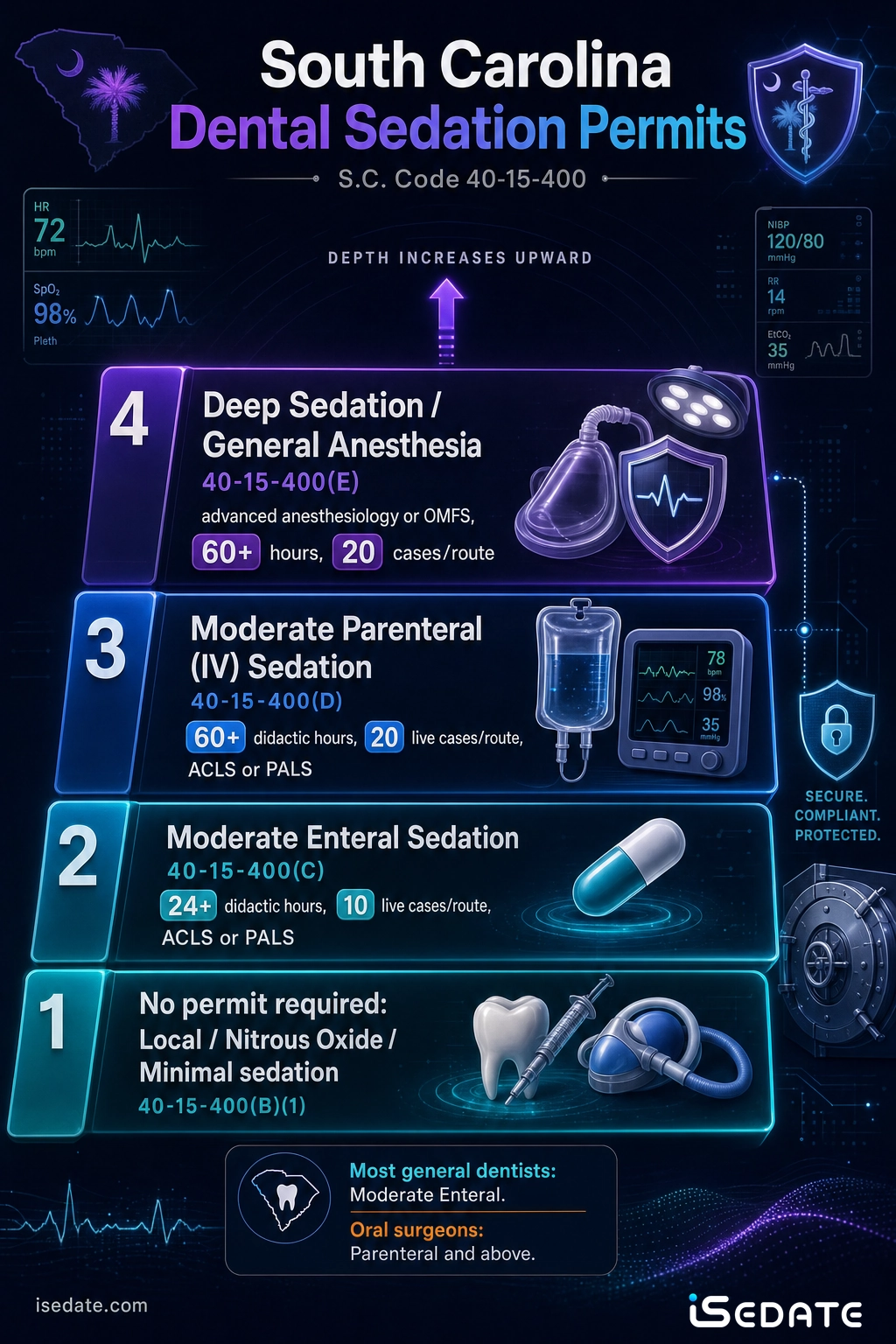
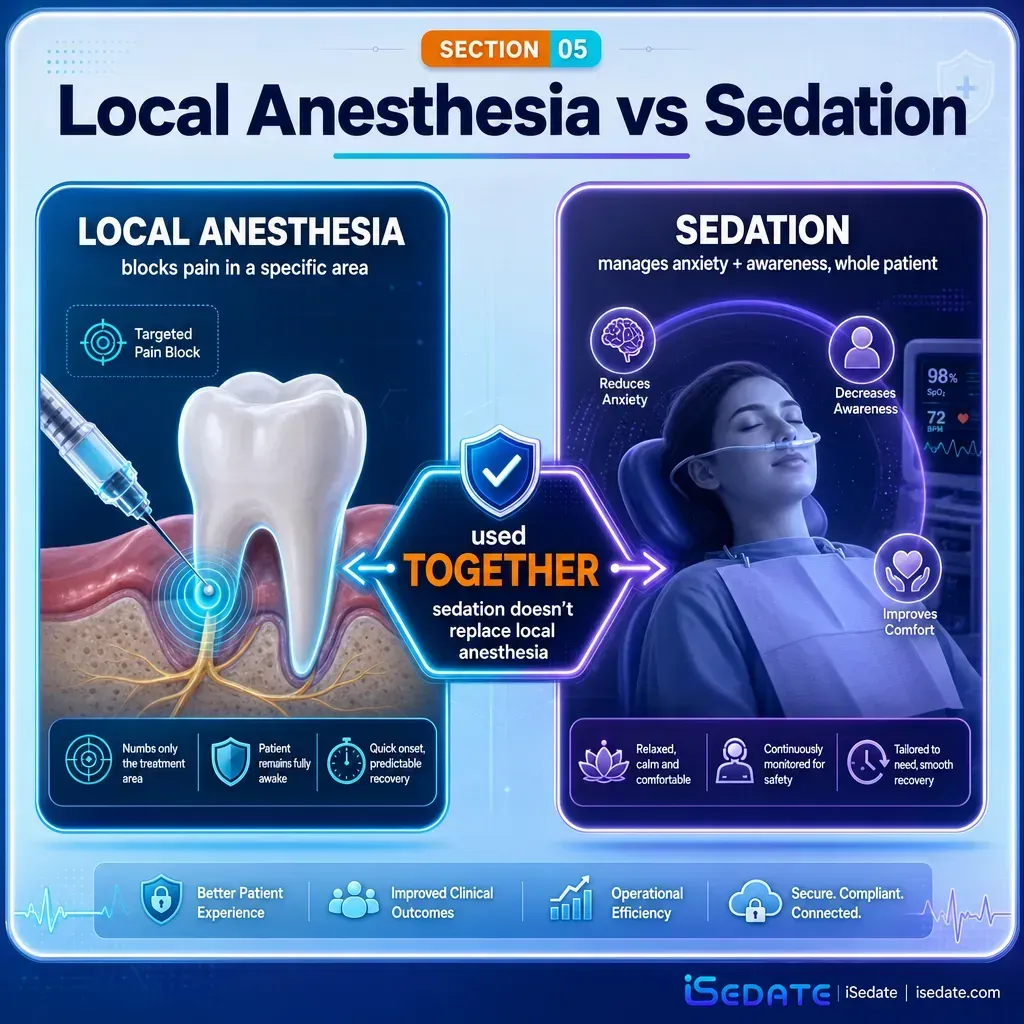
No permit required: local, nitrous, and minimal sedation (§40-15-400(B)(1)). Local anesthesia, nitrous oxide/oxygen inhalation, and minimal sedation, where the airway stays patent and the patient responds normally, do not require a sedation permit. This is the baseline most general practices start from.
Moderate Enteral Sedation permit (§40-15-400(C)). Authorizes moderate conscious sedation by the enteral route, meaning oral or other non-injection routes. This is the workhorse permit for dentists who offer real oral conscious sedation. The board's packet calls for 24 hours of didactic conscious-sedation instruction and 10 cases per route of administration.
Moderate Parenteral Sedation permit (§40-15-400(D)). Authorizes moderate sedation that includes the parenteral route, meaning IV sedation and other injected routes. Because IV titration carries faster onset and higher risk, this permit sits above the enteral permit: 60 hours of didactic instruction and 20 cases per route. This is where oral surgeons and sedation-trained dentists typically operate.
Deep Sedation / General Anesthesia permit (§40-15-400(E)). The top tier, for deep sedation and general anesthesia, where the patient is not easily aroused or is unconscious and may need airway support. Qualification runs through an active South Carolina oral and maxillofacial specialty license or one year of advanced anesthesiology training, plus 60 hours of didactic instruction and 20 cases per route, with additional pediatric training to treat children under 13. For most general dentists this tier is out of scope, and it is largely the province of oral surgeons and dental anesthesiologists.
Source: S.C. Code §40-15-400 | SC Board of Dentistry: deep sedation requirements
Training, ACLS/PALS, and live cases by tier
Each permit has its own bar to clear: a set number of didactic training hours, current life-support certification, and a count of managed live cases per route. You move up by meeting the next tier's requirements and reapplying to the board. The figures below are the board's own, from its moderate and deep sedation application packets.
| Permit | Route / depth | Didactic training | Live cases | Life support |
|---|---|---|---|---|
| No permit (§40-15-400(B)(1)) | Local, nitrous, minimal | No sedation permit required | Not applicable | Per general standards |
| Moderate Enteral (§40-15-400(C)) | Enteral (oral) conscious sedation | 24 hours | 10 per route | ACLS (adults & children) or PALS (children) |
| Moderate Parenteral (§40-15-400(D)) | Parenteral / IV sedation | 60 hours | 20 per route | ACLS (adults & children) or PALS (children) |
| Deep Sedation / GA (§40-15-400(E)) | Deep sedation / general anesthesia | 60 hours, plus OMFS license or anesthesiology training | 20 per route | ACLS (adults & children) or PALS (children) |
Moderate enteral: oral conscious sedation
To hold a Moderate Enteral Sedation permit, the board requires 24 hours of didactic conscious-sedation instruction in an accredited program and 10 cases per intended route, along with current life support and an active, unrestricted dental license. This permit covers genuine oral conscious sedation but stops short of IV.
Moderate parenteral: adding IV sedation
Upgrading to a Moderate Parenteral Sedation permit is the biggest step a general dentist or oral surgeon takes. It requires 60 hours of didactic instruction and 20 cases per route. The training more than doubles and the live-case count rises because IV titration demands hands-on competence a classroom cannot replicate.
Deep sedation and general anesthesia
The Deep Sedation / General Anesthesia permit under §40-15-400(E) requires an active South Carolina oral and maxillofacial specialty license or verified completion of one year of advanced anesthesiology training, 60 hours of didactic instruction, and 20 cases per route, with 60 hours of pediatric didactic training to treat children under 13. A practice may also qualify by using a licensed physician, CRNA, or dental anesthesiologist to administer the sedation. If you are pursuing this tier, work directly from the board's deep sedation packet, since its specifics run beyond this guide.
iSedate Credentialing Tip
The required course must be accredited conscious-sedation training, not a weekend overview. National providers such as DOCS Education's South Carolina sedation courses are one route to the didactic hours and live cases, but the hours, cases, and your life-support certification must all be documented and current when you apply. Do not rely on a number you read on a provider's marketing page: confirm the exact requirements against the board's own packet.
Source: SC Board of Dentistry: moderate sedation requirements and application process | S.C. Code §40-15-400(C) to (E)
What the permit costs and how to apply
South Carolina keeps the application itself straightforward, and the fee is modest compared with the training behind it. The board's packets set out the exact steps.
Submit the written application and fee. File the correct packet for your tier, the moderate parenteral and enteral sedation application or the deep sedation application, with proof of your training hours, live cases, current ACLS or PALS, and an active dental license. A $200 fee, payable to the SC Board of Dentistry, must accompany the application, and it is non-refundable.
List every facility and pass inspection. Every office listed on the application must pass an on-site inspection before the permit is issued, and the equipment required under §40-15-410 must be on-site at the time of inspection. Fail the first inspection and the board schedules a re-inspection within 30 days. In a multi-dentist office, each dentist who sedates files a separate application.
Display the permit. Once a facility passes, the board mails a permit listing the covered dentists, and that permit must be displayed in the office. A dentist who is not listed, or who works in an unpermitted facility, may not provide anything beyond local anesthesia, nitrous oxide, or minimal sedation.
Source: SC Board of Dentistry: sedation application process | SC sedation facility registration form
Facility inspection, display, and renewal
South Carolina layers a facility requirement on top of the individual permit, and this is where a permit is kept or lost. Under §40-15-440, a dentist must give the board at least 30 days' written notice before relocating, adding to, or significantly changing a sedation facility, using the board's sedation facility registration form. Move or materially change your operatory without that notice and the permit tied to it is at risk.
Important
Keep ACLS or PALS current the day you apply and the day you are inspected. The board defines "current" as a course taken within the two years immediately preceding the application. A lapsed certification is a common, avoidable reason a sedation application stalls or a renewal is questioned, so track the expiration date alongside your license renewal.
Your sedation permit is tied to your South Carolina dental license, and the board expects permit holders to stay current in life support and continuing education. The exact renewal cycle and the number of sedation-specific CE hours for each permit are set by board rule and updated periodically, so confirm your current renewal schedule and CE requirements directly with the board so your permit never lapses. The verified figure here is the one the board publishes plainly: the $200 application fee above.
Source: S.C. Code §40-15-440 | SC Board of Dentistry: sedation re-inspection procedures
Records your permit obligates you to keep
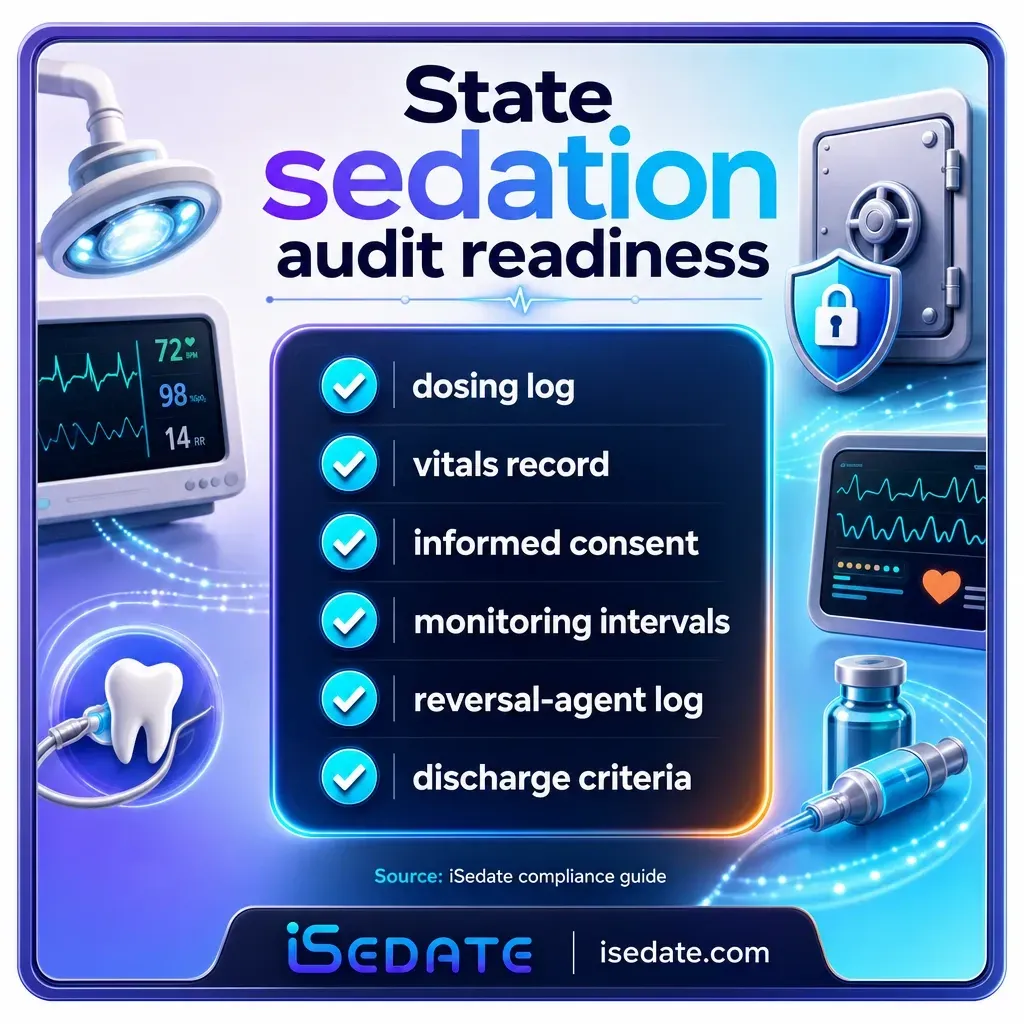
A permit is permission plus obligation. Once you hold a moderate or deeper sedation permit, §40-15-450(D) requires that the patient record document the patient's weight, the type of anesthesia, the type and dosage of drugs administered, fluids administered, a record of vital signs monitoring, the level of consciousness, the duration of the procedure, any complications, and a time-oriented anesthesia record. The medications you administer must be unexpired and logged on a drug sheet retained in the facility.
The per-level intraoperative monitoring itself is set in §40-15-410 and escalates with depth, up to continuous EKG for deep sedation and general anesthesia. Because the monitoring parameters and the exact time-oriented record format run section by section, read them against the current statute, and for the full clinical breakdown of what to monitor and chart at each depth, see our companion guide on South Carolina sedation vitals monitoring, charting, and reporting requirements.
Source: S.C. Code §40-15-450 and §40-15-410
Keeping the permit: audit-ready records
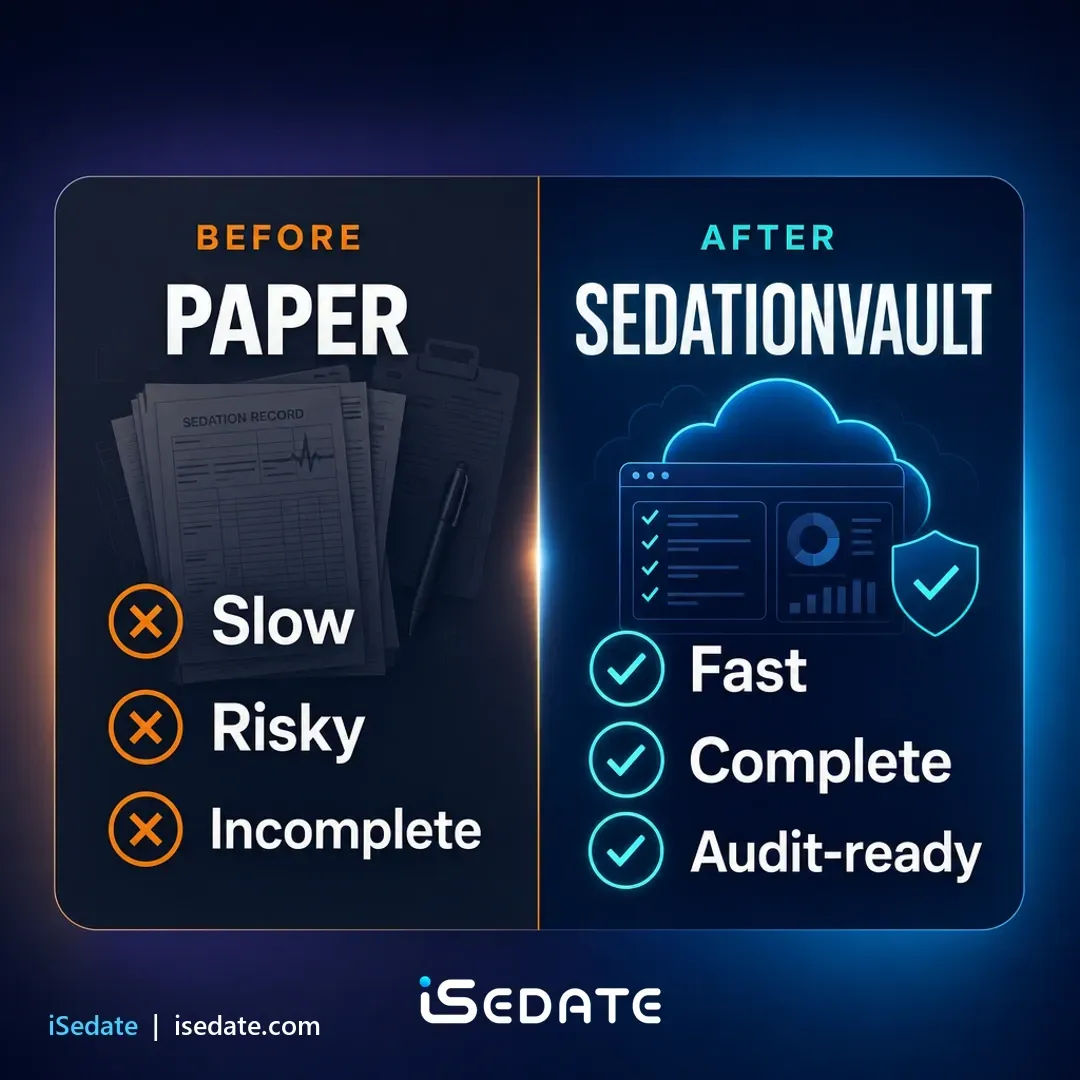
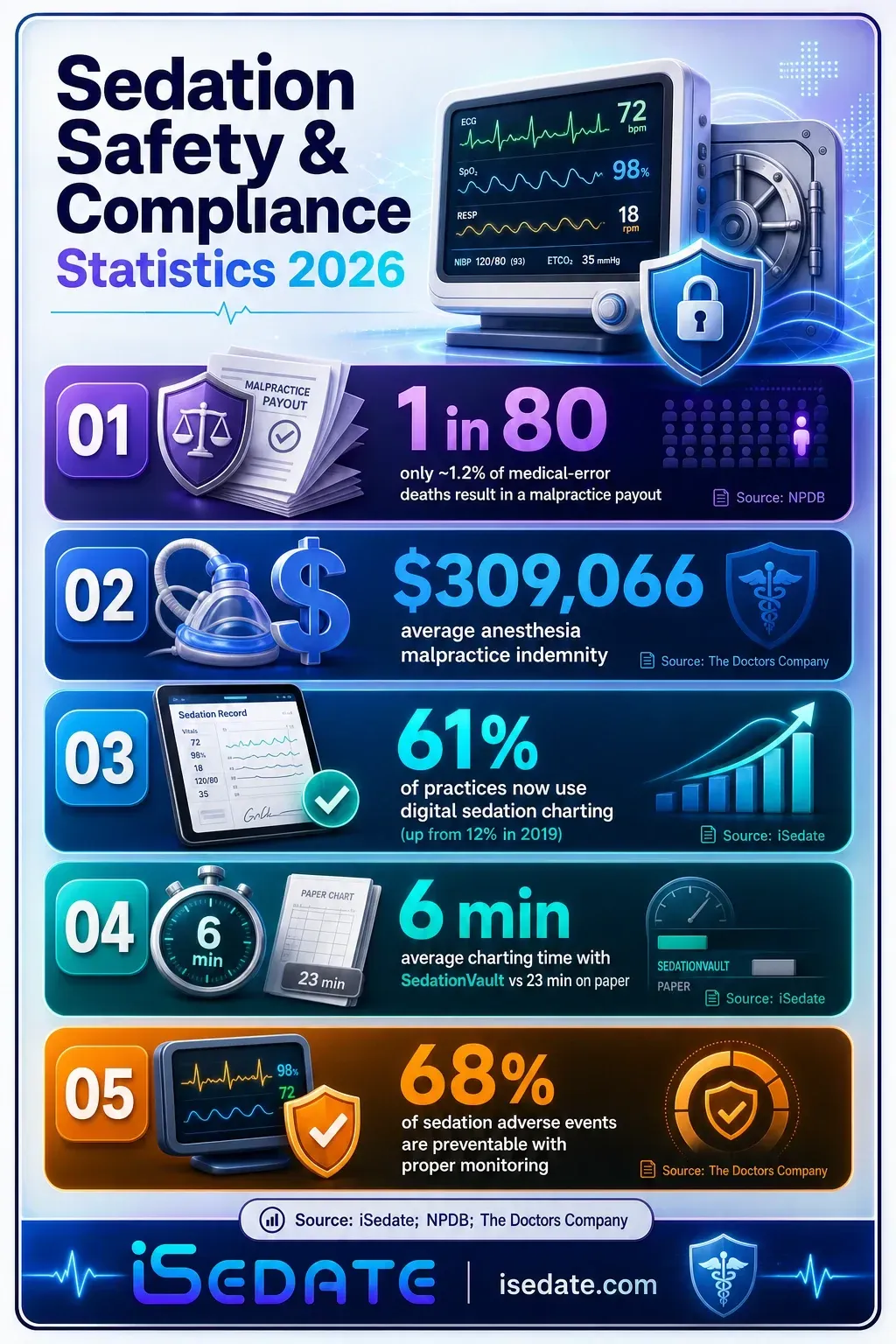
Everything above points to one truth: earning the permit is a one-time hurdle, but keeping it is a daily documentation discipline. A vitals and drug log kept by hand, in the moments between titrating a drug and watching an airway, is exactly where records go incomplete, and incomplete records are what a board review and a malpractice claim both attack. A dentist can run the sedation flawlessly and still lose on the paperwork.
SedationVault removes that failure point. It captures live patient vitals and the drug log automatically into a time-oriented anesthesia record that already carries the nine elements §40-15-450(D) names, so the record builds itself while you focus on the patient. When the board asks for a file, a complete record is a one-click export, not a scramble through paper. See how it maps to the state's rules on our dental sedation compliance and anesthesia record software pages.
Book a Demo of SedationVault See SedationVault PricingFrequently asked questions
What sedation permits does South Carolina require?
How many training hours do you need for an IV sedation permit in South Carolina?
How much does a South Carolina sedation permit cost?
Does South Carolina require ACLS for a sedation permit?
Related guides and neighboring states
Licensed in a neighboring state, or comparing rules across the Southeast? Every state writes its own sedation permit structure, training hours, and records law. See our guides for the states next door, and the national overview for all 50:
- Georgia Sedation Dentistry Licensing & Permit Requirements
- North Carolina Sedation Dentistry Licensing & Permit Requirements
- Sedation Dentistry Licensing & Permit Requirements by State (all 50)
Sources
- S.C. Code of Laws, Title 40, Chapter 15, the Dental Sedation Act (incl. §40-15-85, §40-15-400, §40-15-410, §40-15-440, §40-15-450)
- SC Board of Dentistry: Moderate Sedation Permit Requirements and Application Process
- SC Board of Dentistry: Deep Sedation Licensure Requirements and Application Process
- SC Board of Dentistry: Moderate Parenteral and Moderate Enteral Sedation Application
- SC Board of Dentistry: Sedation Facility Registration form
- SC Board of Dentistry: Dental Sedation Act clarification (Regulation 39-17)
This guide summarizes South Carolina sedation permit rules for general information and is not legal advice. Permit tiers, training hours, live-case counts, the $200 application fee, life-support certification, facility inspection, and records are drawn from S.C. Code Title 40, Chapter 15 and the South Carolina Board of Dentistry's own application packets as cited. The board's phone number, the exact renewal cycle, sedation-specific CE hours, and the verbatim §40-15-410 monitoring parameters are set by the board and updated periodically, so confirm the current requirements directly with the South Carolina Board of Dentistry before you act.