







Alaska Sedation Vitals Monitoring, Charting & Reporting Requirements
If you sedate patients in Alaska, the state does not leave your record to a vague standard of care. Alaska's dental regulations name the items your sedation record must contain: blood pressure, heart rate, respiration, blood oxygen saturation, every drug with its dose, time, and route, the length of the procedure, patient temperature, and any complications. That itemized list lives in 12 Alaska Administrative Code Chapter 28, it is enforced by the Alaska Board of Dental Examiners, and it is the first thing a record review measures you against. This guide breaks down what Alaska requires you to monitor and record at each sedation level, what a compliant record actually looks like on the page, and how to make it audit-ready instead of a liability.
Recent Updates
Last UpdatedNovember 16, 2026
- Re-verified every rule citation against the current 12 Alaska Administrative Code, Chapter 28, and the Alaska Board of Dental Examiners.
- Replaced third-party legal-aggregator source links with the state's own official Alaska Administrative Code and the Board of Dental Examiners pages.
- Added a sample intra-operative interval log showing what a compliant five-minute charting cadence looks like, plus the mandatory-reporting duty under 12 AAC 28.080.
See full history of updates to this post
UpdatedDecember 2018
- Incorporated the amendments that took effect December 9, 2018 to the sedation records rule (12 AAC 28.060) and the deep-sedation monitoring rule (12 AAC 28.061).
- The core rule: Alaska spells out an itemized sedation record under 12 AAC 28.060, covering vitals, every drug with dose, time, and route, procedure length, temperature, and complications, kept in a timely manner.
- Who enforces it: the Alaska Board of Dental Examiners, within the Division of Corporations, Business and Professional Licensing, under 12 AAC Chapter 28 and the authority of Alaska Statute 08.36.
- Deep sedation and general anesthesia carry their own monitoring standard in 12 AAC 28.061: heart rate, blood pressure, and respiration monitored continually, with end-tidal carbon dioxide and a secured IV line.
- During recovery for patients younger than 13, pulse, respiration, blood pressure, and pulse oximetry must be recorded at least every five minutes under 12 AAC 28.060.
- Permit holders must document an on-site inspection by a board-approved organization under 12 AAC 28.068, and the board can revoke a permit over inadequate records.

What This Guide Covers
- Who regulates sedation in Alaska
- The Alaska sedation permit structure
- What you must monitor at each level
- What you must record: the compliance core
- What a compliant record looks like on the page
- How Alaska reviews records
- Why a thin record is the real exposure
- Penalties and mandatory reporting
- The easy button: an audit-ready record
- Frequently asked questions
- Sources and citations
Who regulates sedation in Alaska
Sedation and anesthesia in an Alaska dental office are regulated by the Alaska Board of Dental Examiners, which sits within the Division of Corporations, Business and Professional Licensing in the Department of Commerce, Community and Economic Development. The board issues the sedation and anesthesia permits, approves the on-site inspections, reviews records, and takes disciplinary action. The rules are gathered in one place: 12 Alaska Administrative Code, Chapter 28, Article 1, which governs the administration of deep sedation, general anesthesia, moderate sedation, and minimal sedation under the authority of Alaska Statute 08.36.070.
That distinction matters for compliance, because it means your recordkeeping obligation is a named administrative rule with an exact citation, not a loose expectation. When a reviewer asks whether your sedation record meets the requirement, the answer is measured against the specific sections of Chapter 28 below.
Setting the Record Straight
Myth: The ADA sets federal sedation law that overrides whatever the state says.
Fact: The American Dental Association publishes a national professional standard, not law. In Alaska, the binding authority is Alaska Statute 08.36 and the 12 AAC Chapter 28 board rules, enforced by the Alaska Board of Dental Examiners.
Alaska actually incorporates the ADA and AAP sedation guidelines by reference inside 12 AAC 28.060, so the clinical substance overlaps. But if a reviewer cites a requirement, it comes from the state rule, not the ADA document. The real federal layers that do apply are separate: DEA controlled-substance logs, HIPAA, and CMS or accreditation standards where relevant.
For the clinical reasoning behind these requirements and a national comparison, see our hub guide on Dental Sedation Vitals, Charting & Reporting Requirements by State.
Source: Alaska Board of Dental Examiners, Sedation On-Site Inspections | Official Alaska Administrative Code, Title 12 (Chapter 28)
The Alaska sedation permit structure
Alaska does not number its permits by "Level." It names them by the depth of sedation being administered, and the monitoring and record rules escalate as the sedation deepens. Knowing which category you work in tells you which recordkeeping rules apply. These are the categories as Chapter 28 defines them:
| Alaska category | What it covers | Governing citation |
|---|---|---|
| Nitrous oxide / oxygen inhalation | Inhaled nitrous oxide analgesia, the lightest anxiety control | No permit (practice standard) |
| Minimal sedation | Anxiolysis, patient fully responsive | No permit required for adult patients |
| Moderate (Conscious) Sedation permit | Moderate sedation, also called Conscious Sedation, including the IV route | 12 AAC 28.015 |
| Deep Sedation or General Anesthesia permit | Patient not easily aroused or unconscious (the top tier) | 12 AAC 28.010; monitoring under 28.061 |
Most general dentists work in the minimal-to-moderate range, where the Moderate Sedation permit under 12 AAC 28.015 is the workhorse credential for genuine Conscious Sedation and IV sedation. Deep sedation and general anesthesia sit at the top under 12 AAC 28.010 and carry the strictest monitoring. Alaska also recognizes that a certified registered nurse anesthetist holding a valid Board of Nursing license may administer deep sedation, general anesthesia, or moderate sedation under 12 AAC 28.030, and in that case the dentist must ensure those sedation and anesthesia records become a permanent part of the patient's treatment record. This guide focuses on the recordkeeping that applies once a patient reaches moderate sedation or deeper, because that is where the documentation standard is spelled out most explicitly. If you are working out which permit to apply for, the training hours, or how to upgrade, that belongs in a separate process, covered in our guide to Alaska Sedation Dentistry Licensing & Permit Requirements.
Source: 12 AAC 28.010 and 28.015 (permit requirements) | 12 AAC 28.030 (persons other than permit holders)
What you must monitor at each level
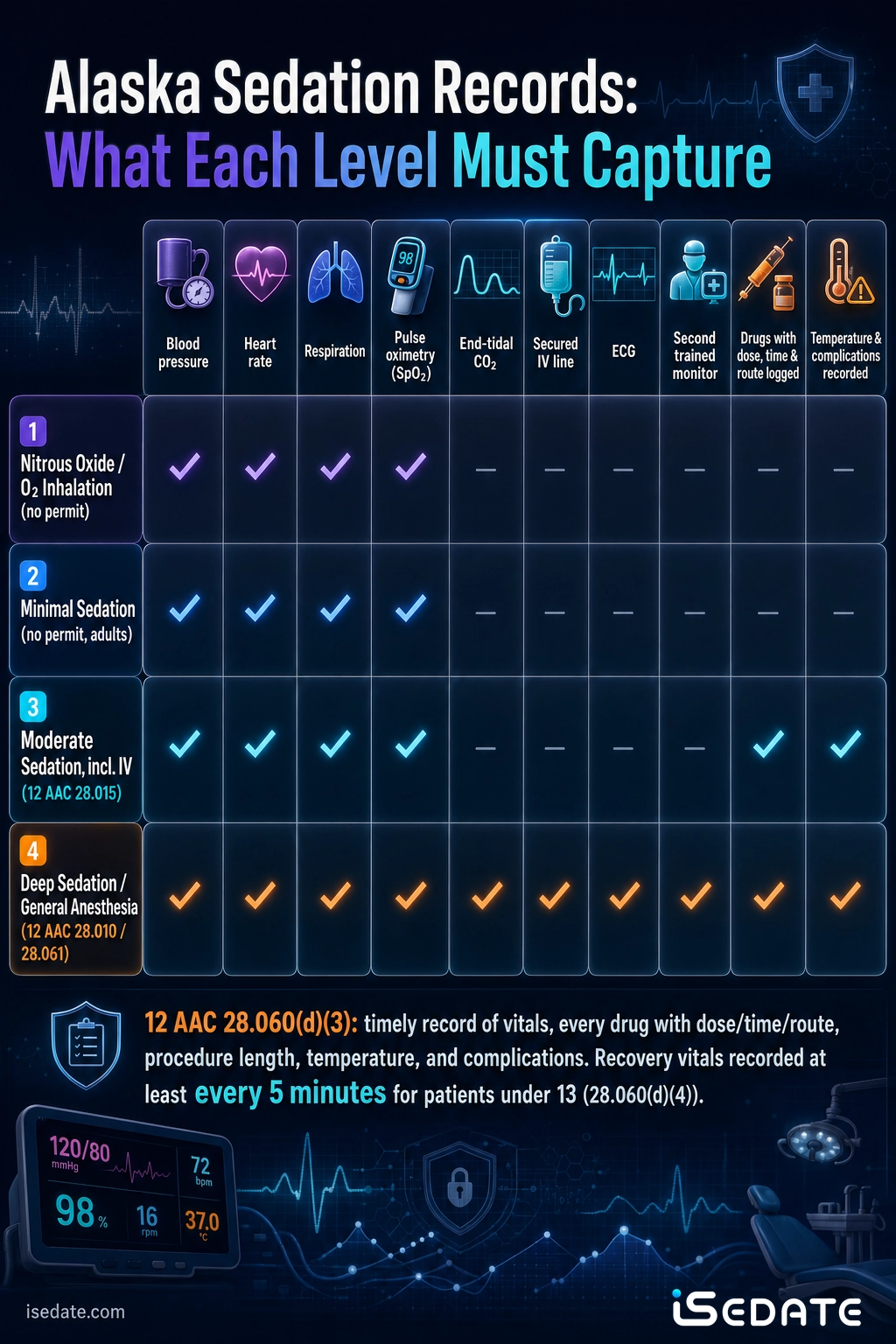
In Alaska, what you are required to monitor is what you are required to write down. The two are inseparable: the deep-sedation and general-anesthesia standard in 12 AAC 28.061 defines the physiological parameters and the equipment, and the record rule in 28.060 requires them to be captured. For deep sedation and general anesthesia, 12 AAC 28.061 requires the provider to continually monitor three systems and to keep specific equipment running:
- Circulation: heart rate and blood pressure are monitored continually, using an ECG and a blood pressure monitoring device.
- Oxygenation: blood oxygen saturation is monitored continually by pulse oximetry.
- Ventilation: respiration is monitored continually with a respiration monitoring device, and an end-tidal carbon dioxide monitor is required for respiration.
- Access and staffing: a secured IV line is maintained throughout, the provider remains in the operatory until the patient is responsive, and a second trained person monitors the patient at all times when the treating dentist is also the anesthesia provider.
Moderate sedation, the Conscious Sedation most sedation dentists provide, carries its own monitoring expectation that tracks the ADA and AAP guidelines Alaska adopts by reference in 12 AAC 28.060: the same core vital signs watched continually, with the recording duty described in the next section. The deeper the sedation, the more parameters you are both watching and logging, and the heavier the equipment and staffing requirement becomes.
Myth, Busted
Myth: Nitrous or a single oral pill is light, so I do not really need to monitor or chart it.
Fact: The depth of sedation, not the route or the drug, drives the requirement. Once a patient reaches moderate sedation, the full monitoring and recording standard in the 12 AAC Chapter 28 board rules applies, no matter how the drug was delivered.
Sedation levels are defined by patient response, and patients can reach a deeper level than intended. Alaska plans for exactly that with its recovery-monitoring rule for deeper-than-intended sedation, which requires timed vitals during recovery.
Source: 12 AAC 28.061 (deep-sedation monitoring) | 12 AAC 28.060 (ADA and AAP guidelines incorporated)
What you must record: the compliance core
This is the section a reviewer reads first. Alaska itemizes what the sedation record must contain in 12 AAC 28.060, and it is unusually specific. The most detailed itemized list sits in the chapter's provisions for patients younger than 13, where Alaska spells the record out most explicitly, and it is the clearest statement of the state's expectation for the contents of a sedation chart.
1. An itemized, timely sedation record
Under 12 AAC 28.060, the dentist must keep sedation and anesthesia records in a timely manner, and the record must contain blood pressure, heart rate, respiration, blood oxygen saturation, each drug given with its dosage, the time it was administered and the route, the length of the procedure, patient temperature, and any complications from the anesthesia or sedation. "In a timely manner" is the operative phrase: the record is built as the case runs, not reconstructed afterward from memory. A note that a patient "tolerated sedation well" is not this record. The itemized timeline of vitals, drugs, doses, times, routes, and complications is.
2. Baseline, recovery, and discharge vitals
Alaska frames the record around the full arc of the visit. Baseline vital signs are recorded before a controlled substance is administered and again before discharge, unless the patient's behavior prevents it. During recovery from deeper-than-intended sedation, pulse, respiration, blood pressure, and pulse oximetry are monitored and recorded at least every five minutes. Vital signs are taken and recorded at discharge, and a discharge entry is made in the record. If a depolarizing or volatile agent is used, temperature is monitored constantly. These provisions live inside 12 AAC 28.060, and together they mean the record has to show the patient's physiology before, during, and after the case, not just a single moment in the middle.
3. Post-operative instructions and the training log
The record does not end at discharge. The patient or escort receives written and verbal post-operative instructions that include a 24-hour emergency contact number. Separately, the office keeps a signed and dated log of emergency training exercises conducted at least twice per calendar year, which is part of the documentation a permit holder is expected to be able to produce. The itemized record provisions in 28.060 are written most explicitly for patients younger than 13; the parallel adult recordkeeping requirement is set by board rule, so confirm the exact adult citation and any differences directly with the board. Across all ages, Alaska's incorporation of the ADA and AAP guidelines in 28.060 means the same time-oriented, drug-and-vitals record is the working standard.
What Alaska's Sedation Record Must Contain
- A timely, itemized sedation and anesthesia record for the case
- Blood pressure, heart rate, respiration, and blood oxygen saturation
- Every drug administered with its dosage, time, and route
- The length of the procedure and patient temperature
- Any complications from the anesthesia or sedation
- Baseline vitals before a controlled substance and again before discharge
- Recovery vitals at least every five minutes (patients under 13), a discharge entry, and written and verbal post-operative instructions with a 24-hour emergency number
Source: 12 AAC 28.060 (sedation records and monitoring) | 12 AAC 28.030 (records kept as a permanent part of the chart)
See how a time-oriented anesthesia record is built automaticallyWhat a compliant record looks like on the page
Knowing the rule and passing a review are two different things, and the gap between them is almost always the timed vitals log. It helps to see the cadence the rule asks for. The simplified example below shows how an Alaska sedation record maps onto the requirement: a baseline reading before the drug, readings at timed intervals while the patient is sedated, the every-five-minute cadence during recovery, and a discharge reading, each line carrying the core monitored parameters alongside the drug log. (Values are illustrative only, not a real patient record.)
| Time / interval | BP | HR | Resp | SpO2 | Temp | Drug / dose logged |
|---|---|---|---|---|---|---|
| Pre-op baseline | 124/78 | 72 | 16 | 99% | 98.4 | Baseline, no agent |
| Intra-op 00:05 | 118/74 | 70 | 14 | 98% | 98.3 | Midazolam 2 mg IV, 09:05 |
| Intra-op 00:10 | 116/72 | 68 | 13 | 98% | 98.3 | No new agent |
| Recovery 00:05 | 120/76 | 71 | 14 | 99% | 98.4 | Recovery interval |
| Discharge | 122/78 | 73 | 16 | 99% | 98.5 | Discharge entry + instructions |
A real case runs longer, and the full drug log, the length of the procedure, and any complications sit alongside this grid. But the shape is the point: a reviewer can look at a record like this and see, line by line, that the patient was monitored and that the monitoring was documented on the clock. A record with a single pre-op reading and a single post-op reading, and nothing in between, fails that test no matter how carefully the case was actually monitored.
iSedate Insight
The difference between a defensible chart and a vulnerable one is rarely clinical skill. It is whether the contemporaneous record proves, interval by interval, what was monitored and what was given. The practices that pass reviews treat the recovery interval as a hard checkpoint, not a target, and log every drug with its dose, time, and route the moment it is given rather than from memory afterward.
How Alaska reviews records
Alaska builds record review into the permit itself. Under 12 AAC 28.068, a permit holder must document an on-site inspection by a board-approved organization, and the board may deny, suspend, or revoke a sedation or anesthesia permit if the equipment, facilities, trained personnel, or records are found inadequate. The board publishes its own Sedation On-Site Inspections page for exactly this process, listing the approved inspecting organizations. In other words, holding a moderate or deep sedation permit comes with a standing expectation that your office, your equipment, and your sedation records are reviewable. The exact inspection cadence and current procedure are administered by the board and can change, so confirm the current process directly with the board before relying on it.

Here is where dentists get burned. It is rarely the clinical care that fails a review. It is the record: a missing time stamp, a recovery interval that stretched past five minutes for a young patient, a drug given but not logged with its dose and route, a discharge that was never documented, a temperature not captured when a volatile agent was used. The care can be flawless and the record can still fail, because an inspector grades what the contemporaneous chart proves, not your intentions.
Record every drug with its dose, time, and route, and hold the every-five-minute recovery interval where it applies. A reviewer does not grade your sedation on how the patient did. They grade it on whether the contemporaneous record proves what you did and when. If the timed record has gaps, the default assumption on review is that the monitoring had gaps too.
Source: Alaska Board of Dental Examiners, Sedation On-Site Inspections (12 AAC 28.068) | Official Alaska Administrative Code, Chapter 28
Why a thin record is the real exposure
An incomplete sedation record is not a filing technicality. It is the evidence the board weighs when deciding whether the standard of care was met, and the same gaps that fail an inspection are the gaps a plaintiff's attorney looks for in a malpractice claim. In both a board review and a lawsuit, the contemporaneous sedation record is the first thing requested and the hardest thing to reconstruct after the fact. When the chart does not prove continuous monitoring, the provider is left arguing memory against a document, and the document wins.
The data behind why these rules exist, and what a documentation failure actually costs when a case goes sideways, lives in our research roundups:
The Data Behind the Rule
Penalties and mandatory reporting
Chapter 28 is backed by enforcement. The board may deny, suspend, or revoke a sedation or anesthesia permit under 12 AAC 28.068 and the board's authority in Alaska Statute 08.36, and inadequate records are explicitly among the grounds. Alaska also imposes a mandatory-reporting duty: under 12 AAC 28.080, mortalities and certain incidents arising from sedation or general anesthesia must be reported to the board. Incomplete sedation records are not a filing technicality, they are the evidence the board weighs when deciding whether the standard of care was met.
The specific penalty schedule, the exact reporting triggers and timelines under 12 AAC 28.080, the routine inspection cadence, and the board's current contact details are administered by the board and can change, so confirm current details directly with the Alaska Board of Dental Examiners rather than relying on a figure that may be out of date. What does not change is the exposure created by a thin record: in both a board review and a lawsuit, a complete, time-stamped sedation record is your strongest defense and the hardest thing to produce after the fact if it was never built during the case.
Source: 12 AAC 28.080 (mandatory reporting) | Alaska Board of Dental Examiners
The easy button: an audit-ready record
The gap between knowing the rule and passing a review is almost always the same thing: a timed vitals and drug log kept by hand during a live sedation case. When a team is managing an airway and an anxious patient, a reading written every few minutes on paper, a drug logged later from memory, a recovery interval tracked by a clock no one is watching, is exactly where the record develops holes.
That is the problem SedationVault by iSedate was built to remove. It connects wirelessly to the vitals monitor already in your operatory and captures pulse oximetry, heart rate, respiration, and blood pressure live, on the clock, alongside the drug log, so the record Alaska asks for in 12 AAC 28.060 writes itself as the case runs rather than being reconstructed afterward. When the board or an inspector asks for the chart, it exports as a one-click, audit-ready sedation visit report that already carries the drug names with doses, times, and routes, the interval vitals, the temperature, and the discharge entry the rule asks for. The point is not fancier charting. It is turning the exact items 28.060 requires into something the software guarantees are present and time-stamped, which is also what dental sedation compliance turns on.
Book a demo and see your Alaska sedation record build itselfFrequently asked questions
Does Alaska require a written sedation record?
How often must vitals be recorded during recovery in Alaska?
What does Alaska require monitoring for deep sedation and general anesthesia?
Who audits dental sedation records in Alaska?
Does Alaska require a discharge note after sedation?
Related guides and neighboring states
Licensed in more than one state? Documentation rules vary from state to state, so confirm the requirements wherever you provide sedation. Alaska is non-contiguous, so there is no bordering state to cross into, but you can compare every state's charting and reporting standard in one place:
- All 50 states: Dental Sedation Vitals, Charting & Reporting Requirements by State
- Alaska Sedation Dentistry Licensing & Permit Requirements
Sources and citations
This guide cites Alaska's primary regulatory sources directly. Rule text is drawn from 12 Alaska Administrative Code, Chapter 28, as published in the official Alaska Administrative Code, and the regulator is the Alaska Board of Dental Examiners within the Division of Corporations, Business and Professional Licensing. The sedation records and monitoring provisions in 12 AAC 28.060 and the deep-sedation monitoring rule 12 AAC 28.061 were amended effective December 9, 2018; the official state code is bot-protected, so the chapter is cited at the official Alaska Administrative Code portal plus the board's own pages, and the exact citations are named in text. Where a detail, such as the parallel adult moderate-sedation record citation, the current penalty schedule, the exact reporting triggers and timelines under 12 AAC 28.080, the routine inspection cadence, or the board's contact details, is administered by the board and subject to change, confirm it directly with the board before relying on it. This guide is general information, not legal advice.
- Official Alaska Administrative Code, Title 12, Chapter 28 (Board of Dental Examiners), Article 1
- Alaska Board of Dental Examiners: Sedation On-Site Inspections (12 AAC 28.068)
- 12 AAC 28.010 (Deep Sedation or General Anesthesia permit); 12 AAC 28.015 (Moderate Sedation permit); 12 AAC 28.030 (persons other than permit holders); 12 AAC 28.060 (sedation records and monitoring); 12 AAC 28.061 (deep sedation and general anesthesia monitoring); 12 AAC 28.080 (mandatory reporting); authority: Alaska Statute 08.36.070















